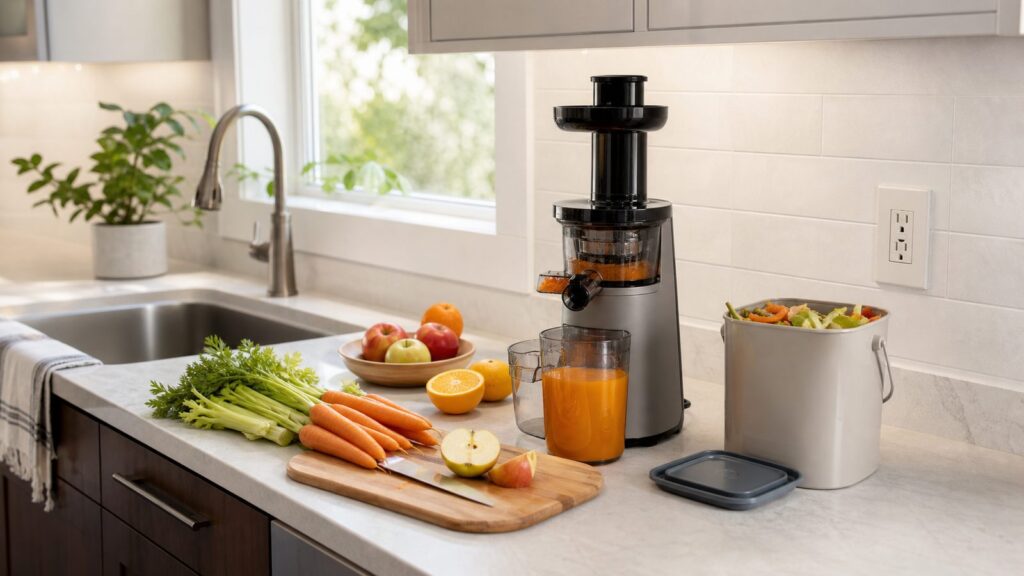
The best mini juicer for a small kitchen is not always the one with the smallest footprint. It is the one you can leave accessible, clean in a few minutes, plug into a safe outlet, and use for the produce you actually buy. For most homeowners, that means a compact centrifugal juicer in the $40 to $100 range for fast apple, carrot, celery, and citrus blends, or a compact cold-press juicer in the $100 to $250 range if leafy greens are the priority.
On our kitchen projects, we see the same pattern repeatedly: homeowners research yield and motor watts, then discover after move-in that the appliance is too tall for the cabinet, too loud for an open kitchen, too annoying to clean, or plugged into the same crowded counter zone as the coffee maker, toaster oven, and blender. A mini juicer is a small appliance, but it still needs a working station.
As an Amazon Associate I earn from qualifying purchases.
This guide covers the product side and the kitchen planning side: juicer types, realistic 2026 costs, dimensions, cleaning, outlet placement, GFCI protection, storage, and when an electrical or cabinetry upgrade should be handled by a pro.
The Tool Desk
Outbyte PC Repair FREERepair Windows errors before they cause bigger problemsFix Now →Outbyte Driver Updater FREEFix the driver behind crashes, sound loss and screen glitchesFind Drivers →Start With the Type of Juice You Actually Make
Before comparing brand names, decide what you want out of the machine. Mini juicers fall into four practical groups: compact centrifugal juicers, compact masticating or cold-press juicers, premium vertical slow juicers, and citrus-only juicers. They can all be useful, but they are not interchangeable.
#1 Best Overall

- NON-STOP JUICING: This powerful masticating juicer’s high-torque motor powers through tough fruits and vegetables like apples, carrots, celery, and leafy greens for smooth, nutrient-rich cold press juice without clogging.
- CUSTOMIZE & CONTROL PULP: Includes 2 interchangeable pulp filters so you can choose Less Pulp or Lots of Pulp, giving you full control over texture when making fresh fruit juice, vegetable juice, or green juice.
- SIMPLE ONE-TOUCH PROGRAMS: Easy operation with 2 convenient programs: Start/Stop and Reverse. Reverse function helps reduce jams and maximize juice extraction for a smoother juicing experience.
- POWER: 150-watt high-torque motor rotates the auger at low speeds for efficient cold press juicing, delivering high-yield fresh juice from every ingredient while minimizing clogging and foam.
- EASY SETUP & COMPACT DESIGN : Space-saving juicer fits easily under kitchen cabinets and is easy to assemble, making it ideal for small kitchens, apartments, or everyday countertop use.
Compact Centrifugal Juicers
A centrifugal juicer uses a fast-spinning cutting disc and strainer basket. It is the fastest and usually the least expensive choice. In 2026, small centrifugal models commonly land around $40 to $100, depending on wattage, cup size, feed chute, warranty, and sale pricing.
This is the right category if you mostly juice firm produce: apples, carrots, cucumbers, celery, beets, ginger, and citrus with the peel removed where required. A small centrifugal machine can make a morning glass quickly, often in a couple of minutes once the produce is washed and cut. The tradeoff is noise. These units are typically louder than slow juicers, and they tend to be less efficient with leafy greens.
A good example of the compact centrifugal format is the Magic Bullet Mini Juicer. Retailer and manufacturer specs commonly list it at about 400 watts, with a footprint around 7 inches by 6 inches by 11.5 inches, a 16-ounce juice cup, single-speed operation, dishwasher-safe removable parts, and a 2-inch feed chute. That size can work well in an apartment kitchen, a condo galley, or a cabinet appliance garage, but the 2-inch chute still means you will be cutting many apples, beets, and larger carrots before juicing.
Recommended Free Tools
Compact Cold-Press or Masticating Juicers
A masticating juicer crushes produce more slowly with an auger. These are often called cold-press juicers, although home models still generate some heat from friction. The real advantage is slower processing, better handling of leafy greens, quieter operation, and often higher juice yield.
Budget and midrange compact cold-press models usually cost about $100 to $250 in 2026. Premium compact or vertical slow juicers commonly run $300 to $500 or more. The higher price is usually tied to motor torque, auger design, quieter operation, pulp dryness, larger hoppers, part quality, reverse functions, warranty length, and less babysitting during operation.
This category makes sense if kale, spinach, wheatgrass, parsley, mint, and other greens are central to your routine. It is not the best fit if you want a quick, low-commitment appliance and hate washing small parts. Slow juicers usually require more chopping, slower feeding, and more cleaning attention around screens and strainers.
Citrus-Only Compact Juicers
Citrus juicers are usually the smallest and cheapest option, often about $20 to $80. They are excellent for oranges, lemons, limes, and grapefruit. They are not a substitute for a vegetable juicer. If you only want fresh orange juice or lemon juice for cooking, buy a citrus unit and save the counter space. If you want carrot-apple-ginger or green juice, skip this category.
Quick wins for a faster PC:
Repair Windows errors before they cause bigger problemsFix Now →Scan for outdated or missing drivers - takes under a minuteDriver Scan →Clear out junk files and repair common Windows errorsFree Scan →Mini Juicer Comparison: Cost, Fit, and Best Use
Most appliance roundups focus on yield, speed, and cleaning. Those matter, but a construction-minded comparison also has to include footprint, counter depth, outlet reach, cabinet clearance, and whether the machine can live near the sink without sitting directly in the splash path.
| Juicer Type | Typical 2026 Cost | Best For | Kitchen Fit Notes | Main Tradeoff |
|---|---|---|---|---|
| Mini centrifugal | $40-$100 | Apples, carrots, celery, cucumbers, citrus blends | Often compact enough for a small counter zone; check chute size and pulp-bin access | Louder, less effective with leafy greens |
| Compact cold-press / masticating | $100-$250 | Leafy greens, herbs, quieter morning use | May be taller or deeper than expected; needs cleaning space near sink | Slower, more prep, more parts |
| Premium vertical slow juicer | $300-$500+ | Daily juicing, high yield, quieter open-plan kitchens | Check under-cabinet height and hopper clearance before buying | Higher upfront cost |
| Citrus-only juicer | $20-$80 | Oranges, lemons, limes, grapefruit | Usually easy to store in a drawer or upper cabinet | Does not juice vegetables or greens |
If you have a tight kitchen, width and depth matter more than the product photo suggests. A juicer that is 7 inches wide but 13 inches deep may still crowd a 24-inch-deep counter once you add a cutting board, bowl of produce, cup, and pulp container. A tall vertical juicer can also be awkward beneath wall cabinets. Standard base counters are commonly around 24 inches deep, and upper cabinets are often mounted about 18 inches above the counter. Any juicer near 16 to 18 inches tall deserves a careful measurement before purchase.
Our Shortlist by Kitchen Situation
The right mini juicer depends less on marketing labels and more on the kitchen it has to live in. Here is how we would narrow the field for common homeowner situations.
Best Budget Mini Juicer for Occasional Use
Choose a compact centrifugal juicer in the $40 to $80 range if you juice once or twice a week and mostly use firm produce. Look for a stable base, removable parts that separate without wrestling, a cleaning brush, and dishwasher-safe components. A 16-ounce cup is enough for one generous serving or two smaller servings.
Outdated Drivers Are Slowing You Down
One free scan finds every outdated or missing driver and matches the right update for your exact hardware.Free scan · exact hardware matchWindows Errors? Fix Them Before They Spread
Repair common Windows errors and clear accumulated junk for a smoother, more stable PC - no reinstall needed.Free scan · no reinstallRank #2

- NON-STOP JUICING: This powerful masticating juicer’s high-torque motor powers through tough fruits and vegetables like apples, carrots, celery, and leafy greens for smooth, nutrient-rich cold press juice without clogging.
- CUSTOMIZE & CONTROL PULP: Includes 2 interchangeable pulp filters so you can choose Less Pulp or Lots of Pulp, giving you full control over texture when making fresh fruit juice, vegetable juice, or green juice.
- SIMPLE ONE-TOUCH PROGRAMS: Easy operation with 2 convenient programs: Start/Stop and Reverse. Reverse function helps reduce jams and maximize juice extraction for a smoother juicing experience.
- POWER: 150-watt high-torque motor rotates the auger at low speeds for efficient cold press juicing, delivering high-yield fresh juice from every ingredient while minimizing clogging and foam.
- EASY SETUP & COMPACT DESIGN : Space-saving juicer fits easily under kitchen cabinets and is easy to assemble, making it ideal for small kitchens, apartments, or everyday countertop use.
The Magic Bullet Mini Juicer fits this use case well on paper because of its roughly 7-inch by 6-inch footprint, 400-watt motor, 16-ounce cup, and dishwasher-safe parts. The single speed keeps operation simple. The 2-inch feed chute is not large, so expect knife work. That is acceptable for a compact machine, but it is a real daily-use consideration.
Best Compact Juicer for Leafy Greens
For kale, spinach, wheatgrass, parsley, herbs, and mixed green juice, start with a compact masticating model. Expect to spend roughly $100 to $250 for a budget or midrange machine. If you juice daily and care about yield, pulp dryness, and noise, premium vertical slow juicers in the $300 to $500-plus range become easier to justify.
The practical test is not just whether the machine extracts green juice. It is whether you will still clean the auger, screen, chute, and pulp path on a weekday morning. If the answer is no, a high-yield juicer becomes an expensive cabinet weight.
Best Mini Juicer for Apartments and Condos
For apartments, condos, and small kitchens, we prioritize three measurements: footprint, height, and storage path. A compact centrifugal model under about 12 inches tall can often slide into a lower cabinet, open shelf, or appliance garage. A heavier slow juicer may be better left on the counter if used daily, but then it needs a dedicated landing zone.
Free tools Windows power users keep installed
One-click scans. No signup required.
Noise also matters in shared walls and early schedules. Centrifugal juicers are fast but can sound harsh in a compact kitchen. Masticating units are slower and generally quieter, which is better for open-plan spaces and households where one person is awake before everyone else.
Best Juicer for a Kitchen Remodel
If you are remodeling, the best juicer is the one included in the plan before rough-in. During design, map the appliance zone with the coffee maker, toaster oven, air fryer, blender, stand mixer, and juicer all accounted for. This is where homeowners gain the most long-term convenience for the least disruption.
Our preferred layout is a morning appliance zone near the sink but not directly in the splash path. That zone usually includes a juicer, cutting board, compost or pulp bin, towel drawer, and a GFCI-protected outlet within easy reach. If the kitchen has a prep sink, that is often the cleanest location. If not, place the juicer close enough to the main sink that rinsing parts does not require crossing the kitchen with wet strainers.
The Contractor’s Fit Check Before You Buy
Use this fit check before ordering a mini juicer. It takes 10 minutes and prevents most buyer regret.
| Check | Target | Why It Matters |
|---|---|---|
| Footprint | Measure width and depth, not just listed capacity | A compact motor base still needs room for produce, cup, and pulp handling |
| Height under cabinets | Confirm clearance below wall cabinets, commonly about 18 inches above counter | Tall hoppers can be difficult to load under cabinets |
| Outlet distance | Cord should reach without crossing sink, cooktop, or prep path | Long cord runs are inconvenient and unsafe in wet zones |
| Sink distance | Within a few steps of sink, but outside the direct splash area | Fast rinsing keeps screens from clogging and pulp from drying |
| Cleaning parts | Look for quick disassembly, brush included, dishwasher-safe removable parts | Cleanup friction is the number-one reason juicers stop being used |
| Produce type | Centrifugal for firm produce; masticating for greens | The wrong mechanism wastes produce and time |
Also check where the removable pulp bin exits. Some compact juicers need side clearance or rear clearance to pull the bin out. If the juicer sits tight against a wall, backsplash return, or tall appliance, that can become annoying every time you use it.
Countertop, Storage, and Cabinet Planning
A mini juicer only saves space if the whole workflow fits. Plan for four zones: wash, cut, juice, and clean. In a small kitchen, these zones can overlap, but they cannot disappear.
Rank #3
- NON-STOP JUICING: Powers through tough ingredients for powerful, non-stop juicing.
- CONTROL PULP: Total Pulp Control allows for customized juice with two interchangeable pulp filters: Less Pulp and Lots of Pulp.
- PROGRAMS: 2 one-touch programs for simple use: Start/Stop and Reverse.
- POWER: Powerful high-torque motor base rotates auger at low speeds.
- EASY SETUP: Simple assembly makes for no-hassle setup and cleaning.
For daily users, leaving the juicer on the counter may be the most honest plan. In that case, choose a location with at least 12 to 18 inches of adjacent prep width if possible. You need space for a cutting board, produce, and the juice cup. If the appliance lives under upper cabinets, confirm that you can feed produce into the chute without pulling the unit forward every time.
For occasional users, deep drawer storage or a pull-out shelf can work better. A deep drawer below the prep area keeps the machine accessible without sacrificing counter space. Check the appliance height, cord position, and whether parts can nest. Some juicers look compact assembled but store poorly because the chute, cup, pusher, brush, and pulp bin scatter across the cabinet.
Appliance garages can be useful, but they need careful electrical planning. A garage with a door, outlet, and countertop appliance inside may trigger specific code and product requirements depending on the setup. Do not assume any cabinet interior can become a powered appliance garage after the fact. Discuss the exact appliance, outlet, door style, ventilation, and shutoff approach with your electrician and cabinet contractor before ordering cabinets.
Outlet and Electrical Planning for Mini Juicers
A mini juicer does not require a building permit by itself. It is a plug-in countertop appliance. Permits and code enter the discussion when you add, relocate, or upgrade kitchen receptacles, circuits, islands, peninsulas, countertops, backsplash, or cabinetry.
Kitchen counters are high-use electrical zones. A juicer might only run for a few minutes, but it often shares morning traffic with a coffee maker, toaster oven, microwave, blender, kettle, or air fryer. That combination can trip breakers if too many high-wattage appliances run together on the same circuit.
For remodel planning, we tell homeowners to map every countertop appliance before electrical rough-in. Mark where each item will live, how often it runs, and whether it is high draw. Then place outlets around real workflows instead of simply meeting the minimum spacing rules. Code compliance is the floor; daily usability is the goal.
What’s actually slowing this PC down?
Pick the symptom - the matching free tool is one click away.
GFCI Protection
Kitchen countertop receptacles generally need GFCI protection because they serve areas where water and electricity are close together. That does not mean every visible device has to be a GFCI outlet face; protection can be provided by a GFCI receptacle upstream or by a GFCI breaker, depending on the circuit design. The important point for a homeowner is simple: do not plug a juicer into an improvised extension cord across the sink or a worn, unprotected outlet near water.
Professional outlet installation in 2026 commonly costs about $138 to $320, with an average around $229 according to HomeAdvisor data. Angi reports kitchen outlets averaging about $300 each and commonly ranging from $75 to $485 per unit. GFCI outlet installation is often reported around $130 to $300, with an average around $210. Permit costs for outlet work may run about $50 to $100, depending on the city or county, inspection requirements, and whether the work is part of a larger remodel.
Those numbers vary because access matters. Adding an outlet before backsplash and drywall are finished is much easier than fishing wiring through a finished wall with tile in place. If you are already replacing countertops, backsplash, or cabinets, coordinate outlet upgrades at the same time.
Cleaning Is the Real Dealbreaker
Juicer satisfaction depends heavily on cleaning tolerance. A machine can have strong yield and still be the wrong purchase if cleanup takes longer than breakfast.
Rank #4

- NON-STOP JUICING: This powerful masticating juicer’s high-torque motor powers through tough fruits and vegetables like apples, carrots, celery, and leafy greens for smooth, nutrient-rich cold press juice without clogging.
- CUSTOMIZE & CONTROL PULP: Includes 2 interchangeable pulp filters so you can choose Less Pulp or Lots of Pulp, giving you full control over texture when making fresh fruit juice, vegetable juice, or green juice.
- SIMPLE ONE-TOUCH PROGRAMS: Easy operation with 2 convenient programs: Start/Stop and Reverse. Reverse function helps reduce jams and maximize juice extraction for a smoother juicing experience.
- POWER: 150-watt high-torque motor rotates the auger at low speeds for efficient cold press juicing, delivering high-yield fresh juice from every ingredient while minimizing clogging and foam.
- EASY SETUP & COMPACT DESIGN : Space-saving juicer fits easily under kitchen cabinets and is easy to assemble, making it ideal for small kitchens, apartments, or everyday countertop use.
Look for parts that release quickly, strainers that can be brushed without scraping your knuckles, and removable components marked dishwasher-safe. Treat dishwasher-safe as limited permission, not a blanket rule. The motor base never goes in the dishwasher, and some screens, gaskets, or small parts may still need hand washing to preserve performance.
The best habit is to rinse immediately. Letting pulp dry on a strainer or screen turns a two-minute rinse into a ten-minute scrub. If you are designing a juicing station, keep it close to the sink and dishwasher. A pull-out trash or compost bin below the prep counter is also worth more than most people expect.
For daily juicing, we like a setup where the cutting board sits between the sink and the juicer, the pulp bin is directly below or beside the prep area, and the dishwasher is close enough that removable parts can be loaded without dripping across the floor. That is not luxury design; it is basic workflow.
Food Safety for Home Juicing
Fresh juice is handled differently than whole produce because juicing can move bacteria from the outside of produce into the liquid. FDA consumer guidance remains practical here: wash fruits and vegetables before cutting or juicing, scrub firm produce with a clean produce brush, and dry produce to reduce bacteria transfer.
Do not rely on peeling alone. A knife can drag contamination from the exterior into the flesh when you cut through an apple, orange, carrot, beet, or cucumber. Wash first, then cut. Keep the cutting board clean, especially if the same counter is used for raw meat prep at other times.
Fresh juice should be consumed promptly or refrigerated in a clean, covered container. If a compact juicer includes a 16-ounce cup with a lid, that is convenient, but it is not a substitute for cold storage. Wash the cup, lid, chute, and strainer after use rather than leaving residue until later in the day.
Independent reader supportYour contribution helps us test, update, and keep practical guides available for everyone.When to DIY vs. When to Hire a Pro
Buying and using a mini juicer is a homeowner-level task. Measuring the counter, choosing the appliance, washing produce, and cleaning removable parts are all DIY. Installing a drawer organizer or clearing cabinet space is usually DIY as well.
Hire a licensed electrician when you need a new outlet, a relocated outlet, GFCI protection corrected, a new small-appliance circuit, or wiring inside an appliance garage. Also bring in a pro if breakers trip repeatedly when the juicer runs with other appliances. Breaker trips are information. They may point to overloaded circuits, poor appliance distribution, aging wiring, or a problem that should not be solved with extension cords.
Do these 3 things before closing this tab:
1Clear out junk files and repair common Windows errors2Fix the driver behind crashes, sound loss and screen glitches3Repair Windows errors before they cause bigger problemsFor a kitchen remodel, the best time to handle this is before finishes. Electrical rough-in happens before drywall, backsplash tile, and finished cabinetry details. Moving an outlet 12 inches during rough-in is usually straightforward. Moving it after stone counters, tile backsplash, and painted walls are complete is slower, messier, and more expensive.
Cabinet work can go either way. A simple shelf adjustment is DIY. A pull-out shelf for a heavy slow juicer, a fitted appliance garage, or a drawer built around appliance dimensions should be handled by a cabinet installer if you want it to carry weight smoothly and align with the rest of the kitchen.
Best Value

- NON-STOP JUICING: Powers through tough ingredients for powerful, non-stop juicing.
- ADDED SLICNG & SHREDDING FUNCTIONALITY: Quickly change between attachments to easily go from cold press juicing to meal prep with slicing and shredding capabilities
- CONTROL PULP: Total Pulp Control allows for customized juice with two interchangeable pulp filters: Less Pulp and Lots of Pulp.
- COLD PRESS SYSTEM: Combines our high-torque motor and 3-stage auger to produce more juice, less foam, and brighter colors than the leading centrifugal juicers.
- LARGE CAPACITY: With a larger 24.oz juice vessel & 36 oz. Pulp container you'll get more juice every time.
Common Buying Mistakes to Avoid
The first mistake is buying only by footprint. A mini juicer still has a chute, pusher, cup, pulp path, cord, and cleaning parts. If the appliance cannot be used without rearranging the counter, it will not feel compact in practice.
The second mistake is choosing centrifugal for a green-juice habit. Compact centrifugal machines can handle some greens, but they are generally better with hard produce. If your main goal is kale, spinach, wheatgrass, and herbs, choose a masticating model and accept the slower pace.
The third mistake is buying cold press without accepting the cleanup. Slow juicers can produce excellent juice, but they are not magic. They may require more chopping, slower feeding, more part washing, and careful screen cleaning.
The fourth mistake is poor outlet planning. A juicer should not force cords across wet areas, cooktops, or main prep paths. If you are already remodeling, outlet placement is not a detail to leave until the backsplash is going in.
The fifth mistake is expecting an ENERGY STAR label to settle the decision. Juicers are not generally ENERGY STAR-listed consumer appliances. Compare wattage, run time, durability, part availability, warranty, and whether the appliance is easy enough to clean that you will actually use it.
Bottom Line: The Best Mini Juicer Is the One That Fits the Routine
If you juice firm produce occasionally, buy a compact centrifugal model in the $40 to $100 range and focus on easy cleaning, a stable base, and a footprint that fits your counter. If leafy greens are the reason you are buying, start with compact masticating models around $100 to $250, or consider a $300 to $500-plus premium slow juicer if daily use and quiet operation matter.
Free tools Windows power users keep installed
One-click scans. No signup required.
From a builder’s perspective, the better question is where the juicer will live. Give it a short path to the sink, a GFCI-protected outlet, room for a cutting board, and storage that does not require unloading half a cabinet. If you are planning a kitchen refresh, coordinate the juicing station with outlet upgrades, backsplash work, under-cabinet lighting, drawer inserts, appliance garages, and counter replacement. That is how a small appliance becomes part of a kitchen that works every morning.
Frequently Asked Questions
What is the best mini juicer for a small kitchen in 2026?
For most small kitchens, a compact centrifugal juicer is the best starting point because it is fast, affordable, and usually costs about $40 to $100. If you mainly juice leafy greens, choose a compact masticating or cold-press model instead, typically around $100 to $250.
Is a compact cold-press juicer better than a centrifugal mini juicer?
It depends on the produce. Cold-press juicers are usually quieter and better for leafy greens, herbs, and higher yield. Centrifugal mini juicers are faster, cheaper, and better for occasional apple, carrot, celery, cucumber, and citrus blends.
How much should I spend on a mini juicer?
Expect about $40 to $100 for a mini centrifugal juicer, $100 to $250 for a compact masticating juicer, and $300 to $500 or more for a premium vertical slow juicer. Citrus-only juicers are usually about $20 to $80.
Recommended Free Tools
Can I use a juicer on any kitchen countertop outlet?
Use a properly installed kitchen countertop receptacle with appropriate GFCI protection. Avoid extension cords across sinks, cooktops, or prep paths. If breakers trip when several appliances run together, have an electrician evaluate the circuit.
Do I need a permit to add an outlet for a juicer?
The juicer itself does not require a permit, but adding, moving, or upgrading a kitchen outlet may require one. HomeAdvisor reports permit costs for outlet work around $50 to $100, though local rules and inspection requirements vary.
Which mini juicer is easiest to clean?
The easiest models have quick-release parts, a simple pulp path, an included cleaning brush, and dishwasher-safe removable components. Rinse parts immediately after use; dried pulp on screens and strainers is what makes cleanup difficult.
Quick Recap
Product prices and availability are accurate as of the date/time indicated and are subject to change. Any price and availability information displayed on Amazon at the time of purchase will apply.
Quick wins for a faster PC:
Scan for outdated or missing drivers - takes under a minuteDriver Scan →Repair Windows errors before they cause bigger problemsFix Now →
