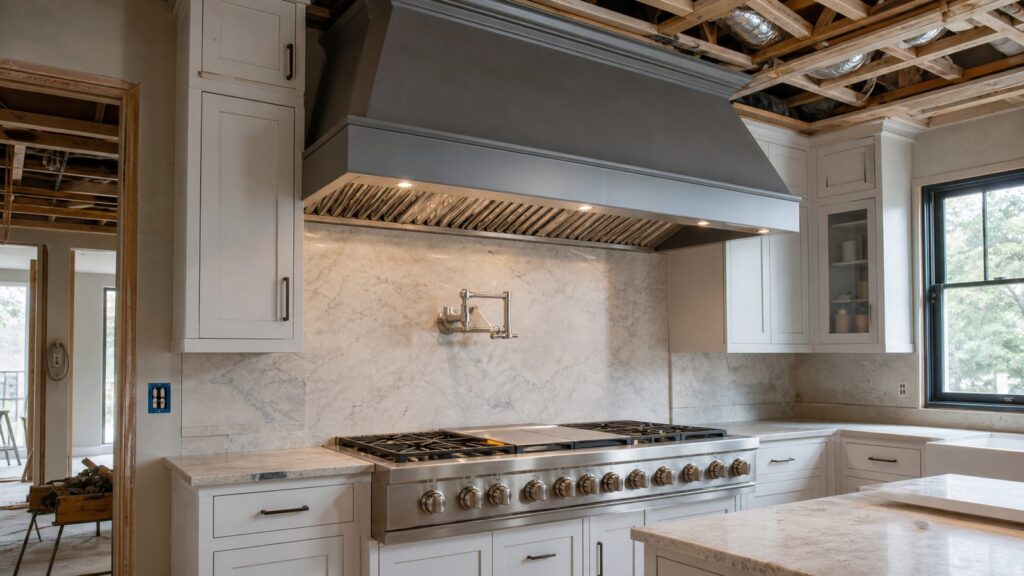
An external blower range hood can be one of the best upgrades for a serious kitchen, but only if it is designed as a complete ventilation system. The hood canopy, remote blower, duct size, roof or wall cap, electrical controls, and makeup air all have to work together. If one part is undersized or poorly located, a 1,200 CFM system can perform like a noisy 400 CFM hood.
For most 2026 U.S. kitchen remodels, a properly installed external or inline blower range hood system lands around $1,800 to $6,000. Custom wood or metal hoods, long duct runs, roof penetrations, tempered makeup air, and premium blower packages can push the number higher. The appliance price is only part of the story; the construction details decide whether the hood actually captures smoke, grease, steam, and combustion byproducts.
On our job sites, we do not start with a brand name. We start with the range, the cooking habits, the cabinet layout, and the duct path. A quiet hood that homeowners actually use on low or medium speed is usually better than an oversized hood that roars, pulls the house negative, and fails inspection because makeup air was not planned.
As an Amazon Associate I earn from qualifying purchases.
What’s actually slowing this PC down?
Pick the symptom - the matching free tool is one click away.
What Is an External Blower Range Hood?
An external blower range hood uses a fan motor located away from the hood body. Instead of having the blower inside the metal hood over the cooktop, the fan may be mounted on the roof, on an exterior wall, in an attic, or inline within the duct run. The hood at the cooking surface captures the plume, while the remote blower pulls air through the duct and exhausts it outdoors.
This setup is different from a standard internal blower hood, where the fan sits directly above the cooking area. Moving the motor away from the kitchen can reduce perceived noise, especially the mechanical fan noise that makes many high-CFM hoods unpleasant. It does not eliminate all sound. You will still hear air moving through the hood baffles, duct, elbows, and exterior cap. If the duct is too small, has too many turns, or uses a restrictive wall cap, the system can still be loud.
#1 Best Overall

- EASY INSTALLATION: With the included EZ1 clips, thisinsert is easy to install for both professionals and DiYers; stainless liner extension accommodates up to 13” deep cabinets, available extensions accommodate cabinets up to 15” deep
- IDEAL AIRFLOW: At 3 sone level of sound, this insert is about as loud as a typical conversation, and is controlled with a 2-speed rocker switch or an ADA compliant wall remote (sold separately)
- BUILT-IN POWER PACK INSERT: This insert provides efficient ventilation for your kitchen, quickly removing smoke & odors from your space with a two-speed blower at 300 Max Blower CFM.
- LED LIGHT: 1-level bright LED lighting provides a better view of your cooktop, no matter the time of day
- QUICK CLEAN-UP: The dishwasher-safe aluminum mesh micro filters and stainless steel finish will not discolor, simplifying the cleaning process
External blower systems are common in higher-end kitchens, pro-style ranges, open-plan homes, and custom hood builds. They are also useful when the homeowner cooks with high heat, uses a grill, griddle, wok burner, or frequently sears and fries. For light cooking on a small induction cooktop, the added cost and complexity may not be necessary.
Best External Blower Range Hood Setups by Kitchen Type
The best range hood with an external blower is not a single model. It is the right combination of hood shape, blower capacity, duct route, and controls for the way the kitchen is built. A wall range with a short duct run needs a different solution than an island range under a finished second floor.
Quick wins for a faster PC:
Repair Windows errors before they cause bigger problemsFix Now →Scan for outdated or missing drivers - takes under a minuteDriver Scan →Clear out junk files and repair common Windows errorsFree Scan →Best Overall Setup: Deep Wall-Mounted Hood With 900 to 1,200 CFM Remote Blower
For many serious residential kitchens, the strongest all-around setup is a wall-mounted hood or liner that is at least as wide as the range, projects far enough over the front burners, and uses a compatible 900 to 1,200 CFM exterior or inline blower. Wall-mounted cooking surfaces are easier to ventilate than island ranges because the wall behind the appliance helps contain the rising plume.
For a 36-inch range, we typically look at a 36-inch or 42-inch hood depending on the burner layout and surrounding cabinetry. For a 48-inch pro-style range, a 48-inch or 54-inch hood is often a better fit. Depth matters. A shallow designer hood with high listed CFM can miss smoke from the front burners. A deeper canopy mounted at the manufacturer’s recommended height often outperforms a more powerful blower connected to poor capture geometry.
Best Quiet Setup: Inline Blower With Straight Duct and Silencer
If kitchen noise is the main concern, an inline blower placed in an attic or remote duct location can work very well. The motor is separated from the hood, and an inline silencer can reduce some air-rush noise when the duct layout allows room for it. Brands such as Fantech are often used for inline ventilation components, while hood manufacturers such as Broan-NuTone/BEST, Zephyr, Wolf/Sub-Zero, ZLINE, Vent-A-Hood, and Viking offer systems with specific blower compatibility.
The key word is compatible. You cannot assume any inline blower will work with any hood. Controls, wiring, speed regulation, duct collars, mounting details, and listing requirements all have to match. Before cabinets are ordered, we want the exact hood insert, blower model, duct diameter, and control method selected.
Best Custom Hood Setup: Listed Insert Inside Wood or Metal Surround
Custom wood and metal hoods can look excellent, but the safe way to build them is around a listed liner or insert. The insert provides the grease filters, capture area, lighting, controls, and required clearances. The surround is then built around that equipment without violating the manufacturer’s spacing from the cooking surface or combustible materials.
For custom hoods, we coordinate the cabinet maker, electrician, HVAC contractor, and appliance supplier early. The insert size affects the cabinet opening. The blower affects duct diameter. The duct affects framing. The roof or wall cap affects exterior appearance and weather detailing. Waiting until trim stage to choose the ventilation package is how remodels get expensive.
CFM: How Much Airflow Do You Really Need?
CFM, or cubic feet per minute, measures how much air the blower is rated to move. Typical residential external and inline blower systems range from about 600 to 1,650 CFM, with many premium kitchen systems clustering around 900 to 1,200 CFM. Bigger is not automatically better.
Broan-NuTone’s range hood guidance makes the same practical point we see in the field: oversized CFM can increase noise and may trigger makeup-air requirements, while undersized ductwork restricts airflow and raises sound levels. Listed CFM is not the same as delivered CFM after the system is installed. Long duct runs, small duct diameter, tight elbows, roof caps, screens, dampers, and transitions all create static pressure that reduces real airflow.
As a rough planning range, many standard electric or induction cooktops can work with 300 to 600 CFM when the hood has good coverage and a short duct path. Larger gas ranges often call for 600 to 900 CFM. Pro-style gas ranges with high total BTU output, charbroilers, grills, griddles, or wok burners commonly justify 900 to 1,200 CFM or more. The final number should follow the appliance manufacturer’s ventilation guidance and local code.
Do not size the system by BTU alone. Burner location, hood depth, mounting height, cooking style, and duct path matter just as much. Lawrence Berkeley National Laboratory research found residential hood capture efficiency varied dramatically, from less than 15% to more than 98%, depending on hood design, airflow, and burner position. That is why a well-shaped hood over the cooking plume can beat a flashy high-CFM hood that barely covers the front burners.
Duct Design Matters More Than Most Buyers Realize
The duct is the part homeowners rarely shop for, but it is often the difference between a good hood and a disappointing one. A remote blower needs a clean path to move air. On our projects, we prefer smooth metal duct, properly sized for the blower and hood collar, with the shortest practical route outdoors.
A high-output kitchen hood commonly uses 8-inch, 10-inch, or larger round duct depending on the manufacturer’s requirements. Reducing a 10-inch blower outlet into a smaller duct to avoid framing work is usually a bad trade. It increases static pressure, increases noise, and reduces delivered airflow. Flexible duct is also the wrong material for most kitchen exhaust runs because it catches grease, restricts flow, and is harder to clean.
The Tool Desk
Outbyte PC Repair FREERepair Windows errors before they cause bigger problemsFix Now →Outbyte Driver Updater FREEScan for outdated or missing drivers - takes under a minuteDriver Scan →Rank #2

- FINGERPRINT RESISTANT STAINLESS FINISH: PrintGuard technology introduces a fingerprint resistant, stainless finish range hood that wipes clean with ease, seamlessly matches other stainless appliances, and is scratch resistant
- MADE IN THE USA: Proudly manufactured in the USA by the Leaders in Residential Indoor Air Quality with foreign and domestic components
- BREATHE CLEANER AIR: The flexbile installation design and 2-speed blower that quickly pulls smoke and odors from the air and through a aluminum filter to cleanse the air, makes this hood vent the perfect addition to your kitchen
- DISHWASHER SAFE: Keep your kitchen spotless and air clean with a removable, dishwasher-safe filter, and replaceable parts help this product last years to come
- DIMENSIONS: This kitchen ventilation tool measures 17.5" L x 30" W x 6" H
Every elbow counts. A short straight duct through an exterior wall will usually outperform a long run that snakes through soffits, crosses an attic, and exits through a roof cap. Roof terminations can be completely appropriate, but they require correct flashing, weatherproofing, clearances, and service access. Sidewall terminations can be simpler, but they need the right cap location and must respect clearances from windows, doors, intakes, property lines, and outdoor living areas.
Never vent a range hood into an attic, soffit, garage, crawlspace, or wall cavity. Kitchen exhaust carries moisture, grease, odors, and combustion pollutants. It belongs outdoors through an approved duct and termination.
External vs Inline vs Internal Blower
Homeowners often use the terms external blower and inline blower interchangeably, but there is a practical difference. An external blower usually means the fan is mounted at the exterior termination, such as on the roof or outside wall. An inline blower sits somewhere along the duct run, often in an attic or mechanical space. An internal blower sits inside the hood.
| Blower Type | Typical Location | Best Use | Main Tradeoff |
|---|---|---|---|
| Internal blower | Inside the hood | Standard kitchens, simpler replacements, shorter budgets | More fan noise in the kitchen |
| Inline blower | In the duct run, attic, or remote mechanical space | Quiet kitchens where service access is available | Needs space, compatible controls, and careful duct planning |
| External blower | Exterior wall or roof | High-output systems and premium remodels | Higher equipment cost, exterior appearance, weather detailing |
If the kitchen is already finished and the duct path is limited, an internal blower may be the more practical option. If the project is a full remodel and ceilings or attic space are open, an inline or exterior blower gives the design team more flexibility.
Free tools Windows power users keep installed
One-click scans. No signup required.
2026 Cost to Install a Range Hood With External Blower
For a remodel-quality external blower system in the United States, a realistic 2026 installed budget is commonly $1,800 to $6,000. Basic replacements cost less. Luxury custom hood projects with premium appliances, roof work, cabinetry, and tempered makeup air can cost substantially more.
National cost references provide a useful baseline. Homewyse lists basic vent hood installation at about $564 to $1,030 per hood as of May 2026. Angi reports typical range hood installation at $650 to $2,500, with an average around $1,750. HomeGuide reports $300 to $850 for replacement and $650 to $2,100 for a new install with outlet and ductwork. Those figures are helpful, but external blower projects often exceed basic installation ranges because the system includes more parts and more trades.
| Item | Typical 2026 Cost Range | Notes |
|---|---|---|
| Remote-blower-ready hood or insert | $900 to $3,500+ | Custom liners, pro-style hoods, and premium finishes cost more |
| External or inline blower | $999 to $1,700+ common | Smaller inline fans may start around $175 to $350, but brand-compatible kitchen blowers often cost more |
| Basic installation labor | $650 to $2,500 | Varies by replacement versus new ducted installation |
| New ductwork | $1,200 to $2,500+ common | Some routes can run roughly $100 to $400+ per linear foot depending on access and finish repair |
| Makeup air | Several hundred to several thousand dollars | Tempered systems in cold or hot climates can exceed the hood cost |
| Permits and inspections | $50 to $300+ | Mechanical, electrical, roof, and local requirements vary |
The biggest price drivers are blower CFM, duct diameter, duct length, number of elbows, roof versus sidewall termination, attic or crawlspace access, cabinet modifications, electrical control wiring, finish patching, local labor rates, and whether the work is part of a larger kitchen remodel.
Makeup Air: The Code Issue You Should Plan Early
Makeup air is replacement air brought into the house when a powerful exhaust fan removes indoor air. Without enough replacement air, a high-CFM hood can depressurize the home. That can make doors harder to open, pull fireplace or water-heater exhaust backward, reduce HVAC comfort, and make the hood perform poorly.
Many code jurisdictions use 400 CFM as an important threshold for domestic kitchen exhaust. The 2024 International Residential Code includes requirements related to domestic cooking exhaust and makeup air, but local adoption and amendments vary. Some inspectors require a motorized makeup-air damper interlocked with the hood above a certain CFM. Others may require tempered makeup air, combustion safety review, or HVAC coordination.
For a 600 CFM hood, do not assume makeup air is optional. For a 1,200 CFM hood, plan on having the conversation before the permit set is finalized. In cold climates, dumping untempered winter air into a kitchen can be uncomfortable and can create condensation concerns. In hot, humid climates, unconditioned makeup air can load the HVAC system and make the kitchen sticky. A simple damper may satisfy one project, while another may need tempered makeup air integrated with the mechanical system.
We prefer to decide makeup air during design, not after inspection. It affects duct routing, electrical controls, mechanical space, exterior penetrations, and budget.
Brands Worth Considering
Several established ventilation brands make strong external or inline blower systems. Broan-NuTone and BEST have broad residential ventilation lines, including remote blower options. Zephyr offers premium hoods and compatible external or inline blower packages. Wolf/Sub-Zero, Viking, Vent-A-Hood, ZLINE, and other pro-style appliance brands also serve this category. Fantech is commonly associated with inline fan systems and ventilation components.
Crashes, No Sound, or Screen Glitches?
Random freezes, missing sound and display glitches usually trace back to one bad driver. Find and replace yours safely.Free scan · under a minuteWindows Errors? Fix Them Before They Spread
Repair common Windows errors and clear accumulated junk for a smoother, more stable PC - no reinstall needed.Free scan · no reinstallThe right brand is the one that matches the hood, blower, duct size, controls, service access, and code requirements. Brand reputation matters, but compatibility matters more. Before buying, verify the exact blower model approved for the hood, the duct diameter, maximum equivalent duct length, mounting requirements, electrical needs, speed control method, damper requirements, and warranty conditions.
We also look at serviceability. A roof-mounted blower that cannot be reached safely is a poor long-term choice. An inline blower buried behind finished drywall is no better. Filters should be easy to remove and wash. Controls should be intuitive. Low-speed operation should be quiet enough that the homeowner uses it for everyday cooking, not just when smoke is already filling the room.
Independent reader supportYour contribution helps us test, update, and keep practical guides available for everyone.When to DIY vs When to Hire a Pro
A straightforward replacement of an existing ducted range hood can sometimes be a competent DIY project. If the new hood uses the same duct size, the same electrical connection, the same mounting height, and the existing duct already vents outdoors, the work may be manageable with basic carpentry and electrical knowledge. Even then, the power should be handled safely, the hood must be mounted into solid framing or blocking, and the manufacturer’s clearances must be followed.
Rank #3

- 20% More Effective: Trust in the Broan-NuTone brand to more effectively remove pollutants in your kitchen than the leading competitor, with strong airflow at 350 Max Blower CFM
- Up to 44% Quieter: With sound equivalent to a refrigerator running, this vent hood is up to 44% quieter than competition at 1.5 sones on working speed
- One Person Installation: With the included EZ1 brackets it's an easy install for a single person in half the time, both professional and DiYers
- Both ENERGY STAR certified and Title 24 compliant (with electric ranges only), this kitchen hood is energy efficient and code compliant
- Bright 1-level, heat resistant LED modules (bulbs included) to enhance your cooking experience
An external blower system is usually pro work. Hire a qualified contractor, HVAC installer, electrician, or remodeler when the project includes a new duct route, roof penetration, wall penetration, external blower mounting, inline blower wiring, makeup-air interlock, cabinet modifications, custom hood enclosure, gas range, combustion appliances, or permit requirements.
DIY mistakes in this category are expensive. We have seen oversized blowers connected to undersized ducts, ducts terminating into attics, roof caps placed where they are hard to flash, and custom wood hoods built too close to the cooking surface. Correcting those problems after cabinets, tile, and countertops are complete costs far more than designing the system properly from the start.
Installation Checklist Before You Buy
Before ordering equipment, confirm the cooking appliance width, burner BTUs, fuel type, hood width, hood depth, mounting height, duct diameter, duct route, termination location, blower location, electrical requirements, controls, damper strategy, makeup-air requirements, and permit scope. If any of those items are unknown, the system is not ready to order.
For a wall range, check that the hood covers the front burners and is mounted within the manufacturer’s height range. For an island range, plan for more overhang because there is no back wall to help contain the plume. For custom hoods, confirm the insert is listed for the application and that combustible clearances are maintained. For roof terminations, verify flashing details and service access. For sidewall terminations, check exterior appearance and clearances from openings and air intakes.
After installation, test the system. Verify that the blower runs at all speeds, the damper opens, air exits at the termination, filters seat correctly, lights and controls work, and makeup air activates when required. A hood that sounds powerful can still be underperforming if the duct is restricted or the makeup-air damper does not open.
Do these 3 things before closing this tab:
1Clear out junk files and repair common Windows errors2Fix the driver behind crashes, sound loss and screen glitches3Repair Windows errors before they cause bigger problemsBottom Line
The best range hood with an external blower is the one designed around the kitchen, not the one with the biggest CFM number on the box. Start with the range and cooking habits. Choose a hood that captures the plume. Size the blower and duct as a matched system. Keep the duct short, smooth, and properly terminated outdoors. Plan makeup air before inspection. Make service access part of the design.
For homeowners investing in a serious kitchen, this is where a good contractor earns their keep. The finished hood should be quiet enough to use, strong enough to capture smoke and grease, compliant with local requirements, and integrated cleanly into the cabinets, roof, wall, and mechanical systems. That takes more planning than a typical appliance purchase, but it is exactly what makes the kitchen work well for years.
Frequently Asked Questions
What is the difference between an external blower and an inline blower for a range hood?
An external blower is usually mounted on the roof or exterior wall at the exhaust termination. An inline blower is mounted inside the duct run, often in an attic or mechanical space. Both move the fan motor away from the hood, but they have different access, wiring, noise, and weatherproofing considerations.
Is an external blower range hood quieter than an internal blower?
Usually, yes, because the fan motor is farther from the kitchen. It will not be silent. Air moving through filters, ductwork, elbows, and the roof or wall cap still creates sound, especially if the duct is undersized or the run is too restrictive.
Recommended Free Tools
How many CFM do I need for a gas or pro-style range?
Many larger gas ranges need 600 to 900 CFM, while pro-style ranges with grills, griddles, wok burners, or high total BTU output often need 900 to 1,200 CFM or more. The hood shape, mounting height, duct design, and appliance manufacturer’s requirements matter as much as the CFM number.
Do I need makeup air for a 600 CFM or 1,200 CFM range hood?
Possibly. Many jurisdictions treat 400 CFM as an important threshold for makeup-air requirements, but local code adoption varies. A 600 CFM hood should be checked against local requirements, and a 1,200 CFM hood should be planned with makeup air from the start.
How much does it cost to install a range hood with an external blower in 2026?
A realistic installed range for a remodel-quality external blower setup is commonly $1,800 to $6,000 in the U.S. Custom hoods, premium blowers, long duct runs, roof work, electrical upgrades, and tempered makeup air can raise the cost significantly.
Can I use any external blower with any range hood?
No. The blower must be compatible with the hood or insert, including the controls, wiring, duct size, mounting method, speed regulation, and manufacturer listing. Mixing unrelated components can create performance, safety, inspection, and warranty problems.
Quick Recap
Product prices and availability are accurate as of the date/time indicated and are subject to change. Any price and availability information displayed on Amazon at the time of purchase will apply.

