Recommended Free Tools
Some links on this page are affiliate links: if you buy through them we may earn a commission, at no extra cost to you.
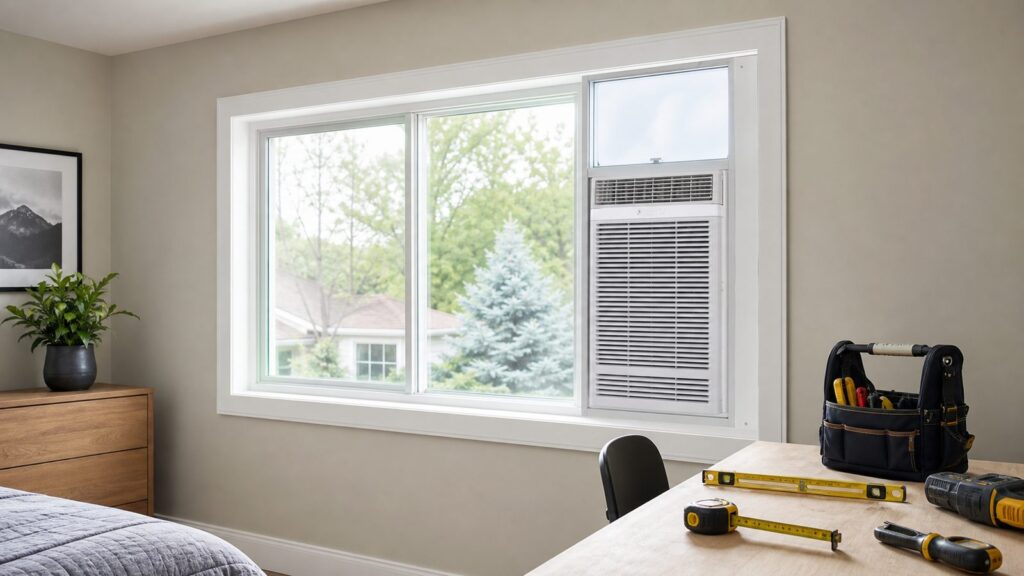
Vertical window air conditioners are built for rooms where a standard double-hung window unit will not fit: horizontal sliding windows, casement windows, and tall narrow openings. The best choice is not simply the highest BTU model or the unit with the most app features. On our job sites, the successful installations are the ones where the window opening, frame condition, support, electrical circuit, drainage pitch, and air sealing are planned before anyone carries a 70-pound appliance up the stairs.
For most homeowners in 2026, the practical short list is an 8,000 BTU or 10,000 BTU slider/casement window AC. A 10,000 BTU vertical unit commonly covers up to about 450 square feet under normal conditions. Expect the unit itself to cost roughly $450 to $750 for many vertical or casement-slider models, with installation often adding $130 to $519 depending on complexity. If the window needs repair, a custom filler panel, a support bracket, or electrical work, the real installed cost can climb quickly.
As an Amazon Associate I earn from qualifying purchases.
The Tool Desk
Outbyte PC Repair FREERepair Windows errors before they cause bigger problemsFix Now →Outbyte Driver Updater FREEScan for outdated or missing drivers - takes under a minuteDriver Scan →This guide explains how to choose the right vertical window air conditioner, when a portable AC or mini-split is the better answer, what dimensions to measure, how much to budget, and where safety problems usually start.
What Is a Vertical Window Air Conditioner?
A vertical window air conditioner is a room AC designed for a tall, narrow window opening instead of a standard double-hung window. You will also see these sold as slider window air conditioners, casement window air conditioners, or casement-slider AC units. The chassis is taller and narrower than a typical window unit, and the included filler kit is intended to close the vertical gap above the appliance.
#1 Best Overall
- Powerful 10,000 BTU Cooling - Designed to efficiently cool medium-sized rooms, this 10,000 BTU window air conditioner provides fast, reliable cooling for bedrooms, living rooms, apartments, offices, and other indoor spaces.
- Built for Casement & Sliding Windows - Specially designed for casement windows and vertical sliding windows, this window AC unit includes a secure installation kit for a proper fit and dependable performance.
- Custom Comfort Controls - Easily adjust your ideal temperature with electronic controls, an included remote control, multiple cooling and fan speeds, an adjustable thermostat, and a convenient 24-hour programmable timer.
- Energy-Efficient Performance - Save energy while staying comfortable with Energy Saver mode, helping reduce power consumption without sacrificing cooling performance.
- Easy Maintenance & Quiet Operation - A washable, reusable air filter helps capture dust and keeps your room air conditioner operating efficiently, while the compact design delivers dependable, quiet cooling all season long.
These units exist because a standard window AC depends on a horizontal lower sash to hold the top rail and close down onto the unit. A casement window swings open, and a horizontal slider moves side to side, so the geometry is completely different. Trying to force a standard AC into that opening usually creates a poor fit, bad drainage, ugly air gaps, and a real fall hazard.
Most vertical window air conditioners are in the 8,000 to 10,000 BTU range. That makes them a good match for bedrooms, home offices, small living rooms, finished attic rooms, and apartments with slider windows. The tradeoff is selection. Vertical units are much less common than standard window ACs, so prices are higher, inventory is thinner, and energy-efficient inverter options are more limited.
Best Uses for Vertical Window AC Units
A vertical window air conditioner makes the most sense when the room has a compatible sliding or casement window, the cooling need is limited to one room, and permanent HVAC work is not justified. We see them used most often in older homes with additions, upstairs bedrooms that run hot, garage offices, sunrooms, rental apartments, and rooms where central air does not reach evenly.
The best applications share a few traits. The room is usually 250 to 450 square feet. The window frame is solid, square, and free of rot. There is a grounded 115V outlet nearby. The outside wall has enough clearance for airflow and condensate. The homeowner wants a removable seasonal solution rather than a permanent wall penetration.
A vertical unit is not the right answer for every warm room. If the room is used daily for work or sleep in a hot climate, a ductless mini-split may cost more upfront but deliver quieter operation, better efficiency, and year-round comfort. If the window is fragile, rotted, historic, or restricted by an HOA, a portable dual-hose AC with a custom vertical panel may avoid risky exterior mounting. If the room is part of a larger whole-home comfort problem, insulation, air sealing, attic ventilation, shading, or duct balancing may be the better construction fix.
How to Measure Before You Buy
Do not start with the appliance. Start with the opening. A vertical AC can be the right size on paper and still fail because the sash path, sill shape, crank hardware, or frame depth blocks the install. Before our crews recommend a unit, we measure the actual working opening, not just the glass size.
PC Slower Than It Used to Be?
A free scan shows the junk files, broken settings and background clutter dragging Windows down - then fixes them in one click.Free scan · Windows 10 & 11Crashes, No Sound, or Screen Glitches?
Random freezes, missing sound and display glitches usually trace back to one bad driver. Find and replace yours safely.Free scan · under a minutePre-Purchase Measuring Checklist
Measure the clear opening width with the window fully open. For a horizontal slider, this is the side-to-side opening where the AC will sit. For a casement, this is the usable width after the sash is opened and any crank hardware is considered. Many vertical units need a relatively narrow width, often around 15 to 16 inches, but each model has its own required range.
Measure the clear opening height from the sill to the top of the open frame. Vertical units and their filler panels need enough height to fit the chassis and seal the remaining space. Some slider/casement models require more than 20 inches of height, while the filler panel may extend much higher.
Check sill depth and slope. The unit needs a stable bearing surface and enough depth for the chassis and support hardware. A shallow vinyl track, loose aluminum rail, or sloped stone sill may need blocking or a manufacturer-approved bracket.
Inspect the frame material. Wood can often accept fasteners if it is sound. Vinyl and aluminum frames require more care because overtightening screws can distort the track, break seals, or void warranties. Masonry openings may need different anchors and should be treated as a more involved installation.
Do these 3 things before closing this tab:
1Repair Windows errors before they cause bigger problems2Scan for outdated or missing drivers - takes under a minute3Clear out junk files and repair common Windows errorsCheck the sash path. A sliding sash must still be able to close against the side of the unit or filler assembly as designed. A casement sash must open far enough to clear the exterior portion of the unit. Crank arms, handles, storm windows, security stops, and bug screens often interfere.
Confirm exterior clearance. The condenser side needs open air, not a tight porch enclosure, shrub, wall, or balcony rail. Restricted airflow makes the unit run hotter, cool worse, and use more electricity.
Locate the outlet. Most 8,000 to 10,000 BTU vertical units use 115V power, but that does not mean every outlet is suitable. Check the amperage, plug type, manufacturer requirements, and what else is on the circuit.
Rank #2

- 6,000 BTU COOLS ROOMS UP TO 250 SQ FT – Electronic window air conditioner efficiently cools bedrooms, home offices, dorm rooms and small apartments. Two-way air direction and multiple cooling modes (52 dBA low, 56 dBA high) let you customize comfort. Ideal for spaces approximately 10x25 feet.
- DIGITAL THERMOSTAT WITH REMOTE CONTROL – Precise temperature control from 64°F to 86°F via LED display and electronic thermostat. Full-function remote included for convenient across-the-room operation. Not WiFi or smart home compatible.
- ENERGY SAVER ECO MODE – Intelligent auto-cycling compressor maintains your set temperature while minimizing power consumption. Uses less energy compared to manual units that run continuously.
- 24-HOUR PROGRAMMABLE TIMER PLUS AUTO-RESTART – Schedule on/off times up to 24 hours in advance to save energy overnight or when away. Auto-restart remembers your settings after power outages so you don't need to reprogram.
- EASY DIY WINDOW INSTALLATION – Fixed chassis design installs quickly in double-hung windows 27.125" to 36" wide and 13.375" high minimum. Includes EZ Mount kit with expandable side panels. Washable, reusable air filter with reminder indicator for easy maintenance.
Know the unit weight. Many vertical models are in the 60 to 80 pound range. If the frame is loose or the window is on an upper floor, support is not optional. It is part of the installation.
BTU Sizing: Do Not Oversize Just Because the Window Is Awkward
BTU capacity tells you how much heat the air conditioner can remove. More is not always better. An oversized room AC can short-cycle, leaving the room clammy because it cools the air before it removes enough humidity. An undersized unit runs constantly and still cannot keep up on hot afternoons.
General room AC sizing works like this: 150 to 350 square feet typically needs about 5,000 to 8,000 BTU, while 350 to 550 square feet usually needs 8,000 to 12,000 BTU. Because most vertical window ACs are 8,000 or 10,000 BTU, they naturally fit the middle of that range.
A 10,000 BTU slider/casement unit is commonly advertised for rooms up to about 450 square feet. Lowe’s, for example, lists a Keystone 10,000 BTU slider/casement model for rooms up to 450 square feet and identifies it as designed for horizontal slider or casement windows. Frigidaire’s 10,000 BTU slider/casement model is also positioned around 450 square feet and includes features such as remote control, sleep mode, and multiple fan speeds.
Adjust the size upward when the room has heavy sun exposure, high ceilings, poor insulation, large west-facing glass, a kitchen heat load, several occupants, or electronics that run all day. Adjust downward when the room is shaded, well insulated, and only lightly occupied. In older homes, we often get better results by improving the envelope first: sealing attic bypasses, adding shade, tightening window gaps, installing window film, or reducing internal heat loads. A smaller AC in a tighter room can outperform a larger AC fighting leaks and afternoon solar gain.
Energy Efficiency: CEER Matters More Than Smart Features
Room air conditioners are rated by CEER, or Combined Energy Efficiency Ratio. Higher CEER means the unit uses less electricity for the same cooling output. ENERGY STAR and the Department of Energy use CEER for room AC comparisons, and the ENERGY STAR product finder is the best place to verify current certified models because retailer listings can lag or omit certification details.
For a bedroom or home office, efficiency should be considered with noise. A quiet unit that can hold a steady temperature at low fan speed is usually more valuable than a loud unit with a long list of smart-home features. Look for sleep mode, low fan speed, published noise data, washable filters, and clear airflow controls.
Inverter window ACs can reduce operating cost and improve comfort because the compressor can modulate instead of cycling fully on and off. The issue is availability. True vertical or casement inverter options remain limited compared with standard double-hung window units. Some premium designs, such as GE’s ClearView ENERGY STAR inverter models, show what is possible in efficient window cooling, but the window style must match the product. Do not assume an efficient standard-window design will work in a vertical or casement opening.
The refrigerant transition is also worth watching. Federal rules are moving equipment away from high-global-warming-potential HFC refrigerants. For room AC buyers, the practical step is simple: check the label and manufacturer literature for newer lower-GWP refrigerants such as R32, and follow the manufacturer’s safety and service instructions. Do not modify refrigerant components or ask a handyman to service sealed refrigeration equipment.
Quick wins for a faster PC:
Scan for outdated or missing drivers - takes under a minuteDriver Scan →Repair Windows errors before they cause bigger problemsFix Now →Cost to Buy and Install a Vertical Window AC in 2026
Vertical window air conditioners usually cost more than standard window units at the same capacity because the chassis, support arrangement, and panel kits are specialized. Standard window ACs at major retailers commonly run about $170 to $600 depending on BTU, inverter technology, smart controls, heating mode, noise rating, and ENERGY STAR status. Vertical and casement-slider units are commonly closer to $450 to $750 for 8,000 to 10,000 BTU models, with scarce or premium models sometimes higher.
Installation costs vary because the window determines the job. Angi reports a 2026 national benchmark of $139 to $519 for window AC installation, with many homeowners paying about $312 for a standard unit plus professional setup. Thumbtack’s 2026 benchmark is lower for simpler work, roughly $130 to $255 on average, depending on unit size, window type, labor rates, and complexity.
| Cost Item | Typical 2026 Range | What Changes the Price |
|---|---|---|
| Vertical/casement-slider AC unit | $450-$750 | BTU rating, brand, scarcity, CEER, remote, sleep mode, smart controls |
| Basic professional installation | $130-$519 | Window type, upper-floor access, local labor, unit weight, sealing detail |
| Support bracket | $30-$150 | Unit weight, sill design, facade material, manufacturer requirements |
| Weatherstripping and filler materials | $10-$100 | Foam only versus acrylic, polycarbonate, plywood, or insulated panel stock |
| Electrical upgrade or dedicated circuit | Several hundred dollars or more | Panel distance, amperage need, existing circuit load, permit requirements |
| Window repair before installation | Varies widely | Rot, loose tracks, damaged vinyl, out-of-square frames, failed hardware |
The biggest cost drivers are labor rates, window condition, upper-floor access, masonry or metal frames, historic or HOA restrictions, bracket fastening, circuit capacity, and whether the included plastic panel kit is good enough. A custom infill panel can add labor, but it often makes the installation quieter, tighter, and better looking.
Do not compare a vertical window AC directly with full central air. Central AC is a whole-home system, and 2026 installation ranges commonly land in the several-thousand-dollar range. HomeAdvisor’s central AC range of $3,884 to $8,068 is a useful broad benchmark, and many full-system projects in hot markets cost more. A vertical window AC is a room-level fix.
Best Features to Prioritize
After fit and BTU, prioritize CEER, noise, airflow control, and serviceability. These matter more in daily use than app controls or a sleek remote.
For Bedrooms
Bedrooms need low noise, stable temperature, and good low-speed operation. Look for sleep mode, a true low fan setting, a clear published decibel rating when available, and inverter operation if a compatible vertical model exists. Compressor noise matters more than fan noise because the compressor cycling on and off can wake light sleepers. A remote control is useful, but only after the unit meets the fit and sound requirements.
Rank #3

- Portable AC Window Vent Kit: This portable AC window vent kit is fitted between the window frame and the window using a hose. It effectively expels hot air generated by the air conditioner out of the window whilst trapping cool air inside, keeping your room cool for longer
- Improved Cooling Performance and Energy Savings: The AC window seal kits are made from durable nylon, effectively preventing hot air from entering and keeping out insects and rain, creating an ‘airtight environment’. This allows the room to cool down rapidly, enhancing the air conditioning’s cooling efficiency, helping to reduce energy consumption and carbon dioxide emissions, saving on electricity bills and putting money in your pocket
- Suitable For a Wide Range Of Portable Air Conditioners: This portable AC window vent kit features a flexible dual-zipper design, making it suitable for both single-hose and dual-hose units, and allowing the hose to be secured at any height. It effectively resolves the common issue of aligning the air conditioner with the window. The window seal is compatible with portable air conditioners, tumble dryers, dehumidifiers and other household appliances, offering versatile use across a variety of scenarios
- Suitable For a Wide Range Of Windows: We offer five sizes of portable AC window vent kits to choose from, including 300 cm, 400 cm, 500 cm, 560 cm and 600 cm. These are suitable for skylights, sunshade windows, casement windows or left/right-opening outward-opening windows. They are not suitable for sliding windows, vertical sliding windows or pivot windows. Please measure the length of all four sides of your window before purchasing, then select the appropriate size to ensure you buy the correct product, install it correctly and achieve a better seal
- Easy to Install: No drilling required. You won’t need to buy a window installation kit, hose adapters or any extra tools—our portable AC window vent kit includes all the necessary accessories (excluding the exhaust hose), along with a comprehensive installation guide! Simply secure the portable AC window vent kit to the inside of the window frame and the window itself using tape, feed the air conditioning hose out of the window, zip it up, and secure it with cable ties. You can open and close the window at any time without removing the window seal. Of course, you can also remove the AC window seal kit when not in use, store it away and reuse it later
For Home Offices
Home offices need quiet operation and predictable airflow. Avoid a unit that blows directly across a desk all day unless the louvers can redirect air. Check where the filter slides out; if the desk blocks filter access, maintenance will be skipped. For rooms with computers, monitors, and printers, include those heat loads in the BTU calculation and verify the circuit is not already heavily loaded.
For Living Rooms and Sunrooms
Living rooms need airflow throw and dehumidification. A 10,000 BTU unit may be appropriate for a 400 to 450 square foot space, but sun exposure and glass area matter. In sunrooms, the cooling problem is often the envelope, not just the appliance. Exterior shade, window film, insulated shades, and air sealing can make a dramatic difference.
Free tools Windows power users keep installed
One-click scans. No signup required.
Installation Details That Separate Good From Bad
A vertical window AC has to do four jobs at once: stay supported, drain correctly, seal the opening, and avoid damaging the window. Most failures come from treating it like a quick appliance drop-in.
Support and Fall Protection
The unit must be secured according to the manufacturer’s instructions. Many installations need a bracket, especially on upper floors or weak sills. The window sash alone should not be treated as the structural support. On older wood windows, we inspect the sill with an awl or screwdriver before installation. If the wood is soft, punky, or separating at joints, it gets repaired before weight is added.
Vinyl sliders deserve special caution. Vinyl tracks can deform under point loads. Fastening into vinyl without understanding the frame can damage the window or compromise drainage paths. In those cases, a support bracket that transfers load properly is often better than relying on the track.
Drainage Pitch
Window ACs produce condensate. The unit generally needs a slight outward pitch so water drains outside rather than back into the room or into the wall assembly. The exact pitch should follow the manufacturer’s installation guide. Too much pitch can stress the chassis or create vibration. Too little pitch can send water where it does not belong.
What’s actually slowing this PC down?
Pick the symptom - the matching free tool is one click away.
Air Sealing
The tall gap above a vertical AC is where many installations lose performance. Thin accordion plastic often leaks, rattles, and looks unfinished. For a better result, build a removable infill panel from rigid acrylic, polycarbonate, painted plywood, or insulated panel stock. Cut it to the actual opening, seal the perimeter with compressible weatherstripping, and fasten it so it can be removed for service or seasonal storage.
For a clean interior finish, we prefer a panel that sits flat, does not bow, and is backed by foam gasket where it meets the frame. In bedrooms, a tighter panel also reduces street noise and insect entry. Avoid spray foam unless you are intentionally making a semi-permanent installation; it is messy, hard to reverse, and easy to overuse.
Vibration Control
Vibration usually comes from loose brackets, unsupported panels, weak sills, or a unit touching the frame in the wrong place. Use manufacturer-approved pads, shims, and fasteners. Do not wedge random scrap under the unit where it can trap water or fall out. If the unit starts rattling after a few days, recheck fasteners and panel contact points before assuming the appliance is defective.
Electrical Load and Circuit Safety
Many 8,000 and 10,000 BTU vertical window air conditioners use standard 115V plugs, but that is not a free pass. The circuit still has to carry the load. A room outlet may also feed lights, computers, a mini fridge, entertainment equipment, or outlets in an adjacent room.
Before buying, check the unit’s amperage, plug configuration, and manufacturer instructions. Then identify what else is on the circuit. If the breaker trips when the compressor starts, do not keep resetting it. That is a warning that the circuit may be overloaded or there may be another electrical issue.
A dedicated circuit can cost several hundred dollars or more, depending on the panel location, wall access, local labor, and permit requirements. If the home has older wiring, ungrounded outlets, aluminum branch wiring, or a panel that is already full, have a licensed electrician evaluate it before installation.
Extension cords are a common problem. Most manufacturers prohibit ordinary extension cords for room air conditioners. If the cord does not reach the outlet, solve the outlet location rather than creating a heat risk with an undersized cord.
Rank #4

- BEST FOR SMALL ROOMS: Cools up to 150 sq ft efficiently with 5,000 BTU cooling power. Ideal for bedrooms, home offices, dorm rooms, workshops, and studio apartments. Compact 16.4" W x 13.4" D x 12.6" H design fits tight spaces.
- QUIET OPERATION - Quieter than many older window AC units, with 2 cooling modes (low 52 dBA for nighttime, high 56 dBA for rapid cooling) and 2 fan speeds for personalized comfort. Simple mechanical controls mean no annoying digital beeps.
- SIMPLE, RELIABLE MECHANICAL CONTROLS: Easy-to-use dials for temperature and fan speed—no Wi-Fi, apps or complex setup required. 10 temperature settings let you dial in your perfect comfort level. Auto restart after power outages.
- LOW MAINTENANCE & ENERGY SMART: No manual draining under normal conditions. Washable, reusable filter for easy care. Low 440W power draw helps reduce energy costs compared to older, inefficient units.
- EASY DIY INSTALLATION: Fixed chassis installs easily and fits double-hung windows 27.125"–36" wide and 13.375" high minimum. EZ Mount kit with foam insulation included. Backed by 1-year GE limited warranty for peace of mind.
Permits, Building Rules, and Liability
Permit requirements vary by city, building type, and scope. A simple plug-in window AC in a single-family home often does not require a mechanical permit, but exterior brackets, facade attachment, electrical work, multifamily buildings, landmarked properties, and HOA-controlled communities can change the answer.
What’s actually slowing this PC down?
Pick the symptom - the matching free tool is one click away.
New York City is a good example of why local rules matter. City guidance emphasizes secure installation, proper support, and safe placement so units do not create hazards over sidewalks or neighboring property. In multifamily buildings, management may also have bracket requirements, seasonal rules, or approved installer lists.
For homeowners, the practical rule is this: if the unit projects over a public area, sits above a walkway, requires exterior fastening, needs electrical work, or is going into a rental, condo, co-op, or HOA property, check the governing rules before purchase. It is easier to select a compliant cooling method than to remove a newly installed unit after a complaint.
Vertical Window AC vs Portable AC vs Mini-Split
Before buying a vertical window air conditioner, compare three options: a true slider/casement window AC, a dual-hose portable AC with a custom vertical panel, and a ductless mini-split. The cheapest box price is not always the cheapest installed solution.
| Option | Best For | Main Advantages | Main Drawbacks |
|---|---|---|---|
| Vertical window AC | Compatible slider or casement windows, room-level cooling | Good efficiency for a room unit, no floor space used, direct outdoor condenser airflow | Narrow model selection, higher unit cost, careful support and sealing required |
| Dual-hose portable AC | Windows that cannot carry weight, rentals, restricted exteriors | No heavy exterior appliance, easier seasonal removal, custom panel can fit tall openings | Uses floor space, usually louder, less efficient than good window units |
| Ductless mini-split | Daily-use rooms, long-term comfort problems, hot climates | Quiet, efficient, strong comfort control, can provide heating depending on model | Higher upfront cost, professional installation, permanent exterior equipment |
| Through-wall AC | Rooms where a permanent wall sleeve makes sense | Does not occupy the window, cleaner long-term installation | Requires wall opening, sleeve, flashing, structural and waterproofing care |
If the room is a bedroom used every night, noise and efficiency may justify a higher-cost solution. If it is a guest room used two weeks a year, a vertical window unit may be the right balance. If the window frame is questionable, do not spend money on the AC until the opening is repaired or another cooling method is selected.
When to DIY and When to Hire a Pro
A careful homeowner can install some vertical window air conditioners, but this is not the same as sliding a small 5,000 BTU unit into a first-floor double-hung window. The appliance is taller, heavier, and more dependent on the filler panel and support system.
DIY Is Reasonable When
DIY can make sense when the unit is on the first floor, the window is square and structurally sound, the manufacturer’s kit fits well, the outlet is nearby and properly grounded, the unit weight is manageable with two people, and no exterior bracket needs complex anchoring. Plan on one to three hours for a straightforward installation, plus time to cut and fit a better panel if the included kit is weak.
Hire a Pro When
Hire a pro when the unit is going above a walkway, the window is on an upper floor, the sill is rotted or loose, the frame is vinyl or metal and difficult to fasten, the building is masonry, the opening needs a custom rigid infill panel, the outlet is questionable, or the property has HOA, condo, rental, or historic restrictions. Also hire help if the unit is too heavy to place safely. A dropped AC can injure someone and destroy the window frame on the way out.
For electrical work, use a licensed electrician. For window repairs, use a carpenter, window contractor, or remodeler who understands drainage and exterior sealing. A room AC installation should not create a water problem inside the wall.
Common Mistakes to Avoid
The biggest mistake is buying a standard window AC and rotating it sideways into a casement or sliding window. Do not do this. Compressors and condensate systems are designed for a specific orientation. Sideways installation can damage the appliance, create leaks, and void the warranty.
The second mistake is trusting the included filler panel without checking air leakage. A tall plastic panel can flex, rattle, and leak hot air. If the gap is large, build a rigid removable panel and gasket it properly.
The third mistake is ignoring the circuit. A 115V plug does not mean the circuit has spare capacity. If the AC shares a circuit with a home office, refrigerator, microwave, or entertainment system, verify the load before summer heat exposes the problem.
The fourth mistake is installing over a bad sill. A rotted wood sill or loose slider track should be repaired first. Air conditioners vibrate, hold water nearby, and add concentrated weight. Weak openings get worse fast.
Do these 3 things before closing this tab:
1Repair Windows errors before they cause bigger problems2Scan for outdated or missing drivers - takes under a minute3Clear out junk files and repair common Windows errorsBest Value

- EFFECTIVE WINDOW SEALING: HOOMEE window seal closes the gap around the exhaust hose of portable air conditioner between the window frame and window, helping block the hot air out and keep cool indoor
- INCREASE COOLING PERFORMANCE: Enjoy a cooler environment in summer as HOOMEE window kit seals around your open window and blocks the return flow of warm air, allowing mobile ac unit to be more efficient and cool your room in less time
- REDUCE ENERGY CONSUMPTION: This window seal contributes to reduce energy consumption and to lower carbon dioxide emissions, which is particularly high in summer due to the massive use of air conditioning. Preventing warm air circulating in your room, HOOMEE window seal helps you save on electrical bills
- EASY TO INSTALL WITHOUT DRILLING: You don't have to buy window kits, adapters for your hose or additional tools. All you need comes with your HOOMEE Window Seal. Simply apply the adhesive hook tape to the inside of your window frame and to the window itself. Attach the window seal to the hook tape. Then, open the zip on the window seal and place your air conditioner hose out of the window. At the end, close the zip tightly around the hose
- UNIVERSAL COMPATIBILITY: Suitable for all portable air conditioners and tumble dryers. Whether for windows that open to the left or windows that open to the right, bottom hung windows or skylights, HOOMEE Window Seal will do the job. Fits window with a maximum perimeter of 400 CM (157 inches)
The fifth mistake is skipping the exterior check. Condenser airflow, bracket bearing, rain exposure, condensate discharge, and neighbor impact all happen outside. The exterior side is not an afterthought.
Our Practical Buying Shortlist
For a typical 300 to 450 square foot room with a compatible slider or casement window, start with an 8,000 or 10,000 BTU model designed specifically for that window type. Confirm the manufacturer’s required opening dimensions before comparing features. If the unit does not fit the window, every other specification is irrelevant.
For a 350 to 450 square foot room, a 10,000 BTU slider/casement unit from a major manufacturer such as Frigidaire or Keystone is a common, practical choice. Look for remote control, sleep mode, multiple fan speeds, clear filter access, and published coverage around 450 square feet. Verify current ENERGY STAR certification through the ENERGY STAR product finder rather than relying only on a retailer badge.
For a smaller bedroom or office closer to 250 to 350 square feet, an 8,000 BTU vertical unit may be a better fit if the room is shaded and reasonably insulated. If the room has strong sun, high ceilings, or poor insulation, 10,000 BTU may still be justified.
For noise-sensitive rooms, prioritize low decibel ratings, inverter operation where available, and sleep mode. For living rooms, prioritize airflow direction and dehumidification. For rentals, prioritize a reversible installation that does not permanently alter the window or facade.
Final Recommendation
The best vertical window air conditioner is the one that fits the opening, matches the room load, can be supported safely, runs efficiently, and seals cleanly. For many homeowners, that means a 10,000 BTU slider/casement model for rooms up to roughly 450 square feet, professionally installed when the window is above grade, structurally questionable, or electrically uncertain.
Budget realistically. A good vertical AC installation in 2026 may be a $450 to $750 unit plus $130 to $519 in labor, with possible add-ons for brackets, sealing materials, electrical upgrades, or window repair. That is still far less than whole-home central air, but it is not a throwaway purchase.
Measure first, buy second, and treat the window as part of the cooling system. A tight, supported, correctly pitched installation will cool better, run quieter, use less energy, and protect the house from the problems we are usually called in to fix after a rushed install: water stains, damaged frames, rattling panels, tripped breakers, and unsafe mounting.
Frequently Asked Questions
What is a vertical window air conditioner?
It is a room air conditioner designed for tall, narrow openings such as horizontal sliding windows and casement windows. These units are usually narrower and taller than standard double-hung window ACs and use a vertical filler panel above the unit.
Can you put a regular window AC sideways in a casement or sliding window?
No. A standard window AC should not be rotated sideways. The compressor, condensate drainage, chassis, and controls are designed for one orientation. Sideways installation can damage the unit, cause leaks, create a fall hazard, and void the warranty.
What size BTU air conditioner do I need for a casement window?
Most vertical casement-slider units are 8,000 or 10,000 BTU. As a general guide, 150-350 square feet needs about 5,000-8,000 BTU, while 350-550 square feet needs about 8,000-12,000 BTU. Sun exposure, poor insulation, high ceilings, kitchens, and multiple occupants may increase the required capacity.
How much does it cost to install a vertical window AC in 2026?
Many vertical or casement-slider units cost about $450-$750 before installation. Professional installation commonly ranges from about $130-$519 depending on the window, access, support bracket, sealing work, and local labor rates. Electrical upgrades or window repairs add more.
The Tool Desk
Outbyte PC Repair FREERepair Windows errors before they cause bigger problemsFix Now →Outbyte Driver Updater FREEScan for outdated or missing drivers - takes under a minuteDriver Scan →Does a window AC need a dedicated electrical circuit?
Not always, but the circuit must be able to handle the load. Many 8,000-10,000 BTU vertical units use 115V plugs, yet homeowners still need to check amperage, plug type, manufacturer instructions, and what else is on the same circuit. A licensed electrician should handle new circuits or questionable wiring.
Is a portable AC or mini-split better than a vertical window AC?
A vertical window AC is often best for a compatible window and one-room cooling. A dual-hose portable AC may be better for rentals or weak windows. A ductless mini-split is usually better for daily-use rooms, hot climates, and long-term comfort because it is quieter and more efficient, though it costs more upfront.
Quick Recap
Product prices and availability are accurate as of the date/time indicated and are subject to change. Any price and availability information displayed on Amazon at the time of purchase will apply.

