Some links on this page are affiliate links: if you buy through them we may earn a commission, at no extra cost to you.
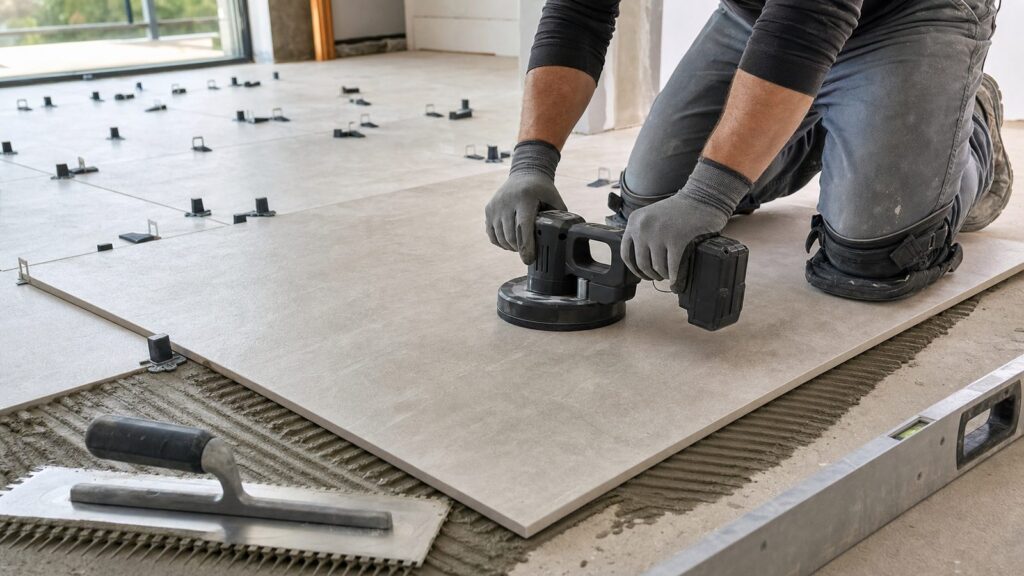
A good tile vibration tool is worth considering when tile gets large, heavy, dense, or expensive enough that hand beating becomes inconsistent. For a small ceramic backsplash, it is usually overkill. For 24 x 48 in. porcelain, shower walls, rectified floor tile, natural stone, or gauged porcelain panels, it can help collapse mortar ridges, push trapped air out, and improve bedding before the mortar skins over.
The best tile vibration tool is not simply the one with the highest RPM or strongest suction cup. On our job sites, the most useful models have controlled variable speed, a reliable vacuum suction cup, a comfortable handle, replaceable pads, good parts availability in the United States, and enough battery runtime to keep pace with the setter. The tool should help the tile settle into the mortar bed without dragging layout lines, forcing mortar into joints, or sinking one edge below the next tile.
As an Amazon Associate I earn from qualifying purchases.
For most homeowners and remodelers, a solid midrange cordless vibration tile beater in the $150 to $300 range is the practical sweet spot. Budget tools around $60 to $150 can work for occasional DIY use if the suction cup holds and the speed control is predictable. Premium slab and panel systems can run $300 to $700 or more, especially when batteries, chargers, anti-friction plates, rails, or handling frames are sold separately.
What a Tile Vibration Tool Actually Does
A tile vibration tool is a handheld vibrating beater, usually built around a vacuum suction cup and a motorized vibration head. After the tile is placed into fresh mortar, the installer uses controlled vibration to help collapse the trowel ridges underneath the tile. The goal is better mortar contact, fewer air pockets, and more consistent support under the tile face, edges, and corners.
Popular on Amazon

- ELIMINATE HOLLOW SPOTS AND UNEVEN BEDDING — This tile vibrating tool applies controlled vibration and pressure to help tiles settle evenly into mortar. Used as a tile vibrator, it reduces air pockets and supports uniform bedding, making it an effective large tile leveling tool for floor and wall installations.
- SECURE GRIP FOR LARGE AND HEAVY TILES — This tile leveling vibrator uses a 5.7″(145 mm) suction cup rated to hold up to 110 lbs to stabilize tiles from 8″ to 48″. Acting as a powerful tile suction cup vibrator, it supports precise placement as a reliable wall tile vibrator.
- PRECISE CONTROL AT ANY ANGLE — Designed for flexible positioning, this professional tile vibrator works as both a wall and floor tile vibrator, delivering controlled vibration for horizontal, vertical, and corner installs. Its cordless design ensures accurate handling as a dependable cordless tile vibrator.
- ONE TOOL FOR MANY TILE JOBS — Designed to handle a range of tile materials, this tile vibrator with battery supports ceramic, marble, porcelain, and stone installs. As a powerful 20V tile vibration tool, it performs reliably as a cordless tile vibration tool across floors and walls.
- READY TO WORK WITH BATTERIES INCLUDED — This tile vibration tool with batteries includes two 20V battery packs, so you can work without interruptions. Designed as a Makita compatible tile vibration tool, it features a clear digital display and 9 precisely calibrated vibration levels for controlled tile leveling, delivering reliable one-hand control as a versatile tile lifter vibration tool.
That sounds simple, but the value is real on today’s tile. Porcelain is dense. Rectified tile has tighter sizing and sharper edges. Large-format tile spans more substrate variation. Gauged porcelain tile panels and slabs are thin, wide, and less forgiving. A 12 x 12 in. ceramic tile can often be bedded well with a beating block and grout float. A 24 x 48 in. porcelain tile has four times the area, more leverage, and more opportunity for hollow spots if the mortar ridges do not fully collapse.
Industry coverage expectations are not casual suggestions. For ceramic and porcelain tile, installers commonly work to at least 80 percent mortar contact in dry interior areas and 95 percent in wet, exterior, and shower areas, with full support at edges and corners. Natural stone is even less forgiving: the Ceramic Tile Education Foundation guidance calls for 95 percent coverage in dry and wet areas, no voids larger than 2 sq. in., no voids within 2 in. of corners, and fully supported corners and edges.
Free tools Windows power users keep installed
One-click scans. No signup required.
A vibration tool helps with that coverage target, but it does not create a professional installation by itself. The mortar still has to be mixed correctly. The notch has to be right. The ridges need to be combed in one direction. The tile has to be moved perpendicular to those ridges. The substrate has to be flat enough before setting starts. If those basics are wrong, vibration can simply make the problem more visible.
Best Use Cases for a Tile Vibration Tool
The clearest use case is large-format tile. In residential remodeling, that often means 12 x 24 in., 24 x 24 in., 24 x 48 in., and larger porcelain tile. In custom bathrooms, we also see vibration tools used on shower walls, curbless shower floors with large cuts, bench faces, fireplace surrounds, and feature walls where tight grout joints make lippage easy to see.
They are also useful with dense porcelain because porcelain does not absorb moisture like softer ceramic tile. Mortar transfer depends heavily on mechanical contact. Vibration helps encourage that contact while the mortar is still workable.
Natural stone is another good candidate, especially larger marble, limestone, quartzite, and travertine pieces. Stone can crack if it is beaten too aggressively with a block or mallet. A variable-speed vibration tool lets the installer use a gentler, more controlled motion. That said, some stone is resin-backed, moisture-sensitive, or prone to staining, so the setting material still needs to match the stone manufacturer’s requirements.
Gauged porcelain tile panels and slabs are where the tool moves from nice-to-have to part of a serious installation system. ANSI A137.3 defines gauged porcelain tile panels and slabs as tile panels or slabs one square meter or larger in facial area. ANSI A108.19 and A108.20 cover installation requirements for interior and exterior or overhead applications. These panels are not just big tile; they require planning, qualified labor, appropriate mortar, proper troweling, handling frames, suction cups, and documented coverage checks.
What to Compare Before Buying
Do not buy a tile vibration tool based only on a product photo and a big suction rating. Many online listings make the tools look similar, but job-site performance comes down to control, grip, durability, and support.
Variable Speed Control
Variable speed matters more than maximum vibration. Lower settings are useful near edges, corners, glass tile, fragile stone, cutouts, and shower niches. Higher settings can help on large floor tile when the mortar bed is fresh and the tile needs help settling. The right setting is the lowest setting that achieves ridge collapse without moving the tile out of alignment.
Over-vibrating is a real mistake. It can make mortar migrate into grout joints, cause a tile to settle below an adjacent piece, or shift a layout line that was already correct. On our crews, vibration is a controlled bedding step, not a way to drag tile across the floor.
Also popular on Amazon

- SEESII Suction Cups for Glass Lifting: Tile Suction Cup Lifter with Handle and Pump, 200KG Load Capacity Heavy Duty Vacuum Lifter for Lifting Large Tile, Granite, Metal, Windows
- 【Why Choose the SEESII Combo Kit? 】:Compared to traditional manual methods, this tile suction cup lifter vibrating tool kit enables you to lift, position, and level tiles effortlessly with strong suction and vibration. Save time, reduce fatigue, and achieve consistently flat, professional results with less rework
- 【Dual Suction Power for Zero Slip & Full Control】:The tile vibrator features a 220 lb (100KG) suction base for stable vibration, while the 8-inch glass suction cup delivers 450 lb (200KG) lifting power for safe handling of heavy tiles. No shifting, no slipping—just perfect placement every time
- 【Designed for Real Tile Jobs & Large Formats】:These tile suction tools work on smooth, non-porous surfaces like porcelain, ceramic, marble, granite, glass, and metal. Handles 12"–48" large-format tiles with ease. (Not recommended for rough or porous surfaces.)
- 【10-Speed Precision Vibration for Any Tile Type】:With 10 adjustable vibration levels, this tile leveling system adapts to every project—from delicate mosaics to large porcelain and stone tiles. Dial at perfect speed for smooth control, better adhesion, and consistent results on walls or floors
Suction Capacity and Cup Size
Most tile vibration tools use a vacuum suction cup to hold the tile face. This is useful for positioning and bedding, but it is not a substitute for a slab handling frame or separate rated suction cups when moving large panels. A tool may claim strong suction in ideal conditions, but real tile can be dusty, textured, wet, or structured.
For smooth porcelain and polished stone, a clean suction pad usually grips well. For textured pavers, heavily structured tile, matte surfaces with dust, or wet tile faces, the grip may be weaker. Before relying on the tool, test suction on the actual tile. Keep the pad clean and inspect it for nicks. Loss of suction while carrying or positioning tile can break tile and injure hands or feet.
Battery Platform and Runtime
Cordless tools are more convenient on occupied remodels, multi-room floors, and shower walls. The best choice is often the one that works with batteries your crew already owns, provided the tool quality is acceptable. A tile setter should not be waiting for a proprietary battery to charge while mortar is mixed and ready.
For DIY users, a tool bundled with one battery and charger can make sense. For contractors, check whether extra batteries are readily available and whether the charger is job-site durable. If the tool uses a common battery platform, that can be worth more than a small difference in vibration speed.
Windows Errors? Fix Them Before They Spread
Repair common Windows errors and clear accumulated junk for a smoother, more stable PC - no reinstall needed.Free scan · no reinstallOutdated Drivers Are Slowing You Down
One free scan finds every outdated or missing driver and matches the right update for your exact hardware.Free scan · exact hardware matchWeight and Ergonomics
A heavy tool may feel fine for three tiles in a showroom. It feels different after a full day of shower walls or a 600 sq. ft. floor. Look for a handle that lets you keep your wrist neutral, a trigger or speed control that is easy to operate with gloves, and a head shape that lets you work near walls and inside corners.
For floors, weight can help the tool do some of the work. For walls, too much weight becomes tiring fast. If you mostly install shower walls, fireplace surrounds, or vertical panels, prioritize balance and grip over brute force.
Parts and Accessories
Replaceable suction pads, anti-friction plates, chargers, and batteries matter. Contractor-oriented tile suppliers typically carry higher-priced BIHUI- or RUBI-style tools and accessories with better parts support than anonymous marketplace imports. As a 2026 price reference, Tile ProSource listed BIHUI vibration tile beaters at about $189.95 and $259.95, with anti-friction plates around $26.03. That is a useful snapshot of the name-brand handheld contractor range.
Tile Vibration Tool Cost in 2026
Most buyers should think in three price bands. The low end is acceptable for limited DIY work, the midrange is where many remodelers and tile contractors land, and the premium range is for large-format production work, slab handling, and panel installations.
| Tool category | Typical 2026 cost | Best fit | Watch for |
|---|---|---|---|
| Budget cordless vibration tools | $60-$150 | DIY floors, occasional large-format tile, small remodels | Weak suction, poor speed control, limited parts, short battery life |
| Midrange contractor tools | $150-$300 | Professional bathroom remodels, 12 x 24 in. to 24 x 48 in. tile, dense porcelain | Battery compatibility, pad replacement cost, warranty support |
| Premium slab and panel systems | $300-$700+ | Gauged porcelain panels, commercial work, high-liability installations | Batteries and accessories may be separate; handling gear is still needed |
Compared with the total cost of a tile project, the tool itself is usually a small line item. Homewyse’s May 2026 national estimate starts around $16.38 to $20.21 per sq. ft. for tile floor installation. Home Depot sample installed cost components show about $1.37 per sq. ft. for setting materials and $6.50 per sq. ft. for installation. RUBI’s 2026 guide places tile labor in a broad range of roughly $5 to $22 per sq. ft.
Those ranges move quickly once real job conditions are included. Demolition, subfloor repair, flattening, waterproofing, crack-isolation membranes, large-format tile, gauged panels, rectified edges, diagonal or herringbone patterns, tight grout joints, natural stone, stairs, niches, curbless showers, epoxy grout, occupied-space protection, and commercial schedule constraints can all raise the price.
A vibration tool does not make a cheap installation expensive. It is more accurate to say it reduces risk on work where failure is already expensive. Replacing hollow 24 x 48 in. porcelain in a finished bathroom costs far more than buying or renting the right tool up front.
Also popular on Amazon

- Pro-Level performance, built for large tiles — tackle oversized tile installs with confidence using this complete set! The heavy-duty suction cup lifter grips tight, while the tile tiling machine delivers flawless vibration. Together, they’re the ultimate tile vibrating tool combo for smooth lifts and precise placement.
- Maximum grip, endless possibilities — take on any job with total confidence using our pro-grade suction vibrating tools. The 5.7″ tile suction tool offers up to 110 lbs of holding power for secure floor and wall installations, while the 8″ suction tool cup delivers a massive 330 lbs of grip, perfect for maneuvering large tiles or glass with ease and precision
- Innovative multi-angle precision — this advanced tile vibration machine is built for precision at every angle. Use it as a floor suction cup tile placer for horizontal tile work, or vertically to level tricky corners with ease. Its flat-handle design with rubber end lets you vibrate and level tiles to perfect 90° corners.
- One neat combo — this tile suction cup vibrating tool set handles it all: tile leveling, marble, ceramic, paver installation, concrete bubble removal, even glass handling! It’s the most versatile floor suction cup tool set for pros using suction cups for tile work and beyond.
- READY TO WORK WITH BATTERIES INCLUDED — This tile vibration tool with batteries includes two 20V battery packs, so you can work without interruptions. Designed as a Makita compatible tile vibration tool, it features a clear digital display and 9 precisely calibrated vibration levels for controlled tile leveling, delivering reliable one-hand control as a versatile tile lifter vibration tool.
How Pros Use a Tile Vibration Tool
The best results start before the tool turns on. On our job sites, we check substrate flatness with a long straightedge before setting begins. Large tile exaggerates dips and crowns. If the floor or wall is not flat enough, patching or self-leveling work is often the real productivity gain.
Quick wins for a faster PC:
Scan for outdated or missing drivers - takes under a minuteDriver Scan →Clear out junk files and repair common Windows errorsFree Scan →Once the substrate is ready, mortar selection comes next. Large-and-heavy-tile mortar is often the right choice for large porcelain because it helps control slump while still supporting the tile. For panels, we follow the tile and mortar manufacturer’s data sheets and the applicable TCNA and ANSI method. In showers, waterproofing cure time and membrane compatibility are part of the job file, not an afterthought.
Troweling technique is critical. Comb the mortar in straight, parallel ridges in one direction. Avoid swirl troweling. Swirls trap air and make it harder to collapse the ridges. After placing the tile, move it perpendicular to the ridges to help push air out. Then use the vibration tool in controlled passes across the tile face.
The first few tiles should be pulled and checked. This is the step homeowners rarely see but good installers rely on. If coverage is short, change the notch size, trowel angle, mortar consistency, back-buttering method, or bedding technique. Keep checking periodically when tile size, substrate, mortar, installer, or conditions change.
Practical Setup Sequence
For a typical large-format floor tile, the sequence looks like this: confirm layout, clean the substrate, key mortar into the surface with the flat side of the trowel, comb fresh mortar in one direction, back-butter the tile if needed, place the tile, move it perpendicular to the ridges, install leveling clips or spacers, vibrate with controlled pressure, clean the joints, and verify plane before the mortar firms up.
Recommended Free Tools
For shower walls, we use a more cautious hand. Walls add gravity, waterproofing layers, penetrations, shelves, niches, and finished edges. The vibration setting should be low enough that it does not make the tile slump or disturb waterproofing transitions. A ledger board, spacers, wedges, and leveling clips still do the alignment work. The vibrator helps bedding; it does not hold tile in place.
What a Tile Vibrator Will Not Fix
A tile vibrator is a bedding aid, not a magic correction tool. It will not make an out-of-plane substrate flat. It will not compensate for mortar that has skinned over. It will not turn the wrong thin-set into the right product. It will not replace back-buttering where coverage checks show it is needed.
It also does not replace a leveling system. Leveling clips and wedges help align tile edges while mortar cures. They reduce lippage, but they do not create mortar coverage. A vibration tool improves bedding, but it does not force two poorly supported tile edges into a durable installation. For rectified large-format porcelain, use both tools as part of a system: flat substrate, correct mortar, directional troweling, proper movement joints, leveling clips, vibration, and verification.
Movement joints deserve specific mention. Large tile fields still move with temperature, moisture, building movement, and substrate behavior. Caulked changes of plane, perimeter movement accommodation, and field movement joints are not optional details on high-quality work. A perfectly bedded tile can still fail if the assembly has no room to move.
What’s actually slowing this PC down?
Pick the symptom - the matching free tool is one click away.
Common Mistakes to Avoid
The most common mistake is buying the biggest, fastest tool and assuming it will solve preparation problems. If a floor has a 1/4 in. crown in the wrong place, the vibration tool may make the tile settle unevenly and make lippage worse. Flatten first.
Also popular on Amazon

- 【Compatible with Milwuke 18V Battery】This tile leveling system works with Milwuke 18V max lithium batteries (models 48-11-1811, 48-11-1815, 48-11-1820, 48-11-1822, 48-11-1828, 48-11-1840 , 48-11-1841, 48-11-1850 etc.). Note:Without Battery
- 【8 Adjustable Speed Settings】The handheld tile leveling machine features 8 speed settings, with a maximum vibration frequency of 25,000 rpm. You can easily adjust the speed based on the tile size and mortar thickness. Simply press “+” or “-” to change the speed.
- 【Strong 110LBS Suction】Equipped with a 5.12-inch thickened suction cup, this DEWALT vibrating tool delivers powerful suction up to 50 kg (110 lbs). It works on wall or floor tiles up to 120 x 120 cm (47.2 x 47.2 inches) and supports one-handed operation.
- 【Thoughtful Design】With the locking button, the suction cup easily secures tiles and keeps the handle lifted, freeing your hands. The smart display shows the vibration level, making it quick and easy to level tiles on floors and walls. This reduces manual effort and helps complete projects faster.
- 【High-Quality Material】The tile leveling machine features an aluminum alloy head for high hardness and strong load-bearing capacity. The suction pad is made of durable, odorless, high-strength rubber, offering excellent wear resistance and long service life.
Another mistake is using the tool on tile that does not need it. Small ceramic tile, mosaics, and many backsplashes are often faster and cleaner with a grout float, beating block, or light hand pressure. Too much vibration on small tile can disturb spacing and bring mortar up through joints.
Open time is another trap. If mortar has skinned over, vibration cannot restore bond. Mortar should still transfer to the back of the tile when it is placed. If it does not, remove it and apply fresh mortar.
Suction misuse is also common. Do not trust a suction cup on a dusty, textured, wet, or heavily structured surface until it has been tested. Clean the tile face and the pad. Inspect the pad. Use separate rated suction cups or a handling frame for large panels. A vibration tool is not a safe substitute for panel handling equipment.
The Tool Desk
Outbyte PC Repair FREERepair Windows errors before they cause bigger problemsFix Now →Outbyte Driver Updater FREEScan for outdated or missing drivers - takes under a minuteDriver Scan →DIY or Hire a Pro?
A capable DIYer can use a tile vibration tool successfully on a straightforward floor if the layout is simple, the substrate is sound, and the tile is not unusually large. A 100 to 200 sq. ft. laundry room or basement area with 12 x 24 in. porcelain may be reasonable for a homeowner who is patient, owns the right saw, and is willing to pull tiles to verify coverage.
For one small backsplash, buying a vibration tool usually does not pencil out. Use a quality trowel, the correct mortar, spacers, and a beating block or grout float. Spend the money on layout, cutting accuracy, and cleanup.
Hiring a pro is the better call for 24 x 48 in. tile, gauged porcelain panels, curbless showers, steam showers, exterior tile, occupied commercial spaces, stairs, natural stone, tight grout joints, and any installation where a failure would be expensive to open back up. These projects require more than the tool. They require substrate prep, waterproofing, movement planning, dust control, cutting equipment, and someone who knows when the mortar coverage is not good enough.
Ask a contractor direct questions. What TCNA or ANSI method are they using? What mortar is specified? How will they verify coverage? How flat does the substrate need to be before setting? What waterproofing system is being used in the shower, and what cure times apply? A serious installer will not be bothered by those questions.
Do these 3 things before closing this tab:
1Clear out junk files and repair common Windows errors2Fix the driver behind crashes, sound loss and screen glitches3Repair Windows errors before they cause bigger problemsSafety, Dust, and Code Notes
Tile work has real safety concerns. Cutting porcelain, stone, backer board, and concrete products can expose workers to respirable crystalline silica. OSHA’s construction silica standard, 29 CFR 1926.1153, requires exposure controls for covered work. On professional projects, that means using compliant methods such as wet cutting, shrouded grinders with HEPA dust extraction where applicable, respiratory protection when required, housekeeping controls, and a written exposure control plan when the standard applies.
For homeowners, the practical message is simple: do not dry-cut tile or cement board in an enclosed garage or kitchen and breathe the dust. Use wet cutting where practical, isolate the work area, use proper dust collection, and wear appropriate PPE. Safety glasses, hearing protection, gloves, knee protection, and suitable footwear are basic equipment, not optional extras.
Wet areas add another layer. Tile and grout are not waterproofing. Showers and tub surrounds need approved backer materials, waterproofing membranes or systems, properly treated seams and penetrations, and code-compliant wall construction. The 2021 IRC includes requirements for water-resistant gypsum backing board limitations in shower and tub compartments, and industry guidance continues to reinforce that tile backer and waterproofing choices matter. A tile vibration tool should never be used as a shortcut around wet-area assembly requirements.
Also popular on Amazon

- 【Compatible with Dwalt 20V Battery】This tile vibrating machine compatible with dwalt 20V Battery. Note: Battery not included
- 【8 Speeds Adjustable Tile Vibrator 】Handheld tile tiler has 8 gears of frequency to adjust. The maximum vibration frequency can reach 25000r/min. Quickly settles tiles into the adhesive ensuring a good, secure installation. The speeds range from a sedate 1 upto a very aggressive 8. Press “+” or “-” to change the speed
- 【110LBS Super Adsorption Capacity】The thickened suction cup has a diameter of 5.12 inches, and the maximum adsorption force can up to 50KG / 110LB which is applicable for tiles in sizes up to 47.2*47.2 inch. Support one-handed operationeasy to paste tiles which greatly improving the efficiency of the work.
- 【LCD Display & Lock Button】The lock button makes the tile vibrator suction easy, it keeps the suction cup handle lifted and free your hand. The back-lit LCD screen shows the vibration level. The particular shape of the double handle keeps the load balanced while lifting and laying tile.
- 【Durable Material】The Tile Vibration Leveling Machine adopts aluminum alloy head structure, which has high hardness, strong bearing capacity. The suction cup pad is made with durable, odorless, extra strength rubber. Strong wear resistance and good durability.
Permits depend on location and scope. Replacing tile on an existing floor may not require a permit. Moving drains, altering shower pans, changing structural framing, adding electrical floor heat, or rebuilding a bathroom often can. Check with the local building department before demolition, especially in condos, multifamily buildings, and commercial spaces.
Our Bottom-Line Buying Advice
For most serious tile work, choose a variable-speed cordless tile vibration tool with a dependable vacuum suction cup, comfortable handle, replaceable suction pads, and parts support from a tile-focused supplier. If you are setting occasional large-format tile, a $150 to $300 contractor-grade model is usually the right balance. If you are setting gauged porcelain panels or commercial large-format tile regularly, budget for the tool as part of a broader panel system, not as a standalone purchase.
Do not overspend on vibration power while underinvesting in substrate prep. A straightedge, laser, proper trowels, large-and-heavy-tile mortar, leveling clips, suction cups, a good saw, and dust control will often affect the finished installation more than the tool brand. The vibrator earns its keep when all those basics are already handled.
The best tile vibration tool is the one that helps the installer reach the required coverage without disturbing layout. Used correctly, it makes large-format tile work more predictable, reduces hollow spots, and lowers rework risk. Used as a substitute for prep or skill, it can hide problems only until the floor is walked on, the shower is used, or the punch list starts.
Frequently Asked Questions
Is a tile vibration tool worth it for large-format tile?
Yes, it is often worth it for 12 x 24 in. tile and larger, and especially for 24 x 48 in. porcelain, dense tile, stone, shower walls, and gauged porcelain panels. It helps collapse mortar ridges and improve bedding, but it still depends on flat substrate prep, correct mortar, directional troweling, and coverage checks.
What’s actually slowing this PC down?
Pick the symptom - the matching free tool is one click away.
Do tile vibration tools prevent lippage?
They can help reduce lippage by improving how evenly the tile settles into the mortar bed, but they do not replace a leveling system. For rectified large-format tile, use substrate flattening, proper mortar, leveling clips or wedges, movement joints, and controlled vibration together.
How much does a good tile vibration tool cost in 2026?
Budget models commonly cost about $60 to $150, midrange contractor tools run about $150 to $300, and premium slab or panel-focused systems can cost $300 to $700 or more. For most remodelers and serious DIYers, the $150 to $300 range is the practical target.
Can a tile vibrator replace back-buttering?
No. Back-buttering is still needed when coverage checks show that the tile is not getting proper mortar contact. A vibration tool helps collapse ridges, but it does not replace the right trowel notch, mortar selection, directional troweling, or periodic tile pulls.
Can you use a tile vibration tool on shower walls?
Yes, but use controlled lower settings and make sure the wall assembly is properly waterproofed and cured. Shower areas typically require very high mortar coverage, commonly 95 percent, with full support at edges and corners. The tool helps bedding but does not replace waterproofing or layout control.
Quick wins for a faster PC:
Scan for outdated or missing drivers - takes under a minuteDriver Scan →Clear out junk files and repair common Windows errorsFree Scan →Fix the driver behind crashes, sound loss and screen glitchesFind Drivers →Can vibrating tile too much weaken the mortar bond?
Over-vibration can cause problems. It may push mortar into joints, shift tile out of alignment, make tile settle unevenly, or disturb a mortar bed that is already losing workability. Use only enough vibration to achieve coverage, then stop and verify the tile plane.
Quick Recap
Product prices and availability are accurate as of the date/time indicated and are subject to change. Any price and availability information displayed on Amazon at the time of purchase will apply.

