Recommended Free Tools
The best smart air conditioner depends first on the installation, then on the app. For most rooms with a suitable double-hung window, a Midea U-shaped Smart Inverter model is the strongest overall type to consider. LG Dual Inverter Smart Wi‐Fi units are compelling when quiet bedroom operation is the priority. If a window unit is not permitted or cannot fit, choose a dual-hose or inverter portable AC such as the Midea Duo Smart Inverter line or a Dreo 740S-class model.
This U.S.-focused guide separates window, U-shaped, portable, casement and through-the-wall ACs, because their efficiency, noise, BTU ratings and installation requirements are not directly comparable. Model numbers, ENERGY STAR records, app capabilities and prices can change, so verify the exact unit before buying.
As an Amazon Associate I earn from qualifying purchases.
Best smart air conditioners at a glance
| Award | Recommended type or candidate | Best for | Main qualification |
|---|---|---|---|
| Best overall window AC | Midea U-shaped Smart Inverter series | Efficient, quieter window cooling with app control | Confirm the exact model’s window dimensions, drainage, certification and smart-home support. |
| Best quiet smart AC | LG Dual Inverter Smart Wi‐Fi series | Bedrooms and noise-sensitive rooms | Noise figures vary by model and operating mode. |
| Best efficiency focus | An ENERGY STAR-certified connected inverter model | Lower operating cost | Compare the exact model’s CEER and annual kWh, not just its brand. |
| Best portable option | Midea Duo Smart Inverter or Dreo 740S-class portable | Renters, casement windows and restricted installations | Portable units generally lose efficiency and floor space compared with window ACs. |
| Best large-room category | 12,000–14,000 BTU inverter window AC | Large rooms with suitable windows | One unit may not cool an open-plan or multi-room layout evenly. |
| Best budget category | 6,000–8,000 BTU smart window AC | Small bedrooms and apartments | A cheaper non-inverter model may cost more to run and may be louder. |
The shortlist reflects the stated criteria in this guide—capacity, efficiency, noise, smart features, installation and ownership value—not an objective universal ranking. Current connected room-AC listings include models from Midea, GE Profile, LG, GREE and other manufacturers in the ENERGY STAR product finder.
What counts as a smart air conditioner?
“Smart” can describe several different capabilities:
#1 Best Overall
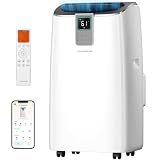
- [COOL THE HEAT, NOT YOUR BILLS] Summer electric bills shouldn't make you sweat twice. This 14,000 BTU portable AC runs a dual motor compressor with 400 CFM airflow, cooling rooms up to 750 square feet — your bedroom, living room, kitchen, dorm, or home gym. At just 2 kWh per day with a 7.8 CEER rating, it delivers serious cooling power without the post-summer bill shock.
- [WHISPER AT 41 DB — YOU WON'T HEAR IT] Most portable air conditioners sound like a constant conversation in your room. This one doesn't. At 41 decibels in Silent Mode, it's quieter than a library whisper (45 dB). Sleep Mode dims every light — including a display you can turn completely off — drops the fan, and holds your set temperature all night. Set the 24-hour timer and wake up because you're rested, not because your AC woke you.
- [SMART COOLING, FROM ANYWHERE] Start cooling before you walk through the door. Connect to the TEMPRIUM App and your portable AC is ready from your phone — whether you're on the couch or heading home from work. Alexa and Google Assistant give you hands-free voice control. Prefer buttons? Grab the remote or tap the LED touch panel. Four ways to control, zero reasons to get up.
- [4-IN-1 COMFORT FOR EVERY SEASON] Cool on summer afternoons. Dry on humid nights. Fan on breezy days. Dehumidify when sticky air moves in. Then fine-tune with Turbo when you need fast relief, Silent for bedtime, Auto for set-it-and-forget-it, and Auto-Swing to spread airflow evenly across the whole room. This isn't just a portable AC — it's your year-round comfort system.
- [SELF-EVAPORATING SYSTEM — NO DAILY DRAINING] Enjoy cooler air with less maintenance. The built-in self-evaporating system helps recycle collected moisture during operation, reducing the need for frequent manual draining in most cooling conditions. No daily bucket emptying, no messy routine — just steady comfort with washable filters that pop out easily for a quick rinse.
- Remote control: An infrared or physical remote, with no internet connection.
- Wi‐Fi control: An app can send commands through the home network and, usually, the manufacturer’s cloud service.
- Scheduling: Timers or recurring schedules. Some apps also offer geofencing or away modes.
- Voice control: Alexa, Google Home, Siri Shortcuts or another assistant. Supported commands may be limited to power, temperature and mode.
- Energy management: Connected ENERGY STAR room ACs include hardware and software that can respond to consumer-authorized energy-related commands; an app alone does not necessarily provide this capability. See ENERGY STAR’s connected-product requirements.
- Matter: A cross-platform standard, but only useful when the exact model and its implementation support it.
- Local control: Commands continue to work within the home or through a local integration if the vendor’s cloud is unavailable.
Do not rely on a retailer’s generic “Wi‐Fi enabled” label. Check the exact model’s current manufacturer support page or manual for supported Wi‐Fi bands, assistants, Matter, account requirements and offline behavior.
Best overall smart window AC: Midea U-shaped Smart Inverter
A Midea U-shaped Smart Inverter model is the best overall candidate when the window and sill can safely accommodate it. Its saddle design places the window sash through a channel in the unit, leaving much of the compressor and condenser outside. That can reduce indoor noise, preserve more of the view and improve the installation’s visual profile compared with a conventional box-style window AC.
Inverter operation is another advantage: the compressor can vary its speed instead of repeatedly switching fully on and off. That may improve part-load comfort, reduce cycling and support efficient operation, although “inverter” by itself does not guarantee the lowest energy use.
Windows Errors? Fix Them Before They Spread
Repair common Windows errors and clear accumulated junk for a smoother, more stable PC - no reinstall needed.Free scan · no reinstallOutdated Drivers Are Slowing You Down
One free scan finds every outdated or missing driver and matches the right update for your exact hardware.Free scan · exact hardware matchChoose it if: you have a compatible, structurally sound double-hung window; want a premium window design; and value efficiency and quieter operation.
Do not choose it if: the window has a storm window, deep exterior ledge, unusual sash track or weak sill; you cannot install the supplied support hardware; or your landlord prohibits this type of installation.
Before purchasing, verify the exact model number, support bracket requirements, minimum and maximum window dimensions, drainage instructions, ENERGY STAR record and current app or voice-assistant compatibility. The manufacturer’s Midea product page is a starting point, not proof that every 2026 model has identical specifications.
Best quiet smart AC: LG Dual Inverter Smart Wi‐Fi
LG’s Dual Inverter Smart Wi‐Fi window-AC lineup is a strong bedroom choice because variable-speed operation can avoid some of the abrupt compressor cycling associated with basic fixed-speed units. LG also offers a broad range of smart window models, including a 12,000 BTU Smart Wi‐Fi example, model LW1217ERSM1, which LG lists for up to 550 square feet and includes an Energy Saver function. See the official LG specifications.
What’s actually slowing this PC down?
Pick the symptom - the matching free tool is one click away.
Do not treat a single published decibel figure as a universal ranking. Manufacturers may measure at different fan settings, and a low-speed number may not represent normal cooling. Listen for compressor cycling, airflow, rattling and vibration. A perfectly quiet compressor will still be disruptive if the sash, side panels or bracket vibrate.
For a bedroom, prioritize the exact model’s indoor noise rating, low-speed or sleep mode, display-dimming controls, notification settings and user reports about vibration. Confirm that the selected capacity suits the room rather than buying a larger unit solely because it appears more powerful.
Best energy-efficient smart AC
The best efficiency choice is an ENERGY STAR-certified connected inverter model with a favorable CEER and annual energy-use estimate. ENERGY STAR says certified room ACs are at least 19%–36% more efficient than applicable federal minimum standards, depending on category and capacity. The active room-air-conditioner specification is identified as Version 5.0, effective October 30, 2023; draft Version 6.0 and Version 7.0 materials should not be treated as active consumer standards without confirmation on the current certification page.
Compare these figures for the exact model:
- CEER: Combined Energy Efficiency Ratio, including applicable standby or off-mode energy.
- EER: Cooling output divided by electrical input under a specified test condition.
- Annual kWh: A standardized estimate, not a promise about your electricity bill.
- Compressor type: Variable-speed operation can help at part load, but the rating still matters more than the marketing term.
ENERGY STAR’s criteria and tables use different thresholds according to capacity, louver configuration, reverse-cycle capability and casement design. A connected Midea, GE Profile or LG listing with a higher CEER is not automatically comparable with a portable or differently configured unit.
To estimate running cost, multiply the unit’s annual kWh estimate by your electricity rate. Treat the result as a comparison tool: climate, insulation, thermostat setting, runtime and local rates can change actual costs substantially.
Best portable smart AC: dual-hose or inverter models
Choose a portable AC when a window unit is forbidden, unsafe or impossible to fit. Midea Duo Smart Inverter models and Dreo 740S-class units are the kinds of premium portable systems worth considering because dual-hose or inverter designs address some weaknesses of basic single-hose portables.
A portable unit remains a compromise. It occupies floor space, creates hose and panel-sealing problems, and is usually noisier indoors because the compressor stays in the room. A single-hose model can depressurize the room and draw warm outdoor air through gaps. Dual-hose designs can reduce that problem, but they still require careful installation.
Portable BTU ratings also require caution. DOE and ASHRAE ratings may be presented differently, and portable and window-unit numbers should not be ranked as though they used identical tests. Compare the correct rating, airflow, hose design, drainage requirements, noise specification and room conditions.
Free tools Windows power users keep installed
One-click scans. No signup required.
Choose portable if: you rent, have a casement or irregular window, need to move the unit, or cannot safely hang an appliance outside.
Choose a window unit instead if: you have a suitable opening and your priorities are efficiency, lower indoor noise, smaller floor footprint and stronger cooling value.
Best smart AC for large rooms
For a large enclosed room, look at smart inverter window units in the 12,000–14,000 BTU range from brands such as LG, Midea, GE Profile or Frigidaire. Select the capacity only after considering ceiling height, sun exposure, insulation, occupants, kitchen heat and climate.
A manufacturer’s square-footage claim is a useful starting point, not a guarantee. An open-plan living area may have a much larger heat load than a closed room of the same area. One window unit may cool the area near the window while leaving distant spaces warm. Zoning, multiple units, a mini-split or central AC may be more appropriate than one oversized room AC.
Quick wins for a faster PC:
Scan for outdated or missing drivers - takes under a minuteDriver Scan →Repair Windows errors before they cause bigger problemsFix Now →Fix the driver behind crashes, sound loss and screen glitchesFind Drivers →Rank #2

- [ENERGY SAVING] Della UL Listed rated 6000 BTU 115V/60Hz window ac unit conditioner has a Combined Energy Efficiency Rate (CEER) of 11.0 which helps reduce the energy costs to save you money throughout the year and helping to protect our climate.
- [QUIET OPERATION] The sound levels as low as 51 dB of this window unit allows the fan to cooling your space at a whisper-soft volume without disturbing your surroundings. Whether you're watching your favorite series, reading a good book, or sleep this unit promotes better relaxation.
- [EFFICIENT COOLING] Cooling Coverage up to 250 Square feet, Ideal for cooling small rooms with 6,000 BTU window air conditioner for living room, home office. Enjoy fast and comfort temperature control on hot summer days.
- [EASY TO INSTALL] the compact size is only 15.2"D x 15.98"W x 12.52"H inches, and the weight is only 38.6 lbs. There is no need to make major changes to the existing window frame. Suitable for windows from 23 to 34 inches, with a minimum height of 14.5 inches. Complete installation accessories are included in the package.
- [SMART DESIGN] This window AC unit includes a remote control and a user-friendly LED control panel, the temperature setting range is 61℉-88℉, 3 Fan speeds, Auto/Cool/Fan/Dry 4 modes, 24 hour timer, sleep mode, eco energy saving mode. Besides, with the redesigned Della+ app, you can control your device at anytime anywhere.
Oversizing can cool the air quickly but remove less humidity, causing short cycles and temperature swings. Undersizing can run continuously without reaching the desired temperature. The ENERGY STAR room-AC guidance is preferable to a simplistic BTU-per-square-foot rule.
Best budget smart AC
For a small bedroom, office or apartment room, a 6,000–8,000 BTU smart window AC from LG, Frigidaire, GE or Windmill may offer the lowest initial cost. The important budget question is not only the purchase price. Check whether the model has scheduling, usable remote control, filter reminders, voice support and a reasonable CEER.
Fixed-speed budget units can be worthwhile for occasional use, but they may be louder and less efficient than inverter models. A low purchase price also becomes a false saving if the unit is undersized and runs constantly, or if its app lacks the schedule that would prevent unnecessary operation.
Prices and promotions change quickly. Compare the exact model at the manufacturer and major retailers, and record the retailer and date if quoting a price.
Do these 3 things before closing this tab:
1Fix the driver behind crashes, sound loss and screen glitches2Repair Windows errors before they cause bigger problems3Scan for outdated or missing drivers - takes under a minuteBest smart AC for unusual windows
Casement windows
Most conventional horizontal window ACs are not suitable for casement windows. Use a dedicated casement model or a portable AC with a properly sealed vertical exhaust panel. Measure the opening angle and clear width, not just the window’s advertised size.
Sliding windows
Sliding windows usually require a vertical installation panel and may not accept a standard horizontal-window kit. Confirm the panel’s dimensions, sealing method and whether the unit’s weight can be supported safely.
Narrow or storm-window openings
A listed minimum width may assume a particular sash position and bracket configuration. Storm windows can interfere with the unit, drainage and exterior clearance. Do not force a model into an opening that does not match its manual.
Through-the-wall installation
A through-the-wall AC is designed for a permanent wall sleeve and is not automatically interchangeable with a window unit. The U.S. Department of Energy distinguishes room AC equipment by installation and testing requirements. Use the correct chassis, sleeve, venting and support system.
How to choose the right smart AC
- Decide whether a window installation is allowed and safe. Renters should check building rules. Heavy units require the supplied supports.
- Identify the window geometry. Measure width, height, sill depth, sash clearance, opening angle and exterior obstructions.
- Calculate the real cooling load. Account for room area, ceiling height, sunlight, insulation, occupants, appliances and open-plan connections.
- Set the comfort priority. For bedrooms, examine noise, vibration, sleep mode and display controls. For living rooms, prioritize capacity and airflow.
- Choose the smart ecosystem. Confirm exact-model support for Alexa, Google Home, Apple Home, Siri Shortcuts, Matter or third-party integrations.
- Compare efficiency correctly. Use CEER, EER and annual kWh within the same product category.
- Inspect ownership requirements. Check weight, filter access, drainage, seasonal removal, warranty and replacement-filter availability.
- Choose portable only when its installation advantages outweigh its efficiency and noise disadvantages.
How to audit an AC’s smart features
Before buying, look for answers to these questions in the exact model’s manual or support page:
- Does setup require 2.4-GHz Wi‐Fi, Bluetooth or location permission?
- Is an account required?
- Can the app change power, temperature, mode and fan speed remotely?
- Does it provide recurring schedules, vacation mode, filter reminders or energy monitoring?
- Can household members share access?
- Does the unit remain usable from its physical controls if the app or cloud fails?
- What happens after a router, Wi‐Fi password or firmware change?
- Are Alexa and Google commands limited to basic functions?
- Is Apple Home, Siri Shortcuts, Matter or local control explicitly documented?
A Wi‐Fi icon is not evidence of Matter or local control. Compatibility can also change with app and firmware updates, so preserve the manual and check the vendor’s current support documentation.
Installation and maintenance checklist
- Confirm the outlet voltage and circuit requirements. Do not use an extension cord or power strip unless the manufacturer expressly permits it.
- Install the supplied support bracket and hardware; do not rely on the window sash alone for a heavy unit.
- Seal side gaps and the window panel carefully. ENERGY STAR warns that poor room-AC installation can create substantial air leakage, comparable to an approximately 6-square-inch hole.
- Follow the manual’s drainage and tilt instructions. Do not assume every unit should be tilted outward by the same amount.
- Keep indoor intakes and outdoor coils unobstructed.
- For portable units, seal the exhaust panel and keep the hose as short and straight as practical.
- Clean the filter at the interval specified by the manufacturer and inspect coils and drainage channels.
- “Self-evaporative” does not mean that condensate will never require attention in very humid conditions.
- Remove or weather-protect seasonal window units when appropriate, and store portable hoses and panels without damaging seals.
Common problems and fixes
The AC will not connect to Wi‐Fi
Confirm the supported Wi‐Fi band, enable Bluetooth or location permission if setup requires it, place the phone and AC near the router, and follow the exact pairing-button sequence in the manual. A 5-GHz-only network or special router security setting may prevent setup.
The router or password changed
Most units need to be placed back into pairing mode and added to the app again. The physical remote and controls should remain available even when the network configuration is lost.
The unit goes offline
Check power, signal strength, router isolation settings and the manufacturer’s service status. Cloud dependence may prevent remote commands even though the AC is cooling normally.
Voice control works only partially
Some integrations expose power and temperature but not every fan or mode setting. Check the exact supported command list instead of assuming app parity.
Water appears indoors
Turn the unit off if water threatens the wall, sill or floor. Check tilt, seals, blocked drainage, filter condition and installation hardware against the manual. Do not continue unattended operation until the cause is corrected.
The coil freezes or the room stays humid
Inspect the filter and airflow, confirm the unit is not oversized for a small room, and follow the manufacturer’s service guidance. Persistent freezing, odor or biological growth may require professional cleaning or service.
The AC is too loud
Check for loose panels, bracket movement, sash vibration and uneven support. Compare noise at the selected fan speed, not only the lowest published figure.
Safety and unattended smart control
Remote start is convenient but not risk-free. Before operating an AC while away, confirm that the filter is clean, drainage is safe, the unit is securely supported, airflow is unobstructed and there are no unusual odors, leaks or error codes. A cloud command may fail, arrive late or leave the unit in its previous mode. Smart control should supplement—not replace—sound installation and maintenance.
Final verdict
Choose a Midea U-style inverter window AC when your window fits and you want the best balance of design, efficiency, noise and smart control. Choose an LG Dual Inverter Smart Wi‐Fi model when quiet operation and a broad window-AC range matter most. Choose a dual-hose or inverter portable AC when a window unit is prohibited or physically unsuitable. For any category, select the exact model by its measured fit, capacity, CEER, annual kWh and documented platform support—not by a generic “smart” badge.
Quick Recap
Product prices and availability are accurate as of the date/time indicated and are subject to change. Any price and availability information displayed on Amazon at the time of purchase will apply.
The Tool Desk
Outbyte Driver Updater FREEFix the driver behind crashes, sound loss and screen glitchesFind Drivers →Outbyte PC Repair FREEClear out junk files and repair common Windows errorsFree Scan →
