PC Slower Than It Used to Be?
A free scan shows the junk files, broken settings and background clutter dragging Windows down - then fixes them in one click.Free scan · Windows 10 & 11Crashes, No Sound, or Screen Glitches?
Random freezes, missing sound and display glitches usually trace back to one bad driver. Find and replace yours safely.Free scan · under a minuteSome links on this page are affiliate links: if you buy through them we may earn a commission, at no extra cost to you.
A good silicone turner should do three things well: slide under food cleanly, protect your cookware, and survive normal kitchen heat without warping, splitting, or holding odors. For most homeowners, the best setup is not one universal tool. It is a two-turner setup: one thin, flexible silicone turner for eggs, fish, crepes, and delicate nonstick work, plus one wider, stiffer silicone turner for burgers, pancakes, chicken cutlets, sheet-pan vegetables, and griddle cooking.
That is the short answer. The better answer is that a turner is part of the kitchen system. On our job sites, we see the same pattern in remodels: homeowners spend heavily on cabinets, counters, appliances, and tile, then end up with everyday cooking tools jammed in a shallow drawer across the room from the range. A $12 turner is inexpensive. A kitchen that stores it where your hand naturally reaches is what makes it useful.
As an Amazon Associate I earn from qualifying purchases.
Do these 3 things before closing this tab:
1Clear out junk files and repair common Windows errors2Scan for outdated or missing drivers - takes under a minute3Repair Windows errors before they cause bigger problemsThis guide covers the tool itself, the materials to look for, realistic 2026 costs, storage dimensions, safety claims, cleaning, and how to plan turner storage during a kitchen refresh or full remodel.
What Is a Silicone Turner?
A silicone turner is a flat cooking tool used to lift, flip, and transfer food. It is sometimes called a spatula, flipper, fish spatula, or pancake turner, but there are real differences. A turner is usually broad and flat, built for getting under food. A silicone spatula, in the scraper sense, is usually flexible and shaped for mixing, folding batter, scraping bowls, or spreading sauce.
Popular on Amazon

- Flexible head easily slides beneath delicate food
- Safe for non-stick cookware and bakeware
- Perfect for flipping burgers and eggs or transferring cookies
- Heat-resistant silicone bonded to durable, flexible stainless steel
- Soft, comfortable, non-slip handles
The reason silicone turners are so common in modern kitchens is simple: they are gentler on nonstick, ceramic, and enameled cookware than bare metal. A stainless turner can be excellent on cast iron, carbon steel, or a commercial griddle, but it can scratch coated pans. Silicone gives you a softer edge and a heat-resistant cooking surface that works well with the cookware most homeowners actually use every week.
The best silicone turners share a few traits: a thin leading edge, a reinforced core, a comfortable handle, food-contact-rated silicone, and construction that does not trap water or grease. The weak ones are too thick at the edge, too floppy in the head, too short at the handle, or built with seams that collect residue.
The Best Silicone Turner Setup for Most Homes
If you cook three or more times a week, buy two turners instead of chasing one perfect tool. A thin flexible turner and a stiffer wide turner cover almost every normal household cooking task.
1. Thin flexible silicone turner
This is the one for eggs, fish fillets, quesadillas, crepes, and pancakes in nonstick cookware. The head should flex enough to slide under delicate food without shoving it across the pan. The leading edge should be thin, not blunt. If the edge looks bulky, it will usually push into fried eggs and tear fish skin before it gets underneath.
Typical cost in 2026: about $10 to $18 for a good mid-range single turner, with budget models around $5 to $10 and premium versions closer to $18 to $30.
2. Stiffer wide silicone turner
This is the one for heavier food: burgers, chicken cutlets, grilled sandwiches, thick pancakes, sheet-pan vegetables, and griddle work. It should have a reinforced nylon or stainless core so the head does not sag under weight. Width matters here. A narrow egg turner may be fine for breakfast, but it can fold under a half-pound burger or a loaded grilled cheese.
Quick wins for a faster PC:
Scan for outdated or missing drivers - takes under a minuteDriver Scan →Repair Windows errors before they cause bigger problemsFix Now →Fix the driver behind crashes, sound loss and screen glitchesFind Drivers →Typical cost in 2026: about $12 to $25 for a quality reinforced model, or $15 to $30 for a two-piece set that includes one solid and one slotted turner.
Product styles worth considering
Current tested recommendations from major food publications frequently include models such as Material’s Soft Edge turner, GIR silicone turners, ThermoWorks Hi-Temp Silicone Turner, OXO silicone turners, and U-Taste-style silicone turner sets. The exact best choice depends less on the brand name and more on the geometry: thin edge for delicate work, stronger head for heavier food, and a handle that fits both your hand and your drawer.
Silicone Turner Buying Guide
When we help homeowners plan kitchens, we think in terms of tasks, clearances, storage, and durability. The same logic applies to small tools. A turner is not just a utensil; it is a hand tool for a hot work zone.
Also popular on Amazon

- Flexible head slides easily beneath delicate food
- Safe for non-stick cookware and bakeware
- Perfect for flipping burgers and eggs or transferring cookies
- Heat-resistant silicone bonded to durable, flexible stainless steel
- Soft, comfortable, non-slip handles
Head thickness
The leading edge is the most important part of the turner. For eggs, fish, pancakes, and crepes, look for a thin beveled edge. A thick front edge makes you work harder and damages food. For burgers and cutlets, some thickness is acceptable because you need strength, but the front should still taper enough to get under browned food cleanly.
Recommended Free Tools
Flexibility
Too much flex is a problem. A very soft turner may be pleasant for eggs but useless for a burger. Too little flex is also a problem because it can scrape aggressively against nonstick coatings and fail to slide under delicate foods. This is why the two-turner setup works: flexible for delicate food, reinforced for heavy food.
Solid vs. slotted
A solid silicone turner supports delicate food better and is easier to use with saucy items, omelets, pancakes, and fish. A slotted turner drains grease, oil, and cooking liquid, which is useful for burgers, bacon, sauteed vegetables, and pan-fried foods. If you buy only one, choose based on how you cook. If you buy two, get one of each.
Handle length
Long handles help protect your hand when cooking on a wide skillet, griddle, or outdoor-adjacent range setup. But long handles create storage problems. Many drawer organizers are roughly 15 inches deep, and expandable organizers commonly span about 12 to 20 inches wide. Before buying a bulky set, measure the inside of the drawer: width, depth, and usable height. A 14-inch tool may technically fit a 15-inch drawer but still jam if the drawer has a back rail, sloped insert, or divider.
Construction
One-piece or sealed-head construction is usually best. Seams, removable heads, and gaps around handles can trap water, grease, and food residue. If you have ever pulled a utensil from the dishwasher and seen cloudy water drip from the handle joint, that is the problem. A sealed tool is easier to clean and usually lasts longer.
The Tool Desk
Outbyte Driver Updater FREEFix the driver behind crashes, sound loss and screen glitchesFind Drivers →Outbyte PC Repair FREERepair Windows errors before they cause bigger problemsFix Now →Heat rating
Many silicone turners advertise heat resistance in the 450 degrees F to 600 degrees F range. Treat that as a brief-contact rating, not permission to leave the tool lying in a hot skillet, leaning against a burner grate, or resting on the edge of a griddle. Pan surfaces can exceed cooking oil temperatures, and a burner or griddle edge can damage even a high-heat tool.
Silicone Turner Costs in 2026
The turner itself is a low-cost item. The bigger cost is when homeowners use a kitchen remodel as the chance to fix drawers, cooking zones, and tool storage. Here is a practical cost breakdown.
| Item | Typical 2026 Cost | Best Use |
|---|---|---|
| Budget silicone turner | $5-$10 | Occasional cooking, backup utensil, rental property kitchen |
| Mid-range silicone turner | $10-$18 | Most everyday kitchens with nonstick cookware |
| Premium single turner | $18-$30 | Frequent cooking, better edge geometry, stronger core, better testing claims |
| Two-piece silicone turner set | $15-$30 | Best value for most homeowners: one flexible and one stiffer tool |
| Full silicone utensil set | $20-$60 | New kitchen setup, matching set, starter household |
| Expandable drawer organizer | $13-$30 | Quick storage upgrade for long utensils |
| Custom drawer insert | Varies by cabinet line and drawer size | Remodels, premium cabinetry, dedicated cooking-tool storage |
For context, 2026 national kitchen remodel averages cluster around $27,000, with common ranges around $14,588 to $41,551. The 2025 Cost vs. Value report placed a minor kitchen remodel benchmark around $28,458 and a major midrange kitchen remodel around $82,793. Compared with those numbers, a $20 utensil and a $25 organizer are tiny line items. But they affect daily function every time you cook.
Also popular on Amazon
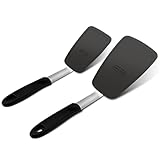
- 2-Piece Silicone Spatula Set (Small & Large): Includes a small spatula (12"L x 3"W with 3" x 4.75" blade) for delicate tasks and a large spatula (13"L x 4"W with 4" x 6" blade) for heavy-duty cooking
- Solid Silicone Spatulas for Cooking: Feature a sturdy non-slip TPE handle and a flexible stainless-steel-reinforced core for easy flipping of eggs, omelets, burgers, pancakes, and crepes
- Flexible Spatula for Kitchen: The thin, food-grade, heat-resistant silicone head glides precisely under delicate foods, while the angled design makes flipping and lifting easy
- Non-Stick Cookware Safe: The soft silicone head of the spatula turner protects coatings from scratches, extending the life of your non-stick pans and bakeware
- Easy to Clean & Dishwasher Safe: The silicone cooking spatula utensils set is easy to clean by hand and is dishwasher safe
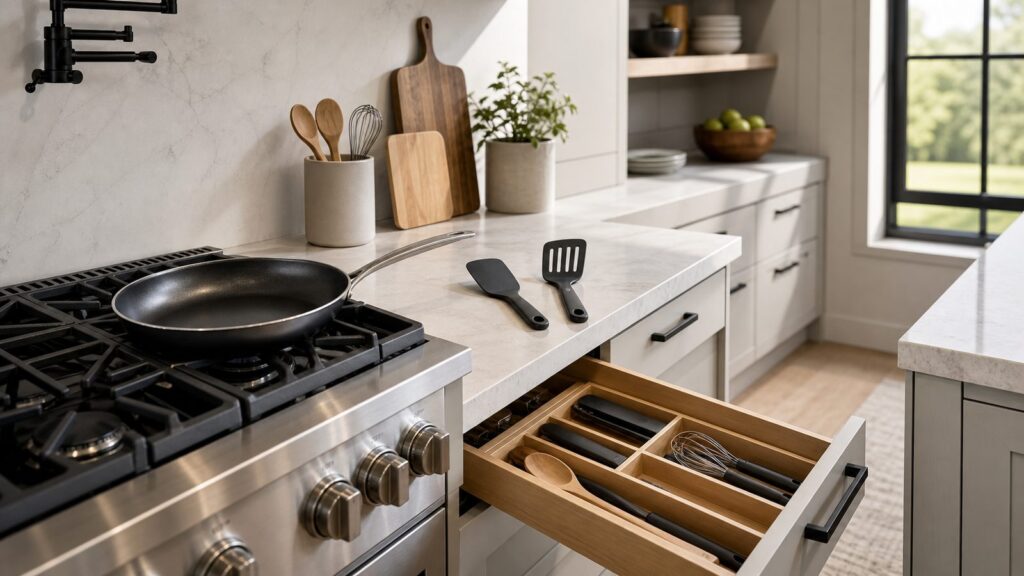
That is why we recommend planning utensil storage during cabinet design, not after the countertops are installed. A deep drawer with full-extension slides beside the range can make a kitchen feel better every day. A shallow drawer packed with long-handled tools becomes a nuisance fast.
Food-Grade Silicone and Safety Claims
For homeowners in the United States, the most meaningful safety language is food-contact compliance, not vague marketing. Look for references to FDA 21 CFR 177.2600 for rubber articles intended for repeated food contact. NSF/ANSI 51 is also relevant for commercial food-equipment materials and higher-assurance claims. LFGB testing is another strong food-contact claim often seen on better silicone kitchenware.
Be skeptical of labels that only say “non-toxic” without a standard behind them. Also, “BPA-free” is not a strong differentiator for true silicone because BPA is mainly associated with certain plastics, not silicone itself. A better product page or package will tell you whether the head is food-grade silicone, whether the tool has a reinforced core, what the temperature rating is, and whether the construction is sealed or one-piece.
For nonstick cookware, avoid bare metal turners and sharp-edged stainless tools. They have their place on cast iron, carbon steel, and grill surfaces, but they are not the right choice for coated cookware. If your kitchen has a mix of cookware, store silicone and wood tools closest to the cooktop and keep metal spatulas in a separate drawer, crock, or divider. That small habit protects expensive pans.
Storage Planning: The Part Most Buying Guides Miss
Food publications do a good job testing how tools perform in the pan. What they often skip is whether the tool actually fits your kitchen. As builders, we care about the whole work zone: where the pan is, where the utensil is, where the prep surface is, and how many steps the cook takes between them.
Free tools Windows power users keep installed
One-click scans. No signup required.
Measure before buying
Measure the inside of the drawer, not the cabinet face. You need interior width, interior depth, and usable height. Check the longest handle in the set and the widest head. A 16-inch turner may not fit in a 15-inch-deep organizer. A bulky silicone head may catch on a shallow drawer box, especially if tools are stacked.
Use full-extension slides
For remodels, specify full-extension drawer slides for utensil drawers. They let the drawer open fully so the tools at the back are visible and reachable. This matters more than homeowners expect. A long turner buried behind tongs and ladles is effectively not stored; it is lost until the next drawer cleanout.
Plan the cooking-tool zone
The best location is usually a deep drawer or vertical utensil pull-out within the cooking zone, close to the range but not directly exposed to heat, steam, or splatter. A narrow pull-out can work well beside a range if it is designed for utensils, oils, or spices, but it must be protected from heat and easy to clean. For higher-end kitchens, custom dividers sized for turners, tongs, ladles, whisks, and prep tools are better than generic flatware trays.
Also popular on Amazon

- SILICONE SPATULA SET - Pack with large and small spatula turner set. Constructed with a easy grip nonslip handle, outer silicone layer bonded with a stainless-steel plate. Flippers for eggs, cookie, pancake, burgers, crepes and more.
- FOOD GRADE & BPA FREE - The silicone spatula set is made of 100% food grade silicone, BPA free material, No odors or color-fading,long-time lasting.
- THIN AND HEAT RESISTANT SILICONE HEAD - Silicone blade and glides easily under food without damaging it. Perfect kitchen silicone spatula set for nonstick cookware and bakeware.
- STRENGTH AND DURABLE - Combines the strength of stainless steel with the advantages of silicone; outer silicone layer bonded to a stainless-steel core. Easy to use and clean.
- NO MELT SILICONE GRIP - The spatula handle coated with high heat resistant silicone too, non-slip grip makes the tool easy to use,and will not melt even close to the fire or hot pans. Dishwasher safe.
Do not store silicone turners loose with sharp knives or jagged metal tools. Nicks in the edge create places for food residue to collect and can shorten the life of the tool. If the drawer is crowded, use a divider or move metal tools to another zone.
Cleaning and Lifespan
Most silicone turners are dishwasher-safe, but the dishwasher is not always the best answer for odor or grease. Silicone can hold smells from garlic, onions, curry, tomato sauce, and cooking oils, especially if the surface has been scratched or roughed up with abrasive scrubbers.
For routine cleaning, use hot water, dish soap, and a non-abrasive sponge. If a turner has a greasy film, wash it by hand before putting it in the dishwasher. Avoid steel wool and harsh scouring pads. They can roughen the surface and make staining worse.
Replace a silicone turner when the edge splits, the internal core becomes exposed, the head loosens, persistent odors remain after cleaning, or the surface becomes sticky or tacky. A heavily used turner may last a few years; a better sealed, reinforced model used properly can last longer. The replacement cost is low enough that there is no reason to keep a damaged food-contact tool in service.
Independent reader supportYour contribution helps us test, update, and keep practical guides available for everyone.When to DIY vs. When to Hire a Pro
Buying better silicone turners is a clear DIY decision. So is adding a retail drawer organizer, moving metal utensils to a separate container, or reorganizing the cooking zone. You can handle those changes in under an hour with a tape measure and a $13 to $30 organizer.
Hire a pro when the storage problem points to cabinetry, electrical, plumbing, ventilation, or layout changes. If you want to add deep drawers, modify cabinet boxes, relocate a range, add outlets, move a sink, install a new hood, alter gas lines, or change walls, that is construction work, not utensil shopping.
Permits depend on the location and scope. A simple drawer organizer does not require a permit. Cabinet insert changes usually do not require one if you are not changing electrical, plumbing, gas, mechanical, or structural systems. But kitchen remodels can trigger permits even when the footprint looks similar. Electrical changes, plumbing relocation, gas work, ventilation changes, structural wall modifications, and some appliance upgrades may require permits and inspections.
Kitchen islands and peninsulas also deserve careful planning. Electrical outlet rules have changed in recent code cycles, and local interpretation matters. Some jurisdictions no longer require receptacles in island and peninsula countertops the way older rules did, but they may require provisions for future outlets or have local amendments. Before cutting into a new island panel or planning power for a prep zone, verify the current local code with your building department or licensed electrician.
Common Mistakes to Avoid
The most common mistake is buying a turner that is too thick at the front edge. It may look sturdy in the package, but it will struggle with eggs, fish, crepes, and pancakes. The second mistake is assuming all silicone tools are the same. Some are silicone-coated nylon or lower-quality blends with less documented heat behavior and shorter useful life.
Also popular on Amazon

- Spatula is the ideal size for lifting cookies from cookie sheet
- Made of silicone bonded to flexible stainless steel
- Rounded corners for scraping sticky dough out of spoons
- Angled handle keeps hands away from food; safe for nonstick cookware
- Heat resistant to 600 degrees F; dishwasher-safe
Another frequent problem is heat abuse. A package may claim 500 degrees F or 600 degrees F resistance, but that does not mean the tool belongs in a hot skillet while you answer the door. Use the turner, then set it on a spoon rest or heat-safe surface away from the burner.
Homeowners also buy oversized utensil sets without checking drawer fit. A full set for $20 to $60 can be a good value, but only if the pieces are useful and storable. Otherwise, you are buying clutter. Measure first, then choose.
During remodels, the mistake is bigger: planning beautiful cabinets without a dedicated cooking-tool zone. A kitchen can have expensive stone counters and still function poorly if turners, tongs, knives, cutting boards, and pans are scattered across the room. Good kitchen design starts with the work you do every day.
Our Practical Recommendation
For a typical US homeowner with nonstick or ceramic cookware, buy a two-piece silicone turner set in the $15 to $30 range or two separate mid-range turners at about $10 to $18 each. Choose one thin, flexible solid turner for eggs and fish. Choose one wider, reinforced slotted turner for burgers, pancakes, and heavier pan work. Look for food-grade silicone, a heat rating of at least 450 degrees F, sealed or one-piece construction, and a handle that fits your drawer.
What’s actually slowing this PC down?
Pick the symptom - the matching free tool is one click away.
If you are remodeling, do not leave tool storage as an afterthought. Plan a full-extension drawer or vertical pull-out within the cooking zone. Size dividers for long tools. Keep silicone and wood near nonstick cookware. Keep metal tools separate. The best silicone turner is not the most expensive one; it is the one that fits your pans, your hand, your drawer, and the way your kitchen is built.
Frequently Asked Questions
What is the difference between a silicone turner and a silicone spatula?
A silicone turner is flat and broad for lifting and flipping food. A silicone spatula is usually a flexible scraper used for mixing, folding, scraping bowls, and spreading.
Are silicone turners safe for nonstick pans?
Yes. Silicone turners are one of the best choices for nonstick, ceramic, and enameled cookware because they are much less likely to scratch the surface than bare metal tools.
What heat rating should a silicone turner have?
Look for at least 450 degrees F. Many quality models claim 500 to 600 degrees F, but treat that as brief-contact resistance, not permission to leave the tool in a hot pan.
Recommended Free Tools
Should I buy a solid or slotted silicone turner?
A solid turner supports delicate foods and saucy items better. A slotted turner drains grease and liquid. Most active kitchens benefit from having one of each.
How should silicone turners be stored in a remodeled kitchen?
Store them in a full-extension drawer or vertical utensil pull-out near the range but away from direct heat and splatter. Measure drawer depth and width before buying long-handled tools.
Do kitchen drawer organizers or cabinet changes require a permit?
A loose drawer organizer does not require a permit. Cabinet modifications usually do not either, unless the work involves electrical, plumbing, gas, ventilation, structural changes, or local code requirements.
Quick Recap
Product prices and availability are accurate as of the date/time indicated and are subject to change. Any price and availability information displayed on Amazon at the time of purchase will apply.
Quick wins for a faster PC:
Repair Windows errors before they cause bigger problemsFix Now →Scan for outdated or missing drivers - takes under a minuteDriver Scan →
