Some links on this page are affiliate links: if you buy through them we may earn a commission, at no extra cost to you.
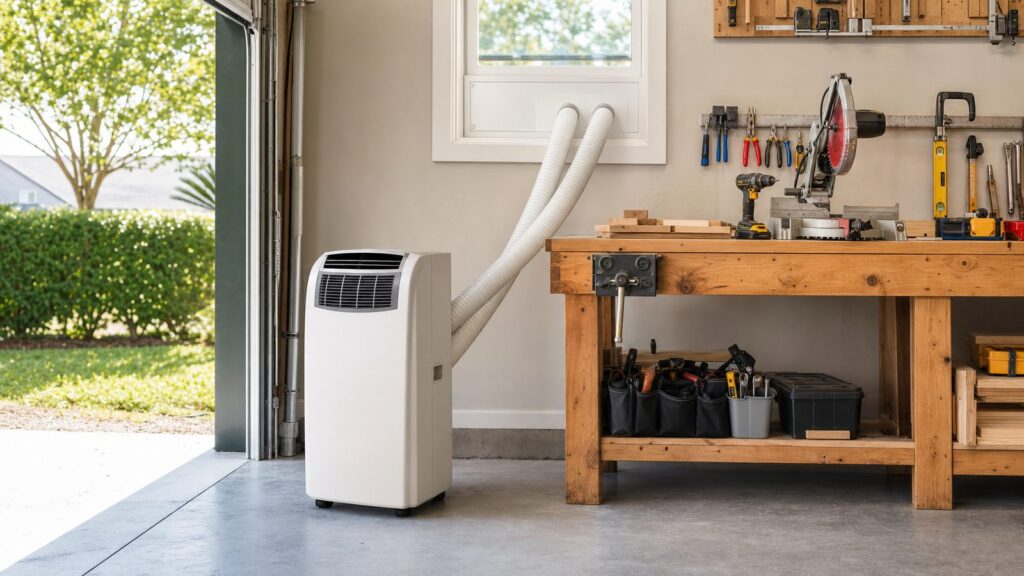
A portable air conditioner can absolutely make a garage more comfortable while you work, but it is not magic. In most garages, the right portable AC is a spot-cooling tool for the workbench area, not a full replacement for a real HVAC system. If you want the short answer: choose a dual-hose inverter portable AC, size it by DOE/SACC BTU, vent it through a sealed panel to the outdoors, and fix obvious garage-door leaks before you blame the machine.
For a typical one-car garage around 240 to 300 square feet, start with an 8,000 to 10,000 DOE/SACC BTU portable unit. For a two-car garage around 400 to 600 square feet, look at 10,000 to 14,000 DOE/SACC BTU, and understand that an uninsulated, west-facing garage may still need a ductless mini-split if you expect daily comfort. On our job sites, we see portable ACs work best when the homeowner cools a defined work zone: a bench, assembly table, tool wall, or finishing area. Trying to turn a bare garage into a conditioned living room with one wheeled unit usually leads to disappointment.
What Makes Garage Cooling Different From Cooling a Bedroom
A garage is a tougher cooling problem than a normal room. It often has an uninsulated overhead door, exposed framing, concrete that stores heat, air gaps at the jambs, and a roof or attic above it that can run far hotter than the outdoor temperature. Add a table saw, air compressor, refrigerator, freezer, car engine, battery charger, or EV charger, and the cooling load climbs fast.
Do these 3 things before closing this tab:
1Repair Windows errors before they cause bigger problems2Scan for outdated or missing drivers - takes under a minute3Clear out junk files and repair common Windows errorsAs an Amazon Associate I earn from qualifying purchases.
That is why the portable AC that feels strong in a 300-square-foot bedroom may feel weak in a 300-square-foot garage. Bedrooms usually have insulated walls, finished ceilings, interior doors, smaller exterior openings, and less solar gain. A garage may leak enough air that a cheap single-hose unit spends half its effort pulling hot outdoor air back through cracks while it exhausts cooled air out the hose.
The practical goal is to lower the temperature where your body and tools are, not necessarily every cubic foot of the garage. A 20-by-22-foot two-car garage is 440 square feet, but if your work happens at an 8-by-12-foot bench zone, you can use curtains, a temporary partition, a fan, and a well-positioned portable AC to make that zone tolerable without fighting the entire garage shell.
#1 Best Overall

- 8,000 BTU DOE/SACC (10,000 ASHRAE)
- 3-in-1 Operation - Enjoy cooling, dehumidifying, and fan mode with our versatile 3-in-1 portable air conditioner
- Dual-Hose Technology - Dual hose technology provides faster, more efficient cooling and consistent room temperatures.
- Inverter Technology - Energy efficient (up to 40% more efficiency)
- Quiet Operation - Leave your dehumidifier running and rest, without being disturbed.
The Best Type of Portable AC for a Garage
The best portable air conditioner for most garages is a dual-hose inverter unit with enough DOE/SACC capacity for the area you actually want to cool. That combination matters more than brand names, smart apps, or cosmetic features.
Dual-hose beats single-hose in most garages
A single-hose portable AC uses air from the room to cool its condenser, then exhausts that hot air outdoors. That creates negative pressure. In a leaky garage, negative pressure pulls hot air back in through the garage door, attic hatch, wall gaps, outlets, and other cracks. You may feel cold air at the supply grille while the overall space barely improves.
A dual-hose portable AC uses one hose to bring in outdoor air for the condenser and another hose to exhaust heat outdoors. The indoor air loop stays more separated from the outdoor air loop. In plain terms, the unit wastes less of the air it just cooled. For garages, that is usually the better design.
Inverter models are worth considering
Inverter portable ACs can ramp their compressor speed up and down instead of cycling hard on and off. For a garage, that helps in three ways: steadier comfort, lower noise once the space starts cooling, and better part-load efficiency. Many higher-performing room ACs now use variable-speed technology for exactly those reasons.
Expect dual-hose inverter portable units to cost more up front. In 2026, common consumer portable ACs in the 6,000 to 12,000 DOE BTU range are generally around $280 to $660. Dual-hose inverter models often land around $500 to $650. That is not cheap, but it is still far below a fully installed ductless mini-split, which is commonly around $5,000 to $7,000 or more for a garage depending on equipment, permits, electrical work, and site conditions.
How to Size a Portable AC for Your Garage
When comparing units, use DOE/SACC BTU, not just the larger ASHRAE BTU number printed in big type on some boxes. Portable ACs lose performance through hoses, infiltration, and heat exchange effects. DOE/SACC capacity is meant to reflect that more realistic performance. CEER is the efficiency rating to compare when you are looking at operating cost.
A simple starting point is 20 to 25 BTU per square foot, but unfinished garages often need more. If the garage faces west, has no ceiling insulation, has a dark door, has high ceilings, or contains heat-producing tools, size up or narrow the cooled zone.
| Garage or Work Zone | Typical Size | Portable AC Starting Point | Reality Check |
|---|---|---|---|
| Bench-only cooling zone | 80-150 sq ft | 6,000-8,000 DOE/SACC BTU | Works best with a curtain, partition, or fan-assisted spot cooling. |
| Small one-car garage | 240-300 sq ft | 8,000-10,000 DOE/SACC BTU | Seal the overhead door and keep hoses short. |
| Typical two-car garage | 400-600 sq ft | 10,000-14,000 DOE/SACC BTU | Portable AC may be acceptable for projects, not daily whole-garage comfort. |
| Large or hot three-car garage | 650+ sq ft | 14,000+ DOE/SACC BTU or multiple zones | A ductless mini-split or dedicated garage HVAC plan is usually more realistic. |
Do not size only from square footage. A 440-square-foot garage in Seattle and a 440-square-foot garage in Phoenix are not the same cooling job. A garage with an insulated door, finished ceiling, and shaded driveway can perform one or two capacity classes better than a bare garage facing late-afternoon sun.
What We Look For in a Garage Portable AC
When we help homeowners think through garage cooling, we care less about a long feature list and more about whether the unit can survive dusty, hot, imperfect conditions. These are the specifications that matter.
Free tools Windows power users keep installed
One-click scans. No signup required.
DOE/SACC capacity
Look for the DOE/SACC rating in the product specifications. A unit advertised as 14,000 ASHRAE BTU may have a DOE/SACC capacity closer to 8,000 to 10,000 BTU depending on design. The DOE number is the one to use when planning.
Dual-hose or hose-in-hose design
For a garage, make this the default unless budget forces otherwise. Single-hose units can work for a small, sealed, short-duration work zone, but they are usually the weaker choice for a leaky garage.
Condensate handling
Portable ACs remove moisture. In a humid climate, a garage session can fill an internal bucket or trigger shutoff if the unit has no good drain path. Look for a continuous drain option if you have a floor drain, utility sink, or condensate pump location. For long woodworking, auto repair, or finishing sessions, this matters.
Filter access
Garage air is dirty. Wood dust, drywall dust, pollen, grass clippings, and general shop debris load filters faster than normal household use. A filter you can remove and rinse in two minutes is better than a clever-looking design that requires taking the unit apart.
Hose diameter, hose length, and vent panel quality
Short, straight hoses perform better. Every bend adds resistance, and every extra foot of warm exhaust hose radiates heat back into the garage. Most manufacturer hose kits are designed for short window runs, not long garage detours. If the manual does not approve a hose extension, do not assume the fan can handle it.
Real 2026 Cost Expectations
A garage portable AC project has three cost buckets: the unit, the venting materials, and the electrical capacity to run it safely. The machine is only part of the budget.
| Item | Typical 2026 Cost | Notes |
|---|---|---|
| Consumer portable AC | $280-$660 | Common 6,000-12,000 DOE BTU units. Budget single-hose models cost less. |
| Dual-hose inverter portable AC | $500-$650 | Usually the better garage choice when the budget allows. |
| Heavy-duty spot cooler | $700-$4,000+ | Useful for shops, commercial spaces, or demanding spot-cooling setups. |
| Garage venting materials | $25-$150 | Foam board, plywood, acrylic, weatherstripping, foil HVAC tape, exterior hood, and fasteners. |
| Dedicated circuit | $200-$600+ | Can rise if the panel is full, the garage is detached, trenching is required, or code upgrades apply. |
| Panel or service upgrade | $1,500-$3,500+ | Possible if the existing electrical system cannot support added load. |
| Garage ductless mini-split | $5,000-$7,000+ | Broader installed ranges can run $2,500-$12,000 depending on zones, permits, and electrical work. |
Operating cost is the number many homeowners forget. A 1,200-watt portable AC running 6 hours per day uses about 216 kWh per month. At 18.83 cents per kWh, that is about $41 per month. A larger 1,800-watt unit running 8 hours per day uses about 432 kWh per month, or about $81 per month at the same rate. Your real bill depends on local rates, insulation, runtime, thermostat setting, and whether your utility uses time-of-use pricing.
How to Vent a Portable AC in a Garage
A portable AC must exhaust outdoors. Do not vent it into an attic, wall cavity, closed garage bay, crawlspace, laundry room, or another part of the house. That only moves heat and moisture somewhere else and can create condensation, pressure, and comfort problems.
The cleanest garage setup is a semi-permanent sealed vent panel. If the garage has a small window, build a rigid insert from plywood, acrylic, or insulated foam board. Cut the hose openings cleanly, seal the perimeter with weatherstripping, and tape the hose collars with foil HVAC tape. A loose plastic window kit is fine for a weekend, but it is not what we like to see left in a garage all summer.
If there is no window, a temporary door-panel insert can work. Some homeowners build a removable panel that sits under the overhead door with gasketed edges and hose ports. That can be practical, but it has to account for rain, pests, security, and trip hazards. A through-wall vent can be cleaner, but that becomes a real building-envelope decision. You need to avoid structural members, wiring, plumbing, fire-rated assemblies, and exterior water problems.
Keep the portable AC as close to the vent as practical. A good target is to keep hoses under 5 to 6 feet if the manufacturer allows it, with broad bends instead of sharp kinks. Do not bury the exhaust hose behind storage boxes. It gets hot, and that heat needs space to dissipate safely.
Seal First, Then Cool
Before buying a larger AC, spend a Saturday tightening up the garage. On remodeling jobs, we often see a $40 seal package make more difference than jumping one size larger in equipment.
What’s actually slowing this PC down?
Pick the symptom - the matching free tool is one click away.
Rank #2

- 【Powerful Inverter Cooling with Dual Hose System】- ZAFRO smart inverter portable air conditioners is powered by upgraded inverter compressor and a dual hose system, this portable air conditioner delivers a high airflow of 480 cubic meters per hour, our dual hose portable air conditioners quickly circulates cool air throughout the room, ensuring even and rapid cooling. The Extra Mode locks the temperature at 61 degrees Fahrenheit and runs at full power to provide instant relief during extreme heat, eliminating uneven cooling and hot spots.
- 【Energy Saving Performance with Smart Inverter Technology】- Our inverter portable air conditioner featuring smart inverter technology, this portable ac unit maintains a stable temperature through precise frequency control, which reduces frequent on-and-off cycles for optimal energy efficiency. By minimizing wasted energy and delivering consistent cooling exactly as needed, this inverter portable ac unit achieves a CEER of 12.8 (well above the standard 7.83), while keeping energy consumption low for all-day operation. With an environmentally conscious design, you can enjoy powerful cooling without unnecessary power draw.
- 【72Hrs Drainage-Free Cooling with Self-Evaporating System】- Say goodbye to manual draining with the self evaporating condensate system. Moisture from the evaporator is collected and evenly thrown into the condenser through a water-slinging wheel, where it evaporates naturally. In environments with humidity < 90%, the self evaporating portable air conditioner is drainage-free for 72hrs, for extreme humidity > 90%, a drain hose is provided, offering a maintenance-free experience 90% of the time, so you never have to worry about emptying a water tank.
- 【Ultra Quiet Operation with Smart Sleep Mode】- Designed for peaceful environments, this quiet portable air conditioner operates at as low as 42 decibels, quieter than normal conversation. This inverter compressor for reduced vibration, optimized piping to lower resonance. Sleep mode automatically adjusts compressor frequency and fan speed to maintain a stable temperature with ultra quiet, ensuring uninterrupted rest.
- 【Smart Control with Enhanced User Experience】- Take full control with smart ZAFRO app and remote, our portable air conditioner allowing you to adjust temperature, switch modes, or set schedules from anywhere. The 24h timer lets you set on and off times to match your daily routine, so you can pre-cool the room before arriving home or have the unit shut off automatically during sleeping hours. Additional friendly features include ambient lighting, power-off memory, and filter-clean reminders for a truly convenient experience.
Start at the overhead door. Replace a flattened bottom seal, adjust side and top weatherstripping, and close visible daylight at the jambs. If the door faces afternoon sun, an insulated garage door or insulation kit can reduce radiant heat. Then check the attic hatch, ceiling penetrations, wall gaps, and the door into the house. If the garage has open studs, exposed roof framing, or an uninsulated ceiling under attic space, cooling will always be harder.
Use a thermometer/hygrometer at work height, not just the AC display. Put it near the bench, about 4 to 5 feet above the floor. The unit may show cool return air while the place you stand is still hot. This simple check tells you whether you need better air direction, a smaller cooled zone, or a more serious HVAC solution.
Electrical and Safety Notes Homeowners Should Not Skip
Large portable ACs draw real power. Many garage receptacles are already serving a freezer, battery chargers, power tools, lights, a garage door opener, or outdoor equipment. If you add a 1,200- to 1,800-watt AC to a loaded 15-amp circuit, nuisance trips are the mild version of the problem.
Check the nameplate amps on the unit before buying. A 12-amp portable AC on a 15-amp circuit leaves little room for anything else. Do not run a large portable AC through a light-duty extension cord. If the manufacturer allows an extension cord at all, it should be short, heavy-gauge, grounded, and rated for the load. In many cases, the better answer is no extension cord and a properly placed receptacle.
Outdated Drivers Are Slowing You Down
One free scan finds every outdated or missing driver and matches the right update for your exact hardware.Free scan · exact hardware matchWindows Errors? Fix Them Before They Spread
Repair common Windows errors and clear accumulated junk for a smoother, more stable PC - no reinstall needed.Free scan · no reinstallGarage receptacles commonly need GFCI protection, and current code requirements continue to evolve. Local amendments matter. If the garage has a refrigerator, freezer, air compressor, EV charger, or other large load on the same circuit, have an electrician evaluate the load before adding a high-capacity portable AC. A dedicated circuit is often a $200 to $600 job in straightforward conditions, but detached garages, full panels, trenching, AFCI/GFCI requirements, and permits can raise that number.
Also think about combustion and air pressure. If your garage contains fuel-burning equipment, a gas water heater, or other appliances, negative pressure from a single-hose AC can be more than a comfort issue. That is another reason we prefer dual-hose units in garages.
Independent reader supportYour contribution helps us test, update, and keep practical guides available for everyone.Best Use Cases for Portable AC in a Garage
A portable AC is a good fit when you use the garage for short work sessions, want to cool a bench or tool area, rent the home, or do not want to spend several thousand dollars on a permanent system. It is also useful when you need seasonal cooling only during the hottest months.
It is less convincing when you want the entire garage held at 72 degrees every day, when the garage is used as a gym, office, studio, or conditioned hobby room, or when the space is large and uninsulated. At that point, a ductless mini-split plus insulation usually makes more sense. It costs more up front, but it is quieter, more efficient, better at whole-room comfort, and does not require a window or hose setup.
Recommended Free Tools
When to DIY vs. When to Hire a Pro
Reasonable DIY work
Most homeowners can handle basic portable AC setup. That includes measuring the garage, choosing a unit, assembling the factory hose kit, replacing garage-door weatherstripping, setting up a thermometer, cleaning filters, and building a simple removable vent panel for an existing window. Budget $25 to $150 for basic vent-panel materials depending on whether you use foam board, plywood, acrylic, trim, exterior hood, and better gasket material.
A careful DIY setup should take 2 to 4 hours if the vent path is simple. Add time if you are building a better panel or sealing the garage door. Test the setup on a hot afternoon, not only at night. Pre-cool the area for 30 to 60 minutes before starting a project, then use a directional fan to move cooled air across the work zone without blowing hot outdoor air toward the AC intake.
Call a contractor or electrician
Bring in a pro if you need a through-wall vent, new exterior penetration, dedicated circuit, panel work, insulation improvements, drywall repair, or a permanent mini-split. Also call for help if the garage shares walls or ceilings with living space and you are unsure about fire separation, carbon monoxide risks, or code requirements.
For a finished garage conversion, gym, office, or workshop used every day, we would usually price the portable AC against the permanent solution early. Spending $650 on a portable AC, $300 on electrical work, $150 on venting, and $80 per month to run it can make sense for seasonal projects. It makes less sense if you already know you want year-round comfort.
The Tool Desk
Outbyte Driver Updater FREEFix the driver behind crashes, sound loss and screen glitchesFind Drivers →Outbyte PC Repair FREEClear out junk files and repair common Windows errorsFree Scan →Our Practical Buying Recommendation
For most homeowners, the sweet spot is a dual-hose inverter portable AC in the 10,000 to 14,000 DOE/SACC BTU range, paired with garage-door sealing and a rigid vent panel. That setup gives a two-car garage owner a fighting chance during project sessions without committing to a full HVAC installation. For a smaller one-car garage, an 8,000 to 10,000 DOE/SACC BTU dual-hose unit may be enough if the space is reasonably sealed.
If the garage is uninsulated, sun-baked, and used daily, do not overspend trying to make portable equipment do permanent-system work. Put the money toward sealing, insulation, electrical planning, and a ductless mini-split estimate. The right answer is not always the biggest portable AC; it is the cooling plan that matches how you actually use the garage.
Maintenance Tips That Keep the Unit Working
Clean the filter more often than the residential schedule if you cut wood, sand drywall, grind metal, or park dusty vehicles nearby. In a woodworking garage, weekly filter checks during heavy use are reasonable. Reduced airflow makes the unit louder, less efficient, and more likely to ice up or shut down.
Keep sawdust and stored materials away from the intake and exhaust. Check the condensate system before long sessions. If the unit drains into a bucket, know how fast it fills on humid days. If it drains through a hose, confirm the hose slopes correctly and cannot be kicked loose.
Quick wins for a faster PC:
Fix the driver behind crashes, sound loss and screen glitchesFind Drivers →Clear out junk files and repair common Windows errorsFree Scan →Scan for outdated or missing drivers - takes under a minuteDriver Scan →At the end of the cooling season, run fan-only mode if the manual recommends it, drain remaining water, clean the filters, wipe down the hose collars, and store the hoses without crushing them. A portable AC that lives in a garage takes more abuse than one in a bedroom, so small maintenance habits matter.
Bottom Line
The best portable air conditioner for a garage is not just the one with the largest number on the box. It is a properly sized DOE/SACC-rated unit, preferably dual-hose and inverter-driven, installed with a short sealed vent path and supported by basic garage air sealing. Expect to spend about $500 to $650 for a strong dual-hose inverter consumer unit, $25 to $150 for a better vent setup, and roughly $40 to $80 per month in electricity for common summer use patterns.
Use portable AC for what it does well: pre-cooling before work, spot cooling around a bench, and making weekend projects bearable. For daily whole-garage comfort, especially in a hot or poorly insulated garage, start talking about insulation, electrical capacity, and a ductless mini-split before you buy the biggest portable unit on the shelf.
Frequently Asked Questions
What size portable air conditioner do I need for a two-car garage?
For a typical 400- to 600-square-foot two-car garage, start with 10,000 to 14,000 DOE/SACC BTU. If the garage is uninsulated, west-facing, has high ceilings, or contains heat-producing tools, a portable AC may only be practical for spot cooling. Daily whole-garage comfort usually points toward insulation and a ductless mini-split.
Is a dual-hose portable AC better for a garage than a single-hose unit?
Yes, in most garages. A single-hose unit exhausts indoor air and creates negative pressure, which pulls hot outdoor or attic air back through gaps. A dual-hose unit separates condenser air from cooled room air, so it usually performs better in leaky garage conditions.
Can I vent a portable AC into the attic or another garage bay?
No. A portable AC must exhaust outdoors. Venting into an attic, wall cavity, closed garage bay, or another room only relocates heat and moisture and can create condensation, pressure, and comfort problems.
How much does it cost to run a portable AC in a garage?
A 1,200-watt unit running 6 hours per day uses about 216 kWh per month. At 18.83 cents per kWh, that is roughly $41 per month. A 1,800-watt unit running 8 hours per day uses about 432 kWh per month, or about $81 per month at the same rate.
Do I need a dedicated circuit for a garage portable AC?
Maybe. Large portable ACs can draw 10 to 12 amps or more, and many garage circuits already serve freezers, chargers, tools, lights, or garage door openers. If the AC will share a circuit with heavy loads, have an electrician evaluate it. A dedicated circuit is commonly around $200 to $600 in straightforward 2026 projects, but complex work costs more.
When is a mini-split better than a portable AC for a garage?
A mini-split is usually better when you want daily comfort, whole-garage cooling, quieter operation, better efficiency, or heating and cooling in one permanent system. Installed garage mini-splits are often around $5,000 to $7,000 or more, but they outperform portable units for long-term conditioned garage use.
Quick Recap
Product prices and availability are accurate as of the date/time indicated and are subject to change. Any price and availability information displayed on Amazon at the time of purchase will apply.

