Some links on this page are affiliate links: if you buy through them we may earn a commission, at no extra cost to you.
For Indian cooking in a U.S. kitchen, the best food processor is not simply the model with the highest wattage or the longest accessory list. It is the machine that handles onions without turning them watery, shreds cabbage and carrots for weekday cooking, kneads atta without overheating, has enough bowl capacity for family prep, and still has a realistic place to live in your kitchen.
Our practical short list is this: choose a Breville 16-Cup Class processor if you do heavy batch prep and have the counter or cabinet space; choose a Cuisinart Custom 14-Cup if you want durable full-size value; choose a KitchenAid 13-Cup With Dicing Kit if you prep for a family and want a strong mid-range setup; choose a Hamilton Beach, Ninja, or compact KitchenAid if you need a budget or secondary processor; and keep a mixer-grinder or wet grinder in the plan for fine chutneys, dry masalas, and idli or dosa batter.
On our kitchen projects, the appliance choice is only half the answer. A processor used for Indian cooking needs landing space, GFCI-protected power, good light, stain-resistant surfaces, accessible trash or compost, and a drawer or cabinet that keeps sharp blades and discs organized. If you are remodeling, this is the time to plan the prep zone properly instead of forcing a heavy machine into a corner after the backsplash is finished.
As an Amazon Associate I earn from qualifying purchases.
What Makes Indian Food Processor Needs Different
Indian cooking asks more from a processor than a basic salsa-and-pie-dough workload. A typical week may include chopping 3 to 5 onions, shredding cabbage, slicing potatoes, grating carrots, mincing ginger and garlic, grinding soaked nuts, kneading atta, and making chutney. Those jobs require different bowl sizes, blade clearances, motor behavior, and cleanup routines.
The first mistake is buying by wattage alone. Wattage can tell you something about power draw, but it does not tell the whole story. Bowl geometry, blade height, torque, base stability, lid seal, pulse control, and the sharpness of the slicing and shredding discs matter just as much. A stable 14-cup machine with a good S-blade and predictable pulse button will usually outperform a flashy machine that smears food along the bowl wall.
#1 Best Overall

- SUPERIOR FUNCTION: The Cuisinart Food Processor with 720-watt motor functions as a vegetable chopper, blender, and food processer in one. Make any kind of dip, puree soup, or sauce including hummus, salsa, guacamole, and more.
- MUST-HAVE FEATURES: The 14-cup food chopper has “on” and “off/pulse” buttons with an extra-large feed tube with bowl sleeve assembly designed for both small and large feed tube pushers. It also comes with a detachable disc stem for easy clean up.
- INCLUDED ACCESSORIES: This food processor comes with dishwasher-safe parts including a stainless steel standard slicing disc (4mm), medium shredding disc, and stainless steel chopping/mixing blade.
- NOTE TO CONSUMER: The shredding and slicing blades of this electric chopper are not adjustable. Please refer to the manual before setting up.
- LIMITED 3-YEAR WARRANTY: The Cuisinart Food Processor comes with a limited 3-year warranty on the entire unit and a full 5-year warranty on the motor.
The second mistake is assuming one appliance replaces everything. A food processor is excellent for coarse chopping, slicing, shredding, kneading small to moderate dough batches, and making thicker pastes. It is usually not the best tool for very smooth idli batter, very fine dosa batter, tiny chutney portions, or powder-fine dry spice blends. For those, a mixer-grinder, small jar grinder, spice grinder, or wet grinder still has a place.
Recommended Free Tools
For most Indian households, the best full-size range is 11 to 14 cups. That size gives you enough bowl volume for onions, cabbage, potatoes, carrots, and batch meal prep without forcing everything through in six tiny rounds. A 3 to 7 cup machine is useful for herbs, small chutneys, and quick weeknight prep, but it can be frustrating as the main processor for a family kitchen.
Best Food Processors for Indian Cooking by Use Case
Prices move with sales and packages, but 2026 U.S. pricing gives a useful planning range. Mini choppers commonly run about $20 to $70. Budget full-size processors are often $50 to $150. Strong mid-range machines usually sit around $170 to $320. Premium processors commonly land between $400 and $700 or more.
Instead of naming one universal winner, we recommend matching the machine to how you actually cook. The right processor for a household making rotis, sabzi, chutney, and batch-prepped vegetables twice a week is different from the right processor for a small apartment where the main need is onions, cilantro, and occasional cabbage.
| Best Use | Recommended Class | Typical 2026 Price | Why It Works | Tradeoff |
|---|---|---|---|---|
| Heavy Indian prep and large families | Breville 16-cup class, including Peel & Dice or Paradice models | About $500 to $700+ | Strong for batch chopping, slicing, shredding, nut pastes, dough, and organized accessory storage | Large footprint and high upfront cost |
| Durable full-size value | Cuisinart Custom 14-Cup class | About $282 to $320 | Reliable size and power for onions, cabbage, dough, and weekly prep | Accessory and dicing options vary by package |
| Mid-range family prep | KitchenAid 13-Cup with dicing kit | About $180 to $230 | Useful for slicing, shredding, dicing, and family meal prep | Not as heavy-duty as premium 16-cup machines |
| Small kitchen or lighter prep | KitchenAid 7-cup or 9-cup, Breville 9-cup class | About $90 to $400 | Good balance of storage size and daily usefulness | Requires batch processing for larger Indian meals |
| Budget or secondary processor | Hamilton Beach, Ninja, or 4-cup mini chopper | About $50 to $150; 4-cup mini around $57 | Good for onions, herbs, small chutney batches, and quick prep | Less ideal for dense atta dough or large-batch grinding |
| Long-life premium choice | Magimix 14-cup class | Often premium priced | Built for durability and long-term kitchen use | High cost and substantial storage footprint |
Best Premium Pick: Breville 16-Cup Class
If you cook Indian food several times a week and want one machine that can handle serious prep, the Breville 16-cup class is the strongest fit. This is the category we would look at for households that batch-chop onions, shred vegetables for the week, slice potatoes, make thicker nut pastes, and knead dough regularly.
Quick wins for a faster PC:
Repair Windows errors before they cause bigger problemsFix Now →Fix the driver behind crashes, sound loss and screen glitchesFind Drivers →Clear out junk files and repair common Windows errorsFree Scan →The main advantage is capacity. A 16-cup bowl gives you room to work without crowding the blade. That matters with cabbage, potatoes, cauliflower, and large onion batches. Premium Breville packages also tend to include thoughtful accessory storage, which is not a minor issue. Loose discs and blades become a safety and usability problem if they end up scattered between drawers.
The downside is space. A 16-cup machine is not something most people want to lift from a low shelf every day. If you buy this class of processor, plan for either permanent counter space or a strong base cabinet with a pull-out shelf. In a remodel, we typically plan at least a 24 to 30 inch wide prep run so the processor can sit fully on the counter with room for a bowl, ingredients, and safe blade handling.
Best Durable Value: Cuisinart Custom 14-Cup Class
The Cuisinart Custom 14-Cup class is a practical sweet spot for many Indian kitchens. It is large enough for family prep, durable enough for frequent use, and usually costs far less than premium 16-cup machines. In 2026, common prices fall around $282 to $320 depending on retailer and package.
A 14-cup bowl works well for onions, cabbage, potatoes, carrots, cilantro, paneer prep, and moderate dough batches. It is also a more realistic size for many U.S. kitchens than a 16-cup premium processor. If you want a processor that can live in a base cabinet or pantry cabinet and come out several times a week, this is one of the most sensible categories.
Do these 3 things before closing this tab:
1Scan for outdated or missing drivers - takes under a minute2Repair Windows errors before they cause bigger problems3Fix the driver behind crashes, sound loss and screen glitchesCheck the exact package before buying. Some models are simple and durable, with fewer specialty discs. Others include more accessories. If dicing is important for you, confirm that the model you are buying includes a dicing kit or supports one. Do not assume all 14-cup processors have the same accessory set.
Best Mid-Range Indian Family Processor: KitchenAid 13-Cup With Dicing Kit
For many families, a 13-cup processor with a dicing kit is the right middle ground. The KitchenAid 13-cup class is often seen around $180 to $230 in 2026 pricing, which puts it below premium machines but above basic budget models.
This category makes sense if your weekly prep includes diced onions, shredded carrots, sliced potatoes, cabbage, and general vegetable work. The dicing kit can be valuable for families that cook dals, sabzis, pulao, poha, upma, and curries throughout the week. It reduces knife work, especially when you are prepping after work or cooking for several people.
Rank #2

- POWERFUL PERFORMANCE: The 1000-peak-watt motor precisely powers through tough ingredients to ensure smooth, consistent results every time.
- AUTO-IQ TECHNOLOGY: Four intelligent Auto-iQ preset programs take the guesswork out of food prep, providing one-touch control for chopping, slicing, shredding, pureeing, and dough making.
- LARGE CAPACITY: The 9-cup bowl with large feed chute is perfect for large batches, family meals, entertaining, or weekly meal prep, saving you time and effort.
- PRECISION CHOPPING BLADES: Stainless steel Ninja Blades are designed for optimal food processing, perfectly precise chopping, even slicing and shredding, and smooth pureeing.
- SLICING/SHREDDING DISC: This ultra-versatile reversible disc can slice cucumbers, meats and more on one side and shred cheese, carrots, and more on the other side.
It is still not a wet grinder and should not be treated like one. Use it for chopping, slicing, shredding, and moderate paste work. Keep dense batters and very fine grinding in the mixer-grinder or wet grinder lane.
Best Compact and Budget Options
Compact machines have a real place in Indian kitchens, especially apartments, secondary kitchens, and households that cook smaller portions. A KitchenAid 7-cup around $90, a 9-cup class processor, or a budget Hamilton Beach or Ninja model around $50 to $150 can handle daily prep without taking over the counter.
The Hamilton Beach Stack & Snap 4-cup mini, commonly around $57, is useful as a secondary tool. It can chop onions, herbs, small amounts of ginger and garlic, and small chutney batches. A mini chopper can actually outperform a large bowl for tiny quantities because the blade reaches the food instead of letting it smear below the blade path.
The limitation is volume and strain. A compact processor is not the right choice for large cabbage heads, multi-pound onion prep, dense atta dough, or heavy nut grinding. If you routinely cook for four or more people, compact should usually mean secondary, not primary.
Indian Task Matrix: Food Processor vs Mixer-Grinder vs Wet Grinder
The cleanest way to choose appliances is to separate tasks. In our remodel planning conversations, this prevents homeowners from buying one expensive machine and then discovering it does not handle their most important foods well.
The Tool Desk
Outbyte Driver Updater FREEFix the driver behind crashes, sound loss and screen glitchesFind Drivers →Outbyte PC Repair FREEClear out junk files and repair common Windows errorsFree Scan →| Task | Best Tool | Practical Notes |
|---|---|---|
| Onion chopping | Food processor | Use pulse control. Stop before the onions turn watery. |
| Ginger-garlic paste | Mini chopper or mixer-grinder | Small bowls work better than large 14 to 16 cup bowls for small quantities. |
| Cilantro, mint, and coconut chutney | Mixer-grinder or mini chopper | For very smooth chutney, a small jar mixer-grinder usually wins. |
| Atta dough for roti or chapati | Food processor with dough blade | Add water gradually through the feed tube and respect flour capacity. |
| Carrot and cabbage shredding | Food processor | An 11 to 14 cup bowl is much more efficient for family prep. |
| Potato slicing | Food processor slicing disc | Use consistent feed pressure and do not overload the feed tube. |
| Nut pastes | Full-size food processor or mixer-grinder | Use short runs and scrape the bowl. Avoid overheating the motor. |
| Idli or dosa batter | Wet grinder or high-quality mixer-grinder | A food processor usually will not produce the same smooth, fermented batter texture. |
| Dry spices and masala powders | Spice grinder or mixer-grinder | Food processors are generally too large and coarse for fine spice powder. |
How to Choose the Right Size
For a single person or couple cooking smaller meals, a 7 to 9 cup processor can be enough if you already own a mixer-grinder. For a family kitchen, 11 to 14 cups is the safer choice. For heavy batch prep, large entertaining, or weekly meal prep, a 16-cup processor can be worth the cost and storage demand.
The important measurement is not just bowl capacity. Look at the machine’s footprint, height under upper cabinets, feed tube size, and accessory storage. Many upper cabinets are mounted about 18 inches above the countertop. Some large processors fit under that space; others do not sit comfortably with the lid installed. Measure before buying.
For remodel planning, we like a 24 to 30 inch wide clear counter run for a full-size food processor. That gives you enough room for the machine, a cutting board, a bowl, and a safe place to set the blade or disc. If the processor will live in a cabinet, a pull-out shelf should be rated for the appliance weight and should allow the machine to be lifted without twisting. Heavy premium processors can be awkward from low shelves, especially for daily use.
Atta Dough: What Works and What Can Damage the Machine
A food processor can knead atta dough for roti or chapati, but it needs to be used correctly. Look for a model with a dough blade or clear manufacturer instructions for dough. Do not assume every machine can handle dense whole wheat dough just because it can chop vegetables.
Free tools Windows power users keep installed
One-click scans. No signup required.
Use pulse or short runs. Add water gradually through the feed tube while the machine runs or pulses, and stop as soon as the dough comes together. Overworking dough in a processor can heat it quickly and strain the motor. The dough should form a cohesive mass, then rest by hand in a bowl. Follow the manufacturer’s flour capacity, especially with whole wheat atta, which can load the motor more heavily than lighter pastry dough.
If your household makes large amounts of dough every day, a stand mixer or dedicated dough-kneading setup may be better. A food processor is excellent for quick batches, but it should not be forced into commercial-duty service unless the manufacturer rates it for that workload.
Kitchen Remodel Planning for a Food Processor Zone
The best processor is the one you will actually use. That depends heavily on where it sits. On our job sites, we plan countertop appliance zones the same way we plan sink, range, and landing areas: by workflow, cleanup, power, light, and storage.
A good food processor zone sits near the sink but not inside the splash-heavy area. You want to rinse cilantro, potatoes, carrots, or greens, move them to the prep zone, process them, then scrape peels and stems into a nearby trash or compost pull-out. The counter should be nonporous and easy to wipe. Quartz, solid surface, porcelain, and well-sealed stone all work, but seams and grout-heavy surfaces near heavy turmeric and oil use need more maintenance.
Rank #3

- POWERFUL PERFORMANCE: Equipped with a 1000-peak-watt motor, this Ninja food processor effortlessly handles tough ingredients, ensuring smooth and consistent results every time.
- AUTO-IQ TECHNOLOGY: Features 4 Auto-iQ intelligent preset programs that take the guesswork out of food prep, providing one-touch control for chopping, slicing, pureeing, and dough making.
- LARGE CAPACITY: The 9-cup bowl is perfect for large batches, making it ideal for family meals, entertaining, or weekly meal prep, saving you time and effort in the kitchen.
- PRECISION BLADES: Includes stainless steel precision blades designed for optimal performance, ensuring even chopping, slicing, and pureeing of all your ingredients.
- DOUGH BLADE INCLUDED: Comes with a specialized dough blade that makes mixing dough for bread, pizza, and pastries a breeze, delivering professional-quality results at home.
Under-cabinet lighting matters more than homeowners expect. A processor blade is sharp, and Indian cooking often means prep happens early morning or after work. Bright, even light over the prep run makes blade changes, slicing discs, and cleanup safer. We prefer task lighting that does not cast a shadow from the person standing at the counter.
Outlet and Circuit Planning
Countertop food processors should plug into code-compliant kitchen receptacles, and those receptacles generally require GFCI protection. Many kitchen circuits also require AFCI protection depending on local adoption and the work being performed. If you are adding or relocating outlets, involve the electrician early rather than after cabinets and backsplash are selected.
For a remodel, electrical costs vary with access and scope. A simple added outlet might appear in an estimate around $175 in some 2026 calculators, but real pricing changes quickly when walls must be opened, tile or stone backsplash must be cut, circuits must be extended, or the electrical panel lacks capacity. A panel upgrade can be a much larger line item, with example estimates around $1,500, and higher costs are common depending on service size and local conditions.
Island and peninsula receptacle rules have changed in recent code cycles, and local jurisdictions adopt code versions on their own schedules. If your island is the main prep zone, do not assume the old outlet layout applies. Ask your electrician what your city currently enforces before the cabinet shop builds the island panels.
What’s actually slowing this PC down?
Pick the symptom - the matching free tool is one click away.
Storage That Keeps Accessories Usable
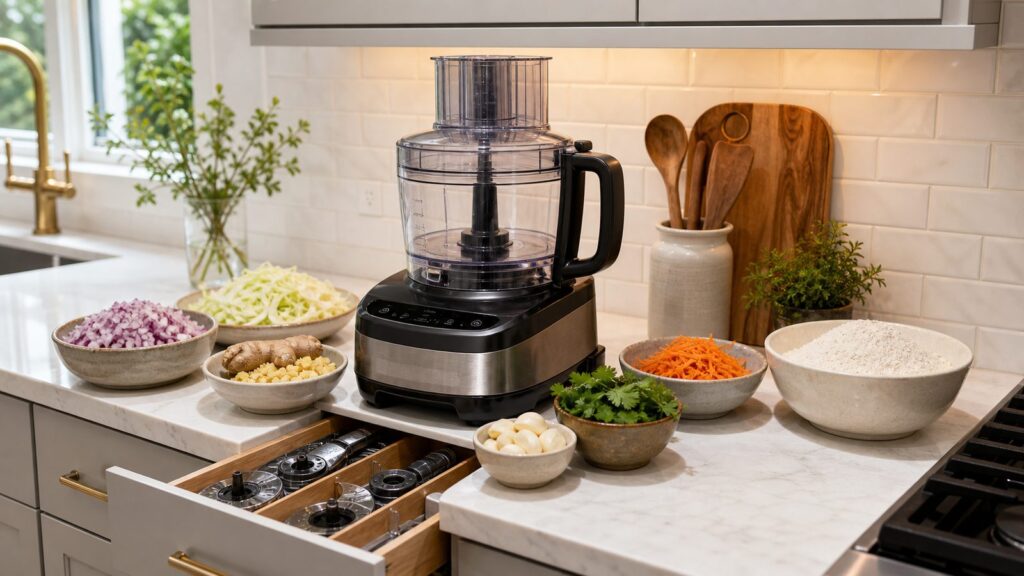
Food processor accessories are useful only if they are easy to find and safe to handle. A premium processor may include multiple discs, blades, bowls, dicing parts, and a storage case. Without a dedicated home, those pieces end up buried in a drawer and the processor gets used less.
For full-size processors, we like a deep drawer directly below or beside the prep counter for blades and discs. Use a storage case when supplied. If the machine is heavy, avoid storing it above shoulder height. If you want the processor hidden, consider an appliance garage only if it can be designed with code-compliant receptacle access, ventilation, and enough depth for the actual machine.
Independent reader supportYour contribution helps us test, update, and keep practical guides available for everyone.Cost: Processor Purchase vs Remodel Planning
The appliance itself may be a $57 mini chopper or a $700 premium processor, but the kitchen planning around it can affect a much larger remodel budget. National 2026 kitchen remodel figures commonly place typical projects around $14,588 to $41,551, while broader contractor guides put many full remodels around $15,000 to $75,000 or more. Major layout changes, luxury finishes, structural work, and high-end kitchens can exceed $90,000 to $200,000.
For food processor planning, the cost drivers are usually not exotic. They are practical items: whether outlets are already in the right place, whether the backsplash must be cut, whether the island needs power, whether the cabinet plan includes pull-out storage, whether the countertop material is difficult to drill or modify, and whether multiple high-draw appliances will be used at once.
| Item | Typical 2026 Planning Range | What Changes the Price |
|---|---|---|
| Mini chopper | $20 to $70 | Brand, bowl size, blade quality |
| Budget full-size processor | $50 to $150 | Motor strength, bowl capacity, accessories |
| Mid-range processor | $170 to $320 | Dicing kits, feed tube design, bowl quality |
| Premium processor | $400 to $700+ | Capacity, torque, accessory storage, durability |
| Added or relocated outlet | Often a few hundred dollars; example line item around $175 | Wall access, backsplash, circuit distance, local labor |
| Panel or service-related upgrade | Example line item around $1,500, often higher by scope | Panel capacity, utility requirements, permits, service size |
| Typical kitchen remodel | About $14,588 to $41,551 nationally | Cabinets, counters, layout, electrical, plumbing, finishes |
When to DIY vs When to Hire a Pro
Choosing and using the food processor is a homeowner-level decision. Measuring counter space, comparing bowl sizes, testing whether a machine fits under your upper cabinets, and setting up a blade storage drawer are all reasonable DIY tasks.
Electrical changes are different. Hire a licensed electrician when you add, move, or replace kitchen receptacles as part of a remodel, especially near sinks, islands, peninsulas, appliance garages, or new countertop runs. Kitchen receptacle spacing, GFCI protection, AFCI requirements, small-appliance circuits, and island rules are code-driven and locally enforced.
Hire a remodeling contractor when the processor zone affects cabinets, countertops, backsplash, lighting, or layout. A 30 inch prep run sounds simple until it competes with the sink base, dishwasher, range landing space, pantry storage, and trash pull-out. A good remodel plan coordinates all of those pieces before materials are ordered.
Permit requirements vary by city. Cosmetic work may not need a permit in many jurisdictions. Electrical, plumbing, structural, gas, hood ducting, and layout changes usually do. Permit costs can range from a few hundred dollars to several thousand dollars depending on scope and location. The safest approach is to verify requirements before work starts, not when inspection or resale documentation becomes a problem.
Windows Errors? Fix Them Before They Spread
Repair common Windows errors and clear accumulated junk for a smoother, more stable PC - no reinstall needed.Free scan · no reinstallOutdated Drivers Are Slowing You Down
One free scan finds every outdated or missing driver and matches the right update for your exact hardware.Free scan · exact hardware matchRank #4

- EASY ASSEMBLY: The smart design lets you set the work bowl onto the base, and uses the lid as the locking mechanism. No more struggling to lock the bowl into place.
- 8-CUP WORK BOWL: The large capacity gives you plenty of room to work with when creating salsas, nut butter, hummus, and so much more. The possibilities are endless.
- STAINLESS STEEL S-BLADE: The stainless steel blade quickly chops and mixes for fast, consistent results.
- REVERSIBLE SLICE/SHRED DISC:The reversible metal disc lets you slice veggies quickly or shred cheese without tiring your forearms.
- EASY-CLEAN TOUCHPAD CONTROLS: Easy-Clean Touchpad Controls feature low, high, and pulse settings.The powerful 450W motor takes care of food quickly and easily.
Common Buying Mistakes to Avoid
Do not buy too small if Indian meal prep is the main job. A 3 to 7 cup machine is convenient, but it is not pleasant for large cabbage, multiple onions, potatoes, and weekly prep. For families, start your search at 11 cups unless storage absolutely prevents it.
Do not expect a large bowl to handle tiny chutney portions well. Small quantities can sit below the blade path and smear around the bowl. A mini bowl, mini chopper, or mixer-grinder jar is often better.
Do not ignore cleanup. Turmeric, garlic, onion, chilies, and oil-heavy mixtures are hard on plastic parts and surrounding surfaces. Look for dishwasher-safe parts where possible, but also plan a wipeable backsplash, accessible sink, and counter material that will not punish daily cooking.
Do not plan outlets after backsplash selection. Cutting a finished tile or slab backsplash to correct a missed outlet is avoidable cost and frustration. Electrical planning belongs in the design phase, before cabinets are built and before counters are templated.
Our Practical Recommendation
For the average Indian family kitchen in the U.S., the strongest value is a 13 to 14 cup food processor paired with a mixer-grinder. That combination covers most real cooking: slicing, shredding, chopping, weekly vegetable prep, atta dough, chutneys, small pastes, and spice work. If you cook in large batches or entertain often, step up to a 16-cup premium processor and plan storage around it from the beginning.
If you are remodeling, treat the processor as part of the kitchen workflow, not as an afterthought. Give it 24 to 30 inches of usable prep counter, nearby GFCI-protected power, good task lighting, a nonporous cleanup-friendly surface, and a dedicated drawer for blades and discs. That planning costs less when it is done before cabinets, counters, and backsplash are installed.
A good food processor can save real time in an Indian kitchen, but the best result comes from matching the appliance to the cooking and matching the kitchen to the appliance. That is the difference between a machine that sits in a pantry and one that earns its space every week.
Frequently Asked Questions
What size food processor is best for Indian cooking?
For most Indian family kitchens, an 11 to 14 cup food processor is the best everyday size. It handles onions, cabbage, carrots, potatoes, and weekly prep without constant batching. Smaller 3 to 7 cup units are useful for herbs and small chutney portions but are usually better as secondary machines.
Do these 3 things before closing this tab:
1Scan for outdated or missing drivers - takes under a minute2Repair Windows errors before they cause bigger problems3Fix the driver behind crashes, sound loss and screen glitchesCan a food processor knead atta dough for roti or chapati?
Yes, if the processor has a dough blade or the manufacturer approves dough use. Use pulse or short runs, add water gradually through the feed tube, and stay within the listed flour capacity. Dense atta can strain a motor if overloaded.
Is a food processor better than a mixer-grinder for chutney?
Not always. A food processor works for larger, thicker chutney batches, but a mixer-grinder or mini chopper is usually better for small quantities and smoother textures because the blade sits closer to the food.
Can a food processor make dosa or idli batter?
A food processor is usually not the best tool for dosa or idli batter. A wet grinder or strong mixer-grinder generally gives a smoother batter and better texture for fermentation.
Do I need a permit to add outlets for countertop appliances?
Often, yes. Permit rules vary by city, but adding or relocating kitchen outlets typically requires electrical code compliance and inspection. GFCI protection, AFCI requirements, small-appliance circuits, and island rules should be reviewed by a licensed electrician.
Free tools Windows power users keep installed
One-click scans. No signup required.
Where should I store a food processor in a remodeled kitchen?
Store heavy full-size processors at counter height or in a base cabinet with a strong pull-out shelf. Keep blades and discs in a dedicated drawer or manufacturer storage case near the prep zone so the machine is safe and convenient to use.
Quick Recap
Product prices and availability are accurate as of the date/time indicated and are subject to change. Any price and availability information displayed on Amazon at the time of purchase will apply.

