Outdated Drivers Are Slowing You Down
One free scan finds every outdated or missing driver and matches the right update for your exact hardware.Free scan · exact hardware matchWindows Errors? Fix Them Before They Spread
Repair common Windows errors and clear accumulated junk for a smoother, more stable PC - no reinstall needed.Free scan · no reinstallSome links on this page are affiliate links: if you buy through them we may earn a commission, at no extra cost to you.
A plastic-free electric kettle should do one simple thing well: boil water without sending that water, or the steam that condenses back into it, across plastic parts. That is the standard we use when discussing these appliances with homeowners during kitchen upgrades. “BPA-free” is not the same thing. A kettle can be BPA-free and still have plastic inside the lid, in the filter frame, around the water window, at the spout, or near a sensor seal.
For most U.S. kitchens in 2026, the best practical choices are stainless steel interiors, borosilicate glass bodies with stainless hardware, or ceramic-lined designs. Expect to spend about $25 to $40 for a basic glass-and-stainless kettle, $45 to $75 for a compact or double-wall stainless model, $90 to $130 for a good variable-temperature kettle, and $180 to $250 or more for premium design, gooseneck precision, or higher-end controls.
As an Amazon Associate I earn from qualifying purchases.
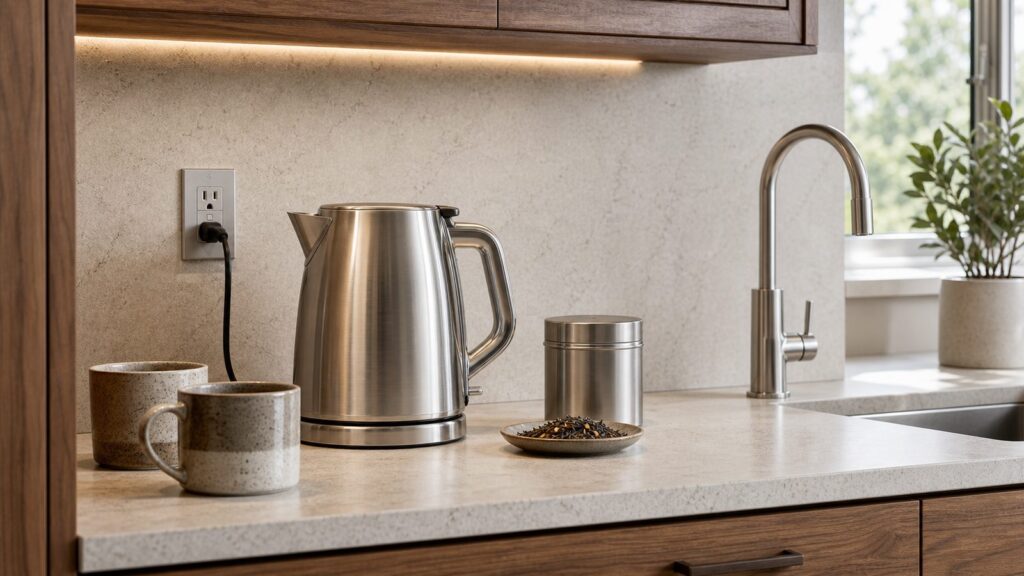
From a builder’s point of view, the kettle itself is only half the decision. A typical countertop electric kettle draws 1,000 to 1,500 watts. At 120 volts, a 1,500-watt kettle pulls about 12.5 amps, which is enough to dominate a small-appliance circuit if it is running beside a toaster, microwave, espresso machine, or air fryer. The right kettle belongs in the right countertop zone, with a properly protected receptacle, room for steam to rise, and surfaces that can handle daily heat and moisture.
What Plastic-Free Should Mean
For a serious buying decision, define plastic-free as no plastic in contact with boiling water, hot water, or the steam-condensate path. That means looking beyond the visible body material. A glass kettle with a plastic lid underside is not fully plastic-free by this standard. A stainless kettle with a plastic water-level window below the fill line is not fully plastic-free either.
Popular on Amazon

- No Plastic Contact with Your Water——With no plastic inside, water never touches plastic, ensuring a pure taste and safer drinking experience
- Faster Than a Stovetop Kettle——Heats 0.5L (2 Cups) water in under 3 minutes for less wait time
- Easy to Clean——Wide mouth and large-angle lid lets you reach every corner with ease
- Safe & Easy to Use——Worry-free auto shut-off and boil-dry safety feature
- Auto Shut-Off Safety——Automatically shuts off within 30 seconds after the water reaches a boil
The safer common hot-water-contact materials are 304 stainless steel, 316 stainless steel, borosilicate glass, and ceramic. Silicone seals may appear in otherwise low-plastic designs, especially around temperature sensors or lid assemblies. Silicone is not the same as hard plastic, but it should be disclosed clearly. If a manufacturer hides the contact path behind vague phrases like “premium materials” or “BPA-free,” keep looking.
On our job sites, we treat these details the same way we treat plumbing fixture finishes or countertop sealers: the surface that touches water matters. The outside finish can be beautiful, but the interior construction decides whether the product fits a healthier kitchen plan.
Recommended Free Tools
Where Plastic Commonly Hides
Before buying, check the product photos, questions, reviews, and replacement-part diagrams for these locations:
- Underside of the lid
- Water-level window
- Spout filter or filter frame
- Interior cap over the temperature sensor
- Fill-line marker inside the kettle
- Plastic hinge parts exposed to steam
- Plastic trim that sits above the spout and collects condensation
If you are comparing models online, search within reviews and Q&A for phrases like “plastic inside lid,” “water touches plastic,” “stainless interior,” “plastic filter,” and “metal filter.” Those terms often reveal more than the marketing bullet points.
The Best Types of Plastic-Free Electric Kettles
There is no single best kettle for every kitchen. The best choice depends on how you use it, how much counter space you have, whether children or older adults use the kitchen, and whether you care about precise brewing temperatures.
| Best use | Recommended style | Typical 2026 price | What to verify |
|---|---|---|---|
| Budget everyday boiling | Borosilicate glass with stainless base, spout, and filter | $25-$40 | No plastic lid underside or plastic filter frame |
| Family kitchen or aging-in-place design | Double-wall stainless steel | $45-$75 | Seamless stainless interior and cool-touch exterior |
| Tea and coffee households | Variable-temperature stainless or glass kettle | $90-$130 | Accurate presets and stainless water-contact parts |
| Pour-over coffee | Gooseneck kettle with temperature control | $180-$250+ | Controlled pour, stable base, stainless interior |
| Apartment or small countertop | 1.0-liter compact stainless kettle | $45-$80 | Short footprint, cord wrap, safe handle clearance |
| Hard-water homes | Wide-mouth stainless or glass kettle | $35-$120 | Easy descaling access and removable stainless filter |
Best Budget Glass Option
A 1.7-liter borosilicate glass kettle with stainless hardware is usually the best value if you want to avoid plastic contact without paying for premium controls. Many current models in this category sell around $25 to $40. They typically boil water quickly, make it easy to see the fill level, and avoid the metallic interior look some homeowners dislike.
The weakness is exterior heat and lid construction. Glass gets hot. If young children use the kitchen, or if the kettle sits near the edge of an island, we prefer a double-wall stainless model. Also inspect the lid carefully. Some glass kettles advertise stainless steel but still use plastic on the lid underside or filter frame.
Best Double-Wall Stainless Option
A double-wall stainless kettle is the most practical plastic-free choice for many full-time kitchens. The inner wall handles the boiling water, while the outer wall reduces surface temperature. That does not make the kettle harmless to touch, but it lowers burn risk compared with exposed glass or single-wall stainless.
Look for a 304 stainless steel interior, stainless lid underside, stainless spout area, automatic shutoff, boil-dry protection, and a base that does not wobble. Most useful models are 1.0 to 1.7 liters. A compact 1.0-liter kettle works well in a condo, basement kitchenette, guest suite, or beverage bar. A 1.5- to 1.7-liter model is better for families, oatmeal, French press coffee, and batch tea.
Also popular on Amazon

- 𝟯𝟬𝟰 𝗙𝗼𝗼𝗱-𝗚𝗿𝗮𝗱𝗲 𝗦𝘁𝗮𝗶𝗻𝗹𝗲𝘀𝘀 𝗦𝘁𝗲𝗲𝗹: stainless steel interior. Plastic-free—spout, inner lid, and filter all made of 304 stainless steel.
- 𝗜𝗻𝘁𝗲𝗿𝗻𝗮𝗹 𝗪𝗮𝘁𝗲𝗿 𝗟𝗲𝘃𝗲𝗹 𝗜𝗻𝗱𝗶𝗰𝗮𝘁𝗼𝗿: Unlike typical plastic water level indicators, ours is completely plastic-free to prevent plastic odors.
- 𝗘𝗮𝘀𝘆 𝘁𝗼 𝗨𝘀𝗲: Internal water level markings for precise filling, and blue LED light turns off when boiling is complete.
- 𝗕𝘂𝗶𝗹𝘁 𝘁𝗼 𝗟𝗮𝘀𝘁: Durable stainless steel construction with superior heat retention (compared to Cosori 171 Glass Kettle) and Strix auto shut-off for long-term reliability.
Best Pour-Over Choice
For pour-over coffee, a gooseneck kettle with temperature control earns its counter space. The narrow spout gives better flow control, and a hold-temperature function can keep water at a target temperature while you grind beans or prep a filter. Premium gooseneck models commonly land between $180 and $250 or more in 2026.
Do not pay that premium for ordinary tea, instant oatmeal, or general boiling unless you also value the design. For most households, a 1.7-liter stainless or glass kettle gives better capacity per dollar.
Materials: Stainless Steel, Glass, and Ceramic
The strongest plastic-free kettles use materials that are familiar in durable kitchens. Stainless steel, glass, and ceramic each have advantages, but they behave differently in daily use.
Stainless Steel
Stainless steel is the workhorse. Look for 304 stainless steel at minimum. 316 stainless steel is more corrosion-resistant, though less common and often more expensive. A seamless stainless interior is easier to clean than an interior with exposed seams, crevices, or mixed-material inserts.
Stainless is durable, opaque, and forgiving. It will not show scale as dramatically as glass, but scale is still there. In hard-water areas, we prefer a wide lid opening so the homeowner can descale and wipe the bottom plate without fighting the kettle body.
The Tool Desk
Outbyte Driver Updater FREEScan for outdated or missing drivers - takes under a minuteDriver Scan →Outbyte PC Repair FREERepair Windows errors before they cause bigger problemsFix Now →Borosilicate Glass
Borosilicate glass is popular because it lets you see the water, scale, and boil activity. It is also visually lighter on the counter than a large stainless appliance. Good glass kettles still need stainless at the base, spout, and filter to meet a low-plastic standard.
The tradeoff is heat and breakage. Glass bodies get hot, and they need careful handling around stone countertops, farmhouse sinks, and tight appliance garages. If the kettle will be used by guests, teenagers, or an older adult with reduced grip strength, double-wall stainless is usually the better specification.
Ceramic
Ceramic electric kettles can be attractive and low-plastic, but they are usually heavier and slower to handle. The added weight matters when the kettle is full. One liter of water weighs about 2.2 pounds before the kettle’s own weight is added. A full 1.7-liter kettle carries about 3.7 pounds of water, plus the body. That can be uncomfortable for some users.
Ceramic also needs close inspection around lid seals and internal fittings. When the construction is sound, it can be a good choice for a cottage-style kitchen, tea station, or low-use guest area.
Do these 3 things before closing this tab:
1Scan for outdated or missing drivers - takes under a minute2Repair Windows errors before they cause bigger problems3Fix the driver behind crashes, sound loss and screen glitchesAlso popular on Amazon

- No Plastic Contact with Your Water——With no plastic inside, water never touches plastic, ensuring a pure taste and safer drinking experience
- Faster Than a Stovetop Kettle——Boils a full cup of water in under 3 minutes for less wait time
- Easy to Clean——Wide mouth and large-angle lid lets you reach every corner with ease
- Dual-Angle Lid Design——One-touch button opens the lid to a splash-reducing angle, or fully opens it when you need to clean or refill.
- Safe & Easy to Use——Worry-free auto shut-off and boil-dry safety feature
Electrical Load and Outlet Planning
This is where many product roundups stop short. A kettle may be small, but electrically it behaves like a serious heat appliance. Most U.S. countertop electric kettles draw 1,000 to 1,500 watts. A 1,500-watt unit at 120 volts draws about 12.5 amps. On a 20-amp small-appliance branch circuit, that leaves limited headroom for another heating appliance running at the same time.
In a remodel, we plan beverage zones deliberately. A good setup groups the kettle, coffee maker, mugs, tea storage, and filtered water near a GFCI/AFCI-protected receptacle on an appropriate small-appliance circuit. The goal is not just convenience. It reduces cord stretching, prevents countertop clutter, and keeps steam away from finishes that do not tolerate repeated moisture.
Do You Need a Special Outlet?
Most electric kettles do not need a special outlet. They plug into a standard 120-volt kitchen receptacle. What they do need is a properly planned kitchen circuit. Modern kitchen countertops are typically served by 20-amp small-appliance circuits, with GFCI protection required in areas where shock risk is present and AFCI requirements depending on the adopted electrical code and local amendments.
Code adoption varies by jurisdiction, and permit rules are local. If you are simply replacing a plug-in kettle, there is no permit issue. If you are adding a receptacle, moving one, opening a backsplash, adding a beverage bar, or changing wiring, use a licensed electrician and follow the locally adopted electrical code.
What’s actually slowing this PC down?
Pick the symptom - the matching free tool is one click away.
Where the Outlet Should Go
For daily use, the outlet should allow the kettle to sit flat on the counter without the cord crossing a sink, cooktop, drawer front, or traffic path. In practice, that usually means a receptacle within a few feet of the beverage zone, high enough above the countertop to stay clear of splash but not tucked where the plug is forced behind a hot appliance.
For islands and peninsulas, current electrical rules have changed in recent code cycles, and many jurisdictions treat receptacle placement differently than they did years ago. Do not assume an island outlet can be added anywhere. During design, coordinate the receptacle location with cabinet panels, waterfall countertop ends, seating overhangs, and the electrician’s approved installation method.
Steam, Cabinets, and Countertop Damage
A kettle releases heat and moisture every time it boils. One boil is harmless. Years of steam under the wrong cabinet door can soften finishes, swell paint-grade panels, cloud under-cabinet lighting lenses, and damage low-voltage controls.
On our kitchen projects, we avoid placing the kettle directly under painted uppers, floating shelves, open wood shelving, or under-cabinet electronics. If the homeowner wants a beverage station, we prefer a section of open counter with a durable backsplash and clear vertical space above the kettle. Even moving the outlet 12 to 18 inches during a remodel can keep the steam plume away from a cabinet door stile or shelf edge.
Appliance Garages Need Ventilation
An appliance garage looks tidy, but it is not always the right place to operate a kettle. A closed or partially closed cabinet traps steam. That moisture can attack cabinet interiors, hinges, face frames, and nearby electrical devices. If you store the kettle inside an appliance garage, pull it out before boiling water unless the space is specifically designed with clearance and ventilation.
Also popular on Amazon

- No Plastic Contact with Your Water——With no plastic inside, water never touches plastic, ensuring a pure taste and safer drinking experience
- Faster Than a Stovetop Kettle——Boils a full cup of water in under 3 minutes for less wait time
- Easy to Clean——Wide mouth and large-angle lid lets you reach every corner with ease
- Dual-Angle Lid Design——One-touch button opens the lid to a splash-reducing angle, or fully opens it when you need to clean or refill.
- Safe & Easy to Use——Worry-free auto shut-off and boil-dry safety feature
For a built-in beverage zone, plan at least enough landing space for filling, boiling, pouring, and setting down a mug. A 24-inch-wide counter section can work for a compact kettle and coffee setup. A more comfortable zone is 30 to 36 inches wide, especially if two people use the kitchen in the morning.
Real 2026 Cost to Buy and Use One
Electric kettles are inexpensive to operate compared with the decisions around them. Boiling about 1 liter of water typically uses roughly 0.1 to 0.12 kilowatt-hours. At a residential electricity rate around $0.18 per kilowatt-hour, that is about $0.018 to $0.022 per 1-liter boil. Two 1-liter boils per day comes to roughly $13 to $16 per year before local rate variation.
Actual cost changes with fill amount, starting water temperature, wattage, insulation, how long the kettle holds temperature, and your local utility rate. National electricity figures also vary by source and month. In 2026, broad U.S. electricity data shows all-sector averages lower than typical residential rates, while consumer-facing residential averages are closer to about 17.9 to 18.8 cents per kilowatt-hour. For household budgeting, use your own utility bill.
| Cost item | Typical 2026 range | What changes the price |
|---|---|---|
| Budget glass/stainless kettle | $25-$40 | Capacity, lid material, filter material, retailer markdowns |
| Double-wall stainless kettle | $45-$75 | Interior quality, exterior finish, cool-touch design |
| Variable-temperature kettle | $90-$130 | Controls, temperature accuracy, warranty, base quality |
| Premium gooseneck or design kettle | $180-$250+ | Pour control, finish, brand, electronics, hold function |
| Operating cost per 1-liter boil | About 2 cents | Local kWh rate, fill volume, starting water temperature |
| Descaling supplies | $0-$15 | Vinegar, citric acid, or packaged descaler |
| Outlet relocation during remodel | Varies widely | Wall access, panel capacity, permit, backsplash, labor rates |
Safety Features Worth Paying For
At minimum, choose a kettle with automatic shutoff and boil-dry protection. Automatic shutoff turns the kettle off when water reaches boiling or the selected temperature. Boil-dry protection shuts the unit down if it is switched on with too little water. These are basic features, not luxuries.
Also look for a stable base, a handle that keeps knuckles away from steam, a lid that opens without putting your hand over the spout, and a power cord that can be shortened or wrapped under the base. For family kitchens, a double-wall body is worth considering because exposed glass and single-wall stainless can become hot enough to burn skin.
Safety listing matters. Look for a recognized U.S. electrical safety certification from an appropriate testing organization. A pretty imported kettle with unclear electrical documentation is not a bargain if support, warranty, or replacement parts are poor.
Independent reader supportYour contribution helps us test, update, and keep practical guides available for everyone.Maintenance: Hard Water, Scale, and Lifespan
A plastic-free kettle is only sustainable if it lasts. Hard water is the main maintenance issue. Minerals collect on the bottom plate, around the spout, and on filters. Scale slows heat transfer, can affect taste, and makes the kettle look older than it is.
Quick wins for a faster PC:
Clear out junk files and repair common Windows errorsFree Scan →Scan for outdated or missing drivers - takes under a minuteDriver Scan →For normal household use, descale every 4 to 8 weeks in hard-water areas and every 2 to 3 months in softer-water areas. Use the manufacturer’s instructions first. Many kettles can be cleaned with diluted white vinegar or citric acid, followed by several clean-water rinses. Descaler packets usually cost $5 to $15, but pantry vinegar or citric acid is often enough.
The best low-maintenance designs have a wide opening, smooth interior, simple bottom plate, and removable stainless filter. Avoid interiors with hard-to-reach ledges, decorative ribs, or mixed plastic trim. If the manufacturer sells replacement filters, lids, or seals, that is a real advantage for long-term use.
Also popular on Amazon

- 𝑼𝑷𝑮𝑹𝑨𝑫𝑬𝑫 𝑫𝑶𝑼𝑩𝑳𝑬-𝑾𝑨𝑳𝑳 𝑫𝑬𝑺𝑰𝑮𝑵: Say goodbye to the traditional single-wall plastic kettle. The upgraded double-wall design with stainless steel inner and outer shell keeps water warm longer and makes the surface of the kettle body safe to touch
- 𝑬𝑵𝑱𝑶𝒀 𝑪𝑳𝑬𝑨𝑵 𝑾𝑨𝑻𝑬𝑹: The seamless inner shell has no crevices for dirt to get trapped in. Every surface your water touches is crafted with food-grade 304 stainless steel instead of glass or plastic. Enjoy pure-tasting water for years to come
- 2-𝑳𝑬𝑽𝑬𝑳 𝑳𝑰𝑫: Open the lid to 45° using the button to avoid hot water splashing or raise the lid to 80° for easy filling and cleaning
- 𝑸𝑼𝑰𝑪𝑲 𝑩𝑶𝑰𝑳: Bring 6 cups / 1.5 liters of water to a rolling boil in 3–6 minutes and know exactly when your water is ready with a blue LED indicator that shuts off when it’s boiling
- 𝑺𝑨𝑭𝑬 𝑻𝑶 𝑼𝑺𝑬: The kettle automatically shuts off 30 seconds after your water comes to a rolling boil and has boil-dry protection that automatically turns off the kettle when no water is inside
When to DIY vs. When to Hire a Pro
Buying and using a countertop kettle is a normal homeowner task. Replacing an old kettle with a new plug-in model is DIY. Cleaning, descaling, comparing materials, and choosing a better location on the counter are also DIY.
Hire a licensed electrician when the solution involves wiring. That includes adding a receptacle, relocating an outlet for a beverage station, changing breaker protection, adding a circuit, troubleshooting nuisance trips, or modifying island and peninsula power. Hire a remodeling contractor when the work touches backsplash tile, countertop cuts, cabinet panels, appliance garages, or finished trim.
Free tools Windows power users keep installed
One-click scans. No signup required.
Permit requirements vary by city and county, but kitchen electrical work is not the place to improvise. A $50 kettle can expose a weak kitchen layout quickly: overloaded circuits, extension cords, steam under cabinets, and outlets in awkward locations. If the kitchen is already being remodeled, fix those issues while walls, backsplashes, or cabinets are open. It is cheaper and cleaner than coming back after the finishes are complete.
Our Practical Buying Checklist
Use this checklist before you buy:
- No plastic in contact with boiling water or steam condensate path
- 304 or 316 stainless steel, borosilicate glass, or ceramic food-contact surfaces
- Stainless lid underside and stainless spout/filter where possible
- Automatic shutoff and boil-dry protection
- Recognized U.S. safety listing
- 1,000- to 1,500-watt draw compatible with how your kitchen circuits are used
- Capacity that matches the household: 1.0 liter for compact use, 1.5 to 1.7 liters for families
- Wide opening for descaling and inspection
- Stable base and short, manageable cord
- Real warranty, U.S. retailer support, and available replacement parts where possible
For most homeowners, the best all-around choice is a 1.5- to 1.7-liter stainless interior kettle or a well-documented borosilicate glass kettle with stainless water-contact parts. Choose double-wall stainless when burn risk matters. Choose variable temperature if you brew green tea, coffee, or specialty teas often. Choose a gooseneck only when controlled pouring is part of your routine.
The Bottom Line
A good plastic-free electric kettle is a small appliance, but it belongs to a larger kitchen system. The right model keeps hot water away from plastic contact, draws power safely from a properly planned circuit, vents steam without damaging cabinets, and can be cleaned well enough to last for years.
If you are remodeling, plan the kettle location the same way you plan the range, sink, coffee maker, and microwave. Put the beverage zone where the work actually happens. Give it a protected receptacle, enough landing space, and finishes that can handle moisture. Then choose the kettle that fits that space instead of forcing the kitchen to work around a countertop appliance.
Recommended Free Tools
Frequently Asked Questions
What does plastic-free electric kettle actually mean?
For a strict standard, it means no plastic touches boiling water, hot water, or steam that can condense back into the kettle. Check the lid underside, water window, spout filter, sensor area, and fill markings.
Are stainless steel electric kettles safer than glass kettles?
Both can be good choices if the water-contact path is stainless, glass, or ceramic. Stainless is more durable and double-wall models reduce exterior heat. Glass makes water level and scale easier to see but the body gets hot.
Is BPA-free the same as no plastic contact?
No. BPA-free only addresses one chemical class. A BPA-free kettle may still have plastic parts touching hot water or steam. For a lower-plastic kitchen, verify the actual interior materials.
How many amps does an electric kettle use?
Most U.S. countertop electric kettles draw 1,000 to 1,500 watts. A 1,500-watt kettle on a 120-volt circuit uses about 12.5 amps, so it can take up much of a kitchen small-appliance circuit while running.
Do I need a special outlet for an electric kettle?
Usually no. Most plug into a standard 120-volt kitchen receptacle. The receptacle should be properly protected, conveniently located, and on an appropriate small-appliance circuit. Hire an electrician for new or relocated outlets.
Can I keep an electric kettle in an appliance garage?
You can store it there, but do not operate it in a closed or tight cabinet space unless the area is designed for heat and steam. Pull the kettle out before boiling to protect cabinet finishes and electrical components.
Quick Recap
Product prices and availability are accurate as of the date/time indicated and are subject to change. Any price and availability information displayed on Amazon at the time of purchase will apply.

