Free tools Windows power users keep installed
One-click scans. No signup required.
Some links on this page are affiliate links: if you buy through them we may earn a commission, at no extra cost to you.
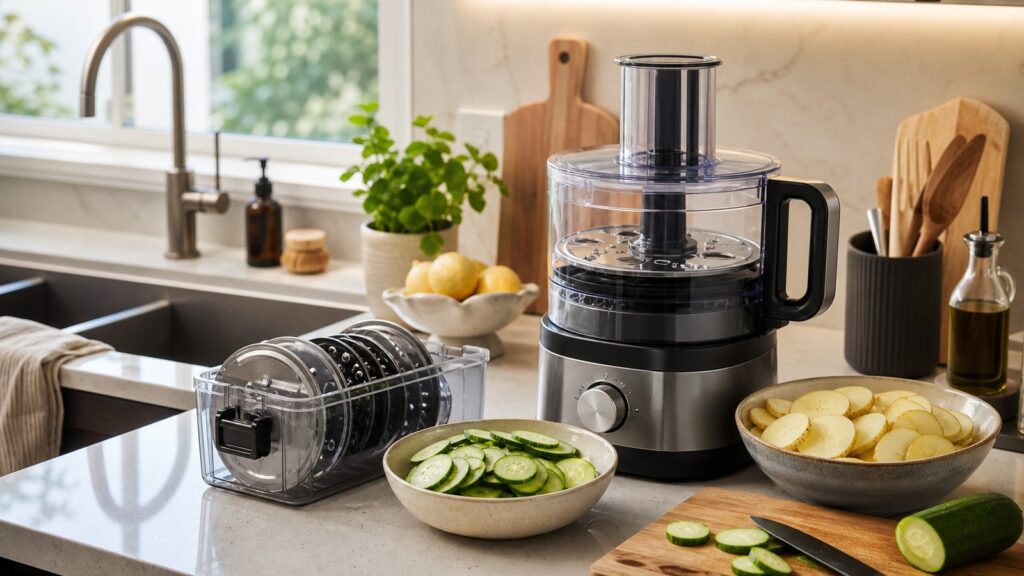
A good food processor with an adjustable slicer is one of the few countertop appliances that can change how a kitchen actually works. It can turn a pile of potatoes, cucumbers, onions, cabbage, zucchini, apples, or carrots into even slices in minutes, and it can also chop, shred, puree, mix dough, and handle meal-prep jobs that would otherwise take a cutting board, knife, mandoline, and a lot of cleanup.
The best choice for most American households is usually a 12- to 14-cup food processor with a true adjustable slicing disc, a wide feed chute, a stable base, dishwasher-safe parts, and safe storage for the blades and discs. Compact 8- to 9-cup machines make sense for small kitchens and lighter cooking. Larger 16-cup machines are better for heavy batch cooking, big families, and frequent entertaining, but they take up real cabinet and counter space.
From a contractor’s point of view, the appliance itself is only half the story. On our kitchen remodels, we see the same pattern again and again: homeowners buy a capable food processor, then stop using it because it is stored too high, too deep, too far from the sink, or too close to a crowded outlet area. A food processor with an adjustable slicer becomes much more valuable when the kitchen has a dedicated prep zone, durable counter surface, good task lighting, nearby GFCI-protected power, and storage that keeps sharp parts organized but out of reach of children.
The Tool Desk
Outbyte PC Repair FREEClear out junk files and repair common Windows errorsFree Scan →Outbyte Driver Updater FREEScan for outdated or missing drivers - takes under a minuteDriver Scan →As an Amazon Associate I earn from qualifying purchases.
What an Adjustable Slicer Actually Does
An adjustable slicing disc lets you change slice thickness without swapping multiple fixed discs. Depending on the model, the adjustment may be made with an external lever, a dial, or marked settings on the disc assembly. The best systems are clear enough that you can move from thin cucumber slices to thicker potato slices without guessing.
This matters because slicing is where food processors either feel like a professional tool or a frustrating gadget. A useful adjustable slicer should produce consistent slices, feed food cleanly without wedging, and let you control thickness for different recipes. Thin slices are useful for slaws, cucumber salads, gratins, and quick pickles. Thicker slices work better for roasted vegetables, potatoes, apples, and meal-prep containers where the food needs structure.
Popular on Amazon

- Built-in bowl scraper saves time. Quickly process ingredients without stopping to use a spatula. Simply move the scraper from side-to-side to scrape the bowl while the food processor is running or the power is off — no need to remove the lid.
- Slice, shred, chop, mix and puree with 2 versatile attachments. The Hamilton Beach food processor gives you 5 processing functions and includes a stainless steel slicing/shredding disc and chopping/pureeing blade so you can tackle every job with ease.
- Powerful 450 watt motor. Make healthy salads, homemade salsa, hearty acai bowls and more. The 450 watt motor easily powers through the toughest ingredients, so you can spend less time processing and more time enjoying.
- Precise control with 2 speeds plus pulse. The low and high speeds plus pulse give you the control you need for a variety of recipes. Use the high speed when you need more power and select the low speed for processing or mixing delicate foods.
- 10 cup bowl capacity. The generous 10 cup bowl fits large volumes of food all at once, and the large feed chute saves you time by reducing the need to pre-cut food before processing or using as a vegetable chopper.
When we evaluate appliances for a kitchen plan, we look at the whole workflow. Can the user set the processor on the prep counter, plug it in without stretching a cord across a wet area, slice a full bowl of vegetables, empty scraps into compost, rinse parts at the sink, and put everything away without unloading half a cabinet? If the answer is no, the best motor in the world will not matter much after the first month.
The Best Size for Most Kitchens
Food processor capacity is usually listed in cups, but that number does not tell the whole story. A 13-cup bowl is not meant to be filled to the rim with liquid, and a small bowl can feel even smaller when slicing cabbage or potatoes because the processed food builds volume fast. Still, the capacity range is a useful starting point.
| Capacity | Best For | Typical 2026 Price Range | Kitchen Planning Notes |
|---|---|---|---|
| 8-10 cups | Small households, light prep, limited storage | $50-$120 | Usually easier to store, but may require batch processing for cabbage, dough, or family meal prep. |
| 12-14 cups | Most families, weekly prep, vegetables, dough, shredding | $120-$250 mainstream; $250-$550 premium | The practical sweet spot for many remodeled kitchens. Plan a lower cabinet, deep drawer, or appliance garage with enough height. |
| 16 cups | Entertaining, large families, batch cooking, serious home cooks | Often $400-$600+ depending on accessories | Powerful and productive, but bulky. Confirm cabinet depth, door clearance, and lifting weight before buying. |
For most homeowners, a 12- to 14-cup processor is the right balance. It is large enough for a head of cabbage, pie dough, shredded cheese, sliced potatoes, and meal-prep vegetables, but it is not as awkward to lift or store as a 16-cup machine. A 13-cup model with in-bowl accessory storage can be especially practical because the discs stay with the unit instead of becoming loose hazards in a drawer.
If your household cooks only occasionally, an 8- or 9-cup processor may be enough. If you make large batches of slaw, salsa, dough, gratins, or freezer meals, step up. The wrong size usually shows up in two ways: the bowl fills too quickly, or the machine is so large and heavy that no one wants to pull it out.
Features That Matter More Than Wattage
Motor wattage is easy to compare, but it is not the whole appliance. A food processor can advertise a strong motor and still slice poorly if the feed chute is narrow, the disc flexes, the bowl fills unevenly, or the pusher lets food tilt. For an adjustable-slicer food processor, these are the features that deserve more attention.
True Adjustable Thickness
Look for clearly marked thickness settings or an external adjustment system. A disc that can move from thin to thick with a visible control is easier to use than one that requires guesswork. Some premium slicers use millimeter-style settings, which is helpful if you want repeatable results for potatoes, cucumbers, or onions.
Wide Feed Chute
A wider feed chute reduces knife work before the food processor even starts. If you have to cut every potato or cucumber into narrow wedges, the machine saves less time. A 3-in-1 feed tube is useful because it can handle larger vegetables while still giving better control for carrots, celery, and narrow foods.
Stable Base
A heavy base with good feet matters on stone countertops. Quartz, granite, and porcelain counters can transmit vibration and noise. A processor that walks across the counter is not just annoying; it is unsafe when sharp discs are spinning. We like to see enough counter depth for the machine, the feed tube, a bowl of uncut food, and a landing area for the finished slices.
Dishwasher-Safe Bowl and Lid
Cleanup friction is one of the biggest reasons people stop using food processors. If the bowl, lid, and pusher are awkward to wash, the appliance becomes a shelf decoration. Dishwasher-safe removable parts help, but homeowners should still rinse starches, onion residue, and sticky dough before they dry.
Recommended Free Tools
Disc Storage
Slicing and shredding discs should never be loose in a drawer. They damage easily, and they create a cut hazard. Look for in-bowl storage, a dedicated case, or a drawer insert that holds the discs vertically. In a remodel, we often plan a deep drawer or pull-out specifically for sharp appliance accessories.
Replacement Parts
A cracked bowl, broken pusher, or discontinued lid can turn a $300 appliance into waste. Before buying, check whether the brand sells replacement bowls, lids, pushers, blades, and discs. Common replacement discs and blades often run about $15-$60 each, with premium or proprietary kits costing more.
Also popular on Amazon

- POWERFUL PERFORMANCE: Equipped with a 1000-peak-watt motor, this Ninja food processor effortlessly handles tough ingredients, ensuring smooth and consistent results every time.
- AUTO-IQ TECHNOLOGY: Features 4 Auto-iQ intelligent preset programs that take the guesswork out of food prep, providing one-touch control for chopping, slicing, pureeing, and dough making.
- LARGE CAPACITY: The 9-cup bowl is perfect for large batches, making it ideal for family meals, entertaining, or weekly meal prep, saving you time and effort in the kitchen.
- PRECISION BLADES: Includes stainless steel precision blades designed for optimal performance, ensuring even chopping, slicing, and pureeing of all your ingredients.
- DOUGH BLADE INCLUDED: Comes with a specialized dough blade that makes mixing dough for bread, pizza, and pastries a breeze, delivering professional-quality results at home.
Best Food Processor Types to Consider
Rather than chasing one universal winner, match the machine to how you cook and how your kitchen is built. These categories are more useful than a simple brand ranking.
Best Overall for Most Families: 12- to 14-Cup Adjustable-Slicer Model
This is the workhorse category. A 12- to 14-cup processor gives enough capacity for weeknight cooking and weekend prep without taking over the kitchen. Look for adjustable slicing, a wide feed chute, a multipurpose blade, a shredding disc, a dough blade if you bake, and a storage case or in-bowl caddy.
Expect to spend about $120-$250 for a solid mainstream model and $250-$550 for a premium model with better accessories, stronger build quality, dicing options, or more refined slicing controls. For many households, this is the best value range because it can replace several smaller gadgets while still fitting under standard wall cabinets if measured carefully.
Best for Small Kitchens: 8- to 10-Cup Compact Processor
A compact processor is a better choice when storage is tight or the household cooks in smaller batches. It will not handle a full cabbage or large dough batch as easily, but it can still slice vegetables, shred cheese where the manufacturer allows it, chop herbs, and make sauces.
Budget models in this size range commonly cost about $50-$120. The tradeoff is usually lighter construction, fewer accessories, smaller feed chutes, and less precise slicing. If you choose this route, make sure the slicer is truly adjustable, not just a fixed slicing disc described with vague marketing language.
Best for Heavy Batch Cooking: 16-Cup Premium Processor
A 16-cup processor makes sense for homeowners who cook in volume: big holiday meals, freezer prep, large slaws, dough batches, or regular entertaining. These machines can exceed $500 depending on the brand and accessory package.
The downside is size. A large processor can be too tall for an appliance garage, too heavy for a high shelf, and too bulky for a shallow cabinet. Before buying one, measure the appliance with the lid and feed tube attached. Also measure the route from storage to counter. If you need two hands and a clear runway just to move it, daily use will drop.
Best for Accessory Lovers: Multi-Kit Systems With Dicing
Some full-size processors include dicing kits, multiple slicing settings, dough blades, storage cases, and nested bowls. These are useful if you will actually use the parts and store them properly. Dicing kits can be especially convenient for salsa, soups, salads, and batch prep, but they add cleaning time and storage complexity.
KitchenAid-style 13-cup systems, for example, are known for adjustable slicing and feed-tube options, and some configurations include in-bowl storage. Live pricing varies by color, retailer, and promotion, so compare the exact accessory package rather than just the model family.
How to Test One Before You Commit
If you can inspect the appliance in person, bring a tape measure and pay attention to the parts your hands will touch. A food processor should lock together clearly, sit flat, and feel manageable to lift. The bowl should not feel brittle, the lid should not require awkward force, and the pusher should fit cleanly.
What’s actually slowing this PC down?
Pick the symptom - the matching free tool is one click away.
Also popular on Amazon

- This is an O.E.M. authorized part
- Fits various Cuisinart models
- OEM Part Number FP-12ASD
- Fits the following models: 3066 3067 3093 3094 3111 3112 KF140 KF593
- Item is manufactured in United States
The best slicing test is simple: potatoes and cucumbers. Potatoes reveal whether the disc cuts evenly under load. Cucumbers show whether thin slices stay consistent or turn ragged. Onions and cabbage are also good real-world tests because they expose feed-chute problems and bowl-volume limits quickly.
At home, run the test where you intend to use the machine. Put it on the actual counter, plug it into the outlet you expect to use, and process enough food to fill part of the bowl. Notice whether the cord is in the way, whether the machine vibrates, whether the lid splashes, and whether you have enough landing space for ingredients and finished food.
Kitchen Layout: Where the Processor Should Live
A food processor with an adjustable slicer belongs in the prep zone, not next to the range. Slicing creates volume. You need room for whole vegetables, trimmed ends, finished slices, a bowl, and cleanup. The best location is usually near the sink, trash or compost, and a clear section of counter at least 24 to 36 inches wide.
For a serious prep area, we like to see a durable counter surface, under-cabinet or ceiling task lighting, a wipeable backsplash, and a nearby receptacle that does not require the cord to cross the sink or cooktop. If the kitchen has an island, the island can be an excellent processor station, but only if power is planned correctly and the appliance has enough counter depth around it.
Storage should be one-motion storage. That means you can open a door or drawer and remove the processor without moving stacked pans, mixers, or serving pieces. If the processor weighs 15 to 25 pounds, a high shelf is a bad long-term plan. Below-counter storage works better when paired with a rated pull-out shelf that can handle both the appliance weight and the downward force of setting parts into place.
Appliance Garages and Cabinet Storage
An appliance garage can be a clean solution, but only if it is designed around the actual machine. Many food processors are roughly 10 to 12 inches wide, 8 to 11 inches deep, and 15 to 18 inches tall with the bowl and feed tube attached. Larger 16-cup machines can be taller and heavier. Measure the exact unit before cabinetry is ordered.
A good appliance garage needs more than a door. It needs enough interior depth for the cord, enough height for the feed tube, enough width for your hands to lift the bowl, and a door style that does not block the work zone. Pocket doors, lift-up doors, tambour doors, and retractable fronts all behave differently. A beautiful garage that forces you to assemble the appliance sideways will not get used.
Costs vary widely. A simple semi-custom cabinet modification may add a few hundred dollars to a kitchen project. A fully integrated appliance garage with finished panels, retractable doors, an interior outlet, custom pull-outs, and matching hardware can reach $1,000-$3,000 or more as part of a larger remodel. That cost can be worth it when it keeps the appliance accessible and the counter clear, but it should be planned early with the cabinet designer and electrician.
Crashes, No Sound, or Screen Glitches?
Random freezes, missing sound and display glitches usually trace back to one bad driver. Find and replace yours safely.Free scan · under a minutePC Slower Than It Used to Be?
A free scan shows the junk files, broken settings and background clutter dragging Windows down - then fixes them in one click.Free scan · Windows 10 & 11Electrical and Permit Considerations
Buying a countertop food processor does not usually require a permit by itself. It is a plug-in appliance, not a built-in appliance. Permits and inspections enter the picture when you add or relocate receptacles, modify kitchen circuits, install power inside an appliance garage, change an island or peninsula, open walls, or alter cabinetry with electrical work.
Modern kitchen electrical planning is not casual. Countertop receptacles in kitchens generally need GFCI protection, and many projects also involve AFCI requirements depending on the jurisdiction and adopted code cycle. Islands and peninsulas have specific rules that have changed in recent code updates, so the local electrical inspector’s requirements matter. A licensed electrician should verify circuit capacity, outlet placement, protection type, box location, and whether the planned appliance garage can legally contain an energized receptacle in your area.
Also popular on Amazon

- SUPERIOR FUNCTION: The Cuisinart Food Processor with 720-watt motor functions as a vegetable chopper, blender, and food processer in one. Make any kind of dip, puree soup, or sauce including hummus, salsa, guacamole, and more.
- MUST-HAVE FEATURES: The 14-cup food chopper has “on” and “off/pulse” buttons with an extra-large feed tube with bowl sleeve assembly designed for both small and large feed tube pushers. It also comes with a detachable disc stem for easy clean up.
- INCLUDED ACCESSORIES: This food processor comes with dishwasher-safe parts including a stainless steel standard slicing disc (4mm), medium shredding disc, and stainless steel chopping/mixing blade.
- NOTE TO CONSUMER: The shredding and slicing blades of this electric chopper are not adjustable. Please refer to the manual before setting up.
- LIMITED 3-YEAR WARRANTY: The Cuisinart Food Processor comes with a limited 3-year warranty on the entire unit and a full 5-year warranty on the motor.
Adding or relocating a kitchen receptacle commonly costs a few hundred dollars to $1,000 or more. The number depends on wall access, backsplash material, tile repair, panel capacity, permit fees, and inspection requirements. Moving an outlet before tile and cabinets are finished is usually much cheaper than cutting into a completed backsplash later.
Also think about real appliance stacking. A food processor, toaster oven, coffee maker, blender, microwave, and stand mixer can crowd the same prep area. If several high-draw appliances are used together, nuisance tripping can become a daily irritation. During a remodel, it is worth discussing dedicated small-appliance circuits and practical outlet spacing before the cabinetry plan is locked.
Quick wins for a faster PC:
Clear out junk files and repair common Windows errorsFree Scan →Scan for outdated or missing drivers - takes under a minuteDriver Scan →Repair Windows errors before they cause bigger problemsFix Now →When to DIY vs. When to Hire a Pro
Choosing and using the food processor is a homeowner-level decision. You can compare capacities, read the manual, test slice thickness, wash parts, and organize discs without hiring anyone. You can also add a nonslip mat, a blade storage case, or a drawer organizer yourself.
Hire a pro when the work affects electrical, cabinetry, counters, or built-in storage. That includes adding an outlet, relocating a receptacle, installing power inside an appliance garage, cutting finished panels, modifying a cabinet box, adding a pull-out shelf, or changing an island. These are small projects compared with a full kitchen remodel, but they can affect code compliance, fire safety, cabinet warranty, and finished appearance.
| Task | DIY? | Typical Cost | Pro Note |
|---|---|---|---|
| Buy processor and accessories | Yes | $50-$550+ | Measure height, width, depth, and cord location before purchase. |
| Add drawer organizer for discs | Usually | $20-$150 | Use a design that shields cutting edges and prevents loose stacking. |
| Install pull-out shelf | Sometimes | $100-$500+ | Check shelf rating for appliance weight plus downward handling force. |
| Add or move receptacle | No for most homeowners | Few hundred dollars to $1,000+ | Use a licensed electrician and confirm GFCI/AFCI and permit rules. |
| Build integrated appliance garage | No, unless skilled | $1,000-$3,000+ | Coordinate cabinet dimensions, door swing, ventilation, and electrical access early. |
Common Buying Mistakes
The first mistake is buying for motor wattage alone. Power matters, but slicing quality depends on the disc, chute, lid, pusher, and bowl geometry. A high-watt machine with poor feeding can still create uneven slices.
The second mistake is ignoring height. A processor that is too tall for the planned appliance garage or too high to fit under wall cabinets becomes a storage problem immediately. Measure it assembled, not just the base.
Do these 3 things before closing this tab:
1Fix the driver behind crashes, sound loss and screen glitches2Repair Windows errors before they cause bigger problems3Scan for outdated or missing drivers - takes under a minuteThe third mistake is loose blade storage. Slicing discs should be kept in a case, caddy, or protected drawer insert. Loose discs can cut hands and dull their own edges when they knock into other tools.
The fourth mistake is expecting one appliance to replace everything. A food processor overlaps with a mandoline, blender, stand mixer, and box grater, but it does not make all of them obsolete. A mandoline can still be better for ultra-thin presentation slices. A blender is still better for very smooth liquids. A stand mixer is still better for many bread and baking jobs.
The fifth mistake is putting the processor in a crowded, wet, or hot work zone. Keep it away from the range, avoid cord routes near water, and give yourself enough counter space to stage food safely.
What We Recommend for a Remodel
If you are remodeling a kitchen and want the food processor to become a tool you use every week, plan for it the same way you would plan for trash pull-outs, mixer storage, or a coffee station. Pick the appliance early enough that the cabinet designer and electrician can work with real dimensions.
Also popular on Amazon

- EASY ASSEMBLY: The smart design lets you set the work bowl onto the base, and uses the lid as the locking mechanism. No more struggling to lock the bowl into place.
- 8-CUP WORK BOWL: The large capacity gives you plenty of room to work with when creating salsas, nut butter, hummus, and so much more. The possibilities are endless.
- STAINLESS STEEL S-BLADE: The stainless steel blade quickly chops and mixes for fast, consistent results.
- REVERSIBLE SLICE/SHRED DISC:The reversible metal disc lets you slice veggies quickly or shred cheese without tiring your forearms.
- EASY-CLEAN TOUCHPAD CONTROLS: Easy-Clean Touchpad Controls feature low, high, and pulse settings.The powerful 450W motor takes care of food quickly and easily.
For most kitchens, our practical specification is a 12- to 14-cup processor, a dedicated prep counter close to the sink, a GFCI-protected receptacle within easy reach, under-cabinet lighting or strong overhead task lighting, and a lower storage location that does not require lifting the machine above shoulder height. If the homeowner cooks heavily, we consider a pull-out shelf or appliance garage. If children are in the home, blade storage gets extra attention.
Budget realistically. The food processor may cost $120-$550, replacement accessories may run $15-$60 each, and the kitchen modifications can cost more than the appliance if electrical and cabinetry are involved. That does not mean the upgrade is excessive. It means the appliance should be treated as part of the kitchen workflow, not an afterthought purchased after the counters are installed.
Bottom Line
The best food processor with an adjustable slicer is not simply the most expensive model or the one with the biggest motor. It is the model that slices evenly, fits your cooking volume, stores safely, cleans without a fight, and works in the kitchen you actually have.
For most homeowners, start with a 12- to 14-cup machine with a clearly adjustable slicing disc, wide feed chute, stable base, dishwasher-safe parts, and reliable replacement-part support. Then make sure the kitchen supports it: 24 to 36 inches of prep space, safe nearby power, good lighting, and storage that lets you grab the appliance in one motion. That is when an adjustable-slicer food processor stops being a gadget and becomes a real kitchen upgrade.
Free tools Windows power users keep installed
One-click scans. No signup required.
Frequently Asked Questions
What is an adjustable slicing disc on a food processor?
It is a slicing disc that lets you change slice thickness without swapping separate blades. Better models use marked settings, a dial, or an external lever so you can move from thin cucumber slices to thicker potato or apple slices with repeatable control.
Is a 13-cup or 14-cup food processor big enough for most families?
Yes. A 12- to 14-cup food processor is the practical sweet spot for most households because it can handle vegetables, shredding, dough, and meal prep without the bulk of a 16-cup machine.
Do I need a permit to add an outlet for a countertop food processor?
Buying the food processor does not usually require a permit. Adding or relocating a kitchen receptacle, changing circuits, or installing power inside an appliance garage may require a permit and inspection depending on local code.
Can a food processor be used inside an appliance garage?
Sometimes, but only if the garage is designed for the actual model. Confirm height with the feed tube attached, depth for the cord, door clearance, ventilation, and local electrical rules for interior receptacles.
Do these 3 things before closing this tab:
1Scan for outdated or missing drivers - takes under a minute2Repair Windows errors before they cause bigger problems3Fix the driver behind crashes, sound loss and screen glitchesIs a food processor with an adjustable slicer better than a mandoline?
It is better for speed, volume, and keeping hands farther from the blade during large prep jobs. A mandoline can still be better for ultra-thin presentation slices and small tasks where washing a full processor is not worth it.
Where should a food processor be stored in a remodeled kitchen?
Store it near the prep zone, ideally close to the sink, trash or compost, and a clear counter. A lower cabinet, deep drawer, pull-out shelf, or properly sized appliance garage is usually better than a high shelf.
Quick Recap
Product prices and availability are accurate as of the date/time indicated and are subject to change. Any price and availability information displayed on Amazon at the time of purchase will apply.

