Windows Errors? Fix Them Before They Spread
Repair common Windows errors and clear accumulated junk for a smoother, more stable PC - no reinstall needed.Free scan · no reinstallCrashes, No Sound, or Screen Glitches?
Random freezes, missing sound and display glitches usually trace back to one bad driver. Find and replace yours safely.Free scan · under a minuteSome links on this page are affiliate links: if you buy through them we may earn a commission, at no extra cost to you.
Most homeowners ask the repair-or-replace question after a leak, a storm, or a roof inspection that raises more questions than it answers. The short answer is this: repair makes sense when the damage is isolated, the roof is still well within its service life, the decking is dry and sound, and the repair cost is a small fraction of replacement. Replacement becomes the better investment when leaks are showing up in multiple areas, shingles are broadly curled or bald, decking is soft, the roof already has two layers, or repair costs are approaching roughly 25% to 35% of a full replacement on an older roof.
On our job sites, we do not treat this as a guessing game. We look at the roof from above and from the attic side when access is available. The outside tells us about shingle condition, flashing, valleys, penetrations, storm damage, and drainage. The attic tells us whether water has been traveling farther than the stain on the ceiling suggests. Rusted nail tips, dark sheathing, daylight around penetrations, compressed insulation, blocked intake vents, and soft decking can change a small repair into a larger roofing scope.
As an Amazon Associate I earn from qualifying purchases.
Free tools Windows power users keep installed
One-click scans. No signup required.
For 2026 planning, most roof repairs in the U.S. fall between about $350 and $2,500. Small fixes such as replacing a pipe boot, sealing a minor flashing issue, or replacing a few shingles may run $150 to $600. Larger repairs involving valleys, chimneys, skylights, decking, rafters, insulation, emergency leak response, or interior moisture damage can reach $3,000 to $8,000 or more. Full roof replacement commonly lands around $5,800 to $14,000 for many typical asphalt roofs, with national averages clustering near $9,500 to $10,000. Larger homes, steep rooflines, premium materials, major decking repairs, or complex roof geometry can push replacement to $46,000 or higher.
The right decision is not just about today’s leak. It is about roof age, material life, repair frequency, code requirements, insurance coverage, future plans, and how much useful life the repair is actually buying.
Popular on Amazon

- Personal Fall Arrest System: Fall protection roofing kit including tongue buckle harness,50ft roofing rope with rope grab & snap hook,5 gallon bucket and steel roof anchor.Warning: Before using this equipment, you must read and understand all Instructions for Use.
- Orange Safety Harness:Roofing Safety Harness offers tongue buckle adjustment superior protection. Full body harness supports users within the capacity range of waist size: 30.7inch-55.3inch leg size: 21.2inch-38inch, fit weigh 130-310 pounds due to the adjustment point.It helps relieve the anxiety of climbing such a steep roof.
- 50ft Fall Protection Rope: 50ft vertical rope assembly with diameter 5/8” in is made from heavy duty braided.Come with double lock-locking rope grab ,anti-panic locking feature allows brake to lock.You can hook the ring up ring (it is behind you back in the center of your shoulder blades) to the rope yourself, just pull it down your back.It is being able to keep the rope in my hand while moving up and down the roof giving me stability.Minimal break strength 5,000 lb. Gate rating 3,600 lb.
- Reusable Temporary Anchor: Made of galvanized steel material top anchor with heavy duty forged d-ring for roofing work. Roof anchor braket came with 20pcs nail (16 penny nail It is about a three and a half inch nail. Strong head to sesure. You could use a duplex it is easier to remove. The bracket can be mounted at the ridge and moved as you move.Minimum Breaking Strength: 5,000 lbs(22.2 kN)
- 5 Gallon Bucket: Designed to protect the roof and crew from accidental falls during construction, roof project and advanced window cleaning tasks. Just in case and ensure the safety of you. It is the perfect limit for application in construction work, roof, thatched roof and high-rise window cleaning tasks such as slate roof, gazebo,bluff,sweep chimneyshed,story garage.
Start With the Practical Decision Tree
A roof repair should solve a defined problem. A roof replacement should solve a system problem. That distinction matters.
If a 9-year-old architectural shingle roof has one cracked pipe boot and the surrounding shingles are in good shape, replacement would usually be excessive. If a 24-year-old asphalt roof has leaks at two valleys, bald shingles on the south slope, brittle tabs, and stained sheathing in the attic, repeated repairs are usually just delaying the inevitable.
Repair is usually the right call when:
- The roof is under roughly half of its expected service life.
- Damage is limited to one slope, one penetration, one small wind area, or one flashing detail.
- The roof deck is dry, flat, and structurally sound.
- Shingles or panels can be matched closely enough for a durable repair.
- The leak has a clear source, such as a pipe boot, chimney flashing, skylight curb, vent, or small storm puncture.
- The repair is inexpensive compared with replacement, usually well below 25% of replacement cost.
Replacement is usually the better call when:
- Leaks show up in multiple rooms or at multiple roof features.
- Attic sheathing has widespread staining, mold, softness, or daylight at penetrations.
- The roof plane is sagging or uneven.
- Shingles are broadly curled, cracked, brittle, or missing granules.
- Storm damage affects several slopes instead of one isolated area.
- The roof has recurring ice-dam damage.
- The roof has two existing layers and local code requires tear-off.
- The repair estimate is roughly 25% to 35% of replacement cost and the roof is already near the end of its expected life.
That 25% to 35% threshold is a rule of thumb, not a law. A $2,000 repair on a newer $18,000 roof may be a smart move. A $4,500 repair on a 22-year-old roof that would cost $13,000 to replace may be poor lifecycle math, especially if the repair does not come with a meaningful warranty or address ventilation and underlayment issues.
Warning Signs That Point to Roof Repair
Some roof problems are real but limited. These are the situations where a good contractor should be able to show you the exact failure point, explain the repair method, and give you a clear expectation for how long the repair should last.
Missing or lifted shingles in one area
Wind can lift shingles along a rake edge, ridge, or exposed slope. If the surrounding shingles are flexible, well-adhered, and not heavily granule-depleted, replacing the damaged shingles may be enough. The repair should include proper nail placement, compatible shingles, and sealing where appropriate. A few shingles may cost $150 to $600 in many markets, but steep pitch, difficult access, or emergency scheduling can raise that number.
Cracked pipe boot
Rubber pipe boots often fail before the main roof covering does. The rubber collar cracks from UV exposure, movement, and age. A failed boot can create a ceiling stain that looks worse than the actual roof problem. Replacing the boot or installing an approved repair collar can be a straightforward repair when the surrounding shingles and decking are sound.
Do these 3 things before closing this tab:
1Repair Windows errors before they cause bigger problems2Scan for outdated or missing drivers - takes under a minute3Clear out junk files and repair common Windows errorsLocalized flashing leak
Flashing is where many roof leaks begin. Chimneys, sidewalls, skylights, dormers, valleys, and roof-to-wall transitions all require careful water management. If the leak is tied to one flashing condition, the repair may involve removing shingles around the area, replacing step flashing or counterflashing, installing membrane, and rebuilding the tie-in. These repairs often fall into the $600 to $1,900 range, depending on access and complexity.
Small puncture or storm impact
A branch, flying debris, or isolated hail impact can damage a small section of roof. The key question is whether the damage is limited. We look slope by slope, not just at the obvious hole. If impacts are scattered across multiple elevations, it may move from repair territory into replacement or insurance claim territory.
Minor fascia, soffit, or edge damage
Not every roof-edge issue means the whole roof has failed. A localized fascia or soffit repair may be appropriate if the roof edge, drip edge, underlayment, and gutter attachment are otherwise in good condition. But if the edge damage comes from chronic overflow, ice dams, missing drip edge, or poor ventilation, the repair needs to address the cause.
Warning Signs That Point to Roof Replacement
A roof is a system: roof covering, underlayment, flashing, decking, ventilation, drainage, and structural support all have to work together. Replacement becomes the practical choice when that system is failing in more than one place.
Quick wins for a faster PC:
Repair Windows errors before they cause bigger problemsFix Now →Fix the driver behind crashes, sound loss and screen glitchesFind Drivers →Multiple leak paths
One leak can be a defect. Several leaks usually indicate age, poor installation, storm damage, or widespread material failure. If water is appearing in different rooms, around multiple penetrations, or after ordinary rain rather than extreme weather, replacement should be seriously considered.
Widespread granule loss or bald shingles
Granules protect asphalt shingles from UV exposure and weathering. When shingles become bald across large areas, especially on sun-exposed slopes, the asphalt mat ages faster. A patch may stop one leak, but it will not restore the surface life of the roof.
Curling, cracking, or brittle shingles
Curled and cracked shingles are difficult to repair cleanly because adjacent shingles can break during the work. This is one reason older roofs become expensive to patch. Even if the immediate leak can be stopped, the act of repairing one area may damage nearby brittle shingles.
Also popular on Amazon

- Vertical lifeline assembly (VLA) features polydac rope that mitigates water absorption and associated damage. The lifeline has an integrated shock pack that keeps the pack off of the user’s back.
- 18” lanyard extension keeps positioning device within reach and reduces trip hazards
- Full body harness with 5-point adjustment
- Temper anchor includes needed hardware
- Multi-lingual instructions
Soft or rotted decking
Soft decking is not a cosmetic issue. Roof fasteners need solid sheathing to hold. If plywood or OSB has deteriorated from long-term moisture, a surface repair will not solve the structural problem. Replacement pricing should include a per-sheet allowance for decking replacement so the homeowner knows the cost before tear-off exposes the full condition.
Recommended Free Tools
Sagging roof plane
A sagging roof plane can point to structural movement, damaged rafters or trusses, failing decking, overloaded framing, or long-term moisture. This requires a closer inspection before any roof covering decision. In some cases, the roofing scope must be coordinated with framing repair.
Two existing roof layers
Many jurisdictions limit roof layering and may require tear-off when there are already two layers, when the deck must be inspected, or when the new material cannot be installed over the old covering. Even where overlays are technically allowed, we generally prefer a tear-off for long-term work because it exposes the deck, old flashing, damaged underlayment, and hidden rot.
2026 Roof Repair and Replacement Cost Comparison
Roof pricing varies by region, access, labor market, roof geometry, material, and season. A simple ranch roof with a 4:12 pitch is not the same project as a two-story home with dormers, valleys, skylights, a chimney, and a steep rear slope. Still, planning ranges help homeowners understand whether a bid is in the right conversation.
| Project type | Typical 2026 cost range | Common scope | Best fit |
|---|---|---|---|
| Minor repair | $150-$600 | A few shingles, nail pops, small flashing touch-up, vent boot, minor sealant work | Newer or healthy roof with one isolated issue |
| Moderate repair | $600-$1,900 | Leak tracing, chimney or skylight flashing, valley repair, larger shingle patch | Localized problem with sound decking |
| Major repair | $2,000-$8,000+ | Decking, rafters, insulation, large storm section, emergency leak response, interior moisture damage | When damage is significant but full replacement is not yet justified |
| Asphalt replacement | $3.50-$8 per sq. ft. installed | Tear-off, underlayment, shingles, flashing, vents, disposal, inspection | Most standard residential roofs |
| Metal replacement | $8-$16+ per sq. ft. installed | Metal shingles or standing seam, underlayment, trim, flashing, panel fabrication | Longer service life and higher upfront budget |
| Premium tile or slate | Often well above asphalt | Specialty labor, structural review, heavier materials, custom flashing | Long-life roofs where structure and budget support it |
For a typical asphalt replacement, many homeowners see full project pricing around $5,800 to $14,000, with national averages near $9,500 to $10,000. A 1,700 to 2,500 square foot roof often lands around $6,000 to $18,000 depending on pitch, tear-off, complexity, local labor, and material selection. Large, steep, premium, or complicated roofs can climb much higher, including $46,000 or more.
Cost drivers homeowners often miss
The visible shingle or panel is only part of the roof price. A complete bid should account for tear-off layers, dump fees, permit and inspection fees, drip edge, flashing, pipe boots, vents, ridge vent, intake ventilation, ice-and-water membrane where required or appropriate, synthetic underlayment, decking replacement, fasteners, warranties, and site protection.
Decking is one of the biggest unknowns. A contractor cannot always see every bad sheet until the old roof is removed. Ask for a clear unit price, such as cost per plywood or OSB sheet installed, so you are not surprised midway through the job. Also ask whether the bid includes replacing step flashing, valley metal, apron flashing, counterflashing, and drip edge, or whether some components are being reused.
Material Lifespans and Repair Logic
The material on the roof changes the decision. A 16-year-old 3-tab asphalt roof and a 16-year-old standing seam metal roof are in very different stages of life.
Asphalt shingles
Standard asphalt shingles often last about 15 to 30 years. Architectural shingles may last about 25 to 40 years depending on product quality, attic ventilation, climate, roof slope, installation, and maintenance. If an asphalt roof is under 10 to 12 years old and the issue is localized, repair is often reasonable. If it is 20 to 25 years old with broad wear, replacement usually deserves a serious look.
Metal roofing
Metal roofing can last 40 to 70 years when properly designed and installed. Repair decisions often involve fasteners, sealants, panel seams, penetrations, coatings, and flashing. Standing seam systems are different from exposed-fastener systems. Exposed fasteners and washers can age and need maintenance, while standing seam problems often involve detailing at penetrations, eaves, ridges, and transitions.
Wood shake or shingle
Wood roofs can last roughly 20 to 50 years depending on climate, ventilation, material quality, maintenance, and fire treatment. Repairs require matching thickness, exposure, and weathering. In some jurisdictions, fire rating rules or local restrictions can affect replacement options.
Tile and concrete
Tile and concrete roofs can last 50 to 100 years, but the underlayment and flashing beneath them may not last as long as the tile itself. A leak in a tile roof is often an underlayment, flashing, valley, or broken-tile issue. Replacement can require structural review because tile is heavy, and repairs require crews who know how to move across the roof without breaking surrounding pieces.
Slate
Slate can last 75 to 100 years or more when the structure, fasteners, flashing, and installation are right. Repair is often preferred when the slate field is sound, but specialty labor matters. Poor repair work on slate can damage valuable material and shorten the roof’s life.
What’s actually slowing this PC down?
Pick the symptom - the matching free tool is one click away.
Also popular on Amazon

- User Weight Capacity- 130- 310 lbs,Compliance: ANSI Z359.11-2021
- Reusable complete personal fall arrest system, including lightweight, universal size advanced seat belts, vertical lifeline components.
- Includes 50 ' 8/16 ' woven ropes, premium hooks, reusable roof anchors including nails, durable premium portable denim bags and extra PP thickened bags
- Usage suggestions: Check the rope before each use. If there is no accidental injury, you can use it with confidence.
- 50FT Roofer's Safety Bucket Kit – Upgrade Safety Harness, Roof Anchor, Reusable Roofing Knee Pads,and 50ft Vertical Lifeline Assembly, ANSI Compliant
Why a Small Shingle Match Can Still Be a Problem
Homeowners often ask why a contractor cannot simply replace the damaged shingles and make the roof look new again. Sometimes we can. Sometimes the repair will function but still look different.
Shingles fade from sun exposure. Granule color changes over time. Manufacturers discontinue colors and profiles. Even the same color name from the same manufacturer may not match a roof that has been weathering for 12 years. On a rear slope, that may not matter. On the front elevation of a home going to market, it can matter a lot.
There is also a technical issue. Older shingles can become brittle. To replace one shingle, the crew often has to lift surrounding shingles to remove nails and install new fasteners. If those surrounding shingles crack during the work, a small patch grows. That does not mean repair is wrong, but it should be discussed before the work starts.
Permits, Codes, and Roof Layers
Roofing is regulated locally. The authority having jurisdiction, often called the AHJ, decides which code edition applies, when permits are required, what inspections are needed, whether ice barriers are required, what wind uplift ratings apply, and whether specific fire ratings or product approvals are needed.
The 2024 International Residential Code includes roof assembly requirements, but local adoption and amendments vary. A city, county, or state may be on a different code cycle or may have stricter rules because of wind, wildfire, snow, hail, or coastal exposure. That is why a good roofing proposal should not just say “built to code.” It should identify permit responsibility and include materials appropriate for the local requirements.
Partial reroof permits
Some jurisdictions require permits for full reroofs but not for very small repairs. Others require a permit when a certain percentage of the roof is replaced, when structural decking is touched, when roof covering is removed down to the deck, or when the work changes materials. Homeowners should not assume a partial project avoids permitting.
Ice barriers and underlayment
Cold-climate areas may require ice barrier membrane at eaves and other vulnerable areas. High-wind areas may require specific fastening patterns or rated assemblies. Low-slope sections may require different materials than steep-slope shingle areas. These details affect cost and schedule, but they also affect whether the roof will pass inspection and perform under weather.
Ventilation corrections
Ventilation is often discovered during reroof planning. A roof can have good shingles and still fail early if attic ventilation is poor. Blocked soffit vents, missing baffles, insufficient intake, mixed exhaust types, or short-circuited airflow can trap heat and moisture. When we see rusted fastener tips, damp sheathing, or uneven attic temperatures, we treat ventilation as part of the roof system rather than a side issue.
Insurance: Replacement Cost, ACV, and Deductibles
Insurance can change the roof decision, but it should not replace construction judgment. A roof can be insurable but still poorly planned, or denied by insurance but still physically near the end of its life.
Homeowners should understand the difference between replacement cost coverage and actual cash value, often called ACV. Replacement cost coverage may pay to replace covered damage according to the policy terms, less the deductible and subject to depreciation rules. ACV coverage pays the depreciated value of the roof, which can leave the homeowner with a much larger out-of-pocket cost on an older roof.
Deductibles matter. If a repair is $1,200 and the deductible is $2,500, filing a claim may not help. If storm damage affects several slopes and the replacement is $16,000, the claim conversation is different. Some claims also involve supplements when hidden decking, code upgrades, or additional damage are documented after tear-off. That documentation should be photo-based and line-item specific.
Ask the contractor for slope-by-slope photos, not just wide drone shots. The most useful documentation shows close-ups of damaged shingles, flashing, valleys, penetrations, decking, fastener placement, ventilation details, and code-related components. A good contractor can separate emergency leak control from the longer insurance and replacement strategy.
The Tool Desk
Outbyte PC Repair FREERepair Windows errors before they cause bigger problemsFix Now →Outbyte Driver Updater FREEScan for outdated or missing drivers - takes under a minuteDriver Scan →Timeline: What Actually Happens From First Call to Finished Roof
The installation itself is often the shortest part of the project. The full timeline includes inspection, estimate, contract approval, material selection, permit processing, material delivery, weather scheduling, installation, cleanup, inspection, and warranty documentation.
Also popular on Amazon

- Premium Roof Braided Rope: 50 FT vertical rope assembly with diameter 0.55 in is made from heavy duty braided 100% polyester that features solid multiple layers sewn terminations to strengthen the construction This way ensures maximum safety and stability for the person using it. Its max weight capacity is 310 lbs, so there is no worry about looseness or breakage.Please confirm length before purchase.
- Alloy Steel Rope Grab:Safety harness roofing rope come with double lock-locking screw mechanism and locking clip added two safeguards to your work environment.Its min. Breaking strength: 3600 lbs, meets ANSI Z359.1.In addition,anti-panic locking feature allows brake to lock the rope grab onto lifeline in event of a fall, even if the user holds the device open.
- Steel Snap Hooks:Roofing tree climbing fall restraint system comes with two strength steel snap hooks constructed of a long-wearing non-corrosive steel material which as a strong connection with your other security equipment like a security harness and anchors with D-rings. Spring switch design & strength lock switch on two sides allows workers to better use the rope while working, and are self-locking with minimal tensile break strength of 5,000 lb. and a 3,600 lb. gate rating.
- Energy Absorber:The lanyard shock absorbers statically tested with minimum breaking strength more than 5,000 pounds (22.2 kN). It is designed for up to 6-foot free fall applications including clothing, tools, etc. with a maximum deployment distance of 48 inch/1.2m & average arresting force 900 lbs. When deployed, the shock cord unpacks allowing a 18' fall before the elastic part of the cord slows the velocity. Tips: No need to break the sealed package, it will pop open automatically when used.
- 【ANSI Standard】:The ANSI fall protection equipment is suitable for use by professionals in various industries, includes one eye termination with hardend thimble and one knot on the other end, applied with Anti-abrasive tubes for protecting rope ends from abrasion. Our roofing safety lanyard rope has multi applications which provides fall protection for climbing, gutter cleaning, steep roofs, inspection, rescue, window washing and other works.
Inspection and estimate
An inspection may happen the same day or within a few days, depending on workload and weather. A straightforward repair estimate can sometimes be written quickly. A full replacement estimate with several material options, ventilation changes, insurance documentation, and decking allowances may take longer.
Permitting and material ordering
Permitting and material ordering commonly add days to weeks. Standard asphalt shingles are usually easier to source than specialty metal panels, tile, slate, custom colors, or unusual profiles. Storm seasons can stretch lead times because suppliers, inspectors, adjusters, and roofing crews all get backed up at the same time.
Installation duration
Many asphalt shingle replacements take 1 to 3 days once the crew starts. Complex asphalt roofs may take 3 to 5 days. Standing seam metal commonly takes 3 to 7 days. Tile may take 3 to 7 days or more. Slate, custom metal, structural repairs, or specialty details can run 1 to 2 weeks or longer.
Do these 3 things before closing this tab:
1Repair Windows errors before they cause bigger problems2Fix the driver behind crashes, sound loss and screen glitches3Clear out junk files and repair common Windows errorsA normal first-call-to-finished-roof timeline is often about 2 to 3 weeks. During storm season, high-demand months, insurance supplements, permit delays, or special-order material lead times, that can stretch to 6 to 12 weeks.
Weather windows
Weather affects quality, not just convenience. Asphalt shingles need suitable temperatures and sun exposure to seal properly. Low-slope membranes need dry substrates. Wind can make tear-off and material handling unsafe. Rain can expose decking and interiors if the job is opened at the wrong time. Extreme heat affects crew safety and material handling. Cold can make shingles brittle and harder to work with.
A contractor who moves a start date because the forecast turned is protecting the roof. The better question is whether the company communicates clearly, stages materials properly, and avoids opening more roof than it can dry-in safely.
When to DIY and When to Hire a Pro
There are a few roof-related tasks a capable homeowner can handle from the ground or from a stable ladder position. There are many tasks that should be left to trained crews with fall protection, roof-specific tools, and insurance.
Reasonable DIY tasks
- Checking the attic for stains, daylight, damp insulation, or musty odor.
- Photographing ceiling stains and noting when they appear.
- Cleaning gutters from a safe ladder setup if you are comfortable and properly equipped.
- Looking from the ground with binoculars for missing shingles, lifted edges, damaged flashing, or debris.
- Trimming small branches near the roof if it can be done safely from the ground.
Hire a professional for:
- Any work on steep, high, wet, icy, or fragile roofs.
- Leak tracing around chimneys, skylights, valleys, dormers, and wall transitions.
- Metal, tile, slate, or low-slope membrane repairs.
- Structural concerns, sagging, soft decking, or suspected rot.
- Storm damage documentation for insurance.
- Repairs requiring removal of surrounding shingles, flashing, or underlayment.
- Any work requiring a permit or inspection.
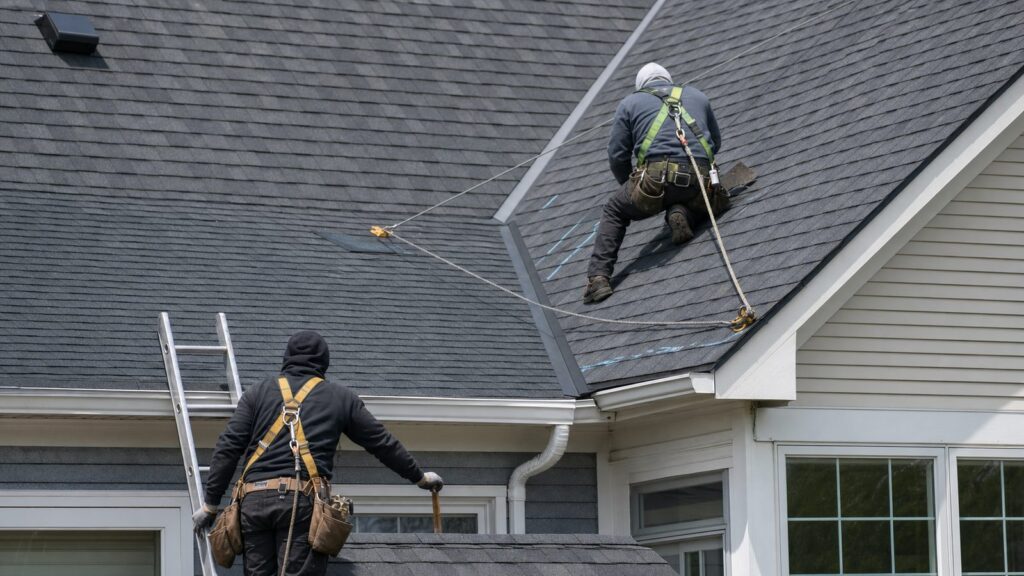
OSHA requires fall protection at 6 feet in construction. Professional roof crews should plan for ladders, anchors, harnesses, guardrails, warning lines, or other compliant systems as applicable. A roof job should not be treated like a quick handyman ladder task. Fall protection takes time and money, and it belongs in the job plan.
Independent reader supportYour contribution helps us test, update, and keep practical guides available for everyone.What a Good Roofing Bid Should Include
A vague roof bid creates problems later. A good bid gives you enough detail to compare scope, not just price.
For a repair, ask for the suspected leak source, repair area, materials being removed and replaced, flashing scope, whether nearby shingles may break during the work, what is excluded, and how the repair is warranted. For replacement, ask for roof area in squares, tear-off layers, underlayment type, ice-and-water membrane locations, drip edge, flashing, pipe boots, ventilation changes, ridge and starter shingles, fastener type, disposal, permit fees, inspection requirements, decking allowance, cleanup method, and warranty terms.
Also ask how the contractor protects landscaping, siding, driveways, attic contents, and gutters. On active job sites, small details like plywood protection, magnetic nail cleanup, dump trailer placement, and daily dry-in planning make a real difference.
Free tools Windows power users keep installed
One-click scans. No signup required.
Questions worth asking before you sign
- What evidence supports repair instead of replacement, or replacement instead of repair?
- Can you show slope-by-slope photos and close-ups of the problem areas?
- How old is the roof, and how much service life is realistically left?
- Will this require a permit or inspection in our jurisdiction?
- What is the per-sheet price for decking replacement if rotten sheathing is found?
- Are you replacing flashing or reusing existing flashing?
- How will ventilation be handled?
- What weather conditions would delay the work?
- What warranty applies to labor and materials?
- What is excluded from the price?
Repair vs Replacement Examples
Here is how the decision usually looks in real planning terms.
Example 1: Newer roof, one failed pipe boot
A 7-year-old architectural shingle roof has a ceiling stain under a plumbing vent after wind-driven rain. The shingles are flexible, the attic sheathing is dry except for a small stain near the pipe, and the boot collar is visibly cracked. This is a repair candidate. The likely scope is replacing the boot and nearby shingles if needed, often in the $150 to $600 range depending on access and market.
Also popular on Amazon

- RELIABLE TONGUE BUCKLES : The Roofing Safety Harness offers tongue buckle adjustment superior protection. Our full body harness supports users within the capacity range of waist size: 30.7inch-55.3inch leg size: 21.2inch-38inch, fit weigh 130-310 pounds due to the adjustment point.
- STEEL D-RINGS : The dorsal D-ring and side hip D-rings are made of high-strength steel reducing constant readjustments and stays in position. and support users within the capacity range of 130 to 310 pounds. 2 side hip rings design for work positioning and store more spare hooks!
- 6ft LANYARD: This safety harness lanyard combines two functions into one, making it convenient to use.It serves as both a fall arrest lanyard and a shock absorber.This eliminates the need for an additional bulky shock pack, reducing the risk of tripping hazards. Its elasticated leg can expand from 4-1/2 to 6 feet with a maximum capacity up to 310 lb (141 kg) including clothing, tools, etc., The lanyard has a tensile strength of 8,500 lbs, ensuring reliable performance safety lanyard.
- DURABLE SNAP HOOK: The shock absorbing fall protection lanyard with double hooks is built to last.The tough webbing used in its construction is highly resistant to abrasion and aging. Self-locking with minimal tensile break strength of 5,000 lb. and a 3,600 lb.gate rating. Safety harness lanyard doesn't soften easily from frequent use.
- ANSI STANDARD: TRSMIMA ensures the safety and well-being of workers through setting standards and offering training, outreach, education, and assistance. Great for use in Construction, Demolition, Climbing, Hunting, Roofing, Emergency, First responder, Landscaping, Security and etc.
Example 2: Older roof, several active leaks
A 23-year-old asphalt roof has leaks near a chimney, in a bedroom, and at a rear valley. The south slope is bald, shingles crack when lifted, and attic sheathing has staining across several bays. A repair may buy a little time, but replacement is usually the better recommendation. If the repair estimate is $4,000 and replacement is $13,500, the repair is nearly 30% of replacement with limited remaining roof life.
Example 3: Storm damage across multiple slopes
A hail or wind event damages shingles across three slopes, with missing tabs, bruising, exposed mat, and displaced ridge shingles. This is not the same as replacing a few blown-off shingles. The homeowner should document the damage, review insurance coverage and deductible, and get a line-item replacement estimate with code and ventilation details.
Crashes, No Sound, or Screen Glitches?
Random freezes, missing sound and display glitches usually trace back to one bad driver. Find and replace yours safely.Free scan · under a minutePC Slower Than It Used to Be?
A free scan shows the junk files, broken settings and background clutter dragging Windows down - then fixes them in one click.Free scan · Windows 10 & 11Example 4: Tile roof with underlayment failure
A tile roof may have many years of tile life remaining but still leak because the underlayment has aged out. In that case, a repair might involve lifting and resetting tile in one area, replacing underlayment and flashing below, and reinstalling usable tile. If leaks are widespread, the practical project may be a lift-and-relay or full underlayment replacement rather than a simple patch.
Future Plans Can Change the Answer
The best roof decision also depends on what you plan to do with the house.
If you are installing solar, replacing an aging roof first can prevent the cost of removing and reinstalling panels a few years later. If you plan to sell, a patched front slope with mismatched shingles may become a negotiation issue even if it does not leak. If you plan to stay for 20 years, a higher-quality replacement system may make more sense than repeated repairs. If cash flow is tight and the roof is otherwise sound, a targeted repair may be the responsible move.
There is no honor in overselling a replacement when a repair will do the job. There is also no savings in stacking repairs on a roof that has already aged out. The contractor’s job is to show the evidence, explain the tradeoff, and help the homeowner choose with clear numbers.
What’s actually slowing this PC down?
Pick the symptom - the matching free tool is one click away.
Bottom Line: Make the Roof Decision With Evidence
Repair the roof when the failure is isolated, the roof is relatively young, matching materials are available, decking is sound, and the repair cost is modest compared with replacement. Replace the roof when the system is broadly aged, leaking in multiple places, structurally compromised, repeatedly damaged, difficult to repair cleanly, or no longer worth patching.
Before you commit, get a roof inspection that includes exterior and attic-side evidence when possible. Ask for photos, line-item pricing, permit clarity, decking allowances, ventilation review, warranty terms, and a realistic schedule. A useful contractor should be able to explain not only what they recommend, but why that recommendation is the better construction decision.
Frequently Asked Questions
How do I know if my roof needs repair or full replacement?
Repair is usually right when damage is isolated, the roof is still relatively young, and the decking is sound. Replacement is usually better when there are multiple leaks, widespread shingle wear, soft decking, sagging, two roof layers, or repair costs approaching about 25% to 35% of replacement on an older roof.
How much does roof repair cost in 2026?
Most U.S. roof repairs run about $350 to $2,500. Small repairs such as a few shingles or a vent boot may cost $150 to $600, while major repairs involving decking, framing, insulation, emergency service, or storm damage can reach $3,000 to $8,000 or more.
Recommended Free Tools
How much does roof replacement cost in 2026?
A typical asphalt roof replacement often falls between about $5,800 and $14,000, with national averages near $9,500 to $10,000. Installed asphalt commonly runs about $3.50 to $8 per square foot, while metal often runs $8 to $16 or more per square foot.
How long does roof replacement take?
Once installation starts, many asphalt roofs take 1 to 3 days, complex asphalt roofs take 3 to 5 days, standing seam metal often takes 3 to 7 days, and tile or slate can take a week or more. From first call to finished roof, 2 to 3 weeks is common in normal conditions, while storm seasons or special-order materials can stretch the timeline to 6 to 12 weeks.
Can I repair my own roof?
Homeowners can safely do ground-level checks, attic inspections, and some gutter maintenance if properly equipped. Hire a pro for steep roofs, active leaks, flashing work, storm damage, structural concerns, metal, tile, slate, low-slope membranes, or anything requiring a permit.
Does a roof replacement always require a permit?
Permit rules are local. Many jurisdictions require permits for full reroofs, structural decking work, material changes, or replacing more than a certain portion of the roof. The local authority having jurisdiction decides the adopted code, inspections, ice barrier rules, wind ratings, and fire-rating requirements.
Quick Recap
Product prices and availability are accurate as of the date/time indicated and are subject to change. Any price and availability information displayed on Amazon at the time of purchase will apply.

