Recommended Free Tools
Some links on this page are affiliate links: if you buy through them we may earn a commission, at no extra cost to you.
A good patio door awning solves a simple problem: it makes the doorway and outdoor living area more usable. The right one cuts glare, keeps rain off the threshold, protects nearby flooring from UV exposure, and can make a west- or south-facing patio feel 10 to 20 degrees more comfortable during peak sun.
The wrong awning creates different problems. We see them on job sites: brackets fastened into siding instead of framing, fabric pitched too flat to drain, retractable units installed on windy elevations with no realistic storm plan, and large covers treated like lightweight accessories when they are actually structural loads hanging off the house.
As an Amazon Associate I earn from qualifying purchases.
Quick wins for a faster PC:
Repair Windows errors before they cause bigger problemsFix Now →Fix the driver behind crashes, sound loss and screen glitchesFind Drivers →For most U.S. homeowners in 2026, a professionally installed small door awning runs about $300 to $800. A typical residential awning project lands around $1,455 to $4,651, with national averages near $2,700 to $3,041. Larger premium retractable patio awnings commonly reach $5,000 to $8,500, and custom or engineered systems can exceed $10,000. Price matters, but the better question is what kind of protection you need and what your house can safely support.
This guide breaks down the best door and patio awning choices the way a contractor evaluates them: by use case, projection, wall attachment, material, wind and snow exposure, drainage, permitting, and serviceability.
Start With the Job the Awning Must Do
Before picking fabric color or motor options, define the job. A small awning over a back door is not the same project as a 16-foot retractable unit over a dining patio, and neither should be designed like a code-defined patio cover with posts and footings.
Popular on Amazon
- UPF 80+ Fabric: This manual retractable awning uses 180 g/m² polyester with PU coating. It provides level 4 colorfastness to resist fading, while UPF 80+ shields against sunlight and reduces heat. The water-resistant canopy blocks light rain for comfort
- 43"-59" Adjustable Side Poles: Our 118" retractable awning features adjustable side poles. It allows flexible shade coverage for windows, balconies, or patios. The twist-lock design is more stable than push-button types, reducing wobbling for reliable use
- 0°-90° Adjustable Angle: The retractable patio awning supports flexible angle adjustment from 0° to 90° using the included crank. The side poles adjust to changing sunlight, reducing glare and direct exposure. It can also function as a privacy screen
- Steel & Aluminum Structure: This retractable awning for patio is built with a high-strength steel frame and aluminum roller tube. It withstands level 2 wind. Retract during severe weather and install with 2 people. Use ropes for stability on balconies
- Adjustable Pole Height: Our retractable sun awning features adjustable poles from 82.7"-122" to fit different spaces. The no-drill design reduces wall damage. Adjustable feet and top/bottom non-slip pads improve stability and allow use on uneven ground
For a single exterior door, the goal is usually threshold protection. You want enough projection to keep rain off the lockset, reduce splash at the sill, and shade the first few feet inside the door. Typical small door awnings project 2 to 4 feet and run 3 to 6 feet wide. They work best over side doors, mudroom entries, basement walkouts, and compact patios where people stand briefly rather than gather for hours.
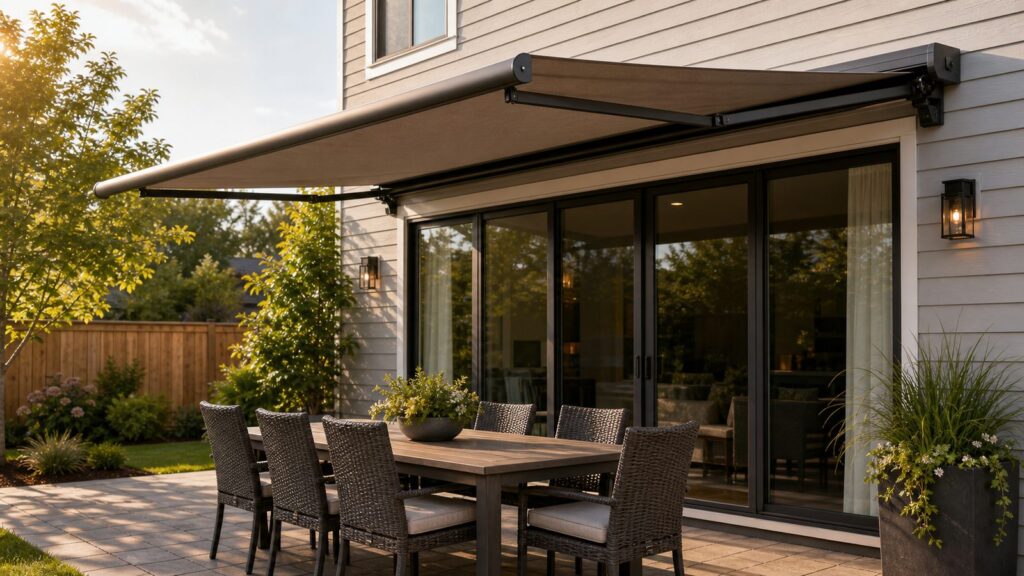
For a patio or deck, the goal is occupied shade. That usually means a width of 10 to 20 feet and a projection of 8 to 13 feet. At that size, wind uplift and wall attachment become much more serious. A 12-by-10-foot awning has 120 square feet of surface area. In a gust, that is not a decoration. It is a sail connected to your house.
For year-round rain protection, a fixed metal, polycarbonate, framed fabric, or permitted patio cover is usually stronger than a retractable awning. For seasonal comfort and flexibility, retractable fabric is often the better fit because it can be extended for summer shade and retracted to allow winter sun.
Best Awning Types for Patio Doors
The best awning type depends on the door location, exposure, and how permanent the shade needs to be. On our projects, we group them into seven practical categories.
Fixed Door Awnings
Fixed door awnings are small, always-in-place covers mounted above an exterior door. They are usually aluminum, steel, polycarbonate, acrylic panel, or fabric on a light frame. For a typical residential door, expect a width of 3 to 6 feet and a projection of 2 to 4 feet.
Do these 3 things before closing this tab:
1Clear out junk files and repair common Windows errors2Fix the driver behind crashes, sound loss and screen glitches3Repair Windows errors before they cause bigger problemsThey are best for back doors, garage man doors, side entries, and patio doors that need basic rain and sun protection. They are not ideal for shading a full seating area. Installed cost often falls around $300 to $800 for smaller units, but stucco, brick veneer, second-story access, or poor framing access can push the price higher.
Fixed Metal Awnings
Metal awnings cost more than many small fabric canopies, but they are durable and useful where rain performance matters. Aluminum is common because it resists corrosion and keeps weight down. Galvanized steel can be stronger but needs a good finish and proper fasteners to avoid rust staining.
Metal awning installation commonly runs about $900 to $4,500, with an average around $2,100. Size, gauge, finish, brackets, and site complexity drive the range. For high-use doors, rental properties, workshops, and exposed entries, metal often gives the best long-term value.
Stationary Fabric Awnings
Stationary fabric awnings use a fixed frame and replaceable fabric cover. They soften the look of a patio door and can be built in custom shapes, widths, and projections. Premium solution-dyed acrylic fabrics are common for shade because the color is part of the fiber, not just a surface coating. Many premium shade fabrics carry 10-year limited warranties against loss of color or strength under normal exposure.
Fabric is not maintenance-free. It needs cleaning, drying, inspection, and eventual replacement. It also needs enough pitch to shed water. A fabric awning installed too flat will hold water, stretch, stain, and stress the frame.
Manual Retractable Patio Awnings
Manual retractable awnings use a crank handle instead of a motor. They are simpler, cheaper, and do not require electrical work. Many standard installations fall around $1,000 to $3,500, though smaller budget models can cost less and premium larger models cost more.
Manual operation works well when the awning is not used every day or when the projection is moderate. The drawback is human behavior. If it is inconvenient to crank in, people leave it out. That is risky before storms, high winds, and heavy rain.
Motorized Retractable Patio Awnings
Motorized retractable awnings are the comfort choice for large patios. A wall switch, remote, or smart control makes daily use easier. Premium systems may add wind sensors, sun sensors, LED lighting, manual override, and replaceable fabric. Typical installation labor and setup can run about $1,000 to $3,000, before very large units, custom work, structural preparation, or electrical upgrades.
Free tools Windows power users keep installed
One-click scans. No signup required.
A wind sensor is helpful, but it is not a guarantee. Retractable awnings should be retracted during high winds or storms unless the manufacturer specifically rates the product for those conditions. We still give homeowners a clear storm procedure because automation can fail, lose power, or react too late in sudden gusts.
Freestanding Shade Structures
Freestanding structures make sense when the house wall is not a good mounting surface. Examples include brick veneer without accessible structure, weak fascia, complicated rooflines, or homes where the owner does not want penetrations through stucco or siding. Freestanding shade can include pergolas, shade sails, metal frames, and detached canopy systems.
The tradeoff is footings. Once posts support a structure, the project may trigger setbacks, easements, zoning rules, or building permits. Footing size depends on soil, frost depth, height, wind load, and the structure itself.
Code-Defined Patio Covers
A patio cover is not just a bigger awning. Under modern residential and building code language, patio covers are structures used for recreational outdoor living, typically attached to or near a dwelling, with limitations on enclosure and use. When posts, ledgers, rafters, solid roof panels, or engineered systems enter the design, treat it as a construction project.
Also popular on Amazon

- Cool Outdoor Shade: Create a comfortable shaded space with this 13.1 x 9.8 ft manual retractable awning. It reduces direct sunlight and heat buildup, making it ideal for patios, balconies, terraces, windows, as well as cafés, restaurants, and storefronts
- UPF 80+ Fabric: Our retractable patio awning uses 280 g/m² polyester with PU coating. It provides level 6 colorfastness to resist fading, while UPF 80+ helps shield against sunlight and reduce heat. The water-resistant canopy blocks light rain for comfort
- Strong Steel & Aluminum Frame: The retractable sun awning features steel brackets, aluminum arms, and a ribbed roller tube for stable support. It withstands level 4 wind. Retract during severe weather. Install at 8-12 ft on solid walls with two people
- Manual Crank Operation: This retractable awning includes a 4.92 ft hand crank, allowing easy extension and retraction without electricity. It is ideal for areas with limited or unstable power. You can adjust the coverage anytime based on sunlight changes
- Adjustable Shade Angle: Our retractable awning for patio supports 45°-85° adjustment for flexible shading. Easily set the angle for optimal coverage, and have another person hold the front bar during adjustment for added security and stability
That means permit review may apply. The local building department may ask for site plans, attachment details, footing sizes, rafter spans, snow loads, wind design, and drainage. In snow regions, coastal wind zones, wildfire areas, and historic districts, assumptions get expensive quickly.
Cost Comparison for 2026
Installed awning pricing varies because the visible product is only part of the job. The hidden cost is often in access, wall preparation, structural blocking, flashing, electrical work, and permits.
| Awning Type | Typical 2026 Installed Cost | Best Use | Key Cost Drivers |
|---|---|---|---|
| Small door awning | $300-$800 | Basic rain and sun protection at one doorway | Wall type, access height, bracket layout, trim conflicts |
| Typical residential awning project | $1,455-$4,651 | Entry, window, deck, or patio shade | Size, material, attachment, removal, permits |
| Manual retractable patio awning | $1,000-$3,500 common range | Seasonal shade without electrical controls | Width, projection, fabric grade, mounting height |
| Motorized retractable awning | $2,700 average; $5,000-$8,500+ premium | Large patios and frequent use | Motor, controls, wind sensor, wiring, service access |
| Metal awning | $900-$4,500; about $2,100 average | Durable year-round door or patio protection | Gauge, finish, frame, size, drainage, labor |
| Engineered patio cover | Often $5,000-$15,000+ | Permanent outdoor room coverage | Posts, footings, permits, snow/wind engineering, roofing |
Square-foot pricing can help with early budgeting. Retractable awnings often benchmark around $15 to $30 per square foot installed, with 2026 estimating data showing roughly $18.26 to $25.40 per square foot for many standard installations. A 12-by-10-foot awning at 120 square feet may therefore pencil out around $2,200 to $3,050 before premium controls, unusual access, structural repairs, or custom finishes.
Do not use square-foot pricing as a final quote. A 10-foot-wide awning mounted into clean wood framing at first-floor height is a different job from the same awning mounted through stucco over masonry veneer above a raised deck.
Size, Projection, and Sun Exposure
Width is the number most homeowners focus on, but projection usually determines comfort. A 14-foot-wide awning that projects only 6 feet may shade the door but miss the table. A 12-foot-wide awning projecting 10 feet may perform better for a smaller seating zone.
For a single patio door, we usually want the awning at least 12 to 18 inches wider than the door opening on each side where trim and wall conditions allow. For a 6-foot sliding door, that often means an 8- to 10-foot-wide awning. For a dining patio, the awning should cover the furniture footprint plus circulation space. A 6-person table commonly needs about 10 by 12 feet of usable shade to feel comfortable.
Orientation changes the answer. West-facing patios are the hardest because low afternoon sun comes in sideways. They often need deeper projection, drop valances, side screens, or a different shade strategy. South-facing patios can benefit from retractable shade because summer sun is high and hot, while winter sun may be welcome. East-facing doors usually need morning glare control but less afternoon heat protection. North-facing doors may need rain coverage more than shade.
Awnings can reduce summer solar heat gain by up to 65% on south-facing glass and 77% on west-facing glass. That matters for patio doors because they are large glass openings. A properly placed awning can reduce glare, protect flooring, and lower the heat load near the door.
What’s actually slowing this PC down?
Pick the symptom - the matching free tool is one click away.
Materials That Hold Up
Material choice should match the exposure and maintenance expectations. There is no single best material for every patio door.
Awning Fabrics
Solution-dyed acrylic is a strong choice for premium shade awnings. It holds color well, breathes better than many waterproof fabrics, and is widely used for retractable patio systems. Vinyl-laminated polyester and PVC-coated polyester offer better water resistance, but they can trap heat and may feel less refined on residential patios. HDPE shade fabric is common for shade sails and freestanding systems, but it is not a rain cover. Traditional canvas can look good, but it generally needs more maintenance than modern synthetic fabrics.
If the awning is primarily for rain, confirm whether the fabric is water-resistant or waterproof, and check the pitch requirements. Many shade fabrics are not designed to carry standing water.
Frames and Fasteners
Powder-coated aluminum is common because it is light, corrosion-resistant, and clean-looking. Galvanized steel is stronger for some spans but heavier. Stainless fasteners are worth specifying near coastal air, pools, irrigation spray, or anywhere rust staining would show. Treated wood blocking may be needed inside the wall to create a reliable fastening point.
The Tool Desk
Outbyte Driver Updater FREEFix the driver behind crashes, sound loss and screen glitchesFind Drivers →Outbyte PC Repair FREEClear out junk files and repair common Windows errorsFree Scan →On our job sites, we care less about the catalog photo and more about the load path: fabric or panel to frame, frame to arms or brackets, brackets to structural framing, and framing down to the foundation. When posts are involved, the load path continues into properly sized footings.
Wall Attachment Is Where Many Awning Jobs Fail
The most expensive awning problems usually start at the wall. A bracket mounted into trim, sheathing, hollow siding, or brick veneer may feel solid on day one and fail after repeated wind movement.
Wood-framed walls are usually the most straightforward when studs, headers, rim joists, or blocking are accessible. Vinyl siding requires stand-off blocks or mounting plates so the bracket bears on structure, not flexible siding. Fiber cement needs careful drilling, flashing, and fastener layout to avoid cracking and water entry. Stucco requires more planning because penetrations can compromise the drainage plane if not flashed correctly. Brick veneer is not structural framing. It may support small loads in some manufacturer-approved conditions, but large awnings should be designed to transfer load to framing or independent posts, not just the veneer.
CMU or solid masonry can be a good substrate with the correct anchors, embedment, spacing, and edge distances. Hollow block, old mortar, and unknown wall assemblies require more caution.
Also popular on Amazon

- Sunshade & Rain Protection: Beat the heat and stay dry! This 12x10 ft retractable awning is made of durable 280g polyester fabric with a water-resistant PU coating and UV80+ protection, helping to block harmful sun rays while keeping you shaded and comfortable. With fade-resistant color and a sturdy design, it’s built for long-lasting use in your patio, garden, or balcony!
- Strong & Wind-Resistant: No more worries about unexpected gusts! This patio awning features a reinforced steel frame and secure screw connections, giving it great wind resistance up to level 4. The thick aluminum support bars keep the canopy smooth and in place—no sagging, no warping. For extra durability, just retract it during stormy weather.
- Easy Angle Adjustments: Too much sun? Need some extra shade? Just turn the hand crank and adjust the awning angle from 40° to 90° in seconds! The smooth retractable design makes it effortless to use, giving you the right amount of shade whenever you need it.
- Quick & Hassle-Free Installation: Installation is a breeze with three people and just a few basic tools! The recommended height is 8 ft to 12 ft, and it comes with all necessary hardware and an easy-to-follow manual. Best for brick or concrete walls—for other surfaces, check with a pro. What you’ll need (not included): Power drill, measuring tape, and wrench.
- Ideal for Any Outdoor Space: From patios and gardens to cafés, restaurants, and shops, this manual retractable awning is a great way to create a cozy, shaded spot anywhere. Whether you’re relaxing at home or running a business, it keeps things cool and comfortable, no sweat!
We also document hidden work. Before covering blocking, flashing, or ledger details, we photograph the assembly. Those photos help future service, warranty conversations, resale documentation, and troubleshooting if water ever appears near the opening.
Drainage and Flashing Matter as Much as Shade
An awning that shades well but dumps water at the threshold is not a good installation. Patio doors are already vulnerable because the sill sits low and people track water across it. The awning should move water away from the door, not concentrate it there.
Check pitch, drip edge, side runoff, and gutter conflicts before ordering. A shallow fabric slope may look clean but can pond during heavy rain. A metal awning without controlled drip edges can create splashback against siding. A large patio cover may need gutters or downspout changes so roof runoff does not overload the new cover.
Flashing is not optional where water can reach the wall connection. Caulk alone is not a long-term water management system. Sealant ages, pulls away, and traps water if the underlying detail is wrong. A good installation uses compatible flashing, backer where needed, proper penetrations, and sealant as a secondary defense.
PC Slower Than It Used to Be?
A free scan shows the junk files, broken settings and background clutter dragging Windows down - then fixes them in one click.Free scan · Windows 10 & 11Crashes, No Sound, or Screen Glitches?
Random freezes, missing sound and display glitches usually trace back to one bad driver. Find and replace yours safely.Free scan · under a minuteWind, Snow, and Storm Safety
Wind is the main structural risk for awnings. A broad projection creates uplift and twisting forces at brackets and arms. Failure often occurs at the connection, not in the fabric. That is why manufacturer span charts, fastener schedules, and local wind criteria matter.
Retractable awnings should be treated as fair-weather shade unless the manufacturer states otherwise. Retract them before storms, high winds, heavy rain, hail, or snow. Wind sensors reduce risk by triggering retraction, but they do not eliminate it. They need power, correct calibration, and a storm that builds slowly enough for the system to respond.
Snow changes the conversation. A retractable fabric awning is not a snow roof. In snow-load regions, a homeowner who wants winter coverage should look at a fixed engineered cover, not a seasonal retractable unit. Fixed metal and polycarbonate covers also need snow-load verification. The fact that a panel is solid does not mean the brackets, ledger, rafters, or posts are rated for local snow accumulation.
Permits, Codes, HOAs, and Property Restrictions
Permit requirements vary by city and county. Small decorative door awnings may not need a permit in many places, but larger patio awnings, structural covers, electrical work, posts, footings, and changes near property lines often do.
Recommended Free Tools
Local code offices commonly look at projection, square footage, attachment method, structural support, electrical components, setbacks, fire separation, and whether the cover affects egress. Some jurisdictions publish patio cover guides with footing tables, framing spans, site plan requirements, and inspection steps. Others handle awnings case by case.
HOAs can be stricter than building departments about color, visibility, projection, and mounting location. Historic districts, coastal zones, wildfire areas, and townhome communities may add more rules. Check before ordering a custom-size awning, because restocking or modification can be expensive.
Independent reader supportYour contribution helps us test, update, and keep practical guides available for everyone.When to DIY vs When to Hire a Pro
A careful homeowner can install some small door awnings. A lightweight 3- to 5-foot fixed canopy over a first-floor door may be reasonable if the instructions are clear, the mounting structure is obvious, the wall is not stucco or masonry veneer, and no electrical work is involved. Expect the job to take 3 to 6 hours for two people, including layout, drilling, flashing, mounting, and cleanup.
Hire a pro when the awning is wide, projects more than about 6 feet, mounts above first-floor height, attaches through stucco or masonry veneer, needs new blocking, conflicts with gutters or trim, includes motors or lighting, or sits in a high-wind or snow-load area. Also bring in a contractor when posts and footings are required. At that point, the project is closer to a small structure than an accessory.
The Tool Desk
Outbyte Driver Updater FREEFix the driver behind crashes, sound loss and screen glitchesFind Drivers →Outbyte PC Repair FREEClear out junk files and repair common Windows errorsFree Scan →Electrical work deserves special attention. Motorized awnings, LED lighting, heaters, and smart controls may need exterior-rated wiring, GFCI protection, weatherproof boxes, proper disconnects, and permits. Extension cords are not a permanent wiring plan.
Common Mistakes to Avoid
The first mistake is buying by width only. Shade performance depends on projection, sun angle, mounting height, furniture layout, and side exposure. A cardboard or painter’s tape mockup on the patio can reveal whether the awning will actually shade the space at 3 p.m.
The second mistake is fastening into the wrong material. Siding, trim, sheathing, and veneer are not substitutes for structure. If the installer cannot explain what the fasteners are bearing into, pause the job.
The third mistake is skipping water management. Any wall penetration above a door deserves careful flashing and sealant compatibility. Water damage around patio doors can rot framing, damage flooring, and create hidden mold conditions long before the awning itself looks worn.
Free tools Windows power users keep installed
One-click scans. No signup required.
Also popular on Amazon

- 【High Quality】The patio retractable awning is crafted from powder-coated aluminum alloy and rust-resistant steel supporting tubes, ensuring wind resistance up to 28MPH. The 280g/m² Polyester with PU coating fabric is water-resistant, ultraviolet and resistant to sun fading, offering 80UV+ solar protection, and tested for wind resistance on the Beauport scale 4.
- 【Versatile Placement】This outdoor retractable awning provides ample shelter, which is a perfect shading solution for outdoor spaces like balconies, courtyards, or commercial areas such as shops, restaurants, patios, and cafes.
- 【Adjustable Slope & Retractable】With a simple clockwise or anticlockwise crank rotation, this manually retractable awning features a hand crank that opens the awning smoothly and quietly. And also allows for adjusting the shaded area up and down based on your preferences.
- 【PracticalL & Decorative】Overall size- 13ft x 8.2ft (L x H);Our sunshade shelteris suitable for most houses and can be mounted on plain cement walls and stable brickwork. To enhance the beauty of outdoor Spaces while providing optimal sun protection.
- 【Easy to Assemble】We provide detailed installation videos and 24-hour customer service. If there is any problem with it we will deal it as soon as possible.
Other common issues include installing too flat, ignoring door swing and headroom, blocking exterior lights or cameras, placing fabric near grill heat, forgetting downspouts, adding motors without a proper electrical plan, and assuming a retractable awning can replace a code-compliant roof.
Maintenance and Service Life
Plan maintenance before you buy. A good awning should have accessible fasteners, replaceable fabric or panels, available parts, documented motor information, and clear warranty terms. Premium fabric warranties may run 10 years under normal exposure, but labor, installation defects, mildew, abrasion, storm damage, and misuse may be excluded.
For fabric awnings, clean with mild soap and water as recommended by the manufacturer. Avoid harsh pressure washing unless specifically allowed. Let fabric dry before retracting for long periods. Inspect stitching, valances, arms, pitch, and fasteners at least once a year.
For metal and polycarbonate awnings, check fasteners, sealant joints, panel movement, corrosion, and debris buildup. Clear leaves from gutters and drip channels. After major storms, inspect brackets and wall connections before assuming everything is fine.
Quick wins for a faster PC:
Repair Windows errors before they cause bigger problemsFix Now →Scan for outdated or missing drivers - takes under a minuteDriver Scan →Retractable systems need operation checks. Run the awning through a full extend-and-retract cycle, confirm limits, test remotes, inspect power cords or hardwired controls, and verify manual override access. A motor that cannot be manually retracted during a power outage is a problem in storm season.
Our Practical Recommendation
For a basic exterior door, choose a fixed metal or polycarbonate awning with a 2- to 4-foot projection, real flashing, and structural fastening. It is simple, durable, and usually cost-effective.
For a main patio where comfort is the priority, choose a quality retractable awning with solution-dyed acrylic fabric, powder-coated aluminum arms, documented wind guidance, and a projection of 8 to 13 feet. Add a wind sensor if the exposure is open, but still plan to retract the awning during storms.
For year-round outdoor-room coverage, skip light-duty retractable products and price a framed patio cover. It will cost more, require more planning, and may need permits, but it is the right tool for rain, snow, and permanent use.
The best patio door awning is the one that respects the house. It shades the glass, drains away from the threshold, connects into structure, meets local rules, and can be serviced later. When those pieces are handled correctly, an awning is one of the most practical upgrades you can make to a patio, deck, or exterior door.
Frequently Asked Questions
How much does it cost to install a patio door awning in 2026?
A small professionally installed door awning usually costs about $300 to $800. Typical residential awning projects run $1,455 to $4,651, while larger retractable patio awnings average around $2,700 and can reach $5,000 to $8,500 or more for premium systems.
Do I need a permit for a door awning or patio awning?
Small door awnings may not require a permit in many areas, but larger patio awnings, structural covers, posts, footings, electrical work, and projects near setbacks often do. Check your local building department and HOA before ordering.
What is better for a patio: fixed or retractable awning?
Retractable awnings are best for seasonal shade and flexibility. Fixed metal, polycarbonate, or framed patio covers are better for year-round rain protection, snow regions, and permanent outdoor-room coverage.
Can an awning be mounted to vinyl siding, stucco, or brick veneer?
Yes, but the awning must be fastened into structural framing or an approved structural substrate. Do not rely on siding, trim, sheathing, or brick veneer alone for large awning loads. Stucco and siding also need proper flashing at penetrations.
Are retractable awnings safe in wind or heavy rain?
Retractable awnings should generally be retracted during high winds, storms, heavy rain, hail, or snow unless the manufacturer specifically rates the model for those conditions. Wind sensors help but do not remove the need for storm precautions.
What awning material lasts the longest?
For shade fabric, premium solution-dyed acrylic is a strong long-term choice and commonly carries 10-year limited fabric warranties. For year-round rain exposure, metal awnings and engineered framed covers usually outperform fabric systems.
Quick Recap
Product prices and availability are accurate as of the date/time indicated and are subject to change. Any price and availability information displayed on Amazon at the time of purchase will apply.

