Windows Errors? Fix Them Before They Spread
Repair common Windows errors and clear accumulated junk for a smoother, more stable PC - no reinstall needed.Free scan · no reinstallCrashes, No Sound, or Screen Glitches?
Random freezes, missing sound and display glitches usually trace back to one bad driver. Find and replace yours safely.Free scan · under a minuteSome links on this page are affiliate links: if you buy through them we may earn a commission, at no extra cost to you.
For a true 500-square-foot space, the best window air conditioner is usually a 10,000 to 12,000 BTU unit. If the room is shaded, well insulated, and closed off from the rest of the house, 10,000 BTU can work well. For most real homes, especially rooms with sun exposure, older windows, high ceilings, open floor plans, or humid summers, a 12,000 BTU inverter window air conditioner is the better starting point.
That recommendation is based on the standard sizing rule of roughly 20 BTU per square foot. At 500 square feet, that points to 10,000 BTU before adjustments. But on our job sites, the room rarely behaves like a neat square on paper. A 500-square-foot bonus room over a garage, a sunny apartment living room, or a kitchen-family room combination can need more cooling capacity than the basic formula suggests.
The right answer is not just “buy the biggest unit you can afford.” Oversized window AC units can cool the air fast but shut off before they remove enough moisture, leaving the room cold and clammy. Undersized units run constantly, struggle during late afternoon heat, and wear harder. The best unit for 500 square feet balances BTU capacity, efficiency, window fit, electrical load, drainage, noise, and installation quality.
As an Amazon Associate I earn from qualifying purchases.
Quick Answer: The Best Window AC Range for 500 Square Feet
For most 500-square-foot rooms in the United States, shop in this range:
- 10,000 BTU: Best for shaded, tight, well-insulated rooms with standard 8-foot ceilings.
- 12,000 BTU: Best default choice for most 500-square-foot living rooms, studios, apartments, and older homes.
- 14,000 BTU: Consider only for high heat gain, such as west-facing glass, poor insulation, vaulted ceilings, kitchen heat, or very hot climates.
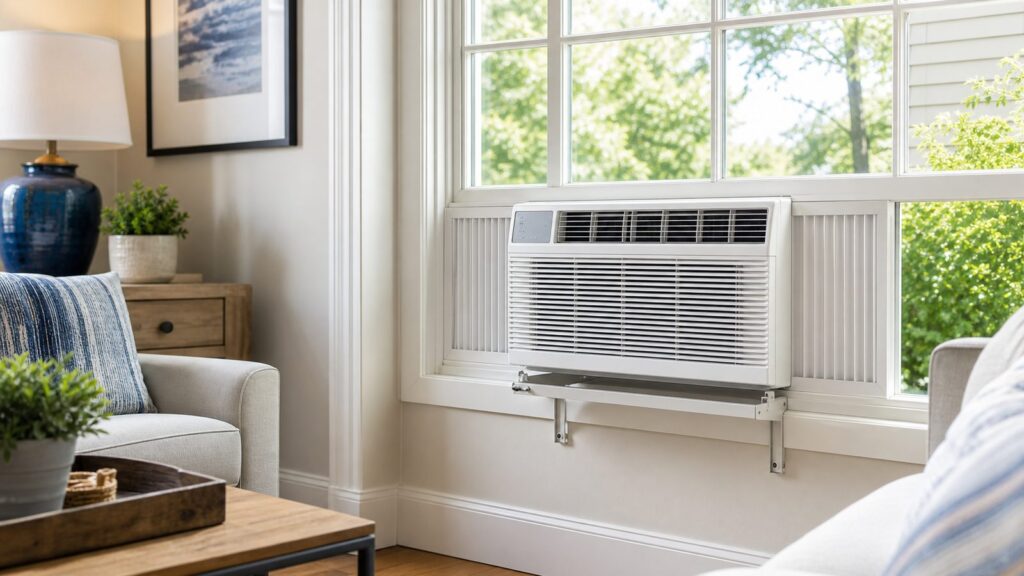
If you want the most practical all-around answer, choose a 12,000 BTU ENERGY STAR-certified inverter window unit that fits your window opening and electrical circuit. In 2026, good 12,000 BTU window AC units commonly cost $439 to $650 before installation. More basic units may be cheaper, while premium U-shaped, saddle-style, or ultra-quiet smart models often sit near the top of that range.
Popular on Amazon

- Multi-Season Comfort – This Midea 12000 BTU air conditioner is more versatile than standard AC units, offering powerful cooling and dehumidification in the summer and reliable supplemental heat in the fall. Best for large rooms up to 550 square feet. Note: Heat pump function will not operate if outside temperature is below 41°F.
- Easy To Use – This air conditioner and heat unit is well-equipped with a digital LED display, 5 Modes, 3 speed settings, 24-hr Timer, and ECO energy saver. The Swing button adjusts the louvers up/down to direct the airflow. Wireless enabled, control your comfort from your smartphone and your smartwatch using the Midea SmartHome app or your voice via Alexa and Google Assistant. All functions can be set via the control panel, remote control, and app or voice assistant.
- Save on Energy Without Sacrificing Comfort – This UL Listed, Energy Star certified air conditioner uses inverter technology to quickly cool your bedroom or apartment while providing up to 35% energy savings compared to the Energy Conservation Standard. With 12,000 BTUs, a CEER of 13.3, and 115V operation, this ac unit is loaded with features like auto shutoff, defrost control, and a washable front filter to maintain peak performance.
- Ultra Low Noise Performance – This ac window unit operates at a noise level as low as 45 dBA. It’s such a quiet air conditioner that you will barely notice it, even when it’s on high. Enjoy your Zoom call, watch your favorite TV show, have a conversation. This ac unit for bedroom also creates just the right amount of white noise so you can get some rest.
- Install Specs – This window air conditioner is designed to fit double hung windows with opening widths of 24 to 38.5 inches. Lower sash must open sufficiently to allow a clear vertical opening of 14.5 inches. AC window unit measures 19.41"W x 22.17"D x 13.9"H. Included components: 12000 btu window air conditioner, remote control, installation kit. This ac heater combo window unit is as a close as you can get to a mini split a/c. You may like it so much you just might buy two!
Retail listings commonly rate 10,000 BTU models for about 450 square feet and 12,000 BTU models for about 550 square feet. That makes 12,000 BTU a sensible mainstream pick when the actual room is 500 square feet and has normal real-world heat load.
Free tools Windows power users keep installed
One-click scans. No signup required.
Our Shortlist: Best Types of Window Air Conditioners for 500 Square Feet
Instead of pretending one model is best for every house, it is more useful to match the unit type to the room. These are the categories we would consider first for a 500-square-foot space.
Best Overall: 12,000 BTU Inverter Window AC
A 12,000 BTU inverter window air conditioner is the most balanced choice for many 500-square-foot rooms. Inverter compressors can ramp up and down instead of simply blasting on and shutting off. That usually means steadier temperature, less harsh cycling, lower indoor noise, and better efficiency.
For a living room, apartment, large bedroom suite, or finished attic space, this is the category we would price first. In 2026, expect many strong 12,000 BTU inverter or smart models to land around $450 to $650. Examples in the market include 12,000 BTU smart inverter and U-shaped units rated for rooms up to about 550 square feet, often listed around $479 to $549 depending on retailer, sale timing, and features.
Best Value: 12,000 BTU Smart Window AC
A standard 12,000 BTU smart window AC without a premium U-shaped cabinet can be a good value if noise is not your top concern. These units often include Wi-Fi controls, a remote, programmable schedules, and energy-saving modes. A 2026 price around $439 to $579 is common for mainstream 12,000 BTU Wi-Fi units.
This category makes sense when the window is in a living area, not right beside a bed or desk, and when the homeowner wants dependable cooling without paying top dollar for the quietest cabinet design.
Best for Quiet Operation: U-Shaped or Saddle-Style Inverter AC
Noise matters more than many buyers expect. A loud unit in a bedroom, home office, or studio apartment becomes irritating fast. U-shaped and saddle-style units reduce indoor noise by placing more of the compressor and vibration outside the window line. Combined with inverter operation, they are usually more comfortable for long daily runtime.
Plan for a premium price. A 12,000 BTU U-shaped smart inverter unit for up to about 550 square feet may list around $479, while other quiet smart inverter options can run around $549 or more. The higher price can be worth it if the unit will run 8 to 12 hours a day all summer.
Best for a Shaded, Tight Room: 10,000 BTU Inverter AC
A 10,000 BTU unit is not too small by default. It is the formula-based answer for 500 square feet. If the room has good insulation, limited west or south sun, modern windows, normal ceiling height, and a door that can stay mostly closed, 10,000 BTU may cool better than an oversized model because it can run longer and remove more humidity.
This is especially true in bedrooms and offices where comfort depends on dry, steady air instead of quick temperature drops. Look for an ENERGY STAR-certified model and compare the CEER rating on the EnergyGuide label.
Best for High Heat Gain: 12,000 to 14,000 BTU
Some 500-square-foot spaces need more than the basic sizing rule. A west-facing room with large glass, a room over an unconditioned garage, a poorly insulated addition, or a kitchen-connected space may overpower a 10,000 BTU unit in July and August. In those cases, 12,000 BTU is usually the first move. A 14,000 BTU unit may be justified if the heat load is severe.
Before jumping to 14,000 BTU, check the electrical requirements and window structure. Larger units are heavier, often draw more current, and may need a larger opening. Some 14,000 BTU models are not practical for weaker vinyl windows or narrow sashes without reinforcement.
500 Square Feet Window AC Decision Table
The table below is the same kind of field logic we use when helping homeowners think through room cooling. Square footage starts the conversation, but the room conditions finish it.
| Room Condition | Recommended Size | Best Unit Type | Why It Works |
|---|---|---|---|
| Shaded room, good insulation, 8-foot ceiling | 10,000 BTU | ENERGY STAR inverter | Enough capacity without short-cycling; better humidity control. |
| Typical 500 sq. ft. living room or studio | 12,000 BTU | Smart inverter window AC | Good real-world buffer for people, sun, electronics, and air leakage. |
| Sunny west or south exposure | 12,000 BTU | High-efficiency inverter or U-shaped | Handles afternoon heat gain while keeping noise and runtime reasonable. |
| Older home with leaky windows or weak insulation | 12,000 BTU | Inverter with upgraded side sealing | Extra capacity helps, but air sealing is just as important. |
| Kitchen, open layout, or high ceiling | 12,000 to 14,000 BTU | Higher-capacity ENERGY STAR model | Cooking heat, volume, and open circulation increase cooling load. |
| Multiple connected rooms or hallway layout | Window AC may struggle | Consider fans, second unit, or mini-split | One window unit is single-zone cooling and cannot push air through closed-off spaces well. |
How Much Does a Window AC for 500 Square Feet Cost in 2026?
For a 500-square-foot room, most homeowners should budget $300 to $600 for a realistic 10,000 to 12,000 BTU window air conditioner. Premium inverter, smart, U-shaped, and quieter units often run $450 to $650. The broad national unit-only range for window ACs is about $150 to $800, but the low end usually applies to smaller rooms, not a true 500-square-foot space.
Installed cost varies because some projects are simple and others uncover window, support, or electrical issues. National 2026 installed-cost references commonly fall in these ranges:
- Standard unit plus professional setup: about $139 to $519, with one common average around $312.
- Broader unit-plus-labor range: about $300 to $1,100.
- Higher-scope installed range: about $350 to $1,150, with an average around $546.
- Labor-only simple installation: roughly $130 to $255 in many markets.
- Retailer basic install add-ons: sometimes around $79 where available, usually for straightforward installs only.
A realistic example: a $439 12,000 BTU unit can become a $600 to $900 project after professional installation, a support bracket, better weatherstripping, disposal of the old unit, and minor electrical correction.
| Cost Item | Typical 2026 Range | Notes |
|---|---|---|
| 10,000-12,000 BTU window AC | $300-$600 | Mainstream range for a 500 sq. ft. room. |
| Premium inverter or U-shaped unit | $450-$650 | Usually quieter and more efficient. |
| Support bracket | $30-$100+ | Strongly recommended for heavier 12,000 BTU units. |
| Foam, weatherstripping, sealant | $10-$50 | Improves comfort and reduces air leakage. |
| Condensate or drip management parts | $10-$40 | Useful where dripping could stain siding, masonry, or walkways. |
| Professional installation | $130-$255 labor-only typical | More if access, repairs, or modifications are needed. |
| Electrical work | Often several hundred dollars | Needed if the circuit, receptacle, or breaker is not suitable. |
Operating Cost: What It Costs to Run a 500 Square Foot Window AC
Most homeowners spend about $15 to $75 per month to run a window air conditioner, depending on unit size, efficiency, runtime, climate, thermostat setting, and local electricity rates. A smaller 8,000 BTU unit running 8 hours per day at $0.16 per kWh can cost roughly $30 to $40 per month. A 10,000 to 12,000 BTU unit can exceed that if it runs hard during hot, humid weather.
The Tool Desk
Outbyte PC Repair FREERepair Windows errors before they cause bigger problemsFix Now →Outbyte Driver Updater FREEFix the driver behind crashes, sound loss and screen glitchesFind Drivers →That is why efficiency matters. The cheapest unit on the shelf can cost more over several summers if it has a lower CEER rating or cycles inefficiently. Look for ENERGY STAR certification and compare the yellow EnergyGuide label before buying. For a unit that runs every day from June through September, spending another $100 to $200 upfront for an efficient inverter model can be reasonable.
There are also construction-related operating costs. A poorly sealed window opening can leak hot outdoor air around the accordion panels all day. On older homes, we often see good equipment underperform because the installation is loose, the side panels are thin, or the sash does not close squarely. Better foam, rigid filler panels, and careful air sealing can make a noticeable difference in a 500-square-foot space.
Measure the Window Before You Shop
BTU capacity is only useful if the unit actually fits the window. Before buying, measure the window opening carefully. Write down the clear opening width, clear opening height, sill depth, and any interference from storm windows, screens, trim, security bars, blinds, or exterior masonry.
Most product listings provide a minimum and maximum window width, minimum opening height, and installation clearance. Compare those numbers to the real opening, not the rough size you remember. A common problem is buying the right BTU unit and discovering the sash opening is half an inch too short.
Quick wins for a faster PC:
Repair Windows errors before they cause bigger problemsFix Now →Scan for outdated or missing drivers - takes under a minuteDriver Scan →Clear out junk files and repair common Windows errorsFree Scan →What to Measure
- Opening width: Measure between the side jambs where the unit and side panels will sit.
- Opening height: Measure from the sill to the bottom of the raised sash.
- Sill condition: Check for rot, cracks, loose paint, soft wood, or flex.
- Exterior clearance: Look for brick ledges, railings, shrubs, awnings, or rooflines.
- Interior clearance: Make sure curtains, furniture, and shelving will not block airflow.
For a 12,000 BTU unit, plan on a two-person lift. Many of these units are too awkward and heavy for one person to set safely, especially on upper floors. A properly rated support bracket is cheap insurance compared with a damaged window frame or a dropped unit.
Installation Details That Affect Comfort and Safety
A window air conditioner is part appliance, part exterior penetration. That means installation quality matters. On our projects, we look at four things before calling the installation acceptable: support, pitch, air sealing, and drainage.
Support the Weight
A 12,000 BTU unit is not something we like to see hanging from a flexible vinyl sash with no bracket. The unit should bear safely on the sill and support hardware, not just clamp to the window. Use a bracket rated for the unit weight and compatible with the exterior wall condition. Wood siding, brick veneer, stucco, and vinyl all behave differently.
Older wood sills deserve extra attention. If a screwdriver can press into soft wood, the sill may be rotted. Do not trust a soft sill to carry a heavy AC unit. Repair or reinforce the window area first.
Set the Correct Pitch
Most window AC units need a slight outward pitch so condensate drains outside as designed. Do not overdo it. Follow the manufacturer’s installation instructions. Too flat can send water inside. Too steep can affect operation, vibration, or sash contact.
Seal Better Than the Factory Panels
The accordion side panels included with many units are convenient, but they are not great insulation. In a 500-square-foot room, air leakage around the unit can undermine comfort. Foam weatherstripping, rigid insulated filler panels, and careful sealing around the sash can reduce hot air infiltration and improve cooling performance.
Keep Airflow Open
Leave the front supply and return air paths open. Curtains, couches, tall shelves, and TV cabinets can block circulation. In a long room, a ceiling fan or small circulating fan can help move cool air to the far end without lowering the thermostat as much.
Independent reader supportYour contribution helps us test, update, and keep practical guides available for everyone.Electrical Load, Circuits, and Code Concerns
Many 10,000 to 12,000 BTU window air conditioners use a standard 115-volt receptacle, but you still need to check the nameplate amperage and the manufacturer’s requirements. Some larger units require 230 volts. Others may technically plug into a standard outlet but still overload a circuit that already serves lights, electronics, a refrigerator, or other appliances.
Do these 3 things before closing this tab:
1Repair Windows errors before they cause bigger problems2Scan for outdated or missing drivers - takes under a minute3Clear out junk files and repair common Windows errorsDo not use extension cords with window AC units. If the cord does not reach, the proper fix is usually a correctly located receptacle on a suitable circuit. If the breaker trips, the plug gets warm, lights dim, or the receptacle is loose, stop and have an electrician evaluate it.
The National Electrical Code is the baseline electrical standard used across much of the country, with local amendments. Local permit rules vary. Some cities require permits for certain mechanical HVAC work, while simple plug-in window AC installation may not require a permit. Los Angeles, for example, has mechanical HVAC permitting rules for covered work, and New York City provides specific public guidance around air conditioner installation and safety. Always check your local building department, lease, HOA, and historic-district rules before installing.
Egress, Rental, HOA, and Historic-District Issues
One of the most overlooked issues is emergency escape. Bedroom windows often serve as emergency escape and rescue openings. The residential code includes egress requirements for sleeping rooms and basements. A window AC can create a problem if it blocks the only compliant egress opening.
If the room is a bedroom and the AC occupies the only usable emergency escape window, pause before installing. You may need a different window, a different cooling strategy, or professional guidance. This is not just a technicality; it affects life safety.
What’s actually slowing this PC down?
Pick the symptom - the matching free tool is one click away.
Renters should check lease terms before installing a window unit. Some buildings require brackets, prohibit exterior dripping, restrict visible units on street-facing elevations, or require professional installation. HOAs and historic districts may limit where window units can be placed, especially on front elevations.
When a Window AC Is the Wrong Solution
A window unit is single-zone cooling. It works best when the 500 square feet is one open room or a studio-like layout. If the area includes multiple rooms, a hallway, and closed doors, one unit may cool the room it sits in while leaving adjacent rooms warm.
Consider another approach if you have any of these conditions:
- The 500 square feet is divided into two or three rooms.
- You need quiet cooling every night in a bedroom.
- Humidity remains high even when the temperature drops.
- The window is weak, historic, unusually shaped, or needed for egress.
- The circuit cannot safely handle the load.
- You expect to use the system for many summers.
For long-term comfort, a ductless mini-split may be the better investment. It costs more upfront, but it avoids blocking a window, runs quietly, provides efficient single-zone cooling, and can often heat as well. Central HVAC upgrades may make sense when multiple rooms need cooling or the existing system is near the end of its service life.
Recommended Free Tools
When to DIY vs. When to Hire a Pro
A simple window AC installation can be a reasonable DIY job if the unit is not too heavy, the window is sound, the outlet is suitable, the room is on the first floor, and the manufacturer’s bracket system fits cleanly. Expect a careful DIY installation to take 60 to 120 minutes if you have help, basic hand tools, foam, and weatherstripping ready.
Hire a pro when the unit is heavy, the window is on an upper floor, the sill is deteriorated, the exterior wall is masonry or stucco, the unit needs a support bracket you are not comfortable installing, or the electrical circuit is questionable. Also hire help if the window is vinyl and flexes under load. Vinyl windows can work with window AC units, but they are not all equally stiff, and the load path matters.
Professional installation is also worth it when water management could damage the building. Condensate dripping onto wood trim, brick ledges, lower windows, walkways, or neighbor property can become a real problem. A small drip-management part is inexpensive; repairing stained trim or water-damaged framing is not.
Maintenance Schedule for a 500 Square Foot Window AC
A window AC that cools 500 square feet works hard. Basic maintenance protects performance and operating cost.
- Every 2 to 4 weeks in heavy use: Remove and clean the filter. More often if you have pets, dust, or heavy pollen.
- Monthly: Inspect side seals, sash contact, foam strips, and the support bracket.
- Monthly: Vacuum the intake grille and keep furniture, curtains, and rugs away from airflow.
- During humid weather: Check drainage and confirm water is not running back indoors.
- Seasonally: Deep-clean coils according to the manufacturer’s instructions.
- At removal or winter shutdown: Inspect the sill for moisture staining, peeling paint, or soft wood.
If the unit starts icing, short-cycling, smelling musty, or failing to drain, do not just lower the thermostat. Clean the filter, check airflow, inspect the coil, and confirm the unit is sized and installed correctly.
Bottom Line: What We Would Buy for 500 Square Feet
For most homeowners, the best window air conditioner for 500 square feet is a 12,000 BTU ENERGY STAR-certified inverter model that fits the window, runs on a suitable circuit, and can be installed with a proper support bracket and upgraded air sealing. That combination gives enough capacity for real homes without jumping straight to an oversized unit.
Choose 10,000 BTU if the room is shaded, tight, well insulated, and standard height. Choose 12,000 BTU for the typical 500-square-foot room. Consider 14,000 BTU only when heat gain is clearly high and the electrical and structural conditions support it.
The unit matters, but the installation matters just as much. A well-sized AC in a leaky, poorly supported window will disappoint. A properly installed inverter unit with good sealing, safe support, and clear airflow can keep a 500-square-foot room comfortable through the worst stretch of summer.
Frequently Asked Questions
What BTU window air conditioner do I need for 500 square feet?
Most 500-square-foot rooms need 10,000 to 12,000 BTU. The basic 20 BTU per square foot rule points to 10,000 BTU, but 12,000 BTU is often better for sunny rooms, older homes, open layouts, high ceilings, and humid climates.
Is 10,000 BTU or 12,000 BTU better for a 500 sq. ft. room?
Use 10,000 BTU for a shaded, well-insulated room with standard ceilings. Use 12,000 BTU for most real 500-square-foot living rooms, studios, apartments, and rooms with normal sun exposure or air leakage.
How much does a 500 sq. ft. window air conditioner cost in 2026?
Most practical 10,000 to 12,000 BTU window AC units cost about $300 to $600. Premium inverter, smart, U-shaped, or quieter models often cost $450 to $650 before installation.
How much does professional window AC installation cost?
Simple labor-only installation often runs about $130 to $255, while broader installed project costs commonly range from about $300 to $1,100 depending on the unit, access, brackets, sealing, disposal, window condition, and electrical work.
Do 12,000 BTU window AC units need a dedicated circuit?
Some can run on a standard 115-volt outlet, but you must check the unit nameplate, amperage, plug type, and circuit load. If the breaker trips, the outlet is loose, the plug gets warm, or the circuit already serves major loads, have an electrician evaluate it.
Can a window AC block a bedroom egress window?
It can, and that may create a code and life-safety problem if the window is the required emergency escape opening. For bedrooms, confirm another compliant egress path before placing an AC in the window.
Quick Recap
Product prices and availability are accurate as of the date/time indicated and are subject to change. Any price and availability information displayed on Amazon at the time of purchase will apply.

