Some links on this page are affiliate links: if you buy through them we may earn a commission, at no extra cost to you.
The best metal wall scanner for a homeowner in 2026 is usually not the most expensive one. It is the scanner that matches the wall, the project risk, and the material you are trying to avoid. For most kitchen, bath, and room projects, that means a multi-mode electronic scanner in the $40 to $90 range that can detect wood framing, metal studs, ferrous and nonferrous metal, and live AC wiring. For cabinet installs, grab bars, tile bath walls, and remodel inspection, a stronger prosumer scanner or visual wall imager in the $90 to $250 range can be worth the money.
On our job sites, we treat wall scanners as layout and risk-reduction tools, not permission slips to drill blindly. A scanner can help you find metal studs, nail plates, copper or steel pipe, fastener lines, and possible wiring. It can also lie to you if the wall has plaster, metal lath, foil insulation, tile backer, moisture, uneven texture, concrete, or old remodel work buried inside it. The right workflow matters as much as the tool.
As an Amazon Associate I earn from qualifying purchases.
The Tool Desk
Outbyte PC Repair FREERepair Windows errors before they cause bigger problemsFix Now →Outbyte Driver Updater FREEFix the driver behind crashes, sound loss and screen glitchesFind Drivers →If you only need to hang a light picture on drywall, a $10 to $20 magnetic finder may be enough. If you are mounting cabinets, a television, floating shelves, a bathroom vanity, or a grab bar, step up to a scanner that gives you more information before you put a bit into the wall. A $60 scanner is cheap compared with one punctured water line, one nicked cable, one cracked tile wall, or one failed cabinet anchor.
Quick Recommendations by Use Case
Here is the short version. For normal drywall in bedrooms, hallways, and living rooms, a good electronic stud finder or magnetic finder can handle most layout work. For kitchens and bathrooms, buy more capability than you think you need, because those walls often hide plumbing, drains, venting, blocking, metal corner bead, nail plates, electrical runs, and tile assemblies.
#1 Best Overall

- Dual audible and visual alarms for clearer identification: When a target is detected, the device simultaneously emits a buzzer and illuminates an LED indicator. Even in noisy construction sites or dimly lit environments, the dual audible and visual cues accurately pinpoint the location of hidden objects.
- High-precision multi-mode detection for more reliable positioning: It can accurately detect wooden frames, metal objects, and live wires behind walls, drywall, or concrete. Calibration before each use effectively improves detection accuracy, providing a reliable reference for drilling and construction.
- Adjustable sensitivity to adapt to different wall surfaces: Supports switching between different sensitivity levels based on wall material and thickness. Whether it's a thin partition or a thick wall, it can be flexibly adjusted to meet the detection needs of various working conditions.
- Lightweight design for comfortable handling: The product features a lightweight design and an ergonomic handle, making it easy to operate and reducing fatigue during extended use. Suitable for both home users and professionals.
- Three-in-one function, more convenient for multiple uses: It integrates wood keel detection, metal scanning and live wire detection, reducing the trouble of frequent tool replacement, and is an ideal auxiliary tool for home decoration, drilling installation and construction renovation.
| Project | Best Scanner Type | Typical 2026 Cost | What to Confirm |
|---|---|---|---|
| Picture hanging on drywall | Magnetic finder or entry electronic stud finder | $10-$40 | Fastener line, stud spacing, wall anchors |
| TV mount | Multi-sensor electronic scanner plus magnetic backup | $40-$90 | Stud edges, centerline, wiring, mount width |
| Kitchen wall cabinets | Prosumer multi-mode scanner or visual imager | $90-$250+ | Studs, pipes, nail plates, blocking, electrical |
| Bathroom grab bar | Multi-mode scanner or visual imager | $65-$250+ | Blocking, studs, plumbing, tile/backer depth |
| Tile shower or vanity wall | Visual imager where compatible, plus inspection from other side | $180-$250+ | Wet wall layout, supply lines, drain arms |
| Plaster wall | Magnetic finder plus higher-end scanner | $20-$180 | Lath interference, fastener pattern, framing layout |
| Concrete or masonry | Scanner with dedicated metal/concrete capability | $90-$180+ | Rebar, conduit, embedded metal, depth limits |
| Remodel inspection | Visual imager or pro diagnostic visit | $180-$250+ tool, more for pro visit | Unexpected utilities, nonstandard framing, hidden repairs |
For a typical homeowner, the best value is a midrange multi-mode wall scanner backed up by a magnetic finder. The electronic scanner gives you a broader read of the wall. The magnet gives you a simple second opinion by finding drywall screws or nails in the framing. When both tools agree, confidence goes up. When they disagree, slow down.
What a Metal Wall Scanner Actually Detects
The term “metal wall scanner” covers several different tools. Some find magnetic fasteners. Some sense density changes in drywall. Some detect metal objects. Some warn about energized electrical wiring. Some visual imagers map objects behind the wall surface on a phone screen. They are often sold side by side, but they do not do the same job.
Crashes, No Sound, or Screen Glitches?
Random freezes, missing sound and display glitches usually trace back to one bad driver. Find and replace yours safely.Free scan · under a minuteWindows Errors? Fix Them Before They Spread
Repair common Windows errors and clear accumulated junk for a smoother, more stable PC - no reinstall needed.Free scan · no reinstallMagnetic Stud Finders
A magnetic finder is the simplest option. It uses a magnet to locate steel drywall screws or nails in studs. It does not scan the cavity. It does not identify copper pipe, PVC drain, electrical cable, or the full width of a stud. It finds fasteners, and from that fastener pattern you infer the stud line.
That sounds limited, but it is useful. In clean drywall, a magnetic finder can be very reliable because fasteners usually run vertically along studs. It costs about $10 to $20, needs no batteries, and fits in a tool pouch. We like it as a backup tool even when we are using more advanced scanners.
Electronic Stud and Metal Scanners
Entry electronic stud finders usually cost about $20 to $40. They read changes in wall density and help locate stud edges or centers through common drywall. Many work best at about 3/4 inch to 1-1/2 inches of depth, which is enough for typical 1/2-inch drywall over wood framing.
Midrange multi-mode scanners, usually about $40 to $90, add more useful modes: wood stud, metal stud, metal detection, deep scan, and AC warning. This is the category most homeowners should start with for kitchen and bath work. A good model can help distinguish whether you are seeing framing, metal, or a possible live wire warning.
Quick wins for a faster PC:
Fix the driver behind crashes, sound loss and screen glitchesFind Drivers →Repair Windows errors before they cause bigger problemsFix Now →Scan for outdated or missing drivers - takes under a minuteDriver Scan →Prosumer Multi-Material Scanners
Prosumer scanners in the $90 to $180 range generally provide better displays, clearer calibration feedback, deeper metal detection, and more reliable center marking. Some can differentiate ferrous metal, such as steel studs or rebar, from nonferrous metal, such as copper pipe. That distinction matters in bathrooms, kitchens, basements, and concrete work.
Depth claims vary by material. A scanner may detect metal much deeper in cured concrete than it can accurately map a small pipe behind tile and backer board. Read the depth rating by mode and material, not just the biggest number on the package.
Visual Wall Imagers
Visual wall imagers are the most homeowner-accessible upgrade for serious remodel work. In 2026, common visual imagers run about $180 to $250 and up. Walabot-style tools market imaging up to about 4 inches in supported wall types. They can show shapes and paths instead of just beeps and bars.
That does not make them magic. Wall type still controls performance. Visual imagers are most useful when mapping hidden objects before installing wall cabinets, a vanity, grab bars, a TV mount, or shelving where several fasteners will enter the wall across a large area.
Recommended Free Tools
Best Scanner Categories for 2026
There is no single “best” scanner for every house. A 1950 plaster wall, a 1990 drywall partition, a tile shower wall, and a basement concrete wall need different expectations. The better way to shop is by category.
Best Overall for Most Homeowners: Multi-Mode Electronic Scanner
For most homes, choose a scanner that detects wood studs, metal studs, metal objects, and live AC wiring. Models in the Bosch GMS120/GMS120-27 class, Zircon MultiScanner class, Franklin ProSensor M-series class, and similar 5-in-1 scanners are the practical center of the market.
Expect to spend about $40 to $90 for a capable homeowner unit and $90 to $180 for a better display, stronger calibration, and more refined detection. This range makes sense if you plan to do more than one project: a bathroom shelf this month, a TV mount next month, and kitchen cabinet work later.
Best Budget Choice: Magnetic Finder Plus Basic Electronic Finder
If the budget is tight, buy a $10 to $20 magnetic finder and a $20 to $40 electronic stud finder. Used together, they are better than either one alone. The magnet finds fasteners. The electronic tool helps estimate stud edges and center. This setup is fine for pictures, towel bars outside wet walls, small shelves, and light-duty room projects.
Do not use this budget setup as your only inspection method for drilling into tiled bathroom walls, kitchen cabinet zones, or walls that likely contain plumbing. The cost savings disappear quickly if you hit a pipe or wire.
Rank #2

- Newest Upgraded Stud Finder - FNIRSI stud finder have Newly Designed Positioning Hole which can accurately and quickly mark up edges and center of metal, studs, pipes, live AC wire behind walls, floors. Fast detection saves users time and effort
- 6-in-1 DETECTION: The wall detector provides users with more detection needs. Exact scan mode locates the center and edges of wood and metal studs up to 0.75'' deep; Depth scan mode locates the center and edges of wood and metal studs up to 1.5'' deep
- 6-in-1 DETECTION: Non-Ferrous Metal scan detects metal (Copper) up to 3.9'' deep; Ferrous Metal scan detects metal (Iron) up to 4.7'' deep; AC scan detects live unshielded AC wires up to 2'' deep; Copper wire scan detects copper wire up to 1.6'' deep
- Digital LCD Display & Audio Alarm: This stud finder comes with LCD display and sound alarm, which can detect the exact location of the objects. Rechargeable mode saves you from the hassle of battery replacement
- Easy to Use & Auto Calibration: Easy-to-read LCD display provide users with comfort and convenience while scanning. The wall detector can be automatically calibrated anywhere on the wall to successfully find the center of studs in one step
Best for Fast Stud Layout: Wide-Sensor Stud Finder
Wide-sensor stud finders are strong for quickly finding multiple points across a stud bay. They are useful for laying out TV mounts, shelves, and cabinet rails because they show the framing pattern faster than a single-point finder. If your main concern is accurate stud location in drywall, this style is efficient.
The limitation is hidden utilities. A fast stud finder may be excellent at showing framing and still give less detail about copper pipe, conduit, or nonstandard objects in the wall. In kitchens and baths, pair it with metal and AC detection.
Best for Metal, Pipe, and Concrete: Multi-Material Scanner
If your house has metal studs, concrete, masonry, or you are trying to avoid pipes, look for dedicated metal mode and ferrous/nonferrous differentiation. Steel studs, rebar, nail plates, and screws are ferrous. Copper pipe is nonferrous. Being able to separate those readings helps you decide what you are likely seeing.
Free tools Windows power users keep installed
One-click scans. No signup required.
This category is also useful for basements, garages, condos, and commercial-style partitions where metal framing is common. Expect to pay around $90 to $180 for a more serious tool.
Best for Serious DIY Remodels: Visual Wall Imager
A visual wall imager makes the most sense when the project has several fasteners, expensive finishes, or high utility risk. Kitchen wall cabinets, bathroom grab bars, floating vanities, large mirrors, tile walls, and built-in shelving all qualify. In 2026, plan on about $180 to $250+ depending on model, sale pricing, and bundles.
The value is not only detection. It is mapping. You can scan a wider zone, see object paths, and compare what the wall image suggests against outlets, plumbing fixtures, attic access, basement access, and the other side of the wall.
How Much Should You Spend?
Spend according to the cost of being wrong. A $15 magnetic finder is reasonable for a framed picture. It is not a serious inspection tool for a tiled shower wall. A $200 visual imager may feel expensive until the alternative is opening a wall, calling a plumber, replacing tile, or repairing a damaged cable.
What’s actually slowing this PC down?
Pick the symptom - the matching free tool is one click away.
| Scanner Level | Typical 2026 Price | Best Fit | Main Limitation |
|---|---|---|---|
| Magnetic finder | $10-$20 | Fastener lines, simple drywall work | Finds screws/nails, not pipes or wiring |
| Entry electronic finder | $20-$40 | Light hanging, basic stud location | Limited depth and utility detection |
| Midrange multi-mode scanner | $40-$90 | Most homeowner kitchen, bath, and room projects | Needs careful calibration and confirmation |
| Prosumer scanner | $90-$180 | Metal studs, pipes, concrete, heavier mounting | Still affected by wall type and surface conditions |
| Visual wall imager | $180-$250+ | Cabinets, grab bars, tile walls, remodel mapping | Supported wall types and interpretation matter |
For home inspection context, a general home inspection in the U.S. commonly runs roughly $343 to $400 on average, with many inspector and appraiser services falling around $300 to $415. More specialized work, such as destructive investigation, moisture testing, thermal imaging, or contractor diagnostics, costs more. A scanner does not replace that inspection, but it can make small projects safer and more informed.
Kitchen and Bath Walls Require More Caution
A living room wall is usually straightforward: drywall, studs, maybe electrical. A kitchen or bath wall is different. Those walls are often utility-dense, especially near sinks, showers, tubs, laundry areas, ranges, refrigerators, and exterior walls.
Behind a kitchen cabinet zone, you may find vertical studs, horizontal blocking, water supply lines, drain vents, electrical home runs, appliance circuits, nail plates, range hood wiring, backsplash tile, and old abandoned penetrations. Behind a bathroom wall, expect supply lines, drain arms, vent stacks, blocking for accessories, shower valves, tile backer, waterproofing layers, and sometimes shared plumbing from the room behind it.
That is why we scan the whole mounting zone, not just the screw points. If a cabinet rail is 54 inches long, we scan the full rail path plus several inches above and below. If a grab bar uses two mounting flanges, we scan the entire rectangle around both flanges, not just the four screw holes. A clean spot at one screw does not make the adjacent screw safe.
Our Job-Site Scanning Workflow
The scanner is one part of the process. The workflow below is the same basic thinking we use before drilling into finished walls.
1. Read the Room First
Before turning on the scanner, look at the wall. Note outlets, switches, plumbing fixtures, cabinets, baseboards, vents, exterior penetrations, and what is on the other side. A bathroom wall shared with a closet or hallway is often easier to inspect from the back side than through tile.
Rank #3

- PRO-GRADE MULTI-FUNCTION DETECTION: Stop guessing, start knowing with this stud finder wall scanner that accurately locates wood studs, metal framing, copper pipes, and live AC electrical wiring behind drywall, saving you from costly mistakes
- ABSOLUTE PRECISION & CONFIDENCE: This wall stud finder helps find the exact center of the stud. The easy-to-read graphical display and color-coded marking ring for clear, confident feedback, turning green for "safe" and red for "live wire detected"
- BUILT FOR THE PROFESSIONAL JOBSITE: Cheaper tools fail; this BOSCH stud finder works. Made with an IP54-rated dustproof and water-resistant body and shock-absorbing rubber casing to withstand daily abuse on a construction site, garage, or workshop
- DUAL POWER FOR ZERO DOWNTIME: This stud detector offers power flexibility, running on the included AA batteries for immediate use or on a BOSCH 3.7V Li-Ion battery sold separately for extended, rechargeable performance, a must-have for any pro
- THE ULTIMATE SCANNER FOR PROS: The wood stud finder provides the reliability & multi-material detection that electricians, plumbers, remodelers, & installers demand; it's an investment in accuracy, safety, and efficiency that pays for itself
2. Mark a Scan Grid
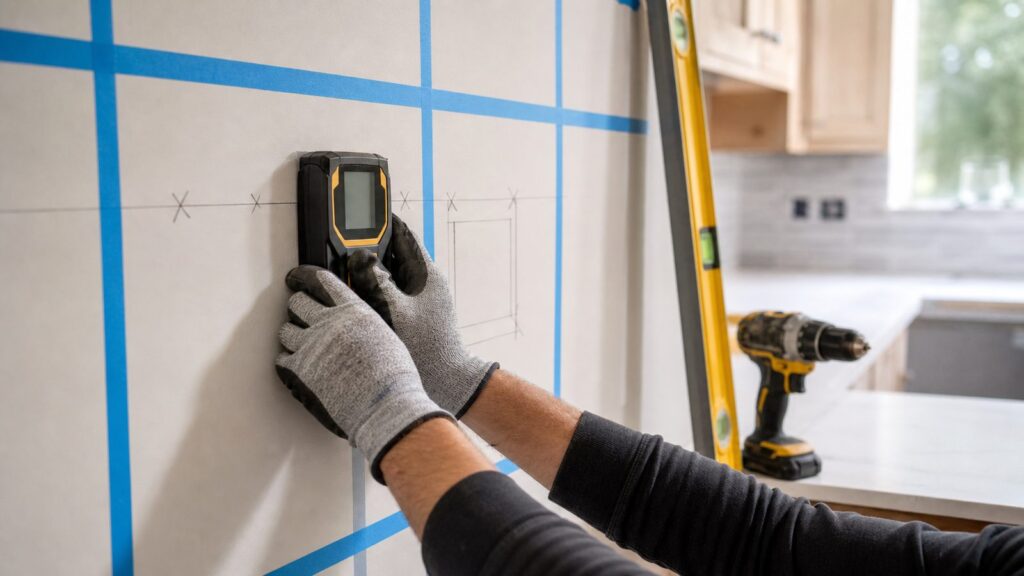
Use painter’s tape and pencil marks. For a shelf or TV mount, mark the proposed mounting zone. For cabinets, mark the top, bottom, and rail line. For grab bars, mark the full bar footprint. Scan horizontally and vertically through that area.
3. Calibrate on the Same Surface
Most electronic scanners need calibration. Calibrate on the same wall surface you are scanning. Do not start directly over a stud, pipe, metal corner bead, or suspected utility. If the readings seem wrong, recalibrate a few inches away and scan again.
4. Scan Slowly and Keep the Tool Flat
Fast passes create bad readings. Keep the scanner flat, move slowly, and use even pressure. Surface texture, hand angle, tile edges, and uneven paint buildup can all affect results. Make several passes from both directions and mark both edges of each object.
5. Look for Pattern, Not One Point
Studs are commonly 16 or 24 inches on center, but remodels and older homes do not always follow the pattern. Wet walls, chases, door openings, corners, and patched areas often break the rhythm. A single beep is not enough. You want a pattern that makes construction sense.
6. Confirm With a Second Method
Use the two-tool method: electronic scanner first, magnetic finder second. If you are near plumbing, check the room below, above, or behind the wall when possible. If the wall has tile, plaster, or concrete, assume more uncertainty and confirm more carefully.
Safety, Codes, and Permits
Live-wire detection is helpful, but it is not a guarantee. AC sensing can miss de-energized wires, deep wires, shielded wiring, wiring behind dense material, or wiring routed in an unexpected way. Before drilling near electrical, shut off the circuit when practical and verify with appropriate testers.
Building codes also matter. Scanners do not replace permit requirements, utility locating judgment, structural framing rules, or electrical protection requirements. Wires and pipes are often protected by nail plates where they pass near the face of framing. Bored holes and notches in studs and joists have limits because too much removed material weakens the structure. Electrical work must also follow NEC-based rules adopted by the local authority.
For a homeowner, the practical rule is simple: if your project changes wiring, plumbing, gas lines, framing, waterproofing, or structural support, check local permit requirements before work starts. Finding a wire or pipe with a scanner does not authorize moving it. It tells you that the job has crossed from hanging hardware into trade work.
Independent reader supportYour contribution helps us test, update, and keep practical guides available for everyone.Common Mistakes That Lead to Damage
The first mistake is buying the cheapest scanner and using it for high-risk drilling. A magnetic finder is useful, but it does not tell you whether a copper line sits between two studs.
The second mistake is treating “no AC warning” as safe. A scanner may not detect a wire if the circuit is off, the wire is deep, the wall is dense, or the cable is shielded. AC mode is a warning layer, not a clearance certificate.
Do these 3 things before closing this tab:
1Fix the driver behind crashes, sound loss and screen glitches2Repair Windows errors before they cause bigger problems3Scan for outdated or missing drivers - takes under a minuteThe third mistake is scanning once in one direction. We want several passes from multiple directions, with both edges marked. If a scanner shows a wide, inconsistent, or drifting signal, that is information. It may mean metal lath, a pipe, a nail plate, foil insulation, or a wall condition that needs more investigation.
The fourth mistake is ignoring wall type. Drywall is easiest. Plaster and lath can confuse scanners because the lath and fasteners create a busy background. Tile and backer board add thickness and density. Foil-faced insulation can create false readings. Concrete and masonry require tools rated for those materials.
When to DIY and When to Hire a Pro
DIY is reasonable when the wall is standard drywall, the load is light to moderate, and you are not modifying utilities. Hanging pictures, small shelves, curtain rods, towel hooks, and some TV mounts are manageable if you scan carefully, use proper anchors or studs, and respect the tool limits.
Rank #4

- 𝐄𝐧𝐡𝐚𝐧𝐜𝐞𝐝 𝐏𝐫𝐞𝐜𝐢𝐬𝐢𝐨𝐧 𝐚𝐧𝐝 𝐒𝐩𝐞𝐞𝐝 𝐒𝐭𝐮𝐝 𝐅𝐢𝐧𝐝𝐞𝐫 𝐌𝐨𝐝𝐞𝐥: Efficiently and Accurately locates edges and centers of metal, studs, joists, pipes, and live AC wires in walls, floors, and ceilings,saving time and effort
- 𝐅𝐢𝐯𝐞 𝐒𝐜𝐚𝐧𝐧𝐢𝐧𝐠 𝐌𝐨𝐝𝐞𝐬 𝐟𝐨𝐫 𝐃𝐢𝐟𝐟𝐞𝐫𝐞𝐧𝐭 𝐍𝐞𝐞𝐝𝐬: 3 stud modes (up to 1.5 inches), metal mode (up to 2.36 inches), and AC mode (up to 2 inches). Deep stud scan detects larger objects and metal scan identifies plumbing
- 𝐃𝐮𝐫𝐚𝐛𝐢𝐥𝐢𝐭𝐲 𝐚𝐧𝐝 𝐄𝐚𝐬𝐲 𝐭𝐨 𝐔𝐬𝐞: This stud finder features a shock-resistant, dust-resistant design for long-lasting durability. Its bright, backlight LCD displays the center and edge of studs, with audio alerts for effortless, efficient use
- 𝐍𝐞𝐯𝐞𝐫 𝐌𝐢𝐬𝐬 𝐚 𝐒𝐭𝐮𝐝 𝐰𝐡𝐢𝐥𝐞 𝐀𝐯𝐨𝐢𝐝𝐢𝐧𝐠 𝐋𝐢𝐯𝐞 𝐖𝐢𝐫𝐞𝐬: This stud finder gives continuous wire alerts in all modes-wood, metal studs, and live AC wires. It keeps you aware of nearby wires, preventing accidental drilling into live wires
- 𝐖𝐢𝐝𝐞 𝐔𝐬𝐞 𝐚𝐧𝐝 𝐑𝐞𝐥𝐢𝐚𝐛𝐥𝐞: Our stud finder is ideal for hanging shelves and heavy objects without damaging walls. It detects live wires and pipes, preventing accidents and costly repairs, making it a valuable tool for any home project
Hire a pro when the consequence of a miss is high. That includes drilling into tile shower walls, mounting heavy wall cabinets, installing grab bars for actual fall protection, anchoring floating vanities, cutting into plaster walls with unknown utilities, drilling concrete that may contain conduit or rebar, or working near known plumbing and electrical routes.
Recommended Free Tools
Also call a professional if the readings do not make sense. On site, contradictory readings usually mean one of three things: the wall assembly is unusual, the scanner is being fooled, or the hidden conditions are more complicated than expected. None of those are solved by drilling faster.
A contractor diagnostic visit may cost more than buying a scanner, but it can be the cheaper decision when finished tile, plumbing, wiring, or structural framing is at stake. A general home inspection average around $343 to $400 is a useful benchmark, but targeted contractor investigation varies by location, wall type, access, and whether any finish material must be opened.
Bottom Line
For most homeowners, the best metal wall scanner is a multi-mode electronic model in the $40 to $90 range, paired with a $10 to $20 magnetic finder for confirmation. For kitchens, bathrooms, tile walls, cabinet installations, grab bars, and remodel inspection, step up to a prosumer scanner or visual wall imager in the $90 to $250+ range.
The scanner choice matters, but the process matters more. Scan the whole mounting zone. Mark a grid. Move slowly. Confirm from more than one direction. Use a second tool. Read the wall layout before drilling. Treat unexpected signals as a reason to investigate, not as a nuisance to ignore.
Quick wins for a faster PC:
Scan for outdated or missing drivers - takes under a minuteDriver Scan →Clear out junk files and repair common Windows errorsFree Scan →Fix the driver behind crashes, sound loss and screen glitchesFind Drivers →A good scanner helps you work cleaner and safer. Good judgment keeps a small project from becoming a repair job.
Frequently Asked Questions
What is the best metal wall scanner for home inspection in 2026?
For most homeowners, the best choice is a multi-mode electronic scanner that detects wood studs, metal studs, metal objects, and live AC wiring. Expect to spend about $40 to $90 for a good homeowner model or $90 to $180 for a prosumer scanner with better depth, display, and material detection.
Can a wall scanner detect plumbing pipes behind drywall?
Many metal wall scanners can detect copper or steel pipes behind drywall, especially in dedicated metal mode. They may not reliably detect plastic PEX or PVC unless the tool senses shape or density changes, so use visual clues, fixture locations, and access from the other side of the wall whenever possible.
Can a wall scanner detect live electrical wires?
Many scanners include live AC warning, but it is not a guarantee. AC detection can miss de-energized wires, deep wires, shielded cable, or wires behind dense wall materials. Shut off circuits when practical and use multiple verification methods before drilling.
What is the difference between a magnetic stud finder and an electronic wall scanner?
A magnetic stud finder locates steel screws or nails in framing. It is cheap, simple, and reliable for finding fastener lines, usually around $10 to $20. An electronic wall scanner reads density, metal, or electrical signals and can provide more information about studs, pipes, metal framing, and possible wiring.
Do wall scanners work through tile, plaster, or concrete?
Some do, but performance varies. Drywall is easiest. Plaster, metal lath, tile backer, foil insulation, concrete, masonry, and textured surfaces can create false readings or reduce depth. Use a scanner rated for the wall type and confirm readings before drilling.
How much should I spend on a wall scanner for kitchen or bathroom projects?
For kitchen and bathroom work, plan on at least $40 to $90 for a multi-mode scanner. For cabinet installation, grab bars, tile walls, or remodel inspection, a $90 to $180 prosumer scanner or $180 to $250+ visual wall imager is often the better fit.
Quick Recap
Product prices and availability are accurate as of the date/time indicated and are subject to change. Any price and availability information displayed on Amazon at the time of purchase will apply.
What’s actually slowing this PC down?
Pick the symptom - the matching free tool is one click away.

