Some links on this page are affiliate links: if you buy through them we may earn a commission, at no extra cost to you.
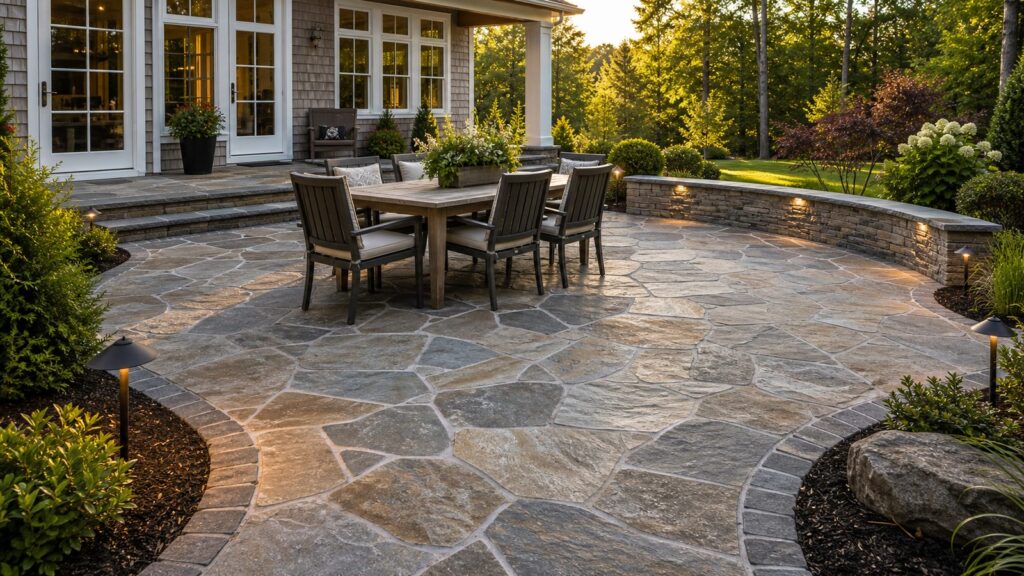
Flagstone is one of the best patio materials when you want a natural, custom look instead of a stamped or manufactured pattern. The catch is that the best-looking flagstone patios are not just about choosing a pretty stone. The setting method, joint width, base depth, drainage slope, furniture layout, and stone thickness all decide whether the patio still feels good underfoot five years from now.
For 2026 budgeting, most professionally installed flagstone patios in the U.S. land around $15 to $32 per square foot for dry-laid work. Mortared or concrete-set flagstone commonly reaches $42 to $45 per square foot, especially with premium stone, tight hand-cut joints, steps, borders, drainage work, or difficult access. A simple 200-square-foot dry-laid patio may cost about $3,000 to $6,400, while a 300-square-foot patio often plans around $4,500 to $9,600 before upgrades.
As an Amazon Associate I earn from qualifying purchases.
On our job sites, we start with function before stone color. Dining areas need flatter stones and tighter joints. Fire pit patios need clearances and seating room. Sloped yards usually need terraces. Garden patios can handle wider gravel or planted joints. That decision-first approach is what separates a patio that photographs well from one that works every weekend.
Quick Design Decision Matrix
| Goal | Best Flagstone Approach | Build Notes | Typical Cost Tier |
|---|---|---|---|
| Outdoor dining | Formal grid, large-format slabs, or tight-joint pattern | Use flatter stones, 1/4- to 1/2-inch joints where possible, and a level dining zone at least 10 by 12 feet | Medium to high |
| Fire pit seating | Circular or radial flagstone layout | Plan 7 feet minimum around the pit when possible, verify fire clearances, and avoid loose joints near chair legs | Medium |
| Small yard | Side-yard bistro nook or front sitting patio | Use consistent stone size and a defined border so the space feels intentional | Low to medium |
| Sloped yard | Terraced flagstone rooms | Use retaining edges, steps, and drainage behind walls; do not force one steep patio plane | High |
| Low maintenance | Dry-laid with tight polymeric sand joints or mortared over a properly detailed slab | Minimize planted joints and correct drainage before setting stone | Medium to high |
| Modern home | Large-format rectangular slabs or geometric bluestone | Keep joint lines crisp and align patio edges with doors, walls, and sightlines | High |
| Cottage garden | Irregular flagstone with gravel or planted joints | Accept more maintenance in exchange for a softer, garden-like look | Low to medium |
Flagstone Basics Before You Pick a Design
Flagstone is a category, not a single material. Common patio stones include sandstone, bluestone, slate, limestone, quartzite, and travertine. Each behaves differently. Some stones are dense and handle freeze-thaw cycles well. Others are softer, more porous, more clefted, or better suited to warmer climates.
#1 Best Overall

- A Monster-level Engine: With our high-performance plate compactor, you'll have the power you need to get the job done. Its 196 cc / 6.5 HP gasoline engine delivers a whopping 5,600 vibrations per minute, while the 12-inch compaction depth ensures optimal results.
- Work Like Never Before: Upgrade your road projects with our plate tamper! With an enlarged 351 in² stamped plate, you'll save time with an impressive working efficiency of up to 7300 ft²/h. Plus, the plate is built to last with its durable 8 mm thickness that won't deform even during tough tamping jobs.
- Move with Ease: Hit the road with our VEVOR vibratory compactor! Its wide, wear-proof wheels ensure smooth travels on any surface, while its heavy-duty 146.6 lbs design offers flexibility for road construction. Get the job done right with this powerful and reliable machine.
- Operation Made Simple: Our soil compactor is a game-changer! With an adjustable choke and linear throttle, you can easily customize the speed range to suit any road condition, boosting its endurance. Experience the power and precision of this versatile tool today.
- Your Road Specialist: The compactor machine that can do it all! Our versatile tool has been well-received in construction, municipal, highway, and railroad projects, delivering professional results in compacting dirt, gravel, lawn, and more. Get the job done flawlessly!
For dry-laid patios, patio-grade flagstone is commonly 1.5 to 2 inches thick. Thinner stone can work over a concrete slab with mortar, but it is usually a poor choice for a compacted-base installation because it can crack, rock, or settle unevenly. If the patio will hold a grill, dining table, outdoor kitchen, or hot tub, stone selection and base design matter even more.
A typical professional dry-laid assembly includes excavation, compacted subgrade, geotextile fabric where soils warrant it, 4 to 8 inches of compacted aggregate base, about 1 inch of setting bed, then individually set stones with tight elevation control. In freeze-thaw regions or clay soils, we lean toward the deeper end of that base range and pay close attention to drainage.
Do these 3 things before closing this tab:
1Clear out junk files and repair common Windows errors2Fix the driver behind crashes, sound loss and screen glitches3Repair Windows errors before they cause bigger problemsMost patios should slope away from the house. A practical target is 1% to 2%, which equals about 1/8 to 1/4 inch per foot. Some local patio guides cite 1% minimum slope, and others reference 1/4 inch per foot away from the foundation. The exact requirement depends on your municipality, but the principle is always the same: water should not sit against siding, foundations, thresholds, weep screeds, or basement walls.
21 Flagstone Patio Design Ideas
1. Irregular Woodland Patio
An irregular woodland patio uses natural stone shapes, wider joints, and a loose organic outline. It works well under mature trees, beside a garden bed, or at the edge of a wooded lot. The visual goal is relaxed, but the build still needs discipline.
Best use: Lounge chairs, benches, hammocks, and informal seating. Maintenance: Medium, especially if leaves collect in the joints. Cost tier: Low to medium if using local stone. Build note: Keep the main walking path tighter and flatter than the outer decorative edges.
2. Formal Geometric Bluestone Grid
Thermal or cleft bluestone in rectangular pieces creates a clean, architectural patio. A running bond, ashlar pattern, or modular grid works especially well with colonial, craftsman, and modern farmhouse homes.
Best use: Dining and entertaining. Maintenance: Low to medium. Cost tier: High because cut stone and tight layout take more labor. Build note: Align the grid with the house, not the fence, unless the fence is the stronger visual reference.
3. Flagstone-and-Gravel Courtyard
Large flagstones set within compacted decorative gravel can turn a side yard or enclosed rear yard into a casual courtyard. The gravel handles drainage, while the flagstone gives stable walking and seating zones.
Best use: Coffee seating, planters, and small gatherings. Maintenance: Medium because gravel migrates and needs occasional raking. Cost tier: Low to medium. Build note: Use steel, cobble, brick, or stone edging to keep gravel from spreading into lawn or planting beds.
4. Grass-Joint Stepping Patio
Wide turf or groundcover joints create a soft, garden-forward patio. This design looks great in cottage gardens and transitional spaces between a lawn and seating area.
Best use: Light seating and garden paths. Maintenance: High compared with sand or mortar joints. Cost tier: Medium. Build note: Avoid this layout under dining tables. Chair legs sink into planted joints and can become frustrating fast.
5. Fire Pit Circle
A circular flagstone patio naturally frames a fire pit and makes seating feel organized. The center can be a gas fire feature, a steel wood-burning ring where allowed, or a masonry fire pit.
Best use: Evening seating and entertaining. Maintenance: Medium. Cost tier: Medium to high. Build note: Confirm local fire rules, overhead clearance, distance from structures, and manufacturer clearances before placing the pit. Plan enough room for chairs to move without tipping on uneven joints.
Rank #2

- Professional Machine - The self-propelled plate compactor has a 196cc/6.5HP engine, delivering 10 inch compaction depth of 2,500 lbs of compaction force and 5,500 vibrations per minute; Raising the density of loose dirt, soil, gravel, sand, asphalt and other media to form a strong & level foundation.
- Efficient & Easy Operation - Speed up the throttle, the 21''x14.5'' one-piece stamped plate can travel 82 ft/min, working efficiency up to 5600 ft²/h. The reasonable weight of 126 pounds and compact form factor make it easy for any adult to use.
- Comfortable & Easy to Move - The compactor machine has a specially designed shock absorption system, improves operator comfort and reduces fatigue. Also, the folding transport wheels kit makes it easy to move around your workplace and store it.
- Precautions - Read the user's manual before using. Check if the nut is loose before each, or tighten it in time. Always wear a hand & eye protective tool when operating. Use unleaded 86+ octane gasoline for engines (0.95 gal max capacity) and SAE 10W-30 engine oil (0.16 gal max capacity). ENGINE OIL IS NOT INCLUDED.
- Warranty - The compactor is free from defects in materials and workmanship 90 days since purchase. The support team is on standby for you.
6. Outdoor Kitchen Landing
Flagstone can soften the look of an outdoor kitchen, but the working zone needs a flatter, more stable surface than a casual garden patio. Tight joints and thicker stone are worth the cost here.
Recommended Free Tools
Best use: Grill stations, counters, refrigerators, and serving areas. Maintenance: Medium. Cost tier: High. Build note: Run sleeves for gas, electric, lighting, speakers, or irrigation before the base is installed. Retrofitting utilities through finished stone is expensive.
7. Pergola Dining Pad
A pergola gives a flagstone dining patio vertical structure and shade. The patio itself should be sized around furniture first, then the pergola posts.
Best use: Dining tables, shade, and string lighting. Maintenance: Low to medium. Cost tier: Medium to high. Build note: A six-person table usually needs at least 10 by 12 feet of clear patio space, and larger tables are more comfortable at 12 by 14 feet or more.
8. Poolside Flagstone
Flagstone around a pool can look rich and natural, but the stone must be selected carefully. Texture, heat absorption, slip resistance, and sealing compatibility all matter.
Best use: Pool decks, lounge chairs, and transitions to lawn. Maintenance: Medium. Cost tier: High. Build note: Avoid highly uneven stone near pool edges. Choose a surface that is comfortable for bare feet and verify that saltwater or pool chemicals will not damage the stone or sealer.
9. Front-Yard Sitting Patio
A small flagstone sitting area in the front yard can make a porch, walkway, or garden feel more welcoming. This works especially well where the backyard is small or shaded.
Best use: Two chairs, a small table, and landscape accents. Maintenance: Low to medium. Cost tier: Low. Build note: Keep the border crisp. A front-yard patio with irregular edges can look unfinished unless it is framed by planting, brick, cobble, or a cut stone band.
10. Side-Yard Bistro Nook
Side yards often waste good square footage. A compact flagstone bistro patio can turn a narrow strip into a practical morning coffee spot or secondary entrance landing.
Windows Errors? Fix Them Before They Spread
Repair common Windows errors and clear accumulated junk for a smoother, more stable PC - no reinstall needed.Free scan · no reinstallOutdated Drivers Are Slowing You Down
One free scan finds every outdated or missing driver and matches the right update for your exact hardware.Free scan · exact hardware matchBest use: Two-person seating and container plants. Maintenance: Low. Cost tier: Low to medium. Build note: Check drainage carefully. Side yards often carry roof runoff, downspouts, sump discharge, and utility lines.
11. Terraced Flagstone Rooms
For a sloped yard, separate terraces are usually better than one tilted patio. Each level can serve a purpose: dining near the house, fire pit below, garden seating beyond.
Best use: Sloped sites and larger backyards. Maintenance: Medium. Cost tier: High. Build note: Budget for steps, retaining edges, drainage stone, wall backfill, and possible engineering. The patio cost is only one part of a terraced project.
12. Built-In Seat Wall Patio
A seat wall gives the patio definition and increases seating without crowding the surface with furniture. Natural stone walls pair especially well with irregular flagstone.
Free tools Windows power users keep installed
One-click scans. No signup required.
Rank #3

- Electric Plate Compactor: This electric plate compactor delivers 5000N force, penetrating 3.9 in into loose soil for solid base preparation. No gas, no fumes, and its lightweight design ensures easy maneuverability for all your compaction needs
- High Efficiency Compaction: Our plate compactor covers up to 500 sq ft in 10 minutes with 3450 VPM vibration and 52.5 ft/min travel speed. Optimized for landscaping, paver installation, and driveway repair, it ensures fast, reliable results
- Heavy-Duty Base Plate: Built with a 4.2 mm thick steel plate, this compactor generates strong centrifugal force for even performance on rough surfaces. Sturdy construction supports long-term use in gardens, patios, and walkway projects
- Backyard & DIY Ready: Designed as a versatile compactor machine, it handles sand, gravel, soil, and small aggregates with ease. Ideal for patios, garden paths, and asphalt patching, helping homeowners save on costly equipment rentals
- 33 ft Power Cord: The long reach makes this a professional compactor for residential projects. Its 1.6A motor delivers consistent operation for soil compaction, walkway prep, or paver installation without frequent outlet changes
Best use: Fire pits, gathering patios, and grade changes. Maintenance: Low to medium. Cost tier: High. Build note: Seat walls are often around 18 to 21 inches high. If the wall retains soil, it is not just decorative; drainage and structural detailing matter.
13. Flagstone Path-to-Patio Transition
A flagstone walkway that widens into a patio makes the outdoor space feel connected rather than dropped into the yard. This is a good choice for detached garages, garden rooms, sheds, and pool houses.
Best use: Connecting destinations. Maintenance: Medium. Cost tier: Medium. Build note: Keep walking joints tighter than purely decorative patio edges. A path should feel predictable underfoot.
14. Modern Large-Format Slabs
Large rectangular stone slabs create a restrained modern look. This design works best when the patio lines up with door openings, window mullions, exterior walls, or pool geometry.
The Tool Desk
Outbyte Driver Updater FREEFix the driver behind crashes, sound loss and screen glitchesFind Drivers →Outbyte PC Repair FREERepair Windows errors before they cause bigger problemsFix Now →Best use: Modern homes and minimalist landscapes. Maintenance: Low. Cost tier: High. Build note: Large-format stone is heavy and unforgiving. Base prep, stone thickness, and setting accuracy need to be right because small lippage differences are easy to see.
15. Rustic Cottage Garden Patio
This design uses irregular stone, soft planting, and thyme, moss, gravel, or low groundcover in the joints. It should feel established, not random.
Best use: Garden seating and informal entertaining. Maintenance: Medium to high. Cost tier: Low to medium. Build note: Choose plants that tolerate foot traffic and your irrigation pattern. Planted joints fail when they are treated as decoration instead of living material.
16. Desert or Xeriscape Flagstone
In dry climates, flagstone pairs well with decomposed granite, river rock, agave, grasses, and drought-tolerant planting. Warm-toned sandstone or limestone can look especially natural in this setting.
Quick wins for a faster PC:
Repair Windows errors before they cause bigger problemsFix Now →Fix the driver behind crashes, sound loss and screen glitchesFind Drivers →Clear out junk files and repair common Windows errorsFree Scan →Best use: Low-water landscapes. Maintenance: Low to medium. Cost tier: Medium. Build note: Light-colored stone may stay more comfortable underfoot than dark stone in intense sun.
17. Water-Feature Patio
A fountain, pond edge, or small water wall can make flagstone feel more grounded in the landscape. The stone texture helps the feature look integrated instead of added later.
Best use: Quiet seating areas and garden rooms. Maintenance: Medium. Cost tier: Medium to high. Build note: Plan electric service, pump access, splash control, and overflow drainage before the patio base goes in.
18. Hot-Tub Surround
Flagstone around a hot tub can look high-end, but this is one of the places where structural planning is critical. A filled hot tub can weigh thousands of pounds.
What’s actually slowing this PC down?
Pick the symptom - the matching free tool is one click away.
Best use: Spa areas and private patios. Maintenance: Medium. Cost tier: High. Build note: The hot tub should sit on a properly designed concrete pad or engineered base, not simply on decorative flagstone. Keep service panels accessible.
Rank #4

- 196cc engine creates up to 3350 pounds of force at 5700 blows per minute
- Single-direction plate travels up to 125 feet per minute
- Included wheel kit and lifting handles make transportation and storage a breeze
- Low-oil shutdown, vibration dampers, and powder-coated finish for durability
- Backed by a two-year residential (90-day commercial) warranty
19. Covered Porch Extension
Extending a porch with flagstone can create a smooth indoor-outdoor transition. The goal is to make the patio feel like part of the house without trapping water at the threshold.
Best use: Covered seating, grills, and transitional spaces. Maintenance: Low to medium. Cost tier: Medium to high. Build note: Keep finished stone below door thresholds, siding, and weep screeds. Maintain positive drainage away from the structure.
20. Mixed Brick-and-Flagstone Border
Brick, cobble, steel edging, or cut bluestone bands can make irregular flagstone look clean and intentional. Borders are especially useful where the patio meets lawn, gravel, or a walkway.
Best use: Traditional homes, front-yard patios, and organic layouts. Maintenance: Low. Cost tier: Medium. Build note: Borders add cost, but they reduce edge movement and make maintenance easier.
21. Low-Voltage-Lit Evening Patio
Lighting changes how a flagstone patio feels after sunset. Path lights, step lights, wall lights, and subtle uplighting can bring out the texture of the stone without making the yard feel overlit.
Best use: Entertaining, steps, paths, and outdoor kitchens. Maintenance: Low. Cost tier: Medium to high. Build note: Sleeve conduit under the patio before base installation. Even if you do not install every fixture now, future wiring becomes much easier.
Dry-Laid vs Mortared Flagstone
The two main installation methods create different patios. Dry-laid flagstone sits over a compacted aggregate base and setting bed. Mortared flagstone is bonded to a concrete slab. Neither is automatically better. The right choice depends on the site, climate, look, budget, and expected use.
Quick wins for a faster PC:
Repair Windows errors before they cause bigger problemsFix Now →Fix the driver behind crashes, sound loss and screen glitchesFind Drivers →Clear out junk files and repair common Windows errorsFree Scan →| Method | Best For | Pros | Watch-Outs | 2026 Installed Cost |
|---|---|---|---|---|
| Dry-laid over compacted base | Garden patios, freeze-thaw areas, repairable patios, informal layouts | Flexible, more permeable, easier to repair, often less expensive | Needs excellent compaction and edge restraint; joints may need periodic refill | About $15-$32 per sq. ft. |
| Mortared over concrete | Formal patios, tight joints, covered areas, stable dining surfaces | Firm surface, crisp joints, formal appearance | Higher cost; cracking risk if slab, drainage, or control joints are poorly detailed | Often $42-$45 per sq. ft. |
In freeze-thaw regions, a dry-laid patio with a dense stone, proper base depth, and flexible joints can be very forgiving. Mortared stone can also perform well, but only when the slab, drainage plane, movement joints, and mortar details are done correctly. A thin veneer stone mortared to a poorly drained slab is where many failures start.
Cost Planning for a 2026 Flagstone Patio
Flagstone pricing has a wide range because the labor is not standardized like poured concrete. Crews sort stone, shape pieces, adjust thicknesses, control lippage, compact base, manage drainage, and often move heavy pallets through tight residential access.
Material-only planning commonly runs about $2 to $15 per square foot for the stone itself. Local stone usually costs less to freight, fits the regional climate better, and is easier to match later if repairs are needed. Premium colors, thick slabs, large-format pieces, and long quarry distances raise the price.
| Patio Size | Simple Dry-Laid Estimate | Higher-End or Mortared Estimate | Common Use |
|---|---|---|---|
| 100 sq. ft. | $1,500-$3,200 | $4,200-$4,500+ | Bistro nook or front sitting area |
| 200 sq. ft. | $3,000-$6,400 | $8,400-$9,000+ | Small dining or lounge patio |
| 300 sq. ft. | $4,500-$9,600 | $12,600-$13,500+ | Dining plus seating |
| 500 sq. ft. | $7,500-$16,000 | $21,000-$22,500+ | Large entertaining patio |
High-cost drivers include demolition, hauling, poor equipment access, steep grading, retaining walls, drainage corrections, tree roots, expansive clay soils, frost-depth concerns, hand-cut tight joints, borders, inlays, steps, lighting, fire features, kitchens, and seating walls. In higher-cost markets, installed natural stone patios can run $20 to $45 per square foot or more.
The Tool Desk
Outbyte Driver Updater FREEFix the driver behind crashes, sound loss and screen glitchesFind Drivers →Outbyte PC Repair FREERepair Windows errors before they cause bigger problemsFix Now →Joint Options Change the Look and Maintenance
Joints are one of the biggest design decisions. Tight mortar joints look formal. Polymeric sand joints look clean and reduce washout when installed correctly. Gravel joints feel casual and drain well. Grass or groundcover joints look organic, but they require trimming, irrigation, and weed management.
For dining patios, we usually recommend flatter stones with tighter joints because chair legs and table feet do poorly on wide, uneven gaps. For garden lounges, wider joints can be acceptable. For accessible or aging-in-place routes, prioritize a smoother walking surface, minimal lippage, and predictable transitions over a highly irregular layout.
Best Value

- Effortless Operation: Equipped with a non-slip handle, this plate compactor stops sweaty palms from slipping even in hot weather
- Mighty Power: This compactor machine's 6.5 HP horsepower can compact 6,534 ft² of ground in 1 hour, and 18 kN compaction force combined with 75 ft/min travel speed can efficiently complete work tasks
- Durable Construction: This professional compactor's engine can reach a speed of 5700 RPM, helping you compact the ground quickly. The thick compaction plate can last for a long time. EPA-certified, ensuring low gas emissions for a cleaner atmosphere
- Large Capacity Fuel Tank: This gas powered compactor features a 0.5 L oil capacity and a 2.5 L fuel tank, use 95 octane gasoline. Simply refuel and start working. For engine protection, continuous operation is recommended for up to about 40 minutes
- Suitable for Various Roads: This vibrating plate compactor can be widely applied in construction, municipal administration, highways, railways, and other fields to fulfill the road surface tamping of dirt, gravel, lawn, and so on
Permits, Drainage, and Safety Notes
Patio permit rules vary by city, county, HOA, and project scope. A ground-level patio may not need a building permit in some places, while other jurisdictions review patios for drainage, setbacks, easements, lot coverage, impervious surface limits, or work near foundations. If the patio includes retaining walls, stairs, electrical, gas, plumbing, a roof, a fireplace, or an outdoor kitchen, expect more review.
Before construction, confirm property lines, utility locations, easements, downspout routes, and required setbacks. Keep the patio surface below siding and thresholds, and slope it away from the home. For fire pits, follow manufacturer clearances and local fire rules. For hot tubs and outdoor kitchens, coordinate electrical, gas, structural support, and service access before stone work starts.
Crashes, No Sound, or Screen Glitches?
Random freezes, missing sound and display glitches usually trace back to one bad driver. Find and replace yours safely.Free scan · under a minuteWindows Errors? Fix Them Before They Spread
Repair common Windows errors and clear accumulated junk for a smoother, more stable PC - no reinstall needed.Free scan · no reinstallWhen to DIY vs When to Hire a Pro
A small dry-laid flagstone area can be a reasonable DIY project if it is ground-level, away from the house, under about 100 to 150 square feet, and does not involve retaining walls, steps, utilities, or complex drainage. Expect heavy labor: excavation, base hauling, compaction, stone sorting, cutting, and repeated lifting. A single pallet of stone can weigh thousands of pounds.
Hire a pro when the patio is attached to the house, larger than a small seating pad, located on a slope, near a foundation, part of a drainage correction, or expected to support a kitchen, fire feature, pergola, hot tub, or seat wall. Professional installation is also worth it when you want tight joints, large-format slabs, formal patterns, or reliable performance in freeze-thaw climates.
On our crews, the biggest difference is not just speed. It is sequencing. We solve elevations, drainage, access, base depth, edge restraint, utility sleeves, and furniture zones before the first stone is set. That planning prevents most of the expensive rework homeowners run into later.
Common Flagstone Patio Mistakes to Avoid
The most common mistake is choosing a photo before choosing the function. Wide planted joints may look beautiful, but they are not ideal under a dining set. Thin stone may be cheaper, but it is not the right material for many dry-laid patios. A patio that looks flat in a sample photo may feel completely different when chair legs catch on uneven joints.
Skipping excavation and compaction is another expensive mistake. Poor base prep leads to rocking stones, puddles, frost heave, washout, and weeds. Ignoring downspouts can send roof water across the patio and into the joints. Setting the patio too high against the house can create moisture problems at thresholds and siding.
The best flagstone patios combine design and construction judgment. Pick the look you want, then make sure the stone thickness, joint material, slope, base depth, and edge restraint support the way you will actually use the space.
Frequently Asked Questions
How much does a flagstone patio cost in 2026?
Most professionally installed dry-laid flagstone patios cost about $15 to $32 per square foot in 2026. Mortared or concrete-set flagstone often runs $42 to $45 per square foot. A 200-square-foot dry-laid patio commonly lands around $3,000 to $6,400, while a 300-square-foot patio often plans around $4,500 to $9,600 before upgrades.
Is dry-laid or mortared flagstone better for a patio?
Dry-laid flagstone is usually more flexible, repairable, and forgiving in freeze-thaw climates when the base and drainage are built correctly. Mortared flagstone over concrete gives a firmer, more formal surface, but it costs more and can crack if the slab, drainage, or movement joints are poorly detailed.
How thick should flagstone be for a patio?
For dry-laid patios, flagstone is commonly 1.5 to 2 inches thick. Thinner stone is usually better reserved for mortar over a concrete slab. Furniture-heavy areas, kitchens, and high-traffic patios should use flatter, thicker, more consistent stone.
What can I put between flagstone joints?
Common joint materials include polymeric sand, stone dust, gravel, mortar, grass, moss, thyme, or other low groundcovers. Tight joints with polymeric sand are easier for furniture. Gravel joints drain well. Planted joints look natural but require more maintenance.
Do I need a permit to build a flagstone patio?
Permit rules vary by location. Some ground-level patios do not need a building permit, but many jurisdictions review patios for drainage, setbacks, easements, impervious coverage, retaining walls, stairs, gas, electrical, or roof structures. Check local requirements before excavation.
How do you keep a flagstone patio from sinking or growing weeds?
Start with proper excavation, compacted subgrade, geotextile where soils warrant it, 4 to 8 inches of compacted aggregate base, a controlled setting bed, edge restraint, and positive drainage. Tight joints and polymeric sand can reduce weed growth, but no joint material replaces good base prep.
Free tools Windows power users keep installed
One-click scans. No signup required.
Quick Recap
Product prices and availability are accurate as of the date/time indicated and are subject to change. Any price and availability information displayed on Amazon at the time of purchase will apply.

