Windows Errors? Fix Them Before They Spread
Repair common Windows errors and clear accumulated junk for a smoother, more stable PC - no reinstall needed.Free scan · no reinstallCrashes, No Sound, or Screen Glitches?
Random freezes, missing sound and display glitches usually trace back to one bad driver. Find and replace yours safely.Free scan · under a minuteSome links on this page are affiliate links: if you buy through them we may earn a commission, at no extra cost to you.
The best left-handed can opener is the one that removes the awkward wrist twist, does not require a hard squeeze, and lives exactly where the left-handed cook reaches for it. For a left-handed-only household, that usually means a true reversed manual can opener. For a mixed-handed household, an ambidextrous smooth-edge opener is often the better everyday choice. For seniors, arthritis, weak grip, or limited hand strength, a hands-free electric opener is usually worth the extra counter or drawer space.
In 2026, most dedicated left-handed manual can openers cost about $10 to $25 online in the U.S. Ambidextrous smooth-edge manual openers usually run about $14 to $30, while mainstream countertop or handheld electric openers typically land around $25 to $45. Premium stainless side-cut models can push close to $90. The opener itself is not an expensive kitchen upgrade. The bigger issue is whether the kitchen layout supports the task: pantry access, drawer location, counter landing space, trash and recycling, lighting, and, for electric models, a convenient code-compliant receptacle.
As an Amazon Associate I earn from qualifying purchases.
The Tool Desk
Outbyte Driver Updater FREEFix the driver behind crashes, sound loss and screen glitchesFind Drivers →Outbyte PC Repair FREERepair Windows errors before they cause bigger problemsFix Now →On our kitchen projects, small usability problems show up quickly during the punch-list stage. A cabinet door swings the wrong way. A utensil drawer is on the wrong side of the range. The under-cabinet light stops before the prep zone. A $17 tool can feel like a daily irritation if the kitchen was planned for the wrong dominant hand. That is why we look at a left-handed can opener as both a product choice and a practical kitchen-design detail.
Best Choice by Household Type
There is no single best can opener for every left-handed user. The right answer depends on who uses the kitchen, how often cans are opened, and whether grip strength is a concern.
Popular on Amazon

- AMAZING LEFT HANDED CAN OPENER ERGONOMICALLY DESIGN FOR LEFTIES - It is the greatest Premium Left Handed Can Opener on the market and a great gift for left-handers. Use it for opening cans, or beer bottles and much more.This can opener is made with a strong stainless steel alloy and will hold everything. The Can opener is designed with a solid and thick handle to fit perfectly when used in the left hand.
- INSPIRING PREMIUM DESIGN FOR LEFTIES - Enjoy the comfort of having the cutting blade on the correct side when holding the can opener with the right hand and turning the handle with the left hand. The blades are made with a stainless steel technology that will cut like the first day forever. You will love it! It is the perfect gift for any special occasion, Christmas, Birthday, School, and more for your Lefties.
- MULTIFUNCTIONAL DESIGN WITH BOTH BOTTLE AND CAN OPENER - These amazing can opener have a good overall size of 8 inches that make it easy to use and store. It is made with heavy duty handles and has an incredibly strong cutting blade with smooth edges. The top part comes with a bottle opener function to open any bottles. Enjoy the premium and modern design of this Left Handed Can Opener from The Left Handed Store!!!
- LIFE CHANGING EXPERIENCE - You’ll be asking “How can I have been opening my cans and bottles without this amazing Left Handed Can Opener all my life?” after your first use. Experience the smooth feel when turning the blades and the comfort of the handles when using the Left-Handed Can Opener with the left hand.
- NO SALE IS EVER FINAL LEFTY’S GUARANTEE - Our goal is to make products that all Lefties can enjoy and that can inspire them in their lives. We love all feedback and use it to create better versions of our products. Please, if you love our product let us know and if you don’t let us know too so we can continue to improve and grow. Simply reach out to us and we'll make sure that you or your Lefty are smiling.
Best for a left-handed-only household
Choose a true left-handed manual can opener. These are built with the mechanism reversed from a standard right-handed opener. The opener is typically held on the left side of the can, and the crank turns away from the user with the left hand. That motion gives a left-handed cook better leverage and avoids the curled-in wrist angle that happens when using a standard opener backward.
Expect to spend about $10 to $25. At the low end, you will find basic left-handed manual models around $10 to $15. Specialty left-handed stores or imported versions may cost more once shipping is included. Look for a larger crank, non-slip handles, stainless cutting parts, and a cutting wheel that bites cleanly without repeated starts.
Best for a shared right- and left-handed kitchen
Start with an ambidextrous smooth-edge opener. These cut from the side of the lid instead of punching down through the top, and many can be used comfortably from either hand. They also reduce the sharp lid edge problem, which matters in households with children, older adults, or anyone who empties cans by hand.
Most good ambidextrous safety openers cost about $14 to $30. A premium stainless model can cost $80 to $90, but most families do not need to start there. The practical tradeoff is that side-cut openers can have a short learning curve. We recommend testing one on several common can sizes before making it the only opener in the house.
Best for seniors, arthritis, or reduced grip strength
Choose a hands-free electric can opener with a simple one-touch control, stable base or secure handheld grip, and a removable cutting assembly for cleaning. Electric models are often marketed to left-handed users because they reduce squeezing, twisting, and sustained grip force. They are also useful for arthritis, tremors, hand injuries, or aging-in-place kitchens.
Mainstream electric countertop and handheld openers usually cost about $25 to $45 in 2026. Before buying, check the storage footprint, cord length or charging method, battery requirements, and whether the opener handles tall or odd-size cans. A bulky opener that has to be dragged out of a high cabinet will not solve the problem.
Comparison Table: Left-Handed, Ambidextrous, and Electric Options
The table below gives a practical way to narrow the choice before shopping. Prices are typical 2026 U.S. online ranges, not guarantees for a specific model or retailer.
| Type | Typical 2026 Cost | Best For | Main Advantage | Watch For |
|---|---|---|---|---|
| True left-handed manual opener | $10-$25 | Left-handed-only households | Reversed motion reduces awkward wrist rotation | Less useful for right-handed guests or mixed households |
| Standard manual opener | $12-$20 | Right-handed users or backup use | Cheap, familiar, compact | Often uncomfortable for left-handed cooks |
| Ambidextrous smooth-edge opener | $14-$30 | Shared kitchens | Works for both hands and reduces sharp lid edges | May take a few cans to learn the feel |
| Premium stainless side-cut opener | $80-$90 | Owners who want heavier construction | Durable feel, refined mechanism | High cost for a simple kitchen tool |
| Electric countertop or handheld opener | $25-$45 | Seniors, arthritis, weak grip, frequent use | Reduces squeezing, twisting, and grip force | Needs storage, cleaning, power, or batteries |
What Makes a Can Opener Truly Left-Handed?
A standard manual opener is usually designed around right-hand grip and right-hand crank rotation. A left-handed user can often force it to work, but the motion is backward. The hand crosses over the can, the wrist bends inward, and the crank can feel like it is fighting the user. That is not just annoying. For someone opening cans several times a week, the repeated awkward movement adds strain.
Also popular on Amazon

- True left handed can opener and bottle opener
- Lefty Kitchen Tools Utensils for Left Hand People/Adults
- Rotale the small handle in counter-clockwise with left hand until the lid opens, easier for left-handers to turn
- Purple handle
- 7.48 inch//19 cm
A true left-handed can opener reverses that operating pattern. The left hand controls the crank in a more natural direction, and the opener sits on the left side of the can. The user can see the cut, maintain better pressure, and keep the elbow in a more relaxed position. The difference is most noticeable with small cans, large commercial-size cans, or any can with a stiff rim.
When we evaluate kitchen hardware for real use, we use a simple test borrowed from universal-design thinking: can the person operate it with one hand, without tight grasping, pinching, heavy wrist twisting, or excessive force? ADA operable-parts guidance uses a 5-pound-force maximum as a benchmark for many accessible controls. A private single-family kitchen usually is not regulated like a public facility, but that standard is still a useful way to judge whether a tool or cabinet feature is genuinely easy to use.
How to Choose the Best Left-Handed Can Opener
1. Match the opener to the users, not the drawer
If one left-handed person uses the kitchen 90 percent of the time, a dedicated left-handed opener is a good choice. If the kitchen is shared evenly between left- and right-handed users, an ambidextrous opener will prevent daily friction. If one user has arthritis or limited hand strength, prioritize low-force operation over handedness alone.
2. Check the crank size and handle texture
A tiny crank saves a little space but costs leverage. Look for a crank large enough to turn with the pads of the fingers, not just the fingertips. Handles should have enough width to avoid a hard pinch. Soft or textured grips help when hands are wet, but avoid cheap rubber that loosens or gets sticky over time.
3. Consider smooth-edge cutting
Smooth-edge openers cut around the side seam instead of down through the lid. That can leave a cleaner edge and make the lid easier to lift off. For left-handed users, many of these openers are naturally easier to position from either side. The downside is the learning curve. Some users think the opener is not working because the lid does not pop loose the same way it does with a traditional opener. Try it on soup cans, tomato cans, tuna cans, and a larger 28-ounce can before judging it.
4. Think about cleaning before buying
Can openers collect food residue at the wheel, gears, magnet, and cutting assembly. Wet metal parts can corrode if they are tossed into a drawer right after washing. For manual openers, choose stainless cutting parts where possible and dry the tool before storing it. For electric models, favor removable cutting assemblies that can be cleaned separately.
5. Do not buy only on price
A $10 opener can be the right answer if it is sharp, comfortable, and stored well. A $17 to $20 opener with a better handle and smoother gear may be a better value for daily use. The false economy is buying the cheapest opener three times because the wheel dulls, the crank slips, or the handle hurts.
Where the Can Opener Belongs in a Left-Handed Kitchen
Storage location matters as much as the opener. If the tool is buried in a deep utensil bin across the kitchen, the user will either avoid it or leave it on the counter. In our remodel planning, we map the actual workflow: pantry or food storage, opener drawer, counter landing area, trash and recycling, sink, and lighting.
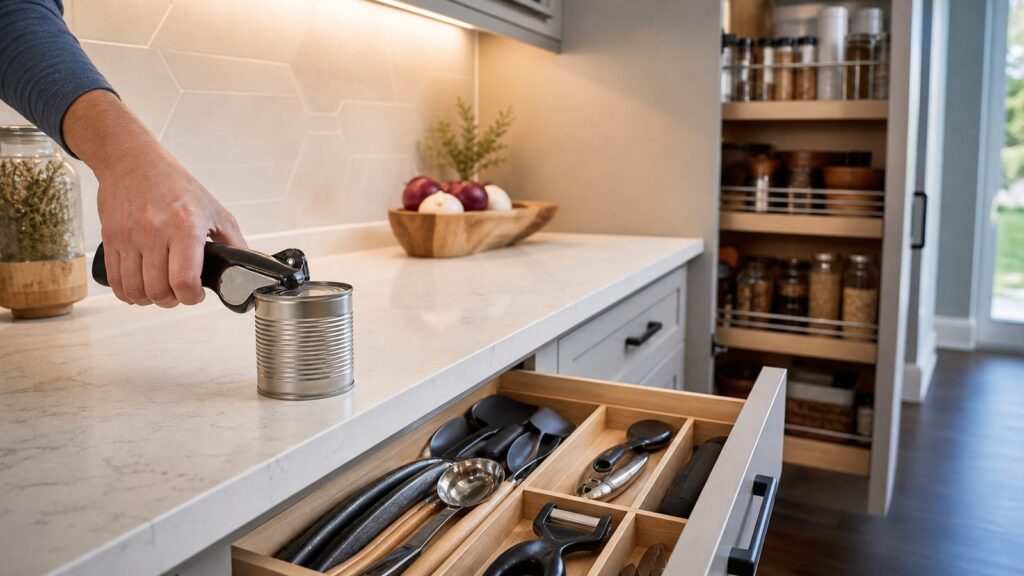
For a left-handed cook, the opener usually belongs in a shallow drawer or top pull-out on the dominant-hand side of the prep zone. A 3-inch to 5-inch-deep drawer with a simple organizer is usually better than a deep mixed utensil drawer. If the can-opening area is near a pantry cabinet, a narrow pull-out tray can keep the opener, measuring cups, funnels, and food-storage clips together.
Also popular on Amazon
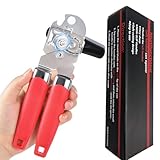
- True left handed can opener
- True left handed bottle opener
- Rotate the small handle in counter-clockwise with left hand until the lid opens, easier for left-handers to turn
- Lefty kitchen tools utensils for left hand people/adults
- 7.48 inch/19 cm, Red handle
Plan at least 15 inches of clear landing space near the opener zone for ordinary use. More is better if the homeowner opens large cans, meal-preps in batches, or uses mobility aids. Countertop clutter ruins this quickly, so we prefer a defined prep area with overhead or under-cabinet task lighting and a nearby trash or recycling pull-out.
What’s actually slowing this PC down?
Pick the symptom - the matching free tool is one click away.
Aisle width also affects comfort. NKBA kitchen planning guidance commonly recommends at least 42 inches of work aisle for one cook and 48 inches for multiple cooks. Those numbers matter for left-handed cooks because elbow room and approach angle change how naturally someone can work at a counter, especially near an island or peninsula.
Electric Can Openers: Outlet, GFCI, and Appliance Garage Notes
An electric can opener can be a smart accessibility upgrade, but it creates planning questions that a manual opener does not. Where does it plug in? Does the cord cross a prep area? Can the user reach it without lifting the appliance from a high cabinet? Can the cutting assembly be removed and cleaned at the sink?
Kitchen receptacles serving countertop areas generally need GFCI protection, and many modern kitchen circuits also involve AFCI requirements depending on jurisdiction and code cycle. Island and peninsula receptacle rules have changed in recent code cycles, so do not assume an old island outlet layout is still the current standard for new work. Local adoption varies, which is why electrical changes should be checked against the code enforced in your city or county.
If you are adding an appliance garage, charging drawer, or new receptacle for a can opener, coffee station, or small appliance zone, plan it during the electrical layout stage. A receptacle added later may require cutting backsplash tile, opening drywall, fishing cable through finished cabinetry, or revising the circuit. For a simple remodel, an added kitchen receptacle can be a small line item. In a finished tile backsplash or island, it can become expensive because of patching, cabinetry access, and inspection requirements.
For built-in storage, we avoid placing heat-producing appliances inside closed appliance garages unless the product and cabinet design allow it. A can opener is low heat, but many homeowners store several small appliances together. Clearances, cord management, GFCI protection, and ventilation should be considered as a group.
Cost: Product Price vs. Remodel Price
The can opener is the cheap part. The surrounding kitchen improvements are where costs vary. In 2026, broad U.S. contractor planning ranges commonly place many kitchen remodels around $15,000 to $75,000. Smaller cosmetic projects often start around $20,000 or more when professional labor, materials, and coordination are included. Full mid-range remodels commonly run about $75,000 to $125,000, while high-end or structural kitchen projects can exceed $150,000.
Per-square-foot planning ranges are also useful. Basic or cosmetic kitchen work may fall around $100 to $250 per square foot. Mid-range remodels often land around $250 to $450 per square foot. High-end kitchens can run $450 to $800 or more per square foot, especially when custom cabinets, stone counters, structural changes, panel-ready appliances, or major electrical and plumbing revisions are involved.
Also popular on Amazon

- Please purchase the True left handed can opener from KYDLLF Store
- True left handed bottler opener from KYDLLF Store
- Rotate the small handle in counter-clockwise with left hand until the lid opens, easier for left-handers to turn
- Lefty kitchen tools utensils for left hand people/adults from KYDLLF Store
- 7.48 inch/19 cm, Black Handle
| Upgrade | Typical Cost Impact | Why It Helps |
|---|---|---|
| Left-handed or ambidextrous opener | $10-$30 | Improves daily comfort with no installation |
| Electric can opener | $25-$45 | Reduces grip force and wrist motion |
| Drawer organizer or shallow insert | Low cost, often under a small finish allowance | Keeps the opener visible and reachable |
| Pull-out pantry or base tray | Varies by cabinet line and hardware | Reduces bending and searching in deep cabinets |
| Under-cabinet task lighting | Varies by fixture type, wiring, and controls | Improves visibility at the prep and opening zone |
| New receptacle or appliance garage wiring | Varies by access, finish conditions, permits, and code | Supports electric openers and small-appliance storage |
The main cost drivers for a left-hand-friendly or accessibility-minded kitchen are not the opener. They are cabinet modifications, pull-out trays, drawer organizers, countertop height changes, better lighting, added receptacles, GFCI and AFCI compliance, appliance-garage wiring, local labor rates, permit fees, and whether plumbing, electrical, or structural work is included.
Quick wins for a faster PC:
Repair Windows errors before they cause bigger problemsFix Now →Fix the driver behind crashes, sound loss and screen glitchesFind Drivers →When to DIY vs. When to Hire a Pro
Good DIY projects
Buying a better opener is an easy DIY decision. So is moving the opener to a more logical drawer, adding a drawer divider, labeling a pantry pull-out, or testing whether a smooth-edge opener works for both left- and right-handed users. Most homeowners can also install basic non-wired drawer inserts and reorganize a prep zone in an afternoon.
A practical DIY audit takes 20 minutes. Stand where you normally open cans. Reach for the pantry item, opener, counter space, trash, recycling, sink, and light switch. If any step requires crossing the kitchen, bending into a dark base cabinet, or switching hands, the layout is costing you effort every time.
Call a professional when wiring, cabinetry, or layout changes are involved
Hire a licensed electrician for new receptacles, appliance-garage power, under-cabinet lighting circuits, or any work that changes kitchen wiring. Kitchen electrical work is inspection-sensitive because countertop areas, wet zones, small-appliance circuits, GFCI protection, and AFCI rules are all involved. A handyman-level shortcut can become a problem at inspection, resale, or insurance time.
Bring in a remodeler or cabinet professional when you are modifying cabinet boxes, adding pull-out storage, changing counter heights, moving appliances, or reworking an island. A pull-out shelf sounds simple until it conflicts with hinges, face frames, plumbing, appliance clearances, or existing drawer boxes. During a larger remodel, it is far cheaper to plan these details before cabinets are ordered than to retrofit them after installation.
Recommended Free Tools
Left-Handed Kitchen Audit Checklist
Use this checklist before buying another gadget or approving a kitchen plan. It catches the small layout decisions that make a kitchen feel natural for a left-handed homeowner.
- Dominant-hand storage side: Is the opener stored on the left-handed user’s natural reach side at the main prep zone?
- Drawer depth: Is the opener in a shallow drawer or top pull-out instead of buried in a deep utensil bin?
- Landing area: Is there at least 15 inches of clear counter space where cans are opened?
- Trash and recycling: Can the user discard lids, cans, and packaging without turning across the room?
- Lighting: Does task lighting cover the actual can-opening area, not just the sink or range?
- Outlet location: If using an electric opener, is there a nearby GFCI-protected receptacle that does not require a cord across the work surface?
- Grip-friendly hardware: Are drawers and pull-outs fitted with D-pulls or handles that do not require pinching?
- Aisle clearance: Does the prep area have enough room for the cook’s elbow, stance, and any mobility device?
Common Buying and Planning Mistakes
The most common mistake is buying a standard right-handed opener and expecting the left-handed user to adapt. Many do adapt, but usually by twisting the wrist, losing leverage, or turning the can instead of the crank. That is not good design. It is a workaround.
The second mistake is ignoring the lid edge. Traditional openers can leave sharp metal. Smooth-edge openers are worth considering for families, seniors, and anyone with reduced dexterity. The third mistake is buying a bulky electric opener without checking storage height, cord length, cleaning access, and whether it works on the can sizes the household actually uses.
Also popular on Amazon

- Left Handed Kitchen Scissors Shears and Can Opener, Peeler Set
- Lefty Kitchen Tools Utensils for Left Hand People/Adults
- 1 X left handed kitchen scissors, 1 X left handed can opener, 1 X elft handed peeler
- For left handed
- How to ues left handed can opener: Rotate the small handle in counter-clockwise with left hand until the lid opens, easier for left-handers to turn
During remodels, the big mistake is treating accessibility as a grab-bar conversation instead of a daily-task conversation. Aging-in-place design is also about D-pulls, pull-out shelves, anti-fatigue flooring, better task lighting, reachable storage, clear work aisles, and controls that do not require tight grasping or wrist twisting. A left-handed can opener is a small example of the larger principle: the kitchen should fit the user, not the other way around.
Do these 3 things before closing this tab:
1Repair Windows errors before they cause bigger problems2Scan for outdated or missing drivers - takes under a minute3Clear out junk files and repair common Windows errorsOur Bottom Line
For most left-handed homeowners, the first choice should be either a true left-handed manual opener in the $10 to $25 range or an ambidextrous smooth-edge opener in the $14 to $30 range. Choose the true left-handed model when one left-handed cook owns the workflow. Choose the ambidextrous model when the kitchen is shared. Choose an electric opener, typically $25 to $45, when grip strength, arthritis, tremors, or fatigue matter more than drawer simplicity.
Then fix the kitchen around the task. Put the opener in the correct drawer. Keep landing space clear. Add lighting where the work happens. Plan power carefully if the opener is electric. In a well-designed kitchen, the best tool is not just easy to buy. It is easy to reach, easy to use, easy to clean, and supported by the layout every day.
Frequently Asked Questions
What makes a can opener left-handed?
A true left-handed can opener reverses the standard right-handed mechanism. It is typically held on the left side of the can, and the crank turns away from the user with the left hand, reducing awkward wrist rotation.
Are left-handed can openers better than ambidextrous can openers?
For a left-handed-only household, a true left-handed opener can feel more natural. In a shared kitchen, an ambidextrous smooth-edge opener is often better because both left- and right-handed users can operate it comfortably.
Free tools Windows power users keep installed
One-click scans. No signup required.
What is the best can opener for left-handed seniors or people with arthritis?
A hands-free electric opener is usually the best choice when grip strength, arthritis, or wrist pain is a concern. Look for one-touch operation, a stable base, cleanable cutting parts, and a size that fits the user’s storage and counter space.
How much does a left-handed can opener cost in 2026?
Dedicated left-handed manual can openers usually cost about $10 to $25 online in the U.S. Ambidextrous smooth-edge manual openers commonly cost about $14 to $30, and mainstream electric openers are usually about $25 to $45.
Do I need a permit to add an outlet for an electric can opener?
Often, yes. Requirements vary by jurisdiction, but kitchen receptacle work commonly involves permits, GFCI protection, AFCI rules, and inspection. Use a licensed electrician for new kitchen outlets, appliance garages, or under-cabinet power.
Where should a can opener be stored in a left-handed kitchen?
Store it in a shallow drawer or top pull-out on the left-handed user’s dominant side near the main prep zone. It should be close to pantry storage, counter landing space, trash or recycling, the sink, and task lighting.
Do these 3 things before closing this tab:
1Fix the driver behind crashes, sound loss and screen glitches2Clear out junk files and repair common Windows errors3Scan for outdated or missing drivers - takes under a minuteQuick Recap
Product prices and availability are accurate as of the date/time indicated and are subject to change. Any price and availability information displayed on Amazon at the time of purchase will apply.

