Some links on this page are affiliate links: if you buy through them we may earn a commission, at no extra cost to you.
The best house electrical switch is not simply the newest smart switch or the most expensive dimmer. The best switch is the one that safely matches the circuit, the lighting load, the room, the wall box, and the way your household actually uses that space.
On our job sites, we start switch planning with a practical question: what problem is this switch supposed to solve? A basic bedroom light may only need a dependable spec-grade rocker. A stairway needs correct multi-location control. A bathroom fan may benefit from a timer. Exterior lights may be worth automating. A living room with recessed LEDs needs a dimmer that is compatible with the exact fixtures, not just a dimmer that looks good on the shelf.
As an Amazon Associate I earn from qualifying purchases.
Crashes, No Sound, or Screen Glitches?
Random freezes, missing sound and display glitches usually trace back to one bad driver. Find and replace yours safely.Free scan · under a minuteWindows Errors? Fix Them Before They Spread
Repair common Windows errors and clear accumulated junk for a smoother, more stable PC - no reinstall needed.Free scan · no reinstallFor most US homes in 2026, a straightforward light switch replacement often lands around $80 to $200 when bundled efficiently, while national averages commonly sit near $150 for a single replacement. More involved switch and outlet installation projects can run about $253 to $711, especially when service-call minimums, smart controls, new wiring, box changes, or older wiring conditions are involved. The device itself may cost $2 to $10 for a basic switch or $50 to $100-plus for a premium smart dimmer, but labor, code compliance, and wiring condition are what usually drive the real installed cost.
This guide breaks down the main types of residential switches, where each one belongs, what they cost, and the safety details that matter before you open a wall box.
Popular on Amazon

- Single pole wall light switch, rating 15A 120-277V, decor wallplate included, gloss finish, UL certified. Reminder: To match BESTTEN light switch color, please select USWP4 series wall plates
- A positive, yet smooth and quiet On/Off paddle action allows you to feel the quality in which every BESTTEN switch is made
- Quick push-in and side wiring options available. Terminal screws accept up to 12 AWG and quick push-in wiring accepts 14 AWG solid copper wire only
- Full-rated current capacity with LED, tungsten, fluorescent or resistive loads. Motor capacity is 80% of switch rating
- The modern look of a decor switch can enhance the style of anywhere a switch is needed
Start With the Circuit, Not the Switch Style
A switch is part of an electrical system. Before choosing toggle, rocker, dimmer, sensor, timer, or smart control, confirm what the switch is controlling and what the circuit can support.
Most common residential wall switches are 15-amp or 20-amp, 120-volt devices. The switch must be rated for the circuit and for the load it controls. Typical lighting branch circuits are 15A or 20A. A 15A lighting circuit commonly uses 14 AWG copper conductors, while a 20A circuit commonly uses 12 AWG copper conductors, subject to local code, circuit design, and the actual installation.
Recommended Free Tools
That rating matters. A switch that controls a few LED recessed lights has a different load profile than a switch controlling a bathroom fan, exterior floodlights, a garbage disposal, or a ceiling fan. A dimmer intended for LED lamps is not automatically suitable for a motor load. A fan-speed control is not the same as a lighting dimmer. A smart switch that needs a neutral conductor should not be forced into an old switch loop that does not have one.
We also look at the wall box. Crowded boxes, shallow boxes, old cloth-insulated wiring, missing grounds, aluminum branch wiring, brittle insulation, and loose splices are all reasons to slow down. Many smart switches and sensor switches are physically deeper than a basic toggle. If box fill is already tight, the safest upgrade may involve a larger box, rewiring, or a different control strategy.
The Main Types of House Electrical Switches
Most homes use a mix of switch types. The right answer for a hallway is not always the right answer for a kitchen, bedroom, garage, or exterior light.
Single-Pole Switches
A single-pole switch controls one light or load from one location. This is the standard switch used in many bedrooms, closets, offices, pantries, and basic utility spaces.
Basic toggle and rocker switches are inexpensive, durable, and easy for guests to understand. Device-only pricing is usually about $2 to $10 for a standard residential switch. In high-use locations, we often prefer commercial or spec-grade switches, typically about $5 to $20 each, because the action feels firmer and the internal components are built for heavier use.
Best use: bedrooms, closets, pantries, utility rooms, simple ceiling lights, and general replacement work where automation is not needed.
Decorator Rocker Switches
Decorator switches use a wide rectangular paddle instead of the traditional toggle lever. Functionally, many are still single-pole, 3-way, or 4-way switches. The difference is appearance and usability.
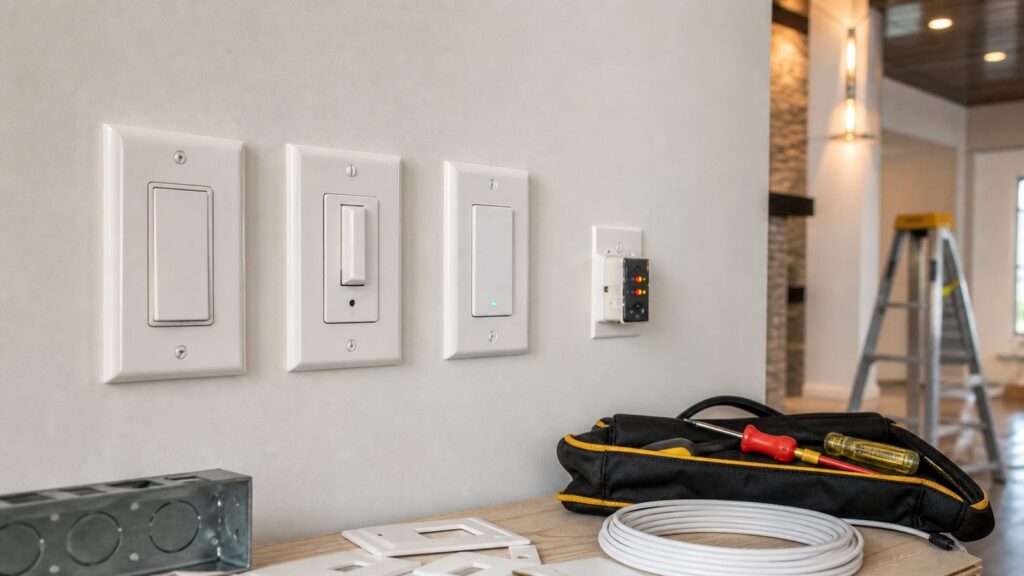
Rocker switches are popular in remodels because they look cleaner with modern cover plates, are easier to press with the back of a hand, and pair well with dimmers, sensors, and smart controls in the same wall plate. For a whole-home finish upgrade, spec-grade decorator switches are usually the best balance of cost, durability, and appearance.
Quick wins for a faster PC:
Fix the driver behind crashes, sound loss and screen glitchesFind Drivers →Clear out junk files and repair common Windows errorsFree Scan →Scan for outdated or missing drivers - takes under a minuteDriver Scan →Best use: main living areas, kitchens, hallways, bedrooms, finished basements, and remodels where a consistent wall-control style matters.
3-Way and 4-Way Switches
Three-way switches control one light or group of lights from two locations. Four-way switches are used between 3-way switches when a light is controlled from three or more locations.
Common locations include stairs, long hallways, large rooms with multiple entries, garages with house and exterior entries, and basement stairs. Device-only costs are commonly around $5 to $25 per switch, but the installed cost can climb if wiring is mislabeled, older, or previously modified by DIY work.
Multi-way switching is one of the places where homeowners get into trouble. Wire color alone does not prove function. A white conductor in a switch box may be reidentified as a hot conductor in older switch-loop wiring. Smart 3-way systems also vary by manufacturer: some use companion switches, some use standard 3-way wiring, and some need a neutral at one or more boxes.
Best use: stairs, hallways, large rooms, garages, and any space where code or common sense requires control from more than one entry point.
Dimmer Switches
Dimmers improve comfort and can reduce energy use, but only when they match the lighting load. With LED lighting, compatibility is the whole game.
A typical LED-compatible dimmer costs about $15 to $60. Premium smart dimmers and hub-based controls often run $50 to $100-plus. The dimmer should be listed for the load type: LED/CFL dimmers for compatible dimmable LED lamps, ELV or MLV dimmers for certain low-voltage lighting systems, and fan-speed controls for fans. Do not use a standard lighting dimmer to control a ceiling fan motor.
On higher-end lighting projects, we check the fixture or lamp manufacturer’s dimmer compatibility list before ordering devices. We also test low-end trim. Cheap dimmers can cause flicker, buzzing, ghosting, pop-on behavior, or a very narrow usable dimming range. A living room full of recessed LEDs should dim smoothly from bright task lighting down to low evening light without flashing or dropping out.
Best use: living rooms, dining rooms, kitchens, primary bedrooms, media rooms, nurseries, and any room where light level changes throughout the day.
Occupancy and Vacancy Sensor Switches
Sensor switches turn lights off automatically and, depending on the type, may turn them on automatically as well. An occupancy sensor typically turns lights on when it detects motion and off after a set period. A vacancy sensor usually requires manual-on operation and then shuts lights off automatically.
Device-only pricing is commonly about $20 to $80. Installed cost depends on wiring, box depth, programming time, and whether a neutral is required. Many sensors include adjustable timeout settings such as 30 seconds, 5 minutes, 15 minutes, or 30 minutes.
We like vacancy sensors in bathrooms, closets, laundry rooms, and utility spaces because manual-on/auto-off behavior saves energy without surprising people. Occupancy sensors make more sense in garages, mudrooms, storage rooms, and some laundry areas where hands-free operation is genuinely useful. In bedrooms and living rooms, automatic-on sensors can be annoying unless carefully placed and programmed.
Best use: closets, bathrooms, laundry rooms, garages, mudrooms, storage rooms, and utility areas.
Timer Switches
Timer switches are simple, reliable controls for loads that should not run all day. Device-only pricing usually falls around $20 to $75.
Bathroom exhaust fans are the classic use. A 10-, 20-, 30-, and 60-minute timer lets the fan keep running after a shower without being left on until bedtime. Timers are also useful for exterior lights, heat lamps where allowed and properly rated, pantry lighting, garage lights, and workshop exhaust fans.
Also popular on Amazon

- EASY REPAIR OR REPLACEMENT FOR ANY ROOM – Upgrade or replace existing switches in bedrooms, kitchens, offices or workshops with a reliable grounding toggle switch designed for DIYers and professionals
- FAST INSTALLATION WITH FLEXIBLE WIRING OPTIONS – Pressure-Lock push-in terminals enable quick connections, while traditional screw terminals support secure wiring for a wide range of installation preferences
- CLEAN WHITE FINISH MATCHES ANY DÉCOR – Bright white color blends seamlessly with existing toggle wallplates (not included), making it ideal for new construction or simple home upgrades
- HIGH POWER RATING FOR DEMANDING LOADS – Supports single-pole circuits with a 120-277VAC, 20A rating, delivering dependable control for lighting and other household fixtures
- UL LISTED FOR SAFETY AND RELIABILITY – Tested to meet strict safety standards, this residential-grade switch ensures consistent performance and peace of mind in everyday electrical applications
For fans and specialty loads, check the switch rating. The device must be rated for the motor or load it controls, not just for general lighting.
What’s actually slowing this PC down?
Pick the symptom - the matching free tool is one click away.
Best use: bathroom fans, laundry fans, exterior lighting, garage lights, utility rooms, and spaces where automatic shutoff is more valuable than smart-home control.
Smart and Matter-Compatible Switches
Smart switches allow app control, voice control, schedules, scenes, remote access, and automation. Matter-compatible switches are increasingly useful in 2026 because Matter improves cross-platform compatibility with systems such as Apple Home, Google Home, Amazon Alexa, and other smart-home platforms.
Basic smart Wi-Fi or Matter switches often cost about $15 to $50 each. Premium smart dimmers, no-neutral devices, and hub-based systems are commonly $50 to $100-plus per control. The installed cost can rise when setup, firmware updates, app pairing, network troubleshooting, or hub configuration is included.
The biggest installation question is neutral availability. Many smart switches need a neutral conductor in the switch box because the electronics require a small amount of constant power. Older homes may have switch boxes without neutrals. In that case, good options include no-neutral smart switches, a hub-based lighting system, smart bulbs, fixture-mounted relay modules, or rewiring the box. The wrong option is jamming in a device that the circuit does not support.
The Tool Desk
Outbyte PC Repair FREEClear out junk files and repair common Windows errorsFree Scan →Outbyte Driver Updater FREEScan for outdated or missing drivers - takes under a minuteDriver Scan →Smart switches are best when they solve a real problem. Exterior lights on sunset schedules, entry lights on arrival scenes, stair lighting for accessibility, vacation lighting, and whole-home bedtime scenes are all strong uses. Replacing every closet switch with Wi-Fi hardware is usually not money well spent.
Best use: exterior lights, entries, kitchens, main living areas, accessibility needs, vacation scenes, and households already committed to one smart-home ecosystem.
Illuminated and Locator Switches
Illuminated switches or locator switches make the switch easier to find in the dark. They are useful in hallways, stair landings, guest bathrooms, bedrooms, and basements.
These are a simple safety upgrade without the complexity of smart controls. They are especially helpful for guests, children, and older adults who need to find a light quickly at night.
Do these 3 things before closing this tab:
1Scan for outdated or missing drivers - takes under a minute2Repair Windows errors before they cause bigger problems3Fix the driver behind crashes, sound loss and screen glitchesBest use: stairs, halls, bedrooms, guest baths, basements, and rooms where the switch is hard to locate after dark.
Weather-Rated Exterior Switches
Exterior and damp-location switching needs more than an indoor switch in a plastic cover. The assembly should be suitable for the location, with weather-rated components, intact gaskets, corrosion-resistant hardware, and appropriate covers. Weather-rated exterior switch and cover assemblies often add $10 to $40-plus in materials.
GFCI and AFCI requirements may also apply depending on the circuit, location, and locally adopted code. For outdoor kitchens, detached garages, pool equipment areas, landscape lighting, and exterior receptacle/switch combinations, we recommend having the full circuit evaluated rather than treating it as a cosmetic swap.
Best use: porches, patios, garages, outdoor kitchens, sheds, detached structures, and exterior lighting controls.
Free tools Windows power users keep installed
One-click scans. No signup required.
Room-by-Room Switch Recommendations
A room-by-room switch schedule is one of the most useful planning tools in a remodel. We list the switch location, controlled load, number of control points, dimming need, automation need, neutral availability, box depth, and environmental rating. That simple schedule prevents expensive changes after walls are patched and painted.
| Room or Area | Best Switch Type | Practical Reason | Typical Device Cost |
|---|---|---|---|
| Bedroom | Spec-grade rocker or LED dimmer | Simple daily use, optional low evening light | $5-$60 |
| Living room | LED-compatible dimmer or smart dimmer | Comfort, scenes, layered lighting | $15-$100+ |
| Kitchen | Decorator rockers, dimmers for recessed lights | Task lighting plus controlled ambient light | $5-$100+ |
| Dining room | LED-compatible dimmer | Adjusts from cleaning light to meal lighting | $15-$60 |
| Bathroom | Vacancy sensor for light, timer for fan | Auto-off lighting and moisture control | $20-$80 each |
| Closet | Vacancy sensor or simple rocker | Prevents lights being left on | $5-$80 |
| Hallway | 3-way/4-way rocker or illuminated switch | Control from multiple locations, safer at night | $5-$25+ |
| Stairs | 3-way/4-way illuminated controls | Safety and code-conscious convenience | $5-$25+ |
| Garage | Occupancy sensor or 3-way switch | Hands-free entry, multiple access points | $20-$80 |
| Exterior lights | Timer, smart switch, or weather-rated control | Schedules, security, weather exposure | $20-$100+ |
For most remodels, the best value is a hybrid approach: spec-grade decorator switches throughout the house, LED-compatible dimmers where light quality matters, sensors in utility spaces, timers for exhaust fans, and smart switches only where automation will be used regularly.
Safety Features and Code Issues That Matter
Electrical switches are small devices, but bad switch work can create shock, heat, arcing, nuisance failures, and fire risk. Electrical distribution and lighting equipment are involved in tens of thousands of US home fires each year. NFPA research found that fire departments responded to an estimated average of 32,620 home fires per year involving electrical distribution and lighting equipment during 2015-2019, with an estimated 430 deaths, 1,070 injuries, and $1.3 billion in direct property damage annually. ESFI also reports home electrical fires at about 51,000 fires each year, nearly 500 deaths, more than 1,400 injuries, and $1.3 billion in property damage.
That does not mean every switch replacement is dangerous. It does mean switch upgrades deserve the same care as any other electrical work.
Recommended Free Tools
Listing and Rating
Use devices listed by a recognized testing laboratory, such as UL or ETL. Match the amp and voltage rating to the circuit and load. A typical residential switch may be 15A or 20A at 120V, but specialty controls have more specific ratings for LEDs, motors, fans, magnetic low-voltage loads, electronic low-voltage loads, or mixed loads.
Grounding
Modern switches should be properly grounded where grounding conductors are present. Older homes may have metal conduit systems, ungrounded cable, or boxes with uncertain grounding continuity. Do not assume the box is grounded just because it is metal. Testing and verification matter.
Neutral Conductors
Many smart switches, sensors, and timers need a neutral conductor. In newer wiring, neutrals are commonly present in switch boxes, but older switch loops may not have one. A neutral is not the same as a ground, and the grounding conductor should not be used as a neutral return path for a smart device.
AFCI and GFCI Protection
AFCI protection is commonly relevant to 15A and 20A dwelling-unit circuits serving many living areas. GFCI protection is relevant in wet, damp, exterior, garage, basement, and other shock-prone locations. Requirements vary based on the NEC edition adopted in your jurisdiction and local amendments. The 2026 NEC cycle continues the trend toward more detailed safety requirements, so the local authority having jurisdiction is the final word.
Mounting Height and Location
The NEC does not set one universal light-switch mounting height for all rooms, but wall control devices are generally expected near room entrances where applicable. Many builders use about 48 inches to the top of the box or switch as a practical standard. Accessibility requirements, project specifications, local rules, and homeowner needs can change that height.
Good switch placement is about more than code. A light switch should be reachable before someone steps into a dark room, should not be hidden behind a door swing, and should be grouped logically. In a kitchen, for example, we want the homeowner to understand which switch controls recessed lights, pendants, under-cabinet lighting, and exterior lights without playing a guessing game.
What Electrical Switch Upgrades Cost in 2026
The lowest-cost switch project is a like-for-like replacement in a modern, properly wired box where the circuit is labeled, the device is accessible, and no repairs are needed. The highest-cost projects involve old wiring, new switch locations, drywall repair, smart-home setup, panel work, permits, or correcting unsafe previous work.
| Switch or Project Type | Typical Device-Only Cost | Installed Cost Notes |
|---|---|---|
| Basic toggle or rocker | $2-$10 | Simple replacements often fall around $80-$200 when conditions are clean |
| Spec-grade decorator switch | $5-$20 | Good value for high-use rooms and whole-home finish upgrades |
| 3-way or 4-way switch | $5-$25 | Labor rises if travelers, commons, or old splices are unclear |
| LED-compatible dimmer | $15-$60 | Compatibility testing may be needed for recessed LEDs and fixtures |
| Occupancy or vacancy sensor | $20-$80 | May need neutral, deeper box, and programming |
| Timer switch | $20-$75 | Useful for fans and exterior lights; must match load rating |
| Smart Wi-Fi or Matter switch | $15-$50 | Setup time, neutral availability, and network strength affect labor |
| Premium smart dimmer or hub-based control | $50-$100+ | Often worth it for reliability, scenes, and no-neutral options |
| Weather-rated exterior assembly | $10-$40+ added materials | Gaskets, covers, corrosion, and GFCI/AFCI context matter |
Nationally, a single light switch replacement is often reported around a $150 average, with a broad range of about $45 to $450. Many straightforward replacements land around $80 to $200. Broader switch and outlet installation projects average closer to $424 nationally, with common ranges from $253 to $711. Another 2026 estimating range puts light-switch installation around $209 to $385 each including labor and materials.
Windows Errors? Fix Them Before They Spread
Repair common Windows errors and clear accumulated junk for a smoother, more stable PC - no reinstall needed.Free scan · no reinstallCrashes, No Sound, or Screen Glitches?
Random freezes, missing sound and display glitches usually trace back to one bad driver. Find and replace yours safely.Free scan · under a minuteAlso popular on Amazon

- Full rated current capacity with tungsten, fluorescent or resistive loads. Motor capacity is 80-percent of switch rating
- Back and side-wiring terminals accept both solid and stranded wire to ease installation
- Heavy-duty impact-resistant thermoplastic construction for long service life in commercial applications
- Two ground connection options: a green grounding screw and a self-grounding clip
- All Decora devices meet or exceed applicable UL, CSA and NOM testing standards
Electrician labor commonly runs about $50 to $130 per hour, and small jobs often carry a first-hour or service-call fee of about $100 to $200. That is why replacing one switch can feel expensive while replacing eight during the same visit may be much more reasonable per device.
Cost drivers include local labor rates, number of devices replaced in one trip, switch type, smart-home setup time, neutral wire availability, larger box requirements, box-fill corrections, aluminum wiring, ungrounded wiring, drywall and paint repair, permit and inspection fees, AFCI or GFCI breaker upgrades, panel access, and whether the work is replacement or new wiring.
Independent reader supportYour contribution helps us test, update, and keep practical guides available for everyone.Smart Switches: Where They Make Sense and Where They Do Not
Smart switches are useful, but they are not automatically the best switch for every room. A reliable $8 spec-grade rocker can be the better choice for a hall closet. A $90 smart dimmer may be the right choice for exterior lighting, a main living area, or an accessibility need.
Before buying smart switches, choose an ecosystem and protocol strategy. Mixing random Wi-Fi switches from multiple apps can work at first and become annoying later. Matter support helps with cross-platform compatibility, but the installation constraints still matter more than the logo on the box. Confirm whether the switch needs a neutral, whether it works in a 3-way setup, whether it supports dimming, whether it needs a hub, and whether your Wi-Fi coverage is strong at that wall location.
What’s actually slowing this PC down?
Pick the symptom - the matching free tool is one click away.
Hub-based systems remain popular on construction and remodel projects because they tend to be reliable, fast, and less dependent on a crowded Wi-Fi network. Some systems also offer no-neutral options, which can be valuable in older homes. Wi-Fi switches can be a good fit for smaller projects, but whole-home smart lighting should be planned as a system.
Good smart-switch use cases include porch lights on sunset-to-sunrise schedules, entry lights that turn on before arrival, vacation scenes, stair and hallway lighting for aging-in-place planning, security lighting, and bedtime routines that shut off main-floor lights from one command.
Weak use cases include rarely used closets, rooms where guests need simple controls, circuits with incompatible wiring, and locations where a smart bulb or plug-in control would solve the same problem with less cost.
When to DIY vs. When to Hire a Pro
A homeowner with electrical experience may be able to replace a simple single-pole switch like-for-like, provided the circuit is clearly identified, power is verified off with a proper tester, the wiring is modern and intact, the box is not crowded, the device is correctly rated, and local rules allow the work.
The Tool Desk
Outbyte PC Repair FREERepair Windows errors before they cause bigger problemsFix Now →Outbyte Driver Updater FREEScan for outdated or missing drivers - takes under a minuteDriver Scan →The DIY material cost can be under $20 for a basic switch. That is the appealing part. The risk rises quickly when the switch controls multiple locations, exterior lights, fans, smart devices, dimmers, aluminum wiring, old ungrounded wiring, or anything in a wet or damp location.
Hire a licensed electrician when you see any of the following: warm or buzzing switches, flickering lights that persist after bulb replacement, scorch marks, cracked insulation, cloth wiring, aluminum branch wiring, missing grounds, no neutral where a device requires one, crowded boxes, unlabeled circuits, repeated breaker trips, exterior or bathroom circuit questions, or any need for new wiring.
You should also bring in a pro for new switch locations, converting single-location control to 3-way or 4-way control, panel or breaker changes, AFCI/GFCI upgrades, permit-required work, and smart lighting systems that need reliable whole-home setup.
A normal like-for-like switch replacement may take a pro 15 to 45 minutes under clean conditions. A smart dimmer or sensor in a crowded box may take 45 to 90 minutes. New wiring, fishing cable through finished walls, repairing old splices, or troubleshooting multi-way circuits can take several hours. A full-house switch upgrade is usually best handled as a planned half-day or full-day electrical visit, depending on device count and conditions.
Our Practical Selection Method
When we build or remodel, we do not start by asking which switch is trendy. We build a switch schedule and make decisions room by room.
First, we identify the controlled load: recessed LED lights, chandelier, fan, exterior fixture, receptacle, disposal, or specialty equipment. Second, we confirm the number of control locations: single-pole, 3-way, or 4-way. Third, we decide whether dimming, sensing, timing, or automation adds real value. Fourth, we check the box: neutral, ground, depth, conductor condition, and fill. Fifth, we match device style so the finished wall plates look intentional throughout the home.
For a typical remodel, our default recommendation is spec-grade decorator switches in most rooms, LED-compatible dimmers in living and dining areas, vacancy sensors in closets and bathrooms where appropriate, countdown timers for bath fans, illuminated controls at stairs and halls, and smart switches for exterior and high-value automation circuits.
That mix is not the cheapest possible package, and it is not the most gadget-heavy. It is the package that tends to age well, pass inspection cleanly, feel natural to use, and avoid replacing simple reliable controls with unnecessary electronics.
Free tools Windows power users keep installed
One-click scans. No signup required.
Final Recommendation
The best electrical switches for a house are selected by function, not by brand alone. Use basic spec-grade rockers where simple control is enough. Use 3-way and 4-way switches where people need control from multiple locations. Use LED-compatible dimmers where lighting comfort matters. Use vacancy sensors, occupancy sensors, and timers where automatic shutoff solves a real problem. Use smart or Matter-compatible switches where schedules, scenes, accessibility, or remote control will actually be used.
Most importantly, respect the wiring. Confirm ratings, grounding, neutral availability, box fill, load compatibility, and local AFCI/GFCI and permit requirements before installing anything. A good switch upgrade should make the home safer, easier to use, and cleaner-looking for the next 10 to 20 years, not create troubleshooting calls six months later.
Frequently Asked Questions
What type of electrical switch is best for each room in a house?
Use spec-grade rocker switches for basic rooms, LED-compatible dimmers for living rooms and dining rooms, vacancy sensors for closets and bathrooms, timer switches for bath fans, 3-way or 4-way switches for stairs and halls, and smart switches for exterior lights, entries, and automation-heavy areas.
How much does it cost to replace a light switch in 2026?
A straightforward installed light switch replacement often costs about $80 to $200, with national averages around $150. More involved switch or outlet installation projects commonly range from about $253 to $711, depending on labor, wiring condition, switch type, permits, and setup time.
Do smart switches need a neutral wire?
Many smart switches need a neutral conductor in the switch box, but not all do. Older homes may not have neutrals at switch boxes, so a no-neutral smart switch, hub-based system, smart bulb, fixture module, or rewiring may be needed.
Can I replace a light switch myself?
A simple like-for-like single-pole switch replacement may be reasonable for an experienced homeowner if power is verified off and local rules allow it. Hire a licensed electrician for multi-way switches, dimmers, smart controls, exterior circuits, old wiring, aluminum wiring, missing grounds, crowded boxes, or any permit-required work.
Are dimmer switches safe for LED lights?
Yes, if the dimmer is rated for LED loads and the lamps or fixtures are dimmable and compatible with that dimmer. The wrong dimmer can cause flicker, buzzing, poor low-end performance, or early equipment failure.
Are Matter-compatible smart switches worth it?
Matter-compatible switches can be worth it when you want better compatibility across Apple Home, Google Home, Amazon Alexa, and other ecosystems. They still need to match the wiring, load, box depth, and control layout, so compatibility with the electrical system comes first.
Quick wins for a faster PC:
Repair Windows errors before they cause bigger problemsFix Now →Scan for outdated or missing drivers - takes under a minuteDriver Scan →Quick Recap
Product prices and availability are accurate as of the date/time indicated and are subject to change. Any price and availability information displayed on Amazon at the time of purchase will apply.

