Some links on this page are affiliate links: if you buy through them we may earn a commission, at no extra cost to you.
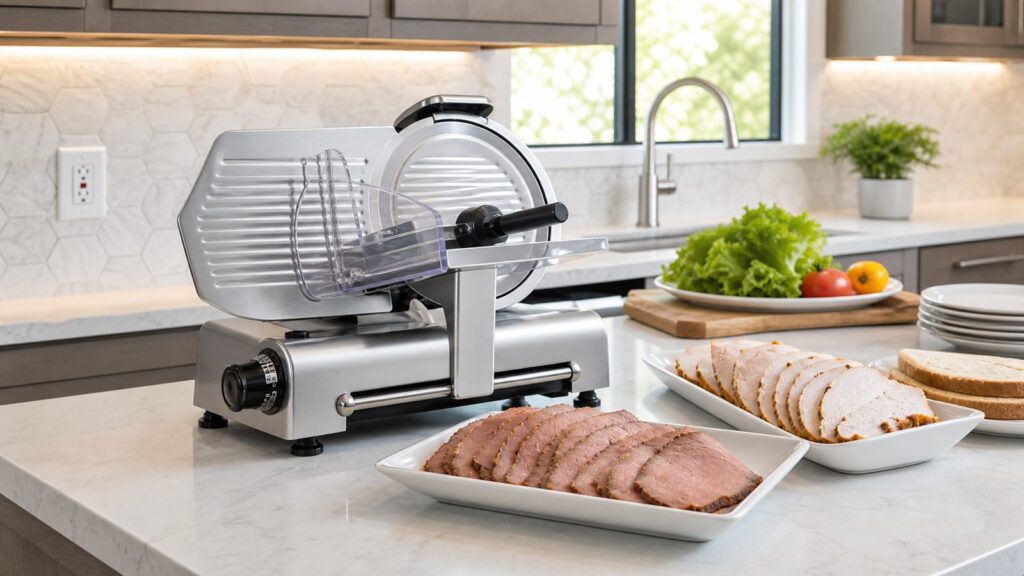
For most homeowners, the best compact meat slicer is a 7.5- to 8.7-inch electric slicer with a 180- to 200-watt motor, a removable stainless steel blade, a solid metal food carriage, suction feet, a blade guard, and parts that come apart without a fight. That size handles roast beef, turkey breast, ham, salami, vegetables, and occasional cheese without taking over the kitchen.
If you slice brisket, bacon slabs, large roasts, or bulk cheese every week, step up to a heavier 10-inch semi-commercial slicer. If you only want deli meat once a month, a $70 budget slicer may work, but it will usually be lighter, louder, harder to clean, and less consistent.
As builders, we look at this appliance differently than a product reviewer does. A slicer is not just something you buy and shove into a cabinet. It needs counter depth, a safe outlet, good lighting, a washable work surface, a place to stage food, and enough clearance to clean it properly. A sharp rotary blade on a cramped counter is not a convenience. It is a layout problem.
Do these 3 things before closing this tab:
1Repair Windows errors before they cause bigger problems2Scan for outdated or missing drivers - takes under a minute3Clear out junk files and repair common Windows errorsAs an Amazon Associate I earn from qualifying purchases.
What Makes a Meat Slicer “Compact” for Home Use?
A compact home meat slicer usually has a blade between 6.7 and 8.7 inches, weighs roughly 8 to 18 pounds, and fits on a standard kitchen counter. Most models in this class are designed for occasional household use, not all-day deli work.
The practical question is not only whether the slicer fits on the counter while turned off. You need to measure it fully assembled, with the food carriage extended, and with enough room for your hands, a plate of unsliced food, and a landing area for finished slices. A slicer listed at 15 inches wide by 10 inches deep can need 18 to 22 inches of real working width once the carriage moves.
Popular on Amazon

- Compact Foldable Design for Small Spaces:This foldable slicer is designed for modern home kitchens, folding down quickly for easy storage. Its compact footprint makes it ideal for apartments, RVs, and small countertops, helping keep your kitchen neat and clutter-free
- Powerful 150W Motor with Quiet Operation:The efficient 150W motor provides reliable cutting performance while operating quietly. Paired with a stainless steel housing, it offers a solid, durable feel and a more refined slicing experience at home
- Durable 6.7” Stainless Steel Blade:Featuring a 6.7-inch stainless steel serrated blade, this slicer stays sharp longer and produces smooth, even slices. Suitable for slicing meat, cheese, bread, vegetables, and more with ease
- Customizable Slicing Thickness:Easily adjust the slicing thickness from 0 mm to 15 mm to match different foods and recipes. From deli-style meats and semi-frozen cuts to cheese, bread, and steak, it delivers consistent, precise results for everyday home slicing
- Easy Cleaning, Stable Design & Cord Storage:The removable blade, slicing platform, and food pusher make cleaning quick and simple. A stainless steel exterior wipes clean easily, non-slip feet enhance stability, and the built-in cord storage at the bottom keeps countertops organized after use
In a typical kitchen, we like to see at least 24 inches of clear counter width for compact slicer work and closer to 30 inches if the homeowner plans to batch-slice cooked meats. Counter depth matters too. A standard 25-inch-deep countertop is usually workable, but shallow counters, appliance garages, tight corners, and raised backsplashes can make the slicer awkward to operate.
Recommended Free Tools
Compact does not mean flimsy. The best small slicer is still stable. Look for a rigid carriage, non-slip or suction feet, a food pusher that keeps your hand away from the blade, and a thickness knob that does not drift while slicing. If the carriage flexes when you press food into it, the slices will wander.
The Best Blade Size for a Home Meat Slicer
For most households, the sweet spot is a 7.5- to 8.7-inch blade. It is large enough for common home cuts but still small enough to lift, clean, and store.
6.7- to 7.5-inch blades
This is the budget compact range. These slicers often cost about $70 to $120 in 2026 and are fine for occasional turkey, ham, roast beef, pepperoni, vegetables, and small cooked roasts. They are easier to store, but the smaller blade limits food height and can struggle with dense cheese, bacon, or semi-frozen meat.
7.5- to 8.7-inch blades
This is the best fit for most serious home kitchens. Expect to spend about $120 to $300 for a good unit. You typically get better motor output, more metal in the body, a sturdier carriage, better suction feet, and cleaner disassembly. This range is what we would plan around in a remodel for a family that meal-preps, smokes meat, buys deli meat in bulk, or entertains regularly.
10-inch blades
A 10-inch slicer moves into premium home or semi-commercial territory. Many cost $300 to $700, and commercial or NSF-listed versions commonly run $700 to $1,500 or more. They handle larger roasts and heavier slicing better, but they also take more counter space and cabinet strength. Before buying one, check the appliance weight, shelf rating, counter depth, and whether you can clean it without wrestling it across the kitchen.
Motor Power: Is 150 Watts Enough?
A 150-watt slicer can be enough for light home use if you are slicing chilled cooked meats in modest batches. For a homeowner who wants a slicer to feel useful instead of fragile, we prefer 180 to 200 watts in a compact model.
Motor power is not the only measure of quality, but it matters when food is dense or repetitive. Cheese, semi-frozen meat, bacon, and long roasts put more load on the blade. A weak motor slows down, the carriage drags, and the user starts pushing harder. That is where slice quality and safety both get worse.
As a rule of thumb, use this guide:
| Use case | Recommended size | Motor range | Typical 2026 cost |
|---|---|---|---|
| Occasional sandwiches, small cooked meats | 6.7-7.5 inch blade | 100-180W | $70-$120 |
| Regular home use, meal prep, charcuterie | 7.5-8.7 inch blade | 180-200W | $120-$300 |
| BBQ, large roasts, bacon, bulk slicing | 10 inch blade | 210-320W+ | $300-$700 |
| Heavy use, cottage food, entertaining kitchen | 10-14 inch commercial unit | Commercial duty | $700-$1,500+ |
If the spec sheet lists a higher wattage but the slicer has a plastic-feeling carriage, poor blade access, or a light base, do not buy on wattage alone. A stable 180-watt slicer is more useful than a wobbly unit with a bigger number on the box.
The Tool Desk
Outbyte Driver Updater FREEFix the driver behind crashes, sound loss and screen glitchesFind Drivers →Outbyte PC Repair FREEClear out junk files and repair common Windows errorsFree Scan →Features Worth Paying For
The best compact meat slicer for home use is the one you will clean correctly every time. That means cleanability should rank as high as blade size and price.
Also popular on Amazon

- 🥩UNIQUE FOLDABLE DESIGN - Our home meat slicer is constructed with a cast aluminum body and 7.5-inch diameter stainless steel blade, which ensures rust and corrosion resistance, sharp cuts, and sturdy for long-term use. Patented foldable design allows this meat slicer to stand up on desktop, as well as folded for storage or hanging to save space.
- 🥩SERRATED BLADE & SMOOTH BLADE - Comes with two replaceable 420 stainless steel blades (one mounted on the machine and the other in the package). Smooth blade is better suited for processing vegetables, fruits, cubed cheeses, etc. Serrated blade is better suited for processing semi-frozen meats, hams, bacon, roast beef, sausages, breads, and more.
- 🥩PRECISELY ADJUSTABLE THICKNESS - Our cheese slicer is equipped with a thickness adjustment knob. By rotating the knob with the scale, you can easily adjust the slice thickness from 1mm to 15mm (0-0.6 inches) precisely. This way you can cut your ingredients to a specific thickness according to your needs.
- 🥩REMOVABLE FOR EASY CLEANING - You can not worry about how to clean the food hidden in it. Both the food platform and the blades can be easily removed and rinsed directly with water. Both blades are dishwasher safe. Please dry the blades after cleaning, and we recommend to drip some cooking oil on the blades to keep them clean.
- 🥩SAFETY DESIGN - The blade safety guard and food pusher ensure that the food slicer is secured in place, allowing you to hold the pusher while operating and protecting your fingers from injury. With child lock protection switch to avoid accidental operation and ensure the safety of you and your family.
Removable stainless steel blade
Do not compromise here. A removable blade makes it possible to clean behind the cutting area, where residue collects. Most compact slicers use stainless steel blades, but replacement availability varies. Before buying, check whether replacement blades are sold for that exact model.
Removable carriage and food pusher
The carriage should move smoothly without rocking. A removable carriage is a major advantage because meat juices, cheese oils, and small food particles collect around rails, handles, and seams. If the carriage is fixed and the blade area is tight, cleaning becomes a chore.
Thickness adjustment from deli-thin to about 1/2 inch
Many home slicers advertise deli-thin cuts up to about 0.5 inch, and some go closer to 0.75 inch. That range is enough for sandwich meat, jerky prep, hot pot meat, vegetables, cheese slices, and thicker roast cuts. The knob should feel firm. If it slips, slices will not stay consistent.
What’s actually slowing this PC down?
Pick the symptom - the matching free tool is one click away.
Blade guard, ring guard, and food pusher
The guard system should keep fingers away from the blade during normal use. A food pusher is not optional. Hands should never be used to chase the last inch of meat into the blade.
Suction feet or a heavy base
A compact slicer must stay put. Suction feet help on smooth stone, quartz, solid surface, laminate, and sealed butcher block counters. On textured or uneven surfaces, a heavier base is more reliable.
Easy storage without unsafe handling
Many people buy a slicer, use it twice, and stop because it is awkward to pull out and clean. A good storage plan matters. If the unit weighs 15 pounds, store it between waist and chest height when possible, not on a high shelf over your head.
What It Should Cost in 2026
For a dependable compact home slicer, budget $120 to $300. That is where the better home-use value sits in 2026. Below that, you can find usable machines, but compromises are common. Above that, you are paying for heavier construction, larger blades, smoother carriages, stronger motors, and commercial-style features.
PC Slower Than It Used to Be?
A free scan shows the junk files, broken settings and background clutter dragging Windows down - then fixes them in one click.Free scan · Windows 10 & 11Crashes, No Sound, or Screen Glitches?
Random freezes, missing sound and display glitches usually trace back to one bad driver. Find and replace yours safely.Free scan · under a minute| Price tier | What you usually get | Best for |
|---|---|---|
| $70-$120 | 6.7-7.5 inch blade, 100-180W motor, lighter housing, more plastic parts | Occasional sandwich meat and small batches |
| $120-$300 | 7.5-8.7 inch blade, 180-200W motor, better carriage, suction feet, easier blade removal | Most home kitchens and meal-prep households |
| $300-$700 | 10 inch blade, stronger motor, heavier aluminum or stainless construction, better precision | BBQ hobbyists, hunters, frequent bulk slicing |
| $700-$1,500+ | Commercial-duty build, larger blades, NSF-style sanitation features, heavier components | Very heavy home use, cottage-food users, serious entertaining kitchens |
Some retailer categories show a huge spread, from very low-cost manual or accessory items to commercial slicers above $5,000. For a normal home kitchen, that full range is misleading. Most homeowners should ignore the extremes and focus on whether a $150 to $250 slicer has the cleaning, stability, and power features they need.
There is also a separate kitchen-readiness cost. Buying the slicer does not include adding a protected outlet, fixing old wiring, modifying an appliance garage, adding task lighting, or improving counter layout. During a kitchen remodel, those upgrades are easier to price and install while cabinets, counters, and electrical work are already open.
Kitchen Planning: Where a Compact Slicer Should Go
On our kitchen projects, we plan small-appliance zones the same way we plan sink, range, and coffee areas: by workflow. A meat slicer needs a clean staging area before the cut, a stable cutting position, and a clean landing area after the cut.
Also popular on Amazon

- 【Foldable Design and Space-Saving】Our innovative foldable meat slicer is designed for easy folding and unfolding, allowing you to maximize your kitchen space. When not in use, it folds compactly for effortless storage in drawers, cabinets, or closets, freeing up your countertop — perfect for compact kitchens.
- 【German RSG 6.7-inch Stainless Steel Blade】The Elite Food Slicer Machine features a 6.7-inch German RSG stainless steel blade known for its strength, wear resistance, and precision. This high-quality blade ensures sharpness and cutting accuracy, making it durable, versatile, and safe — even great for slicing jerky.
- 【0-20mm Precise Thickness Control】With a precision control knob, you can adjust slicing thickness from 0 to 20mm smoothly and accurately, ensuring uniform slices and consistent texture— ideal for home use.
- 【Complete Safety Protection】The Slicer is equipped with a child safety lock, three strong suction rubber feet, a fully-protected food pusher, and has received CE/ETL certifications. These high-standard, comprehensive safety measures ensure your protection.
- 【Versatile Bread, Meat & Vegetable Slicing】Perfect for slicing bread, ham, sausage, turkey, roast beef, jerky, cheese, btomatoes, cucumbers, potatoes, fruits and more— making it a handy option for deli-style slicing at home.
The best location is usually a straight run of counter near the refrigerator, not beside a hot range and not jammed into a corner. You want cold meat to move from refrigerator to slicer with minimal handling. You also want the finished slices to land on a clean plate or tray without crossing raw food, dirty packaging, or the sink splash zone.
A good compact slicer station has:
- At least 24 inches of clear counter width, preferably 30 inches for batch prep.
- Standard 25-inch counter depth or enough room for the carriage to move fully.
- A nearby GFCI-protected receptacle so no extension cord crosses the counter.
- Bright task lighting directly over the work area.
- A washable backsplash and counter surface.
- Storage close enough that the slicer is not carried across the room.
Quartz, solid surface, sealed granite, stainless, and quality laminate are all workable counter surfaces. Unsealed wood around meat prep is harder to keep sanitary. Butcher block can be used if it is properly sealed and maintained, but do not treat it like a commercial cutting table.
Outlet, Code, and Permit Notes for Homeowners
You do not need a permit to buy or use a plug-in countertop meat slicer. You may need an electrical permit if you add a receptacle, relocate island power, upgrade a circuit, open walls, or remodel counters and cabinets.
Modern kitchen electrical rules are stricter than many older homes were built to. Under the 2023 National Electrical Code, kitchen receptacle planning expanded GFCI protection requirements, and 15- and 20-amp kitchen outlet circuits commonly require AFCI protection where adopted. Local code adoption varies, so the final answer comes from your city or county and your licensed electrician.
For wall countertop receptacles, the familiar design standard is that no point along the wall line should be more than 24 inches from an outlet. Island and peninsula rules changed in the 2023 NEC, and many remodels now handle island receptacles differently than older kitchens did. This is one reason we like to talk about small appliances before the electrical rough-in, not after the countertops are installed.
From a practical standpoint, do not run a slicer from an extension cord stretched across a counter, sink area, or walking path. A slicer can draw modest power compared with a range or microwave, but it still belongs on a stable counter with a direct, protected outlet nearby.
Cleaning and Food Safety: The Part That Decides Whether You Should Own One
A meat slicer is only a good kitchen tool if it gets cleaned properly. Food residue hides behind the blade guard, carriage, handle, ring guard area, and thickness plate. If residue dries there, the next use can drag old food across fresh slices.
Commercial food-safety guidance uses a cleaning and sanitizing interval of at least every 4 hours during continuous slicer use. In a home kitchen, the more useful rule is simpler: clean and sanitize immediately after each slicing session, and always clean fully between raw meat and ready-to-eat foods.
A practical home routine looks like this:
- Set the thickness plate to zero or locked.
- Switch the slicer off and unplug it.
- Put on a cut-resistant glove before handling the blade.
- Remove the food pusher, carriage parts, blade, and guards according to the manual.
- Wash with hot soapy water.
- Rinse.
- Sanitize food-contact parts with a food-safe sanitizer mixed to label directions.
- Air dry fully before reassembly.
Do not rely on a quick wipe around the blade. Do not clean while the unit is plugged in. Do not put removable parts in the dishwasher unless the manufacturer specifically says those parts are dishwasher-safe. Heat and detergent can damage coatings, bearings, plastic parts, and labels.
Free tools Windows power users keep installed
One-click scans. No signup required.
Chill cooked meats thoroughly before slicing. Firm, cold food cuts cleaner and reduces drag. Warm meat smears, tears, and leaves more residue in the machine. For cheese, use slow, steady pressure and expect compact slicers to work harder than they do on chilled deli meat.
Also popular on Amazon

- Foldable Design: This innovative foldable meat slicer is easy to open and close. When not in use, it can be folded, standing, or hanging for space-saving storage in drawers, cabinets, or on the wall, making it ideal for small kitchens where space is limited
- Efficient Meat Cutting: Equipped with a 170mm (6.7 in) durable, sharp blade and 180W power drive, this high-end electric meat slicer delivers slicing speeds of 60-90 RPM, ensuring smooth, even cuts without jamming or stalling during use
- Thickness Adjustment: With a precise adjustment knob, this slicer allows smooth and accurate thickness control from 0 to 15mm (0.6 in), ensuring uniform slices for cutting meat, deli meats, roast beef, turkey breast, and more with ease
- Easy to Disassemble and Clean: To enhance convenience, the carriage tray, blade, and food pusher of this deli slicer can be easily disassembled for thorough cleaning, making maintenance quick and hassle-free after each use
- Comprehensive Security Guard: The meat slicer machine features a security lock, strong rubber suction feet, and a full-guard food pusher, offering reliable and secure operation during use
Safety Features and Safe Habits
A rotary slicer blade is hazardous even when it is not spinning if the machine is still plugged in or the blade is exposed. Treat it like a shop tool in the kitchen.
The slicer should have a blade guard, food pusher, stable feet, a clear on/off switch, and a thickness plate that can close to zero. The user should have a cut-resistant glove for blade removal and cleaning. That glove is not a license to be careless; it is a backup layer for the riskiest maintenance steps.
Keep children away from the counter during slicing. Do not talk with your hands near the blade. Do not use a towel to push food. Do not slice the last small scrap if the food pusher cannot hold it securely. The savings from one more sandwich slice are not worth a hand injury.
Blade sharpness matters. A dull blade forces more pressure, which causes ragged cuts and increases the chance of a slip. If the slicer uses replaceable blades, keep track of replacement cost and availability. If it has a sharpening system, follow the manual carefully and clean after sharpening because metal dust and food residue should not stay in the machine.
Can a Compact Meat Slicer Cut Cheese, Bacon, or Frozen Meat?
A good 180- to 200-watt compact slicer can cut some cheese, bacon, and partially firm meat, but expectations matter.
Cheese is dense and sticky. It loads the motor, clings to the blade, and exposes weak carriages quickly. If cheese is a primary use, stay away from the cheapest slicers and look for a sturdier mid-range or semi-commercial model. Work in shorter sessions and clean residue before it hardens.
Bacon is easier if it is very cold and firm, but slab size can be a problem for compact blades. For regular bacon slicing, a 10-inch model is more realistic.
Quick wins for a faster PC:
Clear out junk files and repair common Windows errorsFree Scan →Scan for outdated or missing drivers - takes under a minuteDriver Scan →Repair Windows errors before they cause bigger problemsFix Now →Frozen meat is where homeowners often get into trouble. Many compact slicers are not designed for fully frozen food. Semi-frozen or partially firm meat can slice well for hot pot, jerky prep, or thin stir-fry cuts, but pushing rock-hard frozen meat into a small slicer can damage the blade, strain the motor, and create a safety problem. Read the manual for the exact model.
Independent reader supportYour contribution helps us test, update, and keep practical guides available for everyone.When to DIY vs. When to Hire a Pro
Buying and using a countertop meat slicer is a DIY decision. Planning the kitchen around it may not be.
DIY is reasonable when:
- You already have a clear 24- to 30-inch counter area.
- A protected countertop outlet is within easy reach.
- The slicer can be stored at a safe lifting height.
- You can disassemble, wash, sanitize, and dry the parts after every use.
- You are not changing wiring, cabinetry, counters, or island layout.
Hire a pro when:
- You need a new countertop receptacle or island power location.
- Your kitchen has older wiring or ungrounded outlets.
- You are remodeling cabinets, counters, backsplash, or lighting.
- You want an appliance garage or lift shelf built into cabinetry.
- You are adding a larger semi-commercial slicer that needs stronger storage support.
During a remodel, the right time to discuss slicer storage is before cabinet ordering. A heavy slicer stored on a deep roll-out shelf can be useful, but the shelf hardware must be rated for the load. A 20-pound appliance plus pulling force is different from storing mixing bowls. For a premium slicer, we would look at heavy-duty slides, a full-depth base cabinet, and a dedicated landing area nearby.
How to Choose the Best Compact Meat Slicer for Your Kitchen
Start with your actual use, not the biggest blade you can afford. A family that slices turkey breast twice a month needs a different machine than a barbecue hobbyist slicing brisket every weekend.
Also popular on Amazon

- POWERFUL YET REFINED MEAT SLICER - Boasting 200W power, and 110V voltage, this meat slicer machine is ideal. Its 15-mm tuning range caters to diverse slicing needs. The sleek black design adds a touch of sophistication to any kitchen.
- SLICING MADE SAFE & EASY WITH FOOD SLICER - Effortlessly slice meats with the stainless steel blade and adjustable cutting thickness of this electric meat slicer. The safety guard and slicer knob ensure safe operation.
- VERSATILITY AND PERFORMANCE OF ELECTRIC DELI SLICER - This electric meat slicer offers convenient slicing for various foods. The quality steel tooth blade ensures precision. The detachable food carriage and blade simplify cleaning.
- INTUITIVE OPERATION FOR MEAT SLICERS FOR HOME USE - Elevate your kitchen efficiency with this automatic food preparation marvel, an ideal meat slicer for home. The on-off switch and center hub for blade removal offer user-friendly control.
- COMPREHENSIVE PACKAGE INCLUDING MEAT SLICER MACHINE - Unwrap a complete slicing solution including the machine and a tooth blade. Compact dimensions (13.9" x 9.9" x 10.9") allow convenient storage without compromising performance.
For most homeowners, we would specify:
- 7.5- to 8.7-inch stainless steel blade.
- 180- to 200-watt motor.
- Removable blade.
- Removable or easy-access carriage.
- Metal food carriage and stable guide plate.
- Suction feet or a heavy non-slip base.
- Thickness adjustment from deli-thin to at least 1/2 inch.
- Clear blade guard and food pusher.
- Replacement blade availability.
- Weight you can lift safely from storage to counter.
Then measure the kitchen. Check the operating footprint, not just the stored footprint. Open the cabinet where you plan to store it and measure shelf width, depth, height, and weight capacity. Check the distance to the nearest outlet. Confirm that the cord does not cross the sink, cooktop, or a walking path.
If you are remodeling, this is where a contractor can save you from daily annoyance. We can shift a receptacle, improve task lighting, add a pull-out shelf, change an appliance garage opening, or create a better prep zone before finishes go in. Those small planning decisions often matter more than moving from a 180-watt model to a 200-watt model.
Bottom Line: The Best Pick for Most Homes
The best compact meat slicer for home use is a mid-range 7.5- to 8.7-inch electric slicer with a 180- to 200-watt motor, removable stainless blade, stable carriage, suction feet, blade guard, food pusher, and straightforward cleaning access. Expect to spend about $120 to $300 for a model that feels worth owning.
Go smaller only if storage is tight and your use is occasional. Go larger only if you regularly slice large roasts, bacon, brisket, bulk cheese, or large batches. And before buying any slicer, check the kitchen itself: counter clearance, outlet location, lighting, storage height, and cleaning workflow.
Do these 3 things before closing this tab:
1Scan for outdated or missing drivers - takes under a minute2Clear out junk files and repair common Windows errors3Fix the driver behind crashes, sound loss and screen glitchesA compact slicer can absolutely be a kitchen must-have for the right household. But the best version is not just the one with the sharpest blade. It is the one that fits your kitchen, cleans safely, stores safely, and gets used often enough to earn its space.
Frequently Asked Questions
What size meat slicer is best for home use?
For most homes, a 7.5- to 8.7-inch blade is the best balance of cutting capacity, storage size, and cleaning effort. Smaller 6.7- to 7.5-inch slicers work for occasional use, while 10-inch slicers are better for large roasts, bacon, brisket, and heavy batch slicing.
Is a 150W or 200W meat slicer powerful enough?
A 150W slicer can handle light slicing of chilled cooked meats, but a 180-200W motor is a better target for regular home use. Cheese, bacon, semi-frozen meat, and repeated batches benefit from the extra power and sturdier construction usually found in mid-range models.
How much does a good compact meat slicer cost in 2026?
Budget compact slicers usually cost about $70-$120, while better mid-range home slicers cost about $120-$300. Premium home or semi-commercial slicers often run $300-$700, and commercial units commonly start around $700-$1,500 or more.
The Tool Desk
Outbyte PC Repair FREERepair Windows errors before they cause bigger problemsFix Now →Outbyte Driver Updater FREEScan for outdated or missing drivers - takes under a minuteDriver Scan →Do I need a permit or special outlet for a countertop meat slicer?
You do not need a permit just to use a plug-in meat slicer. You may need an electrical permit if you add or relocate outlets, modify island power, upgrade circuits, or remodel the kitchen. Modern kitchen receptacles commonly require GFCI protection, and many 15- and 20-amp kitchen circuits also require AFCI protection depending on local code adoption.
How often should a meat slicer be cleaned and sanitized?
At home, clean and sanitize the slicer immediately after each use and always between raw meat and ready-to-eat foods. Commercial guidance uses at least every 4 hours during continuous use, but homeowners should focus on full disassembly, washing, rinsing, sanitizing, air drying, and reassembling only when dry.
Where should a meat slicer go in a kitchen remodel?
Plan for a straight counter run near the refrigerator with at least 24 inches of clear width, preferably 30 inches for batch prep. Add direct task lighting, a nearby protected outlet, cleanable surfaces, and storage at a safe lifting height. Discuss this before cabinet ordering and electrical rough-in.
Quick Recap
Product prices and availability are accurate as of the date/time indicated and are subject to change. Any price and availability information displayed on Amazon at the time of purchase will apply.
Recommended Free Tools

