What’s actually slowing this PC down?
Pick the symptom - the matching free tool is one click away.
Some links on this page are affiliate links: if you buy through them we may earn a commission, at no extra cost to you.
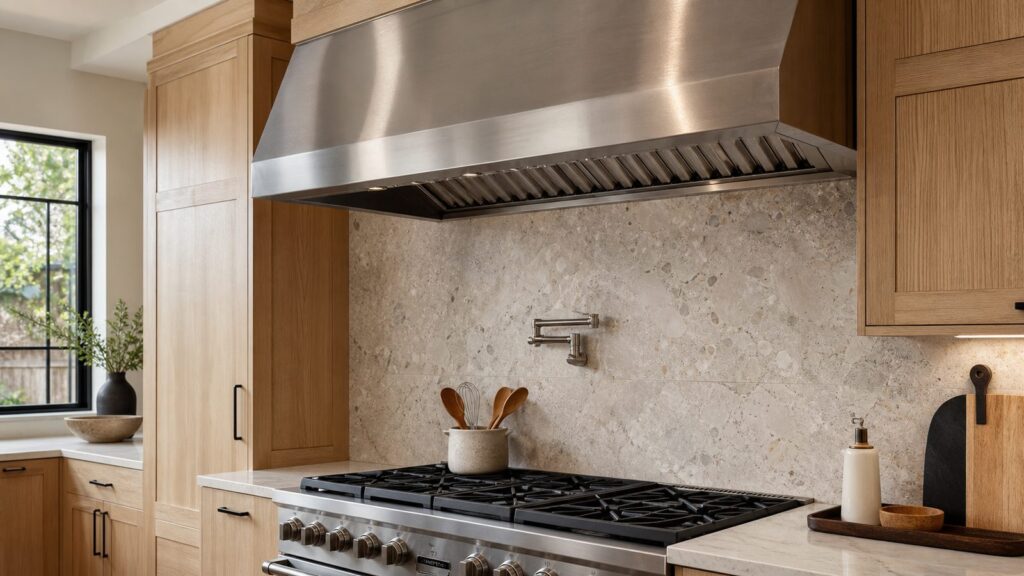
A 1200 CFM range hood is not a normal appliance upgrade. It is a high-capacity ventilation system that can move up to 1,200 cubic feet of air per minute under rated conditions. That level of airflow belongs over serious cooking equipment: large pro-style gas ranges, grill or griddle modules, high-BTU wok burners, oversized island ranges, and covered outdoor kitchens where smoke and grease loads are heavy.
For a typical 30- or 36-inch residential range, 1200 CFM is often more hood than the kitchen needs. The problem is not only cost. A hood this powerful can pull a house under negative pressure, make doors harder to open, backdraft atmospherically vented combustion appliances, draw fireplace smoke into living areas, and become loud enough that homeowners stop using it. On our kitchen remodels, the best 1200 CFM range hood is rarely the one with the biggest number on the box. It is the one installed as a complete system: hood capture area, blower, duct size, duct route, termination cap, makeup air, electrical, cabinetry, and inspection all planned together.
If you are comparing 1200 CFM range hoods, start with one question: does the cooking equipment justify it? A common manufacturer sizing rule for gas cooking is about 1 CFM per 100 BTU. By that guideline, a 120,000 BTU pro-style range can justify about 1200 CFM. A 45,000 BTU range may be closer to 450 CFM. The difference matters because the installed system around a 1200 CFM hood is usually more complicated and more expensive than a standard hood replacement.
Recommended Free Tools
As an Amazon Associate I earn from qualifying purchases.
What 1200 CFM Actually Means
CFM stands for cubic feet per minute. A 1200 CFM hood is rated to move up to 1,200 cubic feet of air every minute, usually at its highest speed and under controlled test conditions. In the real kitchen, actual airflow can be lower because of duct length, elbows, roof caps, wall caps, dampers, transition fittings, grease buildup, and static pressure.
That is why two hoods with the same 1200 CFM rating can perform very differently. A deep wall hood over a 48-inch range with a short, straight 10-inch duct to an exterior wall will usually capture smoke better than a shallow island hood connected to a long run with several elbows. The hood body has to capture the plume before the blower can remove it.
Popular on Amazon

- 1200 CFM Powerful Performance: TAZPI 1200 CFM range hood 30 inch. Equipped with dual motors delivering 1200 CFM of powerful suction, it eliminates smoke from high-heat stir-frying within 3 seconds. 4-Speed Control System, Noise level as low as 55 dB at the highest setting
- Large 30 Inch Panel Providing Full Cooktop Coverage: Compared to traditional under cabinet range hoods, the TAZPI 30 inch under cabinet range hood ducted features a 38.5% larger smoke-capture area, ensuring comprehensive coverage and superior smoke extraction performance
- Smart Gesture Control: This 30 inch range hood ducted features built-in infrared sensor technology that accurately recognizes hand gestures, allowing for touch-free control and making post-meal cleanup simple and hassle-free. The TAZPI range hood also supports a delayed shut-off function (adjustable from 1 to 15 minutes)
- Minimalist Kitchen Aesthetic Design: The sophisticated, modern, high-tech tones blend harmoniously with the kitchen environment; the 30 inch stainless steel under cabinet range hood not only adds layers and depth to the space but also brings an elegant visual appeal to the home
- Easy to Remove Filters for Hassle-Free Cleaning: The TAZPI kitchen hood 30 inch features easy-to-clean stainless steel on both its interior and exterior panels; a simple wipe keeps it spotless, eliminating the hassle of cleaning hard-to-reach corners. It is also dishwasher-safe
For homeowners, the practical takeaway is simple: maximum CFM is only one part of the purchase. You also need enough hood width, enough depth, properly sized duct, and a makeup air plan. Without those pieces, a high-CFM hood can be noisy without being effective.
Free tools Windows power users keep installed
One-click scans. No signup required.
Who Actually Needs a 1200 CFM Range Hood?
A 1200 CFM hood makes sense when the cooking load is large enough to require it. We see it most often in custom kitchens with 48- to 60-inch pro-style ranges, high-output gas burners, indoor grill tops, griddles, wok cooking, frequent frying, or large island cooktops exposed to cross drafts.
For a gas range, total BTU output is a useful starting point. A 48-inch pro range with six burners and a griddle may land near 90,000 to 120,000 BTU. Using the 1 CFM per 100 BTU rule, that points to roughly 900 to 1200 CFM. A 60-inch range or a range with a grill module can push the case even higher, depending on the manufacturer’s ventilation requirements.
Island installations need extra attention. Smoke has open sides to escape, and air movement from windows, HVAC registers, and people walking through the room can push the cooking plume away from the hood. In many island kitchens, better capture geometry matters more than simply adding fan power. A wider, deeper island hood mounted at the correct height usually outperforms a narrow, shallow hood with the same blower rating.
When 1200 CFM Is Probably Too Much
A 1200 CFM hood is usually excessive for a standard electric range, induction cooktop, or midrange 30- to 36-inch gas range unless the homeowner does unusually heavy cooking. If the appliance is around 45,000 BTU, a hood closer to 450 to 600 CFM may be more appropriate. That smaller system can still be ducted outdoors, still remove cooking moisture and odors, and often avoids the cost and complexity of high-capacity makeup air.
Oversizing also creates a usability problem. If the hood is loud on the settings people need every day, they use it less. A good ventilation design should work quietly at low and medium speeds for routine cooking, with the full 1200 CFM available for searing, wok cooking, grilling, or smoky high-heat work.
The Best Types of 1200 CFM Range Hoods
There is no single best 1200 CFM range hood for every kitchen. The right choice depends on the range location, cabinet design, ceiling height, duct path, and noise expectations.
Wall-Mounted 1200 CFM Hoods
A wall-mounted hood is usually the most effective layout when the range sits against an exterior or interior wall. The wall helps contain the cooking plume, and the hood can often be ducted up through the roof or out through the wall. For pro-style ranges, we usually look for a hood at least as wide as the range. When layout allows, going 3 to 6 inches wider improves capture, especially over front burners.
For example, a 48-inch range often pairs well with a 48- to 54-inch hood. A 60-inch range may need a 60-inch hood or wider depending on the cooking surface. Depth is just as important. A deeper hood captures front-burner smoke better than a shallow decorative hood.
The Tool Desk
Outbyte Driver Updater FREEFix the driver behind crashes, sound loss and screen glitchesFind Drivers →Outbyte PC Repair FREERepair Windows errors before they cause bigger problemsFix Now →Range Hood Inserts and Liners
Inserts are popular in custom kitchens because the mechanical unit hides inside a wood, plaster, or metal hood surround. This can look cleaner, but the insert still needs the same mechanical respect: proper liner, capture depth, duct size, blower access, and service clearance.
Current retail examples show entry and prosumer 1200 CFM inserts starting around $1,700. Premium inserts commonly run about $2,400 to $3,989. That is equipment only, before ductwork, cabinetry, electrical, makeup air, and finish repair. If your cabinetmaker is building a custom enclosure, confirm the insert dimensions, liner requirements, mounting height, and service access before fabrication begins.
Island 1200 CFM Hoods
Island hoods are harder to get right because they do not have a back wall to help capture smoke. We typically want more overhang, more depth, and careful mounting height. If the hood is too high or too shallow, smoke can roll past the edges before the blower has a chance to grab it.
Island hoods also tend to involve more finish work. Ducting may need to run through ceiling joists, a second floor, attic space, or roof framing. Chimney extensions may be needed for taller ceilings. These details can make an island hood installation more expensive than a wall hood with the same CFM rating.
PC Slower Than It Used to Be?
A free scan shows the junk files, broken settings and background clutter dragging Windows down - then fixes them in one click.Free scan · Windows 10 & 11Crashes, No Sound, or Screen Glitches?
Random freezes, missing sound and display glitches usually trace back to one bad driver. Find and replace yours safely.Free scan · under a minuteInline and Remote Blower Systems
Internal blowers are built into the hood body. They are simpler and often less expensive, but the noise source is in the kitchen. Inline blowers sit in the duct run, and remote blowers are mounted outside or near the termination. These options can reduce perceived kitchen noise, which matters on a 1200 CFM system.
The tradeoff is planning. Inline and remote blowers need electrical coordination, service access, weatherproof installation where applicable, and manufacturer-approved duct layouts. They can be excellent choices, but they should be designed before framing, cabinetry, or ceiling work is closed up.
1200 CFM Range Hood Cost in 2026
For a high-CFM hood, the appliance price is only part of the budget. In 2026, national range hood installation figures commonly fall around $650 to $2,500, with average reported costs around $1,750. Basic replacement work may be lower, roughly $300 to $850 in some markets, while a new hood with outlet and ductwork often lands around $650 to $2,100 before premium equipment and complicated routing. Basic vent hood installation can price around $564 to $1,030 per hood for straightforward work, but that does not describe most 1200 CFM projects.
Once you add a large hood, 8- to 12-inch ducting, roof or wall penetration, cabinet modification, electrical work, permit fees, and makeup air, the real project budget can climb quickly. On remodels, we tell homeowners to price the full installed system, not just the hood.
Quick wins for a faster PC:
Scan for outdated or missing drivers - takes under a minuteDriver Scan →Clear out junk files and repair common Windows errorsFree Scan →| Cost Item | Typical 2026 Range | What Drives the Price |
|---|---|---|
| 1200 CFM insert | $1,700 to $3,989 | Brand, width, finish, controls, blower type |
| Premium wall hood | $4,900 to $6,013+ | Luxury finishes, size, integrated blower, design details |
| Luxury/designer hood | $8,000+ | Custom styling, premium materials, specialty sizing |
| 1200 CFM blower accessory | About $910 | Internal blower module, brand compatibility |
| Basic hood installation | $564 to $1,030 | Straight replacement, existing duct, minimal finish repair |
| New ducted installation | $1,200 to $2,500+ | Duct route, roof or wall cap, elbows, finish repair |
| Ductwork allowance | Roughly $100 to $400+ per linear foot | Access, duct size, structure, fire-rated penetrations |
| Passive makeup air | $500 to $1,400 installed | Damper size, control wiring, wall penetration |
| Powered or tempered makeup air | $1,500 to $4,000+ installed | Climate, controls, HVAC integration, heating or cooling load |
| Permits and inspections | $50 to $300+ | Local requirements, electrical, mechanical, roof work |
A realistic installed budget for a 1200 CFM hood can range from the low thousands to well over $10,000 when premium equipment, makeup air, custom cabinetry, and finish restoration are included. The biggest variance drivers are hood width, blower location, duct diameter, roof versus sidewall termination, number of elbows, ceiling height, chimney extensions, cabinet rebuilding, drywall and paint repair, and whether HVAC makeup air design is part of the scope.
Duct Size and Routing Matter More Than the Box Rating
Many 1200 CFM range hoods require 8-inch, 10-inch, or even 12-inch ducting depending on the manufacturer and blower configuration. In our field work, 10-inch round duct is a common expectation for 1200 CFM systems, but the hood manual controls. Do not reduce the duct because the framing is inconvenient. Undersized duct is one of the fastest ways to turn an expensive hood into a loud, underperforming appliance.
Use rigid, smooth-wall metal duct. Avoid flex duct. Keep the run short and straight. Minimize elbows. Where turns are unavoidable, use long-radius fittings when possible. Every elbow, transition, damper, and exterior cap adds resistance. A restrictive wall cap can hurt performance even when the duct size looks correct.
Termination location also matters. A roof cap may be the cleanest route in one home, while a sidewall cap may be better in another. The right answer depends on framing, attic access, roof pitch, exterior clearances, and local code requirements. The cap should be sized for the system, include proper weather protection, and be accessible enough for future service.
Capture Area: The Part Homeowners Often Miss
Airflow does not help if the smoke never enters the hood. Capture area is the physical size and shape of the hood that catches the rising plume. For pro-style gas ranges, we prefer a hood at least as wide as the range, and often 3 to 6 inches wider when the layout allows. Depth is critical over front burners. A shallow hood may look sleek but let smoke escape into the room.
Mounting height should follow the hood and range manufacturer’s instructions. Mounting too low can create heat and clearance problems. Mounting too high weakens capture. Before ordering cabinets or a custom hood surround, confirm the exact hood model, required clearances, duct outlet location, and mounting height.
Makeup Air Is Not Optional Planning
IRC-based residential codes commonly trigger makeup air requirements when a kitchen exhaust system is capable of exhausting more than 400 CFM. A 1200 CFM hood is three times that threshold. Even where local enforcement varies, pressure balance still matters.
When a high-powered hood exhausts air outdoors, replacement air has to come from somewhere. If the house is tight, that air may be pulled down a chimney, through a water heater flue, around doors, through dusty attic gaps, or from attached garage pathways. That can create comfort problems and safety concerns, especially around atmospheric combustion appliances.
Also popular on Amazon

- 【Pro-Grade 1200 CFM Ventilation】This 36 inch range hood insert features a powerful 1200 CFM airflow to tackle heavy grease and steam. Designed for wider cooktops, it provides consistent suction to maintain a fresh, smoke-free kitchen environment
- 【Advanced Brushless Technology】 The high-efficiency brushless DC motor provides 8-speed control with minimal noise. This 36-inch range hood combines professional power with energy-saving technology for long-lasting, quiet daily operation as a reliable kitchen exhaust fan
- 【Dual Gesture & Touch Interface】Switch speeds with a simple wave or a quick touch—no mode switching required. The touchless gesture control keeps your 36 inch vent hood spotless and fingerprint-free, even when your hands are full
- 【Heavy-Duty Stainless Steel】An industrial-style 36-inch vent hood insert crafted from 1.0mm thick stainless steel. Features high-flow baffle filters that are dishwasher-safe and includes charcoal filters for optimal air scrubbing in ductless mode
- 【Seamless Built-in Installation】 Engineered for a custom range hood liner, this built-in unit supports both ducted and ductless setups. Includes all necessary hardware for a clean, professional-looking installation into your existing cabinetry
Passive makeup air systems are commonly cited around $500 to $1,400 installed. Powered or tempered makeup air can run about $1,500 to $4,000+ installed, especially in cold climates, hot climates, and humid regions where dumping outdoor air directly into the house creates comfort complaints. Tempered makeup air costs more, but it may be the difference between a system the homeowner uses and one they avoid.
Backdrafting and Combustion Appliances
Before installing a 1200 CFM hood, check for atmospherically vented water heaters, boilers, furnaces, and fireplaces. Direct-vent or sealed-combustion equipment reduces risk, but it does not remove the need for pressure-balance planning. A proper design looks at the whole house: hood airflow, HVAC operation, fireplace use, door and window positions, and makeup air delivery.
On our job sites, we want this conversation early. It is much cheaper to design makeup air while walls and ceilings are open than to retrofit it after the kitchen is finished and the homeowner discovers odors, drafts, or smoke rollout.
Independent reader supportYour contribution helps us test, update, and keep practical guides available for everyone.How to Compare 1200 CFM Range Hoods
When comparing models, start with the cooking appliance manual. Look for the range manufacturer’s ventilation recommendation, total BTU output, width, burner layout, grill or griddle requirements, and minimum hood clearances. Then compare hoods by installed performance, not just retail price.
Key specs to verify include hood width, hood depth, required duct diameter, blower type, sones or noise ratings by speed, filter type, lighting, control layout, mounting height, electrical requirements, and whether the blower is included or sold separately. Some premium hoods list attractive body pricing but require a separate blower accessory. A 1200 CFM internal blower accessory can be around $910, so confirm the complete package before comparing bids.
For grease-heavy cooking, baffle filters are usually the right choice. They are durable, removable, and better suited to high-output cooking than lightweight mesh filters. Confirm dishwasher-safe cleaning instructions, but expect routine cleaning. Grease-loaded filters reduce airflow and increase fire risk.
Noise: Look Beyond High Speed
High speed on a 1200 CFM hood will usually be loud. What matters is whether low and medium speeds are comfortable enough for everyday cooking. If the hood is unbearable at normal settings, it will not get used. Inline and remote blowers can help, but duct design still affects noise. Small duct, sharp elbows, and restrictive caps create air turbulence that homeowners hear as roar or whistle.
When to DIY vs. When to Hire a Pro
A simple hood replacement can be a reasonable DIY project if the new hood is similar in size, uses the existing properly sized duct, has an existing electrical connection, and does not require makeup air changes. That describes very few 1200 CFM installations.
Do these 3 things before closing this tab:
1Repair Windows errors before they cause bigger problems2Fix the driver behind crashes, sound loss and screen glitches3Clear out junk files and repair common Windows errorsHire a pro when the project includes new ductwork, roof or exterior wall penetrations, cabinet modification, hardwired electrical work, large chimney extensions, structural blocking, makeup air, or combustion safety evaluation. A 1200 CFM hood can affect the building envelope and mechanical systems. It is not just a cabinet-mounted appliance.
For a clean bid, ask contractors to include hood installation, ductwork, roof or wall termination, electrical, makeup air, cabinet modifications, drywall and paint repair, permit fees, startup testing, and cleanup. If one proposal is much cheaper, check what is missing. Often the low number excludes makeup air, finish repair, roof work, or duct corrections.
Permits, Inspection, and Code Notes
Local requirements vary, but high-CFM kitchen ventilation often involves mechanical and electrical permits. If the work includes a roof penetration, exterior wall penetration, new duct chase, or new electrical circuit, inspection may be required. Permit fees may only be $50 to $300+ in many markets, but the real value is catching problems before they are hidden behind drywall, cabinets, or roofing.
For a 1200 CFM hood, the code issue homeowners hear about most is makeup air. Many IRC-based jurisdictions require makeup air for kitchen exhaust systems over 400 CFM. The makeup air system typically needs to be roughly equal to the exhaust air and equipped with a damper that opens automatically when the exhaust system operates. Your local code official has the final say, but the design should be ready for that conversation.
Also check manufacturer instructions. Inspectors often treat the installation manual as part of the listing. If the hood requires 10-inch duct, a certain clearance above the cooking surface, or a specific exterior termination, those instructions matter.
Common Mistakes That Make High-CFM Hoods Fail
The most common mistake is buying by CFM alone. A 1200 CFM sticker does not fix a shallow hood, a bad duct route, or missing makeup air. The second mistake is connecting a high-capacity hood to a small 6-inch duct, long run, crushed flex duct, or restrictive cap. That raises noise and lowers actual airflow.
Another common mistake is skipping makeup air because the fan seems to work during a quick test. Depressurization problems usually show up when the hood runs on high with doors and windows closed, the HVAC system operating, and combustion appliances in use. That is exactly when the kitchen is under real load.
We also see hoods mounted too high, custom enclosures built too shallow, and duct paths improvised after cabinets are already installed. These mistakes are expensive because they happen late. The better sequence is to select the cooking appliance, confirm ventilation requirements, design duct and makeup air, coordinate cabinetry, then install and test.
Free tools Windows power users keep installed
One-click scans. No signup required.
Daily Use and Maintenance
Even the best 1200 CFM range hood only helps when it is used correctly. Turn on the hood before cooking begins so airflow is already established. Use back burners when practical because they sit deeper under the capture area. Leave the hood running 10 to 20 minutes after cooking to clear remaining moisture, odors, fine particles, and combustion byproducts.
Use lower fan speeds for routine cooking and reserve the highest setting for searing, frying, wok cooking, grilling, and visible smoke. Clean baffle or grease filters routinely. Heavy cooks may need to clean filters every few weeks; lighter household use may stretch longer. If airflow drops, noise increases, or odors linger, check filters, duct obstructions, damper movement, and exterior cap operation.
Our Bottom Line
A 1200 CFM range hood is worth it when the range, cooking style, and kitchen layout demand that much exhaust. It is not worth it as a vanity upgrade over a normal range. The best system starts with the appliance BTUs, uses a hood with real capture area, follows the manufacturer’s duct size, keeps ductwork short and smooth, includes makeup air from day one, and passes local inspection.
If you are remodeling, make the hood decision before cabinet fabrication and before walls or ceilings are closed. That gives the builder, HVAC contractor, electrician, cabinetmaker, and inspector enough room to solve the system properly. Done right, a 1200 CFM hood keeps smoke, grease, heat, moisture, and cooking byproducts under control. Done casually, it becomes an expensive fan that makes noise while the kitchen still smells like last night’s dinner.
Quick wins for a faster PC:
Fix the driver behind crashes, sound loss and screen glitchesFind Drivers →Clear out junk files and repair common Windows errorsFree Scan →Scan for outdated or missing drivers - takes under a minuteDriver Scan →Frequently Asked Questions
Do I really need a 1200 CFM range hood?
You may need one for a large pro-style gas range, 90,000 to 120,000 BTU cooking load, grill, griddle, wok burner, or oversized island setup. For many standard 30- to 36-inch residential ranges, 1200 CFM is more than necessary.
Does a 1200 CFM range hood require makeup air?
In many IRC-based jurisdictions, yes. Kitchen exhaust systems over 400 CFM commonly trigger makeup air requirements, and a 1200 CFM hood is three times that threshold. Local code enforcement varies, but pressure-balance planning is still necessary.
What duct size is needed for a 1200 CFM range hood?
Follow the hood manufacturer’s installation manual. Many 1200 CFM systems require 8-inch, 10-inch, or 12-inch ducting. A 10-inch round duct is common, but the exact requirement depends on the hood and blower configuration.
How much does it cost to install a 1200 CFM range hood in 2026?
Basic hood installation may run about $650 to $2,500 nationally, but a full 1200 CFM installation can cost much more once premium equipment, ductwork, electrical, roof or wall penetration, finish repair, and makeup air are included. Complete projects can range from the low thousands to well over $10,000.
Do these 3 things before closing this tab:
1Scan for outdated or missing drivers - takes under a minute2Repair Windows errors before they cause bigger problems3Fix the driver behind crashes, sound loss and screen glitchesIs an inline or remote blower better than an internal blower?
Inline and remote blowers can reduce perceived kitchen noise because the motor is moved away from the hood body. They cost more to plan and install, and they require service access, proper wiring, and approved duct routing.
Why is my high-CFM range hood loud but not removing smoke well?
Common causes include undersized duct, too many elbows, restrictive exterior caps, dirty filters, missing makeup air, a hood mounted too high, or a shallow hood that does not capture smoke from the front burners.
Quick Recap
Product prices and availability are accurate as of the date/time indicated and are subject to change. Any price and availability information displayed on Amazon at the time of purchase will apply.

