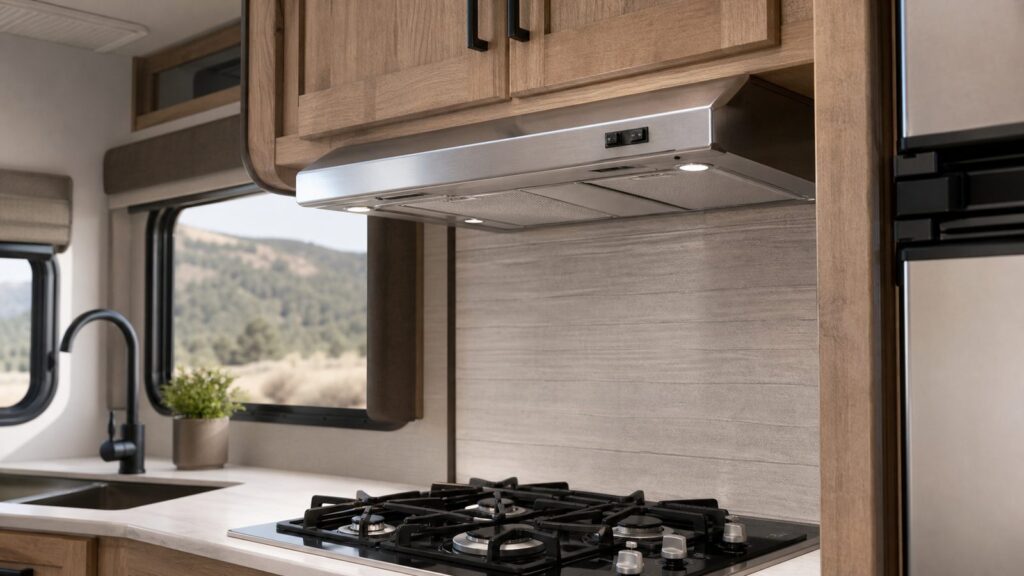
Some links on this page are affiliate links: if you buy through them we may earn a commission, at no extra cost to you.
An RV range hood has a harder job than most people give it credit for. It has to pull steam, cooking odor, grease, and sometimes propane combustion byproducts out of a very small kitchen, while running on 12V power, fitting under shallow cabinets, surviving vibration, and not leaking where the vent exits the wall or roof.
For most RV owners in 2026, the best range hood is not the highest-CFM model or the shiniest stainless face. It is the hood that matches your existing duct path, cabinet width, electrical system, and cooking habits. If you cook often, fry food, boil pasta, or use a propane cooktop, a ducted 12V RV range hood is usually the right answer. If you mostly reheat meals, make coffee, or cannot cut an exterior vent opening, a ductless charcoal-filter hood can be acceptable, but it will not remove moisture from the coach.
As an Amazon Associate I earn from qualifying purchases.
Current RV range hood prices are fairly approachable. Common 12V under-cabinet units typically run about $66 to $170 before labor. A simple DIY replacement into an existing opening may land around $80 to $220 including sealant and small parts. A professional RV-service replacement is more often $200 to $500 total, while converting a ductless setup to a new ducted exterior vent can climb to $300 to $900 or more depending on access, wall construction, and weatherproofing.
Best RV Range Hood Choices by Use Case
On our job sites, we start with the installation conditions before we talk about brands. RV range hoods often look nearly identical online, but a rear-ducted hood, top-ducted hood, and ductless recirculating hood are three different installations. Measure first, then shop.
Popular on Amazon

- Ducted Range Hood: The Furrion Range Hood delivers top performance with a modern look. This ducted range hood must be connected to a duct using pipes to carry airborne particles away.
- Exterior Venting: The Range hood ventilates smoke and removes odors from your RV and ventilates them outside through a vent keeping your RV smoke and odor-free. This Range Hood comes equipped with replaceable and cleanable charcoal filter for easy maintenance.
- LED Light: It comes attached with an LED light that illuminates the cooking surface when needed with a push of a button.
- VibrationSmart & ClimateSmart: This Range Hood is designed with Furrion’s VibrationSmart Technology that helps it to resists vibrations and, ClimateSmart Technology allows it to operate in extreme climate conditions.
- Easy Installation: Mounting hardware and screws are included with a clearly instructed user manual. The product dimensions are (W x H x D) 23.50 Inches x 4.75 Inches x 17.75 Inches. The Furrion Range Hood is backed by Furrion's 12-month warranty.
| Best Use Case | What to Look For | Typical 2026 Price | Best For |
|---|---|---|---|
| Best ducted RV range hood | 12V DC, rear or top duct matching your existing opening, metal grease filter, exterior damper | $100-$168 | Frequent cooking, propane ranges, full-time RVers |
| Best ductless RV range hood | 12V DC, charcoal filter availability, washable grease screen, LED light | $66-$168 | Light cooking, rentals, no exterior vent access |
| Best budget replacement | Same width, same wiring, same duct location, basic fan and light | $66-$110 | Replacing a failed original hood |
| Best stainless-front option | 22-inch or 24-inch stainless face, 12V fan, cleanable filter | $100-$160 | Visible kitchen refreshes |
| Best for quiet, light cooking | Lower-speed fan, ductless or short duct run, LED light, easy filter access | $90-$150 | Weekend campers and small trailers |
| Best for full-time RVers | Ducted exhaust, serviceable switches, replaceable filters, sealed exterior vent | $120-$220 parts | Daily use and heavier cooking |
Examples in the current market show the range clearly. Budget ventless 12V hoods can be listed around $65.99 with 65/85 CFM fan speeds. Midrange 22-inch stainless or black/stainless models commonly sit around $99.99 to $119.99. Branded Furrion and Lippert-style 12V ducted and ductless units often list from about $149 to $168. RecPro listings commonly show 12V hard-wired operation, and some RV hoods advertise airflow around 96 to 118 CFM.
Those numbers are useful, but they are not the whole story. In a short, kinked, or undersized RV duct, a 118 CFM fan may not actually move 118 CFM at the cooktop. In a tight coach, the fan also needs makeup air. Crack a nearby window and the hood may pull noticeably better.
Recommended Free Tools
Ducted vs Ductless: The Decision That Matters Most
The first real choice is whether the hood exhausts outdoors or recirculates air back into the RV.
Ducted RV range hoods
A ducted RV range hood sends air outside through a wall or roof vent. This is the best setup for removing smoke, steam, grease aerosol, odors, and combustion byproducts. If your RV already has an exterior vent behind or above the hood, stay ducted unless there is a specific reason not to.
Ducted hoods are especially useful in small RV interiors because moisture builds fast. Boiling water for 20 minutes can fog windows, wet cabinet faces, and feed mildew in corners that already struggle to dry. A ducted fan does not solve every humidity issue, but it removes the source air instead of filtering and returning it.
Ductless RV range hoods
A ductless hood pulls air through a grease filter and charcoal media, then sends it back into the kitchen. It can reduce grease and odor, but it does not exhaust water vapor or propane combustion products outside. That distinction matters.
What’s actually slowing this PC down?
Pick the symptom - the matching free tool is one click away.
Ductless is a reasonable choice for light cooking, small rental units where exterior cutting is not allowed, or replacing an existing ventless hood without opening the wall. It is not our first choice for someone who cooks bacon every morning, sears meat often, or lives full-time in the rig.
What Size RV Range Hood Do You Need?
Most RV range hoods are 20 to 24 inches wide, with many common replacements at 22 inches. Do not assume the new hood will fit because the width sounds close. Measure the full cabinet opening, the underside depth, the backsplash clearance, and the cooktop clearance.
Write down these dimensions before ordering:
- Overall hood width, commonly 20, 22, or 24 inches
- Cabinet depth from wall to front edge
- Height available between cabinet bottom and cooktop
- Rear duct opening size and location, if ducted
- Top duct opening size and location, if roof-vented
- Distance from the wall to burners, especially front burners
- Switch and light clearance at the front lip
A replacement hood should cover the same footprint cleanly. If the new model is narrower, old screw holes, wall discoloration, or a rough duct opening may show. If it is deeper, it may interfere with cabinet doors, a backsplash trim strip, or the user’s head while cooking.
In RV work, the duct location is often more important than the hood width. A rear-ducted unit may not line up with a top-vented cabinet without modification. A top-ducted unit may be useless if the existing exterior vent is through the sidewall. Confirm the actual duct path before you buy.
Free tools Windows power users keep installed
One-click scans. No signup required.
Also popular on Amazon

- Direct Venting Ducted Exhaust: This RV range hood expels smoke, grease, and odors straight outside through a dedicated vent, ensuring your RV interior stays smoke-free and fresh throughout every meal.
- High-CFM Motor, Strong Ventilation: The RV range hood’s high-RPM fan achieves up to 96 CFM, quickly clearing fumes, odors, and excess heat to keep your cooking area comfortably cool.
- Whisper-Quiet Venting Performance: Operating at just 55 dB with an upgraded winglet noise-reduction fan, this RV range hood keeps your kitchen serene, so you can cook without loud distractions on the road.
- Triple-Barrier Grease & Smoke Capture: The aluminum-carbon cotton-aluminum 3-layer filter deeply traps airborne grease and fumes, rapidly refreshing your RV’s air and maintaining a cleaner interior.
- Space-Saving Ducted Installation: With a slim 22-1/16" x 18-7/8" x 4-5/8" footprint and an 18-7/8" x 13" vent cutout, this unit aligns easily and screws securely under the cabinet. Pairs with 3-burner or oven-range setups.
Airflow, Noise, and 12V Power
Many RV hoods advertise airflow in the 65 to 118 CFM range. For a compact RV galley, that can be enough when the duct is short, the damper opens freely, and there is makeup air. Bigger is not automatically better.
A higher-CFM fan can be louder, draw more battery power, and expose weak ductwork. It can also make a flimsy exterior damper chatter while towing or rattle in wind. We would rather install a moderate fan with a clean duct path and a working damper than a louder fan fighting a restricted vent.
Most RV range hoods are 12V DC and hard-wired into the coach. That is different from a standard residential 120V kitchen hood. Buying a residential hood for an RV can create problems with inverter load, wire sizing, mounting depth, and vibration resistance. Unless you are doing a larger custom conversion with a clear electrical plan, stay with an RV-specific 12V appliance.
When replacing a hood, check the circuit rating, wire condition, fuse labeling, and switch access. Keep splices accessible behind the hood where possible. Fan and light switches are small parts, but they fail often enough that future service access is worth preserving.
The Tool Desk
Outbyte PC Repair FREERepair Windows errors before they cause bigger problemsFix Now →Outbyte Driver Updater FREEScan for outdated or missing drivers - takes under a minuteDriver Scan →Filters: Small Part, Big Difference
Filter availability should influence the purchase more than a small difference in advertised CFM. A range hood with a cleanable metal grease filter and easy-to-buy charcoal filters will serve better than an obscure model with no replacement parts.
For ducted hoods, the grease filter captures airborne grease before it coats the fan and duct. For ductless hoods, the charcoal filter is what helps reduce odor. Charcoal media loads up over time and cannot be washed back to new condition.
In 2026, model-specific RV charcoal filters commonly run around $25 each. Some general circular residential charcoal filter 2-packs are listed around $38, but fitment must be verified by diameter, thickness, center attachment, and retention method. A filter that almost fits is not good enough inside a moving vehicle.
For normal use, inspect the grease filter monthly and wash it when it feels tacky or looks dull. Full-time RVers or frequent fry cooks may need to clean it every 2 to 4 weeks. Replace charcoal filters when odors return quickly after cooking, usually every few months under regular use.
Quick wins for a faster PC:
Repair Windows errors before they cause bigger problemsFix Now →Fix the driver behind crashes, sound loss and screen glitchesFind Drivers →Clear out junk files and repair common Windows errorsFree Scan →Real 2026 Cost Guide
RV range hood pricing is lower than full residential kitchen ventilation, but installation can still vary widely. The expensive part is rarely the hood itself. Labor rises when the installer has to cut the wall or roof, modify cabinetry, reroute wiring, remove old sealant, or correct a leaking exterior vent.
| Project Type | Typical 2026 Cost | What Is Included |
|---|---|---|
| Budget ductless hood purchase | $66-$100 | Basic 12V ventless hood, fan, light, filter screen |
| Midrange ducted or stainless-front hood | $100-$130 | Common 12V under-cabinet replacement unit |
| Premium/branded RV hood | $149-$168 | Furrion/Lippert-style ducted or ductless models before tax and shipping |
| DIY replacement in existing opening | $80-$220 | Hood, screws, connectors, butyl tape, sealant, possible vent cap |
| Professional replacement | $200-$500 | 1-2 labor hours plus parts, depending on shop rate and access |
| Ductless-to-ducted conversion | $300-$900+ | Wall or roof penetration, cabinet modification, wiring access, exterior cap, leak testing |
Residential range hood installation numbers are not directly transferable to RVs, but they help set expectations for complex work. Current residential benchmarks commonly run $650 to $2,500, with an average around $1,750, because house projects can involve larger ductwork, framing, and electrical scope. Simpler labor-only residential hood installs are often cited around $200 to $500 before major duct or electrical work. RV replacements can be less expensive, but a bad wall penetration can cost far more later if it leaks.
Also popular on Amazon

- Slim Profile: Maximizes space in compact RV kitchens.
- Effective Ventilation: 200 cubic meters per hour airflow efficiently removes smoke and odors.
- Dual-Speed Fan: Adjustable settings for customized airflow.
- LED Lighting: Built-in 12V LED lamp illuminates the cooking area.
- Advanced Filtration: Three-layer charcoal filter ensures clean air circulation.
Installation Details That Separate a Good Job From a Problem
A range hood installation is part appliance work, part ventilation work, and part weatherproofing. In an RV, the weatherproofing deserves equal attention.
Exterior vent and damper
For a wall vent, the flap or damper must shed rain while parked and stay reasonably quiet while towing. It should open freely when the fan runs and close fully when the fan is off. A stuck-open damper lets dust, drafts, insects, and water vapor move through the wall assembly.
Outdated Drivers Are Slowing You Down
One free scan finds every outdated or missing driver and matches the right update for your exact hardware.Free scan · exact hardware matchPC Slower Than It Used to Be?
A free scan shows the junk files, broken settings and background clutter dragging Windows down - then fixes them in one click.Free scan · Windows 10 & 11If the old vent cap is brittle, warped, or poorly sealed, replace it during the hood work. Use butyl tape behind the flange where appropriate and the correct exterior sealant for the RV siding or roof material. Document the sealant type and installation date, then inspect it at least annually and after long trips or roof maintenance.
Duct joints and capture
After installation, test the hood. We use a smoke pencil or incense test to confirm that smoke from the front burners is being captured and that duct joints are not leaking into the cabinet. Run the fan with the exterior damper open and crack a nearby window. If airflow improves with the window open, the coach was starving the fan for makeup air.
Cabinet and wall checks
Before cutting any new opening, confirm framing, wiring, plumbing, propane lines, awning arms, exterior trim, and the rain path on the outside wall. Cutting first and investigating later is how small appliance upgrades become wall repairs.
When to DIY vs When to Hire a Pro
A careful owner can replace many RV range hoods, especially when the new unit matches the old cutout, duct direction, screw pattern, and 12V wiring. Plan on 1 to 3 hours for a straightforward DIY swap if the old screws come out cleanly and the exterior vent does not need major work.
DIY makes sense when:
- You are replacing a 12V hood with another 12V hood of the same size
- The existing duct opening lines up
- The wires are accessible and in good condition
- No wall or roof cutting is required
- You are comfortable using butyl tape, sealant, and basic electrical connectors
Hire an RV technician or qualified installer when:
- You are converting ductless to ducted
- A new wall or roof penetration is needed
- The old vent leaked or shows soft wall material
- Wiring is hidden, damaged, undersized, or unlabeled
- The cooktop clearance is questionable
- The RV is under warranty and modification could affect coverage
The pro decision is less about the hood and more about the hole through the RV shell. A $120 appliance installed with the wrong sealant can create a water problem that costs many times the price of the hood.
Independent reader supportYour contribution helps us test, update, and keep practical guides available for everyone.Safety, Standards, and Permit Notes
RV range hood work should respect the RV’s original safety design. The RVIA standards program monitors adherence to standards adopted for RV and park model RV construction, and the broader RV safety framework commonly references NFPA 1192 and ANSI/RVIA standards.
Public NFPA 1192 material-clearance language includes references to range hoods made of 28 U.S. gauge sheet metal with minimum 2-inch vertical sides and a 1/4-inch dead-air space when used as protection over ranges. Treat that as standards context, not a universal DIY recipe. Your specific RV, appliance listing, cooktop manual, and manufacturer clearances still matter.
For like-for-like replacement, many owners will not need a building permit, especially for a removable RV appliance. That can change if the RV is parked as a permanent dwelling, tied into local utilities, or modified under campground, municipality, insurance, or warranty rules. If propane lines, 120V wiring, structural framing, or roof penetrations are involved, slow down and verify requirements before work starts.
Also popular on Amazon

- LED Light: Provides focused cooking light over your stovetop. The built-in lighting helps illuminate pots, pans, and the cooking surface. Make meal preparation easier to see when cooking in the evening or inside a dim RV kitchen
- 51 dB Quiet Operation: RV range hood fan operates at approximately 51dB, similar to the sound level of a quiet conversation. The ventilation system supports airflow while helping minimize distracting noise. Enjoy a more comfortable RV interior while preparing meals, relaxing, or traveling
- 36.76 CFM Airflow: RV range hood helps move cooking smoke, steam, and odors outside through the vent. The steady airflow is suited to compact RV kitchens, helping reduce lingering cooking air around the stovetop
- Easy to Clean: The 3-layer filter twists off for quick, tool-free removal and can be cleaned in the dishwasher for added convenience. Just twist, remove, clean, and reinstall to keep your RV range hood ready for everyday cooking
- Easy 4-Step Installation: Designed for under-cabinet mounting in RVs, Travel Trailers, and Camper Vans. The four-step installation process makes replacement or upgrading your RV stove area straightforward
Never use a ductless hood as your only safety strategy for propane combustion. Keep propane appliances serviced, maintain working CO and propane detectors, and provide ventilation according to the appliance manufacturer’s instructions.
Common Buying and Installation Mistakes
The most common mistake is buying by width alone. Width matters, but duct direction, cabinet depth, wiring, switch location, and exterior vent alignment matter just as much.
Other mistakes we see:
- Buying a residential 120V hood without planning inverter load, mounting depth, vibration, and wiring
- Assuming ductless means ventilated
- Installing a higher-CFM fan into a restricted duct and getting more noise than performance
- Cutting an exterior opening before checking for framing, wires, plumbing, propane lines, or awning hardware
- Skipping butyl tape or using the wrong sealant at the exterior vent
- Choosing a hood with hard-to-find filters
- Ignoring exterior damper rattle until the first highway trip
- Failing to test capture at the front burners after installation
Our Bottom-Line Recommendation
For most RV owners who cook regularly, choose a 12V ducted under-cabinet range hood that matches the existing duct path, has a washable metal grease filter, uses available replacement parts, and fits the cabinet without modification. Expect to spend roughly $100 to $170 for a solid hood, or $200 to $500 total if an RV shop handles a straightforward replacement.
For light cooking or a no-cut installation, a ductless charcoal-filter hood can be a practical compromise. Just be honest about what it does. It can reduce grease and odor, but it sends humidity and combustion byproducts back into the RV. Run a roof vent or window when cooking, keep filters clean, and replace charcoal media on schedule.
Do these 3 things before closing this tab:
1Clear out junk files and repair common Windows errors2Fix the driver behind crashes, sound loss and screen glitches3Repair Windows errors before they cause bigger problemsThe best RV range hood is the one that fits the coach, moves air through a clean path, stays serviceable, and keeps water out of the wall. Get those basics right and the brand choice becomes much easier.
Frequently Asked Questions
Is a ducted or ductless RV range hood better?
A ducted RV range hood is better for frequent cooking because it exhausts smoke, steam, grease aerosol, odors, and combustion byproducts outdoors. A ductless hood is acceptable for light cooking or no-cut replacements, but it mainly reduces grease and odor and does not remove moisture.
How much does an RV range hood cost in 2026?
Most common 12V RV range hood units cost about $66 to $170 before labor. A DIY replacement into an existing opening often totals $80 to $220 with supplies, while a professional replacement commonly lands around $200 to $500.
Can I replace an RV range hood myself?
Yes, if the new hood matches the old width, duct location, and 12V wiring, and no new wall or roof opening is needed. Hire a pro for ductless-to-ducted conversions, hidden wiring problems, roof penetrations, leak repairs, or questionable cooktop clearances.
Do RV range hoods run on 12V or 120V power?
Most RV range hoods are 12V DC under-cabinet appliances. A standard residential 120V hood usually is not a simple swap because it can create issues with inverter load, wiring, mounting depth, and road vibration.
How many CFM should an RV range hood have?
Many RV hoods fall around 65 to 118 CFM, which can work well in a compact galley when the duct is short and the exterior damper opens properly. Clean duct routing and makeup air often matter more than choosing the highest advertised CFM.
How often should I clean or replace RV range hood filters?
Inspect grease filters monthly and clean them when they feel tacky or look loaded. Full-time RVers and frequent fry cooks may need cleaning every 2 to 4 weeks. Charcoal filters should be replaced when cooking odors return quickly, often every few months under regular use.
Quick Recap
Product prices and availability are accurate as of the date/time indicated and are subject to change. Any price and availability information displayed on Amazon at the time of purchase will apply.
Free tools Windows power users keep installed
One-click scans. No signup required.

