Some links on this page are affiliate links: if you buy through them we may earn a commission, at no extra cost to you.
An Arts & Crafts hall cabinet can be a beautiful woodworking project, but it is also a piece of entryway equipment. It has to handle keys, bags, shoes, coats, damp gloves, pet leashes, daily bumps, and imperfect walls. The best result comes from treating the plan as a starting point, not a fixed object that must be forced into your hallway.
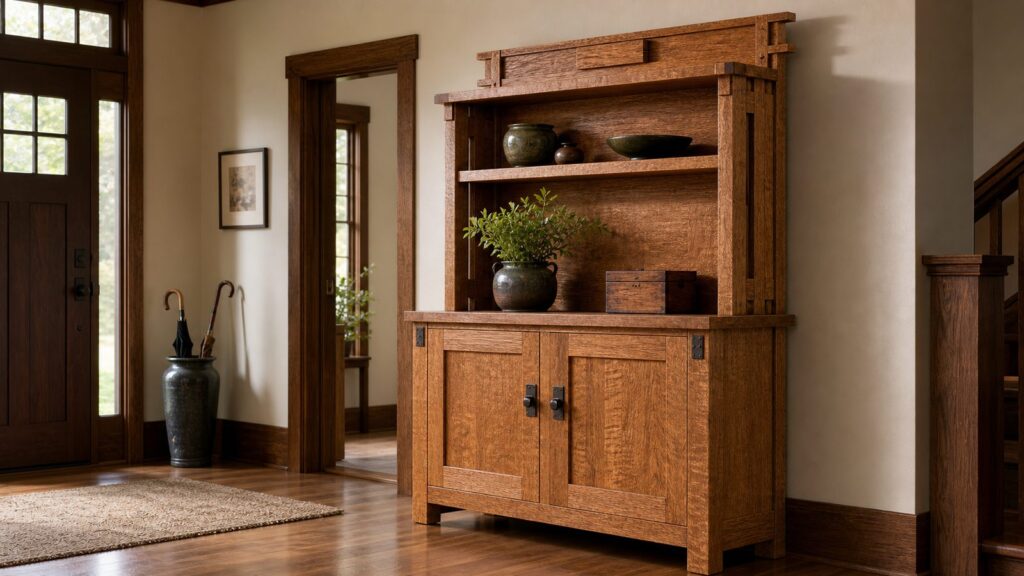
If you are looking at a downloadable Arts & Crafts hall cabinet woodworking plan, expect a furniture-style project built around straight lines, frame-and-panel construction, exposed hardware, and oak. A well-known version of this type of plan is a paid download priced at about $9.95 and described as a raised-top hall cabinet with pinwheel-style frame-and-panel construction, where rails and stiles are machined similarly even though their lengths vary. That is a good example of why these cabinets appeal to woodworkers: the design is disciplined, repeatable, and visually strong.
As an Amazon Associate I earn from qualifying purchases.
Recommended Free Tools
On our job sites, the difference between a good cabinet and a cabinet that feels professionally built usually comes down to planning before the first board is cut. Measure the space, decide whether the cabinet will be freestanding or built in, choose the right white oak strategy, allow for seasonal wood movement, and plan the anchoring. A tall hall cabinet that is only sitting on the floor is furniture. A tall hall cabinet fastened to studs, trimmed to the wall, crossing an outlet, or tied into baseboards becomes a construction detail.
Start With the Right Decision: Plan, Modified Plan, or Custom Build
Before buying lumber, decide which path fits your house and your tolerance for precision work.
Popular on Amazon

- Valued Carpenter Pencil Set: You will get 2 pcs solid carpenter pencils with 26 piece 2.8 mm refills, 1 replaceable sharpener, 1 plastic storage box.The complete carpenter pencils combination allows you to finish your work faster and more easily
- Deep Hole Marker Pencil: The deep-hole construction pencils adopts 45mm elongated tip design, which is more convenient to mark in the small hole or in other tight areas that other carpenter markers cannot reach
- Carpenter Pencils with Sharpener: The sharpener is screwed into the top of the work pencil, which won't get lost either. Built-in pencil sharpener that keep the lead with pointed and smooth to Improves line of sight in fine work
- Stronger Solid Lead: This work pencil is matched with a 2.8 mm thick lead , which is much thicker and stronger during the drawing process of construction work, it will not break or damage easily
- Marks on Various Surfaces: 3 colors solid construction pencil can marks on various surfaces,such as metal, plastic, wood, paper etc. Ideals for woodworkers, contractors, craftsmen, builders, merchants and masons
Use a downloadable woodworking plan when the cabinet can stay freestanding
A plan is the right choice when your hallway has enough clear width, the floor is reasonably level, outlets and HVAC are not in the way, and you can accept the plan’s finished dimensions with only minor changes. For many homeowners, this means a cabinet roughly 30 to 42 inches wide, 14 to 20 inches deep, and 60 to 78 inches tall, depending on the design.
This route suits an experienced DIY woodworker with a table saw, jointer or planer access, router, clamps, drill, accurate measuring tools, and finishing space. If you do not already own the core tools, the tool cost can exceed the cabinet cost quickly.
Do these 3 things before closing this tab:
1Repair Windows errors before they cause bigger problems2Fix the driver behind crashes, sound loss and screen glitches3Clear out junk files and repair common Windows errorsModify a plan when the style works but the house does not cooperate
Older homes often have tall baseboards, out-of-square plaster, sloped floors, narrow stair turns, and trim that should not be damaged. In that case, keep the Arts & Crafts language but adjust the installation strategy. We often recommend a separate base or toe platform, scribe strips at the sides, and a slightly smaller cabinet box that can be leveled and trimmed cleanly.
Do not simply reduce every part by the same percentage. Arts & Crafts furniture depends on proportion: rails, stiles, overhangs, reveals, and shadow lines need to look intentional. If the cabinet must be narrower, the door count, panel layout, and shelf spacing may need to change too.
Hire custom millwork when it becomes part of the building
Bring in a cabinetmaker or finish carpenter when the cabinet needs integrated electrical, wall blocking, custom glass, stair or hallway clearance review, sprayed finish, or tight scribing against old plaster. The minute the cabinet is fastened permanently, wrapped into trim, or designed around building systems, it is no longer just a weekend furniture build.
Measure the Site Before You Cut Wood
A hall cabinet usually lives in one of the least forgiving areas of the home. Entry halls, mudroom transitions, and stair landings collect trim, doors, outlets, returns, floor changes, and traffic patterns. A measured survey prevents expensive rework.
What’s actually slowing this PC down?
Pick the symptom - the matching free tool is one click away.
Record the clear wall width at the floor, mid-height, and top of the planned cabinet. Check floor slope with a 4-foot level or laser. Measure baseboard height and thickness, door casing projection, outlet location, switch plates, thermostat locations, HVAC registers, and nearby door swings. Also measure the route from the shop or garage to the final location. A 72-inch-tall cabinet may be easy to build and impossible to turn through a tight stair landing.
On our projects, we like to make a simple story stick from scrap plywood or straight 1x material. Mark the floor line, baseboard height, shelf heights, door rails, outlet conflicts, and top height on the stick. It is faster than reading a notebook, and it shows proportion problems before they become cut parts.
For passage clearance, think about how the hall is actually used. A cabinet that projects 18 inches into a 42-inch hallway leaves only 24 inches of clear movement at that point. That may be annoying for daily use, difficult for moving furniture, and unacceptable near stairs or egress routes depending on the layout. When in doubt, keep hall cabinets shallower and taller, then use adjustable shelving inside.
Materials: Getting the Arts & Crafts Look Without Wasting Money
Arts & Crafts and Mission-style cabinetry is strongly tied to oak, especially quarter-sawn white oak. The straight grain, ray fleck, and dimensional stability suit the style. But using premium quarter-sawn stock for every hidden part is rarely the best value.
The Tool Desk
Outbyte PC Repair FREEClear out junk files and repair common Windows errorsFree Scan →Outbyte Driver Updater FREEFix the driver behind crashes, sound loss and screen glitchesFind Drivers →Best wood choices
Quarter-sawn white oak is the premium choice for face frames, doors, legs, show panels, and tops. In 2026, online U.S. retail pricing for 4/4 quarter-sawn or rift white oak commonly runs about $8.65 to $16.35 per board foot depending on grade, surfacing, quantity, and shipping. Thicker 8/4 stock can run about $12 to $18 per board foot or more.
Flat-sawn white oak is less expensive, often starting around $5.75 to $9.35 per board foot in larger quantities, but it will not deliver the same period-correct ray fleck. It can still work well for less visible parts, interior rails, or budget-conscious builds.
Red oak, ash, cherry, and maple can all make handsome cabinets, but they change the character. If the goal is a true Arts & Crafts look, reserve your budget for white oak where the eye lands first.
Also popular on Amazon

- Ergonomically Designed: Work in tight areas with a compact design that gets into tough spots
- Both tools are designed to fit into difficult to reach spaces
- Complete a wide range of applications with a high-performance motor that delivers up to 300 UWO, and an impact driver delivering up to 1,400 in-lbs of torque
- Both the DEWALT impact driver and drill driver feature integrated LED work lights with a convenient 20-second delay, ensuring enhanced visibility in dimly lit or challenging work areas
- One-Handed Loading - Keep one hand free with a 1/4 in. hex chuck that accepts 1 in. bit tips
Use plywood where it performs better
Cabinet-grade plywood is not a shortcut when used correctly. It is often the better material for carcass sides, backs, shelves, and drawer boxes because it stays flatter than wide solid panels. In 2026, 3/4-inch maple or hardwood plywood commonly costs about $59 to $105 or more per 4×8 sheet depending on veneer grade, core, formaldehyde-free specifications, and supplier.
A smart hybrid build might use quarter-sawn white oak for the doors, face frame, legs, and exposed end panels, then use veneer-core plywood for the cabinet box and adjustable shelves. That approach keeps the visible Arts & Crafts character while controlling cost and movement.
2026 Cost Guide for an Arts & Crafts Hall Cabinet
A downloadable plan may cost less than lunch, but the finished cabinet is not a $10 project. The real cost is in lumber selection, hardware, glass, finish, waste, and labor.
| Option | Typical 2026 Cost | Best For | Watch Outs |
|---|---|---|---|
| Downloadable woodworking plan | About $6 to $15; one common hall cabinet plan lists at $9.95 | Experienced DIYers who can build close to the published dimensions | Does not include lumber, hardware, finish, tools, or installation changes |
| DIY small hall cabinet materials | Roughly $300 to $1,200 | Freestanding cabinet or lightly modified plan | Quarter-sawn oak, premium hardware, glass, and finish systems push the high end |
| Professional custom cabinet or millwork | Commonly $500 to $1,200+ per linear foot installed, or about $1,256 to $1,534 per custom cabinet | Built-ins, older homes, high-end finishes, custom sizing | Scribing, stairs, out-of-square walls, and finishing complexity drive cost |
| Installation labor only | Often $50 to $200+ per linear foot; some projects run $100 to $300 per linear foot or $40 to $100+ per hour | Installing a completed cabinet safely and cleanly | Anchoring, blocking, trim repair, and leveling can add time |
For a serious DIY build, budget waste realistically. Quarter-sawn oak is bought for appearance as much as volume. You may reject boards because the ray fleck does not match, the color is off, or the grain direction fights the layout. A 15 to 25 percent waste allowance is not excessive for visible parts.
Main cost drivers include wood species and cut, door and drawer count, inset versus overlay doors, frame-and-panel complexity, hand-cut versus machine joinery, finish schedule, hardware, glass panels, local labor rates, and whether the cabinet is freestanding or built in.
Joinery and Construction Details That Matter
The Arts & Crafts look is simple, but it is not crude. Straight lines make mistakes easier to see. A twisted stile, uneven reveal, or mismatched rail width will stand out immediately.
Frame-and-panel construction
Use true frame-and-panel construction for solid wood doors and exposed panels. The panel must float inside the frame so it can expand and contract with seasonal humidity changes. Do not glue a solid white oak panel rigidly across its full width into a frame. That is how cracks, cupping, and failed joints happen.
For rails and stiles, mortise-and-tenon joinery is traditional and strong. Loose tenons, Domino-style joinery, dowels, or well-executed cope-and-stick joinery can also work. Pocket screws are acceptable in hidden utility areas, but they should not define the visible construction of an Arts & Crafts piece.
Plan repeated parts carefully
Many hall cabinet plans use repeated rails and stiles with similar machining. That is efficient, but it demands accuracy. Mill extra test pieces, label every part, and cut matching components in batches. A stop block on the miter saw or crosscut sled is more reliable than measuring each rail one at a time.
Quick wins for a faster PC:
Scan for outdated or missing drivers - takes under a minuteDriver Scan →Clear out junk files and repair common Windows errorsFree Scan →Use full-size layout for the front elevation. Mark door openings, face-frame rails, shelf positions, overhangs, and hardware locations. Small inconsistencies in a rectilinear design do not disappear after finishing; stain often makes them more visible.
Build for entryway abuse
Hall cabinets collect hard daily use. Adjustable shelves are worth the small extra effort because storage needs change by season. Use shelf pins or standards rated for the load you expect. For shoes or damp items, consider a removable tray, washable liner, or a lower shelf finished on all sides.
Use durable hinges, catches, and pulls. Period-style dark bronze, blackened, or hand-forged hardware looks appropriate, but make sure the hinge geometry suits your door thickness and reveal. Many Arts & Crafts doors look best as inset doors, but inset work requires tighter tolerances than overlay doors. In a house with big seasonal humidity swings, leave enough reveal so doors do not bind in August.
Finish Schedule for an Authentic White Oak Look
White oak can look flat and gray if finished casually. The classic Arts & Crafts color is usually warm brown with visible ray fleck, not muddy black stain. Test the finish on offcuts from the actual boards, sanded through the same grit sequence as the cabinet.
Also popular on Amazon

- 【Great Compatibility】This Katerk 1/4 inch hex shank bit holder is specifically designed for 1/4 inch hex shank drill bits. It's compatible with most 1/4 fast hex handles, hex sockets, various electric screwdrivers, and handheld screwdrivers. The bit holder makes it a valuable addition for any handyman.
- 【Secure and Safe】Built with a secure backup nut design, each drill bit holder securely locks onto your bits, ensuring they stay firmly in place. Additionally, our bit holder incorporates a high-quality steel ball rolling design that holds up to several kilograms of weight, ensuring your various drill bits don't fall off.
- 【Easy One-Handed Operation】The bit holder for impact driver allows you to change bits single-handedly, simplifying your workflow. Its multi-color design further allows for quick identification of the drill bit you need.
- 【Compact and Convenient】Thanks to its compact size, this 1/4 inch bit holder is easy to carry around. The bit holder allows for easy attachment to various tools, making this a convenient addition to your construction accessories. The Katerk bit holder is cast from high-quality alloy material, promising a long product lifespan. Despite its rugged strength, the bit holder remains lightweight, making it portable.
- 【Cool Christmas Gift For Men Stocking Stuffers】 This screwdriver bit holder, driver bit holder, impact bit holder, can be given as a gift to your loved one, especially for anyone involved in construction or electrical work. It's a must-have for stocking stuffers for men and women, tools gifts for dad, tech gadgets for men, gifts for dad, gifts for him, gifts for husband, gifts for boyfriend, cool gadgets for men, and cool gifts for dad.
A practical schedule is dye or stain for color, a washcoat or sealer if needed for control, then wiping varnish, oil-based polyurethane, hardwax oil, or a professional catalyzed finish depending on durability requirements. Waterborne finishes can work, but they may leave oak cooler in tone unless the color schedule accounts for it.
For a fumed-oak-inspired look without true ammonia fuming, test a medium brown dye followed by a wiping stain that settles into the grain, then topcoat with satin varnish. Keep sheen restrained. Satin or dull-rubbed finishes usually suit Arts & Crafts work better than a glossy film.
Entry cabinets need more protection than display furniture. Finish the inside surfaces, shelf edges, underside of the top, and bottoms of doors. Uneven finishing can contribute to movement, and unfinished interiors absorb odors and moisture faster.
Freestanding Cabinet vs Built-In Installation
A freestanding hall cabinet can be moved, refinished, and treated as furniture. A built-in cabinet is part of the room. Both can be excellent, but the construction details are different.
Freestanding approach
For a freestanding cabinet, focus on furniture proportions, a stable base, a finished back if visible, and anti-tip anchoring. Even if the cabinet is technically movable, a tall shallow cabinet should be secured to studs. Use proper anti-tip hardware or a concealed cleat fastened into framing, not drywall alone.
Built-in approach
For a built-in look, do not force a square cabinet tight between crooked walls. Build the box slightly smaller, level it, anchor it correctly, then use scribe strips and trim to close the gaps. A separate toe or base platform helps handle floor slope without distorting the cabinet.
If the cabinet intersects existing baseboards, decide whether the baseboard dies into the cabinet, wraps around it, or is carefully removed and reinstalled. Existing trim belongs to the house. We avoid damaging original millwork whenever possible, especially in older homes where profiles may be hard to match.
Safety, Code, and Permit Notes
Most freestanding furniture builds do not require a permit. But a hall cabinet can cross into permitted work if it includes electrical changes, affects egress, alters HVAC, requires structural blocking in certain assemblies, or is part of a larger remodel. Requirements vary by jurisdiction, so verify locally before cutting into walls or moving wiring.
Free tools Windows power users keep installed
One-click scans. No signup required.
Do not cover electrical panels, junction boxes, required access panels, HVAC returns, or receptacles that need to remain accessible. If you want outlets, lighting, charging drawers, or low-voltage wiring inside the cabinet, use a licensed electrician where required. Electrical work should comply with the National Electrical Code as adopted locally, and the International Residential Code includes general electrical requirements used by many jurisdictions.
Lead safety matters in pre-1978 homes. If the project disturbs old painted trim, plaster, or built-in components, follow EPA lead-safe renovation practices. That means containment, dust control, proper cleanup, and certified renovator requirements when applicable. Sanding old painted baseboards casually in an entry hall can spread dust through the house.
Anti-tip anchoring is not optional for tall, shallow storage. Fasten into studs or installed blocking with appropriate screws. If studs do not land where the cabinet needs support, add blocking or use a continuous French cleat tied into framing. Drywall anchors alone are not a professional solution for a loaded hall cabinet.
Independent reader supportYour contribution helps us test, update, and keep practical guides available for everyone.When to DIY and When to Hire a Pro
DIY is a good fit if you have woodworking experience, can work accurately within 1/32 inch for doors and face frames, have space to finish safely, and are building a freestanding or lightly anchored cabinet. Expect several weekends for a careful build. A realistic DIY timeline is 20 to 50 hours depending on joinery, finish, and how much stock preparation you do yourself.
Windows Errors? Fix Them Before They Spread
Repair common Windows errors and clear accumulated junk for a smoother, more stable PC - no reinstall needed.Free scan · no reinstallOutdated Drivers Are Slowing You Down
One free scan finds every outdated or missing driver and matches the right update for your exact hardware.Free scan · exact hardware matchHire a pro if the cabinet must be built into an older home, scribed to plaster, integrated with electrical, finished to a sprayed furniture-grade standard, or carried through difficult stairs. Also hire help if the plan needs major resizing. Changing width, height, and door layout can affect proportions, joinery, hardware clearances, and stability.
Also popular on Amazon

- Long Nib and Deep Hole Marker: Our mechanical carpenter pencil with 45mm nib is designed for easy marking of deep holes or narrow areas. These construction pencils are the great choice for woodworking tools, construction tools, carpenter tools, contractor tools, wood carpentry tools and architect tools
- Extra Refills in 2 Colors for Versatile Marking: The construction mechanical pencil comes with 12 extra 2.8mm refills, including 6 red and 6 black refills. The black refill is suitable for light surfaces, while the red wax is perfect for dark surfaces. Our carpenter mechanical pencil makes sure that you'll have an ample supply for extended use
- Built-in Sharpener: Our construction pencil comes with a built-in sharpener to ensure the mechanical pencil tip is always sharp and ready for use. Never buy an extra pencil sharpener again. A great tool for any woodworker pencil, contractor pencils. The refill can easily be extended or retracted with a simple click of the pencils mechanical, allowing you to work more efficiently and accurately
- Portable Clip Design: Our deep hole construction pencil features a portable clip design, easy to carry and attach to your pocket or tool box, so that you can keep the carpenter pencils mechanical close at hand, making it a convenient tool to have on the go. Great gifts choice for carpenters
- Stronger Pencil Lead: The black refills are made of lead, sturdy and smooth. The red refills are made of wax, clear and light. These marking pencils are much thicker and stronger than normal pencils during the marking process of construction work, suitable for various surfaces, such as glasses, metal, boards, floors, walls, furniture, etc. The written marks can be easily wiped with a wet paper towel when needed
On our crews, we treat installation as its own phase, not an afterthought. A cabinet can be beautifully built and still look wrong if it leans with the floor, gaps against a bowed wall, blocks a door swing, or lands awkwardly against casing. Good installation protects the woodworking investment.
Common Mistakes to Avoid
The first mistake is treating this like ordinary kitchen cabinetry. Arts & Crafts cabinets need furniture proportions: balanced stiles, visible structure, controlled overhangs, and clean shadow lines. A generic box with oak doors will not read the same way.
The second mistake is using premium wood in the wrong places and cheap material where it shows. Spend on quarter-sawn oak for the face. Use stable plywood or secondary wood where performance matters more than appearance.
The third mistake is ignoring wood movement. Solid panels, wide tops, and inset doors all need seasonal clearance. White oak is stable compared with many woods, but it still moves.
The fourth mistake is skipping test finishes. White oak changes dramatically with dye, stain, ammonia fuming, waterborne topcoats, and oil-based finishes. End grain darkens faster than face grain. Test before the cabinet is assembled, not after.
The fifth mistake is weak anchoring. A tall hall cabinet loaded with shoes, books, bags, and winter gear can become top-heavy. Anchor it like something your family will use every day, because they will.
Final Planning Checklist
Before ordering material, confirm the final cabinet width, depth, height, passage clearance, door swing clearance, outlet locations, baseboard strategy, anchoring points, and path into the house. Decide which parts will be quarter-sawn white oak and which parts can be plywood or secondary wood. Choose hardware before drilling doors, and test the finish on real offcuts.
Do these 3 things before closing this tab:
1Repair Windows errors before they cause bigger problems2Fix the driver behind crashes, sound loss and screen glitches3Clear out junk files and repair common Windows errorsFor most homeowners, the best value is not the cheapest build. It is a cabinet that looks period-correct, fits the house, survives daily entryway use, and can be safely anchored without creating code or maintenance problems. A good Arts & Crafts hall cabinet should feel like it has always belonged there, even when it started as a woodworking plan.
Frequently Asked Questions
What wood is best for an Arts & Crafts hall cabinet?
Quarter-sawn white oak is the best traditional choice because it has strong ray fleck, good dimensional stability, and the right Mission-style appearance. To control cost, use it for visible doors, face frames, legs, and panels, then use cabinet-grade plywood for hidden carcass parts and shelves.
How much does it cost to build an Arts & Crafts hall cabinet in 2026?
A downloadable plan may cost about $6 to $15, with one common Arts & Crafts hall cabinet plan listed at $9.95. DIY materials usually run about $300 to $1,200 depending on white oak selection, plywood, hardware, finish, and glass. Professional custom cabinetry commonly runs $500 to $1,200+ per linear foot installed.
Do I need a permit to install a built-in hall cabinet?
A freestanding furniture cabinet usually does not require a permit. A built-in may require review if it involves electrical work, HVAC changes, structural blocking, stair or egress clearance, or a larger remodeling scope. Local rules vary, so check with your building department before cutting walls or moving wiring.
Is quarter-sawn white oak worth the extra cost?
Yes, for the visible parts of a true Arts & Crafts cabinet. It costs more than flat-sawn white oak, often about $8.65 to $16.35 per board foot for 4/4 stock in 2026, but the ray fleck and stability are central to the style. It is usually not necessary for hidden parts.
How should a tall hall cabinet be anchored?
Anchor a tall hall cabinet into wall studs or solid blocking using anti-tip hardware, a concealed cleat, or a French cleat system. Do not rely on drywall anchors alone, especially for a shallow cabinet that may hold shoes, bags, books, or seasonal gear.
What finish gives white oak an authentic Arts & Crafts look?
A warm brown dye or stain followed by a satin wiping varnish, oil-based polyurethane, hardwax oil, or professional catalyzed topcoat can produce a traditional look. Always test the full schedule on offcuts from the actual white oak before finishing the cabinet.
Quick Recap
Product prices and availability are accurate as of the date/time indicated and are subject to change. Any price and availability information displayed on Amazon at the time of purchase will apply.
What’s actually slowing this PC down?
Pick the symptom - the matching free tool is one click away.

