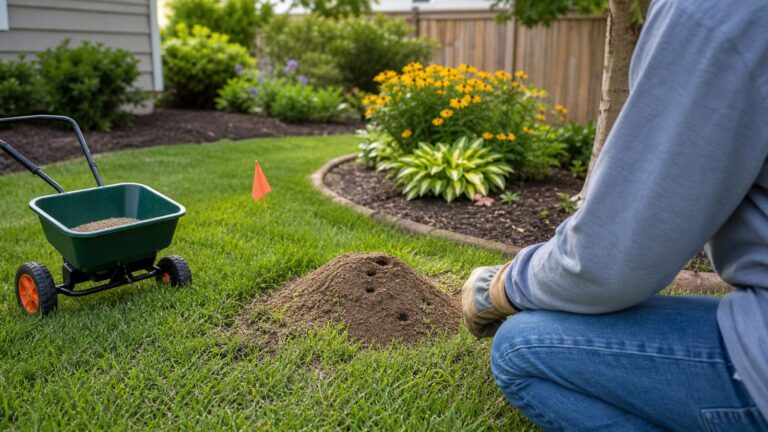
Most dirt mounds without visible holes are not mysterious open burrows. Pocket gophers commonly seal tunnel entrances with soil plugs, while moles push soil upward from underground tunnels. Smaller piles may be earthworm castings or ant nests, and mud chimneys in persistently wet ground may come from burrowing crayfish.
The mound’s shape, size, location, nearby tunnels, plant damage, soil moisture, and season are more reliable than the missing hole alone. Identify the cause before trapping or applying any pesticide, because the appropriate response ranges from doing nothing to correcting drainage or protecting plant roots.
As an Amazon Associate I earn from qualifying purchases.
First, check whether there really is no entrance
A soil mound can cover, seal, or sit beside the opening that produced it. Before disturbing it, photograph the mound beside a ruler or coin. Record its shape and inspect the surrounding area for raised runs, compacted plugs, plant damage, loose soil, or mud pellets.
Recommended Free Tools
Do not assume that every pile is evidence of a damaging animal. A useful first distinction is:
#1 Best Overall

- GARDENING ESSENTIAL: Heavy duty, ergonomic hand trowel ideal for a variety of gardening tasks like digging in tough soil, maintaining your herb garden, digging all holes, turning soil, and more to encourage overall plant health and appearance
- MAXIMUM POWER AND PRECISION: Cast-aluminum head boosts power for digging in tough soil and enhances rust resistance; Ergonomic handle allows for more control of trowel and reduces fatigue
- LONG-LASTING AND RELIABLE: Polished aluminum head stays sharp through heavy use and provides excellent durability for lasting value; Fiskars hand trowels and garden tools are built to last
- QUALITY GARDEN TOOLS: Designed to help you cultivate a better garden, Fiskars garden and yard tools are equipped with smart technologies and award-winning, ergonomic features that make it easier and more enjoyable to transform your outdoor space
- INCLUDES: 1 Fiskars Ergo Trowel with hang hole; Lifetime Warranty
- Large, shaped excavation with plant damage: pocket gopher becomes more likely.
- Round hill with raised surface tunnels: mole becomes more likely.
- Many small, granular piles: earthworm castings are a strong possibility.
- Small loose mound near paving, rocks, or bare soil: consider ants.
- Mud pellets or a chimney in wet ground: consider burrowing crayfish.
These are diagnostic patterns, not guarantees. Local species, soil type, weather, and gardening practices can change how a mound looks.
1. Pocket gophers are pushing soil out of sealed tunnels
A pocket gopher is one of the best explanations for a relatively large, fresh mound with no open hole. Gophers excavate underground tunnel systems and often close the entrance with a compacted soil plug. The opening may be beside or beneath the mound rather than visible at its center, so the surface can look like a hole-free pile of dirt. [c001][c003]
Clues that point to a pocket gopher
- The mound is fan-shaped, crescent-shaped, or horseshoe-shaped rather than perfectly circular.
- A firm soil plug or sealed area is visible near one side of the mound.
- Fresh mounds appear in a line or series as the animal extends its tunnel.
- Plants wilt, disappear below ground, become severed, or show damaged roots.
- Irrigation lines or other buried materials have been damaged.
- New activity continues in different seasons; pocket gophers can be active year-round.
Gophers may eat roots and underground plant parts, and they can pull plants into their tunnels. A fan-shaped mound without any plant damage is less conclusive than a fan-shaped mound alongside wilting or disappearing vegetation.
PC Slower Than It Used to Be?
A free scan shows the junk files, broken settings and background clutter dragging Windows down - then fixes them in one click.Free scan · Windows 10 & 11Outdated Drivers Are Slowing You Down
One free scan finds every outdated or missing driver and matches the right update for your exact hardware.Free scan · exact hardware matchWhat to do
Confirm that the damage and mound pattern fit a gopher before taking action. Extension guidance identifies trapping as a standard control method, but local wildlife regulations and legal methods vary. If you have confirmed active pocket-gopher tunnels, a pocket gopher trap may be appropriate; use and placement must follow the product instructions and applicable local rules. Do not use a generic mole trap or rodenticide simply because a mound is present.
For recurring damage around trees, shrubs, or garden beds, physical protection can help prevent root access. Galvanized hardware cloth can be used as a root or planting barrier where appropriate, but it protects plants; it does not identify, remove, or necessarily stop the gopher elsewhere in the garden. [c003]
Rank #2

- Thickened Aluminum Alloy Material: Our gardening shovel is made of high-quality aluminum alloy material, allowing the garden trowel to dig deeply into the soil and cut through hard turf easily. The 0.08 inch thickness makes our spade shovel more sturdy and long lasting, ensures durability and stability during use, and makes the trowel not easy to break and long lasting
- Ergonomic Design: The trowel garden tool is designed with an ergonomic rubber-grip handle that reduces hand and wrist fatigue while digging. The high-quality non-slip TPR material of the handle makes the trowel garden tool easy to hold and comfortable to use. Saving your labor, time and energy
- Easy to Store: The small hand trowel is lightweight and compact, makes it easy to store on your garden bag and carry out for gardening. The hanging hole in the handle is designed to accommodate a rope. You can hang the hand shovel for gardening on everywhere you want when you need to do gardening works in your own garden or other places
- Easy to clean: Our hand trowel has a smooth surface, with a polished aluminum knife head that is rustproof and long lasting. The small garden shovel is also easy to clean after use, ensuring its smooth appearance and remaining rust resistant for an extended period of time
- Multi-function: This small shovel is suitable for a wide range of horticultural tasks, including digging, weeding, loosening soil, aerating, transplanting, etc. The great gardening tools for women, small shovels for gardening, digging shovel, small plant tools
2. Moles are excavating feeding tunnels below the surface
Moles create hills by pushing excavated soil upward from deeper tunnels. Their feeding tunnels can also form raised ridges near the surface, and neither the hill nor the ridge needs to have an obvious opening. Moles are attracted to moist soil containing earthworms, grubs, ants, and other soil organisms. [c002][c004][c005]
Clues that point to a mole
- The mound is round, conical, or volcano-shaped.
- Raised, irregular surface runs connect to or extend away from the mound.
- The area is a lawn or garden with moist, workable soil.
- Grass may brown or dry over a disturbed tunnel.
- The principal damage is tunneling and root disturbance, not plants being eaten or pulled underground.
A molehill is not the same thing as a gopher mound. Moles generally feed on soil organisms rather than directly consuming plant roots, although their digging can still disturb plants and turf. A neat, round hill with no raised runs may have another cause, including earthworms or ants.
Free tools Windows power users keep installed
One-click scans. No signup required.
What to do
Do not treat every mound as proof of an active mole. Locate a tunnel that is currently being used instead of focusing only on the oldest hill. One monitoring method is to lightly press down a short section of a raised run and check whether it is rebuilt. This can indicate activity, but it does not identify the animal by itself.
University of Minnesota Extension identifies trapping as generally the most effective mole-control approach and recommends concentrating on active tunnels. If you have confirmed active mole runs, a mole trap for active tunnels can be considered. Follow the product directions exactly, and do not use it on a suspected gopher tunnel or on harmless casting piles. [c005]
3. Earthworms are leaving castings, not creating a pest burrow
Numerous small, crumbly piles scattered across turf or garden soil may be earthworm castings. Worms ingest soil and plant-litter material, digest it, and excrete nutrient-containing casts at the surface. The result can look like many tiny dirt mounds even though there is no large excavation or visible entrance.
Rank #3

- 3 Piece Garden Tool Set: The gardening hand tools set includes a garden trowel, a garden rake and a transplanting spade with graduated scale. Great gardening supplies for weeding, digging, transplanting, planting, loosening soil, etc. The great lawn and garden tools to meet most of your daily gardening needs
- Sturdy and Long lasting: The main body of our garden tools set is made with high-quality thickened aluminum alloy material, which is rust-resistant, long lasting and extremely sturdy. Would not easily break even when dealing with thick roots or rocky soil
- Ergonomic Design: The handle is designed with contoured finger grips and palm rest to reduce hand fatigue and strain while planting. The high-quality TPR material of the handle makes the trowel garden tool easy to hold and comfortable to use. Saving your labor, time and energy. The hanging hole on the top makes the garden tools for gardening easy to carry and store
- Hand Trowel: With wide spade and 0.08 inch thickness, the hand shovels for gardening is suitable for digging, planting and transplanting plants without damaging the roots
- Transplant Trowel: The depth measurement on our transplanting shovel will help you to quick measure how depth you want to dig, makes it easier to transplant potted plants and flowers
Clues that point to earthworms
- The piles are small, granular, coiled, or crumbly rather than one large mound.
- They are distributed randomly across an area.
- There is no missing plant, severed root, or obvious tunnel network.
- They become more noticeable after wet weather or during moist spring and fall conditions.
- The soil appears biologically active rather than freshly excavated.
Earthworms are usually beneficial. Their channels help water and nutrients move through soil, and their castings contribute organic material. If the piles make turf uneven, the better response is usually cultural rather than chemical: improve turf density, avoid frequent shallow irrigation, and manage soil moisture appropriately. Extension guidance generally considers earthworms beneficial, and the cited guidance does not identify a pesticide labeled specifically to eliminate them. [c006][c007]
Quick wins for a faster PC:
Repair Windows errors before they cause bigger problemsFix Now →Fix the driver behind crashes, sound loss and screen glitchesFind Drivers →Do not use a gopher, mole, or general-purpose insect treatment just to make casting piles disappear. The presence of castings alone is not evidence of a garden infestation.
4. Ants are excavating nest chambers beneath small piles
Ants can bring soil to the surface while excavating chambers and passages for an underground nest. Some species make obvious mounds, while others nest beneath rocks, logs, bricks, paving, or concrete. In those situations, the entrance may be concealed or too small to notice.
Clues that point to ants
- The mound is small to medium-sized, loose, and crumbly.
- Ants are visible around the pile, especially during warm weather.
- The mound is beside pavement, stones, wood, bare soil, or thinning grass.
- A tiny opening may be present but hidden by loose soil or vegetation.
- Several small mounds occur in thin turf or exposed soil.
Field ants may produce larger mounds, while cornfield ants commonly make smaller conical piles in thin or bare grass. Most lawn ants are a nuisance rather than a serious plant pest. Control is most justified when a nest interferes with mowing, enters a structure, protects honeydew-producing aphids, or damages a particular plant. [c008][c009]
First locate and identify the nest. If targeted control is genuinely needed, an outdoor ant bait station or another treatment labeled for the site and ant species is more appropriate than blanket-spraying the entire garden. Keep any bait away from children, pets, edible crops, and water according to the label.
The Tool Desk
Outbyte Driver Updater FREEFix the driver behind crashes, sound loss and screen glitchesFind Drivers →Outbyte PC Repair FREEClear out junk files and repair common Windows errorsFree Scan →Rank #4

- GARDENING ESSENTIAL: Ergonomic hand trowel with oversized head ideal for a variety of gardening tasks like digging in tough soil, maintaining your herb garden, digging all holes, turning soil, and more to encourage overall plant health and appearance
- MAXIMUM POWER AND PRECISION: Cast-aluminum oversized head boosts power for digging in tough soil quickly and enhances rust resistance; Ergonomic handle allows for more control of trowel and reduces fatigue
- LONG-LASTING AND RELIABLE: Polished aluminum head stays sharp through heavy use; Lightweight FiberComp design provides excellent durability for lasting value; Fiskars hand trowels and garden tools are built to last
- QUALITY GARDEN TOOLS: Designed to help you cultivate a better garden, Fiskars garden and yard tools are equipped with smart technologies and award-winning and ergonomic features; Ideal holiday gardening gifts
- INCLUDES: Fiskars FiberComp Hand Trowel with hang hole; Full lifetime warranty
5. Burrowing crayfish are building mud chimneys in wet soil
Burrowing crayfish can form distinctive mud turrets or chimneys above their burrows. In consistently wet ground, the chimney may erode, collapse, and round off into an ordinary-looking dirt mound. The entrance can therefore disappear even though the burrow remains below.
Clues that point to burrowing crayfish
- The mound is made of recognizable mud pellets or clods.
- The soil stays wet or drains poorly.
- The area is near a pond, stream, ditch, seep, high water table, downspout, or frequently irrigated bed.
- The mound began as a chimney and later collapsed or became rounded.
Location is particularly important here. A dry, well-drained lawn far from surface water is a less likely setting than a low spot beside a ditch or a persistently overwatered garden.
What to do
Address the water condition where practical: check downspouts, irrigation leaks, grading, compaction, and drainage. A soil-moisture reading can help document a persistently wet area, but a meter is optional and does not identify crayfish or solve the drainage problem.
The cited extension guidance states that no pesticide is labeled for crayfish control in the relevant residential context. Chemicals used in wet areas can move off-target and threaten water quality, so do not improvise with unapproved treatments. If chimneys continue after simple irrigation or drainage corrections, a qualified landscape drainage professional may be more useful than an extermination product. [c010][c011]
What’s actually slowing this PC down?
Pick the symptom - the matching free tool is one click away.
Quick identification table
| What you observe | Most likely explanation | Check next |
|---|---|---|
| Large fan-shaped mound with a sealed center | Pocket gopher | Look for plant or root damage and a tunnel beside or beneath the mound. |
| Round or volcano-shaped hill with raised surface runs | Mole | Trace the ridges and test whether a tunnel is active. |
| Many tiny granular piles, especially after wet weather | Earthworm castings | Look for worm activity and signs of actual plant damage before treating. |
| Small loose mound near bare soil, rocks, or pavement | Ant nest | Watch for ants and decide whether the nest is causing a meaningful problem. |
| Mud pellets or a chimney-like mound in wet ground | Burrowing crayfish | Check drainage, irrigation, and proximity to ponds, streams, or ditches. |
A practical diagnostic sequence
- Photograph the mound first. Include a ruler or coin for scale and take a wider image showing nearby plants and landscape features.
- Describe the material and shape. Note whether it is fan-shaped, circular, granular, pellet-like, compacted, or connected to a raised tunnel.
- Look for a plug, not just a hole. A sealed entrance is expected in many pocket-gopher mounds.
- Inspect nearby plants. Check for wilt, missing plants, severed stems, root damage, chewing, or vegetation pulled below ground.
- Assess moisture. Look for a downspout, irrigation leak, ditch, pond, seep, low spot, or soil that stays wet after surrounding ground dries.
- Monitor one mound carefully. Smooth or press down a small area lightly and observe whether nearby soil is rebuilt. Treat this only as an activity check, not proof of species.
- Choose a species-specific response. Do not apply rodent, mole, ant, or general-purpose pesticides until you have identified the likely cause and confirmed that the product label permits the use and location.
When to get help
Consider professional advice when plants or irrigation lines are repeatedly damaged, tunnels extend through a large property, trapping is regulated where you live, or you cannot distinguish a gopher from a mole. For recurring wet-soil mounds, seek a drainage or landscape-water-management assessment rather than a chemical solution. Any wildlife-control provider should be licensed where required and able to explain the species identification, legal method, and expected limits of control.
Best Value

- IDEAL GIFTS FOR MEN, WOMEN - Our gardening tools set is the ultimate gift for any men women who loves to garden. Including rust-proof and durable tools, this set ensures she has everything she needs for a flourishing garden. The ergonomic design makes it comfortable to use, making it a thoughtful gift for wife, mom, daughter, or grandma.
- A COMPLETE GARDEN TOOL SET - A durable garden tools set is all you need for your gardening.
- PREMIUM GARDEN TOOLS - Our gardening tool set comes with a Spray Bottle, Shovel, Crack Weeder, Hand Rake, Weeder, Pruner, 15 Plant tags, a pair of Hand Gloves, and a Heavy Duty Garden Bag to keep all your tools packed away provides everything you need to maintain a beautiful and healthy garden.
- DURABLE & RUST PROOF - Our gardening tool set is made of high-quality aluminium alloy, ensuring that the tools are strong, durable, and resistant to rust and corrosion. The aluminium alloy material is lightweight, making it easy to handle and reducing hand fatigue during use. Additionally, the material is eco-friendly and non-toxic. With our toolset, you can be confident that you're using high-quality, reliable tools that will stand the test of time.
- COMFORTABLE ERGONOMIC HANDLE - Our gardening tool set is designed with your comfort in mind. The ergonomic handle design allows for a comfortable grip and reduces hand fatigue, even during long gardening sessions. The soft yet sturdy handle provides a secure grip and helps prevent slipping, so you can work with confidence. Whether you're planting delicate seedlings or digging up stubborn weeds, our tool set's comfortable design will help you get the job done with ease.
Do not dig into an unfamiliar burrow with your hands. Wear gloves when handling soil or traps, keep traps and baits away from children and pets, and follow all product labels. If the mound is near a waterway, avoid treatments that could wash into the water.
Frequently Asked Questions
What animal makes a dirt mound with no visible hole?
Pocket gophers and moles are the most important possibilities. Gophers commonly seal tunnel entrances with soil plugs, while moles push soil up from underground tunnels. Small piles may instead be earthworm castings or ant nests, and mud chimneys in wet ground may come from burrowing crayfish.
How can I tell a gopher mound from a molehill?
A gopher mound is more often fan-shaped or horseshoe-shaped and may accompany missing plants, damaged roots, or a compacted soil plug. A molehill is more often round or volcano-shaped and may have raised surface feeding runs nearby. These clues are suggestive rather than conclusive.
Should I use pesticide on dirt mounds?
Not before identifying the cause. Earthworms are generally beneficial, and the cited guidance says no pesticide is labeled specifically to eliminate them. Crayfish treatments can threaten water quality, and mole or gopher products are not interchangeable. Use only a legally labeled product and follow its instructions exactly.
Are dirt mounds in a lawn always a sign of a pest?
No. Numerous small granular piles after wet weather are often earthworm castings, which indicate active soil biology rather than a damaging infestation. Ant mounds may also be a minor nuisance that does not require treatment.
The Bottom Line
A missing hole is not enough to identify the cause. Fan-shaped mounds plus root damage suggest pocket gophers; round hills plus raised runs suggest moles; many tiny piles suggest earthworms; small loose piles with visible ants suggest an ant nest; and mud chimneys in wet ground suggest burrowing crayfish. Photograph the evidence, check for plant damage and moisture, then use only a species-appropriate response.
Quick Recap
Product prices and availability are accurate as of the date/time indicated and are subject to change. Any price and availability information displayed on Amazon at the time of purchase will apply.