Some links on this page are affiliate links: if you buy through them we may earn a commission, at no extra cost to you.
A 3-HP cabinet table saw is the right class of saw for a serious cabinet shop, trim carpentry shop, remodeler building custom built-ins, or homeowner who cuts hardwood and sheet goods every week. It is powerful enough for 10-inch blades, dado work, hardwood rips, plywood processing, face-frame stock, stair parts, and furniture-grade joinery. It is also heavy, usually 240V, expensive to move, and incomplete without dust collection, outfeed support, and a safe workflow.
For 2026, plan on roughly $2,700 to $4,600 for a mainstream new 3-HP cabinet saw before tax, freight, accessories, electrical work, and dust collection. A realistic installed station usually lands closer to $4,000 to $8,500 once the saw is powered, vented, aligned, and equipped for daily work. Premium safety-brake models, long fences, commercial electrical work, and engineered dust collection can push the number higher.
On our job sites and in shop planning, we do not treat a cabinet saw like a portable tool purchase. We treat it like installing a fixed piece of production equipment. The saw has to fit the room, the electrical service, the dust system, the people using it, and the work coming through the shop. That is where most bad purchases happen: not because the saw is weak, but because the space, power, dust control, or material handling was never planned.
As an Amazon Associate I earn from qualifying purchases.
What a 3-HP Cabinet Table Saw Is Built For
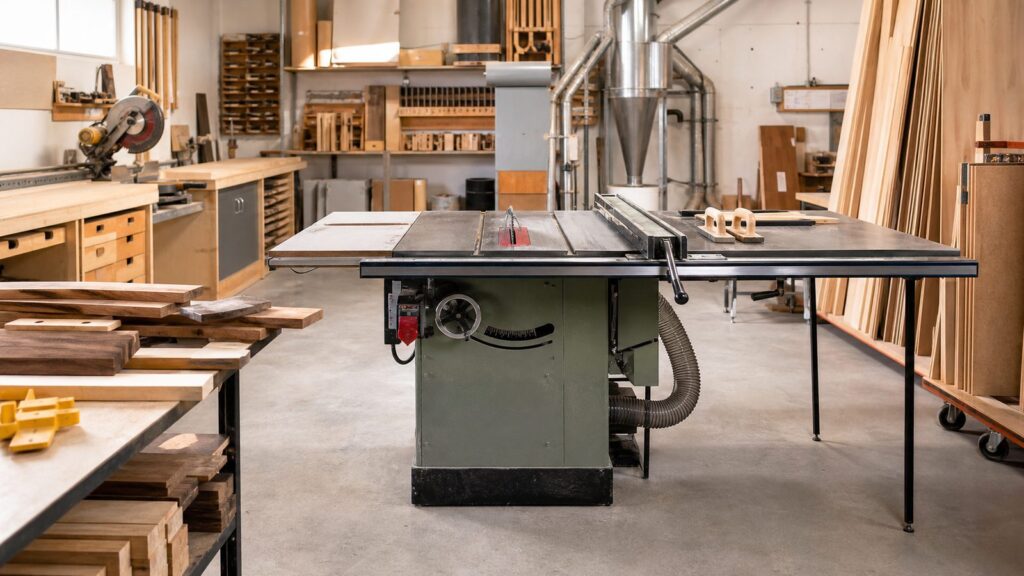
A 3-HP cabinet table saw is a stationary 10-inch table saw built around a heavy enclosed base, cast-iron table, cabinet-mounted trunnions, a belt-driven motor, and a serious rip fence. Most machines in this class use 220V to 240V single-phase power. Many weigh about 450 to 700 pounds before you add extension tables, mobile bases, long rails, or outfeed tables.
The difference between this and a jobsite saw is not just horsepower. A cabinet saw gives you mass, stability, lower vibration, better dust capture, better fence repeatability, and a larger work surface. Those details matter when you are ripping eight-foot maple, cutting cabinet sides, sizing face frames, or running repeat parts for built-ins.
#1 Best Overall
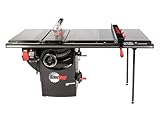
- 69 1/8" w, 33" d, 34" h
- The PCS is SawStop's most popular table saw featuring best-in-class cutting performance.
- Revolutionary SawStop Safety System stops on contact with skin.
- Unmatched fit and finish with a keen attention to detail.
- The 36" Professional T-Glide Advance Rip Fence delivers accuracy, versatility, ease of use, and safety like no other rip fence on the market.
A typical 3-HP cabinet saw setup includes a 10-inch blade, 4-inch dust port, riving knife, blade guard, miter slots, cast-iron wings, and a 30-inch to 52-inch fence. A 30-inch fence works for many furniture and trim shops. A 52-inch fence is useful when you regularly rip full sheets, break down cabinet parts, or want a large right-side work table built into the saw station.
What’s actually slowing this PC down?
Pick the symptom - the matching free tool is one click away.
The machine belongs in a controlled shop environment. For field carpentry, a track saw and a portable table saw often make more sense. A cabinet saw shines when the work can come to the shop, the setup stays aligned, and the crew can use the same calibrated station day after day.
Is 3 HP Enough?
For most custom cabinetmaking and residential built-in work, 3 HP is the sweet spot. It has enough power to rip hardwood, cut plywood cleanly with the right blade, run a dado stack, and maintain feed rate without feeling underbuilt. It also avoids some of the higher electrical and machine-cost penalties that come with larger 5-HP industrial saws.
A 3-HP saw is usually enough for:
- Custom cabinets, vanities, bookcases, mudroom units, and built-ins
- Hardwood face frames, doors, drawer parts, and trim stock
- Sheet goods including plywood, MDF, melamine, and cabinet-grade panels
- Stair parts, shelving, shop fixtures, and repeat jobsite components made in a shop
- Dadoes, rabbets, tenons, grooves, and other joinery with the correct blade or dado set
A 3-HP saw is not the answer to every cutting problem. If a shop is pushing thick hardwood all day, running production cabinet parts, or processing full sheets at high volume, a 5-HP saw, sliding table saw, vertical panel saw, CNC router, or dedicated panel-processing workflow may be better. Horsepower helps, but workflow usually determines productivity.
For occasional DIY use, a 3-HP cabinet saw is often too much machine. It needs more space, more electrical planning, more dust collection, and more money than a casual garage user expects. A 1.75-HP hybrid saw, quality portable saw, or track-saw system can be more practical for weekend projects and small repairs.
The Tool Desk
Outbyte PC Repair FREEClear out junk files and repair common Windows errorsFree Scan →Outbyte Driver Updater FREEScan for outdated or missing drivers - takes under a minuteDriver Scan →2026 Cost: Saw Price vs Installed Cost
The sticker price is only the first number. A cabinet saw is a system: saw, fence, blades, power, dust collection, outfeed, safety gear, delivery, and setup. If you are planning a home shop, garage shop, or commercial millwork area, budget the complete station before ordering the saw.
| Cost item | Typical 2026 US range | Planning notes |
|---|---|---|
| 3-HP cabinet saw | $2,700-$4,600+ | Mainstream professional machines; premium safety-brake and industrial configurations cost more. |
| Freight and delivery | $250-$500+ | Curbside freight is common. Inside delivery, liftgate issues, stairs, and rigging add cost. |
| Electrical circuit | Several hundred to $1,500+ | Depends on panel capacity, distance, conduit, receptacle, permit fees, and whether a subpanel is needed. |
| Dust collection | $700-$2,500+ | Includes collector, 4-inch or larger ducting, canister filtration, gates, hose, fittings, and setup. |
| Blades and dado stack | $150-$700 | Budget for ripping, crosscut, plywood, combination, and dado tooling as needed. |
| Mobile base and outfeed | $300-$1,300+ | A heavy saw needs stable positioning. Sheet goods need real support behind the blade. |
| Small accessories | $50-$250 | Push blocks, featherboards, measuring tools, inserts, setup gauges, and storage. |
Real examples help anchor the range. In 2026, a Grizzly-style 10-inch 3-HP 240V cabinet saw sits around $2,695 plus freight in the $349 range. SawStop Professional Cabinet Saw base pricing starts around $3,025, while common 3-HP T-Glide configurations are around $3,987 and up depending on fence and options. Outlet pricing on a Laguna F3 Fusion 36-inch model has appeared around $2,204.30 from an original price around $3,149, but outlet machines are condition-dependent and should not be compared directly with new-in-box retail.
The more honest installed range for a ready-to-work 3-HP cabinet saw station is about $4,000 to $8,500. A residential garage with available panel capacity and a short electrical run may land near the low end. A commercial shop with permitted electrical work, dust-collection design, fire-risk review, and professional installation can exceed the high end quickly.
Power Requirements and Electrical Planning
Most 3-HP cabinet saws require 220V to 240V single-phase power. The exact circuit is not something to guess from horsepower alone. Use the manufacturer nameplate and manual for the specific saw. Required breaker size, plug type, conductor size, and receptacle configuration vary by model and local code.
Quick wins for a faster PC:
Repair Windows errors before they cause bigger problemsFix Now →Scan for outdated or missing drivers - takes under a minuteDriver Scan →Clear out junk files and repair common Windows errorsFree Scan →Many 3-HP saws are commonly installed on dedicated 20A or 30A 240V circuits, but the word dedicated matters. A cabinet saw should not share a circuit with dust collection, lighting, battery chargers, heaters, or a compressor. Starting current is higher than running current, and nuisance trips become a production problem. Worse, undersized wiring and mismatched breakers create heat and liability.
Rank #2

- SAWSTOP PATENTED SAFETY SYSTEM: Stops a spinning blade on contact with skin. The blade stops in less than 5 milliseconds, and drops below the table, minimizing a potentially life-altering injury to a mere scratch
- RELIABILITY: The Control Box houses the on-off switch, power paddle, and on-board computer, and constantly checks that all systems are working to reliably keep you safe
- 36-INCH T-GLIDE FENCE ASSEMBLY: The 36-inch T-Glide Fence & Rail are made of heavy-gauge steel for sure lockdown and reliably square cutting for years without deflection
- DUST COLLECTION: 99% dust collection is delivered above the table with the blade guard, and below the table with advanced shrouding. Available Overarm Dust Collection (Model # TSA-ODC, sold separately) routes dust away from the blade & into the 4” port
Before buying the saw, verify four things: open breaker space, available panel capacity, distance from the panel to the saw location, and the receptacle or hardwire requirement listed by the saw manufacturer. If the saw will move on a mobile base, plan cord length and cord protection so it cannot be rolled over, pinched, or dragged through dust.
Permits are local, but in many jurisdictions a new 240V shop circuit requires an electrical permit and inspection. In a commercial or employee-occupied shop, assume the work needs to be code-compliant, documented, and performed by a qualified electrician. In a residential garage, the rules still matter because insurance, resale, and fire risk do not disappear because the work is at home.
Space, Weight, and Material Handling
A 3-HP cabinet saw often weighs 450 to 700 pounds before extensions. That weight is useful once the saw is in place, but it makes delivery and placement part of the project. Curbside freight means the crate may be dropped at the driveway or loading area, not rolled into the exact shop location. Measure the path before delivery: gates, door widths, steps, slopes, garage thresholds, floor transitions, and ceiling height.
Do these 3 things before closing this tab:
1Fix the driver behind crashes, sound loss and screen glitches2Repair Windows errors before they cause bigger problems3Scan for outdated or missing drivers - takes under a minuteFor clearances, do not only measure the footprint of the saw. A full 4×8 sheet needs about eight feet in front of the blade and eight feet behind it if you want to move it safely through a cut. In a small shop, that can mean aligning the saw with a garage door, using a folding outfeed table, or building the saw into a central workstation that doubles as assembly space.
A practical cabinet saw bay usually needs:
- At least 4 feet of comfortable operator space in front of the saw for normal boards
- 8 feet or more of infeed and outfeed path for sheet goods and long stock
- 3 feet or more on the working side for stance, push blocks, and fence adjustment
- Clear access to the power switch without reaching over the blade path
- A stable outfeed surface set just below the table height
Outfeed is not optional for cabinet work. Without it, the operator ends up lifting, twisting, or catching falling material during the cut. That is bad for accuracy and worse for safety. A fixed outfeed table is best in a dedicated shop. A folding outfeed table or roller support can work in a garage, but it must be stable and aligned. A narrow roller stand behind the saw is not enough support for cabinet panels.
Fence, Table, and Accuracy Matter More Than Marketing Specs
Once you are in the 3-HP class, the fence and alignment matter more than small horsepower differences. A reliable fence locks parallel, reads accurately, stays square, and does not deflect when sheet goods push against it. Cabinet parts are repetitive. If the fence is off by 1/32 inch over multiple parts, the error shows up in reveals, door gaps, and face-frame fit.
Look closely at the fence length and rail package. A 30-inch rip capacity is enough for many solid-wood shops and smaller built-ins. A 36-inch fence gives more flexibility without taking over the room. A 52-inch fence is useful for cabinet sides and sheet goods, but it increases footprint and may require a larger outfeed plan. Buying a 52-inch fence for a narrow garage can make the saw harder to use, not better.
Recommended Free Tools
Cast-iron wings add mass and stability. Stamped-steel extension wings save cost and weight but may not feel as solid for daily cabinet work. A good miter gauge is helpful, but most professional shops eventually use crosscut sleds, stop blocks, track saws, or miter saw stations for repeat crosscuts. Do not judge the entire saw by the factory miter gauge.
Rank #3
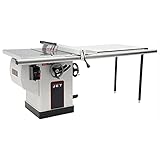
- Exclusive 50-in. commercial XACTA fence II with T-square design
- Poly-V drive belt system delivers quiet, efficient operation
- 11-in. left and right cast iron extension wings provides the largest table surface in its class
- Push-button arbor lock for rapid blade changes
- Quick-release riving knife greatly reduces binding/kickback risk
Dust Collection Is Part of the Saw Purchase
A cabinet saw’s enclosed base and 4-inch dust port make dust collection possible, but not automatic. A shop vacuum is not a substitute for a proper dust collector on a 3-HP cabinet saw. Vacuums have high static pressure but low air volume. Table saw dust collection needs enough airflow through a 4-inch or larger hose or duct to pull chips from the cabinet and keep fine dust from accumulating.
For a single-machine or small-shop setup, plan on a dust collector in the $700 to $2,500+ range with canister filtration, suitable ducting, blast gates, hose, fittings, and a layout that keeps runs short and smooth. Long flex hose, tight elbows, undersized ports, and clogged filters reduce performance fast.
Wood dust is more than cleanup. Fine dust affects breathing conditions, coats equipment, creates housekeeping problems, and can become a combustible dust concern in commercial woodworking. In employee-occupied or commercial shops, dust control can involve hazard analysis, dust-collection design, housekeeping procedures, insurer requirements, and fire-protection review. This is one area where a construction company or cabinet shop should be more careful than a hobby blog suggests.
Free tools Windows power users keep installed
One-click scans. No signup required.
Good practice is simple: collect at the source, keep duct runs efficient, use filtration that captures fine dust, empty containers before they overfill, and maintain clear housekeeping routines. If the shop is commercial, involve the authority having jurisdiction, insurer, and qualified dust-collection professional when the scale of operation warrants it.
Safety, OSHA, and Liability
A cabinet saw can produce excellent work, but it is one of the highest-risk machines in a woodworking shop. The main hazards are blade contact, kickback, thrown offcuts, pinch points, electrical faults, and dust. Power and mass do not make a saw safer; setup and discipline do.
For workplace use, OSHA 29 CFR 1910.213 applies to woodworking machinery and addresses items such as guarding, spreaders, anti-kickback devices, and safe operation. If employees use the saw, it is not just a matter of personal preference. Guards, riving knives, training, maintenance, and safe procedures become employer obligations.
Active injury-mitigation technology, such as brake-equipped cabinet saws, adds cost but deserves serious consideration. For schools, shared shops, companies with employees, and contractors concerned about workers’ compensation exposure, the extra purchase price may be easier to justify than it looks on a saw-only quote. Brake cartridges and blades can be consumables after an activation, so include them in the operating budget.
Our baseline for cabinet saw use is straightforward: use the riving knife whenever possible, use the guard when the cut allows it, use push blocks and push sticks, keep hands out of the blade path, stand out of the direct kickback line, support long stock, and never force a cut to compensate for a dull blade or bad setup. If a cut feels awkward, stop and change the setup.
1.75 HP vs 3 HP vs 5 HP
The right horsepower depends on workload, not pride. A 1.75-HP saw can make beautiful cabinets if the user has sharp blades, good technique, and reasonable feed rates. A 3-HP saw gives more margin for hardwood, dadoes, and regular sheet-good work. A 5-HP saw is for production speed, thick stock, and heavier industrial use.
Rank #4

- Saw stop patented safety system - Stops a spinning blade on contact with skin. The blade stops in less than 5 milliseconds and drops below the table, minimizing a potentially life-altering injury to a mere scratch. Revolutionary SawStop safety system stops on contact with skin.
- Strength & stability - Durable craftsmanship of almost 700 Lbs of iron and steel, and thoughtful details combine for consistent, reliable performance in the most demanding industrial environments.
- Dust collection - Provides outstanding 99% dust collection both above the table via the included dust collection blade guard and below the table with advanced shrouding around the blade. Available Overarm Dust Collection (Model # TSA-ODC, sold separately) routes dust away from the blade and into the 4-inch port.
- Added safety - The ICS has an integrated lock-out tag-out switch for additional safety to ensure that only authorized operators can use the saw. As another added feature, interlock switches on the motor access panels prohibit saw operation if any doors are unlatched.
- 52 In. T-Glide fence assembly - The 52 In. industrial T-glide advance rip fence delivers accuracy, versatility, ease of use, and safety like no other rip fence on the market. The 52 In. T-glide fence & rail are made of heavy-gauge steel for sure lockdown and reliably square cutting for years without deflection.
| Saw class | Best fit | Tradeoff |
|---|---|---|
| 1.75 HP | Serious hobby shops, smaller garages, light cabinet work, occasional hardwood | Lower power and slower feed in thick stock, but easier electrical requirements on some models. |
| 3 HP | Custom cabinets, built-ins, trim shops, frequent hardwood and plywood work | Usually needs 240V, stronger dust collection, more space, and a larger total budget. |
| 5 HP | Production shops, thick hardwood, heavy dado work, faster daily throughput | Higher machine cost, more demanding electrical needs, and often more industrial infrastructure. |
If your shop builds one built-in a month, 3 HP is plenty. If your crew is processing panels every day for multiple jobs, the saw may become a bottleneck no matter how much horsepower it has. At that point, evaluate workflow first: track saw for rough breakdown, cabinet saw for final sizing, sliding table saw for panels, or CNC for repeat production.
Independent reader supportYour contribution helps us test, update, and keep practical guides available for everyone.When to DIY vs When to Hire a Pro
A careful homeowner or experienced woodworker can assemble, align, and maintain a cabinet saw. Many saws arrive partially disassembled, and final setup typically includes installing wings, rails, fence, switch, blade guard, riving knife, belt cover, and mobile base. Plan several hours for assembly and alignment, not 30 minutes.
DIY is reasonable when you already have the correct circuit, a level floor, a safe delivery path, basic mechanical skill, and the patience to align the blade, fence, table, and riving knife. You should be comfortable using dial indicators or accurate setup tools, checking blade-to-miter-slot alignment, setting fence parallelism, and testing cuts on scrap before production work.
Hire a licensed electrician for new 240V circuits, panel changes, subpanels, long conduit runs, commercial work, or any situation where you are unsure about breaker size, conductor size, grounding, receptacle type, or local permit requirements. Electrical work is not a place to improvise from online comments.
Bring in professional help for dust collection if the shop has multiple machines, long duct runs, employees, combustible dust concerns, or insurer requirements. A cabinet saw connected to a weak dust system is still a dusty machine. A properly designed collector protects lungs, equipment, cleanup time, and fire safety.
For a business, also budget training time. A new cabinet saw station should be introduced with written shop rules, cut demonstrations, guard and riving-knife expectations, emergency shutoff location, blade-change procedure, dust-collector startup procedure, and a basic maintenance checklist.
Windows Errors? Fix Them Before They Spread
Repair common Windows errors and clear accumulated junk for a smoother, more stable PC - no reinstall needed.Free scan · no reinstallOutdated Drivers Are Slowing You Down
One free scan finds every outdated or missing driver and matches the right update for your exact hardware.Free scan · exact hardware matchBuying Checklist Before You Order
Before spending $3,000 to $5,000 on the saw itself, walk the whole installation on paper. The best saw is the one your shop can power, feed, collect from, and use safely every day.
- Confirm the saw’s exact voltage, amperage, plug, breaker, and circuit requirements from the manufacturer nameplate and manual.
- Ask an electrician for a quote before purchase if a new 240V circuit is needed.
- Check whether electrical permits and inspections apply in your city or county.
- Measure the delivery path from truck drop-off to final saw location.
- Confirm floor condition, slope, and whether a mobile base is needed.
- Choose fence capacity based on real work: 30, 36, or 52 inches.
- Plan at least 8 feet of outfeed path for sheet goods if the saw will process panels.
- Budget for dust collection, not just a dust hose.
- Decide whether active brake technology is worth the added cost for your risk profile.
- Order blades, zero-clearance inserts, push blocks, featherboards, and setup tools with the saw.
- Schedule assembly and alignment before the saw is needed for production work.
For a contractor, the decision usually comes down to workflow. If your company is buying doors, drawers, and cabinet boxes from suppliers and only trimming occasional filler strips, a cabinet saw may sit idle. If you regularly build custom storage, fireplace built-ins, mudroom benches, vanities, wainscot panels, stair components, and site-specific millwork, a 3-HP saw can pay for itself in accuracy and control.
Best Value

- 85 1/4" w, 33" d, 34" h
- The PCS is SawStop's most popular table saw featuring best-in-class cutting performance.
- Revolutionary SawStop Safety System stops on contact with skin.
- Unmatched fit and finish with a keen attention to detail.
- The 52" Professional T-Glide Advance Rip Fence delivers accuracy, versatility, ease of use, and safety like no other rip fence on the market.
Bottom Line
A 3-HP cabinet table saw is the practical center of many small professional woodshops. It is strong enough for real cabinet work without stepping into full industrial equipment. The mistake is treating it as a single purchase instead of a station. The saw needs 240V planning, real dust collection, outfeed support, safe accessories, delivery logistics, and time for alignment.
For 2026, expect about $2,700 to $4,600 for the saw and about $4,000 to $8,500 for a realistic installed setup. Spend money where it affects daily results: a dependable fence, proper dust collection, safe material handling, sharp blades, and reliable electrical work. Horsepower matters, but a well-planned 3-HP station will beat a poorly supported larger saw on most cabinet and built-in projects.
Frequently Asked Questions
Is a 3-HP cabinet table saw enough for cabinetmaking?
Yes. For most custom cabinets, built-ins, face frames, plywood parts, hardwood rips, and dado work, 3 HP is the practical sweet spot. Production panel shops or shops ripping thick hardwood all day may need 5 HP, a sliding saw, or CNC processing.
How much does a 3-HP cabinet table saw cost in 2026?
A new mainstream 3-HP cabinet saw typically costs about $2,700 to $4,600 before tax, freight, accessories, electrical work, and dust collection. A properly installed saw station commonly totals $4,000 to $8,500.
Does a 3-HP cabinet saw need a 240V circuit?
Most 3-HP cabinet saws require 220V to 240V single-phase power, commonly on a dedicated 20A or 30A circuit depending on the exact model. Always use the manufacturer nameplate and manual, and have a qualified electrician verify the installation.
What size dust collector do I need for a 3-HP cabinet table saw?
Plan for a real dust collector with a 4-inch or larger connection, efficient ducting, and fine-dust filtration. In 2026, a serious single-machine or small-shop setup commonly costs $700 to $2,500 or more.
Is SawStop-style brake technology worth it for a cabinet shop?
For employee shops, schools, shared workspaces, and companies concerned about injury risk and workers’ compensation exposure, active brake technology is often worth serious consideration. It raises the purchase price and adds cartridge costs after activation, but it can reduce the severity of blade-contact injuries.
Can a cabinet table saw be used safely in a residential garage?
Yes, if the garage has adequate 240V power, floor space, outfeed clearance, dust collection, lighting, and safe storage. The owner should also check local permit requirements before adding electrical circuits or changing shop wiring.
Quick Recap
Product prices and availability are accurate as of the date/time indicated and are subject to change. Any price and availability information displayed on Amazon at the time of purchase will apply.

