Do these 3 things before closing this tab:
1Scan for outdated or missing drivers - takes under a minute2Clear out junk files and repair common Windows errors3Fix the driver behind crashes, sound loss and screen glitchesSome links on this page are affiliate links: if you buy through them we may earn a commission, at no extra cost to you.
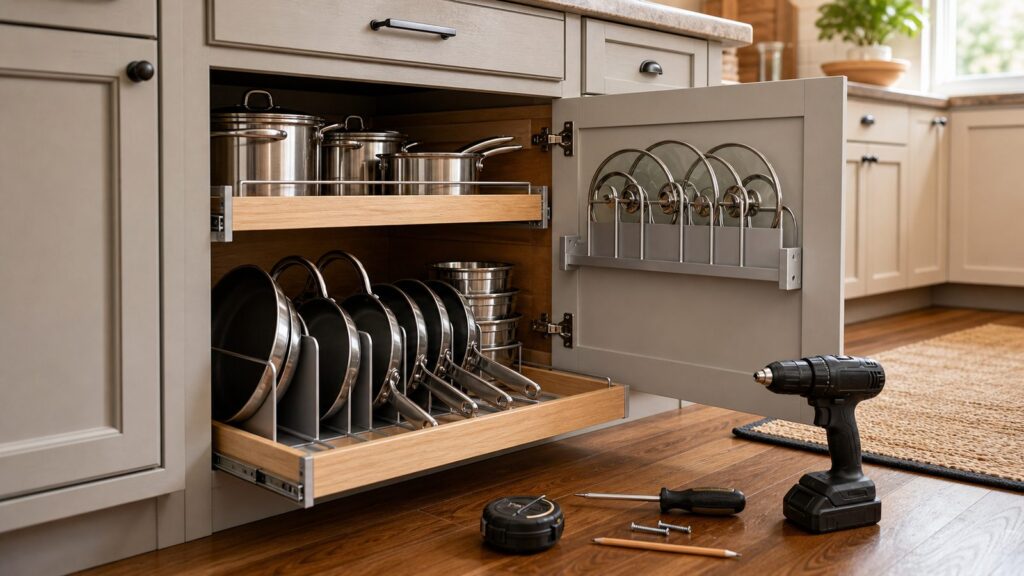
When cabinet space is tight, the answer is not always “buy fewer pans.” Most small kitchens waste the back 6 to 10 inches of base cabinets because cookware gets stacked, buried, and forgotten. The better fix is to make the cabinet work harder: store pans vertically when they are light, pull heavy cookware out on rated slides, and move lids into dedicated shallow storage.
On our job sites, we look at pots and pans storage the same way we look at any cabinet retrofit: What is the cabinet made of? How wide is the clear opening? How much weight will the hardware carry? Will the door, hinge, plumbing, or gas line interfere? Those details determine whether a $25 rack solves the problem or whether the cabinet needs a reinforced rollout tray.
As an Amazon Associate I earn from qualifying purchases.
Here are 10 practical ways to organize pots and pans when cabinet space is limited, with 2026 cost ranges, installation notes, and the situations where each option makes sense.
Start With the Cabinet, Not the Organizer
Before buying anything, measure the real cabinet opening. The nominal cabinet width is not enough. A 24-inch base cabinet may have a clear opening closer to 20 to 21 inches once you account for the face frame and hinges.
#1 Best Overall

- 14 Adjustable Dividers: This pot lid organizer comes with 14 adjustable dividers, you can adjust the width according to the size of your pans or other cookware. Please Note: the overall size of this shelf is 22.83"W x 7.09"D x 7.15"H, check the size of your pot lids, pans and other cookware (especially the large size) before purchase, to ensure our rack fit your kitchenware. Please feel free to contact us if you have any questions.
- Expandable Pot and Pan Organizer: Designed as expandable for storage such as heavy pans, large platters, cutting board and other bakeware. It can be used on a countertop, cabinet and even under the sink.
- 2 DIY Methods: This pot rack has 2 DIY methods. You can use it as a expandable organizer or two separate pot lid racks. The length can easily expands from 12'' to 29'', which allows the flexibility to store in a pantry, cabinet, under the sink, or on countertop.
- Durable Material: Our pot and pan organizer rack is made of heavy duty iron, It's designed to hold even your heaviest cast iron pans. It is extremely robust and durable.
- Keep Your Countertop Tidy: Our pot organizer rack will help keep your pots, pans, lids, trays, plates, cookie sheets and cutting boards well organized and easy to reach.
Measure these eight items:
- Clear opening width: The narrowest usable width between face-frame stiles or door hinges.
- Interior width: Side wall to side wall inside the cabinet.
- Interior depth: From the front frame to the back panel, minus pipes, outlets, gas lines, or rear braces.
- Interior height: Floor to shelf, shelf to shelf, or drawer-box clearance.
- Door swing: Whether the door opens far enough for a pullout to clear.
- Hinge intrusion: How far hinges project into the opening.
- Shelf thickness: Many older adjustable shelves are 1/2 inch or 5/8 inch particleboard and can sag under cookware.
- Cabinet bottom material: Plywood is usually better for fasteners than thin particleboard or hardboard.
For heavy cookware, assume weight adds up fast. A cast iron skillet can weigh 5 to 8 pounds, a Dutch oven can weigh 12 to 18 pounds empty, and a nested stack of stainless pans can easily pass 30 pounds. That load should sit low, on a reinforced shelf, drawer, or bottom-mounted pullout.
2026 Cost Snapshot for Pots and Pans Storage
Costs vary by cabinet condition, hardware quality, and labor rates. In 2026, basic no-drill organizers often cost less than dinner out, while custom cabinet retrofits can run several hundred dollars per cabinet bay. Professional labor for simple installations commonly falls in the $60 to $125 per hour range, with many basic installs taking 1 to 2 hours when the cabinet is square and unobstructed.
Free tools Windows power users keep installed
One-click scans. No signup required.
| Storage Option | Typical 2026 Cost | Best For | DIY Difficulty |
|---|---|---|---|
| Basic lid rack, hooks, clip-on basket, or expandable rack | $8-$30 | Renters, light lids, small pans | Easy |
| No-drill or renter-friendly organizer | $10-$60 | Light cookware only | Easy |
| Vertical Pan Rack or simple cabinet insert | $25-$90 | Skillets, sheet pans, cutting boards | Easy to moderate |
| Single pull-out shelf or wire basket | $50-$150 | Base cabinets with wasted rear space | Moderate |
| Premium two-tier cookware pullout | $180-$370 before labor | Heavy daily-use cookware | Moderate to hard |
| Custom cabinet retrofit | $250-$900+ per cabinet bay | Older cabinets, heavy cookware, finish-matched upgrades | Pro recommended |
The cheapest solution is not always the best value. A $30 rack that collapses under cast iron is not a bargain. For heavy pots, look for published weight ratings, full-extension slides, and solid fastening points.
1. Edit the Cookware Before You Add Hardware
The first storage upgrade is a cookware audit. Pull everything out and sort it into daily, weekly, seasonal, and duplicate categories. Most households need the easiest access for 2 or 3 pans: usually a skillet, a saucepan, and a larger saute pan or Dutch oven. Those should live between knee and shoulder height near the cooktop.
Move roasting pans, oversize stockpots, turkey fryers, specialty woks, and once-a-year pieces to a higher shelf, pantry, garage cabinet, or basement storage. Damaged nonstick pans, mismatched lids, and duplicate pieces should not be allowed to consume prime cabinet space.
This step costs $0 and often frees 20 to 30 percent of the cabinet volume. It also makes the next nine options easier because you are designing storage around cookware you actually use.
2. Use a Vertical Pan Rack Inside a Base Cabinet
Vertical storage works well for skillets, sheet pans, cutting boards, muffin tins, and lids. Instead of stacking pans and dragging one across another, you stand them on edge in separate slots. This protects nonstick coatings, enamel finishes, carbon steel seasoning, and polished stainless exteriors.
Basic vertical racks often cost $25 to $90. Look for adjustable dividers, rubber feet, and a width that fits your cabinet opening with at least 1 inch of side clearance. For a 24-inch base cabinet, many homeowners use one 12- to 16-inch rack and leave the remaining space for a pot or mixing bowl.
Vertical racks are best for medium-weight pans. They are not ideal for a row of heavy Dutch ovens unless the rack is built for that load and sits on a strong cabinet bottom.
3. Put Lids on the Cabinet Door
Pot lids are shallow, awkward, and easy to lose behind larger cookware. A door-mounted lid rack can reclaim shelf space, especially in a base cabinet near the range.
Quick wins for a faster PC:
Scan for outdated or missing drivers - takes under a minuteDriver Scan →Clear out junk files and repair common Windows errorsFree Scan →Measure before drilling. Check the lid diameter, knob height, shelf location, and hinge clearance. Close the door slowly with the lid held in place before marking screw holes. Many failed lid-rack installations happen because the lid handle hits an interior shelf or the screws are too long for the cabinet door.
Rank #2

- Updated Anti-slip Design - This adjustable pots and pans organizer under cabinet can keep outstanding balance during use; Its extended U-turn part offers better footing for smaller kitchen tools so that you'll have no worries about sliding off. Each divider is fitted with a rubber cover to help hold pan/pot in place and protect them from scratches or falling
- 3 DIY Way Tool-free Assembly - Excellent pot organizers inside cabinet for multiple uses; easy and fast assembly in 3 DIY ways: vertical on both sides 21.31"x 9.17"x 16.61"(L x W x H), vertical on one side 11.75"x 9.17"x 16.61"(L x W x H), horizontal on one side 16.61"x 9.17"x 11.75"(L x W x H); just insert the dividers into the slots of the rack, no tools needed, so easy installation
- Super Solid & Sturdy Structure - Upgraded heavy-duty iron construction holds your precious pots/pans steadily and securely; this kitchen cabinet organizer won’t warp, crack, stain or rust, and is super easy to clean; definitely your great helping hand in kitchen organization and storage
- Adjustable 8 Tiers - ORDORA kitchen organizers and storage is great for variety types of pan and pot in your cookware collection up to 12 inches; you can easily adjust the tiers to accommodate 8 or more (stacked) pots, pans, baking dishes, sheets, serving trays, lids, cutting boards, etc
- Upgrade Kitchen Organization - Say goodbye to digging under piles of pans to get the one you need at the bottom! Stack your cookware on this rack, eliminating countertop clutter and getting all your cookware within easy reach while cooking. Stress-free and hassle-free, achieve a clean and orderly kitchen with ORDORA pan organizer shelf rack
Expect to spend about $10 to $40 for a basic lid rack. Use door racks for lighter lids, not heavy cast iron lids or oversized glass lids. If the cabinet door is thin particleboard or MDF, use short screws sized for the door thickness and avoid overloading the rack.
4. Add a Pull-Out Shelf or Wire Basket
A pull-out shelf turns the back of a base cabinet into usable storage. This is one of the highest-value upgrades for deep cabinets because full-extension slides bring cookware all the way forward instead of forcing you to unload the front half of the cabinet.
Midrange pull-out shelves and wire baskets typically cost $50 to $150. Common retail examples in 2026 start around $62, with many branded wire pullouts in the $95 to $136 range depending on size and finish. Installation usually takes 1 to 2 hours if the cabinet bottom is solid and the opening is square.
Outdated Drivers Are Slowing You Down
One free scan finds every outdated or missing driver and matches the right update for your exact hardware.Free scan · exact hardware matchPC Slower Than It Used to Be?
A free scan shows the junk files, broken settings and background clutter dragging Windows down - then fixes them in one click.Free scan · Windows 10 & 11Check four things before buying: clear opening width, cabinet depth, door-hinge clearance, and the strength of the cabinet bottom. If the bottom is thin particleboard, reinforce it before installing slides. A good pullout is only as strong as the surface it is screwed into.
5. Install a Two-Tier Cookware Pullout
For serious cooks, a two-tier cookware pullout is often the cleanest solution. It stores pots and pans on two sliding levels, usually with hooks, dividers, or wire supports that keep items separated. Some premium units use full-extension slides rated around 100 pounds, which matters when you are storing multi-ply stainless, cast iron, or enameled cookware.
In 2026, premium cookware pullouts commonly cost about $180 to $370 before labor. A 21-inch two-tier chrome cookware organizer may run around $218 at major retailers. Labor depends on cabinet condition, but a straightforward installation is commonly 1 to 2 hours. Older cabinets, out-of-square boxes, or weak bottoms can add time.
This is a strong option for a 21- to 24-inch base cabinet near the cooktop. It is less ideal under sinks because plumbing and disposal lines often block slide travel.
What’s actually slowing this PC down?
Pick the symptom - the matching free tool is one click away.
6. Convert a Base Cabinet to a Deep Drawer With Peg Dividers
Deep drawers are excellent for pots and pans because they carry weight low and let you see everything from above. Adjustable peg systems keep pots, pans, lids, and bowls from sliding into each other.
If your kitchen already has deep drawers, a peg-board insert may cost $40 to $150 depending on material and size. If you are converting a door cabinet into drawers, the project becomes a cabinet retrofit. Expect $250 to $900+ per cabinet bay when a carpenter or cabinetmaker builds drawer boxes, installs heavy-duty slides, modifies doors or fronts, and matches the finish.
For heavy cookware, specify full-extension or over-travel slides with an appropriate weight rating. A standard light-duty drawer slide is not the right hardware for a drawer full of cast iron.
7. Use Toe-Kick or Under-Cabinet Drawers for Flat Items
Toe-kick drawers are shallow drawers built into the recessed space below base cabinets. They are not the first choice for heavy pots, but they are useful for lids, sheet pans, cooling racks, pizza pans, and cutting boards.
Recommended Free Tools
Rank #3

- 【Maximize Your Kitchen Space — Pot and Pan Organizer for Kitchen Storage】 Keep your cookware neatly organized with this 5-tier pot and pan organizer rack. Perfect for storing pots, pans, dishes, and utensils, this kitchen storage shelf helps declutter countertops and maximize vertical space in your kitchen, pantry, or dining room.
- 【Heavy-Duty & Stable Metal Pot Rack Organizer】 Built with a durable metal frame and thick boards, this freestanding kitchen rack can hold up to 100 lbs of cookware. The reinforced structure ensures stability, while the anti-slip adjustable feet keep your pan organizer rack balanced on any floor surface.
- 【Multi-Purpose Kitchen Storage Shelf with Hooks】 Designed with 8 side hooks, this cookware rack is ideal for hanging frying pans, spatulas, and cooking tools. Use it as a pan organizer, dish rack, or kitchen shelving unit — perfect for apartments, small kitchens, and pantry storage.
- 【Modern Rustic Design — Fits Any Kitchen Décor】 The combination of black metal frame and wood grain shelves gives this pot rack shelf a modern yet rustic farmhouse look. It’s not only a functional kitchen storage shelf, but also an attractive kitchen display rack that complements any home style.
- 【Easy to Assemble & Adjustable Shelves for Cookware】 This adjustable pot and pan organizer can be assembled in minutes with clear instructions. The shelves can be adjusted to fit large pots, Dutch ovens, or small frying pans, making it a flexible cookware organizer for kitchen.
A toe-kick drawer usually needs custom work because the cabinet base must be modified without weakening the cabinet run. Costs vary widely, but $250 to $600 per drawer is a realistic range in many kitchens, with higher costs when finish matching or tight trim work is required.
Keep toe-kick storage light and flat. Avoid anything heavy enough to make the drawer hard to pull from a low position. Also check for HVAC registers, plumbing lines, central vacuum piping, and electrical before planning this upgrade.
8. Add a wall rail or Ceiling Pot Rack Where Structure Allows
When cabinets are full, vertical wall space can help. A wall rail works well for attractive, frequently used pans. One exposed rail near the cooktop can be practical without making the kitchen feel cluttered.
Basic rail systems and hooks can cost $15 to $80. Wall-mounted systems must fasten into studs, blocking, masonry, or a properly rated anchor system. Ceiling pot racks need structure above, not just drywall. Do not hang heavy cookware from adhesive hooks or unverified anchors.
For renters, removable hooks may be acceptable for utensils or very light lids, but they are not reliable for cast iron, Dutch ovens, or large pan stacks. Humidity, cooking grease, and repeated loading can cause adhesive failure.
9. Fix the Corner Cabinet With a lazy Susan or blind-corner pullout
Corner cabinets waste space when cookware is stacked into a dark back corner. A lazy Susan can work for lighter pots and mixing bowls. A blind-corner pullout is better when you want trays to slide forward and bring the rear storage with them.
Simple lazy Susan inserts may cost $50 to $150. Better blind-corner pullouts can cost several hundred dollars before labor, especially with soft-close hardware and heavier weight ratings. Installation is more involved than a straight pullout because the unit must clear the door opening, side wall, hinges, and adjacent cabinet run.
Do not overload a lazy Susan with heavy cast iron unless the shelf, pole, and mounting points are rated for it. Corner systems are convenient, but they are not automatically stronger than a standard shelf.
The Tool Desk
Outbyte PC Repair FREEClear out junk files and repair common Windows errorsFree Scan →Outbyte Driver Updater FREEScan for outdated or missing drivers - takes under a minuteDriver Scan →10. Retrofit the Cabinet With Custom Rollout Trays and Reinforcement
When the cabinet box is older, narrow, out of square, or made from weak material, a custom retrofit is often better than forcing in a store-bought organizer. A cabinetmaker can add reinforced bottoms, finish-matched rollout trays, vertical dividers, soft-close slides, and modified door clearances.
This is where a construction company can save a homeowner from repeat failures. On our projects, we check the cabinet bottom, side walls, fastening depth, drawer slide rating, and door clearance before recommending hardware. If the cabinet bottom flexes under hand pressure, it needs reinforcement before it carries cookware on slides.
Rank #4

- Please Note: Pot organizer rack is 19.23"W x 15.83"H x 7.98"D. Measure your kitchen cabinet space before purchase to ensure fit. Be sure to account for handles and overall height- requires min. width 25.2 in, height 17.7 in, depth 10.98 in after storing cookware
- Unmatched Strength & Balance: This pan rack neatly arranges heavy and light pots in one step! Fits various cookware up to 12 inches - cast iron pans, dutch ovens, skillets, etc. Built tough with Double Eagle-co strength and secure snap-on, hold up to 120 lbs (15 lbs/tier)
- Adjustable Tier Design: Ditch cluttered cabinets with this vertical pot pan organizer! Unlike fixed one-piece racks, its adjustable design and 2 DIY methods let you easily customize the layout - work as a single or double-sided organizer to fit your space perfectly
- Efficient Kitchen Organization: Get clutter-free counters and cabinets instantly! This 8-tier pan organizer rack has ample spacing for easy access to pots, pans and lids - no more stacking hassle. It boosts pantry, countertop or stovetop storage while keeping your kitchen tidy
- Effortless 2-Minute Setup: Enjoy quick and hassle-free installation with our pot organizers inside cabinet. Tool-free assembly gets your kitchen organized in no time. For best results, please check the instructions first. Your tidy kitchen is just moments away
A custom cabinet retrofit commonly runs $250 to $900+ per cabinet bay in 2026. The low end may cover a single rollout tray in a straightforward cabinet. The high end can include hardwood drawer boxes, soft-close heavy-duty slides, face-frame modifications, finish-matched fronts, and custom dividers.
When to DIY and When to Hire a Pro
Many pots-and-pans organization projects are good DIY work. A careful homeowner can usually install a vertical rack, shelf divider, basic lid rack, or simple pullout with a drill, tape measure, level, and screwdriver.
DIY is reasonable when the organizer is light-duty, the cabinet is in good shape, no plumbing or wiring is in the way, and the instructions match your cabinet style. Plan on 30 minutes for a basic rack and 1 to 2 hours for a simple pull-out shelf.
Hire a pro when the cookware is heavy, the cabinet bottom is weak, the cabinet is face-frame and the opening is tight, the doors need adjustment, or the installation requires cutting shelves, adding blocking, relocating hinges, or modifying drawer fronts. In 2026, handyman rates commonly run about $60 to $125 per hour plus materials. Average handyman project costs often land around $164 to $648, with a national average near $406 depending on the job scope.
For custom cabinet work, a carpenter or cabinetmaker is usually the better fit than a general handyman. The difference is not just appearance. Proper drawer boxes, reinforced mounting, and aligned soft-close slides determine whether the organizer still works smoothly after years of loaded use.
Independent reader supportYour contribution helps us test, update, and keep practical guides available for everyone.Safety and Permit Notes
Most cabinet organizers do not require a building permit because they are non-structural interior storage improvements. That said, permit rules are local. If the work involves moving electrical, plumbing, gas piping, HVAC, or structural framing, stop and verify requirements before cutting or drilling.
Safety matters most in three places: overhead storage, door-mounted racks, and wall or ceiling racks. Heavy cookware should not be stored high overhead unless the shelf and fasteners are rated for the load. Door racks should carry light lids only. Wall rails and ceiling racks must be anchored into structure, not just drywall.
Also consider everyday ergonomics. Daily-use cookware should live between knee and shoulder height. That range reduces lifting strain and keeps hot, heavy pans from being handled above eye level.
Common Mistakes That Waste Money
- Buying before measuring: Measure the real clear opening, not the cabinet label or door width.
- Ignoring hinges: Hinges can block a pullout even when the cabinet interior is wide enough.
- Overloading weak cabinet bottoms: Thin particleboard needs reinforcement before heavy slides are installed.
- Using door racks for heavy lids: A cabinet door is not a structural shelf.
- Stacking nonstick pans bare: Use soft liners or pan protectors if pans must nest.
- Putting cast iron overhead: Heavy cookware belongs low, stable, and easy to lift.
- Relying on adhesive hooks for heavy items: Heat, grease, and humidity reduce adhesive reliability.
- Forgetting handle clearance: Pan handles can catch on face frames, pipes, gas lines, and adjacent storage.
The Best Setup for Most Small Kitchens
For a typical small kitchen, the best system is a combination of three ideas: keep the 2 or 3 daily-use pans in the easiest base cabinet, use vertical dividers for skillets and lids, and install one full-extension rollout for heavier pots. If the cabinet is older or weak, reinforce it before adding hardware.
Best Value

- Larger Weight Capacity & Stable: MUDEELA pan organizer rack for cabinet to organize the kitchen and add efficient storage. With a DeepFit snap-on structure, the MUDEELA pots and pans organizer inside cabinet offers a snug fit, firmly holding pots, pans, lids, skillets, cutting boards, and bakeware without dividers popping out
- Expandable Pot Lid Organizer Rack: MUDEELA 11.81''-22.85'' expandable pots and pans organizer under cabinet has 2 DIY methods. Use it as an expandable pan lids organizer inside cabinet or 2 individual pot rack. MUDEELA versatile pot organizer rack for under cabinet saves tons of space on cabinets, drawers, or countertops, keeping them nice and clean. Fit cabinets and a variety of 6-to-12-inch cookware
- Thoughtful Dual Protection: Wrapped with anti-damage strips, the MUDEELA pot and pan organizer for cabinet keeps your valued cookware from scratches. Also, our upgrade elongated anti-slip rubber tubing holds the pan lid organizer in place. No more worry about cutting board organizer pot holders sliding
- Tool-Free 1-Minute Assembly: Set up your pot lid organizer for cabinet in just 60 seconds - no tools required! Our sturdy lid organizer pots and pans stays perfectly in place without wobbling, tilting, or falling apart. Just declutter your kitchen organization and storage effortlessly with the MUDEELA baking sheet organizer
- Self-adaptive Flexible Kitchen Storage: MUDEELA pot lid holders inside cabinet is more flexible and suits pots and pans of any size. With 10 adjustable dividers, you can customize the cookie sheet organizer for cabinet and keep pots & pans sorted & more easily accessible. The U groove of pan lid storage organizer is deeper to hold all kinds of lids in place
A practical layout might look like this: a vertical rack for skillets in a 24-inch base cabinet, a door-mounted rack for light lids, and a bottom-mounted rollout for a Dutch oven and saucepans. That combination often costs $100 to $300 in off-the-shelf parts, or $250 to $900+ if built as a custom cabinet retrofit with stronger materials and finish-matched work.
The goal is not to fill every inch. The goal is to make every pan reachable without unloading the cabinet. When cookware slides out, stands upright, and has a defined home, even a small cabinet can work like a larger one.
Frequently Asked Questions
What is the best way to organize pots and pans in a small kitchen?
Use a combination system: keep daily-use pans near the cooktop, store skillets and lids vertically, and put heavy pots on a full-extension rollout or deep drawer. This solves the biggest problem in small kitchens: wasted rear cabinet space.
Are pull-out cabinet organizers worth it for pots and pans?
Yes, especially in deep base cabinets. Full-extension pullouts make the rear 6 to 10 inches usable and reduce the need to stack heavy cookware. Choose hardware with a published weight rating and install it into a solid or reinforced cabinet bottom.
How much does it cost to install pull-out shelves for cookware in 2026?
A basic pull-out shelf or wire basket typically costs $50 to $150 before labor. Premium two-tier cookware pullouts often cost $180 to $370. Professional labor commonly runs $60 to $125 per hour, with many simple installs taking 1 to 2 hours.
Do I need a permit to add cabinet organizers or pot racks?
Most cabinet organizers do not require a permit because they are non-structural storage upgrades. Permits may become relevant if the work involves moving electrical, plumbing, gas piping, HVAC, or structural framing. Always check local rules before modifying those systems.
How do I store heavy cast iron pans safely?
Store cast iron low, preferably on a reinforced shelf, deep drawer, or bottom-mounted rollout with rated slides. Avoid upper shelves, adhesive hooks, and light door-mounted racks for heavy pans.
How do I measure my cabinet for a pots-and-pans organizer?
Measure the clear opening width, interior width, depth, height, hinge intrusion, door swing, shelf thickness, and cabinet bottom material. Also check for plumbing, outlets, gas lines, and any rear or side obstructions before buying hardware.
Quick Recap
Product prices and availability are accurate as of the date/time indicated and are subject to change. Any price and availability information displayed on Amazon at the time of purchase will apply.
What’s actually slowing this PC down?
Pick the symptom - the matching free tool is one click away.

