PC Slower Than It Used to Be?
A free scan shows the junk files, broken settings and background clutter dragging Windows down - then fixes them in one click.Free scan · Windows 10 & 11Crashes, No Sound, or Screen Glitches?
Random freezes, missing sound and display glitches usually trace back to one bad driver. Find and replace yours safely.Free scan · under a minuteThe easiest container plants are the ones that fit your patio’s light, your watering routine and your winters. For sunny, dry pots, choose plants such as lavender, sedum or rosemary; for some partial shade, consider Mexican fleabane, white gaura or salvia. None is maintenance-free: containers still need drainage, regular moisture checks and occasional feeding or repotting.
Start with the conditions your pots can provide
This list leans toward sun-loving plants that prefer freely draining soil, because those are practical choices when you want to reduce watering. It is not a universal shade list. Before choosing, check how many hours of direct sun the spot gets, whether you can water during hot spells and whether the plant can survive winter in your climate.
- For hot, sunny spots: consider lavender, sedum, houseleeks, rosemary, thyme, sage, oregano, agapanthus, sea holly, tickseed or spurge.
- For sun or partial shade: consider salvia ‘Nachtvlinder’, white gaura, Mexican fleabane, tradescantia or tickseed.
- For edible harvests: choose herbs, grouping those with similar moisture needs.
Plant names and hardiness notes below reflect recommendations from the Royal Horticultural Society (RHS), whose growing conditions and ratings are UK-based. They are not direct substitutes for local hardiness-zone guidance. Cultivar availability and suitability vary by region.
20 low-maintenance plants for pots
1. Lavender (Lavandula), especially compact English lavender such as ‘Hidcote’
Lavender brings aromatic foliage and flowers to a sunny container. Compact ‘Hidcote’ is one RHS-recommended option for sheltered, drought-resistant conditions. Use a pot with drainage and a free-draining mix; lavender is drought resistant once established, not exempt from checking its moisture.
Quick wins for a faster PC:
Repair Windows errors before they cause bigger problemsFix Now →Scan for outdated or missing drivers - takes under a minuteDriver Scan →#1 Best Overall

- Sturdy Fabric Material: Our Non-Woven fabric grow bags are crafted using high-strength weaving technology, which allows the planting bags to remain lightweight while possessing an impressive ability to bear weight.
- Excellent drainage: It provides water drainage through the soil to eliminate over-watering and allows your plants to breath, translating to healthier and more vigorous growth.
- Easy to Use: Grow bags prevent circling root structures. Heavy-duty handles and rugged material means you can move bags full of soil and plants with ease.
- Versatile in function:The non-woven planting bag features space efficiency, excellent thermal insulation, and durability. These characteristics make it space-saving and root-protecting during storage, transportation, and use, while also extending its service life and enhancing overall planting efficiency.
- Your Great Gardening Partner – Land Guard is a customer-focused company committed to exceeding expectations in both quality and service. Since our inception, we've received excellent feedback. The garden grow bag is one of our flagship products, designed to enhance the gardening experience, and we are confident in its quality and performance. Happy Gardening!
2. Sedum or stonecrop (including Hylotelephium ‘José Aubergine’)
These succulents suit full sun and well-drained soil. RHS lists ‘José Aubergine’ for late-season flowers. Choose a pot that drains freely and avoid leaving the roots in waterlogged compost.
3. Echeveria
Echeveria offers sculptural foliage and can work well in a low-care summer container. Treat it as tender where winter temperatures freeze; plan to protect it or bring it somewhere frost-free if needed.
4. Sempervivum (houseleeks)
Houseleeks are foliage succulents suited to low-water pots. Their priority is sharp drainage, so they are a better fit for a bright, dry position than for a pot that stays damp.
5. Rosemary (Salvia rosmarinus)
Rosemary is an evergreen culinary herb for a sunny pot with a well-drained growing medium. It pairs well with other Mediterranean herbs that prefer similar conditions.
Recommended Free Tools
6. Thyme (Thymus)
Compact thyme is useful where a small container needs both culinary value and ground-covering foliage. Give it bright light and drainage rather than consistently soggy compost.
Rank #2

- STURDY FABRIC MATERIAL: Our fabric grow bags are made of high-quality, thickened non-woven fabric and features reinforced stitching, which is breathable, reusable and durable for long time use. With the fabric planter , your plants will grow well in your balconies, backyards, terrance or patios
- PROMOTE PLANT GROW HEALTH: The non-woven fabric garden bed provide 360-degree ventilation, allowing for optimal plant root growth by facilitating excess water drainage and air flow throughout the soil and roots. This design helps prevent root circling and promotes healthier, more vigorous plant growth
- 15 GALLON LARGE GROW BAGS: Our 15 gallon fabric raised planter diameter: about 23.5 inch/60cm, height: about 8 inch/20cm, offering a large area for your fun gardening. very suitable for indoor and outdoor planting, perfect solve the problem of limited garden space and poor garden soil
- EASY TO USE AND STORAGE: The Fabric Pots for Gardening are designed with 4 handles around it, which is easy to carry. No assembly required, which is the fastest and easiest way to start planting. When the growing season is over, simply empty the earth out of the Plant Container, fold it for storage and can be reused year after year
- WARM TIPS AND GUARANTEED : Please keep plants warm in winter and cooler in summer. We are responsible seller, If receives the fabric raised planting bed is not in a good condition or any unhappy with the purchasing, please contact us for support
7. Sage (Salvia officinalis)
Sage grows in containers and shares the sunny, drained conditions favored by rosemary and thyme. Do not keep its potting mix waterlogged.
8. Greek oregano (Origanum vulgare subsp. hirtum)
Greek oregano is an edible choice for a bright spot and a freely draining pot. It can join rosemary, thyme and sage in a drier herb grouping.
9. Chives (Allium schoenoprasum)
Chives grow well in pots and provide edible leaves and flowers. They prefer more fertile, moisture-retentive care than Mediterranean herbs, so plant them separately from rosemary, thyme, oregano and sage if their watering needs differ.
What’s actually slowing this PC down?
Pick the symptom - the matching free tool is one click away.
10. Parsley (Petroselinum crispum)
Parsley is a straightforward container herb when you want foliage to harvest as well as a green accent. Use a well-drained potting mix and monitor its moisture, especially in a sunny container.
11. Agapanthus (Agapanthus)
Agapanthus suits a full-sun pot with well-drained soil; RHS gives July–August as its flowering period. Some evergreen forms are tender, so check the form you buy and its local winter needs.
Rank #3

- 300G THICKENED FABRIC, BUILT FOR MULTIPLE SEASONS — 300 g/m² non-woven fabric (vs. 200 g/m² or thinner on entry-level bags), so the walls hold their shape when filled and resist tearing at the seams. Each empty bag weighs 4 oz — 16 oz for the 4-pack. Fold flat and store indoors over winter and they are built to be replanted season after season 3.
- AIR-PRUNED ROOTS, NO ROOT ROT — Water drains through the whole fabric wall instead of pooling at one drainage hole, and air reaches the root ball from every side. Roots stop at the fabric edge and branch out instead of circling the pot, which is why plants in fabric bags build a denser feeder-root system than plants in plastic pots. Indoors, set the bags on a saucer or tray — the fabric drains from the base.
- DOUBLE-STITCHED HANDLES THAT DON'T RIP — Two woven webbing straps are sewn to the bag wall with a double-stitched box-X reinforcement (not cut from the same fabric as the bag body), tested to carry 180 LB. A filled 5-gallon bag of damp soil runs roughly 40–50 lbs, so the handles are the part that decides whether you can chase the sun across a patio — or not.Equipped with strong reinforced handles, easy to move the plants around your garden, patio or balcony, even when the bag is filled with soil.
- SIZED FOR HERBS, GREENS, STRAWBERRIES & FLOWERS — 12.2" across and 10.2" deep is the right root room for basil, mint, cilantro, rosemary, lettuce, spinach, strawberries, marigolds and compact peppers. Growing full-size tomatoes, potatoes or squash? Size up to our 7, 10 or 15 gallon bags instead — those crops need more depth than a 5-gallon bag can give.
- FOLDS FLAT — STORE THE WHOLE SET IN A DRAWER — Empty the soil, fold each bag flat, and all 4 stack down to about 1.96inch — they slide into a cupboard gap or under a shelf instead of taking up a corner of the balcony all winter. Rigid plastic pots can't do this, which is what makes fabric bags practical for apartments and small patios.
12. Salvia ‘Nachtvlinder’
This flowering salvia suits full sun or partial shade and drained soil. RHS lists a June–August flowering period and describes it as hardy in the UK context; check local winter suitability before relying on that rating elsewhere.
13. White gaura (Oenothera lindheimeri)
White gaura can flower in sun or partial shade in a free-draining container. RHS lists June–August as its flowering period.
Do these 3 things before closing this tab:
1Repair Windows errors before they cause bigger problems2Scan for outdated or missing drivers - takes under a minute3Clear out junk files and repair common Windows errors14. Verbena officinalis ‘Bampton’
For a sunny pot, this verbena offers a long flowering window: RHS lists June–September. Give it well-drained soil rather than a container that holds excess water.
15. Mexican fleabane (Erigeron karvinskianus)
Mexican fleabane spreads and spills over a container’s edge, softening the pot outline. It suits sun or partial shade and drained soil.
16. Tradescantia ‘JS Brainstorm’
RHS highlights this selection for resilience in both wet and dry conditions and for positions in sun or partial shade. That flexibility does not make waterlogged compost a good choice; the pot still needs drainage.
Rank #4

- 🍅【PREMIUM MATERIAL】Fabric raised garden bed is made of premium quality thickened non-woven fabric, designed with reinforced stitching, which is reusable and durable for long time use. With the plant grow bags, your plants will grow well in your balconies, backyards, terrance or patios.
- 🌱【PROMOTE PLANT GROW HEALTH】Our planter raised beds provide 360 degree ventilated for better plant root growth, allow excess water drain away and air flow throughout the soil and plant roots, which could prevent the roots from circling and swirling, promote plants grow healthier and more vigorously.
- 🌵【128 GALLON GROW BAGS】Our 128 gallon grow bags are L:72"x W:36" x H:12", offering a large area for your fun gardening. 8 Grids divided design make you to mange your plant easily, perfect for growing potatoes, vegetables, flowers, herb, fruit and other plants.
- 🌼【EASY TO USE & STORAGE】If you do not have enough space to grow vegetables, planting container is ideal for backyard, terrance, patio and balcony. No assembly required, which is the fastest and easiest way to start planting. When the growing season is over, simply empty the earth out of the fabric bag, fold it for storage and can be reused year after year.
- 🪴【24 HOURS AFTER SALES SERVICE】We are committed to customer need, if you have any questions about the products, please let us know. Our customer service team would be stay online within 24 hours and offer you reply as soon as possible.
17. Sea holly ‘Blue Hobbit’ (Eryngium)
This compact sea holly is suited to full sun and well-drained soil. RHS lists June–September as its flowering period.
18. Tickseed ‘Moonbeam’ (Coreopsis verticillata)
‘Moonbeam’ tickseed grows in sun or partial shade in drained soil. RHS lists flowers from July to September, making it an option for a seasonal container display.
19. Artemisia ‘Powis Castle’
This silver-leaved plant prefers full sun and well-drained soil, but RHS marks it tender. Think of it as low-water, not universally low-care: its winter protection or overwintering needs may rule it out for exposed, cold locations.
20. Broad-leaved glaucous spurge (Euphorbia myrsinites)
This trailing spurge suits full sun and well-drained soil. RHS lists an April–July flowering period; avoid placing it in a pot that stays wet.
Independent reader supportYour contribution helps us test, update, and keep practical guides available for everyone.Set up containers to make care easier
Choose a suitable pot and growing medium
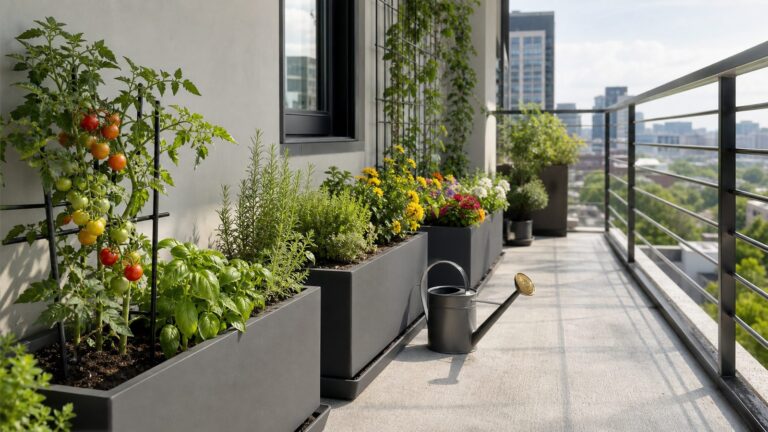
Use containers with drainage holes and a loose, well-drained potting mix. RHS recommends gritty compost for container herbs. A pot with more compost volume dries more slowly than a tiny one, so a few suitably sized containers can be easier to manage than many small pots. Match the pot size to the plant rather than crowding a large plant into a small volume.
Best Value

- Many gardeners will agree that there’s nothing as rewarding as enjoying produce that they’ve grown themselves. Fortunately growing crops in containers enables just about anyone to experience this joy—with no garden plot needed! Find out how to care for and harvest flavor-packed miniature tomatoes salad greens peppers basil chives blueberries citruses cantaloupes and other favorites to serve at your next meal!|Looking for eye-catching displays to perk up a space? Discover sure-to-please ornamental plants for any situation plus ideal ways to arrange them in decorative containers for the special look that you want. Let the mantra “thriller filler spiller” help you to design pots with a stunning focal point surrounded by complementary plants that fill in around it and trail over the edge!|Learn about plant care including how to identify and control diseases and pests select the best potting mix apply water and fertilizer—and overcome “FOOF” (fear of overfertilizing)!|Wondering how big a container your plant needs? Don’t know whether to use terra-cotta or plastic pots? Find out how to choose the proper container by size type purpose and more.|Some plants like geraniums have lots of varieties from which to choose. If you’re overwhelmed by the many options available just check out the recommended selections for 38 specially profiled plants.|For added enjoyment browse—and learn from—the insightful and entertaining anecdotes from experienced gardeners included in this helpful guide.
Group plants by light and moisture
Combine plants only when their growing needs align. Lavender, rosemary, thyme, oregano and sage can share a sunny, free-draining setup. Chives prefer more fertile, moisture-retentive conditions. Mint, if you grow it, likes more moisture and should be kept in its own pot rather than mixed with the drier Mediterranean herbs.
Check moisture instead of following a rigid calendar
Containers need more frequent watering and feeding than the same plants growing in the ground, and small pots in hot sun can dry quickly. Check the compost regularly and water according to the plant, pot and weather; do not wait for plants to wilt as a routine. RHS says containers may need watering up to twice a day in hot weather, but that is conditional guidance, not a fixed schedule for every pot.
Plan for seasonal and winter care
Container roots can need more winter protection than plants in the ground. Tender plants such as Echeveria, tender evergreen agapanthus forms and ‘Powis Castle’ artemisia may need shelter or a protected overwintering place, depending on local conditions. Treat RHS flowering windows and hardiness descriptions as UK guidance, then check your local climate and plant label.
What “low-maintenance” means for container plants
Lower maintenance means choosing plants naturally suited to the site and reducing avoidable work—not leaving pots unattended. University of Illinois Extension puts it plainly in Easy-Care Native Plants (modified March 2025): “There is no such thing as no maintenance, only lower maintenance.” Its native-plant recommendations are region-specific; if you want a US-native container, confirm that the mature plant size and pot volume are compatible before planting.
The most reliable shortcut is to match the plant to the conditions you can consistently provide: sunlight, drainage, enough compost volume, moisture checks and appropriate winter care.
Quick Recap
Sources and further guidance
- RHS: 14 drought-tolerant plants for pots to reduce watering
- RHS: Growing plants in containers: Expert Guide
- University of Illinois Extension: Growing Herbs in Containers
- RHS: Herbs in containers
- RHS: Containers: Summer Planting Ideas
- RHS: 10 award-winning shrubs for containers
- University of Illinois Extension: Easy-Care Native Plants
Product prices and availability are accurate as of the date/time indicated and are subject to change. Any price and availability information displayed on Amazon at the time of purchase will apply.