Some links on this page are affiliate links: if you buy through them we may earn a commission, at no extra cost to you.
To start a successful container garden, match crops to your available sunlight, choose pots with drainage and enough root space, and use a container potting mix rather than garden soil alone. Then water according to the weather and pot—not a fixed calendar—and feed plants only as needed. These 12 practical tips help home gardeners make the most of patios, balconies, doorsteps, and other small spaces.
1. Choose crops that fit your sunlight
Check how much direct sun each spot receives before buying plants. Tomatoes and peppers need at least six hours of sun daily, according to Penn State Extension’s container-gardening guidance, updated March 30, 2026. Lettuce and kale tolerate or prefer some shade, making them better options for less sunny areas. Compact or dwarf varieties can also suit tight spaces.
As an Amazon Associate I earn from qualifying purchases.
University of Illinois Extension classifies full sun for vegetables as at least six hours and partial shade as four to six hours. Place each pot where its crop’s light needs can be met; containers are easier to reposition than garden beds. Penn State Extension · University of Illinois Extension
2. Give roots enough room
Pot dimensions are crop-specific starting points, not a universal formula. Recommendations vary by crop and source, so check the needs of the plant you intend to grow.
Popular on Amazon

- 300G THICKENED FABRIC, BUILT FOR MULTIPLE SEASONS — 300 g/m² non-woven fabric (vs. 200 g/m² or thinner on entry-level bags), so the walls hold their shape when filled and resist tearing at the seams. Each empty bag weighs 4 oz — 16 oz for the 4-pack. Fold flat and store indoors over winter and they are built to be replanted season after season 3.
- AIR-PRUNED ROOTS, NO ROOT ROT — Water drains through the whole fabric wall instead of pooling at one drainage hole, and air reaches the root ball from every side. Roots stop at the fabric edge and branch out instead of circling the pot, which is why plants in fabric bags build a denser feeder-root system than plants in plastic pots. Indoors, set the bags on a saucer or tray — the fabric drains from the base.
- DOUBLE-STITCHED HANDLES THAT DON'T RIP — Two woven webbing straps are sewn to the bag wall with a double-stitched box-X reinforcement (not cut from the same fabric as the bag body), tested to carry 180 LB. A filled 5-gallon bag of damp soil runs roughly 40–50 lbs, so the handles are the part that decides whether you can chase the sun across a patio — or not.Equipped with strong reinforced handles, easy to move the plants around your garden, patio or balcony, even when the bag is filled with soil.
- SIZED FOR HERBS, GREENS, STRAWBERRIES & FLOWERS — 12.2" across and 10.2" deep is the right root room for basil, mint, cilantro, rosemary, lettuce, spinach, strawberries, marigolds and compact peppers. Growing full-size tomatoes, potatoes or squash? Size up to our 7, 10 or 15 gallon bags instead — those crops need more depth than a 5-gallon bag can give.
- FOLDS FLAT — STORE THE WHOLE SET IN A DRAWER — Empty the soil, fold each bag flat, and all 4 stack down to about 1.96inch — they slide into a cupboard gap or under a shelf instead of taking up a corner of the balcony all winter. Rigid plastic pots can't do this, which is what makes fabric bags practical for apartments and small patios.
| Crop | Published pot-size guidance |
|---|---|
| Tomatoes | At least 20 inches wide for one plant (Penn State Extension, updated 2026); 20 inches for tomatoes and fruits (University of Illinois Extension, copyright 2022). |
| Peppers | 14 inches for peppers (Penn State Extension, updated 2026); 16 inches (University of Illinois Extension, copyright 2022). |
| Eggplants | 14 inches (Penn State Extension, updated 2026). |
| Carrots | 12 inches (University of Illinois Extension, copyright 2022). |
| Radishes, onions, beets, leafy greens, herbs, and flowers | 10 inches (University of Illinois Extension, copyright 2022). |
These are published growing recommendations. The cited guides do not state a single sizing method that makes the figures directly interchangeable. Check the specific crop guidance when choosing a pot. Penn State Extension · University of Illinois Extension container guide
3. Make drainage a requirement
Choose a pot with open drainage holes so excess water can escape and air can reach the roots. A decorative outer pot can hold a removable growing pot, but empty pooled water rather than letting the inner pot sit in it. As University of Illinois Extension horticulture educator Andrew Holsinger put it, “Proper drainage is just as important as the amount of water added to the container.”
What’s actually slowing this PC down?
Pick the symptom - the matching free tool is one click away.
University of Illinois Extension’s drainage and watering tips
4. Choose pot material for the site and your routine
Material affects a container’s weight, how quickly its mix dries, and how stable it is. Plastic is lightweight and dries more slowly than porous terracotta. Cement or stone is heavier, which can help stabilize a top-heavy plant. Larger pots generally need watering less often, but an oversized pot can leave excess mix wet for longer and increase the risk of root rot.
Also popular on Amazon

- DURABLE AND STURDY: Made of 300G thickened nonwoven fabric, Jorvila grow bags are wear-resistant, washable, easy to clean and reusable; At the end of use, you can simply clean it and fold it up for storage after drying
- LET ROOT GROW HEALTHIER: Aeration fabric pots provide excellent ventilation for plants, prevent root tangles and knots through Self Air Pruning, improve root structure and promote healthy plant development
- EXCELLENT DRAINAGE: Nonwoven material provides great drainage for the soil and reduces the effects of overwatering, which allows plants to grow in ideal growing conditions, warmer in winter and cooler in summer
- EASE OF MOVEMENT: The widened handle is made of high-density material and reinforced with X-stitches; The bottom and sides are double stitched and not easy to tear; You can move the planting bag to where it is needed
- WIDE APPLICATION: Raw materials high quality non-woven fabrics are food friendly materials; It is suitable for a wide range of vegetables and fruits, such as: potatoes, tomatoes, carrots, strawberries, onions and peppers
On a balcony or rooftop, consider whether the pot will remain stable in wind and whether its weight is suitable for the location. University of Illinois Extension’s container-size guidance · Penn State Extension
5. Use potting mix, not garden soil alone
Container plants need a growing medium that drains and aerates while retaining enough moisture and nutrients. Soilless mixes may contain sphagnum moss, composted bark, perlite, vermiculite, or coconut coir. Penn State Extension says finished compost can make up as much as half of the mix. By contrast, garden soil alone does not provide suitable drainage and aeration for containers and may carry weed seeds or pathogens.
Check the mix label for its ingredients and whether it already includes fertilizer. Penn State Extension · University of Illinois Extension container guide
6. Feed plants based on the mix and label
Container roots have access only to the nutrients in the pot, and watering can leach nutrients away. Some potting mixes contain fertilizer, so check the package before adding more. Penn State Extension recommends slow-release fertilizer at planting and soluble fertilizer every two to four weeks. University of Minnesota Extension says regular applications may begin two to six weeks after planting, depending on the growing medium, watering, and plant growth. These are different extension recommendations, not one universal schedule.
Also popular on Amazon

- Sturdy Fabric Material: Our Non-Woven fabric grow bags are crafted using high-strength weaving technology, which allows the planting bags to remain lightweight while possessing an impressive ability to bear weight.
- Excellent drainage: It provides water drainage through the soil to eliminate over-watering and allows your plants to breath, translating to healthier and more vigorous growth.
- Easy to Use: Grow bags prevent circling root structures. Heavy-duty handles and rugged material means you can move bags full of soil and plants with ease.
- Versatile in function:The non-woven planting bag features space efficiency, excellent thermal insulation, and durability. These characteristics make it space-saving and root-protecting during storage, transportation, and use, while also extending its service life and enhancing overall planting efficiency.
- Your Great Gardening Partner – Land Guard is a customer-focused company committed to exceeding expectations in both quality and service. Since our inception, we've received excellent feedback. The garden grow bag is one of our flagship products, designed to enhance the gardening experience, and we are confident in its quality and performance. Happy Gardening!
Follow the chosen fertilizer’s label and avoid over-fertilizing. Penn State Extension · University of Minnesota Extension, reviewed 2026
7. Water thoroughly, then let the pot drain
Water the root zone until moisture reaches the bottom of the container and excess runs out through the drainage holes. Avoid wetting foliage repeatedly where practical. Do not leave the mix dry for extended periods, but do not keep roots sitting in saturated media either. University of Illinois Extension watering guidance · University of Minnesota Extension
8. Adjust watering to conditions
There is no reliable fixed calendar for every container. Watering needs depend on pot size and material, the plant, the season, the location, and the temperature. At least daily watering is common in warm weather; hot, dry conditions may call for more than once a day. Check the mix and plant rather than assuming yesterday’s schedule still applies.
Mulch can reduce surface evaporation. If you use a saucer, do not let retained water keep the mix soggy. University of Illinois Extension · University of Minnesota Extension, reviewed 2026
Also popular on Amazon

- 【Plastic Planters Built for Stability & Space Efficiency】10 inch square plant pots with drainage, square 6.69 inch base no tipping, while the 11.42 inch depth securely anchors tall palms or fiddle-leaf figs. The rigid plastic construction (1 lb each) outperforms flimsy round pots for plants - stack 5 lightweight square plastic planters vertically or cluster them tightly on patios/shelves.
- 【Leak-Proof Planting Pots with Precision-Fit Trays】Included 8.66 inch trays (1.18" depth) snap snugly under each planter’s 7.68-inch base - 5X thicker than generic planter pots. 32 drainage holes per pot no root rot in moisture-sensitive succulents, while the 5-gallon capacity suits tomatoes in all-season planting pots.
- 【Weatherproof Plastic Planters for Extreme Conditions】Matte black plastic planters withstand -30°F to 160°F without cracking. The 3mm-thick walls (vs. 1.5mm in cheap plant pots) shield roots from frost/heat stress. Ideal for balcony herb gardens, poolside shrubs, or indoor jungle displays.
- 【Effortless 5-Pack Plastic Planters for Bulk Planting】Save 20% vs single pots: This 5 set plastic planters bundle (5 pots + 5 trays) covers 125+ gallons of planting space. At 1 lb each, rearrange rosemary bushes or snake plants effortlessly. Perfect for rental-friendly pots for plants.
- 【Versatile Planter Pots for Small Trees & Decorative Displays】Designed for dwarf citrus trees, olive shrubs, or decorative faux plants, these 11.42-inch deep flower pots (5-gallon capacity) support robust growth. Matte black finish blends with modern decor – upgrade from basic nursery planter pots.
9. Reserve the brightest spots for fruiting crops
Give tomatoes, peppers, and other sun-loving crops the brightest suitable position. Use less sunny spots for crops such as lettuce and kale that tolerate or prefer some shade. If you have several containers, arrange them according to each crop’s light needs rather than treating the whole patio or balcony as one uniform growing area.
Penn State Extension · University of Illinois Extension
Quick wins for a faster PC:
Clear out junk files and repair common Windows errorsFree Scan →Scan for outdated or missing drivers - takes under a minuteDriver Scan →10. Add support before plants need it
Tomatoes, pole beans, and cucumbers may need a stake, cage, or trellis. For a plant you plan to stake, Penn State Extension advises placing the stake in the pot before filling it. That avoids driving it into an already planted root area. Tie the plant as it grows; University of Illinois Extension gives about 12 inches of growth as a point to begin tying.
Penn State Extension · University of Illinois Extension
Also popular on Amazon
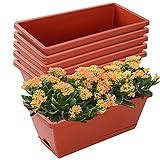
- WINDOW BOX PLANTERS DIMENSIONS - Includes pack rectangular plastic planters. The size of plastic flower planters: L16.6 x W7 x H5.9 inches, large enough to support any projects and ideas. Great for herbs, flowers, foliage, grass, cactus, succulents, ferns, arborvitae and more.
- DURABLE PLANT POTS - Made of high quality plastic, which is recyclable, lightweight and sturdy, our window planters for outdoor can be exposed to the sun, rain and snow without discoloration for a long-lasting use. The surface of the planters is smooth, so it is easy to clean too.
- ATTACHED DRAINAGE TRAY - This large plastic plant pot with drainage features a attached saucer at the bottom for proper draining of live plants. Which helps your plants to grow healthier.
- WATER INLET DESIGN - The rectangular plant pots are designed with 2 water inlets at the bottom, so you can water your plants from the water inlet directly. This design ensures that you can water your plants well without making the tables or windowsills get wet, keeping it clean and dry.
- MULTIPURPOSE - The rectangular red planter is simple and practical, which makes it a nice home decor for your windowsill, garden, porch, balcony, kitchen, deck, patio, and other indoor outdoor use. Suitable to plant miniature roses, tulip, carnation or other flowers, vegetables, fruits.
11. Plan spacing for mature plants
Seedlings may look small enough to crowd together, but the mature plants need room for their foliage and roots. Plant density depends on the crop’s space requirements and rooting depth. Use a larger pot or separate containers when several plants would otherwise compete for limited space. University of Illinois Extension’s vegetable-container guidance
12. Give herbs their own care plan
Choose herbs with compatible watering and drainage needs if you plan to grow them together. Pinch them during the growing season to encourage bushier growth, and avoid over-fertilizing. Annual leafy herbs can generally be harvested more heavily than perennial herbs. Tender herbs can be moved indoors gradually in fall, then placed in the sunniest indoor location available.
The Tool Desk
Outbyte PC Repair FREEClear out junk files and repair common Windows errorsFree Scan →Outbyte Driver Updater FREEFix the driver behind crashes, sound loss and screen glitchesFind Drivers →University of Illinois Extension’s guide to growing herbs in containers
Quick Recap
Product prices and availability are accurate as of the date/time indicated and are subject to change. Any price and availability information displayed on Amazon at the time of purchase will apply.

