Some links on this page are affiliate links: if you buy through them we may earn a commission, at no extra cost to you.
A window air conditioner with heat can solve a very specific problem: one room needs cooling in summer and useful heat in mild-to-moderate winter weather, but the budget or building conditions do not justify a full ducted HVAC replacement. For a bedroom over a garage, a finished attic, a sunroom, a small ADU, a workshop, or an older room with no ductwork, the right unit can be a practical fix.
The key is knowing what you are actually buying. Some window units use a true heat pump, moving heat with a compressor cycle. Others use electric-resistance supplemental heat, which is closer to a built-in space heater. Both can be sold as a window AC “with heat,” but they do not perform the same, cost the same to run, or work equally well in cold weather.
As an Amazon Associate I earn from qualifying purchases.
Outdated Drivers Are Slowing You Down
One free scan finds every outdated or missing driver and matches the right update for your exact hardware.Free scan · exact hardware matchWindows Errors? Fix Them Before They Spread
Repair common Windows errors and clear accumulated junk for a smoother, more stable PC - no reinstall needed.Free scan · no reinstallFor 2026, most window AC units with heating capability fall around $380 to $900 before installation. Common 8,000 to 12,200 BTU models are often around $380 to $600, while larger 18,000 to 25,000 BTU 208/230/240V units commonly land around $690 to $900. A basic DIY installation may add $20 to $150 in brackets, foam, insulation, fasteners, and weatherstripping. A standard handyman installation often runs $150 to $400 in labor. If the unit needs a new 230V circuit, electrical work can add several hundred dollars to more than $1,500 depending on panel capacity, distance, wall finish, and local permit requirements.
Our job-site recommendation is simple: use a window heat-pump air conditioner when you need targeted comfort at a low upfront cost. Use a ductless mini-split when the room is permanent living space, quiet operation matters, cold-weather heating matters, or you want a cleaner building-envelope detail. Use a central heat pump when the goal is whole-home heating and cooling.
#1 Best Overall

- Multi-Season Comfort - Midea 8000 BTU window air conditioner with heat is better than standard ac units. It will beat the heat in summer with powerful cooling and dehumidification and keep you warm through the fall with supplemental heat. Best for large rooms up to 350 square feet. NOTE: heat pump function works when outside temp> 41°F.
- Easy To Use – This air conditioner and heat unit comes with an LED display, 5 Modes (Heat, Auto, Cool, Dry, Fan), 3 speed settings (Auto/H/M/L), 24-hr Timer, and ECO energy saver. The Swing button adjusts the louvers up/down to direct the airflow. Wireless control enabled window ac with heat unit from anywhere with the SmartHome App, or with your voice via Alexa and Google Assistant. All functions can be set via the control panel, remote control, and app or voice assistant.
- Save Energy Being Cool – Save on energy costs and enjoy ultimate comfort with this energy star certified unit. This energy efficient air conditioner unit is engineered with variable-speed inverter technology that will quickly cool your bedroom or apartment space while using considerably less electricity; up to 35% energy savings compared to the Energy Conservation Standard. Washable filter is easily accessed from front panel for regular cleaning to maintain peak performance.
- Ultra Low Noise Performance – This ac window unit operates at a noise level as low as 45 dBA. It’s such a quiet air conditioner that you will barely notice it, even when it’s on high. Enjoy your Zoom call, watch your favorite TV show, have a conversation. This ac unit for bedroom also creates just the right amount of white noise so you can get some rest.
- Install Specs – This window air conditioner is designed to fit double hung windows with opening widths of 24 to 38.5 inches. Lower sash must open sufficiently to allow a clear vertical opening of 14.5 inches. AC window unit measures 19.41"W x 22.17"D x 13.9"H. Included components: 8000 btu window air conditioner, remote control, installation kit. This ac heater combo window unit is as a close as you can get to a mini split a/c. You may like it so much you just might buy two!
What Is a Window Air Conditioner With Heat Pump?
A window heat-pump air conditioner is a room air conditioner that can reverse its refrigeration cycle. In cooling mode, it pulls heat out of the room and rejects it outdoors. In heating mode, it pulls heat from outdoor air and delivers it indoors. That is the same basic heat-transfer principle used by ductless mini-splits and central heat pumps, scaled into a window-mounted appliance.
That is different from a window AC with electric-resistance heat. Resistance heat uses electrical resistance to create heat directly. It can be useful as backup or short-duration supplemental heat, but it generally costs more to operate than compressor-based heat-pump heating because one watt of electricity produces roughly one watt of heat. A heat pump can deliver more heat energy than the electricity it consumes because it is moving heat rather than creating it from scratch.
Do these 3 things before closing this tab:
1Fix the driver behind crashes, sound loss and screen glitches2Repair Windows errors before they cause bigger problems3Scan for outdated or missing drivers - takes under a minuteThis distinction matters when shopping. Product listings may say “with heater,” “with supplemental heat,” “heat/cool,” or “multi-season.” Before buying, verify three numbers: cooling BTU, heating BTU, and voltage/amp requirements. Heating BTU can be lower than cooling BTU. A unit advertised as 12,000 BTU cooling may provide around 10,000 to 11,000 BTU of heating, and some larger models require 208/230/240V power instead of a standard 115V receptacle.
Best Use Cases: Where These Units Make Sense
Window heat-pump air conditioners are best understood as room equipment, not house equipment. They are useful when one enclosed area has a comfort problem and the structure can safely accept the unit.
Good use cases include a 300 to 550 square foot bedroom, office, bonus room, small addition, sunroom, insulated garage bay, or detached workspace. They can also make sense in older houses where extending ductwork would be expensive or disruptive. In rentals or temporary situations, a window unit may be the only practical option, though the lease, HOA, building management, and local rules still need to allow it.
On our projects, we are more cautious with open floor plans, very cold climates, bedrooms with only one code-required egress window, historic facades, second-story installations over walkways, and rooms where quiet is a high priority. A window unit adds weight to the opening, changes the weather seal, creates a visible exterior condition, and occupies part of the window. Those are construction details, not just appliance details.
The Tool Desk
Outbyte PC Repair FREEClear out junk files and repair common Windows errorsFree Scan →Outbyte Driver Updater FREEFix the driver behind crashes, sound loss and screen glitchesFind Drivers →Quick Comparison: Window Heat Pump vs Other Room Comfort Options
The best choice depends on whether the problem is temporary comfort, permanent living-space conditioning, or whole-home HVAC replacement. This table gives a practical contractor-level comparison.
| Option | Typical 2026 Cost | Best For | Main Limitation |
|---|---|---|---|
| Cooling-only window AC | About $150 to $1,000 for the unit | Low-cost summer cooling | No real winter heating |
| Window AC with resistance heat | Commonly $380 to $900 | Mild supplemental heat in one room | Higher operating cost in heat mode |
| True window heat-pump AC | Commonly $500 to $900 | Year-round single-room comfort in moderate climates | Limited cold-weather capacity and visible window installation |
| Portable heat pump | Often similar to premium portable AC pricing | Rooms where window mounting is not possible | Bulkier, less clean air seal, floor space required |
| PTAC | Often higher once wall sleeve work is included | Hotels, apartments, ADUs, durable through-wall setups | Requires wall penetration and exterior grille |
| Ductless mini-split | Often $1,500 to $5,000 per zone installed | Permanent room or zone comfort | Higher upfront cost and professional refrigerant work |
| Central heat pump | Commonly about $6,000 to $25,000 installed | Whole-home heating and cooling | Major HVAC project, duct and load considerations |
How Much Does a Window AC With Heat Cost in 2026?
For 2026, a practical budget for a heat-capable window air conditioner is $380 to $900 for the unit itself. Smaller and mid-size models are usually the better value. Larger models cost more, weigh more, and are more likely to require a 230V circuit.
Retail examples in the current market include 8,000 BTU heat-capable units around $380, 12,000 BTU inverter models with supplemental heating around $472, 12,000 BTU smart window AC units with heat around $599, 23,200 BTU 230V units with roughly 16,000 BTU supplemental heat around $693, 25,000 BTU 230V units with heater around $789, and 18,800 BTU 208V heat-capable units around $899. A GE-style 12,200 BTU cooling and 10,800 BTU heating unit may be around $599 and require 240V power, which is a reminder that price is only part of the purchase decision.
Installed Cost Ranges
A simple DIY installation in a compatible window may only require the unit plus $20 to $150 for better foam, weatherstripping, insulation panels, a support bracket, shims, screws, and basic hand tools. Many factory kits are adequate for a quick installation but not as tight as we like for long-term comfort.
Quick wins for a faster PC:
Repair Windows errors before they cause bigger problemsFix Now →Fix the driver behind crashes, sound loss and screen glitchesFind Drivers →For a standard first-floor window, professional or handyman installation often runs $150 to $400 in labor. The number moves up when the unit is heavy, the work is above grade, the sill needs repair, a bracket must be anchored into masonry, storm windows interfere, or the trim requires careful sealing.
Electrical work is the major cost variable. A standard 115V unit may be able to use an existing dedicated or lightly loaded grounded receptacle. A 208/230/240V unit may require a new circuit, breaker, receptacle, and permit. Depending on panel space, wire distance, wall finish, access, and local rates, that electrical scope can add several hundred dollars to more than $1,500.
How to Size a Window Heat Pump Correctly
Start with cooling BTU, then check heating BTU. Common room sizing still follows familiar cooling ranges: about 8,000 BTU for roughly 300 to 350 square feet, 10,000 BTU for about 400 to 450 square feet, 12,000 BTU for about 500 to 550 square feet, 18,000 BTU for about 900 to 1,000 square feet, and 23,000 to 25,000 BTU for up to about 1,400 to 1,500 square feet.
Those numbers are only a starting point. A west-facing room with large glass, poor attic insulation, cathedral ceilings, or air leakage may need more capacity. A shaded room with good insulation and a tight envelope may need less. Kitchens, workshops, high occupancy, computers, and exercise equipment add internal heat. Sunrooms and garages deserve extra caution because square-foot charts often understate the load if the walls, ceiling, slab, or glass are poorly insulated.
What’s actually slowing this PC down?
Pick the symptom - the matching free tool is one click away.
For additions, ADUs, finished garages, and sunrooms, we prefer a Manual J-style room load estimate rather than buying strictly from a square-foot chart. Oversizing can short-cycle the compressor, reduce humidity control, increase noise, and create uneven comfort. Undersizing leaves the unit running constantly and still missing the setpoint during peak weather.
Cooling BTU, Heating BTU, Voltage, and Amps: Check All Three
Before buying, confirm the nameplate and specification sheet. The three numbers that matter most are cooling BTU, heating BTU, and electrical requirement. Do not assume the heating output matches the cooling output. Do not assume every 12,000 BTU unit plugs into a normal outlet.
Many smaller room units are 115V, but larger heat-capable models often require 208/230/240V. That changes the project. A 240V model cannot be adapted safely to a standard household receptacle with a cheap plug adapter. It needs the correct circuit, breaker, wire size, receptacle, grounding, and overcurrent protection. If the electrical panel is full or far from the room, the electrical work can cost more than the appliance.
We also look at cord location, receptacle distance, manufacturer extension-cord restrictions, and whether the circuit already serves lights, computers, a microwave, or other loads. A window unit should not be treated like a lamp. Compressor startup, heat mode, and long run times make circuit planning part of the installation.
Rank #2

- ✔ Fast Cooling & Heating: Dive into an all-season solution with our window AC and heater system, this 8000BTU unit featuring air conditioning, 4000BTU heating, dehumidifier & fan function for ideal climate control of room up to 350 square feet. Perfect choice for your room like home, office, or apartment
- ✔ Considerate Designs: This air conditioner & heater unit comes with an LED display, 5 modes (Heat, Auto, Cool, Dry, Fan), 3 speeds (Auto/H/M/L), 24H Timer and ECO energy-saver. Washable filter is easily accessed from front panel for regular cleaning to maintain peak performance. The swing button adjusts the louvers to direct the airflow. Easily create the perfect environment for multi-seasons
- ✔ WIFI-Enabled & Voice Control: Beside of the panel & remote control, seamlessly integrate with phone APP or voice control (works with Alexa/Google Assistant); Set routines for optimal temperature changes allows you to adjust your window air conditioner from anywhere so that you can enjoy endless comfort immediately once arriving home
- ✔ Simple Installation: Included with side panels and other installation parts save you a lot of assembly time. A detailed instruction manual makes assembly easily done in a short period (windows width: 26" - 36"; window height: 16")
- ✔ 100% Satisfaction: We do cover 1 year warranty on this ac unit, any questions about it, please don't hesitate to contact us at any time for getting a satisfied service. We are confident to stand behind our product and would like to guarantee you a best shopping experience with us
True Heat Pump vs Supplemental Electric Heat
This is where many buyers get tripped up. “With heat” does not automatically mean “heat pump.” Some units provide heat through electric-resistance strips. Others provide compressor heat-pump operation. Some combine heat-pump operation with supplemental resistance heat.
A true heat pump is usually the better year-round comfort choice when the climate is mild enough for the unit’s operating range. It can run more efficiently in heating mode and often pairs well with inverter compressor technology. An inverter model can modulate output instead of cycling fully on and off. In real rooms, that usually means steadier temperature, fewer blasts of air, lower sound levels, and better part-load operation.
Resistance heat is simpler but less efficient. It may be fine for occasional shoulder-season use, a workshop used a few hours at a time, or backup heat in a small room. It is less attractive as the main heat source for daily winter use, especially in areas with high electric rates.
Efficiency Labels and 2026 Standards
Do not rely on old roundups or outdated model numbers. Room air conditioner efficiency standards tighten for products manufactured on or after May 26, 2026, so current EnergyGuide labels, CEER, and EER ratings matter. ENERGY STAR-certified room air conditioners also emphasize improved materials and clearer sealing and insulation instructions to reduce air leakage.
Free tools Windows power users keep installed
One-click scans. No signup required.
That last point is not a minor detail. A room air conditioner is partly an appliance and partly an opening in the building envelope. If the side panels leak air, the sash is loose, the sill is rotted, or the unit is pitched wrong, the rated efficiency on the box will not be what the homeowner feels in the room. On our job sites, we treat the installation like a small weatherization project: support the load, manage drainage, seal air gaps, protect the sill, and keep the window secure.
For incentives, verify eligibility by exact model. Many heat-pump rebates and tax incentives apply to ducted central systems or ductless mini-splits, not necessarily plug-in room units. Check the AHRI or ENERGY STAR listing, your utility program rules, and a qualified tax adviser before counting a rebate in the budget.
Installation Details That Affect Performance
A window heat pump performs only as well as the opening allows. Before buying, measure the window width, height, sill depth, stool projection, and exterior clearance. Check the manufacturer’s minimum and maximum window dimensions. Also check the unit weight. Larger models can weigh 80 to 130 pounds or more, which is not a one-person installation.
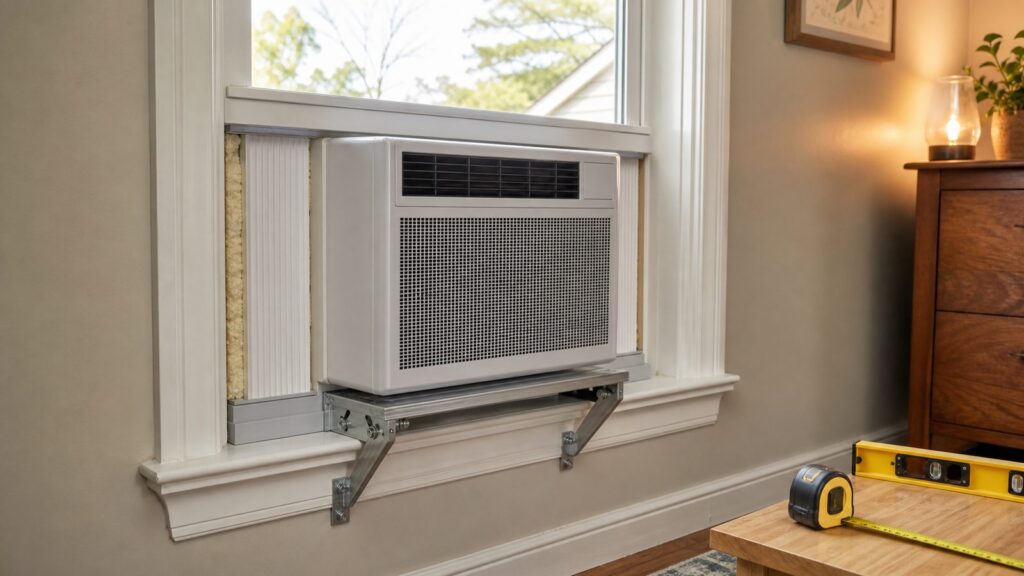
Support matters. We prefer a properly rated support bracket when the manufacturer requires it, when the unit is heavy, when the window frame is older, or when the installation is above grade. The unit must be stable, level side to side, and pitched according to the manufacturer’s drainage requirements, often slightly downward toward the exterior. Too much pitch can strain the chassis or look sloppy. Too little pitch can send condensate toward the interior.
Recommended Free Tools
Air sealing matters just as much. Thin accordion panels leak air and transmit noise. For better performance, use rigid insulated filler panels where possible, compressible weatherstripping at the sash, low-expansion foam or removable sealant where appropriate, and a clean interior air seal that can be serviced later. Do not trap water in wood trim. Do not seal over rot. Do not block drainage paths.
Security is another detail homeowners miss. A window unit can make a window easier to force open if the sash is not locked or mechanically secured. Use sash locks, manufacturer brackets, and appropriate fasteners. For bedrooms, never sacrifice the only required emergency escape and rescue opening without confirming code compliance and a safe alternate egress path.
Older Homes: What to Inspect Before Purchase
Older homes need a closer look before a heavy window appliance goes in. We check the sill for rot, soft wood, cracked paint, loose stops, failed glazing, and water staining. We operate the sash fully. If the window does not stay open on its own, the balance or weights may be failing. A window AC should not depend on a weak sash to hold it in place.
Lead paint is a serious consideration in pre-1978 homes. Scraping, sanding, drilling, or disturbing painted window components can trigger lead-safe work practices. That does not mean a window unit cannot be installed, but it does mean the work should be planned instead of improvised.
Storm windows can also complicate installation. Some units need a clear exterior path for drainage and airflow. If the storm-window frame blocks the bottom of the unit, you may need a spacer or a different installation approach that follows the manufacturer’s instructions. Poor airflow around the exterior coil hurts performance and can shorten equipment life.
Finally, check the outlet. A grounded receptacle is not optional. If the room has old two-prong outlets, questionable polarity, cloth wiring, aluminum branch wiring, or frequent breaker trips, bring in an electrician before buying a high-load appliance.
Permits, Electrical Rules, and Local Restrictions
Permit rules vary by city, county, building type, and scope. A simple plug-in window unit may not require a mechanical permit in many locations, but electrical work often does. A new circuit, new receptacle, panel work, exterior penetrations, or work in multifamily buildings can trigger permits and inspections.
Some jurisdictions treat heat-pump installations more formally, especially when they are part of broader energy-code compliance or building electrification work. Cities also differ on whether exterior equipment placement, condensate discharge, noise, or facade changes are regulated. Multifamily buildings and HOAs may restrict visible window units entirely.
Our practical checklist is straightforward: confirm the unit is allowed, confirm the electrical circuit is legal and adequate, confirm the window can support and secure the unit, confirm drainage will not damage the building, and confirm the installation does not block required egress. If any of those answers are uncertain, solve that before purchasing.
Independent reader supportYour contribution helps us test, update, and keep practical guides available for everyone.When to DIY vs When to Hire a Pro
DIY can make sense when the unit is a manageable weight, the window is in good condition, the installation is first-floor or otherwise safely accessible, the unit uses an existing compatible grounded receptacle, and the manufacturer’s kit fits the opening cleanly. A careful homeowner can usually complete a basic installation in 1 to 3 hours with a helper, a level, drill, screwdrivers, tape measure, weatherstripping, foam, and the correct bracket if required.
Rank #3

- Reliable Window Conditioner: Our powerful 23,200 BTU cooling capacity / 16,000 BTU supplemental heating capacity window ac unit can efficiently provide comfort all year long for any large space up to 1,500 Sq.Ft.
- All in One AC: Enjoy cooling, supplemental heating, dehumidification, and fan circulation; Supplemental Heating mode is meant to be operated when temperatures outside are between 23 and 76 degrees; Mode is supplemental and NOT meant as primary heat source
- Smart Remote: The remote takes the temperature of the room you are in, displays it on the LCD screen and sends a signal to your ac wall unit every 3 minutes for accurate cooling
- Powerful Cooling on a Budget: Our High Efficiency window AC Unit will give your electric bill a break by using the 'Energy Saver' or 'Sleep' mode
- Space Saving Design: Save your floor space with window air conditioners; Window installation kit included; Minimum window height: 19.5"
Hire a pro when the unit is heavy, the window is old or damaged, the work is above the first floor, the opening needs carpentry, the exterior is masonry or stucco, the room has storm-window complications, or the installation needs a cleaner air-seal detail. Hire a licensed electrician when the unit requires 208/230/240V power, a new circuit, breaker work, a new receptacle, or troubleshooting of an overloaded circuit.
For finished additions, ADUs, and conditioned garages, consider whether a ductless mini-split is the better long-term solution. The upfront price may be several times higher than a window unit, but the result is usually quieter, tighter, better looking, more durable, and better suited to year-round heating.
When Not to Use a Window Heat Pump
Do not use a window heat pump as a shortcut for a whole-house comfort problem. It will not balance temperatures through a large open plan, fix undersized ductwork, or solve poor insulation throughout the home. It is a room solution.
Avoid this category when the room’s only suitable window is also the only required bedroom egress window. Be cautious in very cold climates unless the model is specifically rated for the outdoor temperatures you expect and you have backup heat. Many room units lose heating capacity as outdoor temperature drops, and some rely heavily on supplemental resistance heat.
Skip the window unit if the facade is HOA-restricted, the building is multifamily with strict rules, the exterior discharge could create icing or drainage problems, or the room requires very quiet operation. Even good inverter window units are generally more audible than well-installed ductless indoor heads.
Also avoid installing into rotten windows, loose sashes, weak frames, or openings that cannot be sealed without trapping water. Fix the building condition first. A $600 appliance should not become the reason a wall assembly starts taking on water.
What’s actually slowing this PC down?
Pick the symptom - the matching free tool is one click away.
Best Buying Framework for 2026
Start with the room, not the product page. Measure the space, identify sun exposure, note ceiling height, check insulation quality, and decide whether the room needs occasional comfort or daily year-round conditioning. Then match the equipment.
For a 300 to 350 square foot room, look around 8,000 BTU cooling capacity. For 500 to 550 square feet, look around 12,000 BTU. For 900 to 1,000 square feet, 18,000 BTU may be appropriate, but only if the room layout is reasonably contained. For 1,400 square feet or more, a window unit becomes a less elegant solution, even when 23,000 to 25,000 BTU models are available. At that scale, noise, power requirements, air distribution, and installation weight become real drawbacks.
Choose an inverter model when the budget allows. It is usually the better comfort upgrade because it can reduce cycling and hold a steadier room temperature. Look for current EnergyGuide data, CEER/EER ratings, a clear heating-capacity number, a published noise rating, washable filters, remote or smart controls if useful, and installation hardware that matches the weight of the unit.
Finally, price the whole project. A $599 unit may be the right buy if it uses an existing compatible circuit and fits the window. The same unit may be the wrong buy if it requires a new 240V circuit, sill repair, and a custom support detail. At that point, a mini-split estimate belongs in the comparison.
Bottom Line
The best window air conditioner with heat pump is not simply the biggest or cheapest unit. It is the unit that matches the room load, provides real heating capacity for your climate, fits the window safely, uses the correct electrical supply, and can be sealed like part of the building envelope.
For one room, mild winters, and a controlled budget, a window heat-pump AC can be a smart $500 to $1,200 installed solution, assuming no major electrical work is needed. For permanent living space, colder climates, quiet bedrooms, ADUs, or higher-finish additions, a ductless mini-split is often the better construction-grade answer. For whole-home comfort, step up to a central heat pump design and treat it like the major mechanical project it is.
Frequently Asked Questions
Is a window air conditioner with heat the same as a heat pump?
Not always. Some window AC units use true heat-pump heating, while others use electric-resistance supplemental heat. Check the product specifications for heating type and heating BTU before buying.
How much does a window AC with heat pump cost in 2026?
Most heat-capable window units cost about $380 to $900 before installation. A simple DIY install may add $20 to $150 in materials, while professional installation often adds $150 to $400. New 230V electrical work can add several hundred dollars to more than $1,500.
Can a window heat pump heat a room in winter?
Yes, in the right climate and room size. Window heat pumps work best in mild-to-moderate winters. In colder weather, output can drop, and some models depend on supplemental electric heat, so backup heat may still be needed.
Do I need a permit to install a window air conditioner with heat?
A simple plug-in window unit may not require a permit in many areas, but local rules vary. A new circuit, 230V receptacle, panel work, multifamily installation, or exterior modification may require permits or approvals.
Can I plug a 12,000 BTU window AC with heat into a normal outlet?
Some 12,000 BTU units are 115V, but many heat-capable models require 208/230/240V power. Always verify voltage, amperage, plug type, and circuit requirements on the exact model.
What size window AC with heat do I need?
As a starting point, use about 8,000 BTU for 300 to 350 square feet, 10,000 BTU for 400 to 450 square feet, 12,000 BTU for 500 to 550 square feet, and 18,000 BTU for 900 to 1,000 square feet. Sun exposure, insulation, ceiling height, air leakage, and room use can change the load.
Outdated Drivers Are Slowing You Down
One free scan finds every outdated or missing driver and matches the right update for your exact hardware.Free scan · exact hardware matchPC Slower Than It Used to Be?
A free scan shows the junk files, broken settings and background clutter dragging Windows down - then fixes them in one click.Free scan · Windows 10 & 11Quick Recap
Product prices and availability are accurate as of the date/time indicated and are subject to change. Any price and availability information displayed on Amazon at the time of purchase will apply.

