Start with the subwoofer on the floor—not at ear height. For most home-theater and stereo systems, bass quality depends far more on the subwoofer’s horizontal position, nearby walls, room modes, phase, crossover, and calibration than on raising the cabinet to the listener’s ears. Elevate it only for a specific reason, such as flood protection, floor vibration, a down-firing design’s clearance requirements, or a measured improvement in your room.
The short answer: keep it low
A conventional powered subwoofer should normally sit directly on a stable floor, close to a wall or corner. Genelec recommends placing subwoofers close to walls and on the floor because this supports efficient acoustic coupling and helps avoid destructive low-frequency reflections. See Genelec’s subwoofer placement guidance.
As an Amazon Associate I earn from qualifying purchases.
A subwoofer does not need to be at ear level. Main speakers are positioned relative to the listener because midrange and treble are directional and affect stereo imaging. Deep bass is considerably less directional, so the subwoofer’s relationship with the room usually matters more than its height relative to the listener.
The Tool Desk
Outbyte Driver Updater FREEFix the driver behind crashes, sound loss and screen glitchesFind Drivers →Outbyte PC Repair FREERepair Windows errors before they cause bigger problemsFix Now →That does not mean bass is completely impossible to localize. A subwoofer can become easier to locate if the crossover is set high, the port is noisy, distortion is present, or the listener is very close to it. Even then, raising it to ear height is rarely the right solution.
#1 Best Overall

- 10" front-firing spun-copper IMG woofer
- All-digital amplifier with 300 watts peak power
- Volume low pass crossover and phase control
- Line level LFE RCA inputs for maximum receiver compatibility
- Dimensions 14 5" x 12 5" x 16 4"
Where to begin placing a subwoofer
1. Along the front wall
A sensible first position is on the floor along the front wall, slightly away from the room’s center line. Genelec gives this as a starting position for a single subwoofer in its monitor placement guidance.
This location is convenient for most systems and keeps the subwoofer close to the main speakers. Leave the clearance specified in the owner’s manual around the driver, port, amplifier, controls, and ventilation openings.
2. In a front corner
A corner can provide more output because the subwoofer is reinforced by several room boundaries. REL describes corner placement as useful for efficient low-frequency pressurization; however, extra output is not the same as smooth bass. A corner can also emphasize room resonances, producing bass that is boomy in one seat and weak in another. See REL’s single-subwoofer placement guidance.
Windows Errors? Fix Them Before They Spread
Repair common Windows errors and clear accumulated junk for a smoother, more stable PC - no reinstall needed.Free scan · no reinstallCrashes, No Sound, or Screen Glitches?
Random freezes, missing sound and display glitches usually trace back to one bad driver. Find and replace yours safely.Free scan · under a minuteUse a corner as a strong starting point, not as a universal rule. If it sounds thick, one-note, or uneven, test another location.
3. Another wall position or nearfield placement
A side-wall location may produce a smoother response than the front wall in some rooms. Placing the subwoofer beside or behind the sofa can also work, particularly when front-wall placement produces a deep null or when stronger tactile impact is desired.
Rank #2

- POWERED SUBWOOFER FOR EXTRA BASS & PUNCH – 10-inch Dynamic Balance woofer and configured directed port provide accurate bass depth that brings music and movies alive. The perfect home theater subwoofer for small-to-mid size rooms. Waterproof : No
- LOUDER CLEARER SOUND EVEN AT HIGH VOLUME – Enjoy a thrilling balanced audio experience with rich, deep sound, even at low frequencies, when using the 10 inch subwoofer. BLENDS EASILY WITH ANY SPEAKER & plays demanding nodes without distortion
- DOUBLE THE AMPLIFIER POWER TO 100 Watts of Power with its in-built 50-watt RMS amp. Sophisticated engineering featuring best in class resonance-free driver materials makes this subwoofer with built in amp highly durable and FIT FOR EXTENDED USE
- EASY TO INTEGRATE WITH EXISTING SYSTEMS – Hook up this compact subwoofer to the receiver and upgrade your music sound instantly. Features continuously variable 80-160 Hz crossover and 40-160 Hz (-3dB) frequency response
- A sleek detachable grille on the front, speaker and line-level inputs, speaker-level outputs on the back, plus a Phase Toggle Switch for multiple subwoofers, make this home subwoofer cohesive and complete
Nearfield placement reduces the distance between the subwoofer and the listener, but it may make the bass experience less consistent between seats. REL notes that room dimensions, construction materials, and reflectivity make every room different, so placement should be refined for the particular space. Its room setup guide explains this room-dependent approach.
Does raising a subwoofer improve sound?
Not automatically. Raising the cabinet changes its distance from the floor and ceiling, its boundary reinforcement, the room modes it excites, and the way bass reaches the listening position. The result could be better, worse, or effectively unchanged depending on the room and equipment.
For most ordinary rooms, moving the subwoofer several feet horizontally has a larger practical effect than raising it a few inches. A low platform or approved feet may still be useful, but usually for a mechanical or practical reason rather than because elevation inherently produces deeper, tighter, or smoother bass.
Acoustic placement versus vibration isolation
Isolation feet and platforms can reduce mechanical energy transferred into a suspended wood floor, furniture, or a neighboring structure. They may also reduce audible rattles. That is different from reducing airborne bass—the sound pressure traveling through the room and building.
An isolation product may help with structure-borne vibration without significantly reducing the bass heard by neighbors. It also does not guarantee a smoother frequency response. Choose it to solve a demonstrated vibration or stability problem, not as an automatic sound-quality upgrade.
Rank #3
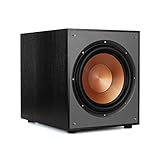
- 12" high excursion spun-copper Imp woofer
- 29 hertz – 120 hertz plus /- 3 dB
- 400 watt
- Max acoustic output 116dB
- Bass-reflex via rear firing port. Amplifier power (control/peak): 200 watts/400 watts
When elevating a subwoofer is reasonable
Flood-prone or damp rooms
In a basement or other area at risk of water intrusion, raising the subwoofer can protect the cabinet and amplifier. Use a rigid, level platform that fully supports the cabinet and is wide enough to prevent tipping. Keep electrical connections and ventilation clear, and do not assume a raised platform makes the equipment waterproof.
Suspended floors and structural vibration
If the floor audibly vibrates, the subwoofer walks during playback, or mechanical vibration is being transmitted into a neighboring room, a purpose-built isolation platform or manufacturer-approved feet may help. The support must remain rigid and stable under the subwoofer’s weight and movement.
Down-firing subwoofers
A down-firing model may require a particular gap between its driver and the floor. A platform can be appropriate only if it preserves that clearance and does not block or restrict the driver. The exact owner’s manual takes precedence over general advice.
A measured room-response improvement
Elevation can be worth considering if microphone measurements show a clearly better response at a different height and the platform is safe. Treat this as a room-specific experiment, not a general recommendation. Re-measure and recalibrate after changing the height.
How high should a subwoofer be?
There is no universal maximum height or ideal number of inches. The safest practical rule is to use the lowest stable height that solves the problem.
Recommended Free Tools
Rank #4

- COMPLETE YOUR SYSTEM: Pairs seamlessly with any speaker, adding the deep bass foundation your music and movies need.
- DESIGN THAT FITS YOUR SPACE: Available in black, with a swappable grille to match your décor. Black grille included; gray sold separately.
- CLEAN, POWERFUL BASS: A 200W Class-D amplifier and rigid, braced cabinet deliver tight, accurate low end without boominess or distortion.Clean, Powerful Bass: A 200W Class-D amplifier and rigid, braced cabinet deliver tight, accurate low end without boominess or distortion.
- FLEXIBLE CONNECTIVITY & SETUP: Stereo RCA, LFE, and speaker-level inputs integrate easily with any system, with auto-on and simple controls for fast tuning.
- DESIGNED IN THE USA: Backed by a long-lasting 5-year warranty for performance you can trust.
- Best default: floor level.
- Usually low risk: a few inches on approved feet or a compatible isolation platform.
- Needs careful evaluation: a shelf, cabinet, or stand that permits movement or resonance.
- Special-case only: high wall, ceiling, or overhead placement.
Acceptable height depends on the enclosure, driver orientation, port location, cabinet weight, platform rigidity, room geometry, listener positions, safety risk, and manufacturer instructions. Check the manual for minimum driver-to-floor clearance, port clearance, ventilation, permitted orientations, approved mounting hardware, and any limit on tilt. Do not assume that every subwoofer can be placed on its side or mounted above the floor.
How to find the best position
Use the subwoofer crawl
The subwoofer-crawl method is useful when the obvious front-wall or corner position does not sound right. SVS describes this technique in its subwoofer placement guide.
- Temporarily place the subwoofer at the main listening position.
- Play bass-heavy music, a bass sweep, or suitable test material at a moderate level.
- Walk around the room’s perimeter, especially along walls and in corners.
- Listen for the position where bass sounds smooth and even, not merely the position where it sounds loudest.
- Move the subwoofer to that location.
- Return to the listening seat and compare it with the original position.
- Check more than one seat if the room is used by several people.
Listen for one-note bass, a missing low end at the seat, large differences between seats, rattling furniture, and a noticeable sound coming directly from the subwoofer.
Use measurements when available
A calibrated measurement microphone and room-measurement software can make small differences easier to see. A practical sequence is:
Free tools Windows power users keep installed
One-click scans. No signup required.
- Measure the main listening position.
- Compare several candidate floor positions and, if necessary, a low elevated position.
- Adjust level, phase, and distance or delay for integration with the main speakers.
- Set the crossover in relation to the main speakers and the receiver or processor’s bass-management arrangement. SVS explains this relationship in its crossover guidance.
- Re-measure after changing the subwoofer’s height or location.
- Apply room equalization only after choosing a physically suitable position.
Room correction can reduce some peaks and integration errors, but it cannot reliably restore sound at every deep null. Physical placement comes first.
Best Value
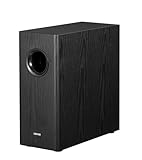
- [ Deep & Powerful 8-Inch Bass ]: Experience 35Hz deep bass with the T5s powered subwoofer, which features an 8-inch long-throw woofer and a powerful 70W RMS output (driven by Class-D amplifier). Perfect for home audio and home theater.
- [ Precision Control, Seamless Integration ]: Adjust the low-pass filter (30Hz–160Hz) and phase selector (0°/180°) to match any home stereo or active speaker setup.
- [ Slim Design, Low Distortion ]: This space-saving compact subwoofer fits into any spaces. The 18mm MDF cabinet with a front-firing driver and right-firing acoustic port minimizes resonance for clean, tight bass. Its wood grain finish and low-profile grille blend seamlessly with home decor.
- [ Smart & Energy-Efficient ]: Auto-standby saves power after 15 minutes of inactivity. The built-in amplifier ensures plug-and-play operation – no external receiver needed! Includes 3.5mm-to-RCA and RCA cables for instant setup.
- [ Two Connections ]: ① Sub out-equipped speakers/amps: RCA to T5s’ Signal In; main speaker connects directly to audio source. ② No sub out: Connect T5s in series (audio source → T5s’ Signal In → T5s’ Signal Out → main speaker). Note: For ②, main speaker requires LINE IN (Bluetooth/USB/optical/non-wired not supported).
Does the subwoofer need to face the listener?
Usually not at deep-bass frequencies. Front-firing, down-firing, and side-firing designs can all work when installed according to the manufacturer’s instructions. The enclosure’s clearance and the resulting room response are generally more important than pointing the driver directly at the listener.
Orientation matters more when the crossover is relatively high, the subwoofer is used nearfield, the port or driver has insufficient clearance, or the design uses a passive radiator or unusual cabinet geometry. Never cover a port or place a down-firing driver against a platform that restricts its movement.
Placement mistakes to avoid
- Putting the subwoofer on a narrow, lightweight, or unstable stand.
- Using soft furniture, a resonant shelf, or a cabinet that cannot support the weight.
- Enclosing the subwoofer in furniture without a design specifically intended for that application.
- Blocking a port, down-firing driver, amplifier, or cooling openings.
- Choosing the loudest position instead of the smoothest position.
- Assuming a corner is always best.
- Raising the cabinet without securing it against children, pets, foot traffic, or vibration.
- Changing height or location without recalibrating distance, phase, delay, and level.
- Setting the crossover unnecessarily high and making the subwoofer easier to localize.
- Using equalization to compensate for a deep null that should be addressed through placement.
- Confusing isolation with soundproofing.
Special situations
Multiple subwoofers
Multiple subwoofers do not need visual symmetry or identical heights. They can be placed at different locations when the enclosures and calibration system support it. The objective is more consistent bass across seats, not matching furniture lines. Genelec discusses the room interaction and benefits of single- and multiple-subwoofer arrangements in its subwoofer guidance.
Apartments and neighboring rooms
Use isolation only when the problem is structure-borne vibration, such as a vibrating floor or rattling building elements. Raising the subwoofer will not necessarily stop airborne bass from passing through walls, floors, or ceilings. Lower playback levels, careful placement away from shared structures where practical, and building-specific acoustic treatment may be more effective.
Furniture-constrained rooms
A subwoofer may sit beside or under furniture if the driver, port, amplifier, controls, and ventilation remain unobstructed. Avoid an enclosed cabinet unless the manufacturer designed the subwoofer for that installation. Cabinet panels and doors can rattle, while restricted airflow can cause overheating or reduced output.
Wireless subwoofers
Wireless connection changes how the audio signal reaches the subwoofer; it does not remove the acoustic requirements. The cabinet still needs a stable support, suitable clearances, and a position that works with the room. Confirm power-cable reach and the manufacturer’s recommended orientation.
Bottom line
Put a normal subwoofer on the floor, begin near the front wall or a corner, and test the result rather than assuming the corner is perfect. Raise it only when a clear practical, vibration-control, clearance, safety, or measured-response reason justifies doing so. Use the lowest stable platform that meets the exact model’s requirements, keep drivers and ports clear, and recalibrate after every meaningful placement change.
Quick Recap
Product prices and availability are accurate as of the date/time indicated and are subject to change. Any price and availability information displayed on Amazon at the time of purchase will apply.

