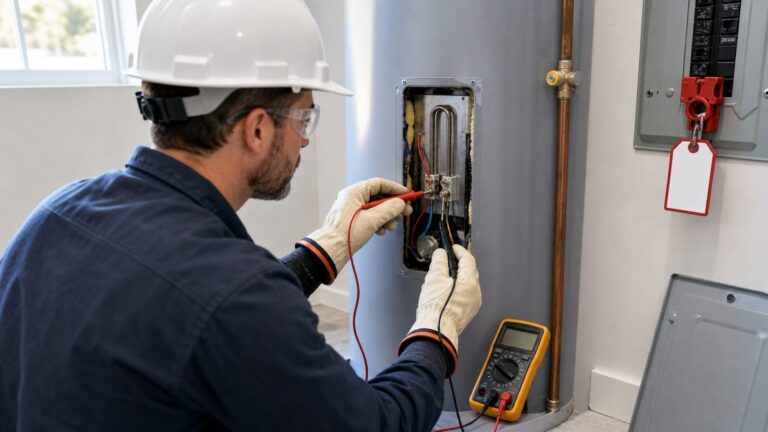
If lightning may have damaged your home, put people first: move away from immediate hazards, call emergency services for fire, injury, a suspected gas leak or another urgent danger, and keep out of any home authorities have restricted or that appears unstable. Do not assume the house or its wiring is safe just because damage is not visible. Once authorities say it is safe to proceed, document the damage, notify your insurer and arrange qualified inspections before permanent repairs.
1. Protect people and stay clear of immediate hazards
Get everyone away from smoke, fire, suspected gas leaks, falling or unstable materials, and any other immediate danger. Call emergency services from a safe location if anyone is injured, there is a fire or smoke, you suspect a gas leak, or another urgent hazard is present. Never approach a fallen or dangling power line.
As an Amazon Associate I earn from qualifying purchases.
Do not enter if local authorities have restricted access or if the home appears structurally unstable. A lightning strike can be accompanied by fire, water damage, electrical faults and structural damage; a quick look from the doorway is not a safety clearance. The American Red Cross advises checking for exterior hazards and seeking an appropriate building inspection when structural damage is suspected. Its guidance is for home and fire recovery, not a lightning-specific inspection standard.
Look for warning signs from a safe distance
- Loose or downed power lines, or visible damage to a gas line.
- Large or new cracks in the foundation, missing supports, sagging areas or other signs that the building may be unstable.
- Smoke, flames, or damage that could conceal an active fire.
If you see a warning sign, keep away and contact emergency responders or the relevant utility or qualified professional. Do not treat this list as proof of safety if none of the signs are visible. Some damage may be hidden, and checking one area does not clear another part of the home. Follow local responders’ directions rather than trying to decide for yourself whether a damaged house is safe.
#1 Best Overall

- Valued Carpenter Pencil Set: You will get 2 pcs solid carpenter pencils with 26 piece 2.8 mm refills, 1 replaceable sharpener, 1 plastic storage box.The complete carpenter pencils combination allows you to finish your work faster and more easily
- Deep Hole Marker Pencil: The deep-hole construction pencils adopts 45mm elongated tip design, which is more convenient to mark in the small hole or in other tight areas that other carpenter markers cannot reach
- Carpenter Pencils with Sharpener: The sharpener is screwed into the top of the work pencil, which won't get lost either. Built-in pencil sharpener that keep the lead with pointed and smooth to Improves line of sight in fine work
- Stronger Solid Lead: This work pencil is matched with a 2.8 mm thick lead , which is much thicker and stronger during the drawing process of construction work, it will not break or damage easily
- Marks on Various Surfaces: 3 colors solid construction pencil can marks on various surfaces,such as metal, plastic, wood, paper etc. Ideals for woodworkers, contractors, craftsmen, builders, merchants and masons
Think of this first stage as protecting people, not investigating the loss. Do not go inside to retrieve belongings, inspect the attic, or check appliances while an immediate hazard remains. If the situation changes—for example, smoke appears or a new hazard becomes visible—move farther away and contact emergency services again from a safe place.
2. Treat electrical symptoms as a reason to stop and call a professional
Lightning can damage wiring, electrical systems and connected appliances even when the damage is not obvious. Sparks, broken or frayed wires, a hot-insulation smell, or a breaker that has tripped are reasons to keep clear and contact a qualified electrician. Do not reset a suspect breaker, cycle breakers to test the system, or plug appliances back in to see whether they work.
The Red Cross advises turning off electricity at the main panel if there are sparks, damaged wires or a hot-insulation smell and the panel can be reached safely. If water blocks the way, do not step into it to reach the panel; call a qualified electrician. A tripped breaker may indicate damaged wiring, so do not turn it back on. These steps do not establish that the rest of the electrical system is safe; an electrician should assess suspected damage.
Free tools Windows power users keep installed
One-click scans. No signup required.
Do not use the absence of visible scorch marks, sparks or a burning smell as a home test. A strike may affect connected equipment and electrical components without leaving an obvious sign at the place you can see. Likewise, an appliance that appears to turn on is not evidence that the electrical system has been inspected or that all affected equipment is undamaged. Leave diagnosis and decisions about restoring power to a qualified professional when there are symptoms or suspected damage.
If you are unsure whether a panel is safely accessible, do not approach it to find out. Water, visible wiring damage or other hazards can make the route unsafe. Tell the electrician what you observed, including any tripped breaker, damaged wire, spark or unusual hot-insulation odor. Do not attempt repairs yourself or treat a sequence of breaker resets as a substitute for inspection.
3. Re-enter only after the right clearance
Follow local authorities’ instructions about when and where you may return. If structural damage is suspected, have an appropriate building professional assess it before entry or repair. Electrical symptoms call for an electrician; a structural concern calls for an inspector or qualified building professional. Depending on what happened, more than one assessment may be needed.
Rank #2

- Ergonomically Designed: Work in tight areas with a compact design that gets into tough spots
- Compact and Lightweight: Both tools are designed to fit into difficult to reach spaces. The 1/4" impact driver has a length of 5.55 in. and weighs just 2.8 lbs, while the 1/2" drill/driver measures only 7.5 in. and weighs 3.6 lbs
- Both the DEWALT impact driver and electric drill driver feature integrated LED work lights with a convenient 20-second delay, ensuring enhanced visibility in dimly lit or challenging work areas
- One-Handed Loading - Keep one hand free with a 1/4 in. hex chuck that accepts 1 in. bit tips
- Power drill cordless with 1/2" single sleeve ratcheting chuck provides tight bit gripping strength, making bit changes faster and more secure
These are different questions: an electrician can assess suspected electrical damage, while an appropriate building professional can assess suspected structural damage. An assessment in one area does not automatically resolve a concern in another. If responders or a professional identify hazards, follow their instructions and do not enter restricted areas until they say it is appropriate.
If power is out and authorities have allowed entry, use a battery-powered flashlight rather than an open flame to see. A flashlight is only a light source; it does not make an unsafe or damaged home safe to enter. Avoid moving unstable damaged objects, and leave areas with electrical, gas or structural warning signs to qualified responders or professionals. Do not use a candle or other open flame to inspect a dark space.
Once entry is permitted, continue to be cautious: a cleared building is not necessarily free of every repair issue. Do not disturb unstable materials or start cleanup in an area where electrical, gas or structural concerns remain. If you find a new warning sign, stop and seek appropriate professional guidance rather than continuing the inspection.
4. Document the damage and notify your insurer
Once it is safe to do so, record the condition of the home and belongings before cleanup or disposal. Take clear photos or video of each affected room, exterior area and damaged item. Make an inventory of affected property, including what is damaged and, when you can, identifying details such as model or serial numbers. Preserve damaged items for inspection where practical.
- Photograph or video damage before moving, cleaning or discarding affected items.
- Make a written inventory of damaged property and keep copies of the images and records.
- Contact your insurer or agent promptly. Explain that lightning struck or may have damaged the home, and ask what documentation, inspection or claim steps it requires.
- Keep receipts for necessary temporary repairs and other relevant costs, and record whom you spoke with and when.
Try to capture the overall area as well as individual damage: images of a room or exterior section can provide context, while close views show a particular damaged item. Keep the original photos or videos and organize them with your inventory. If an item has identifying details you can safely record, add those to your notes. Do not delay urgent steps to protect people or prevent further damage in order to take pictures; document what you can when it is safe.
Preserve damaged belongings for inspection where practical. If an item must be moved or discarded for safety or another practical reason, document its condition first if possible and ask the insurer how it wants the item handled. The insurer can tell you what records or inspection it needs, so do not assume that a particular photograph or list is all that will be required.
Rank #3

- 【Great Compatibility】This Katerk 1/4 inch hex shank bit holder is specifically designed for 1/4 inch hex shank drill bits. It's compatible with most 1/4 fast hex handles, hex sockets, various electric screwdrivers, and handheld screwdrivers. The bit holder makes it a valuable addition for any handyman.
- 【Secure and Safe】Built with a secure backup nut design, each drill bit holder securely locks onto your bits, ensuring they stay firmly in place. Additionally, our bit holder incorporates a high-quality steel ball rolling design that holds up to several kilograms of weight, ensuring your various drill bits don't fall off.
- 【Easy One-Handed Operation】The bit holder for impact driver allows you to change bits single-handedly, simplifying your workflow. Its multi-color design further allows for quick identification of the drill bit you need.
- 【Compact and Convenient】Thanks to its compact size, this 1/4 inch bit holder is easy to carry around. The bit holder allows for easy attachment to various tools, making this a convenient addition to your construction accessories. The Katerk bit holder is cast from high-quality alloy material, promising a long product lifespan. Despite its rugged strength, the bit holder remains lightweight, making it portable.
- 【Cool Christmas Gift For Men Stocking Stuffers】 This screwdriver bit holder, driver bit holder, impact bit holder, can be given as a gift to your loved one, especially for anyone involved in construction or electrical work. It's a must-have for stocking stuffers for men and women, tools gifts for dad, tech gadgets for men, gifts for dad, gifts for him, gifts for husband, gifts for boyfriend, cool gadgets for men, and cool gifts for dad.
Triple-I says standard homeowners policies generally cover damage directly caused by lightning, including fire and many forms of electrical damage. That general description is not a decision about your claim. Coverage depends on your policy and applicable rules; the source of a surge, exclusions, deductible, limits and claim deadlines may matter. Ask your insurer how those terms apply to your loss and what deadlines or documentation requirements govern your policy and location.
When you report the loss, describe what happened without assuming that every damaged item will be covered. Ask what the next claim steps are, whether an inspection is needed, what evidence to preserve, and whether there are particular deadlines or requirements that apply to your policy and location. Keep notes of the conversation and copies of records you send. Coverage and payment are determined by the policy and applicable rules, not by general descriptions of typical homeowners coverage.
5. Prevent further damage without rushing into permanent repairs
After documenting the damage, reasonable temporary measures may help prevent additional loss—for example, covering a roof opening or broken window if it can be done safely. Keep receipts and coordinate with the insurer about what it needs to inspect. Ask before starting permanent repairs because claim and policy requirements differ.
Temporary protection is not permission to take an unsafe risk. If reaching a roof opening, broken window or other damaged area would expose you to a structural, electrical or other hazard, do not attempt the work yourself. Ask the insurer how to proceed and use an appropriate qualified professional. Keep records and receipts for necessary temporary work, and distinguish it from permanent repairs when communicating with the insurer.
Be cautious if a contractor pressures you to sign immediately or promises a particular insurance outcome. Check credentials and reputation, request a written scope and price, and avoid rushed signatures or large upfront payments. The NAIC cautions consumers about contractor pressure after disasters; its guidance does not establish a universal bid standard or guarantee that a particular contractor or estimate will meet your insurer’s requirements.
If you compare repair bids, focus on practical information such as the contractor’s credentials and reputation, written scope, price and timeline, and ask the insurer what it requires. Do not rely on a contractor’s promise about what the insurer will pay. A contractor’s estimate is not a coverage decision, and claim requirements can vary by policy and location. Take time to understand what you are signing and avoid large upfront payments or rushed commitments.
Rank #4

- Long Nib and Deep Hole Marker: Our mechanical carpenter pencil with 45mm nib is designed for easy marking of deep holes or narrow areas. These construction pencils are the great choice for woodworking tools, construction tools, carpenter tools, contractor tools, wood carpentry tools and architect tools
- Extra Refills in 2 Colors for Versatile Marking: The construction mechanical pencil comes with 12 extra 2.8mm refills, including 6 red and 6 black refills. The black refill is suitable for light surfaces, while the red wax is perfect for dark surfaces. Our carpenter mechanical pencil makes sure that you'll have an ample supply for extended use
- Built-in Sharpener: Our construction pencil comes with a built-in sharpener to ensure the mechanical pencil tip is always sharp and ready for use. Never buy an extra pencil sharpener again. A great tool for any woodworker pencil, contractor pencils. The refill can easily be extended or retracted with a simple click of the pencils mechanical, allowing you to work more efficiently and accurately
- Portable Clip Design: Our deep hole construction pencil features a portable clip design, easy to carry and attach to your pocket or tool box, so that you can keep the carpenter pencils mechanical close at hand, making it a convenient tool to have on the go. Great gifts choice for carpenters
- Stronger Pencil Lead: The black refills are made of lead, sturdy and smooth. The red refills are made of wax, clear and light. These marking pencils are much thicker and stronger than normal pencils during the marking process of construction work, suitable for various surfaces, such as glasses, metal, boards, floors, walls, furniture, etc. The written marks can be easily wiped with a wet paper towel when needed
What lightning claims look like nationally
Triple-I estimated that U.S. homeowners insurers paid $1.65 billion for lightning-related claims in 2025, across 61,986 claims, for an average of $26,616 per claim. These are national insurance-industry estimates published in 2026, not a government census or a prediction of what an individual homeowner will receive. A specific claim depends on the damage, policy and applicable rules.
Quick wins for a faster PC:
Repair Windows errors before they cause bigger problemsFix Now →Scan for outdated or missing drivers - takes under a minuteDriver Scan →Clear out junk files and repair common Windows errorsFree Scan →The figures help show that lightning damage is a significant category of homeowners claims, but they should not be used as a repair-cost estimate for your home or a forecast of your claim payment. The average combines different losses and policies across the country. Your deductible, coverage limits, exclusions, the damage itself and applicable requirements all matter to an individual outcome.
Independent reader supportYour contribution helps us test, update, and keep practical guides available for everyone.Frequently asked questions
What should I do after lightning strikes my house?
First, move people away from immediate hazards and call emergency services for fire, smoke, injury, a suspected gas leak or another urgent danger. Stay away from fallen power lines and do not enter a restricted or visibly unstable home. Once it is safe and authorities allow access, document damage, contact your insurer and arrange a qualified inspection for suspected electrical or structural damage.
Is it safe to go back inside after a lightning strike?
Do not assume it is safe based on the lack of visible damage. Follow local authorities’ instructions and stay out if the home is restricted or appears unstable. Electrical symptoms such as sparks, frayed wires, a hot-insulation smell or a tripped breaker call for a qualified electrician; suspected structural damage should be assessed by an appropriate building professional before entry or repair.
Does homeowners insurance cover lightning damage?
Triple-I says standard homeowners policies generally cover damage directly caused by lightning, including fire and many forms of electrical damage. That is general information, not a guarantee for a particular loss. Your policy terms, the source of a surge, exclusions, deductible, limits, deadlines and applicable state rules may affect coverage. Contact your insurer or agent for guidance about your policy.
Windows Errors? Fix Them Before They Spread
Repair common Windows errors and clear accumulated junk for a smoother, more stable PC - no reinstall needed.Free scan · no reinstallCrashes, No Sound, or Screen Glitches?
Random freezes, missing sound and display glitches usually trace back to one bad driver. Find and replace yours safely.Free scan · under a minuteHow do I file a lightning damage claim?
When it is safe, photograph or video the damage, make an inventory of affected property and preserve damaged items for inspection where practical. Contact your insurer or agent promptly, explain what happened and ask what evidence, inspection and claim steps it requires. Keep receipts for necessary temporary repairs and other relevant costs, as well as notes about claim conversations.
Best Value

- Milwaukee Ink all Fine Point Marker, Black, 4 Per Pack
- 4 per pack Features Clog Resistant Marker Tip Writes through Dusty, Wet and Oily Surfaces Durable Marker Tip for Writing on Concrete, OSB and Rough Surfaces
- Clog resistant tip writes on dusty, wet and oily surfaces and is optimized for rough surfaces such as OSB, cinderblock and concrete
- Hard hat clip- attaches for easy access
- Quick dry time with reduced smearing and marking
Should I start repairs before the insurer inspects the damage?
Document the damage first when it is safe, then take reasonable temporary steps to prevent further loss, such as covering a roof opening or broken window if that can be done safely. Keep receipts and coordinate with the insurer about inspection needs. Ask before beginning permanent repairs because policy and claim requirements differ.
Sources
- American Red Cross: Home Fire Recovery — safety, re-entry and inspection guidance used where a strike causes fire or comparable home damage.
- American Red Cross: Electricity and Utilities — guidance on electrical hazards and utility issues.
- National Association of Insurance Commissioners: How to File a Homeowners Insurance Claim — documentation, temporary repairs and contractor cautions.
- Insurance Information Institute: What Is Lightning? — general homeowners coverage explanation and national lightning claim estimates.
Frequently Asked Questions
What should I do after lightning strikes my house?
Move people away from immediate hazards and call emergency services for fire, smoke, injury, a suspected gas leak or another urgent danger. Stay away from fallen power lines and do not enter a restricted or visibly unstable home. When access is safe and permitted, document the damage, notify your insurer and arrange qualified inspections where needed.
Is it safe to go back inside after a lightning strike?
Not necessarily. Follow local authorities’ instructions, and do not enter if the home is restricted or appears unstable. Sparks, frayed wires, a hot-insulation smell or a tripped breaker call for a qualified electrician; suspected structural damage should be assessed by an appropriate building professional.
The Tool Desk
Outbyte Driver Updater FREEFix the driver behind crashes, sound loss and screen glitchesFind Drivers →Outbyte PC Repair FREEClear out junk files and repair common Windows errorsFree Scan →Does homeowners insurance cover lightning damage?
Triple-I says standard homeowners policies generally cover damage directly caused by lightning, including fire and many forms of electrical damage. Coverage for a specific loss depends on policy terms and applicable rules, including factors such as the source of a surge, exclusions, deductible, limits and deadlines. Ask your insurer or agent how your policy applies.
How do I file a lightning damage claim?
When safe, photograph or video damage, make an inventory of affected property and preserve damaged items for inspection where practical. Contact your insurer or agent promptly and ask what documentation, inspection and claim steps it requires. Keep receipts for necessary temporary repairs and notes about claim conversations.
Should I start repairs before the insurer inspects the damage?
Document the damage first when it is safe, then make reasonable temporary repairs to prevent further damage if they can be done safely. Keep receipts and coordinate with the insurer about inspection needs. Ask before beginning permanent repairs because policy and claim requirements differ.
The Bottom Line
After a lightning strike, protect people first and stay out of restricted or visibly unsafe areas. Treat electrical symptoms and suspected structural damage as reasons to call qualified professionals, not as problems to test yourself. Once it is safe, document the loss, contact your insurer, keep receipts and coordinate temporary measures before starting permanent repairs.
Recommended Free Tools
Quick Recap
Product prices and availability are accurate as of the date/time indicated and are subject to change. Any price and availability information displayed on Amazon at the time of purchase will apply.