Some links on this page are affiliate links: if you buy through them we may earn a commission, at no extra cost to you.
What size trencher do I need? Choose the machine only after the installation design establishes trench depth, width, pipe or cable size, required grade, soil conditions and site access. A walk-behind trencher can suit a short, shallow residential irrigation run, while deeper, wider, longer or rocky utility work may require a ride-on trencher or a compatible attachment. Published maximum depth is a machine capability—not a recommended burial depth. Confirm the exact chain or boom configuration, carrier compatibility and local excavation requirements before digging.
Start with the trench, not the trencher
The line being installed determines the trench. The trench dimensions and job conditions then determine the trencher class and configuration. Write down these requirements before looking at rental listings or attachment catalogs:
As an Amazon Associate I earn from qualifying purchases.
- Finished depth and cover: Include the pipe or cable diameter, bedding, required cover and any extra depth needed at crossings or frost-prone locations.
- Finished width: Account for the product, required side clearance, bedding material and the trench shape specified by the designer.
- Run length and production target: A machine that can physically make the cut may still be inefficient for a long installation.
- Ground conditions: Soil strength, roots, gravel, cobbles, rock, moisture and buried obstructions affect torque, chain selection, stability and achievable production.
- Access and footprint: Gates, landscaping, slopes, overhead obstructions, turning space and ground-bearing capacity can rule out a larger machine.
- Carrier and attachment details: For an attachment, verify mounting, hydraulic flow, pressure, coupler arrangement and the carrier’s rated operating capacity.
Vermeer Product Manager Nick Olsen summarizes the sizing logic this way: “The digging depth and width determine the size of the boom a contractor needs, but they can also affect the size of the ride-on trencher required.”
Do not select a machine because its advertised maximum is far beyond your design. Extra capacity can add weight, footprint, cost and damage risk without improving the installation.
Popular on Amazon

- Easy installation or repositioning of sprinkler heads in hard-to-reach areas.
- Construct custom swing joints.
- Use with 1/2 In. barb fittings to connect sprinkler heads.
- Flexible polyethylene tubing.
- Thick wall pipe with 1/2" Inside Diameter.
How much depth and width does each application need?
Irrigation lines
Irrigation burial depth is project-specific. The University of California Statewide Integrated Pest Management Program gives a lawn-installation example of trenches approximately 8–10 inches deep and 4 inches wide for pipe. That example is not a universal requirement for every irrigation main or lateral. Your irrigation plan, local rules, freeze exposure, vehicle crossings and future maintenance needs may require different cover.
Use the design depth and width to select a chain that makes the required cut without relying on a machine’s absolute limit. A narrow chain reduces backfill volume, but it must still provide the specified clearance around the pipe and allow proper bedding. Verify the pipe outside diameter, fittings and any sleeve or conduit that must pass through the trench.
What’s actually slowing this PC down?
Pick the symptom - the matching free tool is one click away.
Drainage and drain tile
A drainage trench is designed around hydraulic performance, not simply the depth a trencher can reach. University of Illinois drainage guidance describes subsurface pipe installed at a specified depth and grade, with cover decisions influenced by soil and loading conditions. The route must also reach a lawful, workable outlet.
Before choosing equipment, establish the design elevation at the inlet, continuous fall, outlet elevation, pipe diameter, bedding and cover. A trencher that cuts quickly but cannot maintain the required grade—or cannot reach the outlet without excessive rework—does not solve the drainage problem. In wet or unstable soil, plan how spoil, water and trench-wall stability will be managed during installation.
Water, gas, electrical and communications utilities
Utility requirements vary by line type and jurisdiction. Water, gas, electrical, communications and other services can have different minimum cover, separation, warning-tape, conduit and inspection requirements. The route should be approved against the requirements that apply to the worksite before excavation begins.
Existing services must be located through the applicable local process. An Illinois Extension safety guide explains that 811 is the locate-request route in its context and that state requirements vary. Use the local one-call authority, observe its notice period and wait for markings and responses before digging. A locate ticket does not authorize a trench depth or eliminate the need for careful excavation around marked lines.
Also popular on Amazon

- Dimensions: 1/2 in. inner diameter (ID) x 20 ft. length
- Flexible vinyl tubing
- Blends in naturally with surroundings
- Neutral black color
- Safe for fish and plants
Match the machine class to the job
| Job situation | Likely machine class | What must be verified |
|---|---|---|
| Short, shallow residential irrigation or similar run | Walk-behind or pedestrian trencher | Rated depth, chain width, soil capability, access, slope limits and production for the actual model |
| Longer run, deeper cut or repeated utility work | Utility ride-on trencher or a compatible trencher attachment | Required depth and width, boom configuration, hydraulic compatibility, stability, transport and ground pressure |
| Rocky ground, roots, wider/deeper trench or high output target | Higher-torque ride-on configuration, specialized chain or wheel, or another approved excavation method | Torque, cutting system, tooth selection, operator control, spoil handling, footprint and realistic production |
Vermeer identifies pedestrian trenchers for shallow electrical, irrigation and fiber installations. Its ride-on selection guidance adds dimensions, ground conditions, footprint, attachment and productivity to the decision. Bobcat likewise requires checking the carrier and hydraulic compatibility when using a trencher attachment.
Larger equipment is not automatically better. A heavy ride-on may be inefficient or inaccessible in a residential yard, while a small walk-behind may stall, wander or suffer excessive wear in compacted gravel. Choose the smallest machine that can reliably meet the design in the actual ground, with reserve capability for the worst section.
Use published specifications correctly
Manufacturer figures are configuration-dependent. Bobcat states that its trencher attachments can dig up to 60 inches, depending on model and configuration. Across its attachments, chain widths are typically 4–12 inches. Its model guidance describes approximate light-to-medium capacities of 2–3 feet and medium-to-heavy ranges of 3–4 and 4–5 feet, split by attachment and model. These are examples of available capacity, not universal burial recommendations.
For a concrete small-machine example, Ventrac lists the KY400 trencher as up to 5½ inches wide and 40 inches deep. That specification does not mean every site should use a 40-inch trench or that the unit will achieve that cut in every soil type.
Quick wins for a faster PC:
Repair Windows errors before they cause bigger problemsFix Now →Scan for outdated or missing drivers - takes under a minuteDriver Scan →| Published figure | Qualification | How to use it |
|---|---|---|
| Up to 60 inches digging depth | Bobcat; depends on model and configuration; current product information accessed in 2026 | Screen models for maximum reach, then confirm the selected boom, chain, soil capability and safe operating limits |
| Typically 4–12 inches chain width | Bobcat attachment range; width varies by attachment | Match actual chain width to the designed trench and product clearance |
| Approx. 2–3 feet, 3–4 feet and 4–5 feet model ranges | Bobcat model guidance; approximate classes divided by attachment/model | Use as a starting class comparison, not as a code or installation standard |
| 5½ inches wide and up to 40 inches deep | Ventrac KY400 stated product dimensions; current information accessed in 2026 | Check whether the narrow trench, depth and carrier access fit your design and soil |
| About 8–10 inches deep and 4 inches wide | University of California lawn-irrigation installation example | Treat as a context-specific lawn example, not a universal irrigation requirement |
A step-by-step sizing method
- Obtain the installation requirements. Get the irrigation plan, drainage design or utility specification. Record required depth, width, grade, cover, pipe or cable diameter, bedding and separation distances.
- Check jurisdictional requirements. Confirm permits, inspections, minimum cover, frost-related provisions, road or driveway crossing rules and any environmental restrictions. For utilities, submit the locate request through the local one-call system and resolve conflicts before finalizing the route.
- Measure the site. Map the run length, turns, slopes, gates, overhead obstructions, soft ground, landscaping and the location where spoil and backfill can go. Measure the narrowest access point, not just the open area at the start.
- Classify the ground. Identify topsoil, clay, sand, wet soil, roots, gravel, cobbles and rock. Ask the equipment provider which chain, teeth or wheel is approved for those conditions; do not assume a standard chain is suitable for rock.
- Set the minimum machine capability. Select a configuration whose rated depth exceeds the required finished depth with practical operating margin, and whose available width matches the design. Capacity must be available in the chosen boom, chain and tooth setup—not merely somewhere in the product family.
- Check the carrier or base machine. For an attachment, verify mounting, hydraulic flow and pressure, coupler, auxiliary controls, lift capacity, counterweight and operating manual limits. A physically mountable attachment is not necessarily hydraulically or structurally compatible.
- Evaluate production and stability. Compare expected cutting speed, spoil placement, turning time, refueling or charging, transport and operator visibility. On slopes or uneven ground, stability and control may matter more than maximum depth.
- Confirm the selection with the provider. Give the rental or manufacturer representative the exact depth, width, soil, access, run length and carrier details. Request the recommended configuration and operating limits in writing before pickup.
- Plan restoration. Decide how pipe bedding, warning tape, backfill, compaction and surface repair will be handled. A very narrow trench may reduce excavation but leave insufficient room for proper bedding or compaction if the design is wrong.
Depth, width and trench shape: practical trade-offs
Depth margin
A boom that barely reaches the design depth can lose capacity in hard spots, while an excessively deep-capable machine can increase footprint and cost. Base the margin on known variability in the site and the machine’s rated performance in comparable material. Never use spare reach as a reason to bury a line deeper than the approved design.
Width and product clearance
Chain width controls excavation volume and affects backfill effort. The narrowest chain is not always correct: fittings, sleeves, bedding, pipe deflection limits and inspection access can require more room. Confirm the finished trench width—not just the nominal pipe diameter—before ordering equipment.
Also popular on Amazon

- 【Package included】52FT(16M) 1/2" drip irrigation tube hose, 1/2 inch drip irrigation fittings:1 *switch valves, 2*1/2"tubing irrigation tee,2* 1/2 inch Tubing Straight Couplings, 2* Ends Plug, 2 *Elbows . 5 *3 way 1/2" to 1/4" Reducing Tees, 5* 6-Way 1/2" to 1/4"Irrigation Tees,1* 3/4" to 1/2" Hose Adapter.The length of the irrigation hose is sufficient for use, and the equipped irrigation fittings meet your daily needs
- 【DIY Irrigation system】Our 1/2 irrigation main line tubing OD:16mm,ID:12mm fits for drip irrigation fittings connector with an inner diameter of 1/2 inch and an outer diameter of 0.6-0.63” (16 mm) tubing.1/2''drip irrigation hose is an indispensable drip irrigation parts for your garden irrigation
- 【Easy to install】You can cut the 1/2 inch irrigation tubing to the length of you want. Through the equipped irrigation fittings connector, Just push the irrigation tube firmly onto the drip irrigation fittings connector and tighten the nut. The lock-nut increases the tightness of the tube and will not leak, you can freely switch from a 1/2 inch irrigation pipe to a 1/4 irrigation tubing . It is the perfect combination for a DIY irrigation system
- 【Premium Material】The 1/2 inch irrigation tubing is made of premium pvc material and the drip irrigation connector is made of high-strength plastic. It can ensure the normal use of our drip irrigation kits in the hot summer weather
- 【Wide Application】The drip irrigation hose system kits is ideal for garden beds, residential, farm, greenhouse gardening and agricultural watering applications.This drip line irrigation parts is also a great choice for potted plants,greenhouse , flower,vegetable ,orchard, nursery indoor/outdoor irrigation systems
Grade for drainage
Drainage work requires a method of checking elevation as the trench advances. Establish benchmark elevations, use the specified grade-control method and protect the outlet. A trencher does not automatically produce a level or continuously sloped trench.
Ground conditions and productivity
Soil resistance rises with compaction, cemented layers, roots and rock. Vermeer notes that challenging ground and larger cuts can call for more torque. Compare engine or hydraulic power, chain speed, tooth pattern, machine traction and operator control rather than relying on depth alone.
Do these 3 things before closing this tab:
1Clear out junk files and repair common Windows errors2Fix the driver behind crashes, sound loss and screen glitches3Repair Windows errors before they cause bigger problemsProduction also depends on the job layout. A small trencher may outperform a large one when access is tight and the run is short because it requires less setup and restoration. Conversely, repeated long runs can justify a ride-on machine that maintains speed and reduces operator fatigue. Nick Olsen advises, “If the footprint size is not an issue, size the tractor for the worst-case scenario.” Apply that advice only after confirming that the larger tractor can enter, turn and work without damaging the site.
Safety and utility conflicts before excavation
- Submit the locate request early enough for the local notice period, and verify that all responses are complete.
- Walk the marked route and compare markings with plans, meters, service entrances and visible utility features.
- Redesign the route or depth when a conflict appears; do not rely on the trencher to pass beneath an uncertain line.
- Follow current local excavation, trench-protection, traffic-control and personal-protective-equipment rules.
- Keep bystanders away from the chain, spoil pile and machine swing area; use the operator’s shutdown and lockout procedures before clearing material.
- Plan for water, unstable walls and access for emergency response. A narrow trench can still present serious hazards.
Locate procedures and excavation rules differ by state and country. The 811 recommendation described by Illinois Extension is not a substitute for checking the authority and rules where your project is located.
Independent reader supportYour contribution helps us test, update, and keep practical guides available for everyone.Common selection mistakes and fixes
Choosing by maximum depth alone
Problem: The machine reaches the advertised depth but cannot cut the required width or handle the soil. Fix: Match depth, width, chain, teeth, torque and ground capability as one configuration.
Treating an irrigation example as a code requirement
Problem: The 8–10-inch, 4-inch lawn example is applied to mains, frost zones or vehicle crossings without checking the design. Fix: Use the project plan and locally applicable requirements for final cover.
Recommended Free Tools
Also popular on Amazon
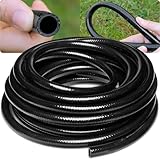
- Flexible 50ft 1/2" drip irrigation tubing that bends around raised beds, greenhouse staging, and irregular garden layouts without kinking or cracking. At 0.5" ID / 0.65" OD it is compatible with all standard quick-connect irrigation system fittings for fast tool-free assembly. High-quality durable construction supports above-ground and underground installation — ideal mainline for any garden drip irrigation system or vegetable garden watering system.
- Make gardening less of a chore - Easy to assemble and use, the Carpathen drip tubing 1/2 inch will feed your plants immediately. Just cut your 1/2 inch tubing to the desired length and use it as a supply drip line irrigation for your garden irrigation system. Save your time and let the drip irrigation tubing 1/2 inch water your raised garden beds, window boxes, garden rows, orchards, ground cover, or other landscaped areas.
- Create your garden watering system with high-quality drip irrigation parts easier than ever. The 1/2 tubing can serve as the main drip irrigation 1/2 inch tubing for your drip irrigation kit and water your plants efficiently. Branch out with the 1/4 irrigation tubing and connect it to the drip irrigation emitters. Your DIY home irrigation system enhances plant growth, making garden care more enjoyable. Get ready to enjoy a thriving garden – all thanks to our easy-to-use 1/2 inch irrigation tubing
- Spend less, get more - The Carpathen 1/2 inch poly tubing is UV resistant and designed for underground irrigation or above-ground installation. This 1/2 poly tubing will last year-round on any weather. Season after season the drip irrigation system 1/2 inch tubing will keep your plants hydrated with minimal waste from evaporation. The flexibility of the black tubing enables it to perfectly fit tight planting areas with curves or switchbacks. Choose to cut down your water bills!
- Your garden's best friend – we trust our irrigation system parts so much that if your 1/2 inch irrigation tube ever hiccups, we've got you covered. No cost, no fuss, just our fantastic customer service. With every 1/2 drip tubing, we're not just delivering a tool but an unwavering commitment to you. Your garden deserves nothing but the best, and so do you. Let's nurture your garden and your trust, one drip at a time.
Ignoring grade and outlet on drainage work
Problem: The trench is deep enough but water does not reach a legal, functioning outlet. Fix: Establish elevations and grade before selecting the machine and verify them during excavation.
Skipping carrier compatibility
Problem: An attachment mounts but has inadequate hydraulic flow, pressure, lift capacity or control. Fix: Compare the attachment specification with the exact carrier model and consult the manufacturer or rental provider.
Underestimating access
Problem: The selected ride-on cannot pass a gate, turn at the endpoint or operate without damaging finished surfaces. Fix: Measure the entire route and consider a smaller pedestrian machine, staged access or another approved excavation method.
Worked selection examples
Residential lawn irrigation
An irrigation plan calls for a short lawn run with a shallow trench and narrow pipe. After confirming the design and local cover requirements, measure the narrowest gate and identify roots or compacted areas. A pedestrian trencher may be appropriate if its actual chain width and rated depth exceed the plan and its teeth suit the soil. The UC IPM 8–10-inch-deep, 4-inch-wide example can help visualize a lawn installation, but it does not replace the project’s specifications.
Outdated Drivers Are Slowing You Down
One free scan finds every outdated or missing driver and matches the right update for your exact hardware.Free scan · exact hardware matchWindows Errors? Fix Them Before They Spread
Repair common Windows errors and clear accumulated junk for a smoother, more stable PC - no reinstall needed.Free scan · no reinstallSubsurface drainage
A drainage installation needs a specified depth, continuous grade, pipe, bedding and outlet. Choose equipment that can maintain the route and handle wet soil, then establish elevation controls before cutting. A machine with greater maximum depth is not a substitute for a grade plan or stable trench-management procedure.
Long utility corridor
A long communications or electrical run may exceed the practical production of a walk-behind trencher. Compare a ride-on or compatible attachment using the designed width and cover, soil and rock conditions, access, transport and carrier hydraulics. Complete utility locating and conflict resolution before committing to the route.
Quick Recap
Product prices and availability are accurate as of the date/time indicated and are subject to change. Any price and availability information displayed on Amazon at the time of purchase will apply.

