Free tools Windows power users keep installed
One-click scans. No signup required.
In a typical United States household, an ordinary receptacle is nominally 120 volts AC at 60 Hz. The terms 110 V and 115 V are common older labels or rating conventions for the same general North American voltage class. A U.S. home normally has 120/240-V split-phase service: standard outlets use about 120 V, while selected high-power appliances use approximately 240 V between two hot legs.
In many countries outside North America, the modern nominal household supply is 230 V at 50 Hz, often described casually as 220–240 V. The number printed on an appliance, the country where it is used, and the voltage measured at a particular receptacle are related—but they are not always the same thing.
As an Amazon Associate I earn from qualifying purchases.
The short answer
| Question | Best modern answer |
|---|---|
| What voltage is a normal U.S. wall outlet? | 120 V AC nominally, usually at 60 Hz |
| Why do people say 110 V or 115 V? | They are older shorthand, equipment ratings, or descriptions of the 120-V class—not usually separate modern utility systems |
| What does 240 V mean in a U.S. home? | Approximately 240 V between the two hot legs of a 120/240-V residential service, used by some dryers, ranges, water heaters, and other large loads |
| What is the usual household voltage in Europe and many other countries? | 230 V AC nominally at 50 Hz, commonly called 220–240 V |
These are nominal values. A receptacle does not have to measure exactly 120.000 V or 230.000 V at every moment. Utility regulation, demand, wiring length, transformer distance, and the measurement itself can produce a reading above or below the nominal number.
Outdated Drivers Are Slowing You Down
One free scan finds every outdated or missing driver and matches the right update for your exact hardware.Free scan · exact hardware matchPC Slower Than It Used to Be?
A free scan shows the junk files, broken settings and background clutter dragging Windows down - then fixes them in one click.Free scan · Windows 10 & 11What 110, 115, and 120 volts actually mean
110 V
“110 V” is still widely used in conversation, product listings, and older documentation for the North American household system. It normally means the 120-V class rather than a promise that the outlet will measure exactly 110 V.
#1 Best Overall

- Additional Tips - The following incorrect operations may cause the multimeter not to show results: Firstly, the plugs of test leads are not fully inserted or not inserted into the correct sockets. Secondly, the manual rotary switch is not placed in the correct position. In addition, this meter can not test all AC Current and below 100mV AC Voltage. Please check the user manual carefully before measurement.
- Versatile Digital Multimeter - Accurately measures AC/DC Voltage, DC Current, Resistance, and Diode. This Multimeter is a really useful tool for solving industrial and household electrical issues. Suitable for Household Outlets, Fuses, Batteries (including Vehicles), Automotive Circuit Troubleshooting, Charging Systems, Testing electronics in Cars etc.
- Troubleshooting with Accuracy - This Multimeter has a sampling speed of 2 times per second; Built-in a backlight LCD display with 3 ½ digits (1999 count) 0.6”, and high polarity including negative and positive readings.
- Ensures Safety - Double fuse is anti-burn and protects from overloading. The silicone cover can protect the multimeter from failing damage and prevent electric shocks. And low battery indication will be displayed when battery power is low.
- Ease of Use - Support Data Hold and Continuity Buzzer. Includes Convenient feature like LCD Backlit Screen makes it easy to use in dimly light areas. Batteries/Set of Test Leads/User Manual are Included.
That shorthand does not make every device marked “110 V” automatically safe on every other supply. The appliance’s voltage and frequency label and the manufacturer’s instructions control. Never connect a device intended for the 110/120-V class directly to a 220–240-V outlet.
115 V
“115 V” is another designation associated with the same general class. It appears in motor, appliance, and technical specifications and may reflect a rating convention rather than a separate residential utility voltage.
For practical purposes, a 115-V appliance is often intended for a nominal 120-V North American circuit, but the permitted input range varies by product. Motors and other equipment can be particularly sensitive to voltage drop, so use the manufacturer’s stated range rather than guessing from the label alone.
Quick wins for a faster PC:
Scan for outdated or missing drivers - takes under a minuteDriver Scan →Clear out junk files and repair common Windows errorsFree Scan →Fix the driver behind crashes, sound loss and screen glitchesFind Drivers →120 V
120 V is the modern nominal voltage for ordinary U.S. household receptacles. Most standard 120-V branch circuits use one hot leg and a neutral conductor. The neutral is the midpoint of the residential service, which is why a typical outlet receives about 120 V from hot to neutral.
Why a U.S. home has both 120 V and 240 V
U.S. residential service is commonly described as 120/240 V, single-phase, split-phase service. The service has two hot legs that are opposite in phase, with a neutral between them:
Rank #2

- VERSATILE FUNCTIONALITY: Measures AC/DC voltage up to 600V, 10A DC current, 2MΩ resistance; additional features include continuity, diode test and battery test
- LEAD-ALERT PROTECTION: LEDs on the meter illuminate to indicate proper test lead placement, enhancing accuracy and safety during measurements
- BACKLIT DISPLAY: LCD shows clear readings in low-light conditions for enhanced visibility
- BATTERY TEST: Battery test mode can be used for checking if batteries are working
- CONVENIENT FEATURES: Test lead holders on the back of the meter, kickstand and optional magnetic hanger (Cat. Nos. 69445 or 69417) for hands-free operation
- Hot leg 1 to neutral: approximately 120 V
- Hot leg 2 to neutral: approximately 120 V
- Hot leg 1 to hot leg 2: approximately 240 V
Ordinary receptacles normally use one hot leg and neutral. A high-power appliance can use both hot legs, producing approximately 240 V. This is the arrangement behind many electric dryers, ranges, ovens, water heaters, heat pumps, welders, and other dedicated loads. The exact circuit requirements depend on the appliance and local electrical code.
A 240-V circuit is not simply “a stronger 120-V outlet.” It may require a different receptacle, two-pole overcurrent protection, larger conductors, grounding and neutral arrangements appropriate to the equipment, and installation by a qualified electrician. Do not change a receptacle or move wires to obtain 240 V.
Do these 3 things before closing this tab:
1Scan for outdated or missing drivers - takes under a minute2Repair Windows errors before they cause bigger problems3Fix the driver behind crashes, sound loss and screen glitchesWhy a meter may show 110, 115, 118, 120, or 125 V
A nominal voltage identifies the intended system or voltage class. It is not an exact, unchanging measurement at every point of use.
Voltage can vary because of:
- Normal utility-voltage regulation
- Distance from the distribution transformer
- Voltage drop in branch-circuit wiring
- Large loads starting or running elsewhere on the circuit
- Loose, damaged, overloaded, or poorly terminated wiring
- Differences between the service entrance and the receptacle
- The accuracy, range, and condition of the measuring instrument
Consequently, a healthy 120-V system may produce readings such as 115, 118, 120, or 125 V depending on where and when it is measured. A single reading that is slightly different from the nominal value does not by itself prove that the home has a different electrical system.
Concern is warranted when the reading is substantially outside the expected range or when it is accompanied by flickering lights, buzzing, hot receptacles, burning smells, repeated breaker trips, equipment damage, or unexplained changes in appliance behavior. Stop using the affected circuit and contact a qualified electrician or the utility. Do not remove the receptacle cover or open the service panel to investigate unless you are properly qualified.
Rank #3
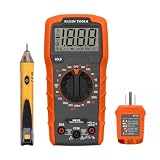
- VERSATILE MULTIMETER: Measures up to 600V AC/DC voltage, 10A DC current, and 2MOhms resistance
- CONTINUITY TESTING: MM320 multimeter with visual and audible indicators for testing continuity
- NON-CONTACT VOLTAGE TESTER: NCVT1P with bright LED indicating working status, changing to red and producing audible tones when voltage is detected
- HIGH-INTENSITY VOLTAGE DETECTION: NCVT1P with bright red LED and audible tone for detecting voltage in the range of 50 to 1000 VAC
- RELIABLE RECEPTACLE TESTER: Klein's Cat. No. RT110 detects wiring configurations, indicates correct wiring, and identifies common wiring faults
220 V and 240 V are not always the same thing
In the United States, “240 V” generally refers to the line-to-line voltage available from a 120/240-V residential service. “220 V” is often used informally for the same broad high-voltage category, especially in older descriptions, but the actual nominal system and allowed operating range should be verified.
Outside North America, “220–240 V” is commonly used as a consumer-friendly description of systems whose modern nominal value is generally 230 V. The exact supply may vary by country, installation, and tolerance. Therefore, “220 V,” “230 V,” and “240 V” should not be treated as interchangeable labels for every appliance or circuit.
Common household voltage by location
| Location or system | Nominal household supply | Frequency | Practical meaning |
|---|---|---|---|
| United States, ordinary receptacles | 120 V | 60 Hz | Standard household plug voltage; 110 V and 115 V are common shorthand or rating terms |
| United States residential service | 120/240 V | 60 Hz | Two approximately 120-V hot-to-neutral legs and approximately 240 V hot-to-hot |
| Canada and much of the North American system | 120/240 V | 60 Hz | Ordinary appliances commonly use 120 V; high-power appliances may use 240 V |
| Europe and many IEC-based systems | 230 V | 50 Hz | Often described in consumer materials as 220–240 V |
| Australia | 230 V | 50 Hz | Household mains are commonly identified as 230 V, 50 Hz |
| Japan | 100 V | 50 or 60 Hz, depending on region | Japan is not a 110/120-V or 220/240-V household system |
This table describes prevailing systems, not every installation. A building may contain dedicated circuits, transformers, generators, converters, legacy wiring, or site-specific equipment. Check the property, circuit, appliance label, and local utility information before connecting equipment.
Frequency matters as much as voltage
Voltage is only one part of electrical compatibility. The United States commonly uses 60 Hz, while many 220–240-V countries use 50 Hz.
Frequency can matter especially for motors, clocks, pumps, fans, compressors, heating controls, and some transformers. A device rated 100–240 V, 50/60 Hz is generally designed to accept power across that voltage and frequency range, subject to its instructions. A device marked only 120 V, 60 Hz should not be connected directly to a 230-V, 50-Hz supply.
Rank #4

- VERSATILE MEASUREMENTS: Digital Multimeter accurately measures up to 600V AC/DC voltage, 10A DC current, and 2 ohm resistance, offering precise readings for various electrical tasks
- EXTENSIVE FUNCTIONALITY: In addition to voltage, current, and resistance, the meter tests batteries, diodes, and continuity, providing comprehensive testing capabilities in one device
- DUAL-RANGE VOLTAGE DETECTION: Voltage Tester NCVT3P detects from 12 to 1000V AC or 70 to 1000V AC, accommodating a wide range of low-voltage and standard voltage applications
- BUILT-IN FLASHLIGHT: The NCVT3P features a bright flashlight that illuminates the work area, offering convenient visibility and independent use from the voltage detection function
- ACCURATE AND WIDE-RANGE TESTING: ET45 tests AC voltages from 28V to 240V AC and DC voltages from 32V to 330V, covering commonly used residential voltages for reliable testing
Some electronic power supplies automatically accommodate different voltages and frequencies; others require a manual selector or are single-voltage devices. Read the input label rather than inferring compatibility from the plug shape.
How to check an appliance before using it abroad
- Find the input label. Look on the rating plate, power brick, cord tag, or manufacturer documentation for voltage and frequency.
- Identify whether it is single-voltage or dual-voltage. “100–240 V, 50/60 Hz” indicates broad input compatibility. “120 V, 60 Hz” does not.
- Check the wattage or amperage. High-power appliances place heavy demands on converters and adapters.
- Determine the required plug shape. A physical plug mismatch is separate from an electrical-voltage mismatch.
- Use the correct equipment. A plug adapter changes the shape of the connection. It does not change voltage or frequency.
- Follow the manufacturer’s restrictions. Some converters are unsuitable for motors, electronically controlled appliances, heating devices, or sensitive equipment.
Typical compatibility cases
- 120 V, 60 Hz only: Intended for the North American 120-V class. Do not connect it directly to 220–240 V.
- 220–240 V, 50 Hz only: Intended for a higher-voltage supply. It will not operate correctly from a North American 120-V receptacle unless an appropriate step-up transformer or converter is specified.
- 100–240 V, 50/60 Hz: Usually suitable worldwide within that stated range. You may still need a plug adapter.
- 115/230 V selectable: Set the selector exactly as directed before connection. A wrong setting can destroy the device and create a shock or fire hazard.
For a single-voltage hair dryer, iron, heater, or cooking appliance, a plug adapter alone is not enough when the destination voltage differs. A converter or transformer must be suitable for the appliance’s wattage and type. High-wattage or motor-driven products deserve particular caution.
How to measure the voltage at an outlet
The most direct consumer-level method is an appropriately rated digital multimeter set to AC voltage. This is a live-voltage measurement and is not an appropriate beginner experiment if you are unfamiliar with electrical testing.
If you already know how to use a multimeter safely
- Inspect the meter, leads, and probes for damage.
- Confirm that the meter and probes have an appropriate voltage and measurement-category rating for the installation.
- Insert the black lead into COM and the red lead into the voltage/resistance input—not a current or amperage jack.
- Select AC voltage, often shown as V~. Use the highest range first if the expected voltage is unknown.
- Keep your fingers behind the probe guards and touch only the insulated portions of the leads.
- Measure at the receptacle without touching the metal probe tips. For a standard U.S. outlet, hot-to-neutral should be around 120 V; hot-to-ground should be similar on a correctly wired receptacle; neutral-to-ground should normally be close to 0 V.
- Remove the probes carefully, then return the meter to a safe setting.
Critical warning: Never place a test lead in a current jack while measuring outlet voltage. That can create a short circuit, arc, serious injury, or fire. If you are unsure which function, range, or connection to use, do not probe the outlet. Have a qualified electrician measure it.
receptacle testers and non-contact testers: useful, but limited
A plug-in receptacle tester can provide a quick indication of common wiring conditions on compatible three-wire outlets. A typical 110/125-V tester may indicate issues such as open ground, reverse polarity, open hot, or open neutral through a light pattern.
It is not a precision voltage meter and cannot provide a complete diagnosis. Basic testers may miss certain dangerous conditions, including some problems involving bootleg grounds, shared neutrals, intermittent faults, wiring capacity, or problems upstream of the receptacle. Treat the result as an initial indication, not proof that the circuit is safe.
A non-contact voltage tester can be useful as a preliminary presence/absence check, but it does not tell you whether the outlet is 110, 115, or 120 V. False positives and false negatives are possible because of tester design, battery condition, wiring arrangement, shielding, and the environment. It should not replace a properly rated meter or professional diagnosis.
Independent reader supportYour contribution helps us test, update, and keep practical guides available for everyone.When the voltage reading is abnormal
Do not keep testing a suspicious circuit merely to obtain a more precise number. Use this decision guide:
Recommended Free Tools
Best Value

- Accurately Test Full Features: Accurately measures AC/DC voltage, DC current, resistance, continuity test, diode and batteries.
- High Quality & Safety :Our multimeter is designed to safely and accurately troubleshoot a variety of automotive and household electrical problems. Overload Protection on all ranges to ensure long-term service life,Low Battery Indication, Audible continuity sensor checks that the circuit or wires conduct electricity. Double insulation with a good angled stand for hand free use.
- EASY TO USE: 2.7"Large Backlit LCD Display, Data Hold, Easy to Read Large Back-light Screen forvisibility in dimly light areas. Our mutimeter tester is widely used in Car repair, Homeuse, Schools, laboratories, Families and factories, suitable for Car Drivers, Beginners,Professional Electricians, Housewives, Students Use.
- Nice Protective Orange Shell with Stand Built: Our digital multimeter can be hand held or stood using its fold out stand. Removable thick rubber cover is made of kind of non-slip slightly soft plastic that will help with drop protection & minor bumps protection.
- 2 YEARS Quality Guarantee & Included 9V Battery: The compartment lid at the back is easy to remove. Battery/Set of Test Leads/User Manual are Included.They guarantee against faulty materials and workmanship for 2 years-giving you total peace of mind. If there is any issue within24 months of your purchase, we will replace it for vou with no doubt.
- Slightly below or above 120 V, with no symptoms: The reading may be normal voltage variation. Compare only with an appropriate reference and consult an electrician if the difference is persistent or unusual for the property.
- Large or unstable changes: Stop using sensitive or high-power equipment and contact an electrician or utility.
- Flickering lights, buzzing, heat, burning odor, or damaged appliances: Turn off the affected circuit if it can be done safely and obtain professional help promptly.
- Different outlets show dramatically different voltage: Do not assume the outlets are on different nominal systems. A wiring fault, loose connection, or supply problem may be involved.
- You are considering opening an outlet, panel, junction box, or appliance: Stop and use a qualified electrician.
Common mistakes to avoid
- Calling every U.S. outlet exactly 110 V
- Assuming 110 V, 115 V, and 120 V are interchangeable for every device
- Assuming every U.S. receptacle provides 240 V
- Calling every international supply 220 V when its modern nominal value is 230 V
- Ignoring 50-Hz versus 60-Hz compatibility
- Believing a plug adapter converts voltage
- Using a converter without checking wattage, appliance type, and frequency
- Using a receptacle tester as proof that an outlet is safe
- Putting a multimeter lead in the amperage jack during a voltage test
- Removing outlet covers or probing exposed conductors to answer a basic voltage question
Frequently Asked Questions
Is household voltage 110 or 120 volts in the United States?
The modern nominal voltage for an ordinary U.S. receptacle is 120 V AC at 60 Hz. “110 V” is common shorthand and may also describe older terminology or a measured value, but it is not usually a separate modern residential system.
Is 115 V the same as 120 V?
They belong to the same general North American voltage class, and 115 V often appears as an equipment rating or technical designation. The manufacturer’s specified input range controls whether a particular device is suitable.
Does a normal U.S. outlet provide 240 volts?
Normally, no. A standard receptacle supplies approximately 120 V. A U.S. home may have approximately 240 V between its two hot service legs for dedicated circuits serving equipment such as ranges, dryers, and water heaters.
Is 220 V the same as 240 V?
Not necessarily. In the United States, 240 V generally refers to the line-to-line residential supply used by some large appliances. In many other countries, 220–240 V is shorthand for a system whose modern nominal value is usually 230 V. Check the actual appliance and installation ratings.
What’s actually slowing this PC down?
Pick the symptom - the matching free tool is one click away.
Will a plug adapter convert 220 V to 120 V?
No. A plug adapter changes only the physical plug configuration. A single-voltage appliance needs a suitable voltage converter or transformer when the destination supply differs, and frequency and wattage must also be compatible.
Can I measure an outlet with a multimeter?
Only if you understand live electrical measurements and have an appropriately rated meter and leads. Set the meter to AC voltage, use COM and the voltage input, never the current jack, and do not touch the probe tips. If there is any uncertainty, use a qualified electrician.
The Bottom Line
For a normal U.S. household outlet, say 120 V AC at 60 Hz. “110 V” and “115 V” are common shorthand or rating conventions for that voltage class. U.S. residential service is generally 120/240 V, so dedicated high-power circuits may provide approximately 240 V. In much of Europe, Australia, and other IEC-based systems, the modern nominal supply is 230 V at 50 Hz, commonly described as 220–240 V. Before connecting equipment, verify both voltage and frequency on the appliance label—and remember that a plug adapter does not convert either one.
Quick Recap
Product prices and availability are accurate as of the date/time indicated and are subject to change. Any price and availability information displayed on Amazon at the time of purchase will apply.




