Some links on this page are affiliate links: if you buy through them we may earn a commission, at no extra cost to you.
Household dust is the material that settles after your home has been collecting particles from people, pets, outdoor air, fabrics, cooking, combustion, building materials, and mechanical systems. It is not mostly dead skin, and it is not just dirt. In a typical home, dust can include outdoor soil, soot, pollen, mold spores, textile fibers, skin flakes, pet dander, dust mite fragments, insect debris, bacteria, microplastics, drywall dust, sawdust, and, in older homes, hazardous legacy materials such as lead-based paint dust or asbestos-containing material.
The practical answer is this: you reduce dust by controlling the source first. Cleaning matters, but cleaning alone is a treadmill if soil is being tracked in daily, return ducts are pulling air from a crawlspace, bath fans do not exhaust outdoors, the HVAC filter is loose in the rack, or a remodel is cutting drywall without containment.
As an Amazon Associate I earn from qualifying purchases.
On our job sites, we think of dust as a budget. Every home gets some dust. The goal is to spend less of that budget: less brought in at the door, less generated by materials, fewer places for dust to hide, better capture at the HVAC and room level, and safer containment when construction is happening.
What Household Dust Is Actually Made Of
Dust is a changing mix, not one substance. The dust in a house beside a gravel road is different from the dust in a sealed urban apartment, and both are different from the dust in a home with pets, carpet, a wood-burning fireplace, or an active remodel.
Popular on Amazon

- POWERFUL UPRIGHT VACUUM CLEANER: DuoClean PowerFins Technology combines two brushrolls—a PowerFins and soft roller—for nonstop contact to deep clean carpets and area rugs, directly engage hard floors, and pick up more debris in every pass (vs. original DuoClean)
- LIFT-AWAY ABOVE-FLOOR CLEANING: Step on the easy-release pedal to detach the lightweight Lift-Away pod for portable cleaning on stairs, furniture, baseboards, ceilings, and other above-floor areas
- SELF-CLEANING BRUSHROLL: Delivers powerful pet hair pickup with no hair wrap, continuously removing hair from the brushroll as you clean carpets and hard floors—ideal for homes with pets
- HEPA FILTRATION & ANTI-ALLERGEN SEAL: The HEPA filter and Anti-Allergen Complete Seal Technology trap 99.9% of dust and allergens inside the vacuum cleaner for whole-home cleaning—great for allergy-prone households
- PERFECT FOR PETS: The Pet Power Brush tackles stubborn pet hair on stairs and upholstery, while the Upholstery Tool removes embedded hair and debris from furniture and other fabric surfaces
Common household dust can include:
- Outdoor soil and road particles: fine dirt, sand, tire residue, soot, and particles carried in on shoes, paws, clothing, and outdoor air.
- Human and pet material: skin flakes, hair, pet dander, saliva proteins, and tracked-in debris from animals.
- Textile fibers: lint from clothing, bedding, upholstery, carpet, curtains, towels, and rugs.
- Biological particles: pollen, mold spores, bacteria, dust mite bodies and droppings, and insect fragments.
- Combustion particles: smoke, candle soot, fireplace residue, gas cooking byproducts, and particles from attached garages.
- Construction material: drywall dust, joint compound, sawdust, insulation fibers, concrete dust, tile dust, and paint sanding residue.
- Legacy hazards: lead dust from pre-1978 paint and asbestos fibers from certain older flooring, insulation, mastics, siding, and ceiling materials when disturbed.
One useful modeling estimate summarized by EPA research found that about 31.3% of indoor dust came from outdoor soil alone. Other summaries that count airborne outdoor particles estimate an even larger outdoor contribution. That matches what builders see in real houses: entryways, leaky doors, garage connections, open windows during high-pollen seasons, and unsealed crawlspace or attic pathways can load a home with particles faster than a vacuum can keep up.
Why Some Homes Get Dusty So Fast
If you wipe a table on Monday and see a gray film again by Wednesday, the house is telling you something. It may be a normal lifestyle load, or it may be a building problem.
Outdated Drivers Are Slowing You Down
One free scan finds every outdated or missing driver and matches the right update for your exact hardware.Free scan · exact hardware matchPC Slower Than It Used to Be?
A free scan shows the junk files, broken settings and background clutter dragging Windows down - then fixes them in one click.Free scan · Windows 10 & 11Normal dust drivers
Some homes simply have more particle sources. Pets, children, high foot traffic, carpet, open shelving, heavy curtains, older upholstery, wood stoves, candles, and frequent open-window ventilation all increase the dust load. A family of five with two dogs and carpeted stairs will produce and move more dust than two adults in a home with hard floors and closed storage.
Building defects that look like dust problems
Dust can also be a symptom of the house not managing air properly. We look harder when a homeowner says the dust is black, gritty, musty, or concentrated around vents and baseboards.
Possible defects include:
- Leaky return ducts: return leaks can pull dusty air from attics, crawlspaces, wall cavities, basements, or garages.
- Filter bypass: a good filter does little if air can go around it through gaps in the rack.
- Negative pressure: powerful exhaust fans, clothes dryers, or leaky ductwork can pull unfiltered air through cracks.
- Bath fans that do not terminate outdoors: moisture and lint can accumulate in cavities if exhaust is dumped into an attic or soffit area.
- Crawlspace communication: gaps around plumbing, ducts, and floor penetrations can carry soil dust, moldy odors, and humidity into living space.
- Deteriorating duct liner: older internal duct lining can shed particles if damaged or breaking down.
For construction and remodeling, dust is often predictable. Cutting cement board, sanding joint compound, grinding concrete, removing plaster, and tearing out carpet can create a major short-term dust load. The difference between a clean remodel and a miserable one is planning: containment, tool extraction, protected returns, daily cleanup, and final detail cleaning.
The Dust Budget: Five Ways to Reduce Dust Before It Spreads
The most effective strategy is not buying one expensive machine. It is stacking several practical controls. Start with the cheapest source controls, then improve cleaning, filtration, and ventilation where they make sense.
Recommended Free Tools
1. Stop outdoor dust at the door
A strong entry system is one of the best low-cost dust controls in a home. We like a three-zone setup:
- Zone 1: Outdoor scraper mat. Use a coarse mat outside each main entry. A practical size is at least 24 by 36 inches for a secondary door and 36 by 60 inches or larger for the main family entry.
- Zone 2: Indoor absorbent mat. Inside the door, use a washable or easy-vacuum mat long enough for two steps. That usually means 3 to 5 feet of walk-off surface.
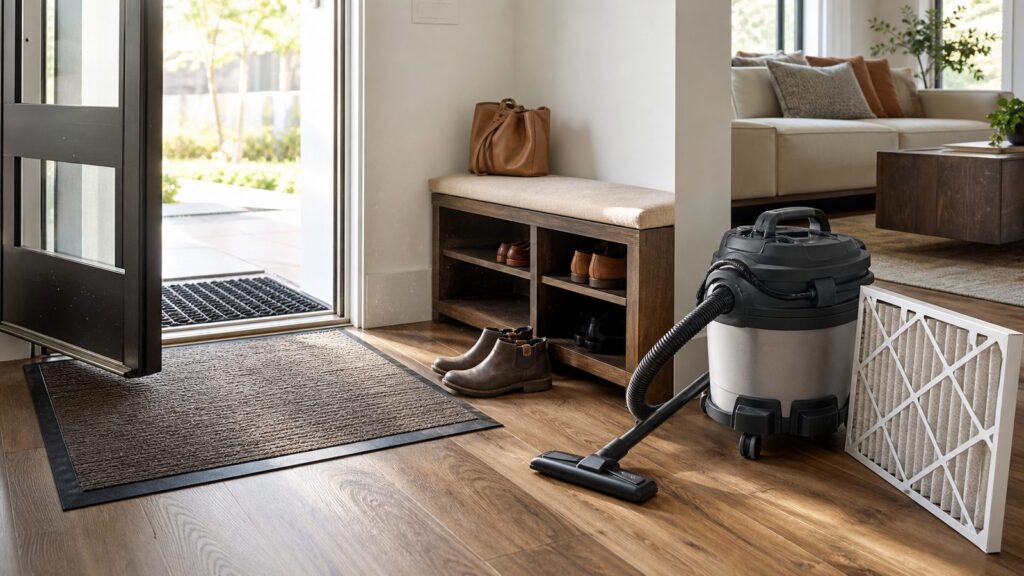
- Zone 3: shoe storage and bench. Give people a place to sit and remove shoes. A 12- to 18-inch-deep bench and a simple tray or cubby system can prevent soil from moving into the house.
For homes with dogs, add a towel hook, paw-wipe basket, or washable runner near the most-used door. This is not decorative housekeeping; it is source control.
2. Choose finishes that do not store dust
Dust loves rough surfaces, soft fibers, deep trim profiles, open shelving, and clutter. Hard, smooth, cleanable finishes make a measurable difference in how dusty a room feels.
In high-dust or allergy-sensitive rooms, favor sealed wood, tile, luxury vinyl plank, smooth painted walls, simple baseboards, closed cabinets, washable roller shades, and low-pile washable rugs. Carpet can be comfortable, but it is also a dust reservoir. If a bedroom or playroom stays dusty despite regular cleaning, carpet removal may be worth pricing. Current 2026 cost guides put carpet removal around $120 to $720 for many projects, about $280 on average, or roughly $0.50 to $5.10 per square foot. Stairs, glued carpet, disposal fees, subfloor repairs, moisture damage, or mold concerns can push the cost higher.
3. Clean with capture, not redistribution
A feather duster can make a room look cleaner for 20 minutes while moving particles back into the air. Better dust control uses damp wiping, microfiber, and sealed HEPA vacuuming.
A practical weekly routine is:
- Vacuum high-traffic floors and rugs at least once a week, more often with pets.
- Damp dust hard surfaces with a microfiber cloth instead of dry sweeping dust into the air.
- Vacuum upholstery, stair treads, and rug edges where dust accumulates.
- Clean top-down: fans and high shelves first, counters and trim next, floors last.
- Use a sealed HEPA vacuum, preferably bagged, if allergies or fine dust are a concern.
Consumer HEPA vacuums range widely, from budget bagged models in the low hundreds to premium sealed cordless or canister systems around $500 to $850 and above. For dust control, sealed HEPA filtration and clean disposal matter more than marketing claims about suction.
Also popular on Amazon

- POWERFUL SUCTION. Dirt, fur & dust don’t stand a chance against the Pet Hair Eraser Allergen Lift-Off vacuum’s suction power.
- LIFT-OFF DETACHABLE POD. Conveniently clean anywhere in your home, even hard-to-reach areas, with the lightweight canister and quick-release extension wand.
- HEPA SEALED ALLERGEN SYSTEM. This vacuum captures dust allergens inside the vacuum so they don’t escape back into the air you breathe.
- TANGLE-FREE BRUSH ROLL. Cut the hassle, not the hair. This vacuum is designed to handle hair and fur.
- SCATTER-FREE TECHNOLOGY. Vacuuming hard floors shouldn't be a headache. Strong suction and scatter-free technology makes cleaning a breeze.
4. Manage humidity for dust mites and mold
Dust mites are common in U.S. homes. NIEHS has reported detectable dust mite allergen in beds in 84% of homes, with more than 45% having bedding concentrations associated with allergy development. Dust mites feed on organic material and thrive in humid textiles, especially bedding, mattresses, upholstered furniture, and carpet.
For bedrooms, the best first moves are not exotic. Use allergen encasements on mattresses and pillows, wash bedding weekly, dry bedding thoroughly, vacuum with HEPA filtration, and keep indoor relative humidity below about 50%. A $10 to $25 digital hygrometer is enough to know whether humidity is part of the problem. If summer indoor humidity stays above 55% to 60%, the answer may be HVAC runtime, duct leakage, ventilation balance, basement moisture control, or a dehumidifier rather than more cleaning.
Quick wins for a faster PC:
Fix the driver behind crashes, sound loss and screen glitchesFind Drivers →Clear out junk files and repair common Windows errorsFree Scan →Scan for outdated or missing drivers - takes under a minuteDriver Scan →5. Capture particles with the right filtration
HVAC filters are not all equal. Many inexpensive filters mainly protect equipment from large debris. They are not designed to capture the finer particles that affect indoor air quality. MERV 13 filters can reduce finer particles when the HVAC system can handle the added resistance.
Before upgrading filters, photograph the filter size, filter rack, and return locations. A filter that is 1/4 inch undersized, bowed, installed backward, or surrounded by bypass gaps will underperform. Retail MERV 13 filters in 2026 often cost about $18 to $25 each for common 1-inch sizes and about $50 to $65 each for 4-inch media filters, depending on brand, size, pack quantity, and replacement frequency.
If you move to MERV 13, ask an HVAC contractor to verify static pressure and airflow, especially on older systems, undersized returns, or equipment that already sounds strained. A high-efficiency filter that starves the blower is not an upgrade. In some homes, the right fix is a deeper media cabinet, better return sizing, duct sealing, or a whole-house filtration add-on. Installed whole-house air cleaner systems commonly land in the low thousands, with one 2026 average around $2,610, depending on equipment, duct modifications, electrical work, HVAC compatibility, and local labor.
Costs: What Dust Reduction Projects Usually Run in 2026
Dust control can be nearly free, or it can become a mechanical or remodeling project. The right budget depends on the source. Do not start with duct cleaning or a whole-house air cleaner if the real issue is a missing entry mat and carpeted bedrooms.
Free tools Windows power users keep installed
One-click scans. No signup required.
| Dust-control option | Typical 2026 cost | Best use | Watch-outs |
|---|---|---|---|
| Entry mats and shoe storage | About $50 to $300 for a practical setup | Reducing tracked-in soil at main entries | Use washable mats and enough length for several steps |
| Professional house cleaning | About $25 to $90 per cleaner-hour, or $50 to $90 per hour for a crew | Routine reset for busy homes, pets, high traffic | Price varies by size, clutter, bathrooms, soil level, and frequency |
| Whole-home deep cleaning | Commonly about $200 to $450, more for heavy dust | First-time cleanup, post-renovation residue, high shelves, blinds, trim | Construction dust and detailed surfaces add labor |
| MERV 13 HVAC filters | About $18 to $25 for many 1-inch filters; $50 to $65 for many 4-inch filters | Improving central particle capture when system airflow allows | Verify fit, bypass gaps, static pressure, and change interval |
| Portable HEPA air purifier | About $100 to $900; filters often $20 to $200 every 6 to 12 months | Bedrooms, nurseries, offices, smoke events, renovation recovery | Size by CADR for the room and maintain filters |
| Air duct cleaning | Average about $389; typical range $271 to $509; complex jobs can exceed $1,000 | Visible contamination, vermin, post-construction debris, airflow problems | Not a routine cure for normal settled dust |
| Carpet removal | About $120 to $720 for many projects; roughly $0.50 to $5.10 per sq. ft. | Removing a major dust reservoir from bedrooms, stairs, allergy rooms | Glued carpet, stairs, disposal, subfloor prep, moisture, or mold add cost |
Do Air Purifiers Reduce Dust?
Yes, portable HEPA air cleaners can reduce airborne particles, but they do not eliminate the source of dust and they do not clean settled dust from shelves, bedding, floors, or blinds. They work best in closed or semi-closed rooms where people spend hours, such as bedrooms, nurseries, offices, and living rooms.
The number to look for is CADR, or clean air delivery rate. For a bedroom, choose a unit sized for the actual square footage and ceiling height. A purifier rated for a 150-square-foot room will not do much in a 400-square-foot open family room with a vaulted ceiling. Run the unit continuously on a quiet setting rather than only turning it on after dust appears.
Maintenance matters. A clogged prefilter reduces airflow. A neglected HEPA filter becomes an expensive box fan. In dusty homes, pet homes, smoke events, or after remodeling, filter life can be shorter than the package estimate. Many replacement filters run $20 to $200 every 6 to 12 months.
Avoid ozone generators marketed as air cleaners. For occupied homes, the safer core strategy is source control, appropriate filtration, and ventilation. Ozone is not a shortcut for good dust management.
Do these 3 things before closing this tab:
1Repair Windows errors before they cause bigger problems2Fix the driver behind crashes, sound loss and screen glitches3Clear out junk files and repair common Windows errorsShould You Clean Your Air Ducts?
Air duct cleaning is one of the most oversold dust fixes. It can be useful, but it is not where we usually start.
Also popular on Amazon

- POWERFUL SUCTION FOR CARPET & HARD FLOORS: Clean carpets and hardwood floors with strong multi-surface suction. This lightweight upright vacuum cleaner lifts dirt, debris, and pet hair for a complete home clean.
- LIFT-AWAY FUNCTIONALITY FOR ABOVE-FLOOR CLEANING: Detach the pod to clean stairs, furniture, and more—attach the upholstery or crevice tools to clean dust and debris from baseboards, curtains, blinds, tight spaces and other surfaces.
- PERFECT FOR PET HAIR CLEANUP: Powerful suction and a specialized upholstery tool removes pet hair from carpets, furniture, and stairs with ease—ideal for homes with pets and everyday messes.
- HEPA FILTER WITH ANTI-ALLERGEN COMPLETE SEAL: Advanced HEPA vacuum technology traps dust and allergens* inside the vacuum, helping deliver a cleaner home environment. *Allergens refer to non-living matter.
- SWIVEL STEERING FOR EASY MANEUVERABILITY: Navigate tight spaces, corners, and around furniture with ease using smooth swivel steering for effortless control across floors.
Consider duct cleaning when there is visible debris blowing from registers, known construction debris in the ducts, evidence of vermin, visible microbial growth, a major dust event, or airflow problems that require inspection. It can also make sense after a sloppy remodel where returns were left open and the system ran during sanding or demolition.
Do not expect duct cleaning alone to fix ordinary dust on furniture. If return ducts are leaking, the filter rack has bypass gaps, or the house is pulling air from an attic or crawlspace, cleaning the duct interior without sealing the pathway is temporary. In many cases, duct sealing and return-side correction are more important than cleaning.
Typical 2026 air duct cleaning costs average about $389, with common ranges around $271 to $509. Other national pricing places many jobs around $270 to $500, while complex homes with multiple systems, difficult access, contamination, coil or blower cleaning, duct repairs, or many vents can reach $1,000 or more.
Dust During Remodeling: What Good Contractors Do Differently
Construction dust is not normal household dust. It can be sharper, finer, heavier, and sometimes hazardous. Drywall sanding dust, silica-containing dust from concrete or tile work, wood dust, insulation fibers, and paint dust should be controlled at the source.
On our job sites, dust control starts before demolition. A proper dust plan should include:
- Isolated work area: plastic barriers, zipper doors, sealed floor protection, and protected traffic paths.
- Covered or disabled returns: HVAC returns in the work zone should be protected so the system does not distribute dust through the house.
- Negative pressure: air should move from clean areas toward the contained work zone, then through filtration or safe exhaust.
- HEPA extraction at tools: saws, sanders, grinders, and drywall tools should capture dust where it is made.
- Daily HEPA cleanup: not just sweeping. Dry sweeping fine construction dust makes it airborne again.
- Final detail clean: high surfaces, walls, trim, cabinets, counters, floors, registers, and filter changes.
After renovation, clean top-down. Start with ceilings, fans, high shelves, and light fixtures. Move to walls, trim, cabinets, counters, and windowsills. Finish with floors. Change HVAC filters after the dust-producing phase and again after final cleanup if the load is heavy.
Older homes need extra caution
Homes built before 1978 may contain lead-based paint. Work that disturbs painted surfaces can create lead dust, which is especially dangerous for children and pregnant people. Renovation, repair, and painting work in many pre-1978 homes must follow EPA lead-safe rules, including certified practices for containment, dust minimization, and cleanup.
What’s actually slowing this PC down?
Pick the symptom - the matching free tool is one click away.
Asbestos is also a concern in some older materials, including certain floor tiles, mastics, pipe insulation, siding, textured coatings, and insulation products. The rule is simple: do not sand, grind, saw, scrape, or demolish suspect materials until they are identified. Testing is cheaper than contaminating a house.
Ventilation, Exhaust, and Dust: The Building-Science Side
Ventilation helps dilute indoor pollutants, but uncontrolled air leakage can bring dust in from bad places. A home should exhaust moisture and pollutants outdoors while filtering or intentionally supplying replacement air.
Also popular on Amazon

- 【550W High-Power Motor & 45kPa Strong Suction】 Powered by a 550W motor, this cordless vacuum delivers up to 45,000Pa of suction for efficient, deep cleaning. Effectively lifts embedded dirt, fine dust, and stubborn pet hair from hardwood, carpet, and tile floors. Lightweight and tangle-free, it’s an ideal choice for daily maintenance in family homes, apartments, and pet-friendly households.
- 【Upgraded Tangle-Free Turbo Brush & LED Headlight – The Pet Hair Terminator】The Upgraded anti-tangle roller prevents hair wrap—lab-tested to handle hair from up to 6 pets with zero tangles. Built-in LED lights reveal hidden dust under furniture, making it a must-have for pet owners and long-haired households.Note:Easy Care for Lasting Power: Remove tangled hair from the brush head weekly and empty the dust cup at the MAX line. Simple routine maintenance ensures consistent, reliable performance.
- 【One-Touch Hygienic Emptying – No Mess, No Hands】 The patented one-touch ejection system empties the dustbin in just 3 seconds—hands never touch dirt. Sealed design contains dust and allergens, preventing secondary pollution for a cleaner, healthier home.
- 【 Dual HEPA + Stainless-Steel Filtration】The dual-layer HEPA and stainless-steel filter system traps up to 99.99% of fine dust, pet dander, helping maintain cleaner indoor environments.Ideal for allergy sufferers and families seeking fresher, purer indoor air.
- 【Ultra-Lightweight & Maneuverable – Lighter Than a Water Bottle】Weighing only 6 lbs (3.3 kg) with a low-profile design and 180° swivel steering, it glides effortlessly under furniture and cleans stairs with ease. The adjustable telescopic tube suits all family members—adults, seniors, and teens—enabling comfortable cleaning without bending or strain.
Kitchen and bath exhaust should terminate outdoors, not into attics, crawlspaces, garages, or wall cavities. Modern residential codes require exhaust systems to discharge outdoors in proper locations. That matters because a bath fan dumping humid air into an attic can create moisture problems, insulation contamination, and dusty or moldy air pathways back into the home.
Balanced pressure matters too. A powerful range hood, several bath fans, a clothes dryer, and leaky return ducts can put a home under negative pressure. When that happens, the house pulls makeup air through cracks: rim joists, crawlspace gaps, attic bypasses, garage walls, recessed lights, and plumbing penetrations. Dust follows the air.
Practical signs of pressure or leakage problems include:
- Dust streaks around baseboards, attic hatches, outlets, or recessed lights.
- Musty dust smells when the HVAC system runs.
- Black or gray marks near supply registers.
- Rooms that are hard to heat or cool despite good equipment.
- Filters that load unevenly or quickly.
- Dust that returns immediately after deep cleaning.
These are not solved by scented sprays or more frequent dusting. They call for diagnostic work: duct inspection, pressure testing, air sealing, crawlspace review, exhaust correction, and HVAC airflow verification.
Independent reader supportYour contribution helps us test, update, and keep practical guides available for everyone.When to DIY and When to Hire a Pro
Most dust reduction starts as DIY work. Hire when the problem points to mechanical defects, hazardous materials, or construction dust that needs containment.
Good DIY dust projects
- Install a three-zone entry mat and shoe-storage setup.
- Replace loose, incorrect, or dirty HVAC filters with the right size and rating.
- Vacuum weekly with sealed HEPA filtration.
- Damp dust surfaces with microfiber cloths.
- Wash bedding weekly and use mattress and pillow encasements.
- Track humidity with a digital hygrometer and keep relative humidity below about 50% where possible.
- Declutter open shelves, fabric bins, and under-bed storage.
- Use portable HEPA air cleaners sized by CADR in bedrooms or offices.
Hire a professional when
- You suspect lead paint, asbestos, mold contamination, or vermin in ducts or cavities.
- Dust is coming from supply registers or the HVAC system smells musty or dirty.
- You are upgrading to MERV 13 and the system already has weak airflow or noisy returns.
- Bath or kitchen exhaust does not terminate outdoors.
- You need duct sealing, return-air correction, crawlspace isolation, or pressure diagnostics.
- You are remodeling and need containment, negative air, HEPA tool extraction, or post-construction cleaning.
For remodels, put dust control in the contract. Do not rely on a vague promise to “keep things clean.” Specify isolated work areas, covered returns, negative pressure where appropriate, HEPA extraction at dust-producing tools, daily cleanup, protected paths, and final detail cleaning. Those details change the lived experience of a remodel.
The Tool Desk
Outbyte PC Repair FREERepair Windows errors before they cause bigger problemsFix Now →Outbyte Driver Updater FREEScan for outdated or missing drivers - takes under a minuteDriver Scan →A Practical Room-by-Room Dust Plan
Entry and mudroom
Use the three-zone entry system: outdoor scraper mat, indoor absorbent mat, and shoe storage. Keep a washable runner on the path from the most-used door. If the garage is attached, weatherstrip the house-to-garage door and avoid storing dusty construction materials, lawn chemicals, and open debris near the entry.
Bedrooms
Bedrooms deserve priority because people spend 7 to 9 hours breathing close to bedding. Use allergen encasements, wash sheets weekly, reduce extra pillows and heavy curtains, vacuum under beds, and run a properly sized HEPA purifier if allergies are an issue. Keep relative humidity under about 50% to reduce dust mite pressure.
Living areas
Replace deep-pile rugs with low-pile washable rugs where practical. Choose closed storage instead of open shelving for items that are rarely used. Vacuum upholstery and clean fan blades monthly. If candles leave gray film on nearby walls or ceilings, reduce burn time or switch habits.
Also popular on Amazon

- POWERFUL SUCTION FOR CARPET & HARD FLOORS: Clean carpets and hardwood floors with strong multi-surface suction. This lightweight upright vacuum cleaner lifts dirt, debris, and pet hair for a complete home clean.
- LIFT-AWAY FUNCTIONALITY FOR ABOVE-FLOOR CLEANING: Detach the pod to clean stairs, furniture, and more—attach the dusting brush or crevice tool to clean dust and debris from upholstery, baseboards, curtains, blinds, and other surfaces.
- PERFECT FOR PET HAIR CLEANUP: Powerful suction removes pet hair, dander, and debris from carpets, upholstery, and stairs—ideal for homes with pets.
- HEPA FILTER WITH ANTI-ALLERGEN COMPLETE SEAL: Advanced HEPA vacuum technology traps 99.9%* of dust and allergens**. *Based on ASTM F1977 (0.3 microns+), tested by IBR Laboratories per ASTM F1977-22 standard test method of a vacuum cleaner system, 2024. **Allergens refer to non-living matter.
- SWIVEL STEERING FOR EASY MANEUVERABILITY: Navigate tight spaces, corners, and around furniture with ease using smooth swivel steering for effortless control across floors.
Kitchen
Use the range hood when cooking, especially with gas appliances or high-heat cooking. Clean greasy surfaces because sticky film captures dust. Confirm the range hood exhausts outdoors if it is intended as an exhaust hood; recirculating hoods can help with some grease and odor through filters, but they do not remove moisture and combustion byproducts from the home.
Recommended Free Tools
Bathrooms and laundry
Run bath fans during showers and for about 20 minutes afterward. Clean lint around dryers and laundry areas. Verify dryer vents and bath fans discharge outdoors. Moist air makes dust stickier and can support mold growth in the wrong conditions.
Basement and crawlspace connections
Seal obvious gaps around pipes, ducts, and penetrations. Manage bulk water first: grading, gutters, downspouts, sump performance, and vapor control. A dusty, damp crawlspace connected to the living area will keep feeding the house until the connection is corrected.
The Bottom Line
Dust is not one problem, so it does not have one fix. The best results come from source control first: stop soil at entries, remove dust reservoirs, choose cleanable finishes, control humidity, keep exhaust outdoors, seal dusty air pathways, and use filtration that your HVAC system can actually support.
For normal homes, weekly HEPA vacuuming, damp dusting, good entry mats, correct HVAC filters, and bedroom textile control can make a visible difference within 2 to 4 weeks. For homes with leaky returns, crawlspace communication, post-renovation debris, lead paint risk, or asbestos concerns, dust becomes a construction and safety issue. That is when the right contractor, HVAC professional, or environmental specialist is worth more than another cleaning gadget.
What’s actually slowing this PC down?
Pick the symptom - the matching free tool is one click away.
Frequently Asked Questions
What is household dust actually made of?
Household dust is a mix of outdoor soil, soot, pollen, skin flakes, pet dander, textile fibers, mold spores, dust mite fragments, insect debris, bacteria, microplastics, and sometimes construction debris. In older homes, dust can also contain hazardous materials such as lead paint dust or asbestos fibers if those materials are disturbed.
Why does my house get dusty so fast?
Fast dust buildup usually means the home has high particle sources or an air movement problem. Common causes include pets, carpet, open shelving, poor entry mats, leaky return ducts, filter bypass gaps, negative pressure, crawlspace air leaks, or recent renovation work.
Do air purifiers really reduce dust?
Portable HEPA air purifiers can reduce airborne dust when they are sized correctly for the room and maintained with clean filters. They work best in bedrooms, nurseries, offices, and renovation recovery areas. They do not replace source control or remove dust already settled on surfaces.
Is a MERV 13 filter safe for my HVAC system?
MERV 13 can be a good upgrade if the air handler can handle the added resistance. Before switching, confirm the correct filter size, check for bypass gaps, and ask an HVAC contractor to verify static pressure and airflow if the system is older, noisy, or already has weak airflow.
Quick wins for a faster PC:
Scan for outdated or missing drivers - takes under a minuteDriver Scan →Repair Windows errors before they cause bigger problemsFix Now →Should I pay for air duct cleaning to reduce dust?
Air duct cleaning is not usually the first fix for normal settled dust. It makes more sense when there is visible contamination, vermin, post-construction debris, material blowing from registers, or airflow problems. If ducts are leaking or returns are pulling dusty air from an attic or crawlspace, sealing and repair matter more than cleaning alone.
What should I know about lead or asbestos dust in an older home?
Homes built before 1978 may contain lead-based paint, and some older materials may contain asbestos. Do not sand, grind, scrape, or demolish suspect materials until they are identified. Lead-related renovation work may need EPA lead-safe certified practices, and asbestos concerns should be handled by qualified testing and abatement professionals.
Quick Recap
Product prices and availability are accurate as of the date/time indicated and are subject to change. Any price and availability information displayed on Amazon at the time of purchase will apply.

