PC Slower Than It Used to Be?
A free scan shows the junk files, broken settings and background clutter dragging Windows down - then fixes them in one click.Free scan · Windows 10 & 11Outdated Drivers Are Slowing You Down
One free scan finds every outdated or missing driver and matches the right update for your exact hardware.Free scan · exact hardware matchCrabgrass is a warm-season annual grass weed that sprouts from seed, spreads through summer and usually dies after frost. A few plants are mostly an eyesore; a dense invasion can crowd turf and leave a lawn thin. It is not an emergency, and herbicide is not always necessary: the main long-term defense is a healthy, dense lawn.
What crabgrass is and how to recognize it
Crabgrass is the common name for grasses in the genus Digitaria. Smooth crabgrass (Digitaria ischaemum) and large, or hairy, crabgrass (Digitaria sanguinalis) are common lawn species. They are annuals, not broadleaf weeds: each season’s plants grow from seed, emerge as soil warms in spring and spread during summer. Most die after fall frost, though UC IPM notes they may persist longer in some mild California locations.
As an Amazon Associate I earn from qualifying purchases.
In a lawn, crabgrass often looks lighter green and coarser than the surrounding turf, becoming more conspicuous in summer as cool-season grass struggles with heat or stress. Hairiness can help distinguish the two common species, but crabgrass can be confused with other grassy weeds. If you are uncertain, ask a local extension diagnostic service before treating.
Quick wins for a faster PC:
Clear out junk files and repair common Windows errorsFree Scan →Scan for outdated or missing drivers - takes under a minuteDriver Scan →Repair Windows errors before they cause bigger problemsFix Now →Is crabgrass really that bad?
Usually, no: a few scattered plants are primarily an aesthetic problem. UNH Extension describes crabgrass as “merely an aesthetic issue in most situations” (UNH Extension, September 12, 2019). But the effect depends on how much is present. Its coarse, spreading growth can become objectionable in managed turf, and Penn State Extension notes that crabgrass can dominate turf stands and cause severe thinning over time (Penn State Extension).
#1 Best Overall

- Water-Based Formulation: Experience the power of our unique water-based formulation that ensures superior control and faster plant uptake, delivering results you can see quickly
- Extended Residual Control: Enjoy up to 30 days of residual control, keeping your turfgrass free from troublesome weeds for longer periods and reducing the need for frequent applications; Rainfast in less than an hour
- Broad-Spectrum Weed Control: Effectively targets a wide range of weeds, including crabgrass, foxtail, kikuyu grass, signal grass, torpedo grass, and key broadleaves like bindweed, clover, dandelion, black medic, and horseweed
- Versatile Application: Perfect for residential lawns, golf courses, commercial properties, and other non-residential turfgrass sites. It is labeled for use on both warm-season and cool-season turf types, ensuring adaptability to various environments; See label for proper mixing instructions
- USE AS INTENDED: Read, understand and follow label safety and application instructions; Follow proper storage and disposal instructions; NY can only be applied as a spot application; Proper PPE required long sleeve shirt, long pants, socks and shoes, chemical resistant gloves; See label for environmental hazards; State restrictions may apply
Think about the lawn’s condition and purpose. A few plants in a low-priority area may not justify treatment. A widespread infestation in a lawn you want to keep dense and uniform is a more meaningful turf-quality problem—and may point to thin or stressed grass that needs attention as well as weed control.
Choose a response based on what is growing
| Situation | Reasonable response | Limit to keep in mind |
|---|---|---|
| Thin or bare areas, or planning for next season | Improve turf density, address site or maintenance problems, and seed suitable areas when the season is right. | Repair takes time, and seed already in the soil can still sprout. Spring preemergent herbicide can also prevent desirable grass seed from germinating. |
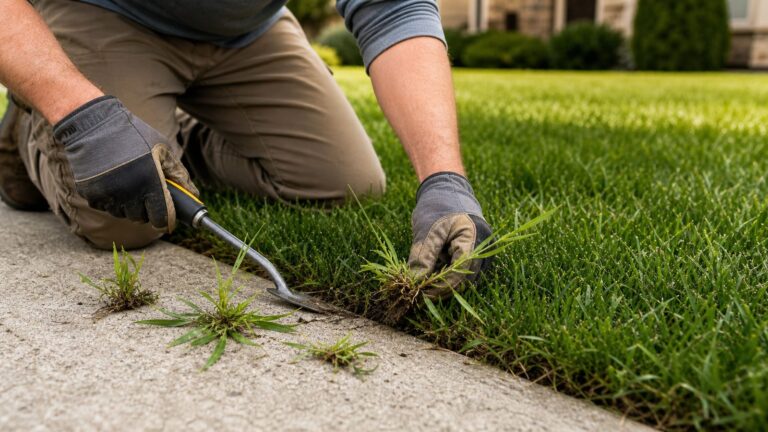
| A few young plants | Pull them by hand while the soil is moist, removing roots while disturbing as little soil as possible. | This is practical for small, early infestations, not a large population. |
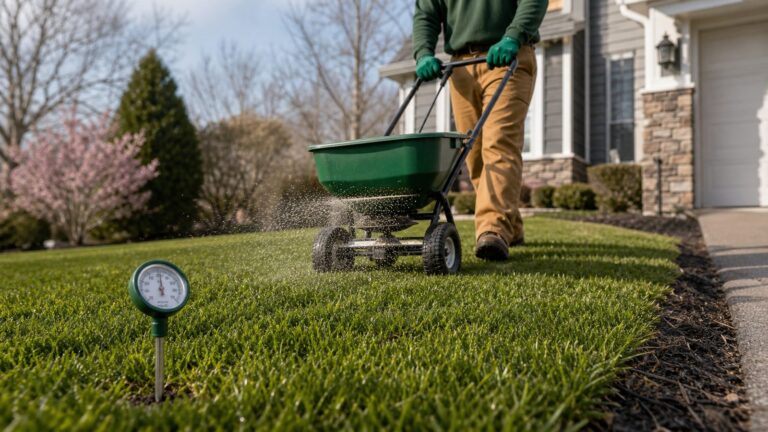
| Preventing new seedlings | Consider a product labeled for preemergent use on your lawn, applied before local germination and according to its label. | Timing mistakes reduce control; many products also block grass seed. Granular products may need a spreader, and some require water for activation. |
| Small, actively growing plants have emerged | If needed, consider a postemergent product labeled as compatible with your turf species. | Large plants are harder to control. Some selective herbicides can injure desirable grass, and professional application may be needed. |
| Large plants late in the season | Where practical, limit seed production, then plan lawn repair and prevention for the next growing season. | Postemergent control is less reliable on established plants; mature crabgrass commonly declines after frost. |
Build a lawn that can compete
Keeping desirable turf dense is the central long-term approach. Choose grass suited to the site, maintain it appropriately, and repair thin or bare patches when the season and any product restrictions allow. Mowing guidance varies by region and grass type: Maryland Extension recommends 3–4 inches, while UNH Extension recommends at least three inches. These are regional recommendations, not a universal height for every lawn. Follow local advice for your turf species.
Rank #2

- WEED KILLER SPRAY FOR LAWNS: With a simple hose-end application, kill weeds in your lawn, including dandelions, chickweed, clover, crabgrass and foxtail with Ortho WeedClear Lawn Weed Killer Ready-to-Spray
- FAST-ACTING WEED CONTROL: This weed killer hose sprayer kills listed weeds like crabgrass, dandelion, clover, chickweed and creeping charlie down to the root and gets results with 1 application
- COVERAGE: This 32 fl. oz. container of Ortho WeedClear Lawn Weed Killer Ready-to-Spray provides up to 5,000 sq. ft. of lawn care
- HOW TO USE: Apply to listed lawn weeds that are young and actively growing by connecting your garden hose to the weed killer sprayer, sliding the switch to "ON" and spraying evenly until the lawn is wet
- WHERE TO USE: This spray weed killer for lawns won't harm lawn grasses when used as directed - use on northern lawn grasses including Bermudagrass, Buffalograss, Fescues, Kentucky Bluegrass, Ryegrass and Zoysiagrass
Density matters because crabgrass takes advantage of open ground. A spring preemergent may prevent seedlings for a time, but it does not repair the underlying thin turf, and its timing can conflict with seeding plans.
The Tool Desk
Outbyte PC Repair FREEClear out junk files and repair common Windows errorsFree Scan →Outbyte Driver Updater FREEFix the driver behind crashes, sound loss and screen glitchesFind Drivers →When to use a crabgrass preventer
Preemergent herbicides act before seeds germinate, so application must precede the local germination window. There is no dependable single date for the whole country: weather, region and year affect timing. Maryland Extension gives a regional cue of sustained soil temperatures around 53–55°F for five days and cautions that forsythia bloom is not consistently reliable. Treat that temperature cue as local guidance, not a universal rule.
Rank #3

- Roundup for Lawns Crabgrass Destroyer2 kills crabgrass and grassy weeds to the root
- This weed killer for lawns is formulated to kill even the toughest crabgrass and grassy weeds
- Apply this product to Kentucky bluegrass, fine fescue, perennial ryegrass and tall fescue
- Apply this product to actively growing weeds (during the early growth stages for the best results), when daytime temperatures are between 45°F and 90°F
- This 64 oz. container of Roundup for Lawns Crabgrass Destroyer2 is ready-to-use with a trigger sprayer
UC IPM’s California guidance recommends applying preemergents weeks before typical local germination and says many products need about ½ inch of water soon after application. Product directions differ, so use the label for the product you have, including its application, watering, turf-compatibility and safety instructions. Local extension advice can help identify the appropriate regional window.
Coordinate weed prevention with grass seeding
Many preemergent herbicides prevent desirable grass seed from germinating too. If you need to overseed, check the specific product label for restrictions and timing before applying anything. Iowa State Extension notes that late-summer seeding can work after a spring preemergent has broken down, but the interval and compatibility depend on the product and turf. Do not assume that a spring application is harmless to later seeding.
Rank #4

- Weed killer for lawns: Kill crabgrass, dandelion, clover and other listed common weeds in your lawn with Ortho WeedClear Lawn Weed Killer Ready-To-Use
- Fast-acting weed control: This weed control product kills like crabgrass, dandelion, clover, chickweed and creeping charlie down to the root and gets results with 1 application
- Spot treatment for weeds: Won't harm lawn grasses when used as directed - use on northern lawn grasses including Bermudagrass, Buffalograss, Fescues, Kentucky Bluegrass, Ryegrass, and Zoysiagrass
- Spray weed killer: Apply to weeds that are young and actively growing in the spring or fall; spray to lightly cover weed leaves
- Ready to use: This 1 gal. container of Ortho WeedClear Lawn Weed Killer Ready-to-Use includes the battery-powered Comfort Wand to accurately target weeds you want to kill
What to do after crabgrass has emerged
For a handful of young plants, hand pulling can be effective, especially when the soil is moist enough to remove roots with minimal disturbance. Once plants are widespread, pulling becomes labor-intensive.
What’s actually slowing this PC down?
Pick the symptom - the matching free tool is one click away.
Postemergent treatments are most effective on small, actively growing plants. Large, established crabgrass is harder to control, and an unsuitable product can damage lawn grass. Check that the product is labeled for both crabgrass and your turf species, and follow all label directions. When plants are already large late in the season, focus on practical seed prevention and plan to repair thin areas and revisit prevention next season.
Best Value

- ALL-IN-ONE FORMULA: BioAdvanced's All-in-One formula kills listed lawn weeds and crabgrass without harming the lawn
- KILLS TOUGH WEEDS: Control over 200 broadleaf weeds like dandelion, clover, and crabgrass using our powerful weed killer concentrate
- DOWN TO THE ROOT: BioAdvanced All-In-One Lawn Weed and Crabgrass Killer I penetrates and removes tough listed weeds down to the root
- RAINPROOF IN ONE HOUR: Our weed killer concentrate formula is rainproof in one hour, providing protection that wont wash away
- EASY-TO-USE CONCENTRATE: Easily apply with our concentrated formula, perfect for targeting weeds in your lawn, and compatible with various grass types
Sources and scope
This guidance draws on university extension and public-university IPM resources: Iowa State Extension, Maryland Extension, UNH Extension, UC IPM, and Penn State Extension. Their recommendations are general lawn guidance, not a diagnosis of a particular lawn. Herbicide legality and availability, label directions, turf tolerance and treatment timing depend on location and product.
Quick Recap
Product prices and availability are accurate as of the date/time indicated and are subject to change. Any price and availability information displayed on Amazon at the time of purchase will apply.