Quick wins for a faster PC:
Fix the driver behind crashes, sound loss and screen glitchesFind Drivers →Clear out junk files and repair common Windows errorsFree Scan →The 100,000-hour LED bulb did not disappear because LEDs suddenly became unable to last that long. In many cases, the number described the projected life of an LED package under controlled conditions—not the expected life of a complete household bulb with a driver, capacitors, solder joints, housing, and heat-management system.
Modern ratings of 10,000 to 25,000 hours are often more conservative and easier to interpret. For homes, commercial buildings, and construction projects, the best choice is not necessarily the bulb with the largest number on its packaging. Fixture compatibility, thermal design, certification, warranty, dimmer performance, and serviceability usually matter more.
As an Amazon Associate I earn from qualifying purchases.
The short answer: chip life is not whole-bulb life
LED lifetime is commonly expressed as L70: the estimated time until light output falls to 70% of its initial level. That is a lumen-maintenance measurement, not necessarily the moment the bulb stops working. ENERGY STAR explains the distinction in its LED lighting guidance.
Recommended Free Tools
A 100,000-hour L70 claim could mean that an LED package was projected to retain 70% of its original light for that long under modeled test conditions. It did not automatically mean that:
#1 Best Overall

- Energy-Saving Brilliance: The EVELOR A19 100 watt LED light bulbs consumes only 13W while delivering the same brightness as a 100W incandescent bulb, achieving up to 90% energy savings. It's the perfect upgrade from outdated, inefficient lighting.
- Vivid, Sunlight-Like Illumination: With 1500LM brightness and a CRI of 80+, this bright white bulb enhances color accuracy, making spaces appear more vibrant. The non-flicker 100 watt lamp light bulbs beads ensure steady brightness, while the 5000K daylight white light is ideal for areas where clarity and visibility matter.
- Reliable Non-Dimmable Lighting: Designed for consistent performance, these light bulbs 100w provide unwavering illumination-perfect for living rooms, bedrooms, garages, meetingroom, office,kitchen, bathroom, readingroom, study, basement and workspaces where stable light is essential.
- Long-Lasting Durability: Rated for 15,000+ hours, these A19 E26 ampoule LED bulbs reduce replacement frequency and maintenance costs, making them suitable for indoor, outdoor, and commercial use.
- Eye Comfort & Easy Installation: The no-flicker design ensures smooth, strain-free lighting, while the standard E26 base allows for quick installation. Enjoy a bright, steady glow that enhances any environment.
- the complete bulb would turn on after 100,000 hours;
- brightness would remain close to its original level;
- color would not shift;
- the driver electronics would survive that long;
- the bulb was tested in real use for 100,000 hours; or
- the warranty covered anything close to that period.
Other terms can be more demanding. L80 and L90 describe the point at which less light has been lost. B10 and B50 indicate how many units are expected to fall below the stated lumen-maintenance level. A product’s “rated life” should therefore be read together with its endpoint, test method, application, and warranty.
Why 100,000-hour claims became less common
Early claims often relied on optimistic projections
LEDs can degrade gradually rather than fail like incandescent filaments, but long-term predictions require evidence. The U.S. Department of Energy has noted that 100,000-hour LED product claims were once common and often lacked adequate supporting data. It also warned that manufacturers sometimes presented the projected life of an LED package as the life of the complete lamp or luminaire. See the DOE LED product reliability guidance.
DOE testing also found performance and quality problems in early products, helping push the industry toward more consistent testing and reporting. Its LED Lighting Facts program ended in March 2018, but its testing work influenced how LED claims were evaluated. The program is documented by the Department of Energy.
LM-80 and TM-21 do not test a bulb for 100,000 hours
IES LM-80 measures lumen maintenance for LED packages, arrays, or modules over a defined test period. IES TM-21 uses that data to project longer-term lumen maintenance. A projection can be useful, but it is not the same as operating a finished screw-in bulb for the entire claimed period.
Rank #2

- 【Efficiency Meets Comfort】 Dalattin's A19 engergy saving LED bulbs replace 60W incandescents with just 9W while delivering full 800 lumens brightness, slashing energy usage by up to 85%. This eco-conscious choice not only saves you approximately $1.08 annually per bulb but also ensures a cooler operation,and enhancing safety. With a lifespan of up to 13.7 years (at 3 hours daily use), they provide a lasting, no worry experience.
- 【Enhanced Ambiance】 Boasting a high Color Rendering Index (CRI) of 80+, our bulbs bring out the truest hues in your surroundings, ensuring colors appear as vivid and accurate as in natural light. This makes them ideal for spaces where aesthetics matter, from art galleries to cozy living rooms, ensuring that every detail shines in its most authentic light.
- 【Eyes First, Safety Always】 Designed with eye care in mind, our non-flicker and non-dazzling technology reduces eye strain, promoting a healthier visual environment. No of lead, mercury, these bulbs prioritize user safety and environmental sustainability, making them suitable for households with children and pets, without compromising on the quality of light.
- 【Seamless Integration, Versatile Charm】 Universally fitting into E26 sockets, our bulbs effortlessly blend into any setting—be it residential, commercial, or hospitality. From bedrooms to cafes, they enrich spaces with their energy-efficient glow, adding a touch of sophistication without the need for special fixtures. Embrace the future of lighting with bulbs that seamlessly adapt and excel in every application.
- 【Long Lifespan & Dedicated Service】Last up to 7 years with typical 3-hour daily use, significantly outlasting traditional bulbs.
The Illuminating Engineering Society has addressed inconsistent lifetime marketing and misuse of LM-80 and TM-21 in its position statement on LED lifetime claims. ENERGY STAR specifications likewise require documented LM-80 data and TM-21 projections for applicable LED sources. In the cited Lamps Version 2.0 specification, minimum rated-life requirements included 15,000 hours for solid-state omnidirectional and decorative lamps and 25,000 hours for directional lamps. Those figures apply to the specified categories and version; they are not a universal rule for every bulb sold today.
What actually fails inside an LED bulb?
An LED bulb is a small power-supply system, not just a nearly indestructible diode. The LED may gradually lose output while another component fails abruptly.
- Driver electronics: The driver converts household AC into the controlled current the LEDs require. Its components can fail from heat, voltage stress, or surges.
- Electrolytic capacitors: These are especially sensitive to high temperatures and aging.
- Thermal interfaces and heat sinks: Poor heat transfer raises temperatures in both the LED package and driver.
- Solder joints and connections: Repeated heating and cooling can cause fatigue or intermittent faults.
- LED packages and phosphors: These can lose light output or shift color without an immediate electrical failure.
- Power surges: A transient can damage the driver even when the LED itself has substantial remaining life.
- Dimmers and switches: Incompatible dimmers, smart switches, three-way circuits, or switches that leak current can cause flicker, buzzing, overheating, or premature failure.
A teardown of particular products can illustrate these failure mechanisms, but it should not be treated as a statistical survey of every LED bulb. Hackaday’s examination also highlights an important practical point: a bulb can become functionally obsolete through dimming or color change before it suffers catastrophic failure.
Why heat is a construction and maintenance issue
Heat is one of the most important factors in LED life. ENERGY STAR notes that higher operating temperatures accelerate degradation and shorten useful life. A small A19 bulb must fit into a shape and socket originally designed around an incandescent lamp, often leaving limited room for heat to escape.
Rank #3
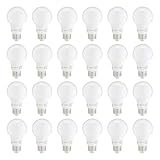
- LONG LASTING PERFORMANCE: These LED bulbs offer a 10,000 hour lifespan, providing lasting illumination for over 9 years (based on 3 hours of use each day), helping minimize replacements
- GREAT ATMOSPHERE: Enjoy daylight white light bulbs that create a bright, crisp atmosphere for any room
- STANDARD FIT: The E26 standard base provides compatibility with most fixtures, making it easy to install these LED bulbs in lamps and overhead lighting
Risk increases in:
- sealed ceiling globes;
- recessed cans without adequate ventilation;
- base-up installations in hot fixtures;
- high-output bulbs packed into small housings;
- outdoor fixtures exposed to high ambient temperatures;
- fixtures near ovens, furnaces, or hot attic spaces; and
- low-cost products with minimal thermal capacity.
For a replacement lamp, check the package for suitable for enclosed fixtures, damp-rated, or wet-rated language as appropriate. These labels describe defined application categories; they do not make every hot or poorly ventilated installation safe.
How much longer is 100,000 hours?
The arithmetic helps explain why the number was attractive but not always useful. These are usage calculations, not promises of actual product life:
| Rated hours | At 3 hours per day | At 8 hours per day |
|---|---|---|
| 10,000 | 9.1 years | 3.4 years |
| 15,000 | 13.7 years | 5.1 years |
| 25,000 | 22.8 years | 8.6 years |
| 50,000 | 45.7 years | 17.1 years |
| 100,000 | 91.3 years | 34.2 years |
In practice, a bulb may be replaced because of driver failure, reduced light, color preference, fixture renovation, smart-home changes, breakage, or product availability long before a theoretical 100,000-hour endpoint. Rated hours measure operating time, not simply calendar age.
Did manufacturers deliberately shorten LED life?
The available evidence does not establish a coordinated industry decision to make household LEDs fail sooner. The historical incandescent-lightbulb cartel is not, by itself, proof of an equivalent modern LED scheme.
Rank #4

- 【Energy Efficiency】: EVELOR A19 LED light bulb is an energy-saving 9W (60W equivalent) bulb, saving up to 90% energy compared to traditional incandescent light bulbs 60 watt. The led lamp bulb is designed to be highly efficient, making it an ideal replacement for old-fashioned bulbs.Gift options for Christmas and other festivals.
- 【High Brightness & Excellent Light】: With 800LM and a high CRI 80+ (color rendering index), the light it gives out is close to the sun's value, making colors in your room appear richer, true and natural. Also, it has No flicker LED beads for enhanced brightness. This makes the light bulbs 60 watt daylight white 5000K light bulbs a perfect fit for any room where accurate color perception is important.
- 【Non Dimmable Feature】: The A19 E26 LED lightbulbs is Non Dimmable, providing a consistent level of illumination. This is especially useful in areas where a steady light source is required, such as in hallways or stairways. Daylight white light bulb gives a reliable and unchanging light output, different from some dimmable bulbs.
- 【Long Lifespan】: Type a 60w LED light bulbs a long lifespan of 15000+ hours, which means fewer replacements and less hassle. Whether used indoors in living rooms, bedrooms, kitchens, bathrooms, dining rooms, entryways or outdoors in gardens, garages, porches, patios, or in commercial settings like offices, hotels, bars, coffee shops, restaurants, etc., this led light bulb can last for a long time, reducing maintenance costs.
- 【No Flicker & Stable Performance】: NO Flicker design ensures a stable and comfortable light output, providing a better visual experience and protecting your eyes. It operates at 110 - 130VAC and has an E26 Medium base for easy installation. The daylight white light bulbs offer a smooth and steady glow, enhancing the overall lighting effect of any space.
There is stronger support for a less dramatic explanation: early testing was incomplete, package-life projections were sometimes applied to complete products, heat management is difficult in compact bulbs, and manufacturers balance component quality, brightness, efficiency, color quality, dimming, size, and retail price.
It is plausible that some low-cost products reduce heat-sink size, component quality, or operating margin to meet a price target, but that should not be generalized to every lower-rated bulb. A credible 15,000- or 25,000-hour complete-lamp rating may be a better proposition than an unsupported 100,000-hour number.
Independent reader supportYour contribution helps us test, update, and keep practical guides available for everyone.Do 100,000-hour LEDs still exist?
Yes—but the application and the subject of the claim matter. A high rating is more plausible when the LED is lightly driven, the system has generous thermal capacity, ambient temperatures are controlled, and the manufacturer provides LM-80/TM-21 documentation or system-level reliability data.
Distinguish among:
- an LED package rating;
- a replaceable lamp rating;
- an integrated LED luminaire rating;
- a commercial or outdoor-lighting reliability claim; and
- a consumer A19 screw-in bulb rating.
A 100,000-hour claim for a bare module or purpose-designed commercial luminaire should not be treated as equivalent to the same number printed on a low-cost household bulb. Integrated fixtures may remove the need for lamp replacement but can require replacement of the entire fixture when the LED board or driver fails. Commercial modular systems may be more serviceable.
Best Value

- Technical Features: 24 Packs, A19 Daylight LED bulbs, 8.5 watts, 800 lumens, daylight 5000k, light bulbs 60 watt equivalent, E26 base, non-dimmable, frosted, AC-120V, CRI 80, beam angle 230°, turn on instantly
- Energy Saving and Long-lasting: Save up to 80 on energy costs by replacing 60W with just 8.5W
- Direct Replacement: Perfect replacement for incandescent light bulbs. No breakable parts and are free of toxic chemicals, they are safe for your family and the environment
- Eye-care and Comfortable: Flicker-free and non-dazzling led bulbs protect your eyes while ensuring a healthy environment. No lead or mercury, no IR radiation
- High Brightness and CRI 80+: Designed with the advance LED source technology, 60w LED light bulbs to emit with a full 800 lumens of brightness. With high CRI 80+, the A19 standard light bulbs 60 watts will provide you natural and brilliant realistic colors
What current products show
As a snapshot of manufacturer and retailer pages viewed on August 18, 2026, mainstream products commonly advertise approximately 10,000 to 25,000 hours:
| Example | Advertised signal | Best fit and caution |
|---|---|---|
| Sylvania/LEDVANCE A19 | 25,000 hours, 90+ CRI, dimming, specified enclosed-fixture approval | Useful for conventional applications; confirm the exact model and purchasing channel. |
| Philips consumer A19 | Approximately 10,950–11,000 hours for the specified bulb | Illustrates that lower ratings are common; verify the exact package. |
| Sunco A19 filament | 25,000 hours and five-year warranty | Decorative appearance; check enclosure and temperature suitability. |
| Philips Hue White A19 | 25,000-hour nominal life and two-year warranty | Appropriate when smart controls justify added electronics and cost. |
| Feit Electric Smart A19 | Product page lists a 25,000-hour figure and warranty information | Check platform, switch, dimmer, and network compatibility. |
| Simply Conserve A19 | 25,000 hours and five-year warranty; retailer displayed $30.08 for 12 | Bulk value; price and availability are volatile. |
Specifications, prices, warranties, and stock can change. Treat the examples as illustrations of the market, not endorsements or guarantees.
How to choose a long-lasting LED bulb
- Match the application. Confirm whether the fixture is open or enclosed, indoor or outdoor, and dry, damp, or wet location.
- Check dimming and switching. Match the bulb to the dimmer, three-way circuit, smart switch, and expected switching frequency.
- Look for recognized certification. ENERGY STAR, UL, ETL, or another recognized safety listing provides more useful evidence than a large hour number alone.
- Read the warranty and exclusions. Check coverage for enclosed fixtures, commercial use, dimmers, temperature, and installation conditions.
- Evaluate thermal design. Be skeptical of very high-lumen bulbs in tiny sealed housings. For difficult or hot locations, choose explicit application approval.
- Buy the light you actually need. Compare lumens for brightness, CRI for color rendering, color temperature for appearance, and flicker performance for comfort.
- Consider serviceability. A replaceable lamp may be preferable in an accessible building fixture; an integrated luminaire may make sense when its design, warranty, and maintenance plan are stronger.
- Compare total cost. A premium bulb can be worthwhile in a difficult-to-access location, but only if its application rating and warranty support the premium.
Diagnosing an LED bulb that fails early
- Move the bulb to a known-good open fixture. If it works there, the original fixture, heat, socket, switch, or dimmer may be responsible.
- Check whether the bulb is approved for enclosed, damp, or wet use as installed.
- Remove or test the dimmer and smart switch if flicker, buzzing, delayed startup, or intermittent operation is present.
- Inspect for loose sockets, visible damage, or signs of surge-related failure. Electrical work beyond basic lamp replacement should be handled by a qualified electrician.
- Record the purchase date, model number, and installation conditions before making a warranty claim.
Frequent switching can also matter: rated hours measure time energized, while some products separately specify switching-cycle limits. Smart bulbs add radios, firmware, app dependencies, standby power use, and additional electronics, so they are poor value when a simple on/off lamp is all a space requires.
Free tools Windows power users keep installed
One-click scans. No signup required.
Quick Recap
Product prices and availability are accurate as of the date/time indicated and are subject to change. Any price and availability information displayed on Amazon at the time of purchase will apply.




