Free tools Windows power users keep installed
One-click scans. No signup required.
Some links on this page are affiliate links: if you buy through them we may earn a commission, at no extra cost to you.
The short answer: plug high-wattage appliances directly into a properly wired wall receptacle. Use a certified surge protector for sensitive electronics such as computers, monitors, televisions, game consoles, routers, and audio equipment. Choose a UPS when those devices also need short-term battery backup.
A surge protector is not a stronger wall outlet. It plugs into the building’s branch circuit, adds outlets, and can limit certain brief voltage spikes. It does not increase the circuit’s capacity, make overloaded appliances safe, or replace GFCI protection, proper grounding, or a dedicated circuit.
As an Amazon Associate I earn from qualifying purchases.
Wall outlet versus surge protector: what is the actual choice?
These devices are not competing power sources. A surge protector connects to a wall receptacle, so everything still depends on the same circuit breaker, wiring, receptacle, and electrical service.
The difference is function. A wall receptacle supplies branch-circuit power. A basic power strip supplies additional outlets. A surge protector adds circuitry—commonly based on metal-oxide varistors—to limit some brief overvoltage events. A UPS may add battery backup, voltage regulation, and surge protection.
Popular on Amazon

- 【4+4 Outlets Power Strip with 4 USB Ports】- The 3-side power strip with 8AC widely outlets and 4 USB charging ports, each USB A port features 5V/2.4A Max output. USB C charging port features 5V/3A MAX. can power up to 12 devices simultaneously.
- 【Surge Protector Power Strip with 3 Side Design & Wide Space】- 3-side design that makes it easier to make the plugs not covering any outlet, and the 8 AC outlets with 1.8 inches long space in between, larger than standard 1.5-inch socket. Larger spacing makes it easier to use for all kinds of equipment. The compact design saves more space, suitable for the home, office, and college dorm room.
- 【Multi Safety Protection】- ETL Certificates. This power strip has overload protection, short-circuit protection, over current protection, over-voltage protection and overheating protection. The surge protector with overload protection protects your electrical appliances from lighting, surges or spikes. The minimum energy-absorbing capacity of 900 Joules. It will automatically cut power to protect connected devices when voltage surge is overwhelming.
- 【6 Ft extension cord with Flat Plug】- The 45° flat plug design prevents the bottom plug from clogging and allows for easy installation in tight spaces; the 6-foot power cord allows for flexibility, and two mounting holes on the back allow for secure installation of this power outlet in a variety of applications.
- 【 Our After Sale Service 】- ETL Certificates. Our friendly and reliable customer service will respond to you within 24 hours. You can purchase with confidence, with our 30-day return and 12-month warranty.
That distinction matters because many products look alike. A multi-outlet strip is not automatically a surge protector. Check the product’s markings, certification, ratings, and instructions.
| Device | Main function | Surge protection | Battery backup | Typical use |
|---|---|---|---|---|
| Wall receptacle | Supplies branch-circuit power | Usually no | No | Compatible loads within circuit limits |
| Power strip | Adds outlets | Not necessarily | No | Low-power devices |
| Surge protector | Adds outlets and limits some transient overvoltages | Yes, when properly rated and certified | No | Sensitive electronics |
| UPS | Provides temporary battery power | Usually | Yes | Computers, networking equipment, NAS devices |
| GFCI device | Reduces shock risk from ground faults | No | No | Bathrooms, kitchens, garages, outdoors, and damp areas |
| Whole-home SPD | Protects multiple circuits from certain surges | Yes | No | Service-panel or distribution-system protection |
See UL Solutions’ explanation of power strips and surge protectors for the distinction between the categories.
What’s actually slowing this PC down?
Pick the symptom - the matching free tool is one click away.
What should plug directly into the wall?
Use a wall receptacle for devices with heating elements, high continuous loads, substantial startup current, or manufacturer instructions requiring a dedicated receptacle. Common examples include:
- Portable space heaters
- Toasters and toaster ovens
- Air fryers
- Coffee makers and electric kettles
- Hair dryers and curling irons
- Clothes irons
- Electric skillets and crockpots
- Microwaves where the manufacturer specifies a dedicated connection
- Refrigerators and freezers, unless the manufacturer specifies an approved protective device
- Washers, dryers, ranges, and stoves
- Window air conditioners
- Sump pumps and other motor-driven equipment, unless the manufacturer specifies another arrangement
The reason is not that a surge protector inherently reduces available power. The concern is sustained current, heat buildup, loose connections, cord construction, and overload risk. A portable strip should not be treated as permission to run multiple high-load appliances from one receptacle.
The U.S. Fire Administration recommends plugging major appliances directly into wall outlets. Follow the appliance manufacturer’s instructions if they are more specific.
Special warning: space heaters
Do not use a space heater with a typical power strip or surge protector unless the heater and the protective device expressly permit that arrangement. Direct connection to a suitable wall receptacle is the conservative choice. Never connect several heaters or other heating appliances to one circuit.
The Tool Desk
Outbyte Driver Updater FREEScan for outdated or missing drivers - takes under a minuteDriver Scan →Outbyte PC Repair FREERepair Windows errors before they cause bigger problemsFix Now →Which electronics benefit from surge protection?
A properly certified surge protector is worth considering for equipment that is expensive, difficult to replace, sensitive to power disturbances, or connected to several conductive cables. Examples include:
- Desktop computers and monitors
- Televisions and game consoles
- Home-theater and stereo equipment
- Cable modems, routers, and networking equipment
- External drives and NAS devices
- Printers and smart-home hubs
- Chargers and other low- to moderate-power electronics
The protector must be plugged directly into a properly grounded wall receptacle and must not be overloaded. If equipment also connects to coaxial cable, telephone wiring, Ethernet, an antenna, or another conductive line, consider whether the protector provides appropriate protection for that path. Protecting only the AC cord may leave another route for a transient.
How much can a strip or protector handle?
Outlet count is not capacity. Eight outlets do not mean eight high-power appliances can operate safely at once.
Also popular on Amazon

- All the Power You Need: Features 12 AC outlets, 1 USB-C port, and 2 USB-A ports to power appliances, mobile devices, and more. Total USB output is shared across all USB ports, with a maximum output of 15W.
- Fast Charge Your iPhone: Use the 20W USB-C port to give your iPhone 15 a high-speed charge from 0-50% in just 26 minutes.
- 8-Point Safety System: Combines surge protection, fire resistance, overload protection, temperature control, and more to protect you and your devices.
- Optimized Layout: Features extra space between outlets to accommodate bulky plugs. The 5 ft cord is ideal for desks (4 - 5 ft wide), bedside tables, and sofa side tables.
- What You Get: Anker 351 Power Strip, 2 mounting screws, welcome guide, our worry-free 18-month warranty, lifetime* $200,000 connected equipment warranty, and friendly customer service.
- Find the strip or protector’s maximum amperage or wattage.
- Check each appliance’s nameplate or manual.
- Estimate current when useful: amps = watts ÷ volts.
- Keep the combined load within the product’s rating and the circuit’s limits.
- Remember that the circuit breaker, wiring, receptacle, plug, cord, and portable device all matter.
A typical U.S. household circuit may be rated at 15 or 20 amperes, but the actual allowable load depends on the installed wiring, breaker, circuit design, receptacles, and applicable electrical requirements. The weakest applicable component limits the installation. UL advises matching the connected load to the strip’s electrical rating.
Recommended Free Tools
How to choose a legitimate surge protector
Look for:
- A legitimate mark from a recognized testing laboratory, such as an appropriate UL Listed marking
- A clear model number and manufacturer
- Maximum amperage or wattage and nominal voltage
- A protection-status indicator, if supplied
- Indoor or outdoor suitability appropriate to the location
- Instructions explaining whether the product is a power strip, surge protector, UPS, or another device
- Suitable data-line protection when the installation needs it
Do not choose solely by outlet count, a large joule number, claims such as “lightning proof,” or phrases such as “military grade” and “unlimited protection.” A connected-equipment warranty is conditional; it may require proper grounding, installation, registration, and compliance with exclusions. It is not a guarantee that damaged equipment will be reimbursed.
Joules, clamping voltage, and response time
Joule rating: A larger number can indicate greater energy-handling capacity, but joule figures are not necessarily comparable between manufacturers. The result depends on surge current, duration, clamping voltage, and the manufacturer’s measurement method. Treat joules as one data point, not a universal ranking. NEMA cautions that joule comparisons can be misleading.
Clamping voltage or VPR: This describes the voltage level at which the protector begins limiting a transient, or the measured let-through voltage under the applicable test. Lower is generally preferable within the relevant standard and product design, but the number should not be interpreted in isolation.
Response time: Avoid making nanoseconds the main buying criterion. Surge-protection technologies are already fast for typical power-line surge events, so certification, construction, ratings, and suitability matter more than an impressive response-time claim. The NIST guide on electrical surges provides further context.
What a surge protector cannot do
A plug-in protector can reduce the risk from certain transient overvoltages, including some switching events and utility disturbances. It cannot guarantee protection from every failure or electrical event. It generally does not:
- Guarantee protection from a direct lightning strike
- Correct bad house wiring or a defective receptacle
- Protect people from ground-fault shock
- Prevent overloads or make a branch circuit more powerful
- Guarantee protection from sustained overvoltage or brownouts unless specifically designed for that purpose
- Ensure that an appliance’s motor startup current is safe
- Guarantee replacement of damaged equipment
During severe storms, unplug sensitive equipment when practical. Layered protection—service-panel protection, properly installed point-of-use protection, and protection for connected communication lines—may be more comprehensive than relying on one strip.
GFCI, grounding, and whole-home protection
A GFCI and a surge protector solve different problems. A GFCI disconnects power when it detects an imbalance associated with a ground fault, reducing shock risk. A surge protector limits certain brief overvoltages to protect equipment. One cannot substitute for the other.
Use appropriate GFCI protection in bathrooms, kitchens, garages, basements, outdoors, and other locations where moisture or contact with grounded surfaces increases shock risk. Equipment must also be rated for its location.
Crashes, No Sound, or Screen Glitches?
Random freezes, missing sound and display glitches usually trace back to one bad driver. Find and replace yours safely.Free scan · under a minuteWindows Errors? Fix Them Before They Spread
Repair common Windows errors and clear accumulated junk for a smoother, more stable PC - no reinstall needed.Free scan · no reinstallAlso popular on Amazon
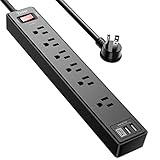
- Power Strip with 6 Outlets & 3USB Ports: 6 AC Surge protector outlets(1680 Joules) including 1 Widely Spaced Outlet, 2 USB A Ports & 1 USB C Port, 6 feet power cord, Surge protector indicator and 10A Overload Protector switch protects against spikes and fluctuations.
- Smart Charging USB Ports: Build in smart charging technology, Each USB A port features 2.4A Max output. USB C charging port features 3A MAX, 3 USB ports can charge almost any USB device (smart phone, tablet, fire stick, e-reader, blue tooth headphones, portable speaker etc).
- Surge Protector outlet: The 6 AC outlets provide surge protector against electrical spikes. with response speed less than 1Ns, and minimum energy-absorbing capacity of 1680 Joules, its response time is much shorter than the single MOV surge protector circuit, It truly provides great protection of your precious plugged-in devices.
- 6 Feet Flat Plug Power cord with Cable Ties: 6 Ft Extension Cord makes it more flexible, Reusable Fastening Cable Ties Can tie up the unused cord and make it better organized. the Mounting hole at the back allows this wall mount power strip to be securely installed in various applications, such as wall mounts, floor mounts, workbenches, under counters & more.
- Our After Sale Service: Our friendly and reliable customer service will respond to you within 24 hours. You can purchase with confidence, with our 30-day return and 12-month warranty.
Some plug-in surge protectors rely on a properly grounded receptacle for their intended protection path. An ungrounded, reverse-wired, loose, or defective receptacle may prevent the protector from working as intended and may affect an equipment-protection policy. A receptacle tester is only an initial indication, not a substitute for an electrician’s diagnosis.
Whole-home surge protective devices are installed as part of the electrical distribution system. Type 1 and Type 2 devices are commonly associated with service or panel protection, while Type 3 devices include point-of-use products such as plug-in protectors. Requirements vary by jurisdiction, adopted code edition, building type, and installation circumstances. Have a qualified electrician select and install a panel-mounted SPD.
ESFI’s home-safety guidance explains the difference between GFCI protection, whole-home protection, and point-of-use protection.
Why daisy-chaining is unsafe
Do not plug one power strip into another. Do not connect multiple relocatable power taps in series, and do not use extension cords as a permanent substitute for additional receptacles. An extension cord and a power strip are not interchangeable products.
Do these 3 things before closing this tab:
1Scan for outdated or missing drivers - takes under a minute2Repair Windows errors before they cause bigger problems3Fix the driver behind crashes, sound loss and screen glitchesOSHA guidance states that listed relocatable power taps should connect directly to a permanently installed branch-circuit receptacle rather than to another power tap or extension cord. ESFI also advises against connecting extension cords together.
Keep strips visible and ventilated. Never cover them with rugs, bedding, or furniture. Do not pinch cords behind furniture or use equipment that is frayed, cracked, discolored, warm, buzzing, or giving off an odor. Stop using it and replace it; investigate the receptacle or circuit if the problem continues.
The CPSC distinguishes extension cords from power strips and identifies construction and safety characteristics that should be appropriate to the product and location.
Independent reader supportYour contribution helps us test, update, and keep practical guides available for everyone.When a UPS is better than a surge protector
Use a UPS when a brief interruption could cause data loss, an unsafe shutdown, or unwanted downtime. Suitable examples include a desktop computer, monitor, router, modem, NAS, or small server. A UPS may also provide voltage regulation, but features vary by model.
Quick wins for a faster PC:
Repair Windows errors before they cause bigger problemsFix Now →Scan for outdated or missing drivers - takes under a minuteDriver Scan →Do not use an ordinary UPS for heaters, kitchen appliances, refrigerators, or other loads that exceed its output rating or startup capability. UPS units differ in watt capacity, VA rating, runtime, output waveform, voltage regulation, and battery-replacement requirements. Size the unit for the actual connected load.
Also popular on Amazon
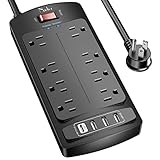
- 【Power Strip with 8AC outlets & 4 USB】- Power bars with surge protector with 8AC outlets & 4 USB charging ports (1 USB C Outlet), 6 Feet Heavy Duty extension cord, surge protector(2700 Joules) with overload protection protects against spikes and fluctuations.
- 【USB- C Fast & Smart Charge】- 4 USB Charging ports, each USB A port features 2.4A Max output. USB C charging port features 3A MAX. Built- with smart technology, detecting charging devices and deliver optimal charging speed automatically, compatible with most USB devices. NOTE: The UCB-C port doesn't support any other devices which need 9~22V charging voltage.
- 【8AC Surge Protector Outlets】- This power Strip provides 2700 joules of surge protection for electronic devices and serves as a reliable power extension cord. (The “Protected” indicator light turns on to indicate that your devices are protected.)
- 【Safety and Certificate】- ETL safety certified, with extension cord and other major components certified by ETL. The over current protection switch limits the power strip's working current to certain setting, so it will not get hot during usage. Environmental protection and fire-resistance PC shell with flame retardant at 1382℉ makes it more durable and longer lifetime.
- 【What You Get】- Nuetsa Power strip, Maunal, 30-day return, our worry-free 12-month, and reliable customer service will respond to you within 24 hours.
For example, the manufacturer’s page for the APC Back-UPS BX1000M identifies a 1000VA/120V unit with automatic voltage regulation, an LCD, data-line protection, and a user-replaceable battery. Those specifications do not make it suitable for high-wattage appliances.
Room-by-room examples
Kitchen
Plug kettles, toasters, coffee makers, air fryers, toaster ovens, and microwaves into suitable wall receptacles. Do not gather several heating appliances on one portable strip. Use GFCI protection where required by the location and local rules.
Home office
A certified surge protector can serve a computer, monitor, printer, and low-power accessories if the combined load is within its rating. Use a UPS instead when a short outage could interrupt work or damage unsaved data.
Entertainment center
A surge protector is reasonable for a television, console, streaming device, and audio equipment. Do not overload it with a heater or other high-current appliance. Consider protection for coaxial or other conductive signal paths where appropriate.
Garage, basement, and outdoors
Moisture and grounding conditions are critical. Use GFCI protection and products rated for the location. A standard indoor strip is not an outdoor electrical solution.
Construction or renovation work
Temporary power must be planned around the circuit, cord, tool, and site conditions. Use listed equipment appropriate to the environment, protect connections from moisture and physical damage, and do not create long chains of strips and extension cords. If a project repeatedly needs more outlets or trips breakers, the solution may be a properly installed temporary or permanent circuit—not another adapter.
Do surge protectors expire?
There is no universal replacement interval such as every two years. Protective components can degrade after significant surges, and the product should be inspected periodically. Replace it when:
- The manufacturer’s protection indicator shows loss of protection
- It has experienced a significant surge or lightning event
- The housing is cracked, melted, warped, or discolored
- The cord or plug is damaged
- It becomes unusually warm, buzzes, smells, or trips repeatedly
An indicator light is only a diagnostic aid. It does not prove that every protective component remains at its original performance. UL recommends inspection rather than relying on a universal expiration date.
Quick Recap
A practical decision checklist
- Is it a heater, kitchen appliance, major appliance, or motor-heavy load? Plug it directly into a suitable wall receptacle unless the manufacturer specifies an approved alternative.
- Is it sensitive electronics and does a brief outage matter? Use a correctly sized UPS.
- Is it sensitive electronics but battery backup is unnecessary? Use a certified surge protector.
- Is the location wet, outdoors, or near plumbing? Use appropriate GFCI protection and equipment rated for the location.
- Does the strip or receptacle show heat, damage, buzzing, odor, or repeated tripping? Stop using it, replace damaged equipment, and have the circuit checked if necessary.
- Do you permanently need more outlets? Have a qualified electrician install additional receptacles instead of building a chain of portable devices.
Product prices and availability are accurate as of the date/time indicated and are subject to change. Any price and availability information displayed on Amazon at the time of purchase will apply.

