Some links on this page are affiliate links: if you buy through them we may earn a commission, at no extra cost to you.
The best engineer’s toolbox is not one oversized kit or a collection of expensive instruments. It is a capability-based system: tools to measure dimensions and electrical behavior, inspect signals, supply controlled power, make connections, modify hardware, prototype ideas, and protect the person doing the work.
For most engineers building from scratch, start with safety glasses, quality screwdrivers and hex keys, a digital multimeter, digital caliper, wire stripper/crimper, pliers, cutters, a utility knife, steel rule, soldering station, and precision repair kit. Add a drill and bits next. An oscilloscope, bench supply, logic analyzer, and function generator are indispensable for electronics work but unnecessary purchases for many software, civil, process, or documentation-focused roles.
How to use this list
“Indispensable” depends on the work. A controls engineer, manufacturing engineer, robotics builder, field-service engineer, and software engineer will not use the same 25 tools every day. The list below therefore combines a practical core toolbox with specialist equipment that becomes essential for particular engineering tasks.
The Tool Desk
Outbyte Driver Updater FREEFix the driver behind crashes, sound loss and screen glitchesFind Drivers →Outbyte PC Repair FREERepair Windows errors before they cause bigger problemsFix Now →
As an Amazon Associate I earn from qualifying purchases.
For a construction-oriented engineering environment, the most frequently used items will usually be the dimensional and layout tools, fastening tools, drill and bits, clamps, vise, deburring tools, labeling supplies, and task-appropriate personal protective equipment. For electrical, embedded, and instrumentation work, the multimeter, oscilloscope, power supply, soldering station, logic analyzer, and waveform generator move much higher in priority.
Buy for the work you actually perform, not for the most impressive specification sheet. Accuracy, safety category, calibration, replacement parts, ergonomics, and compatibility with your existing equipment are often more important than brand prestige.
1. Digital multimeter
A digital multimeter is the foundational electrical instrument. It measures quantities that otherwise require guesswork: voltage, resistance, continuity, current, and often frequency. Depending on the model, it may also measure capacitance and temperature.
Popular on Amazon
For general engineering use, look for suitable voltage and current ranges, fused current inputs, clear continuity indication, durable leads, and an appropriate electrical safety rating. True-RMS capability is valuable when measuring non-sinusoidal, switched, or distorted waveforms rather than clean sine waves. Fluke’s catalog illustrates the range available, from compact general-purpose meters to professional True-RMS families such as the 115, 175, and 179.
Use the meter correctly: never measure resistance or continuity on an energized circuit, verify the lead position before measuring current, and select a meter and probes rated for the environment. A consumer meter is not automatically suitable for service inside electrical distribution equipment.
2. Digital caliper
A digital caliper is the fastest general-purpose instrument for checking outside dimensions, inside dimensions, depth, and steps. It is useful when checking brackets, fasteners, shafts, enclosures, printed parts, machined components, and replacement hardware.
Choose the range and resolution for the work rather than assuming that more decimal places guarantee better measurements. Keep the jaws clean, avoid using them as a clamp or scribe, and confirm whether the instrument is suitable for the dirt, oil, and moisture found in the workshop or field.
PC Slower Than It Used to Be?
A free scan shows the junk files, broken settings and background clutter dragging Windows down - then fixes them in one click.Free scan · Windows 10 & 11Crashes, No Sound, or Screen Glitches?
Random freezes, missing sound and display glitches usually trace back to one bad driver. Find and replace yours safely.Free scan · under a minuteMitutoyo’s ABSOLUTE Digimatic Caliper line is an example of a caliper using an absolute encoder, while its AOS variants are designed to improve resistance to dirt, oil, and water. A caliper is more versatile than a rule, but it is not a replacement for a micrometer, height gauge, or calibrated inspection system when tighter tolerances are involved.
3. Oscilloscope
An oscilloscope shows voltage as a function of time. That makes it possible to see waveform shape, amplitude, frequency, timing, noise, crosstalk, transients, ringing, and signal-integrity problems that a multimeter can hide.
When selecting one, prioritize bandwidth, sample rate, memory depth, channel count, probe quality, trigger capability, and electrical safety ratings. Screen size matters, but it is rarely the deciding specification. A scope with inadequate bandwidth or poor probes can produce a polished view of an inaccurate measurement.
For digital systems, check whether the scope can capture the edge rates and timing relationships involved. For power electronics or mains-connected equipment, confirm the scope, probes, grounding arrangement, and measurement method are suitable before connecting anything. An ordinary grounded bench oscilloscope can create a short circuit if its probe ground is attached to the wrong point.
Free tools Windows power users keep installed
One-click scans. No signup required.
4. adjustable bench power supply
An adjustable, current-limited DC bench supply provides controlled power for prototypes and repairs. It lets you start at a known voltage, restrict available current, observe consumption, and reduce the chance of destroying a circuit during first power-up.
Useful features include constant-voltage and constant-current operation, readable voltage and current displays, adjustable current limiting, low output noise where the application requires it, and one or more isolated outputs. Multi-output models are valuable when a system needs separate positive, negative, analog, digital, or auxiliary rails.
Keysight describes bench supplies as equipment for proving designs and product quality. In practical use, the supply is particularly valuable for bringing up an untested board, testing a device at different voltages, and finding abnormal current draw. Current limiting is a safeguard, not permission to ignore polarity, grounding, fuses, thermal limits, or the circuit’s maximum ratings.
5. temperature-controlled soldering station
A temperature-controlled soldering station is more repeatable and versatile than a basic fixed-temperature iron. It supports assembly, wire repair, connector work, through-hole soldering, and many rework tasks while allowing the operator to match heat to the tip, solder, board, and component.
Recommended Free Tools
Look for replaceable tips, rapid thermal recovery, stable temperature regulation, comfortable handpiece geometry, accessible replacement tips, and ESD control when working with static-sensitive electronics. Heating power and thermal recovery matter when a joint draws heat away rapidly; a station that regulates temperature well but recovers slowly can still be frustrating on large ground planes or heavy connectors.
Hakko’s station range demonstrates the difference between ordinary temperature regulation and higher-performance heating approaches intended to maintain tip temperature under thermal load. Soldering also requires ventilation, eye protection, careful handling of hot surfaces, and appropriate control of fumes and flux residues.
6. Precision electronics repair toolkit
A precision electronics toolkit covers the small fasteners and fragile assemblies that full-size workshop tools cannot handle. A useful kit may include a compact bit driver, specialty bits, tweezers, spudgers, opening picks, suction or prying tools, and small screw-handling accessories.
This is the kit to reach for when repairing laptops, phones, test equipment, instruments, small appliances, cameras, and embedded prototypes. A light-use kit is sufficient for occasional repairs; a broader professional kit makes more sense when repairs are routine or involve many proprietary fasteners.
iFixit positions its Essential Electronics Toolkit for jobs such as screens, batteries, appliances, eyeglasses, and general electronics repair. Its larger Pro Tech Toolkit is intended for a wider range of professional repair work. Match the kit to the fasteners and assemblies you actually encounter rather than buying the largest case by default.
7. screwdriver and bit set
Engineers encounter Phillips, slotted, Torx, hex, Pozidriv, security, and both metric and imperial fasteners. A quality screwdriver and bit set prevents stripped heads, damaged housings, and wasted time searching for the correct driver.
Look for hardened bits, accurate tip geometry, comfortable handles, a sensible organizer, and magnetic or controlled-tip options where they are useful. Precision drivers and full-size drivers serve different scales of work, so one tiny electronics set is not a substitute for robust drivers used on fixtures, machinery, enclosures, and hardware.
Use the correct size and keep the driver aligned with the fastener. If a fastener is corroded, over-torqued, or security-rated, forcing an almost-correct bit usually makes the repair harder.
Also popular on Amazon
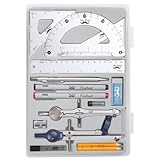
- Package includes 2 Compasses, 2 triangles, 1 6-inch ruler, 1 protractor, 2 pencils for compass, 2 fineliners, 1 metal mechanical pencil, 1 pencil sharpener, 1 eraser, and 2 pencil lead refills.
- With the durable plastic case, you can protect and keep the tools in one place in a backpack or desk, easy to carry and store.
- Mr. Pen geometry set is perfect for students, teachers, math experts, architects, engineers, artists, and designers at any level.
- It's also a perfect gift for your kids and friends, and it's easy to take to class and store in the classroom or at home.
8. hex-key set
Metric and inch hex keys are inexpensive, compact, and essential for machinery, fixtures, bicycles, robotics, laboratory equipment, furniture-like assemblies, and many commercial products.
Buy both measurement systems if your work involves imported equipment, mixed hardware, or field repairs. Ball-end keys improve access when the tool must approach at an angle, but straight engagement is preferable for loosening tight fasteners or applying high torque. A folding set is convenient for field work; individual L-keys or T-handles provide better leverage and access at the bench.
9. torque wrench or torque screwdriver
Controlled torque matters whenever fastener preload affects safety, sealing, alignment, friction, bearing life, or component integrity. Under-torquing can allow loosening or leakage; over-torquing can distort parts, damage threads, or crack housings.
Use a torque screwdriver for small electronics, instrumentation, connectors, and precision assemblies. Use a calibrated torque wrench for larger mechanical and structural hardware. Select the correct torque range and drive size, confirm whether it works in the required direction, and follow the manufacturer’s storage and calibration guidance.
What’s actually slowing this PC down?
Pick the symptom - the matching free tool is one click away.
Torque values are not interchangeable between dry, lubricated, plated, and otherwise treated fasteners. Use the assembly specification where one exists, and do not treat a torque tool as accurate outside its stated range.
10. wire stripper and crimper
A wire stripper and crimper is a high-value tool for controls, electrical prototyping, robotics, harnesses, instrumentation, and field repairs. A good tool strips insulation without nicking the conductor and forms a repeatable crimp on the specified terminal.
Check the supported wire gauges, terminal families, connector geometry, and whether the tool produces the required crimp profile. Klein’s 2005N, for example, combines stripping, cutting, and crimping functions while specifying supported wire gauges and terminal ranges.
Do not confuse ordinary plastic-dipped handles with insulation rated for live electrical work. A tool intended for energized electrical work must be specifically rated for that purpose, and the complete electrical safety procedure—including isolation, verification, and appropriate PPE—still applies.
11. needle-nose pliers
Needle-nose pliers reach into connectors, terminals, cable cavities, small mechanisms, and confined mechanical features. They are useful for positioning wires, retrieving small parts, holding hardware, and manipulating components where fingers cannot reach.
Smooth gripping surfaces are preferable for delicate finished parts because serrations can mark or distort them. Use a dedicated crimper for controlled electrical connections and a dedicated cutter when a clean, properly supported cut is required. Needle-nose pliers are not a substitute for either tool.
12. flush cutters or diagonal cutters
Flush cutters trim component leads, cable ties, small conductors, and wire ends close to a surface. Diagonal cutters provide a more general cutting profile and may be better for ordinary workshop wire.
Choose the jaw geometry and cutting capacity for the material. Precision electronics cutters are designed for relatively small, softer conductors; cutting hardened wire, piano wire, heavy cable, or screws can damage their edges or create a dangerous chip. Keep the cutting direction and possible flying fragments in mind.
Quick wins for a faster PC:
Scan for outdated or missing drivers - takes under a minuteDriver Scan →Repair Windows errors before they cause bigger problemsFix Now →Fix the driver behind crashes, sound loss and screen glitchesFind Drivers →13. utility knife with replaceable blades
A utility knife handles packaging, insulation, sheet goods, gaskets, cable jackets, labels, and many workshop materials. A model with a secure blade lock, guarded storage, ergonomic grip, and readily available replacement blades is generally more useful than one built around novelty features.
Use a stable cutting surface, cut away from the body, retract or cover the blade when it is not in use, and replace dull blades rather than applying more force. Stanley’s tool categories illustrate the continuing role of the utility knife as a general-purpose workshop and field tool.
14. cordless drill/driver
A cordless drill/driver is the most broadly useful powered hand tool for drilling and fastening fixtures, enclosures, brackets, panels, prototypes, and field hardware. Variable speed, a clutch, forward and reverse, and a comfortable grip make it useful across a wide range of tasks.
Choose the battery platform as carefully as the drill. Bosch’s current range distinguishes compact 12V tools for lighter or confined work from 18V models intended for greater torque and tougher materials. Also compare chuck size, speed range, clutch settings, battery availability, charger compatibility, weight, and ergonomics.
Do these 3 things before closing this tab:
1Scan for outdated or missing drivers - takes under a minute2Repair Windows errors before they cause bigger problems3Fix the driver behind crashes, sound loss and screen glitchesA drill/driver is not automatically the best tool for masonry, heavy structural fastening, impact work, or precision machining. Use the appropriate mode, bit, speed, and personal protective equipment for the material.
15. drill-bit set
A drill is only as useful as its bits. A practical engineering set includes high-speed-steel bits for metal, brad-point or general-purpose bits for wood, masonry bits when needed, and driver bits for fastening.
Also popular on Amazon

- Professional Geometry Set - Includes 2 drawing compasses, metal protractor metal, ruler, triangles, 2 mechanical pencils (0.5 & 0.7mm), 2 fineliner pens (black and red), 2 pencils, 2 tubes of lead refills, 2 erasers, 9 small eraser refills, 1 sharpener and a plastic storage box
- 2 Drawing Compasses - made of high quality stainless steel, featuring a center screw to adjust radius and prevent leg moves, giving the precise result you want. One of them comes with adjustable pencil holder, compatible with various kinds of pens, creating circles up to 10 inches in diameter
- Metal Protractor and Rulers Set - This geometry set includes common mathematical kits like ruler, triangles and protractor. All of them are labeled with clear and standard metric measurement, perfect for back to school supplies, engineering, architecture and math work
- Pens and Pencils - metal mechanical pencils in two line sizes: 0.7mm pencil is suitable for daily writing and sketching, while 0.5mm is perfect for intricate details and precise work. It also comes with 2 fineliner pens in black and red color, which is quick dry and waterproof
- Portability and Wide Application - We provide a sturdy plastic box to carry and organizer all the tools. The built-in bracket model keeps all the drafting supplies neat and safe. This multifunctional drafting set is a great for architectural drawings, mechanical design, engineering work, art and mathematics. Ideal gift for architects, engineers, artist and college students
Match the bit material, point geometry, coating, diameter, and cutting speed to the workpiece. Keep bits organized by size and type, and replace damaged bits rather than compensating with excessive pressure. For metal, cutting fluid, correct speed, workholding, and chip control often matter as much as the bit brand.
16. Deburring tool and file set
Drilling, cutting, machining, sheet-metal work, and 3D printing often leave burrs or sharp edges. A deburring tool and file set turns rough parts into safer, better-fitting parts without requiring a machine tool.
Include flat, half-round, round, and needle files where the work warrants them, along with a hand deburring tool and suitable countersinks. Deburr holes before inserting wires, seals, fasteners, or people’s hands near the part. Remove only the material necessary to break the edge; aggressive filing can change a critical dimension or weaken a thin feature.
17. Steel rule and tape measure
A caliper is not always the right measurement instrument. A steel rule is fast for short layout work and rough checks, while a tape measure is better for assemblies, workspaces, cable runs, mounting locations, and field dimensions.
Use the appropriate tool for the tolerance. A tape measure is convenient for establishing a cabinet location or estimating a cable run, but it should not be used to certify a close mechanical fit. A steel rule is quick and durable, but it cannot provide the same inside, depth, or step measurements as a caliper.
18. combination square or machinist’s square
A square exposes errors before parts are permanently joined. It checks perpendicularity, edge alignment, layout lines, bracket position, and the relationship between fabricated components.
Free tools Windows power users keep installed
One-click scans. No signup required.
A combination square adds a rule, adjustable head, and often a level or scribe function. A machinist’s square is useful when compact, reliable perpendicularity checks are more important than adjustable layout features. Keep the reference faces clean and verify that the square itself has not been dropped or damaged.
19. Clamps and a small bench vise
Clamps hold work while drilling, soldering, gluing, cutting, filing, or measuring. A small bench vise provides repeatable support and leaves both hands free for the operation.
For delicate or finished parts, look for soft jaws or use protective pads. Other useful considerations include swivel capability, throat depth, jaw width, mounting stability, and the ability to hold irregular shapes. Do not rely on hand pressure when a rotating drill, saw, cutter, or hot soldering tool is involved.
20. Cable and wire labeling supplies
Labeling supplies are documentation tools as much as workshop accessories. label printers, heat-shrink labels, write-on cable markers, and reusable tags reduce troubleshooting time in prototypes, panels, test fixtures, temporary installations, and field equipment.
Label both ends of a cable where practical, use an identification scheme that matches the drawings or wiring documentation, and choose labels that survive the expected heat, abrasion, moisture, chemicals, and sunlight. Clear identification prevents avoidable wiring and maintenance errors long after the original builder has left the project.
21. Logic analyzer
A logic analyzer complements an oscilloscope by capturing digital transitions across multiple channels. It is particularly useful when voltage levels look correct but a system still has incorrect timing, framing, or communication behavior.
Many logic analyzers can decode buses such as I2C, SPI, UART, and similar protocols. When comparing models, check channel count, input-voltage compatibility, sampling rate, capture memory, trigger functions, software support, and whether the analyzer is appropriate for the signal speeds being investigated.
A logic analyzer generally tells you what digital transitions occurred; it does not replace an oscilloscope for judging analog signal quality, noise, overshoot, ringing, or power-rail behavior.
22. Function or arbitrary-waveform generator
A function or arbitrary-waveform generator supplies controlled test stimuli for amplifiers, filters, sensors, control loops, and communications circuits. Instead of waiting for a real-world input, an engineer can apply a known sine wave, square wave, ramp, pulse, sweep, or custom waveform.
Compare frequency range, waveform types, amplitude accuracy, output impedance, modulation, sweep capability, synchronization, and the number of channels. Confirm that the generator’s output level and DC offset are compatible with the circuit under test. A generator is most valuable when the team regularly validates response to repeatable inputs; it is not a universal requirement for every engineer.
Independent reader supportYour contribution helps us test, update, and keep practical guides available for everyone.23. Arduino-compatible development kit
An Arduino-compatible development kit turns embedded concepts into working prototypes quickly. It is useful for sensors, actuators, simple control systems, data logging, educational demonstrations, and early proof-of-concept work.
The current Arduino Starter Kit is built around an UNO R4 WiFi platform and includes components, guided projects, a physical book, and online learning resources. That makes it a credible starting point for students, educators, makers, and multidisciplinary engineers who need to explore an idea before committing to production hardware.
Recommended Free Tools
Remember the boundary between a prototype and a product. A development board may not provide the environmental protection, electrical isolation, security, lifecycle support, certification, connector durability, or real-time guarantees required in production equipment.
Also popular on Amazon
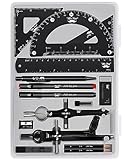
- This package includes 2 compasses, 2 triangles, 1 6-inch ruler, 1 protractor, 2 pencils for the compass, 2 fineliners, 1 metal mechanical pencil, 1 pencil sharpener, 1 eraser, and 2 pencil lead refills. It provides all the essential tools for geometry, math, and design work.
- The tools come in a durable plastic case, which keeps them organized and protects them from damage. The case is compact and easy to carry in a backpack or store on a desk, ensuring convenience and portability.
- Each tool in the set is designed for ease of use and durability. Whether measuring angles, drawing accurate lines, or sharpening pencils, these tools are crafted to provide a seamless and enjoyable experience for all users.
- Mr. Pen geometry set is suitable for a wide range of users, including students, teachers, math experts, architects, engineers, artists, and designers at any level. It caters to various needs, from precise measurements to artistic creations.
- With its practicality and versatility, this geometry set makes a perfect gift for kids, friends, or anyone interested in mathematics and design. Its compact size allows easy transportation to class or storage in the classroom or at home.
24. Safety glasses
Safety glasses belong in the toolbox, not in a separate “later” category. Drilling, cutting, grinding, soldering, compressed air, flying chips, chemicals, and broken tool fragments can all create eye hazards.
OSHA identifies eye and face protection for physical, chemical, and radiation hazards and says selection should follow a workplace hazard assessment. Choose protection compatible with the task, prescription eyewear, face shields, hearing protection, and other required PPE. Ordinary safety glasses do not protect against every splash, high-energy impact, laser, or radiation hazard.
25. Hearing and respiratory protection appropriate to the hazard
Hearing protection is relevant around grinders, drills, saws, compressors, and other noisy equipment. Select the type and attenuation for the environment, and remember that hearing protection does not remove the need to control noise at its source.
Respiratory protection requires more care than simply buying a disposable mask. OSHA places feasible engineering and work-practice controls ahead of respirators. When a respirator is necessary, the workplace needs an appropriate program covering hazard-specific selection, fit, training, maintenance, and related requirements. Dust, fumes, vapors, soldering emissions, coatings, and cutting products are not interchangeable hazards.
Safety glasses, hearing protection, respiratory protection, gloves, protective clothing, fall protection, and hard hats are selected according to the task and workplace assessment. This list’s PPE items do not replace the project’s safety plan or required site controls.
A practical buying order for a first toolbox
Do not buy all 25 tools at once unless your work genuinely requires them. A sensible general-purpose sequence is:
- Safety first: safety glasses and any task-specific PPE required by the workplace.
- Basic hand tools: screwdriver and bit set, metric and inch hex keys, needle-nose pliers, flush or diagonal cutters, utility knife, steel rule, and tape measure.
- Core measurement: digital multimeter and digital caliper.
- Electrical assembly: wire stripper/crimper, soldering station, precision electronics toolkit, and labeling supplies.
- Fabrication: cordless drill/driver, drill-bit set, deburring tools, files, square, clamps, and small vise.
- Specialist electronics: adjustable bench power supply, oscilloscope, logic analyzer, and function or arbitrary-waveform generator.
- Embedded prototyping: Arduino-compatible development kit when the project involves microcontrollers, sensors, or controls.
This order changes by discipline. A manufacturing engineer may move the caliper, square, files, vise, and torque tool to the front. An electrical engineer may buy the multimeter, soldering station, bench supply, and oscilloscope early. A software or systems engineer may need only the hand tools, a repair kit, and selected measurement equipment.
Do these 3 things before closing this tab:
1Repair Windows errors before they cause bigger problems2Scan for outdated or missing drivers - takes under a minute3Clear out junk files and repair common Windows errorsWhat to check before purchasing
- Accuracy and calibration: Determine whether the tool is for rough layout, troubleshooting, prototype work, or documented inspection. Professional measurement equipment may need calibration records and a defined interval.
- Safety rating: Check electrical category ratings, probe ratings, insulation markings, guarding, and the intended environment. Plastic-dipped handles do not make a hand tool suitable for live electrical work.
- Consumables: Confirm that soldering tips, drill bits, blades, labels, batteries, replacement jaws, and specialty bits will remain available.
- Compatibility: Match metric or imperial dimensions, connector families, battery ecosystems, software support, voltage levels, and fastener standards to the equipment already in use.
- Workholding: A modest drill, saw, or soldering tool becomes much safer and more accurate when the part is clamped securely.
- Documentation: Keep manuals, calibration records, wiring diagrams, torque specifications, and tool settings with the project where appropriate.
- Environment: Consider dust, moisture, oil, vibration, temperature, static electricity, confined spaces, and whether the tool will live on a bench, in a vehicle, or on a construction site.
Optional digital tools for the engineering workstation
Not every useful engineering tool is physical. A Windows-based engineer troubleshooting missing, outdated, or corrupted device drivers may consider Outbyte Driver Updater and PC Repair as an optional workstation-maintenance utility. Its described functions include driver scanning, backup and restore, optimization, and disk-space tools. It should not replace Windows Update, manufacturer support, antivirus protection, backups, or proper hardware diagnosis; review compatibility, permissions, privacy, and licensing before installing any maintenance software.
For broader Windows repair or disk-space issues, Outbyte PC Repair is an optional utility and does not replace backups, antivirus protection, or hardware diagnosis.
For engineering educators, creators, laboratories, or product teams, StreamNeo cloud 24/7 live streaming can support a different kind of toolbox: a recorded tool demonstration, repair walkthrough, course preview, or product tutorial that loops as a continuously available cloud-hosted stream. It is a content-production service, not a substitute for any of the 25 physical tools above.
Keep Engineering Demonstrations Live on YouTube 24/7
StreamNeo helps engineering educators, labs, creators, and product teams turn an owned or licensed prerecorded tool demonstration, repair walkthrough, course preview, or product tutorial into an always-on YouTube Live stream. Upload the video and paste a YouTube stream key; the stream runs in the cloud while the PC stays off.
Quick wins for a faster PC:
Fix the driver behind crashes, sound loss and screen glitchesFind Drivers →Clear out junk files and repair common Windows errorsFree Scan →Scan for outdated or missing drivers - takes under a minuteDriver Scan →That workflow keeps a channel live without leaving a PC or encoder running. StreamNeo checks stream health every 30 seconds and restarts a dropped stream automatically, which helps keep a demonstration available between live sessions.
A 24-hour 720p/30fps trial is free with no card at signup, giving the team a practical way to check the loop, YouTube destination, and presentation before deciding on a continuing broadcast workflow.
Common mistakes when building an engineering toolbox
- Buying specialist instruments too early: An oscilloscope or waveform generator can transform electronics debugging, but it is unnecessary for work that never involves time-varying electrical signals.
- Confusing resolution with accuracy: More displayed digits or a finer caliper resolution does not automatically mean a more accurate measurement.
- Using the wrong cutter: Precision electronics cutters can be ruined by hardened wire, heavy cable, or metal fasteners.
- Using ball-end hex keys for high torque: The angled contact is convenient but weaker than straight engagement.
- Skipping workholding: Holding a part by hand while drilling, cutting, or filing increases the chance of injury and inaccurate work.
- Leaving wires unlabeled: A prototype may be understandable today and unserviceable six months later.
- Treating current limiting as foolproof: A bench supply cannot correct reverse polarity, an incorrect voltage, a shorted capacitor, a damaged component, or an unsafe circuit connection.
- Assuming a prototype is production-ready: Arduino-compatible boards and hobby tools accelerate learning and proof-of-concept work, but production systems require their own design controls, testing, protection, and certification.
- Choosing PPE casually: Eye, hearing, and respiratory protection must match the actual hazard and workplace requirements.
Frequently Asked Questions
What should an engineer buy first?
For a general-purpose toolbox, start with safety glasses, screwdrivers and bits, metric and inch hex keys, a digital multimeter, digital caliper, pliers, cutters, utility knife, steel rule, and labeling supplies. Add a wire stripper/crimper, soldering station, precision repair kit, drill/driver, and bits according to the work.
Does every engineer need an oscilloscope?
No. An oscilloscope is essential when you must inspect changing electrical signals, timing, transients, noise, or signal integrity. It is often unnecessary for primarily software, civil, process, documentation, or non-electrical engineering work.
The Tool Desk
Outbyte PC Repair FREERepair Windows errors before they cause bigger problemsFix Now →Outbyte Driver Updater FREEFix the driver behind crashes, sound loss and screen glitchesFind Drivers →Is a digital multimeter enough for electronics troubleshooting?
It is the essential starting instrument, but not always enough. A multimeter measures values such as voltage, resistance, current, and continuity; an oscilloscope reveals waveform shape and timing, while a logic analyzer helps decode digital communication. A bench supply adds controlled power and current limiting.
Can ordinary hand tools be used on energized electrical equipment?
Not merely because they have plastic-dipped handles. Tools for energized electrical work must have the appropriate insulation and rating, and the work must follow the applicable isolation, verification, PPE, and safety procedures. When possible, de-energize the equipment before working.
Should a torque wrench be included in a small toolbox?
Include one when fastener preload affects safety, sealing, alignment, friction, or component life. A torque screwdriver is better for small electronics and instruments; a calibrated torque wrench is appropriate for larger mechanical assemblies.
The Bottom Line
The ultimate engineering toolbox is a deliberately chosen system, not a trophy collection. Build the safe hand-tool and measurement core first, then add fabrication tools, electronics instruments, and prototyping equipment as your projects demand them. A well-maintained, correctly rated tool used with good documentation will outperform a larger toolbox assembled without a clear job in mind.
What’s actually slowing this PC down?
Pick the symptom - the matching free tool is one click away.
Quick Recap
Product prices and availability are accurate as of the date/time indicated and are subject to change. Any price and availability information displayed on Amazon at the time of purchase will apply.

