Some links on this page are affiliate links: if you buy through them we may earn a commission, at no extra cost to you.
A good Tiffany-style ceiling fan should do two jobs well: light the room beautifully and move enough air to justify hanging a fan from the ceiling. The best choice for most homes is not necessarily the most ornate shade. It is the fan that fits the room size, clears the ceiling safely, has the right dry/damp/wet rating, uses a fan-rated electrical box, and gives you usable light without rattling a heavy glass shade every time the motor runs.
For 2026, most Tiffany-style ceiling fans sold in the U.S. fall into a niche category: indoor fandeliers, retractable-blade fixtures, and 52-inch fans with stained-glass-style bowl lights. They work best in dining rooms, bedrooms, foyers, breakfast rooms, and traditional or transitional kitchens where decorative lighting matters as much as air movement. They are usually not the first choice for a steamy bathroom, a range hood substitute, or a room that needs high-CFM cooling all day.
On our job sites, we treat these fans as decorative electrical fixtures with moving parts, not just ceiling decor. That means we verify the ceiling box, the fan weight, blade clearance, moisture rating, switching plan, and maintenance access before anyone falls in love with the glass pattern.
As an Amazon Associate I earn from qualifying purchases.
What Counts as a Tiffany-Style Ceiling Fan?
Most products marketed as Tiffany ceiling fans are Tiffany-style, not original Tiffany Studios or Tiffany & Co. pieces. That distinction matters. In today’s retail market, the term usually means stained glass, stained-glass-look resin, amber or jewel-tone shades, floral or geometric panels, oil-rubbed bronze frames, antique brass trim, black housings, and warm LED lighting.
The common formats are:
- Fandelier with retractable blades: Often 36 to 48 inches wide, with clear or tinted acrylic blades that fold away when the fan is off.
- traditional ceiling fan with Tiffany bowl light: Commonly 42 to 52 inches, with visible blades and a stained-glass-style lower shade.
- Small decorative fan for a nook or bedroom: Usually 30 to 42 inches, intended for modest air movement and visual character.
- Premium or vintage-inspired stained-glass fan: Heavier, more expensive, and more dependent on proper support and careful balancing.
Prices vary widely. Budget stained-glass-look fans can appear around $85 to $150. Midrange retractable Tiffany-style fandeliers commonly run about $190 to $320. Decorative 52-inch stained-glass fans often list around $250 to $370. Specialty, vintage, or premium marketplace units may reach roughly $550 to $667 or more before installation.
Popular on Amazon
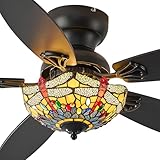
- 【 Installation Made Easy】 We've provided clear, step-by-step instructions and installation videos to guide you through the process, making it simple to install on your own. This versatile fan is perfect for various indoor spaces, including farmhouse-style rooms, living rooms, bedrooms, offices, studies, and kitchens.
- 【 Ceiling Fan Lighting】 This ceiling fan comes with a 24W dimmable LED light, offering a more energy-efficient. The tiffany ceiling fan features three color temperatures—3000K warm light, 4000K natural light, and 6500K cool white light. Perfect for any occasion, whether it’s a cozy evening, a lively party, or focused work.
- 【 Design Tiffany Ceiling Fan】The Tiffany ceiling fan features a stunning handcrafted glass shade, adding a classic touch to your home decor. Its unique retro style complements both indoor and outdoor spaces, making it an ideal antique ceiling fan for any room.
- 【 Remote Control】 Control your fan and light with ease using the included remote. You can adjust the fan speed with 6 levels, select your desired light color temperature, and set a timer (1/2/4/8 hour sleep mode). You can also turn the fan and light on or off independently.Memory function brings you back to your favorite fan and light settings when powered off via remote. When turned off using the main wall switch, only the light setting is preserved.
- 【 Worry to buy 】 Ceiling Fans with Light have a 3-year motor support and a 1-year support on other parts. We uphold the highest standards for all our products by testing each product for optimal performance, just buy with confidence,our fans make an excellent choice for personal use or as a thoughtful gift, adding both style and comfort to any space.
Best Rooms for Tiffany Ceiling Fans
A Tiffany-style fan belongs where the glass, finish, and warm light improve the room. It should not be forced into a space where a simpler high-airflow fan or a dedicated exhaust fan would perform better.
Outdated Drivers Are Slowing You Down
One free scan finds every outdated or missing driver and matches the right update for your exact hardware.Free scan · exact hardware matchWindows Errors? Fix Them Before They Spread
Repair common Windows errors and clear accumulated junk for a smoother, more stable PC - no reinstall needed.Free scan · no reinstallBreakfast Nooks and Dining Rooms
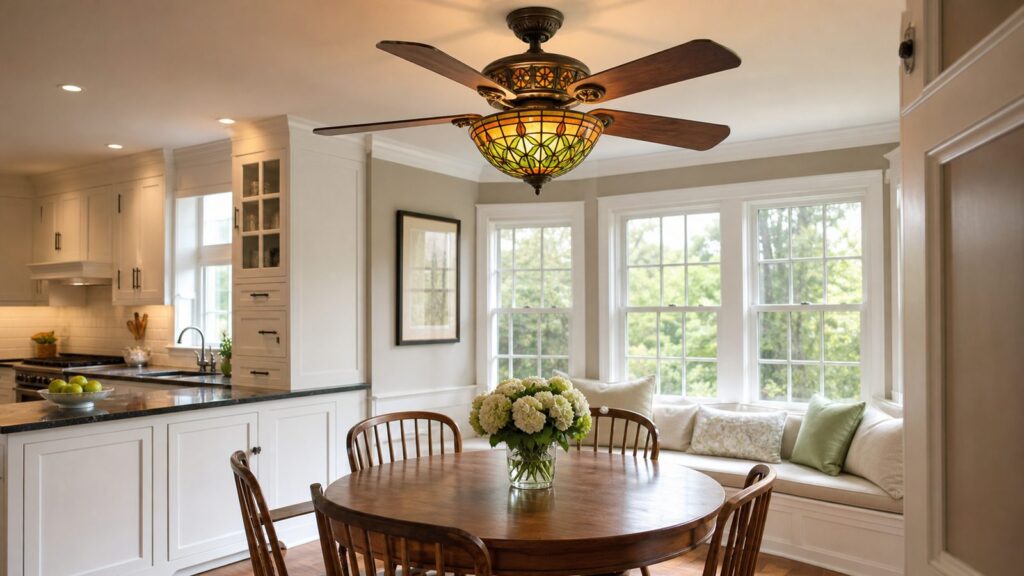
This is the strongest use case. A 36- to 48-inch retractable fandelier over a breakfast table can provide gentle air movement and a decorative focal point without looking like a large bedroom fan. For dining rooms up to about 225 square feet, a 44- to 48-inch model usually fits well. If the room is closer to 225 to 400 square feet, a 52-inch fan or two smaller fixtures may make more sense.
Use dimmable LEDs when possible. Dining rooms need flexibility: brighter light for homework or cleaning, softer light for dinner. Look for warm white around 2700K to 3000K if you want the glass to glow rich amber, red, and green. If the fan has only a cool 5000K setting, the same glass can look flatter and harsher.
Bedrooms
Bedrooms need quiet operation more than drama. A DC motor is worth considering because it typically runs quieter and more efficiently than a basic AC motor. ENERGY STAR says certified ceiling fans are up to 44% more efficient than conventional fans because of improved motors and blade designs. That matters in bedrooms where the fan may run for 6 to 10 hours overnight.
For bedrooms up to 144 square feet, look at roughly 42-inch fans. For 144 to 225 square feet, 44 inches is common. For larger primary bedrooms from 225 to 400 square feet, 52 inches is a typical target. If you choose a retractable fandelier, check the listed airflow. Some decorative models look right but do not move air like a conventional 52-inch paddle fan.
Kitchens
A Tiffany fan can work in a kitchen, especially over a breakfast area or in an open kitchen sitting zone. It should not interfere with the range hood, pendant lights, upper cabinet doors, or appliance doors. We also avoid placing decorative glass directly in the grease path from a cooktop.
For kitchen-adjacent spaces, choose smoother glass patterns and accessible shades. Deep texture, raised solder lines, and intricate panels collect grease film and dust faster than homeowners expect. If the shade cannot be removed and washed safely, it becomes a maintenance problem.
A ceiling fan is not a substitute for kitchen ventilation. Cooking moisture, smoke, grease, and combustion byproducts still need proper exhaust through a range hood or code-compliant ventilation system where required.
Bathrooms and Powder Rooms
Be careful here. Many Tiffany-style ceiling fans are indoor dry-rated only. A full bathroom creates humidity, condensation, and splash risks. A ceiling fan only circulates air; it does not remove moisture from the building envelope.
Free tools Windows power users keep installed
One-click scans. No signup required.
For bathrooms, the dedicated exhaust fan comes first. After that, only consider a damp-rated or wet-rated ceiling fan if the location, ceiling height, local code, and manufacturer instructions allow it. Damp-rated products tolerate humidity but not direct water. Wet-rated products are needed where water exposure is possible. In many bathrooms, a decorative Tiffany fan simply is not the right fixture.
Room-by-Room Selection Matrix
The table below gives practical starting points. Always confirm the manufacturer’s installation manual, listed ratings, and local code requirements before purchase.
| Room | Typical Fan Size | Mount Type | Rating Priority | What to Prioritize |
|---|---|---|---|---|
| Breakfast nook | 36-48 in. | Standard or short downrod | Dry, unless humid location | Dimmable warm light, easy-clean glass, quiet motor |
| Dining room | 44-52 in. | Centered over table or room | Dry | Glass quality, dimming, balanced airflow |
| Bedroom under 144 sq. ft. | About 42 in. | Flush or standard | Dry | Low noise, DC motor, remote control |
| Bedroom 144-225 sq. ft. | About 44 in. | Standard downrod | Dry | Airflow data, reversible motor, warm LEDs |
| Large bedroom or living area | 52 in. or multiple fans | Downrod matched to ceiling height | Dry or damp as needed | CFM, motor quality, blade span |
| Kitchen-adjacent area | 36-52 in. | Away from range and cabinet conflicts | Dry or damp depending on location | Cleanable shade, placement, light output |
| Bathroom | Only if appropriate | Code- and clearance-dependent | Damp or wet | Dedicated exhaust first, listed fixture only |
How Much Do Tiffany-Style Ceiling Fans Cost in 2026?
For budgeting, separate the fan purchase from the installation. A homeowner replacing an existing fan on a fan-rated box has a very different project than someone adding a new ceiling location, running new wiring, and installing a heavy glass fandelier on a tall ceiling.
| Item | Typical 2026 Cost | Notes |
|---|---|---|
| Budget Tiffany-style fan | $85-$150 | Often stained-glass-look materials, basic controls, lighter construction |
| Midrange retractable fandelier | $190-$320 | Common 36-52 in. options with remote, LED settings, retractable blades |
| Decorative 52-inch stained-glass fan | $250-$370 | Better scale for larger rooms; verify airflow and support requirements |
| Specialty or vintage-style unit | $550-$667+ | May include heavier glass, premium finish, or marketplace pricing variance |
| Professional installation | Average about $253 | Common national range is about $146-$360 for standard jobs |
| Complex installation | $600+ | New wiring, high ceilings, attic access, structural support, or difficult switching |
| Permit | $20-$100 | Often required for new wiring or structural changes, depending on municipality |
| Final inspection | $25-$75 | Local requirements vary |
The most common cost surprise is the ceiling box. A light fixture box is not automatically acceptable for a ceiling fan. Fans create dynamic load, vibration, and torque. If the existing box is not listed for ceiling-suspended paddle fans, the job may require a fan-rated brace or new structural support.
Other cost drivers include sloped ceilings, ceilings above 10 feet, old wiring, separate fan and light controls, AFCI or GFCI requirements, attic access, plaster repair, and heavy glass assemblies that take longer to assemble and balance.
The Three Labels to Verify Before Buying
Before we approve a decorative ceiling fan for a project, we want three pieces of information in writing: the fan-rated support requirement, the moisture rating, and the airflow/energy data.
1. Fan-Rated Box Requirement
The installation manual should state how the fan must be supported. Most ceiling fans must be mounted to a listed fan-rated outlet box or a structural support system designed for fan loads. This is not a cosmetic detail. A Tiffany-style fan may include glass shades, metal framing, a motor, blades, and a remote receiver. That weight plus motor vibration needs proper anchoring.
2. Dry, Damp, or Wet Rating
Dry-rated fans are for dry interior rooms. Damp-rated fans can handle humidity but not direct water. Wet-rated fans are built for locations where water exposure is possible. Many Tiffany-style fandeliers are dry-rated only, which makes them poor candidates for bathrooms, laundry rooms, covered porches, and steamy kitchen locations unless the listing says otherwise.
Do these 3 things before closing this tab:
1Clear out junk files and repair common Windows errors2Scan for outdated or missing drivers - takes under a minute3Repair Windows errors before they cause bigger problems3. Airflow and Energy Data
Decorative fans are sometimes marketed with strong lighting photos and weak airflow details. Look for CFM, motor type, wattage, blade pitch, and speed settings. ENERGY STAR certification is a plus when available. In a bedroom or family room, a fan that looks good but barely moves air will disappoint within the first week.
Blade Span, Ceiling Height, and Placement
Fan size should follow room size, not just fixture style. Common sizing guidance is about 42 inches for rooms up to 144 square feet, 44 inches for rooms from 144 to 225 square feet, and 52 inches for rooms from 225 to 400 square feet. Larger rooms may need more than one fan.
Ceiling height matters just as much. On an 8-foot ceiling, a low-profile or flush-mount fan may be needed to preserve safe head clearance. On a 9- or 10-foot ceiling, a standard downrod often works. Taller or vaulted ceilings usually need a longer downrod so the blades sit low enough to move air effectively.
Placement deserves a real layout check. In kitchens, confirm clearances around cabinet doors, pendant lights, refrigerator doors, range hoods, and island seating. In bedrooms, center the fan over the primary open area rather than directly over a tall bed canopy or built-in feature. In dining rooms, check that the fan does not visually fight with sconces, chandeliers, or built-ins.
What’s actually slowing this PC down?
Pick the symptom - the matching free tool is one click away.
Lighting Quality: Brightness, Color, and Dimming
Tiffany glass changes how light behaves. Amber, red, blue, and green panels absorb and tint light. A fixture that looks bright in a product photo may feel moody in a real room with darker paint, wood cabinets, or limited daylight.
If the fan will be the main room light, check lumen output rather than relying on wattage. For a bedroom, many homeowners are comfortable with layered lighting: the fan light for general light plus lamps for reading. For kitchens, the fan light should not be the only task light. Counters need under-cabinet lights, recessed lights, or pendants placed where shadows will not interfere with prep work.
Color temperature is also critical. Warm white, roughly 2700K to 3000K, usually flatters Tiffany-style glass. Neutral white around 3500K can work in kitchens. Cooler 5000K light may be useful for task visibility but can make traditional stained-glass colors feel less warm. If the fan offers 3-color LED settings, test all three before finalizing the room’s other bulbs.
Integrated LEDs are convenient, but they come with questions. Can the LED module be replaced? Is the dimmer compatible? Does the remote remember the last setting? Are replacement shades available? A beautiful fan becomes frustrating if a proprietary light board fails and parts are unavailable.
The Tool Desk
Outbyte Driver Updater FREEFix the driver behind crashes, sound loss and screen glitchesFind Drivers →Outbyte PC Repair FREEClear out junk files and repair common Windows errorsFree Scan →Retractable Tiffany Fandeliers: Where They Work and Where They Do Not
Retractable-blade Tiffany fandeliers are popular because they look more like chandeliers when off. They are useful in breakfast rooms, compact bedrooms, dressing areas, and traditional dining rooms where visual softness matters.
The tradeoff is airflow. Many retractable fans use shorter acrylic blades and decorative housings that prioritize appearance. Some move enough air for comfort in a small to medium room. Others are closer to a decorative light with a breeze feature. For primary cooling in a large bedroom, living room, or sunroom, a conventional 52-inch fan with well-designed blades may perform better.
When comparing retractable models, check the open blade span, motor type, CFM rating, noise reviews, and whether the blades are serviceable. We also look for wobble complaints. A fandelier with glass panels, retractable blades, and a remote receiver has more parts to align than a basic fan.
Also popular on Amazon

- [52-inch Tiffany-Style Ceiling Fan]: This ceiling fan features a handcrafted vintage stained-glass shade adorned with graceful heart patterns and rich jewel-toned details. Unlike traditional ceiling fans, this stained-glass light fixture brings a unique vintage artistic touch to your home, seamlessly blending with a variety of styles—from vintage and classic to modern. It is not only a practical lighting and ceiling fan for the home but also a high-quality decorative piece that instantly elevates the ambiance of any room.
- [Multifunctional and Controllable]: This ceiling fan with light can be controlled via remote control or app. Supports 6 fan speed levels and 3-color dimmable LED light modes (warm/cool/neutral) with customizable brightness to meet different scene needs. It supports 1/2/4/8-hour timer settings and light memory. The forward and reverse rotation functions provide powerful cooling with downward airflow in summer and and circulate warm indoor air in winter, realizing year-round comfortable ventilation and temperature balance for your living space.
- [Dual-sided Blades]: The ceiling fan comes with 5 dual-sided blades (wood grain and black), allowing you to customize the fan’s overall look to match your decor. Built-in high-quality, silent DC motor ensures stable operation with only 35dB low noise, providing ultra-quiet environment for sleeping, working and resting without harsh buzzing sound, bringing you silent and comfortable wind experience all day long.
- [Flexible Installation]: Comes with 2 downrods, flexible to adjust installation height as needed (installation videos on the product details page). The upgraded canopy structure supports installation on ceilings with an inclination angle of less than 15 degrees. This 52" large Tiffany ceiling fan light covers a wide air supply area, ideal for living room, bedroom, dining room, villa, cafe, restaurant and other medium and large indoor or outdoor patios spaces.
- [After-sales Service]: 12-month free replacement service: We can offer a free replacement service for damaged parts. Professional customer service: We have a professional team to help you solve product installation or product quality problems. If you have any questions, please feel free to contact us, we will give you a satisfactory answer within 24 hours.
When to DIY vs. When to Hire a Pro
A careful homeowner can sometimes replace an existing ceiling fan with a similar-weight fan if the existing box is fan-rated, the wiring is in good condition, the ceiling is accessible, and the new fixture uses the same switching arrangement. Even then, the power must be shut off at the breaker, the fan must be assembled exactly to the manual, and the final installation should be balanced and tested at every speed.
Quick wins for a faster PC:
Repair Windows errors before they cause bigger problemsFix Now →Scan for outdated or missing drivers - takes under a minuteDriver Scan →Hire a licensed electrician or qualified pro when any of the following apply:
- The existing ceiling box is for a light fixture only.
- New wiring, a new switch leg, or a new fan location is needed.
- The ceiling is vaulted, unusually high, plaster, tile, or difficult to access.
- The fan is heavy, glass-intensive, or specialty mounted.
- The room is a bathroom, damp kitchen zone, laundry area, or covered outdoor space.
- Local rules require a permit or inspection.
- You want separate wall controls for fan speed and light dimming.
Professional installation averages about $253 nationally in 2026, with many standard jobs falling between $146 and $360. That price can be money well spent when the alternative is an unsupported fan, nuisance wobble, damaged glass, or a code issue that shows up during a future home sale.
Safety, Code, and Permit Notes
Ceiling fan work touches both electrical and structural safety. The National Electrical Code requires fan support rules that are different from ordinary light fixtures. In practical job-site terms, that means we do not trust an unknown ceiling box just because a light has hung there for 20 years.
For new wiring or moved boxes, many municipalities require an electrical permit. Permit fees are commonly $20 to $100, and final inspection fees may run $25 to $75 depending on the location. Local rules also affect AFCI protection, GFCI protection, bathroom zones, kitchen circuits, and whether a homeowner may do the work themselves.
Bathrooms need special attention. A ceiling fan does not replace code-required exhaust ventilation. Moisture must be removed from the room, not just pushed around. If a bathroom fan is undersized or missing, solve that first before adding decorative air circulation.
After installation, every fan should be tested at low, medium, and high speed. Watch the canopy, downrod, shade, and blade assembly. Small wobble can often be corrected with balancing weights or blade alignment. Persistent movement, clicking, scraping, or glass vibration should be corrected before regular use.
Our Practical Buying Checklist
Before ordering a Tiffany-style ceiling fan, use this checklist:
- Measure the room square footage and choose the blade span accordingly.
- Confirm ceiling height and the correct flush mount or downrod length.
- Read the manual for fan-rated box and support requirements.
- Verify dry, damp, or wet rating for the exact room.
- Check CFM, motor type, wattage, and ENERGY STAR status where available.
- Confirm lumen output, color temperature, and dimming behavior.
- Make sure the remote receiver fits in the canopy.
- Match finish to fixed hardware such as cabinet pulls, faucets, hinges, and door hardware.
- Check replacement parts for shades, LED modules, remote controls, and blade kits.
- Read warranty terms and owner reviews for wobble, noise, and light failure patterns.
For finishes, oil-rubbed bronze and antique brass usually pair well with traditional amber and floral Tiffany glass. Black frames work better in transitional kitchens with black hardware, white cabinets, soapstone-look counters, or darker window frames. Brushed nickel can work, but it often looks less natural with warm stained-glass palettes unless the rest of the room already uses cool metals.
Recommended Free Tools
Cleaning and Maintenance
Tiffany-style fixtures need gentler maintenance than plain white fan lights. Dust the blades regularly so buildup does not throw the fan out of balance. Clean glass with a soft cloth and mild cleaner approved by the manufacturer. Avoid harsh chemicals on patina finishes, solder lines, resin panels, acrylic blades, and painted metal.
In kitchens, expect to clean more often. Grease film can dull textured glass and collect around metal seams. If you cook frequently, avoid the most intricate shade patterns directly near the range. A smoother shade in a breakfast nook is much easier to live with than a highly textured fixture placed in the cooking zone.
Once or twice a year, check visible screws, blade arms, glass retainers, and the canopy. Do not overtighten glass hardware. The goal is secure, not stressed. If the fan develops new wobble or noise, stop using it at high speed until it is checked.
Bottom Line: The Best Tiffany Fan Is the One That Fits the Room
The best Tiffany-style ceiling fan is not a single model. It is the right combination of size, support, moisture rating, airflow, light quality, and serviceability for the room where it will live.
Recommended Free Tools
For a dining room or breakfast nook, a 36- to 48-inch retractable fandelier can be a strong choice if the light is dimmable and the fan moves enough air. For a bedroom, prioritize a quiet DC motor, a practical blade span, and warm controllable light. For a kitchen, use the fan away from grease and range ventilation duties. For a bathroom, install proper exhaust first and only use a damp- or wet-rated fan where code and clearances allow.
From a builder’s standpoint, the ceiling box and rating labels matter as much as the glass. Get those right, and a Tiffany-style fan can add character, light, and comfort for years. Skip them, and even a beautiful fixture can become an expensive correction.
Frequently Asked Questions
Are Tiffany ceiling fans bright enough to be the main room light?
Sometimes, but do not assume they are. Stained-glass shades tint and absorb light, so check actual lumen output, color temperature, and dimming behavior. In kitchens, use separate task lighting for counters even if the fan has a bright LED kit.
Can you install a Tiffany ceiling fan in a bathroom?
Only if the fan is properly damp-rated or wet-rated for the location and local code allows it. Most Tiffany-style fans are dry-rated indoor fixtures. A bathroom also needs dedicated exhaust ventilation; a ceiling fan only circulates air.
Outdated Drivers Are Slowing You Down
One free scan finds every outdated or missing driver and matches the right update for your exact hardware.Free scan · exact hardware matchPC Slower Than It Used to Be?
A free scan shows the junk files, broken settings and background clutter dragging Windows down - then fixes them in one click.Free scan · Windows 10 & 11How much does it cost to install a Tiffany ceiling fan in 2026?
Fan purchase commonly ranges from about $85 to $370 for mass-market Tiffany-style models, with specialty units around $550 to $667 or more. Professional installation averages about $253 nationally, with many standard jobs around $146 to $360. Complex wiring, high ceilings, fan-rated box installation, or permits can push the total above $600.
Do Tiffany ceiling fans need a special electrical box?
They need a fan-rated electrical box or listed support system approved for ceiling-suspended paddle fans. A standard light fixture box may not be strong enough for fan vibration, motor torque, and the added weight of glass shades.
Are retractable Tiffany fandeliers good at moving air?
They can be good for gentle comfort in small and medium rooms, but many do not move air like a conventional 52-inch paddle fan. Check the open blade span, CFM rating, motor type, and owner feedback about airflow and wobble.
What size Tiffany ceiling fan do I need?
As a starting point, use about 42 inches for rooms up to 144 square feet, 44 inches for 144 to 225 square feet, and 52 inches for 225 to 400 square feet. Larger rooms may need more than one fan.
The Tool Desk
Outbyte PC Repair FREEClear out junk files and repair common Windows errorsFree Scan →Outbyte Driver Updater FREEScan for outdated or missing drivers - takes under a minuteDriver Scan →Quick Recap
Product prices and availability are accurate as of the date/time indicated and are subject to change. Any price and availability information displayed on Amazon at the time of purchase will apply.

