Free tools Windows power users keep installed
One-click scans. No signup required.
Some links on this page are affiliate links: if you buy through them we may earn a commission, at no extra cost to you.
For most homes, set the water heater to 120°F (49°C). This is the practical default recommended in U.S. Department of Energy residential guidance and supported by the U.S. Consumer Product Safety Commission because it reduces water-heating energy use while lowering the risk of tap-water scalds.
Hotter storage may be appropriate for professionally managed building systems, but it should not be treated as a universal household recommendation.
As an Amazon Associate I earn from qualifying purchases.
For most homes, set the water heater to 120°F (49°C). This is the practical default recommended in U.S. Department of Energy residential guidance and supported by the U.S. Consumer Product Safety Commission because it reduces water-heating energy use while lowering the risk of tap-water scalds.
That setting is not a universal rule for every building. Hospitals, hotels, multifamily properties, care facilities, and other buildings with formal water-management programs may use hotter storage temperatures to manage Legionella risk. In those systems, hot water must be properly tempered before it reaches fixtures. A higher thermostat setting in an ordinary home, without reliable anti-scald controls, can create a serious burn hazard.
#1 Best Overall

- Instant Read Meat Thermometer | Our instant read thermometer features a temperature probe and advanced, highly accurate technology with a 1-2 second response time. Our instant read food thermometer comes pre-calibrated with instructions and a meat temperature chart, plus a recalibration feature if needed.
- Multi-Use | From bbq thermometer to baking thermometer, our digital food thermometer for cooking is perfect for meats, liquids, deep frying and candy making. For air fryer, oven, grill, BBQ, griddle, smoker, kitchen and outdoors.
- Easy-Read Digital Thermometer For Cooking | Large instant thermometer dial with bright blue backlight means you can always read the temperature, whether you are grilling in the dark or baking in your kitchen. Perfect must have grilling accessory for kitchen essentials.
- Waterproof (IP67) | Perfect digital cooking thermometer for meat, our digital meat thermometer for food of any kind is waterproof IP67 rated and can be washed and cleaned under running water. A must-have among your grilling and kitchen accessories.
- Stocking Stuffers for Men | Our meat thermometer for cooking and grilling arrives in an elegant gift box, making it an ideal Christmas gifts for men, mens gifts, mens stocking stuffers, and stocking stuffers for adults. Perfect gifts for dad, husband, him, white elephant gifts or a secret santa favorite.
Why 120°F is the best starting point for most homes
A storage water heater loses heat while it sits, and hotter stored water generally requires more energy to maintain. Lowering an unnecessarily high setting can therefore reduce standby heat loss and water-heating energy use. The exact savings depend on the heater type, tank insulation, household usage, incoming-water temperature, and local utility rates, so there is no universal dollar amount or percentage that applies to every home.
Safety is the other major reason to avoid an unnecessarily high setting. Water hotter than 120°F can cause severe burns quickly. Children under five and older adults are particularly vulnerable because their skin may burn more easily or they may be less able to sense, move away from, or react to hot water. Even water at 120°F is not burn-proof: prolonged contact can still injure skin.
Quick wins for a faster PC:
Repair Windows errors before they cause bigger problemsFix Now →Fix the driver behind crashes, sound loss and screen glitchesFind Drivers →Clear out junk files and repair common Windows errorsFree Scan →The number on the thermostat is also not necessarily the temperature coming out of every faucet. Thermostats may be inaccurate, and delivery temperature can vary because of plumbing length, flow rate, fixture conditions, pressure-balancing devices, and mixing valves. When the actual temperature matters, measure the water at the fixture rather than relying only on the control setting.
120°F versus 130°F or 140°F
| Situation | Usually appropriate approach | Important qualification |
|---|---|---|
| Typical single-family home | Start at 120°F (49°C) | Verify the faucet temperature, especially after an adjustment. |
| Home with young children, older adults, or reduced mobility | Prioritize scald prevention; 120°F is the safer default | Do not raise the setting without a documented reason and reliable tempering controls. |
| Household considering a hotter setting because of health or infection concerns | Discuss the decision with a healthcare professional | CDC household guidance notes that 130–140°F may kill germs such as Legionella, but also increases burn risk and calls for thermostatic protection at fixtures. |
| Managed commercial, institutional, or large-building system | Use a documented water-management strategy | Storage, circulation, disinfection, mixing valves, monitoring, maintenance, and local code all matter. |
Do not raise a residential heater to 130–140°F simply because a general online recommendation says hotter is better. The correct temperature depends on the building, equipment, occupants, plumbing design, and reason for the change.
The Legionella issue: storage temperature is not delivery temperature
The main argument for hotter water storage is control of Legionella and other waterborne germs. CDC household guidance says maintaining a home water heater between 130°F and 140°F can kill germs such as Legionella, but it also explicitly recognizes the increased scald risk. For a household considering a setting above 120°F, CDC advises discussing the decision with a healthcare provider and using thermostatic valves that mix hot and cold water at the tap.
Rank #2

- 【Fast & Accurate】Our meat thermometer digital delivers accurate readings within ±1°F in just 1–2 seconds, with a wide temperature range of -58°F to 572°F (-50°C to 300°C). No more waiting over the heat - know your food's exact temperature instantly.
- 【Rugged & Waterproof 】Fully sealed with an IP67 rating, so you can rinse it under running water without worry. Durable ABS housing withstands drops and impacts, built to last through years of indoor cooking and outdoor grilling.
- 【Easy-to-Read Display】Large bright LCD with backlight for clear readings day or night. Simple °C/°F switch and easy calibration.
- 【Multi-use & Gift for Grill Lovers】Great for grilling, bbq, smoking, air frying, baking, candy making and liquids. Packaged in an elegant box, it’s a fantastic birthday gift for men, great stocking stuffer and ideal present for husbands and grill enthusiasts.
- 【4000+ Hour Battery Life】Auto-sleep and motion-activated wake mean no constant battery changes - just grab and go for marathon cookouts.
Building-system guidance is more structured than ordinary household advice. CDC guidance for managed building water systems recommends storing hot water above 140°F (60°C), keeping circulating hot water above 120°F (49°C), and using engineering controls such as thermostatic mixing valves near fixtures to reduce scalding. Those recommendations are intended for managed building systems—not as a blanket instruction for every single-family residence.
Recommended Free Tools
This distinction is essential:
- Storage temperature is the temperature maintained in the tank or other hot-water source.
- Circulation temperature is the temperature maintained in a recirculating hot-water loop.
- Delivery temperature is what reaches a shower, sink, or other fixture.
A professionally designed system may store and circulate water at a higher temperature, then blend it with cold water through a properly selected thermostatic mixing valve before delivery. That approach is not automatically safe: the valve must be correctly sized, installed, adjusted, protected from tampering where appropriate, and maintained. A mixing valve also does not replace local plumbing requirements, equipment instructions, temperature verification, or a building water-management plan.
When does a home need a thermostatic mixing valve?
Most homes using a correctly adjusted 120°F water-heater setting do not need to add a mixing valve solely because one is available. The primary safety step is setting and verifying the heater correctly.
A thermostatic mixing valve becomes more relevant when:
- a professional has a documented reason to maintain hotter storage;
- the property has a recirculating or otherwise complex hot-water system;
- the building is multifamily, commercial, institutional, or subject to a formal water-management program;
- local plumbing rules or project specifications require point-of-use temperature control; or
- occupants need a controlled maximum delivery temperature while the system must maintain a higher storage or circulation temperature.
These valves combine hot and cold water to provide a controlled outlet temperature. Residential products are available with adjustable outlet ranges, but product selection is not a generic do-it-yourself decision. A plumber should confirm the valve’s temperature range, flow capacity, connection size, compatibility with the heater and plumbing layout, installation location, and applicable code. The valve should also be tested and serviced as recommended by its manufacturer.
How to set and verify a water heater safely
- Identify the heater and read its instructions. Gas, electric, tankless, heat-pump, indirect, and combination systems use different controls and adjustment procedures. Heat-pump water heaters may have product-specific installation, operating, and maintenance considerations.
- Begin at 120°F for an ordinary residence. On some controls, the dial may say “warm” rather than display a number. Do not assume a dial position is accurate without checking the manufacturer’s labeling or measuring the water.
- Make only a small adjustment. Do not repeatedly turn the control while guessing. After changing it, allow the system to stabilize for the period specified by the manufacturer.
- Measure at a faucet. Run the hot water long enough to obtain a representative reading, while avoiding contact with the stream. Use a digital meat thermometer or candy thermometer in the water stream or a container of flowing water. The thermometer verifies temperature; it does not replace the owner’s manual or professional work.
- Check more than one fixture when scalding is a concern. Compare a nearby sink, a shower, and a fixture farther from the heater if practical. Different pipe runs, flow rates, and valves can produce different readings.
- Recheck after the adjustment. If the measured temperature does not match the control setting, or if it varies substantially between fixtures, stop relying on the dial alone and have the system inspected.
Useful tool: A digital meat thermometer or candy thermometer is a simple way to verify hot-water temperature at a faucet. Choose a thermometer with a suitable temperature range, keep the probe from touching the fixture or container, and avoid splashing. Never use touch as a substitute for measurement.
Special considerations for vulnerable occupants
Use extra caution when the home includes:
- children younger than five;
- older adults;
- people with reduced mobility or slower reaction times;
- people with reduced ability to sense heat; or
- people whose medical or immune-related circumstances make waterborne pathogens a particular concern.
For the first four groups, scald prevention should carry substantial weight, and 120°F is generally the prudent starting point. For medical or immune-related concerns, ask a healthcare professional whether a higher-temperature strategy is appropriate. Do not independently raise the heater and assume a mixing valve will make the installation safe.
Rank #3
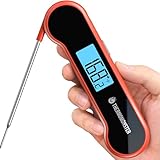
- 【8X Faster + 4X More Precise】: Upgraded with an industrial-leading professional thermocouple sensor, Themomonster meat thermometer digital with NIST certified ±0.5℉ precision provides you the accurate temperature of your food in just 0.5 Seconds.
- 【Temperature Lock & Long Probe】: With a 4 inch long probe and the temperature lock, you can easily measure and read the temperature away from the heat.
- 【Auto Flip Large LCD Display】: Features an innovative auto flip large LCD screen with exceptional brightness, this food thermometer is perfect for both left and right hand users outdoors and at night.
- 【100% Waterproof】: With upgraded 100% waterproof design, you can easily wash and clean your thermometer under running water.
- 【Motion Sensing Sleep/Wake】: Features a responsive motion-sensing mechanism, the thermometer will wake up instantly when you pick it up and auto-sleep after seconds if no operation were made for energy-saving.
Gas, electric, tankless, and heat-pump heaters
The 120°F residential recommendation is about the normal household hot-water goal, not a universal adjustment procedure. The way that temperature is controlled differs by equipment:
- Gas and conventional electric tank heaters: follow the model-specific instructions for the thermostat or control. Do not remove covers or disturb gas controls, wiring, burners, thermocouples, or safety devices unless the manufacturer’s instructions and your qualifications permit the work.
- Tankless heaters: the displayed set point may be closer to the outlet target, but flow rate, incoming-water temperature, programming, and fixture controls still affect delivery temperature. Verify at the fixture.
- Heat-pump water heaters: use the manufacturer’s operating modes and temperature controls. Efficiency, recovery, backup heat, sanitation cycles, and maintenance behavior vary by model.
- Indirect or combination systems: the water-heater control may interact with a boiler, buffer tank, recirculation loop, or mixing valve. Have a qualified professional evaluate the system before changing a control that affects more than one component.
Do not buy a replacement thermostat, gas control, thermocouple, or valve based only on appearance. These parts are model- and system-specific, and an incorrect component can create equipment damage or a serious safety hazard.
When to call a plumber
Arrange professional help if the faucet temperature is unexpectedly high, changes sharply during use, differs widely between fixtures, or will not stabilize after following the manufacturer’s adjustment procedure. A plumber should also handle mixing-valve installation, recirculation changes, gas-control work, electrical work inside the heater, and modifications to multifamily or commercial systems.
Follow state and local anti-scald requirements, especially in rental properties, multifamily buildings, care settings, and commercial facilities. Building owners and construction teams should document the intended storage and delivery temperatures, valve locations, commissioning readings, maintenance responsibilities, and any water-management procedures required by the project or jurisdiction.
Independent reader supportYour contribution helps us test, update, and keep practical guides available for everyone.A practical decision checklist
- Ordinary residence: set the heater to 120°F and verify the faucet temperature.
- Young children or older adults present: keep scald prevention as the priority; check shower and sink temperatures rather than trusting the dial.
- Considering 130–140°F: first identify the reason, consult a healthcare professional when the concern is health-related, and obtain professional advice about thermostatic tempering.
- Complex, multifamily, or commercial system: use a qualified plumbing professional and a documented water-management approach rather than a one-number internet rule.
- Temperature is inconsistent or controls are malfunctioning: stop experimenting with the setting and have the heater and valves inspected.
Frequently Asked Questions
Is 120°F the right water-heater temperature for most homes?
For most ordinary residential applications, 120°F (49°C) is the recommended starting point. It balances energy conservation and scald prevention. The actual temperature at a faucet can differ from the thermostat setting, so verify it with a thermometer when accuracy matters.
Rank #4

- Completely Waterproof: IPX6 waterproof rating means you can wash this cooking thermometer under running water without fear. This food thermometer for cooking ensures cleanup is ultra-fast
- Easy to Read: The large, easy-to-read numbers and bright backlit display make this instant read thermometer simple to check your cooking progress whether you're indoors or grilling outdoors, at any time of day
- Calibration: Calibration function ensures lasting accuracy, making this temperature probe a reliable BBQ companion; this durable kitchen utensils can also be used as a commercial cooking tool, offering reliable results for a lifetime of use
- Easy to Store: Candy thermometer features a foldable probe design to neatly store the thermometer in a drawer or use the magnetic back or hook for convenient storage
Should I set my water heater to 130°F or 140°F?
Not automatically. CDC guidance recognizes that 130–140°F storage can help kill germs such as Legionella, but hotter water increases burn risk. Discuss a higher setting with a healthcare professional when the concern is health-related, and use professionally selected thermostatic mixing valves to control delivery temperature.
Do these 3 things before closing this tab:
1Clear out junk files and repair common Windows errors2Fix the driver behind crashes, sound loss and screen glitches3Repair Windows errors before they cause bigger problemsDoes the ideal setting differ for gas and electric water heaters?
Gas and electric tank heaters, tankless units, heat-pump water heaters, and combination systems use different controls. The 120°F goal may apply, but the adjustment procedure must come from the specific owner’s manual. Verify the result at the faucet.
Does every home need a thermostatic mixing valve?
No. A typical home using a correctly adjusted 120°F setting does not need a mixing valve solely for safety. A valve is more relevant when hotter storage is professionally justified, the system is complex, or local code or building-management requirements call for one.
How can I check whether my water heater is really set to 120°F?
Use a candy thermometer or digital meat thermometer to measure hot water at a faucet. Do not rely on touch. Follow the heater manufacturer’s instructions, avoid splashing, and have a professional investigate if readings are unexpectedly high or inconsistent.
The Bottom Line
Set most residential water heaters to 120°F (49°C), then verify the actual temperature at the faucet. Hotter storage can be appropriate in professionally managed systems, but it requires reliable thermostatic tempering, maintenance, code compliance, and careful attention to occupant safety.
The Tool Desk
Outbyte PC Repair FREEClear out junk files and repair common Windows errorsFree Scan →Outbyte Driver Updater FREEFix the driver behind crashes, sound loss and screen glitchesFind Drivers →Quick Recap
Product prices and availability are accurate as of the date/time indicated and are subject to change. Any price and availability information displayed on Amazon at the time of purchase will apply.

