Some links on this page are affiliate links: if you buy through them we may earn a commission, at no extra cost to you.
The best cable management and cord storage of 2023 depends on what is actually untidy: a loose charging lead, a changing bundle, an exposed wall run, a power strip, or cables you need to carry. Use clips for individual accessible cables, reusable ties or sleeves for bundles, raceways for visible routes, boxes or trays for power-strip clutter, and a tech pouch for portable storage.
If you are trying to tidy one charging lead, start with adhesive cable clips. If you have several cables running together, use reusable hook-and-loop ties or a sleeve. For a cable crossing a wall or baseboard, use a raceway; for a power strip, use a box or tray. A travel pouch is the right answer only when the cables need to leave the desk with you.
That distinction matters more than choosing a supposedly universal “best” product. Cable clutter comes from different problems—loose connectors, bundled runs, exposed cables, surplus power-strip cable, and portable accessories—and each needs a different organizer.
What’s actually slowing this PC down?
Pick the symptom - the matching free tool is one click away.
As an Amazon Associate I earn from qualifying purchases.
This guide retains its 2023 buying-guide framing. Product prices, pack sizes, revisions, colours, and availability can change, so check the current retailer or manufacturer listing before buying. The recommendations below are category-based and are not claims of independent hands-on testing.
Quick recommendations
| Problem | Best product type | Why it fits | Main drawback |
|---|---|---|---|
| One or two loose desk or bedside cables | Cable clips | Keep the connector in a reachable position | Adhesive may not suit every surface |
| Several cables travelling together | Reusable cable ties | Adjustable and easy to reopen as equipment changes | They bundle cables but do not conceal or route them |
| A group of cables that should look like one run | Cable sleeve | Conceals and consolidates several wires | Removing one cable can be inconvenient |
| Cables crossing a wall, skirting board, or desk edge | Raceway or cord cover | Creates a defined, protected route | Requires measuring, surface preparation, and sometimes cutting |
| A power strip and excess cable behind furniture | Cable-management box or under-desk tray | Contains concentrated electrical clutter | Must be large enough and must not restrict necessary access or ventilation |
| Cables and adapters carried between locations | travel tech pouch | Separates and protects small accessories | It stores cables; it does not manage a fixed installation |
1. adhesive cable clips: best for frequently used individual leads
Use clips for a phone charger, USB lead, headphone cable, keyboard cable, mouse cable, or another connector that repeatedly slips behind a desk or bedside table. A clip fixes the cable at a chosen point without enclosing the entire run, so the plug remains easy to grab.
Popular on Amazon

- Cable Management Kit: 4pcs Cable Sleeves( 20 in L x 0.4 in w), 20pcs reusable wire ties,35Cable Clips 11 Cord Holders, 2 Self Adhesive Cable Tie Rolls(The length of each roll is 118 in), 20Pcs Cable Zip Tie Mounts(3.54L*1.1in W),100 Cable Fastening Ties (size of every : 7.87in L x0.12in W)
- 6 kinds of Cable Clips:46pcs wire Clips is made from eco-friendly Polyamide66 material, nontoxic, extra strong.Works on all clean surfaces like desks, walls, baseboards, cabinets, wood, ceramics, etc.Two colors(black&transparent) meet your needs well
- Premium Material: Made of highly sturdy and quality materials the components included in this kit are built to las, ensuring clutter free organization of your cords and cables for years to come. The included cable holders boast strong self-adhesive sticky pads ensuring they remain affixed to your desired surface at all times
- Easy to Install:Our wire loom is split and easy to load wires. Once loaded, our braided cable sleeve will close on itself and perfect wire wrap. No drilling, nailing or taping required.This cord protector also can keeps cat from chewing cables
- 20pcs 2 Roll Self Adhesive Ties: Each wire ties is 5.75 in length and 0.5 inches in width. Include an eye hole in the tail allowing the tie to be attached to a cable or hung from a hook. Multiple wire organizer can be attached together to form one longer tie
OHill-style adhesive clips are a representative choice in this category. Multi-piece packs are useful when several cables need separate anchor points around a desk, nightstand, monitor stand, or entertainment centre. They are also a sensible first purchase when the problem is access rather than concealment.
Do these 3 things before closing this tab:
1Clear out junk files and repair common Windows errors2Scan for outdated or missing drivers - takes under a minute3Repair Windows errors before they cause bigger problemsLook for a clip whose opening suits the cable diameter. A clip that is too tight can pinch the insulation; one that is too loose will not hold the lead reliably. Before applying an adhesive clip:
- Clean and dry the surface according to the adhesive maker’s directions.
- Choose a flat, sound surface rather than dusty, greasy, damp, flaky, or heavily textured material.
- Plan the cable path first so the clip is not forced to carry a sideways pull.
- Check whether removal could lift paint, veneer, wallpaper, or a delicate finish.
Clips are not a substitute for a raceway when a cable must cross a wall, and they are not the best way to support a heavy bundle. For additional examples of this product category, see Good Housekeeping’s cord-management solutions.
2. Reusable hook-and-loop ties: best for changing bundles
When a monitor, dock, computer, keyboard, mouse, speakers, and other peripherals all share a route, individual clips can create more work than they solve. Use reusable ties to gather the cables into manageable groups, then route or support those groups with a sleeve, tray, or raceway if needed.
VELCRO Brand ONE-WRAP ties are a representative example. The tie wraps around a cable or bundle and fastens back onto itself. Because it can be opened and adjusted, it is better suited than a single-use zip tie to a workstation or home entertainment system that will be rewired later. Different sizes can accommodate thinner signal leads and bulkier power cables, and different colours can help identify groups.
Quick wins for a faster PC:
Clear out junk files and repair common Windows errorsFree Scan →Scan for outdated or missing drivers - takes under a minuteDriver Scan →Repair Windows errors before they cause bigger problemsFix Now →Also popular on Amazon

- High quality material:XHF Adhesive Cable Clips are manufactured from Strong Adhesive and PA66 nylon
- Widely used: USB Cable, Ethernet Cable, Outdoor String Lights, LED Strip Lights, Tachograph Cable, TV Cable, Desk and under Desk cables, etc
- Size: Base 5/8" x 5/8", inner diameter of buckle 1/4" x 2/5",120pcs
- Suitable for a variety of object surface: whether glass, wall, ceramic, wood, metal, plastic, they can stay firmly on the surface
- No residue: even if you want to remove them, it can easily tear the whole piece of glue, without any stain
Do not make the bundle tighter than necessary. Leave cables able to move naturally, avoid sharp bends, and do not trap a cable under furniture or against a sharp edge. Manufacturer guidance specifically warns against securing wires in a way that damages or pinches them.
3. Cable sleeves: best for concealing several cords
A sleeve is useful when several wires run from one place to another and the goal is to make them appear as one tidy run. It works well behind a desk, between a computer and monitor, or around an entertainment centre where the cables generally travel in the same direction.
The Joto Cable Management Sleeve is a representative product identified as a best-overall option in Bob Vila’s accessible buying guide. The important feature is the sleeve format rather than an assumption that one brand suits every installation: the cables are gathered inside a reusable covering instead of being individually attached to a surface.
Measure before ordering. Count the cables, consider their combined diameter, and allow room for the largest connectors to enter the sleeve. A sleeve is less convenient when:
- One cable must be removed regularly while the rest stay in place.
- The cables branch in several directions.
- Large plugs or power bricks must pass through the sleeve.
- You need to inspect or replace individual cables frequently.
For branching runs, use separate ties and short sleeves, or route each branch with clips or a raceway instead of forcing everything into one continuous bundle.
Also popular on Amazon
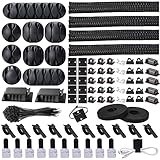
- Cable Management Organizer Kit: This comprehensive kit includes a variety of solutions including 4pcs Cord Protector( 20 inch l x 4 inch w), 10pcs reusable wire ties, 36 Self Black Adhesive Cord Holders, 2 Self Adhesive Cable Tie Rolls(The length of each roll is197 inch), 100 nylon wire ties (size of every : 7.9 inch L x0.12 inch w)
- Safety Material: Made of highly sturdy and quality materials the components included in this kit are built to las, ensuring clutter free organization of your cords and cables for years to come. The included cable holders boast strong self-adhesive sticky pads ensuring they remain affixed to your desired surface at all times
- 3 kinds of Black Cable Clips:36pcs wire Clips is made from Polyamide66 material, nontoxic, extra strong.Works on all clean surfaces like desks, walls, baseboards, cabinets, wood, ceramics, etc.Two colors(black transparent) meet your needs well
- Easy to Use:Our wire loom is split and easy to load wires. Once loaded, our braided cable sleeve will close on itself and perfect wire wrap. No drilling, nailing or taping required.This cord protector also can keeps cat from chewing cables
- Flexibility Versatility:including10pcs and 2 Roll Self Adhesive Ties. Each wire ties is 6 in length and 0.5 inches in width. Include an eye hole in the tail allowing the tie to be attached to a cable or hung from a hook. Multiple wire organizer can be attached together to form one longer tie
4. Raceways and cord covers: best for exposed wall or baseboard runs
If a cable must visibly travel across a wall, skirting board, desk area, or television installation, a raceway is usually the cleanest category of solution. Unlike a clip, it encloses and routes the cable. It can reduce the visual mess and protect a low-voltage cable from casual snagging, but it does not turn an unsafe electrical installation into a safe one.
D-Line cable raceways are representative of surface-mounted systems available with adhesive installation or screw fixing, depending on the product and application. D-Line’s range also distinguishes TV and low-voltage raceways, office cable-management products, floor cable covers, boxes, and trays. Select the product for the actual route rather than assuming all “cord hiders” have the same capacity or mounting method.
How to install a surface raceway
- Map the route. Choose the shortest practical path with gentle bends. Avoid door hinges, walkways, heat sources, sharp corners, and areas where the cable could be crushed.
- Measure the run. Include turns and allow for the raceway’s stated internal capacity. Do not fill it so tightly that cables are pinched or difficult to replace.
- Check the surface. Adhesive mounting is most dependable on a clean, level, non-dusty surface. Painted, porous, damp, rough, or contaminated surfaces may need a different fixing method.
- Choose the fixing method. Use the supplied adhesive only where the surface and load are suitable. Screw fixing is more appropriate where the manufacturer permits it and a more permanent installation is required.
- Test before committing. Lay out the cable and cover, verify that the connectors reach their destinations, and check that furniture or doors will not press on the route.
- Close and inspect the cover. The cable should sit loosely enough to avoid damage, with no sharp bend at either end.
For mains-voltage wiring, fixed electrical outlets, or any installation that may fall under local electrical or building requirements, use the correct listed equipment and consult a qualified electrician. Decorative adhesive raceways are intended to organise exposed cables; they are not permission to run unsafe wiring through walls or alter electrical systems.
Recommended Free Tools
5. Cable-management boxes and under-desk trays: best for power-strip clutter
When the mess is concentrated around a power strip, charger bricks, and excess cable behind a desk or entertainment centre, a clip or sleeve treats only part of the problem. A cable-management box can hide the power strip and surplus length, while an under-desk tray supports the strip and routes cables below the work surface.
These are different products. A box is an enclosure; a tray is a support and routing platform. D-Line’s home range treats organiser boxes and trays as separate solutions. Check the inside dimensions against the power strip, plugs, adapters, and cable exit points before buying. A box that fits the strip but not its bulky power bricks is not a practical fit.
Do not seal or bury equipment in a way that blocks required switches, fuses, reset buttons, inspection access, or ventilation. Keep the box away from water and heat, do not overload the power strip, and do not use an enclosure as a reason to hide damaged cords or questionable electrical connections. The organisation system should make inspection easier, not conceal a fault.
Also popular on Amazon

- Cable Management Kit:4pcs Cable Sleeves( 20 in L x 0.4 in w), 20pcs reusable wire ties,53Cable Clips 12Cord Holders, 2 Self Adhesive Cable Tie Rolls(The length of each roll is 118 in), 20Pcs Cable Zip Tie Mounts(3.54L x1.1 inW),200Cable Fastening Ties:100pcs (8 in*0.12 in ),100pcs(6 in*0.12 in)
- 6 kinds of Cable Clips:65pcs wire Clips is made from Polyamide66 material, nontoxic, extra strong.Works on all clean surfaces like desks, walls, baseboards, cabinets, wood, ceramics, etc.Two colors(black&transparent) meet your needs well
- Premium Material:The sleeve is made from PET material, sturdy, flexible, and self-wrapping. The included cable holders boast strong self-adhesive sticky pads ensuring they remain affixed to your desired surface at all times
- 20pcs 2 Roll Self Adhesive Ties: Each wire ties is 5.75 in length and 0.5 inches in width. Include an eye hole in the tail allowing the tie to be attached to a cable or hung from a hook. Multiple wire organizer can be attached together to form one longer tie
- Widely Application: suitable for most occasions and perfect for organizing charging cords, power cords, network cables, audio cables, video cables, and cable runs, in data centers, at the office, or home
6. Travel tech pouches: best for portable cable storage
A pouch solves a storage problem rather than a routing problem. Choose one when you carry charging cables, adapters, memory cards, batteries, and small electronic accessories between home, work, or a job site.
The Peak Design Tech Pouch is a representative example. Its official product information describes a clamshell opening, internal pockets, elastic loops, a cable pass-through, and weatherproof recycled-nylon construction. Those features help separate accessories and make them visible, but they do not replace clips, sleeves, trays, or raceways around a permanent workstation.
For site or field use, choose the size and protection level based on the equipment you actually carry. A pouch is not automatically a hard case: keep fragile electronics and exposed connectors away from tools, moisture, impact, and loose metal objects.
Independent reader supportYour contribution helps us test, update, and keep practical guides available for everyone.How to choose the right cable organiser
Start with the cable count and diameter
One thin charging cable needs a clip. A handful of similar cables may need reusable ties. A large group may need a sleeve, tray, or raceway with measured internal capacity. Include power bricks and connector heads in the measurement; the cable’s narrow shaft is not the whole installation.
Decide whether access or concealment matters more
Use clips when connectors must remain reachable. Use ties when you mainly need a tidy bundle. Use a sleeve or raceway when appearance and route definition matter more than removing one lead quickly. Use a box when the clutter is a power strip and its surplus cable.
Also popular on Amazon

- 327 PCS Cable Management Kit:4 cord protector 20 in L x 0.4 in w,25 Cable Zip Ties,65Cable Clips 13Cord Holders,200 Cable Fastening Ties:100pcs 6 in x 0.12 in and 100 pc 4 in x 0.12 in,5 Self Adhesive Cable Tie Rolls, each roll is 39 in,20 Cable Zip Tie Mounts 3.54L x 1.1 inW
- 7 kinds of Cable Clips:Toally 65pcs wire clips ,extra strong.Works on all clean surfaces like desks, walls, baseboards, cabinets, wood, ceramics, etc.Expand space visually by hiding the cables under the table and next to the back
- Easy installation :No nails, no holes, no damage to the desktop, comes with a highly adhesive glue, leaving no marks. The included cable holders boast strong self adhesive sticky pads ensuring they remain affixed to your desired surface at all times
- Premium Materials: cable sleeves are made from PET material, nontoxic, extra strong an durable,and easy self wrapping. While the cable clips are made from good materials, providing extra strength to securely hold your cables in place
- Safety and Tidy: Preventing pets from biting the wires that causing safety hazards. Keeps your feet from being snagged by cables while giving a cleaner look
Allow for future changes
Home-office and entertainment systems rarely stay unchanged. Reusable hook-and-loop ties are preferable to permanent zip ties when equipment may be added, removed, or replaced. Leave enough capacity in a sleeve, tray, or raceway for reasonable expansion without overfilling it.
Match the fixing method to the surface
Adhesive products need a compatible, clean surface and may damage finishes during removal. A screw-fixed raceway is more secure in suitable circumstances, but drilling can damage hidden services and requires an appropriate fixing. Never drill where electrical cables or plumbing may be concealed; use a safe fixing plan or professional help.
A practical installation sequence
- Unplug and identify. Label unknown cables before moving them. Replace damaged cables rather than trying to hide them.
- Separate by destination. Make groups for the monitor, computer, peripherals, chargers, and power. Avoid mixing cables merely because they are nearby.
- Remove unnecessary length. Coil only the surplus gently; do not tightly wind cables around hot equipment or create sharp kinks.
- Secure individual access points. Put clips where frequently used connectors can be reached without pulling on the device socket.
- Bundle changeable groups. Use reusable ties, leaving the bundle loose enough to avoid pressure and allowing future additions.
- Conceal the defined runs. Add a sleeve for a shared route or a raceway where the route crosses a visible surface.
- Contain the power area. Use a correctly sized box or tray, while preserving ventilation and access to controls.
- Test every connection. Reconnect equipment, move the desk or furniture through its normal range, and check that no cable is stretched, pinched, or pulled from its plug.
Common mistakes to avoid
- Using clips for a heavy bundle: the adhesive can fail and the cable may be pulled sideways.
- Overfilling a sleeve or raceway: crowded cables are harder to replace and may be forced into damaging bends.
- Using a sleeve where cables branch repeatedly: separate routes are easier to service.
- Applying adhesive to a dusty or unsuitable surface: clean, level, dry surfaces generally give the best chance of a reliable bond.
- Tightening ties until they mark the insulation: secure cables without crushing them.
- Hiding a power strip without checking the enclosure: preserve ventilation, access, and safe electrical loading.
- Confusing cable tidiness with electrical compliance: organisers do not replace correct wiring, approved equipment, or professional electrical work.
- Buying from an old price list: the 2023 title is historical; current prices, variants, and availability require a fresh retailer check.
Bottom line
For most loose desk and bedside leads, begin with adhesive cable clips. Add reusable hook-and-loop ties when several cables travel together. Choose a cable sleeve for a concealed bundle, a raceway for an exposed wall or baseboard route, and a box or tray for power-strip clutter. Keep a travel tech pouch separate from fixed cable management: it organises the accessories you carry, not the wiring in the room.
Frequently Asked Questions
Use adhesive clips for individual cables that must stay reachable, then add reusable hook-and-loop ties or a sleeve for groups of cables running in the same direction. An under-desk tray is more suitable when the main problem is a power strip and several adapters.
What is the best cable management for a desk?
Cable clips are better when you frequently unplug a cable and want the connector held in place. A sleeve is better when several cables share one route and concealment matters more than quick access to each individual lead.
Are cable clips or a cable sleeve better?
They can damage paint, veneer, wallpaper, or other delicate finishes when removed. Adhesive products work best on clean, dry, flat, compatible surfaces; check the product instructions and test an inconspicuous area if the finish matters.
Will adhesive cable clips damage a wall or desk?
Yes, if the box is correctly sized and designed for that use, but do not block ventilation, switches, reset controls, inspection access, or safe cable exits. Never use a box to conceal damaged cords or an overloaded electrical connection.
Can I put a power strip in a cable-management box?
A sleeve gathers several flexible cables into one bundle. A raceway is a surface-mounted channel that defines and conceals a route along a wall, baseboard, desk, or similar surface. Use a raceway when the cable must cross a visible surface.
What is the difference between a raceway and a cable sleeve?
The Bottom Line
Best overall approach: match the organiser to the failure point. Clips preserve access, ties handle changing bundles, sleeves conceal grouped cables, raceways control visible runs, boxes and trays contain power-strip clutter, and pouches organise portable accessories. Measure first, protect the cable from pinching and sharp bends, and treat electrical safety and local requirements as separate from appearance.
Quick Recap
Product prices and availability are accurate as of the date/time indicated and are subject to change. Any price and availability information displayed on Amazon at the time of purchase will apply.

