For most home canners, the Presto 16-Quart Pressure Canner and Cooker (01755) is the best place to start. It holds seven quart jars or 10 pint jars, works on gas, electric-coil, and compatible smooth-top ranges, and costs considerably less than the premium All American 910. Choose the Presto 23-Quart (01781) for large batches, the Presto 01784 for induction, or the All American 910 for heavy-duty construction and a gasket-free metal-to-metal seal.
The Presto Precise 12-Quart Digital Pressure Canner is the convenience choice, but it needs a more careful qualification: Presto says its dedicated electric canner is designed to meet USDA home-canning guidelines, while university Extension guidance remains much more established for the traditional stovetop pressure-canner process. Ordinary electric multi-cookers such as Instant Pot and Ninja Foodi models are not substitutes for a pressure canner.
This ranking combines the strongest available hands-on comparison—Serious Eats’ 2023 testing of six pressure canners—with current manufacturer specifications, manuals, prices, parts information, and USDA and university Extension safety guidance. It does not claim that all five models were personally tested in one new laboratory comparison.
As an Amazon Associate I earn from qualifying purchases.
Quick wins for a faster PC:
Clear out junk files and repair common Windows errorsFree Scan →Scan for outdated or missing drivers - takes under a minuteDriver Scan →Repair Windows errors before they cause bigger problemsFix Now →Quick verdict
Prices below are the official prices displayed by the manufacturers when checked on August 10, 2026. Prices, availability, included accessories, and product generations can change.
| Pick | Best for | Jar capacity | Gauge or control | Cooktops | Price checked | Main caveat |
|---|---|---|---|---|---|---|
| Presto 16-Quart 01755 | Most stovetop users | 7 quarts, 10 pints, or 13 half-pints | Dial gauge | Gas, electric coil, compatible smooth-top | $166.99 | Not induction-compatible; gasket and gauge need maintenance |
| All American 910 | Experienced canners and premium construction | 4 quarts or 7 pints | Dial gauge plus weighted regulator | Gas, electric, flat-top | $349.95 | Expensive, relatively small, and more involved to close |
| Presto 23-Quart Induction 01784 | Induction users and large batches | 7 quarts, 20 pints, or 26 half-pints | Dial gauge | Induction, gas, electric coil, compatible smooth-top | $215.99 | Portable induction units may not support its size, wattage, or loaded weight |
| Presto 23-Quart 01781 | Large harvests and pint-heavy batches | 7 quarts, 20 pints, or 26 half-pints | Dial gauge | Gas, electric coil, compatible smooth-top | $185.99 | Not induction-compatible; much larger to fill, lift, and store |
| Presto Precise 12-Quart Digital 02144 | Automated countertop operation | 5 quarts or 8 regular-mouth pints | Temperature sensor and digital controls | 120-volt countertop appliance | $386.99 | Independent Extension endorsement is less established than for stovetop canning |
Important: “16 quart” and “23 quart” describe the vessel’s liquid capacity, not the number of quart jars it can process. Both Presto stovetop models hold seven quart jars; the 23-quart models mainly add capacity for two layers of pint or half-pint jars.
#1 Best Overall

- The only method recommended safe by the US Department of Agriculture for canning vegetables, meats, poultry, and seafood
- Doubles as a boiling-water canner for preserving fruits, jams, jellies, pickles, and salsa; Handy as a large capacity pressure cooker
- Constructed of warp-resistant heavy-gauge aluminum for fast, even heating; Works on regular and smooth-top ranges; Extended 12-year limited warranty
- Deluxe pressure dial gauge registers the complete range of processing pressures; This precise measurement is especially important at higher altitudes
- Extra-large size is great for big canning jobs; Includes canning/cooking rack and complete 76-page instruction and recipe book
Pressure canner versus pressure cooker: the safety distinction
A pressure canner is not simply a pressure cooker with a larger marketing label. For low-acid food preservation, a qualifying canner must be large enough to hold at least four upright quart jars and must provide a way to vent air, regulate pressure or temperature, and release pressure safely. The National Center for Home Food Preservation explains the minimum canner requirements.
Pressure canning is used for most vegetables, meats, poultry, fish, seafood, beans, and soups because these foods are low in acid. The process reaches temperatures above the boiling point of water, which is necessary to control Clostridium botulinum spores when the complete tested time-and-temperature process is followed. Oregon State Extension explains the food-safety distinction.
Fruits, jams, jellies, pickles, and many salsas generally use a boiling-water process instead. The tested recipe determines the method—not a button labeled “canning” on an appliance.
Do not use an Instant Pot, Ninja Foodi, Crock-Pot Express, or similar electric multi-cooker to pressure-can low-acid food. NCHFP and Penn State Extension say that ordinary electric multi-cookers have not been shown by USDA or university research to safely process low-acid foods using USDA pressure-canning procedures. That warning is different from saying that every dedicated electric canner is identical to a multi-cooker; the Presto Precise is a purpose-built appliance, but its evidence should still be described accurately rather than as “USDA-approved.”
How these pressure canners were evaluated
The available evidence falls into three separate categories:
- Hands-on comparison: Serious Eats’ 2023 test of six pressure canners included water tests, food tests, time-to-pressure observations, cooling observations, gauge monitoring, lid evaluation, and review of buyer feedback. It selected the Presto 16-quart as the best choice for most people and the All American 910 as the best choice for experienced canners.
- Current product evidence: Manufacturer pages and manuals were used for current prices, capacities, cooktop compatibility, warranties, controls, included racks, and replacement parts. The Presto 23-quart model is included here as the larger-capacity version of the tested Presto design; it should not be presented as having received the same exact hands-on award as the 16-quart model.
- Food-safety evidence: NCHFP, USDA FSIS, Penn State Extension, Oregon State Extension, and other university Extension guidance establish the safe-use framework. A countertop test or a sealed jar does not, by itself, validate every recipe, jar size, food density, or appliance.
If a future hands-on comparison is performed, the meaningful measurements would include time to vent, time from venting to target pressure, pressure stability, natural-depressurization time, gauge agreement with a calibrated reference, lid ergonomics, jar loading, water use, cleaning, and replacement-part availability. Even those measurements would not replace recipe-specific thermal-process validation.
Free tools Windows power users keep installed
One-click scans. No signup required.
1. Presto 16-Quart Pressure Canner and Cooker 01755: best overall
Best for: Beginners, moderate household batches, and shoppers who want a conventional stovetop canner at a reasonable price.
Why it wins: The Presto 01755 offers the most useful combination of capacity, price, manageable weight, and straightforward operation. Serious Eats selected it as its best pressure canner “for everyone,” describing it as roomy and easy to use. Presto’s current product page lists a $166.99 price when checked, a 12-year limited warranty, and a rack and instruction/recipe book in the box.
Specifications and capacity
- 16-quart liquid capacity.
- Up to seven quart jars, 10 pint jars, or 13 half-pint jars.
- Heavy-gauge aluminum construction.
- Dial pressure gauge.
- Compatible with gas, electric-coil, and suitable smooth-top ranges.
- Designed for household burners of 12,000 BTUs or less.
The seven-quart capacity matters more than the 16-quart label. It meets the minimum four-quart upright-jar requirement with room for a normal household batch, while remaining less bulky than a 23-quart canner. For many kitchens, that is the best balance.
Trade-offs
The aluminum body is not induction-compatible, and the dial gauge should be tested at least annually through a county or university Extension service. The replaceable gasket and overpressure plug also need inspection and eventual replacement. Serious Eats preferred adding Presto’s optional weighted-gauge set, which can simplify pressure monitoring for users who prefer a physical signal over watching a dial.
Do these 3 things before closing this tab:
1Repair Windows errors before they cause bigger problems2Fix the driver behind crashes, sound loss and screen glitches3Clear out junk files and repair common Windows errorsBuy it if: You are starting pressure canning, usually process one batch at a time, and have a compatible non-induction stovetop.
Skip it if: You have an induction range, regularly process 20 pints at once, or specifically want a gasket-free lid.
2. All American 910: best premium choice for experienced canners
Best for: Experienced home canners who prioritize heavy-duty construction, dual pressure indication, and a metal-to-metal seal over price and maximum capacity.
Why it stands out: The All American 910 uses a gasket-free metal-to-metal sealing system. Its cast-aluminum body, dial gauge, and weighted regulator give the user both a continuous pressure reading and a physical pressure signal. Serious Eats selected this model as its best pressure canner for experienced canners.
Outdated Drivers Are Slowing You Down
One free scan finds every outdated or missing driver and matches the right update for your exact hardware.Free scan · exact hardware matchPC Slower Than It Used to Be?
A free scan shows the junk files, broken settings and background clutter dragging Windows down - then fixes them in one click.Free scan · Windows 10 & 11Specifications and capacity
- 10.5-quart liquid capacity.
- Holds four quart jars or seven pint jars.
- Heavy-duty cast aluminum.
- Approximately 11.5 pounds empty, according to the manufacturer.
- 5-, 10-, and 15-pound pressure settings.
- Gas, electric, and flat-top stove compatibility, subject to the cooktop manufacturer’s limits.
- $349.95 official displayed price when checked.
- Made in the United States, according to All American.
The 910 is not a high-volume canner. Its four-quart capacity is sufficient for the minimum tested pressure-canning process, but the Presto 16-quart and 23-quart models process more jars per batch. It makes the most sense for smaller batches or for a buyer who values its construction and sealing design more than throughput.
What the gasket-free seal does—and does not—mean
There is no large replaceable rubber lid gasket, but “gasket-free” does not mean maintenance-free. The metal sealing surfaces must be kept clean and lightly maintained according to the manual. The vent, regulator, overpressure plug, and dial gauge still require inspection. The clamp-and-wing-nut lid also demands more attention to correct lid placement and even tightening than Presto’s twist-on lid.
Buy it if: You can accept a smaller batch and higher price in exchange for the metal-to-metal seal and robust construction.
Rank #2
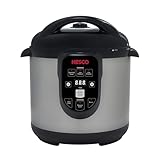
- DEDICATED ELECTRIC PRESSURE CANNING WITH BUILT‑IN SAFETY CONTROLS automatically regulates pressure and temperature, helping home canners confidently preserve vegetables, meats, broths, and sauces without the guesswork of stovetop canning.
- MULTI‑FUNCTION COOKING MODES (PRESSURE COOK, SLOW COOK, STEAM & WATER BATH) let one appliance handle soups, stews, jams, and batch meals, making it easy to switch from preserving a harvest to preparing family dinners.
- DIGITAL DISPLAY WITH PRESET PROGRAMS AND TIMER delivers controlled, repeatable cycles, so each canning or cooking batch finishes evenly—ideal for processing multiple jars or maintaining consistency across large meal prep sessions.
- SAFETY LOCK LID, AUTOMATIC FLOAT VALVE & PRESSURE REGULATION SYSTEM prevent opening under pressure and reduce user error, helping beginners and experienced users can and cook with confidence.
- 9.5‑QUART REMOVABLE NONSTICK INNER POT WITH INCLUDED CANNING & STEAM RACKS accommodates multiple jars per batch and simplifies cleanup, setting this electric canner apart from stovetop canners and basic pressure cookers.
Skip it if: You are a first-time canner who wants the simplest lid operation or need to process large quantities of pint jars.
Recommended Free Tools
3. Presto 23-Quart Induction-Compatible 01784: best for induction
Best for: Induction users who want a conventional stovetop pressure-canning workflow and enough room for large pint batches.
Why it stands out: Standard aluminum is nonmagnetic and will not work directly on an induction element. The Presto 01784 solves that limitation with a stainless-steel-clad base. Presto lists it as compatible with induction, gas, electric coil, and smooth-top ranges, although the specific cooktop must still support the canner’s diameter, wattage, and loaded weight.
Specifications and capacity
- 23-quart liquid capacity.
- Holds seven quart jars, 20 pint jars, or 26 half-pint jars.
- Heavy-gauge aluminum body with stainless-steel-clad base.
- Dial gauge.
- 12-year limited warranty.
- 12,000-BTU household burner limit.
- $215.99 official displayed price when checked.
The 01784 has the same seven-quart capacity as the 16-quart Presto when processing quart jars. Its advantage is pint and half-pint capacity, often using two layers. That makes it useful for beans, vegetables, sauces, and other foods commonly preserved in pint jars.
Induction caveat
Do not assume that “induction-compatible” guarantees compatibility with every portable induction unit. Check the burner’s maximum supported weight, heating diameter, wattage, and the canner manufacturer’s instructions. A fully loaded canner can exceed 50 pounds, and a portable unit may not be designed for that load. Penn State describes this type of model as an induction-compatible example; it does not constitute a university endorsement of a particular product.
The Tool Desk
Outbyte PC Repair FREERepair Windows errors before they cause bigger problemsFix Now →Outbyte Driver Updater FREEFix the driver behind crashes, sound loss and screen glitchesFind Drivers →Buy it if: Your primary range is induction and you want a full-size, manual pressure canner.
Skip it if: You have a small kitchen, process only occasional four- or five-jar batches, or your induction burner cannot support a large loaded vessel.
4. Presto 23-Quart Pressure Canner and Cooker 01781: best large-capacity value
Best for: Large gardens, frequent canning, and shoppers who want the lowest cost per jar on a standard non-induction range.
Why it stands out: The Presto 01781 delivers the same principal jar capacity as the induction 01784 at a lower official displayed price: $185.99 when checked. It is the practical large-batch choice for gas, electric-coil, and compatible smooth-top kitchens.
Specifications and capacity
- 23-quart liquid capacity.
- Seven quart jars, 20 pint jars, or 26 half-pint jars.
- Aluminum construction.
- Dial gauge.
- Rack and instruction/recipe book included.
- 12-year limited warranty.
- 12,000-BTU household burner limit.
Its main benefit is not more quart jars: it still holds seven quarts. The extra space is primarily useful when processing pint jars or half-pints in stacked arrangements. Follow the exact manual for rack placement; some configurations require a second rack for the upper layer.
Trade-offs
The 01781 is considerably larger to fill, heat, store, and lift than the 16-quart model. It uses more water and occupies more burner and cabinet space. It also has the same dial-gauge testing and gasket maintenance requirements as the smaller Presto.
Buy it if: You regularly preserve large harvests or want to process up to 20 pints in a batch.
Skip it if: You mostly process quart jars, have limited storage, or use induction.
5. Presto Precise 12-Quart Digital 02144: best electric convenience option
Best for: Users who want automated heat control, a countertop setup, and a digital timer rather than manual burner adjustment.
Why it stands out: The Presto Precise 02144 is a dedicated digital pressure canner, not an ordinary electric multi-cooker. It has an automatic jar-warming phase, venting phase, digital display, and built-in timer. Serious Eats tested Presto’s electric canner and found it reached its canning countdown faster than the other units in that comparison, while also noting that its operation differs from traditional gauge-equipped canners.
Specifications and capacity
- 12-quart liquid capacity.
- Pressure-canning capacity of five quart jars or eight regular-mouth pint jars.
- Temperature sensor rather than a conventional pressure gauge, according to Presto.
- 120 volts and 1,485 watts.
- Can also perform a boiling-water process for pints and smaller jars, but is not tall enough to cover quart jars with the recommended water depth in boiling-water mode.
- One-year limited warranty.
- Presto says no altitude adjustment is required for pressure canning.
- $386.99 official displayed price when checked.
The evidence caveat matters
Do not call this an “USDA-approved” or “USDA-certified” canner. USDA and NCHFP provide home-canning guidance but do not approve or certify home-canning equipment. Presto says the 02144 is designed to meet USDA home-canning guidelines and explicitly acknowledges that government agencies do not certify the appliance.
That is a manufacturer claim, not the same as independent USDA or university certification. Extension guidance remains much more established for conventional stovetop pressure canners. The accurate distinction is:
Rank #3

- AUTOMATED FOR EASY CANNING: The Presto Pressure Canner simplifies home canning with its automated features, ensuring confident and precise results every time.
- EXTRA-TALL SIZE: This pressure canner is designed to hold quart jars, making it perfect for both pressure and boiling water canning, accommodating larger batches effortlessly.
- NO ADJUSTMENTS NEEDED: Pressure canning at high altitudes is hassle-free with no adjustments required, thanks to the Presto Pressure Canner's innovative design.
- INNOVATIVE SENSOR: The electric pressure canner features a sensor that automatically maintains the exact temperature required for safe canning, eliminating the need for constant monitoring.
- USER-FRIENDLY CONTROL: The control knob allows you to select the canning method and set the processing time, while the LED digital display guides you through each step of the process.
- Ordinary electric multi-cookers: not recommended for low-acid pressure canning because their heat-up, venting, and cool-down behavior has not been validated for USDA processes.
- Dedicated electric canners such as the Presto 02144: purpose-built products with manufacturer claims and model-specific operating instructions, but less independently established support than the traditional stovetop workflow.
Do not transfer a stovetop canner’s pressure, venting, or cooldown procedure to the digital model. Use the current manual and its programmed process.
Buy it if: Countertop convenience and automated operation are worth the higher price and smaller batch size, and you understand the evidence qualification.
Skip it if: You want the most conventional, broadly supported process or need seven quart jars or 20 pints per batch.
How to choose the right pressure canner
Choose by actual jar capacity
- Normal household batches: The Presto 16-quart is usually easier to handle and still processes seven quarts or 10 pints.
- Large harvests: A 23-quart Presto processes seven quarts or up to 20 pints, but requires more water, storage, and lifting.
- Small batches: The All American 910 handles four quarts or seven pints. The Presto digital model handles five quarts or eight regular-mouth pints.
Jar geometry matters. Quart jars are generally not stacked in the same way as pint jars, which is why a 23-quart canner does not necessarily process more quart jars than a 16-quart canner.
What’s actually slowing this PC down?
Pick the symptom - the matching free tool is one click away.
Choose by gauge type
Dial gauge: Shows pressure continuously and makes altitude changes easy to see. The trade-off is maintenance: have the gauge tested at least annually, usually through a county or university Extension office. See Penn State’s dial-gauge testing guidance.
Weighted gauge: Signals pressure through rocking, jiggling, or steam release according to the model’s instructions. It does not require annual accuracy testing in the same way a dial gauge does, but the vent, regulator, and safety components still need inspection.
Dual gauge: The All American 910 combines a dial gauge and weighted regulator. This gives a continuous reference plus a physical pressure signal, but also adds components to understand and maintain.
Digital control: The Presto 02144 uses a temperature sensor and programmed controls rather than a conventional pressure dial. Its automated interface is convenient, but “no calibration needed” is a manufacturer statement—not independent proof that a sensor remains accurate indefinitely.
Quick wins for a faster PC:
Repair Windows errors before they cause bigger problemsFix Now →Fix the driver behind crashes, sound loss and screen glitchesFind Drivers →Choose by cooktop
- Gas or electric coil: The standard Presto 01755 and 01781 are practical choices.
- Induction: Choose the Presto 01784 or another model explicitly designed for induction. Standard aluminum canners will not work directly on an induction element.
- Smooth-top or glass: Technical compatibility is not enough. Check the range’s maximum loaded weight, burner diameter, and canning restrictions. Do not slide a loaded canner across glass.
- Portable burner or propane setup: Do not assume an outdoor burner is interchangeable with a household range. Presto specifies household burners of 12,000 BTUs or less for its stovetop models; excessive heat can damage the canner and make pressure control unsafe.
A full canner can exceed 50 pounds when loaded. Verify that the range, burner, counter, and the person loading it can safely support and move the vessel.
Choose by construction and lid design
Aluminum: Presto’s aluminum models are lighter, generally less expensive, and heat readily. Standard aluminum is not induction-compatible, and the conventional Presto lid uses a gasket and overpressure plug.
Cast aluminum: The All American 910 is heavier and more expensive, but its cast-aluminum body and metal-to-metal seal appeal to users who want a premium construction approach.
Twist-on lid: Presto’s lid design is generally more immediately understandable for beginners.
Recommended Free Tools
Clamped lid: All American’s wing-nut and clamp arrangement eliminates the large replaceable gasket, but requires careful lid placement, even tightening, and clean sealing surfaces.
Consider parts and maintenance before buying
A pressure canner is a long-term appliance with wear items. Before choosing a model, check whether the manufacturer sells the parts you are likely to need: gaskets, overpressure plugs, gauges, regulators, racks, and lids. Presto maintains an online parts lookup system, including information for current and older models. All American sells replacement parts for models 910 through 941.
Independent reader supportYour contribution helps us test, update, and keep practical guides available for everyone.Altitude: pressure is not one-size-fits-all
Altitude changes the pressure needed to reach the target processing temperature. The correct setting depends on the recipe, processing temperature, gauge type, and elevation. Always use the pressure specified by the current tested recipe rather than substituting a generic chart.
For general 240°F guidance, USDA FSIS lists these dial-gauge pressures:
The Tool Desk
Outbyte Driver Updater FREEScan for outdated or missing drivers - takes under a minuteDriver Scan →Outbyte PC Repair FREEClear out junk files and repair common Windows errorsFree Scan →| Elevation | Dial-gauge pressure |
|---|---|
| Sea level to 2,000 feet | 11 pounds |
| 2,001 to 4,000 feet | 12 pounds |
| 4,001 to 6,000 feet | 13 pounds |
| 6,001 to 8,000 feet | 14 pounds |
| 8,001 to 10,000 feet | 15 pounds |
Weighted-gauge instructions commonly use 10 pounds at lower elevations and 15 pounds above 1,000 feet, but recipe instructions take priority. See USDA FSIS altitude guidance and NCHFP’s pressure-selection guidance.
Rank #4

- INDUCTION-COMPATIBLE: Full-sized consumer pressure canner designed to work on induction ranges, gas, electric, and smooth-top stoves. Versatile and reliable for all your canning needs
- SAFE & USDA-APPROVED: Achieve safe and confident canning with the only method recommended by the USDA for preserving vegetables, meats, poultry, and seafood. Includes precise pressure gauge for accuracy
- DUAL FUNCTIONALITY: This canner doubles as a boiling water canner, perfect for preserving fruits, jams, jellies, pickles, and salsa, making it an essential tool for every home canner
- DURABLE CONSTRUCTION: Crafted from heavy-gauge aluminum with an induction-compatible stainless steel-clad base, ensuring quick and even heating on all types of stovetops, including induction. Extended 12-year limited warranty
- ADVANCED SAFETY FEATURES: The air vent/cover lock ensures pressure builds only when the cover is properly closed and prevents opening until the pressure is safely reduced. Your canning process is secure and easy to manage
Presto says the Precise digital canners automatically adjust for altitude and require no altitude adjustment. Treat that as a manufacturer specification, not government certification.
Safe pressure-canning workflow
Use this as a checklist, not as a replacement for the current canner manual or a tested recipe.
- Choose a current tested recipe. Use NCHFP, USDA publications, or a university Extension source. Do not improvise ingredient proportions, jar sizes, headspace, processing time, or pressure. Start with the USDA and NCHFP publications.
- Inspect the canner before every use. Clear the vent pipe. Confirm that the air vent or cover lock moves freely. Inspect the gasket or metal sealing rim, overpressure plug, gauge, regulator, and lid.
- Add the specified hot water. NCHFP’s general stovetop procedure begins with 2 to 3 inches of hot water, but a particular manual or electric model may require a different amount.
- Load the jars upright on the rack. Do not place jars directly on the bottom and do not force an overcrowded arrangement. Follow the model’s instructions for a second rack and stacked pints.
- Secure the lid with the vent open. Depending on the design, leave the weight off or the vent pipe open.
- Heat on high until steam flows freely.
- Vent continuously for 10 minutes. Only then close the vent or add the weight. Venting removes air from the canner and is not optional.
- Reach the recipe’s specified pressure. Start the processing timer only after the required pressure—or the digital program state specified by the electric model—is reached.
- Maintain steady pressure. Adjust the burner gradually rather than making large changes. Pressure fluctuations can cause under-processing or liquid loss.
- Handle a pressure drop correctly. If pressure falls below the recipe’s target, follow the current recipe and manual. For conventional pressure-canning procedures, the processing time generally must be restarted from the beginning; confirm the rule for the exact process.
- Let the canner depressurize naturally. Never run cold water over it, move it into a draft, open the vent prematurely, or force-cool it.
- Wait after pressure reaches zero. Follow the manual’s instruction—commonly 10 minutes after removing the weight—then open the lid away from your face.
- Remove jars upright. Use a jar lifter and cool jars undisturbed. Do not retighten bands or press the lids.
- Discard questionable food without tasting it. Bulging lids, spurting liquid, off odors, leaking, or other spoilage signs require discarding. A sealed lid proves only that a seal formed; it does not prove that the food received an adequate thermal process. See USDA FSIS shelf-stable-food guidance.
Troubleshooting common problems
The pressure gauge never rises
Possible causes include a lid that is not fully secured, a badly seated or damaged gasket, a blocked vent pipe, insufficient heat or water, overcrowded jars interfering with the lid, a damaged overpressure plug, or a damaged sealing surface. Do not simply keep increasing the heat. Turn off the heat and let the canner cool and depressurize safely before inspecting it, then use the model-specific troubleshooting instructions.
Pressure rises too high
Reduce heat according to the manual. If the regulator is not functioning normally, the vent appears blocked, or a safety mechanism activates, turn off the heat and allow natural depressurization. Never open a pressurized canner.
Pressure fluctuates
Large swings can result from excessive heat, a burner that cycles aggressively, a poorly matched burner, or insufficient adjustment after pressure is reached. Use smaller heat changes. Do not compensate by changing the recipe’s pressure or processing time.
Jars lose liquid
Siphoning can follow sudden pressure changes, fluctuating pressure, inadequate headspace, or failure to remove air bubbles. Loss of liquid is not automatically spoilage, but inspect the jar and evaluate it against the recipe’s guidance, including whether the seal remains intact.
The smooth-top range seems compatible, but the canner is unstable
Stop and check the range manual for maximum loaded weight, burner diameter, and whether the manufacturer prohibits canning. Confirm that the canner base is flat and clean, and never slide the loaded vessel across glass. If the cooktop cannot safely support the canner, use a properly specified alternative rather than guessing.
Other models worth knowing about
Presto Precise 17- and 23-quart digital canners
Presto now lists newer digital models, including the 17-quart 02152, 16-quart 02154, and 23-quart 02153. They may appeal to readers who want digital automation with more quart capacity, but performance, controls, jar loading, and evidence should be assessed by exact model. A hands-on result from the older 12-quart 02144 should not automatically be applied to every newer digital canner.
NESCO NPC-9
The NESCO NPC-9 is a dedicated electric canner with 9.5-quart capacity, 10- and 15-psi regulators, a removable nonstick pot, and an ETL listing. ETL addresses electrical and appliance safety; it does not by itself establish USDA thermal-process validation for every low-acid recipe. That distinction is why it is not ranked above the five picks here.
Mirro, Granite Ware, and T-fal
These brands may be worth considering when current availability, exact-model manuals, replacement parts, and food-safety documentation can be verified. Serious Eats tested several competing products but did not rank them above the Presto 16-quart and All American 910 in its comparison.
Buying used or vintage
A used canner can save money, but do not use an unidentified vintage model for food preservation until it has been identified and inspected. Verify all of the following:
Do these 3 things before closing this tab:
1Repair Windows errors before they cause bigger problems2Fix the driver behind crashes, sound loss and screen glitches3Clear out junk files and repair common Windows errors- No deep pitting, cracks, warping, or damaged sealing surfaces.
- The lid and body are the correct matched pair.
- A replacement gasket, overpressure plug, gauge, regulator, and rack are available when applicable.
- The dial gauge can be tested through Extension.
- The vent pipe is clear.
- A current manual exists for that exact model.
- The canner can safely sit on the intended cooktop and support its loaded weight.
Frequently asked questions
Frequently Asked Questions
Can a pressure canner be used on a glass-top stove?
Sometimes. Check both the canner instructions and the range manufacturer’s limits for loaded weight, base diameter, and canning. Presto lists its standard models for suitable smooth-top ranges, but a full canner can exceed 50 pounds. Never slide a loaded canner across glass.
Do I need to test a pressure-canner dial gauge?
Yes. Dial gauges should generally be tested at least annually, usually through a county or university Extension office. Weighted regulators do not require annual accuracy testing in the same way, but their vents, regulators, and safety parts still require inspection.
Is the Presto Precise digital canner USDA-approved?
No product should be described that way. Presto says the dedicated 02144 is designed to meet USDA home-canning guidelines, but USDA and NCHFP do not certify or approve home-canning equipment. That is also different from an ordinary electric multi-cooker, which Extension services do not recommend for low-acid pressure canning.
Can I pressure-can soup, beans, meat, or vegetables in any pressure cooker?
No. Low-acid foods require a pressure canner that meets the applicable minimum requirements and a current tested recipe. A small pressure cooker or ordinary electric multi-cooker is not a substitute merely because it reaches pressure.
Is a sealed jar safe to eat?
Not necessarily. A seal does not prove that the food received the required time-temperature process. Follow a tested recipe, inspect jars for spoilage, and discard questionable food without tasting it.
Which pressure canner is best at high altitude?
A dial-gauge stovetop canner can work well, but you must apply the tested recipe’s altitude-specific pressure. The Presto digital model claims automatic altitude adjustment; treat that as a manufacturer specification rather than government certification.
The Bottom Line
For most people, buy the Presto 16-quart 01755. It offers the best balance of price, capacity, availability, and manageable operation for a conventional stovetop. Move up to the Presto 23-quart 01781 for large pint batches, choose the 01784 if you use induction, and choose the All American 910 if premium construction and a gasket-free metal-to-metal seal matter more than capacity or price. The Presto Precise 12-quart digital model is the convenience pick, but use its exact manual and describe its safety evidence as a manufacturer claim—not USDA approval.
Quick Recap
Product prices and availability are accurate as of the date/time indicated and are subject to change. Any price and availability information displayed on Amazon at the time of purchase will apply.
Free tools Windows power users keep installed
One-click scans. No signup required.




