Quick wins for a faster PC:
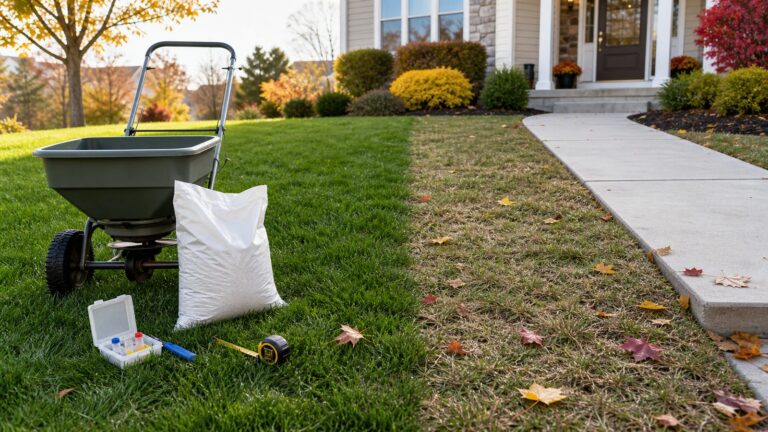
Clear out junk files and repair common Windows errorsFree Scan →Scan for outdated or missing drivers - takes under a minuteDriver Scan →For most cool-season lawns, the best time to overseed is late summer to early fall—early enough for seed to germinate and roots to establish, but late enough that cooler weather reduces heat stress. A useful planning target is to finish about 45 days, or four to six weeks, before your area’s average first killing frost. That is a rule of thumb, not a nationwide calendar date: local climate, elevation, shade, soil temperature and grass species all matter.
First identify the lawn. Tall fescue, Kentucky bluegrass, fine fescue and perennial ryegrass are cool-season grasses and are usually the candidates for permanent fall overseeding. Bermudagrass and other warm-season lawns are a different case: bermudagrass may be overseeded with temporary ryegrass for winter color, but that is not the same project as repairing a thin cool-season lawn.
As an Amazon Associate I earn from qualifying purchases.
What overseeding actually means
Overseeding means sowing new grass seed into an existing lawn without removing all of the established turf. It is intended to increase density, repair moderate thinning and fill small areas that have declined from heat, traffic or normal wear.
What’s actually slowing this PC down?
Pick the symptom - the matching free tool is one click away.
It is not the same as every kind of lawn repair:
| Project | What it means | When it makes sense |
|---|---|---|
| Overseeding | New seed is added while desirable existing turf remains. | The lawn is generally healthy but thin or patchy. |
| Patching | Only small bare spots are repaired. | A few localized areas need attention; the rest of the lawn is satisfactory. |
| Renovation | Much of the existing vegetation is killed or removed before reseeding. | More than half the turf is dead, weeds dominate, the species is wrong or the lawn has widespread problems. |
| New-lawn seeding | Seed is established on mostly bare soil. | The site is being established from scratch. Rates and preparation differ from overseeding. |
| Sodding | Established turf is installed as rolls or slabs. | Fast cover, erosion control or immediate use is more important than the lower cost and flexibility of seed. |
Seed cannot solve a site problem. Persistent shade, poor drainage, standing water, severe compaction, thick thatch, active disease, aggressive perennial weeds or a lack of irrigation during establishment should be diagnosed before seed is purchased. Colorado State University’s lawn-renovation guidance is useful when overseeding is no longer enough.
#1 Best Overall

- OPERATION: Adjustable arm support on this seed, salt and fertilizer spreader helps provide maximum comfort
- HAND-HELD SPREADER: Perfect hand-held fertilizer, salt and seed spreader for small yards
- CAPACITY: A seed, fertilizer and salt spreader that holds up to 1,500 sq. ft. of Scotts lawn products for year-round lawn care
- USAGE: These hand spreaders for lawns are great for year-round use to seed, fertilize, salt and ice melt
- COVERAGE: These salt, fertilizer and seed spreaders for lawns are engineered for smooth, even coverage
First identify your grass type
Cool-season grasses
Common examples are tall fescue, Kentucky bluegrass, fine fescues and perennial ryegrass. They grow most actively in cool spring and fall weather and are common in northern states and parts of the transition zone. Many remain green through much of the cool season if moisture is adequate.
Warm-season grasses
Common examples are bermudagrass, zoysiagrass, centipedegrass, St. Augustinegrass and buffalograss. They grow primarily in warm weather and commonly become dormant or lose color during winter.
Grass identification is more reliable than choosing a bag labeled only “sun and shade.” Look at the texture, growth habit and seasonal color, and check old seed or sod records if available. The University of Maryland’s grass-establishment guidance provides a useful starting point, but local extension recommendations should take priority.
Recommended Free Tools
Do not give a warm-season lawn the cool-season lawn’s seed rate, mowing height or timing. The permanent-repair and winter-color projects require different decisions.
When to overseed in fall
Use frost lead-time, not a universal calendar date
- Find the local average first fall frost or freeze date. Use NOAA’s first-fall-freeze information, the NOAA climate normals, your local National Weather Service office or a university extension calendar.
- Count backward approximately 45 days. Missouri Extension describes allowing four to six weeks before the first killing frost; this gives seedlings time to produce roots and enough top growth for their first mowing.
- Check the soil at about 1 inch deep. Maryland gives approximately 50–70°F as an optimum soil-temperature range for grass-seed germination. Penn State gives approximately 50–65°F as a useful general range for cool-season root growth. These are guidance ranges, not a single universal trigger for every species.
- Adjust for the site and species. Seed earlier in colder climates, at higher elevations, in shade, where leaves arrive early or when using a slower-establishing grass. A sheltered sunny yard may have a different practical window from a shaded yard a few miles away.
- Watch the forecast. If an unusually early hard freeze is approaching, finish a reasonable seeding job rather than waiting for a theoretically perfect soil temperature. NOAA’s dates are planning normals, not a promise about the current year.
The practical signal is soil that is still warm enough for germination but trending cooler, with enough growing time left before a hard freeze. Waiting until the soil reaches the low end of the germination range can leave seedlings too immature for winter. Seeding too early, while weather is hot and dry, increases water demand and competition from existing turf and weeds.
Why fall usually beats spring for cool-season lawns
Fall combines warm soil, cooler air and generally lower heat stress. New roots can develop before the following summer, and weed competition is often lower than in spring. In many regions, rainfall and soil moisture are also more favorable. Penn State summarizes the broader advantage in its lawn-establishment guidance.
Fall is not automatically successful. A late planting may germinate but fail to mature before winter. An early planting made during hot, dry weather may dry out repeatedly or struggle against established turf and weeds.
Regional examples
These published windows illustrate why month-only advice can mislead. Use them as regional examples, then verify your own local conditions:
| Region or source | Published guidance | How to interpret it |
|---|---|---|
| Minnesota | Mid-August to mid-September | Colder and farther-north sites should favor the earlier end. |
| Maryland | Mid-August to mid-October for cool-season seeding | August or early September is often preferable where early leaf drop could bury seedlings. |
| Iowa | Mid-August through mid-September | Warm soil and cool nights support establishment. |
| Missouri | September, with four to six weeks before killing frost | A good example of frost lead-time rather than a fixed national date. |
| Pennsylvania | Late summer to early fall; seeding later than mid-October is generally discouraged | Elevation, latitude and the actual forecast still matter. |
| Northern Illinois | Early August through early September | The shorter establishment window makes early timing important. |
| Lower-elevation Arizona | October for bermudagrass winter overseeding | This is temporary winter ryegrass color, not permanent cool-season lawn repair. |
See the University of Minnesota’s regional seeding guidance, Iowa’s late-summer and fall lawn-care instructions and Missouri Extension’s fall timing guidance for regional context.
Rank #2
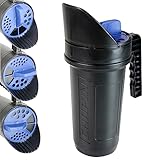
- 64-OUNCE BOTTLE: high-capacity poly bottle with a wide opening and easy screw top, quickly remove the lid to add your preferred seed, salt, fertilizer, etc. and simply screw back into place
- TURF AND SALT: year-round use; for steps, sidewalks and small paths in the winter; grass patches, shaded areas, gardens, and small sections the rest of the year
- 3 OPENINGS IN LID: twist lid to choose small, large and wide openings; each designed to fit different particulates like ice melt, salt, fertilizer, grass seed, sand and most pelletized products
- LARGE HANDLE: easy to grip, scoop and fill; accommodates small and large-sized hands, with or without gloves for use any time of the year
- PORTABLE: keep it on a shelf, in a closet or in the car and pull it out when it’s needed; you can even store it with product inside when not in use
Should you overseed, patch, renovate or sod?
| What you see | Better direction |
|---|---|
| The lawn is mostly desirable turf but thin. | Overseed. |
| Only a few small bare spots exist. | Patch those areas individually rather than treating the entire lawn. |
| Weeds outnumber desirable grass. | Diagnose and control the cause; renovation may be more efficient. |
| Foot traffic has made the soil hard and water runs off. | Correct compaction before or during overseeding. |
| Water stands after rain or the area stays wet. | Improve drainage or select a more suitable plant. Aeration alone will not correct poor drainage. |
| Dense shade prevents turf from thriving. | Use an appropriately shade-tolerant fine fescue where suitable, reduce the shade if possible or choose another groundcover. No turfgrass performs well in dense shade. |
| More than half the lawn is dead or the species is unsuitable. | Consider renovation or sod. |
| You need immediate erosion control or usable cover. | Sod or an erosion-control blanket may be preferable to seed. |
| A warm-season lawn turns brown in winter. | Decide whether temporary ryegrass color justifies the added maintenance; do not treat it as ordinary cool-season overseeding. |
Choose seed that matches the lawn and site
Match the seed to the existing species, sun exposure, moisture, traffic, pets, heat and drought stress, desired mowing height and disease history. Favor regionally recommended cultivars, blends or mixtures over a generic promise on the front of the bag.
| Grass | Strengths | Limitations and cautions |
|---|---|---|
| Turf-type tall fescue | Generally deep-rooted and a strong candidate for sunny, moderately dry or higher-traffic sites. It often handles drought stress better than some alternatives when the cultivar and site are appropriate. | It is coarser than Kentucky bluegrass and does not spread by rhizomes, so damaged spots may fill more slowly. |
| Kentucky bluegrass | Spreads by rhizomes and can recover well from wear. | It generally requires more water and fertilizer and can develop thatch. Establishment is slower than perennial ryegrass. |
| Fine fescues | Useful for shade and lower-input lawns, depending on the species. | Individual fine fescues differ in shade, drought and moisture tolerance. They may perform poorly in intense heat or wet soils. |
| Perennial ryegrass | Germinates and establishes quickly and can be useful in locally appropriate cool-season mixtures. | Winter hardiness and disease resistance vary by cultivar and region. Use turf-type perennial ryegrass, not cheap non-turf seed, when it is appropriate. |
A blend combines several cultivars of one grass species. A mixture combines multiple species. Both can be useful: genetic diversity may improve adaptation and reduce the chance that one disease or stress affects the entire stand. The best combination depends on the region and site. Penn State’s seed and seed-mixture guidance and Minnesota’s seed-buying guide explain how to evaluate them.
Do these 3 things before closing this tab:
1Scan for outdated or missing drivers - takes under a minute2Clear out junk files and repair common Windows errors3Fix the driver behind crashes, sound loss and screen glitchesRead the seed label
Before buying, inspect:
- Species and named cultivars.
- Germination percentage.
- Purity.
- Test date.
- Other crop seed.
- Weed seed.
- Inert matter.
- Noxious weeds.
As a regional purchasing benchmark, Minnesota Extension prefers lawn seed with more than 90% purity, more than 85% germination, a test date within nine months, less than 0.5% other crop, less than 0.3% weed seed, less than 8% inert matter and no noxious weeds. Those figures are not a universal legal standard for every state, but they help distinguish a high-quality turf product from a bargain bag padded with unwanted material.
Avoid bags containing annual ryegrass, also called Italian ryegrass, when the goal is permanent cool-season turf. It can be useful as temporary cover or in some warm-season winter-color programs, but it is not a durable substitute for locally adapted lawn grass. Annual ryegrass should not be described as disappearing after one year in every climate; it is better understood as a temporary or less-persistent choice.
How much seed to use
There is no single correct overseeding rate. The rate varies by species, mixture, region, seed quality, traffic and whether the job is overseeding, patching, renovation or new establishment. Start with the supplier’s overseeding rate for the exact mixture, check it against local university guidance and calibrate the spreader rather than trusting a generic dial setting.
Cool-season overseeding examples
The following Maryland rates are useful examples, not universal rates:
| Turf type | Example overseeding rate |
|---|---|
| Turf-type tall fescue | 4 lb per 1,000 sq. ft. |
| Kentucky bluegrass | 1–1½ lb per 1,000 sq. ft. |
| Fine fescue | 2½–3 lb per 1,000 sq. ft. |
| Perennial ryegrass for lawn renovation | 4–6 lb per 1,000 sq. ft., according to Penn State; this is not interchangeable with every overseeding label. |
Higher rates are not automatically better. Excess seed can create crowded, weak and disease-prone plants, while too little seed leaves the lawn thin. Measure the lawn, account for the actual blend and follow the product label.
Separate rates for winter-color ryegrass
These rates apply to temporary ryegrass overseeding over warm-season turf, not permanent cool-season lawn repair:
| Program | Example rate |
|---|---|
| Oklahoma winter ryegrass | 10–20 lb per 1,000 sq. ft. |
| Lower-elevation Arizona bermudagrass program | 12–15 lb per 1,000 sq. ft. |
The difference is intentional. Do not substitute a winter-color rate for a cool-season fescue or bluegrass overseeding rate. See Oklahoma State’s lawn-management guidance and the University of Arizona’s bermudagrass winter-overseeding publication.
Rank #3
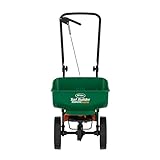
- NO ASSEMBLY REQUIRED: Scotts spreader comes pre-calibrated and ready-to-use with a fold-down handle for easy storage; use it year-round including as an ice melt spreader or salt spreader for snow
- CAPACITY: Broadcast spreader holds up to 5,000 sq. ft. of Scotts lawn products, and can be used as a lawn food, salt, ice melt or grass seed spreader - ideal for treating smaller areas
- OPERATION: These fertilizer spreaders for lawns feature a hopper and agitator designed for smooth product funneling and consistent coverage
- SIDE SHIELD: Scotts exclusive EdgeGuard Technology on these broadcast spreaders for lawns keeps lawn product off landscaping, driveways, and sidewalks
- BROADCAST SPREADER: Use the Scotts Turf Builder EdgeGuard Mini Broadcast Lawn Spreader to apply Scotts lawn care products, like grass fertilizer for lawns
Prepare the existing lawn before spreading seed
1. Diagnose the cause
Walk the lawn after rain and during the hottest part of summer. Note shade, standing water, compacted routes, thin areas, disease symptoms, insect damage, heavy thatch, traffic and places where the existing species is poorly adapted. A soil test can identify pH and nutrient problems, but it cannot determine every cause of poor turf. Sunlight, drainage, traffic and species adaptation still require a site assessment.
2. Test soil before adding amendments
Test before applying significant amounts of lime, sulfur, phosphorus, potassium or other nutrients. Apply only what the test and local recommendations justify. Maryland identifies approximately pH 6.0–6.8 as optimum for turf growth and reports tall fescue doing well around pH 5.8–6.5; those are useful examples, not prescriptions for every species or soil.
Do not bury established turf under a thick layer of compost or topsoil. If topdressing is appropriate, keep it thin enough that existing crowns and leaves are not buried. During a full renovation, amendments can be incorporated into bare soil; overseeding an established lawn is different.
3. Control weeds carefully
Hand-pull small weeds where practical. If an herbicide is necessary, read its label for the required interval before seeding. Most importantly, do not apply a pre-emergent weed-control product where desirable grass seed must germinate unless the label explicitly permits reseeding. Illinois Extension warns that pre-emergent herbicides can affect the desired lawn seed as well as weed seed.
4. Mow low, but do not scalp
For a normal cool-season overseeding, mow lower than the normal maintenance height so light reaches the seed and the seed can contact soil. Maryland’s procedure uses approximately 2–2½ inches; Iowa guidance uses approximately 1½–2 inches. Use the lower end only when it is appropriate for the existing grass and local conditions. Do not scalp a cool-season lawn down to bare crowns.
PC Slower Than It Used to Be?
A free scan shows the junk files, broken settings and background clutter dragging Windows down - then fixes them in one click.Free scan · Windows 10 & 11Crashes, No Sound, or Screen Glitches?
Random freezes, missing sound and display glitches usually trace back to one bad driver. Find and replace yours safely.Free scan · under a minuteUse a sharp blade, remove bulky clippings, and clear leaves and debris. The objective is an open surface, not a damaged lawn.
5. Aerate only when compaction warrants it
Core aeration removes plugs and can help compacted soil admit air and water. It is especially useful on heavily trafficked lawns. Maryland describes hollow-tine cores approximately 2–4 inches deep and spaced 2–6 inches apart; a lawn with little compaction may need aeration only every two or three years rather than annually.
Solid-tine aerators are not equivalent to hollow-tine core aerators: they do not remove soil and may press some soil together. Do not automatically aerate every lawn, and do not use aggressive machine work simply because a lawn is thin. Poor drainage needs drainage improvement or a more suitable plant, not just more holes.
6. Dethatch, vertical-mow or slit-seed only as needed
- Hand raking is usually adequate for a small area or light surface preparation.
- Vertical mowing or power raking can open the surface and remove debris, but aggressive use can damage crowns and create more bare soil than the seed can fill.
- Slit seeding cuts shallow grooves and places seed directly into them. It is often the most reliable mechanical option for a thin established lawn when equipment is available.
- Dethatching is appropriate only when thatch is genuinely excessive. Do not dethatch every lawn by default.
How to overseed step by step
- Measure the lawn. Calculate the square footage and determine the amount of seed using the exact product’s overseeding rate.
- Prepare and mow. Control weeds, mow to the appropriate reduced height, remove clippings and clear leaves.
- Open the soil surface. Core-aerate compacted areas, slit-seed, lightly vertical-mow or rake exposed areas as appropriate. The goal is seed-to-soil contact.
- Apply justified amendments. Use soil-test results and local rules. Do not assume lime, compost or starter fertilizer is necessary.
- Calibrate the spreader. Test it over a measured area using a small amount of seed. Spreader dial numbers are not universal.
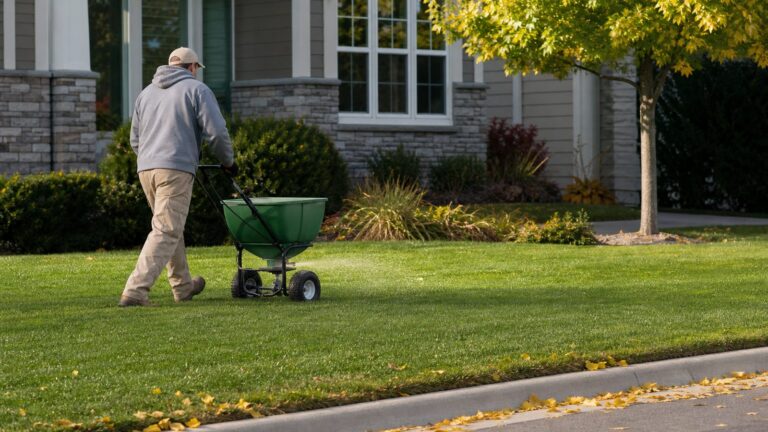
- Divide the seed into two equal portions. Apply one half in a north–south direction and the other east–west. Use a reduced setting for each pass. Two perpendicular half-rate passes distribute seed more evenly than one heavy pass.
- Improve contact. Lightly rake or roll so the seed rests against soil. Do not bury it deeply. Maryland advises no more than approximately ½ inch of soil or ¼ inch of compost or straw over the seed; Kentucky bluegrass should not be planted deeper than approximately ¼ inch.
- Use light mulch only where needed. A thin layer of suitable straw or another cover can help exposed soil, slopes or very dry sites. A thick layer can smother seedlings and hold excessive moisture.
- Begin irrigation immediately. Do not wait for the seedbed to dry after the work is complete.
Seed needs light and close contact with soil. It should rest in or against the surface, not sit on top of clumps, under a blanket of leaves or beneath a deep layer of compost.
Rank #4

- NO ASSEMBLY REQUIRED: Scotts spreader comes pre-calibrated and ready-to-use; use it year-round including as an ice melt spreader or salt spreader for snow
- CAPACITY: Broadcast spreader holds up to 15,000 sq. ft. of Scotts lawn products, and can be used as a lawn food, salt, ice melt or grass seed spreader
- OPERATION: These fertilizer spreaders for lawns feature a hopper and agitator designed for smooth product funneling and consistent coverage
- SIDE SHIELD: Scotts exclusive EdgeGuard Technology on these broadcast spreaders for lawns keeps lawn product off landscaping, driveways, and sidewalks
- BROADCAST SPREADER: Use the Scotts Turf Builder EdgeGuard DLX Broadcast Lawn Spreader to apply Scotts lawn care products, like grass fertilizer for lawns
Water after overseeding: keep the seed zone moist
The central rule is simple: keep roughly the upper inch of soil consistently moist, not saturated. Frequency depends on soil texture, slope, wind, shade, rainfall, sprinkler output and how quickly the surface dries.
- Use light, frequent irrigation during germination. On hot, dry or windy days, that may require several brief cycles; Minnesota notes that establishment sometimes calls for irrigation three or four times per day.
- Check the soil rather than following a fixed twice-daily schedule. The surface should not crust and dry, but water should not run off, puddle or remain constantly saturated.
- Reduce irrigation frequency and water more deeply once seedlings reach approximately 1–2 inches tall. Iowa Extension describes this transition after the upper inch has been kept moist during germination.
- Adjust for rainfall. A sprinkler schedule that works on sandy soil may overwater clay, shade or a low-lying area.
- Prefer morning or earlier-day watering when possible. Avoid routinely leaving foliage wet overnight, especially where disease has been a problem.
Seed can fail even when the total weekly rainfall looks adequate if the seedbed dries repeatedly between brief showers. Conversely, saturated soil can wash seed away, reduce oxygen and encourage disease.
Fertilize without creating a new problem
Every overseeded lawn does not need high-phosphorus starter fertilizer. Test the soil first and follow local fertilizer laws.
- A starter fertilizer may be appropriate for new establishment, renovation, patching or a documented phosphorus deficiency.
- An established lawn with adequate phosphorus does not automatically benefit from more phosphorus. Some jurisdictions restrict phosphorus except in specific situations.
- Apply nitrogen only at a label- and region-appropriate rate. Excess nitrogen can produce weak, overly lush growth, more mowing and greater disease pressure.
- Do not assume that compost, lime or a fixed N-P-K ratio is required.
- Never use a pre-emergent weed-and-feed product where the desired grass seed must germinate unless the label expressly permits it and states the reseeding interval.
Maryland’s established-lawn guidance illustrates why nutrient decisions should be based on testing, regulations and the lawn’s actual condition rather than a universal starter-fertilizer recommendation.
Free tools Windows power users keep installed
One-click scans. No signup required.
First mowing, traffic and falling leaves
First mowing
Under favorable conditions, the first mowing may be approximately four to six weeks after seeding, but the grass—not the calendar—determines the date. Maryland’s rule is to mow when the new grass reaches one-third above the target mowing height. For a 3-inch target, that means mowing at approximately 4 inches.
- Use a sharp blade.
- Remove no more than about one-third of the blade at one mowing.
- Do not wait indefinitely and allow seedlings to become tall, weak and difficult to cut.
- Avoid turning sharply or making repeated passes on soft soil.
Keep traffic off new seedlings
Restrict people, pets and equipment until the area has been mowed at least twice or for approximately one month after germination, depending on growth and soil firmness. Walking across a wet, newly seeded area can uproot seedlings and compact the surface before roots are established.
Manage leaves without burying the seedlings
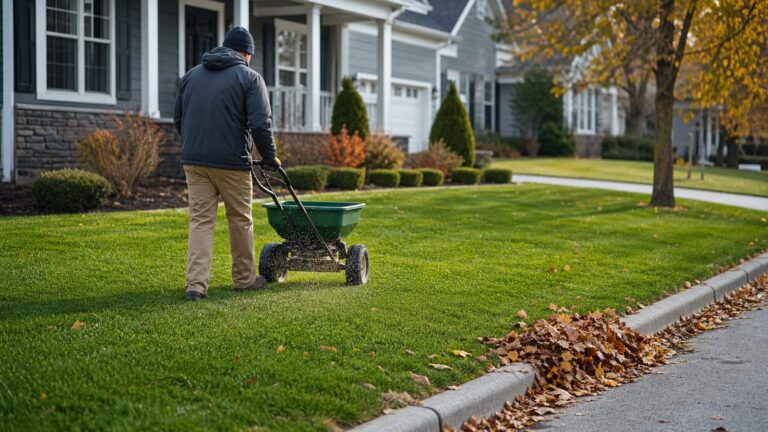
Falling leaves can be a major problem because a dense, wet mat blocks light and traps moisture over young grass. Remove whole leaves before they accumulate heavily. You can mulch dry leaves finely if the turf remains visibly open and the pieces do not form a mat.
Minnesota Extension offers a practical threshold: mulch while most of the lawn remains visible, and collect leaves once less than about 50% of the lawn surface is visible. This is a useful management rule, not an absolute biological cutoff. If seedlings are hidden beneath whole leaves, collect or blow off the excess carefully.
If you missed the ideal fall window
Do not confuse “late” with “impossible,” but recognize that the odds decline as the growing window shortens.
Best Value

- PRECISE & EFFICIENT COVERAGE – Handheld seed spreader perfect for distributing grass seed, lawn food, fertilizer, salt, or ice melt evenly across your lawn or driveway for consistent results without waste. Helps create a healthy, green lawn without clumps or patchy spots.
- MULTI-USE WITH ADJUSTABLE OPENINGS – Versatile spreader with customizable flow settings for fine grass seed, coarse fertilizer, or larger granules. Also works for ice melt and pool chemicals for year-round lawn and yard care.
- ERGONOMIC & LIGHTWEIGHT DESIGN – Comfortable handle and lightweight build reduce hand fatigue, making it easy to use for extended periods. Lightweight 1L capacity design reduces strain, making it easy for seniors to carry and use.
- EASY TO USE & REFILL – Wide top opening allows for quick filling and hassle-free operation—no complicated parts or tools required. Twist cap with multiple openings controls flow for precise spreading. Durable construction ensures reliable performance season after season.
- GREAT GIFT: Warrantied like no other, the way it should be. Garden Guru products are built to last and come with a LIFETIME WARRANTY and a 90 day "no questions asked" Satisfaction Guarantee. Seriously.
- A few weeks late, with warm soil and a favorable forecast: You can make a targeted attempt if you accept lower establishment odds. Prioritize the most important thin areas and maintain moisture.
- Too late for fall establishment in a cold region: Consider dormant seeding. This means placing seed when conditions are too cold for immediate germination so it can remain dormant until spring. Minnesota describes dormant seeding before the ground freezes or before major snowfall; emergence may begin when air and soil temperatures rise above approximately 40°F.
- A few small bare spots: Patch them during the next favorable window rather than disturbing the entire lawn.
- Large area, erosion risk or urgent appearance: Sod or an erosion-control blanket may be more dependable than late seed.
- Warm-season lawn: Do not apply dormant-seeding advice intended for permanent cool-season turf without local guidance.
Dormant seeding extends the opportunity in cold climates, but it is not the same as successful fall establishment and is less predictable. It should not be used as a substitute for proper timing when a normal fall seeding window remains.
If you have a warm-season lawn: winter ryegrass is a separate project
Bermudagrass is the main candidate for fall winter-color overseeding. The objective is temporary green color while the bermudagrass is dormant or declining, not permanent conversion to a cool-season lawn. In lower-elevation Arizona, zoysiagrass and St. Augustinegrass are not generally suitable candidates for this treatment.
Timing and conditions
- In Oklahoma, late September and October are general timing examples; planting after November 1 can prevent germination in that region.
- In lower-elevation Arizona, October is used when daytime temperatures are around 80–85°F and nighttime temperatures are near 55°F.
- Wait until warm-season growth is slowing, but do not wait until conditions are too cold for ryegrass germination.
Preparation and seed choice
Mow the bermudagrass short and remove debris so seed can reach the soil. Perennial ryegrass generally provides better winter quality and frost tolerance. Annual ryegrass is cheaper and faster but tends to be coarser and more temporary. Use the local program’s recommended product and rate.
The Tool Desk
Outbyte Driver Updater FREEScan for outdated or missing drivers - takes under a minuteDriver Scan →Outbyte PC Repair FREERepair Windows errors before they cause bigger problemsFix Now →Oklahoma gives approximately 10–20 lb per 1,000 sq. ft.; the lower-elevation Arizona program gives approximately 12–15 lb per 1,000 sq. ft. These high rates are for winter-color programs and are not appropriate for cool-season fescue or bluegrass overseeding.
Plan for the trade-offs
Winter ryegrass requires additional mowing, irrigation and fertilization. It can also compete with bermudagrass during spring transition. Follow local transition guidance and do not manage the ryegrass and bermudagrass as though they were one permanent turf type. The Arizona turf-maintenance schedule provides additional regional context.
Why fall overseeding fails
| Symptom | Likely cause | Corrective direction |
|---|---|---|
| Little or no germination | Seeding was too late, the seed dried out, it was buried too deeply, it washed away, or the seed was old or poor quality. | Check the frost window, label, soil contact and irrigation. Reseed only when the weather still permits establishment. |
| Germination appears in stripes | The spreader was not calibrated or passes overlapped unevenly. | Use two perpendicular half-rate passes and calibrate over a measured area. |
| Seed is visible but not growing | Poor soil contact, a dry seedbed, compaction or excessive thatch. | Lightly rake, slit-seed or core-aerate as appropriate, then maintain consistent moisture. |
| New grass emerged and then disappeared | Drought, disease, frost, traffic, excessive nitrogen or poor drainage. | Reduce stress and diagnose the cause before reseeding. |
| Weeds dominate the seedlings | Spring timing, exposed weed seed, inadequate turf density or an herbicide conflict. | Address weeds before seeding and avoid incompatible pre-emergent products. |
| Grass is lush but weak or disease-prone | Too much seed or nitrogen. | Follow the recommended rate and soil-test-based fertilizer plan. |
| Seed is washed into piles or bare strips | Heavy irrigation, runoff, slope or poor surface preparation. | Use shorter irrigation cycles, improve contact and consider a light cover or erosion-control product on exposed slopes. |
| Seedlings are buried by leaves | A wet, whole-leaf mat blocked light and held moisture. | Mulch finely while the turf remains visible; remove heavy accumulation. |
| Ryegrass does not transition in spring | Excessive nitrogen, continued irrigation, high mowing or late-season management. | Follow regional transition practices and avoid treating temporary ryegrass as permanent turf. |
Printable fall-overseeding checklist
- Identify whether the lawn is cool-season or warm-season.
- Decide whether the lawn needs overseeding, patching, renovation or sod.
- Find the local average first killing-frost date.
- Allow approximately 45 days for cool-season establishment.
- Confirm that soil is still warm enough for the selected species.
- Choose regionally suitable species, cultivars, blends or mixtures.
- Check purity, germination, test date, weed seed and other crop seed on the label.
- Measure the area and use the product’s overseeding rate.
- Address weeds, drainage, shade and compaction first.
- Soil-test before adding lime, phosphorus or other amendments.
- Mow low enough to expose the surface, but do not scalp the lawn.
- Core-aerate only where compaction warrants it.
- Spread half the seed in one direction and half perpendicular to it.
- Press or lightly rake seed into close contact with soil without burying it deeply.
- Keep the upper inch consistently moist during germination.
- Reduce watering frequency and irrigate more deeply after seedlings establish.
- Keep traffic off the area until it has been mowed at least twice or has had roughly a month to establish.
- Remove heavy whole leaves and mulch only when the turf remains substantially visible.
- Begin mowing when the grass reaches the correct height, removing no more than one-third.
Further reading: The most useful regional details come from university and public-agency sources, including Maryland seeding procedures, Illinois planting guidance, Illinois maintenance and compaction guidance, Penn State turfgrass science and Minnesota’s dormant-seeding guidance.
Frequently Asked Questions
Can I overseed after the first frost?
A light frost does not automatically make seeding impossible, but the remaining growing time matters more than the calendar label. If the soil is still warm and the forecast leaves enough time before a hard freeze, a late attempt may work with lower odds. If it is too cold for establishment, dormant seeding may be an option in cold regions; it is intended to germinate in spring, not immediately in fall.
Do these 3 things before closing this tab:
1Clear out junk files and repair common Windows errors2Scan for outdated or missing drivers - takes under a minute3Repair Windows errors before they cause bigger problemsDo I need starter fertilizer when overseeding?
Not automatically. Soil-test results, local fertilizer rules and the lawn’s nutrient needs should determine whether phosphorus, potassium or nitrogen is appropriate. Starter fertilizer may be justified for new establishment, renovation, patching or a documented phosphorus deficiency, but an established lawn with adequate phosphorus does not need extra phosphorus simply because it was overseeded.
Can I apply weed-and-feed at the same time as grass seed?
Usually, this is risky. Pre-emergent herbicides can prevent desirable grass seed from germinating. Read the product label for both the reseeding interval and the specific grass species; do not apply a pre-emergent where new seed must germinate unless the label explicitly allows it.
How often should I water newly overseeded grass?
Water often enough to keep approximately the upper inch of soil consistently moist without runoff or puddling. The exact frequency depends on soil, weather, shade, slope and sprinkler output, so inspect the seedbed rather than following a fixed twice-daily schedule. Once seedlings reach about 1–2 inches, gradually water less often but more deeply.
The Bottom Line
For a cool-season lawn, overseed roughly 45 days before your local average first killing frost, while the soil remains warm enough for germination. Match the seed to the existing grass and site, expose soil without damaging the lawn, spread at the labeled rate in two directions, maintain steady moisture and protect seedlings from traffic and leaf mats. If the lawn is warm-season, mostly dead, badly shaded, poorly drained or too late in the season, choose the appropriate winter-color, renovation, dormant-seeding, patching or sod strategy instead.
The Tool Desk
Outbyte PC Repair FREEClear out junk files and repair common Windows errorsFree Scan →Outbyte Driver Updater FREEFix the driver behind crashes, sound loss and screen glitchesFind Drivers →Quick Recap
Product prices and availability are accurate as of the date/time indicated and are subject to change. Any price and availability information displayed on Amazon at the time of purchase will apply.