Quick wins for a faster PC:
Clear out junk files and repair common Windows errorsFree Scan →Scan for outdated or missing drivers - takes under a minuteDriver Scan →Repair Windows errors before they cause bigger problemsFix Now →Usually, no—not if your hydrangea flowers on old wood. Bigleaf, mountain, oakleaf, and climbing hydrangeas can form next year’s flower buds on stems produced during the previous growing season, so cutting those stems back in fall or winter may remove the blooms you are waiting for. Smooth and panicle hydrangeas flower on new wood and can be pruned, but late winter or early spring is usually the better time.
The right answer depends on the species or cultivar, not simply on the arrival of cold weather. Before making a major cut, identify the hydrangea and decide whether you need pruning at all.
As an Amazon Associate I earn from qualifying purchases.
Old wood versus new wood: the decision that matters
“Old wood” means stems that grew during the previous season. On an old-wood hydrangea, next year’s flower buds may already be present on those stems by fall. Removing them during winter can leave a healthy-looking shrub with few or no flowers the following summer.
“New wood” means growth produced during the current season. Hydrangeas that flower on new wood develop their flower buds later, so they are generally more tolerant of dormant-season pruning.
#1 Best Overall

- CLEAN CUTS FOR LIVE GROWTH: Bypass blade design is ideal for pruning delicate flower stems and green growth, helping reduce crushing and plant damage while cutting stems and small branches up to 5/8” in diameter
- BLADES STAY SHARP: Precision-ground steel blades are engineered to stay sharp through heavy use, & all-steel construction provides lasting durability, delivering consistent cutting performance for regular garden maintenance & detailed pruning tasks
- SMART BLADE FEATURES: Blade coating helps reduce friction for smoother cuts, minimizes sap buildup & gumming, and enhances resistance to rust for longer-lasting performance in outdoor conditions; sap groove keeps the blades from sticking during use
- COMFORTABLE, CONTROLLED GRIP: Ergonomic, non‑slip handle enhances control and reduces hand fatigue during repetitive cuts; easy‑open safety lock secures the blade for safe transport and compact storage
- INCLUDES: (1) Fiskars Bypass Pruning Shears designed for everyday gardening and plant care and backed by a Lifetime Warranty. Product care tips: Wipe pruners clean after each use to prevent sap build-up and lightly oil blade for longer product life
There are exceptions. Some reblooming bigleaf cultivars flower on both old and new wood, which makes them more forgiving, but severe pruning can still remove some of their early-season flower potential.
Should you cut back your hydrangea before winter?
| Hydrangea type | Where next year’s flowers form | Before-winter recommendation | Best routine timing |
|---|---|---|---|
| Bigleaf (Hydrangea macrophylla) | Mostly old wood; reblooming cultivars may also use new wood | Avoid hard fall or winter cutting | Shortly after flowering, before next year’s buds are established |
| Mountain (H. serrata) | Old wood | Leave healthy stems in place | After flowering, only if pruning is needed |
| Oakleaf (H. quercifolia) | Old wood | Generally do not cut it back before winter | Minimal pruning after flowering; remove dead or damaged wood in spring if necessary |
| Climbing (H. anomala subsp. petiolaris) | Old wood | Do not make a major winter reduction if flowers matter | Trim long shoots after flowering; remove dead wood as needed |
| Smooth (H. arborescens) | New wood | Can be cut back, but waiting is usually preferable | Late winter or early spring |
| Panicle or peegee (H. paniculata) | New wood | Can tolerate pruning; leaving flowerheads is also fine | Late winter or early spring |
| Reblooming bigleaf, including some Endless Summer, Let’s Dance, and Tuff Stuff groups | Old and new wood | More forgiving, but avoid unnecessary severe pruning | Light shaping after flowering or during dormancy, according to the cultivar |
These categories are a useful starting point, but the plant label and cultivar name are more reliable than a general rule. Flowering behavior can vary among cultivars, and cold exposure can kill old buds even when pruning was timed correctly.
What to do in fall
For an old-wood hydrangea, the safest fall routine is usually simple:
The Tool Desk
Outbyte Driver Updater FREEFix the driver behind crashes, sound loss and screen glitchesFind Drivers →Outbyte PC Repair FREERepair Windows errors before they cause bigger problemsFix Now →- Leave healthy, living stems in place.
- Leave dried flowerheads if you like their winter appearance.
- Remove only material that is clearly dead, broken, or diseased.
- Do not interpret “fall cleanup” as cutting the shrub down to a short framework.
Dried flowerheads can provide winter interest. In mild areas, leaving mophead flowerheads over winter can also offer limited protection to tender buds beneath them. They can be removed in early spring once the risk of severe weather has passed.
Rank #2

- DUAL CUTTING POWER: VERSATILE PRUNING COMBO --- With both Pruning Shears and Pruning Snip, this combo delivers unmatched versatility. Whether you're delicately trimming flowers and shrubs, tackling thicker tree branches, or tending to your vegetable and fruit garden, our combo pack excels in all areas. They're also perfect for landscaping projects and maintaining the health and appearance of indoor plants. With this pack, you have a versatile tool that simplifies your gardening tasks.
- ULTRA SHARP --- Much less effort to cut branches with our combo pack. Our pruning shears are crafted from premium Stainless Steel, and the pruning snip features a stainless steel blade with a titanium coating. Our garden scissors and garden clippers boast exceptional durability and sharpness. A perfect pruning shears for gardening and a must-have garden tool, hedge clippers pruners for gardening.
- RUST PROOF STAINLESS STEEL GARDENING SHEARS --- Our branch cutter tree pruner combo is built to last.
- SENIORS AND ARTHRITIS FRIENDLY --- Our pruners for gardening have comfortable handles that are easy to grip. With a non-slip texture for enhanced control, you can confidently prune in wet conditions. You can work longer without any hand fatigue.
- SAFETY LOCK PREVENTS ACCIDENTS --- Both of our pruning shears and pruning snips come with a built-in safety lock that securely holds the blades closed when not in use, preventing any accidental openings that could lead to injuries. This feature is designed for easy, one-handed activation, offering convenience and peace of mind whether you're storing the combo or carrying them in your pocket or toolkit. Trust in the safety and simplicity of our combo pack for all your gardening needs.
Oakleaf hydrangeas are especially worth leaving intact because their dried flowerheads, peeling bark, and fall foliage contribute to the winter structure of the plant. A major fall cut may also remove the stems that carry next year’s flowers.
When late-winter pruning is appropriate
Smooth hydrangeas
Smooth hydrangeas, including ‘Annabelle’ and newer pink-flowered cultivars, flower on current-season growth. They can usually be reduced in late winter or early spring before active growth begins. Established plants may tolerate substantial reduction, sometimes near the ground, but that does not mean every plant needs to be cut that severely.
A lighter approach preserves a taller framework and can reduce the amount of soft new growth that later flops under large flowerheads. The best cut depends on whether your priority is a compact shrub, strong stems, or maximum size.
Free tools Windows power users keep installed
One-click scans. No signup required.
Panicle hydrangeas
Panicle hydrangeas such as ‘Limelight,’ ‘Quick Fire,’ ‘Berry White,’ ‘Bobo,’ and ‘Pinky Winky’ also flower on new wood. They can be pruned in late winter or early spring, when the plant is dormant and its structure is easy to see.
Rank #3

- LONG-LASTING SHARPNESS: Japanese SK5 bypass blade with titanium coating is tested through 5,000 cuts to maintain a sharp edge and deliver clean, consistent cuts on live stems and branches
- BUILT FOR 5X DURABILITY: Heavy-duty 3-layer titanium-coated SK5 blade resists wear and corrosion, while anodized aluminum handles and high-hardness screws reinforce the pruner. Repeated cutting tests show up to 5X the durability of standard pruners
- POWERFUL 4X LEVER CUTTING: The optimized lever-action design multiplies cutting force up to 4X, making thicker branches easier to prune with less hand effort. Cuts branches up to 3/4" with smooth, controlled power for everyday garden pruning
- ARTHRITIS & SENIORS FRIENDLY: Ergonomic non-slip rubber handles cushion pressure and provide a secure, comfortable grip, helping reduce hand and wrist fatigue. A comfortable hand pruner for seniors, arthritis and longer pruning sessions
- ONE-HAND SAFETY LOCK: The easy-access safety lock opens and closes with one hand for faster trimming, then securely holds the blades closed for safer carrying and storage
Rather than shearing the entire shrub uniformly, reduce selected stems to strong buds or maintain a permanent framework. Excessively hard annual cuts can encourage vigorous, weak growth and may make a large shrub less structurally balanced. If the dried flowerheads provide useful winter interest, simply leave them until the late-winter pruning window.
Some references permit fall pruning on new-wood hydrangeas. Waiting until late winter or early spring is often more practical because it preserves the dried flowerheads, avoids stimulating late-season growth, and allows you to see which stems have actually suffered winter damage.
How to identify a hydrangea without its label
Identification by appearance is helpful, but it is not infallible. Cultivars can differ, and reblooming selections do not always follow the simplest species-level rule.
Do these 3 things before closing this tab:
1Fix the driver behind crashes, sound loss and screen glitches2Repair Windows errors before they cause bigger problems3Scan for outdated or missing drivers - takes under a minute- Panicle hydrangea: Cone-shaped flower clusters that may mature from white or green to pink. ‘Limelight,’ ‘Quick Fire,’ ‘Berry White,’ ‘Bobo,’ and ‘Pinky Winky’ are common examples.
- Smooth hydrangea: Rounded, snowball-like flower clusters, commonly associated with ‘Annabelle’ and related cultivars.
- Bigleaf hydrangea: Large, serrated leaves with either rounded mophead flowers or flatter lacecap flowers. Flower color may change with soil conditions, although white cultivars generally remain white.
- Oakleaf hydrangea: Leaves shaped like oak leaves, often followed by strong red or burgundy fall color and peeling bark.
- Climbing hydrangea: A woody vine with white, flattened flower clusters that climbs walls, fences, or trellises.
If the plant label is available, check the scientific name and cultivar rather than relying only on flower color. A generic name such as “blue hydrangea” does not identify its pruning group.
Rank #4

- SECURE & EASY TO LOCK: Our garden shears have a safety locking mechanism to keep the sharp blades securely closed when not in use, and can effectively reduce accidental injuries. It's a perfect design.
- WIDELY USED: Our pruning shears set include 3 different blades for a variety of general pruning work. Perfect for trimming flowers, plants, bonsai, hydroponics, herbs, light branches and so on. It's also a perfect gift for freind.
- ERGONOMICALLY DESIGNED RUBBER GRIP: Our pruning shears are made of high-purity PP+TPR plastic, has strong toughness and strength. The handle part is ergonomic in design and non-slip.
- ATTENTION: The blades of gardening scissors are very sharp, should be placed where children can not reach.
- TRUSTWORTHY MERCHANT: We stand behind the quality of everything we sell, if you are not satisfied with the product, please feel free to contact us.
How to prune safely when pruning is appropriate
- Start with dead, damaged, or diseased wood. Remove it before considering cosmetic shaping. If a stem is only partly damaged, cut back to healthy wood.
- Use the right cut for the job. For heading cuts, cut just above a healthy bud, ideally one facing outward. This encourages new growth away from the center of the shrub.
- Avoid long stubs. Do not leave unnecessary lengths of bare stem above a bud, but do not cut flush into the bud either.
- Thin rather than shear mature shrubs. Renewal pruning removes a portion of the oldest stems at ground level, allowing younger replacement stems to develop while preserving the plant’s overall structure.
- Be cautious with rejuvenation pruning. Cutting an old-wood hydrangea hard to the ground can remove a season’s flower buds. It is a separate, more drastic technique—not routine winter cleanup.
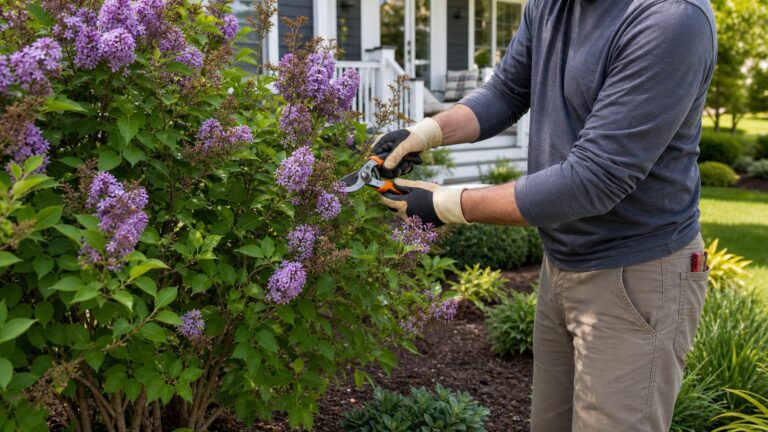
Use sharp, clean pruners for small stems. Thicker established stems may require loppers or a pruning saw. Do not force a hand pruner through wood that is too large; crushing the stem can create a poor wound and make the work less safe.
For routine flowerhead removal and small branches, bypass pruning shears are the most useful starting tool. If you are working on a mature shrub with thicker stems, bypass loppers for shrubs can provide additional reach and leverage, while a small pruning saw is appropriate for wood beyond the safe capacity of either tool.
Clean tools when disease spread is a concern
Clean visible sap and debris from cutting tools before disinfecting them. When moving between plants—especially if one shows signs of disease—use a suitable disinfectant according to its product label. Some disinfectants can corrode metal or damage sharp cutting edges, so do not treat every chemical product as interchangeable.
A garden tool disinfectant is an optional addition for gardeners pruning multiple shrubs or handling suspected disease. Tool hygiene does not replace removing infected material or improving the plant’s growing conditions, but it can reduce the chance of carrying pathogens from one plant to another.
Independent reader supportYour contribution helps us test, update, and keep practical guides available for everyone.Winter protection is different from pruning
If a hydrangea is vulnerable to cold, wind, or browsing, protection may be more useful than cutting it back.
- Rabbit protection: In areas where rabbits browse woody stems, place a wire barrier around vulnerable shrubs. A hardware cloth garden fence is an optional solution where browsing is a recurring problem; keep it far enough from the plant that animals cannot reach through it easily.
- Mulch: A suitable mulch layer can help moderate soil temperature and protect roots. Keep mulch from being piled tightly against the stems.
- Wind protection: Exposed plants may need protection from drying winter winds, particularly where tender bigleaf stems are at risk.
- Containers: Container-grown hydrangeas have less root insulation than plants in the ground and may need a separate overwintering strategy suited to the cultivar and local climate.
These measures are not universal requirements. Their value depends on the species, cultivar, hardiness, exposure, and severity of the local winter. Bigleaf hydrangeas are particularly vulnerable to losing old flower buds after cold injury, while panicle and smooth types are generally more dependable in colder conditions because they flower on new wood.
Best Value

- What Makes VT-C800 Unique? Ever-Sharp Teflon-Coated SK5 Blades | Jam-Proof Sealed Spring | Ambidextrous Thumb Lock | Backed by Lifetime Support
- 【UPGRADED SK5 BLADE FOR 3X LASTING SHARPNESS】Built with an ultra-sharp SK5 steel blade and Teflon non-stick coating, the C800 is designed for cleaner cuts, smoother slicing, and less sticking during repeated garden scissors. The hard SK5 blade helps maintain a sharp cutting edge, while the low-friction coating helps reduce sap and resin buildup on roses, stems, shrubs, vines, and small branches
- 【SEALED JAM-PROOF SPRING, NO MID-CUT JAMS】Say goodbye to exposed springs that catch leaves, dirt, and garden debris. Unlike ordinary plant shears and garden shears, the C800 uses a sealed Jam-Proof Spring system that helps block moisture and debris, resist rust and wear, and keep the blade snapping back smoothly. Less cleaning, more reliable blade return — for backyard gardens, flower beds, shrubs, and damp outdoor conditions
- 【EASY THUMB-ACTIVATED SAFETY LOCK】These garden clippers feature a simple one-handed thumb glide lock that works smoothly for both left- and right-handed gardeners, even when wearing thick gardening gloves. It delivers quick, secure locking during storage or transport, helping prevent accidental openings and making the gardening shears safer and easier to carry between pruning tasks
- 【ERGONOMIC DESIGN FOR WEAK HANDS】Designed for comfort during longer backyard pruning sessions, the C800 features curved non-slip grips that help improve control and reduce hand fatigue. Smooth blade return and a comfortable handle shape make pruning easier for seniors, regular growers, and women gardeners
A simple decision process
- Find the label. Record the species and cultivar if possible.
- Classify the flowering wood. Bigleaf, mountain, oakleaf, and climbing types are generally old-wood bloomers; smooth and panicle types are generally new-wood bloomers.
- Ask whether pruning is necessary. If the plant is healthy and the only issue is dried flowers, waiting is often the least risky choice.
- Remove hazards first. Dead, broken, and diseased stems can be dealt with selectively rather than cutting the entire shrub.
- Choose the season. Prune old-wood types shortly after flowering when possible. Prune new-wood types in late winter or early spring before active growth.
- Protect instead of cutting when appropriate. Use barriers, mulch, or wind protection when the problem is browsing or winter exposure—not excessive size.
Common mistakes to avoid
- Cutting every hydrangea to the ground: This may work for some smooth hydrangeas, but it can remove next year’s flower buds on old-wood types.
- Assuming every fall cut is harmful: New-wood hydrangeas can tolerate dormant-season pruning, although waiting is often preferable.
- Using one calendar date nationwide: Climate, exposure, cultivar, and winter severity change the safest timing.
- Pruning based only on flower color: Blue, pink, and white flowers do not reliably identify the pruning group.
- Promising more flowers from any pruning: Incorrect timing, winter injury, inadequate light, and cultivar differences can all affect flowering.
- Confusing dead flowerheads with dead stems: A dried bloom is not proof that the branch beneath it should be removed.
Frequently Asked Questions
Can I cut back a hydrangea in October or November?
It depends on the type. Avoid major fall cuts on bigleaf, mountain, oakleaf, and climbing hydrangeas because they generally flower on old wood. Smooth and panicle hydrangeas are more tolerant, but late winter or early spring is usually the better pruning window.
Recommended Free Tools
Should I remove dead hydrangea flowers before winter?
Usually, you do not need to. Leaving dried flowerheads preserves winter interest and may offer limited protection to buds on some old-wood types. Remove them in early spring, or remove only those that are broken, diseased, or in the way.
Which hydrangeas can be cut back hard?
Smooth hydrangeas are the most tolerant of substantial reduction because they flower on new wood. Panicle hydrangeas also tolerate dormant-season pruning, but a structured reduction is generally preferable to indiscriminate shearing. Confirm the cultivar before using severe rejuvenation pruning.
What if my hydrangea has no label?
Use clues such as cone-shaped panicle flowers, rounded smooth-hydrangea flowerheads, oak-shaped leaves, or climbing growth. Identification by appearance can be imperfect, so avoid severe pruning until you are reasonably confident of the type.
The Bottom Line
Bottom line: Do not automatically cut hydrangeas back before winter. Leave old-wood types largely intact, remove only clearly dead or damaged material, and wait until late winter or early spring to prune smooth and panicle types. When the label is missing, identify the plant before making a major cut—because the wrong timing can remove an entire season of flowers.
What’s actually slowing this PC down?
Pick the symptom - the matching free tool is one click away.
Quick Recap
Product prices and availability are accurate as of the date/time indicated and are subject to change. Any price and availability information displayed on Amazon at the time of purchase will apply.