The Tool Desk
Outbyte Driver Updater FREEFix the driver behind crashes, sound loss and screen glitchesFind Drivers →Outbyte PC Repair FREERepair Windows errors before they cause bigger problemsFix Now →For most home-theater and hi-fi subwoofers, a stable, level floor is the right place to start—not a tall stand. Keep the cabinet on its designed feet, check that its driver and ports have clearance, then optimize where it sits in the room. Consider isolation feet or a platform if the floor, furniture or adjoining rooms react to the bass. A stand is appropriate only when the subwoofer is designed for elevated placement and the support is stable and approved.
Why the floor is the default
A floor is an acoustic boundary, not just a convenient surface. Along with the walls and ceiling, it shapes the way low-frequency sound behaves in a room. Bringing a subwoofer near boundaries can increase bass output, but it can also excite room resonances. More output is not necessarily smoother or more accurate bass. Room dimensions and the subwoofer’s position relative to the listening seat usually matter more than raising the cabinet a few inches. See Audioholics’ explanation of subwoofer placement and room boundaries and SVS’s overview of room gain.
As an Amazon Associate I earn from qualifying purchases.
Many conventional home subwoofers are designed to operate close to the floor. Velodyne recommends a stable, flat, level surface and warns against stands, brackets, tripods and tables because the cabinet could fall or be knocked over. That is manufacturer guidance, not a universal rule for every specialty or studio model: follow the instructions for your particular subwoofer. Velodyne’s placement guide also cautions against obstructing downward-firing ports or passive radiators.
“On the floor” does not have to mean bare cabinet against bare flooring. It generally means close to the floor, supported securely by the supplied feet or by a compatible isolation accessory. Avoid a support that blocks a driver or port, leaves the cabinet unstable, or conflicts with the manufacturer’s placement instructions.
#1 Best Overall

- 7.8” (200mm) Wide x 10” (254mm) Depth 3.5” (90mm) Height. 75lbs weight capacity. Package includes 1 Stand.
- PATENTED ISOACOUSTICS ISOLATION: Tested at the National Research Council of Canada (NRC). The IsoAcoustics award winning design provides superior isolation performance.
- EXCITING THE SUPPORTING SURFACE: The isolators manage the energy of the speaker to reduce vibrations resonating through the supporting surface to eliminate dissonant sounds in the listening area or adjoining rooms.
- REDUCES INTERNAL REFLECTIONS: IsoAcoustics isolator reduces internal reflections to eliminate smear. The result is an improved stereo image of natural spatial sound.
- COMPATIBILITY: ISO-200Sub is designed to accommodate most subwoofers, and can be used as a single unit, or combined with additional units for larger subwoofers.
Floor, feet, platform or stand?
| Support | What it can do | Main limitation or risk | Best fit |
|---|---|---|---|
| Floor with supplied feet | Provides a stable, low placement consistent with many subwoofer designs. | Mechanical vibration may still reach a suspended floor or nearby objects. | Default for most conventional home-theater and hi-fi models. |
| Isolation feet | May reduce mechanical coupling, rattles or cabinet movement. | Do not correct room-mode peaks, nulls or poor crossover integration. | A sub that walks on a smooth surface, or a floor that vibrates. |
| Isolation platform | Provides a broad, level support and may reduce structure-borne vibration. | Needs adequate footprint, load capacity and clearance for downward-firing parts. | A broad-footprint cabinet, carpeted floor, or a specific vibration problem. |
| Short, rigid plinth | Can provide a firm, level base in a particular installation. | Changes the cabinet’s height and must not obstruct its driver or port. | Only when the subwoofer remains stable and the design permits it. |
| Tall stand, table or shelf | Can solve a specific height or space problem for a model designed for it. | Raises the center of gravity; may introduce tipping, rattling or clearance problems. | Compact or specialty models whose manufacturer permits elevated placement. |
A stand does not inherently make bass tighter. Raising a subwoofer changes its height and its mechanical connection to the support, so it can change the response at some frequencies. But it does not remove room modes, and a small height adjustment is usually a lower-priority variable than moving the cabinet a substantial distance or changing the listening position.
Choose a location before choosing an accessory
Room modes create places where bass is unusually strong and places where it cancels. A corner often provides more output because the subwoofer is near multiple boundaries, but the result can be boomy, uneven between seats or difficult to integrate. A front-wall position, slightly off the room’s central axis, is a reasonable starting point; Genelec offers that placement as guidance for a single subwoofer, not a guarantee for every room. Genelec’s monitor-placement guidance explains its starting position.
Try the subwoofer crawl
- Temporarily put the subwoofer at the main listening position. Keep it on a stable surface and do not obstruct its driver or port.
- Play a repeating bass line, a bass sweep, or a familiar bass-heavy track at a moderate level.
- Walk around the room perimeter and listen near the floor, roughly where the subwoofer will eventually sit. Note places where bass sounds both strong and even, not merely loud.
- Move the subwoofer to a promising location and listen from the main seat. Try more than one candidate if needed.
- Check the result from every important seat. A position that sounds good in one chair may not be consistent across a sofa.
- After choosing a position, adjust the system’s level, phase or polarity, crossover and equalization as needed. Receiver and processor controls differ, so use the instructions for your equipment.
SVS and KEF describe this listening-based search method; KEF specifically recommends listening close to floor level because the subwoofer operates there. It is a practical way to find promising positions, not a guarantee of a perfectly flat response. See SVS’s placement guide and KEF’s crawl instructions.
Rank #2
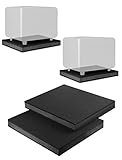
- ENHANCES AUDIO PERFORMANCE: This sound isolation pads for speakers studio monitor and subwoofer, isolates any vibration generated from the speakers or the desk up. Gives your audio clarity much better, bring you a better sound.
- FOR 8-10 INCHES SPEAKER: This speaker riser works for most of 8 inch / 8.5 inch / 9 inch / 10 inch studio monitors, loudspeakers, subwoofer. Such as use for yamaha hs8
- THICK ANTI-VIBRATION & ANTI-SLIP FOAM: Stability, cuts well 3-layer Dampening Acoustic Stands Pads, Made of shock absorbent rubber sponge and Non-slip Fibreboard base. Not only reduces vibration, but keeping your audio in place
- SIZE: 13'' x 15.5'' x 1.8'' inch (W x L x H). Perfect for home, apartments, desktop or studio use.
- Come with 2 studio monitor isolation pads.
What isolation can—and cannot—solve
Isolation accessories are most relevant when the problem is mechanical: a floorboard vibrates, furniture buzzes, a cabinet moves, or bass seems to be travelling through the building structure. Isolation feet or a platform may reduce some structure-borne vibration, but results depend on the subwoofer, support, building and installation. Genelec says additional acoustic isolation generally has no significant influence on the sound of its subwoofers because their cabinet vibration is already very low. That is useful counterevidence to treating isolation as a universal sonic upgrade. Genelec’s isolation FAQ discusses that point.
- Isolation may help with: floor vibration, rattles, cabinet movement, or some mechanical energy transferred into a supporting surface.
- Isolation does not reliably fix: a room-mode peak or null, a poor subwoofer location, excessive gain, incorrect phase, or a badly integrated crossover.
- Isolation is not soundproofing: airborne bass can still travel through walls, ceilings, doors and ventilation paths. It cannot guarantee that neighbors will not hear bass.
Start by checking whether the sound comes from the structure or from a loose object. Secure rattling objects and furniture, then try compatible isolation if the floor itself reacts. On a suspended wood floor, mechanical vibration can be conspicuous; a concrete slab may behave differently, but airborne bass can still pass through the building. In an apartment or townhouse, reducing playback level may be necessary even when isolation is used.
Carpet, hard floors and subwoofer design
Carpet and rugs
Carpet is not a meaningful deep-bass absorber in the way people sometimes assume. Its practical concern is support: thick pile and padding can make a heavy cabinet rock or sink unevenly. Supplied feet may keep the cabinet stable and provide clearance. Spikes can improve stability on some thick carpets, but they may damage the flooring beneath; use them only if appropriate for the floor and permitted by the manufacturer. A platform can spread the load and provide a firm base, provided the subwoofer remains level and any underside driver or port has free space.
Rank #3

- Studio Grade Audio Performance Anywhere: a must-have subwoofer isolation riser for any home studio. High-performance acoustic isolation pad eliminates vibrations and ensures crisp, clear speaker sound.
- Thick Sound Dampening Foam Riser: Premium quality high-density foam pad made from thick foam, EVA material, and a sturdy MDF board for extra stability and optimal sound dampening performance.
- Universal 12-15 Inch Subwoofer Isolation Pad: Compatible with all 12-inch, 13-inch, or 14-15-inch subwoofers. Universal subwoofer pad fits all subwoofer, loudspeaker, or speaker models, types, and brands.
- Excellent Vibration Reduction And Stabilization: Reduce subwoofer-generated vibrations and enhance noise isolation anywhere. The non-slip base makes this subwoofer platform ideal for apartments and studios.
- Signature Sound Addicted Quality: Invest in a superior-quality 20" x 17" x 3'' speaker isolation pad that will stand the test of time and offer you excellent noise isolation and speaker performance.
Down-firing, front-firing and ported models
Down-firing drivers, ports and passive radiators need the clearance specified by the manufacturer. A thick rug, soft carpet, or platform that blocks the underside can muffle or obstruct output. Front- or side-firing models offer more options for support, but their ports still need the required clearance. A rear-ported cabinet should not be pushed against a wall without checking its instructions. Do not put a subwoofer inside furniture unless its manufacturer allows it: an enclosure can block a port, transmit rattles and restrict airflow.
What’s actually slowing this PC down?
Pick the symptom - the matching free tool is one click away.
Diagnose the symptom before changing the support
| Symptom | More likely cause | First step |
|---|---|---|
| Bass is loud in one seat and weak in another. | Room modes and position-dependent cancellations. | Try the crawl, reposition the sub or listening seat, and consider multiple subs if the seating area remains inconsistent. |
| Bass sounds boomy across the room. | Excessive level, boundary reinforcement, or a room resonance with a long decay. | Reduce subwoofer level and try a different position, including one farther from the corner; use appropriate EQ if available. |
| Floorboards vibrate or furniture buzzes. | Structure-borne vibration or a resonating object. | Secure the object and try compatible isolation feet or a platform. |
| A neighbor hears low-frequency thumps. | Structure-borne vibration, airborne bass, or both. | Lower playback level, check for mechanical rattles, and try isolation without assuming it will stop airborne transmission. |
| The subwoofer walks on hardwood. | Insufficient grip or unstable feet. | Use suitable feet or a stable platform compatible with the cabinet. |
| Bass loses impact after moving the sub onto a stand. | A changed boundary relationship or system integration. | Try floor placement again and recalibrate before attributing the change to the stand alone. |
| Output is muffled or there is port noise. | A blocked port, driver or passive radiator, or inadequate clearance. | Restore the manufacturer’s required clearance. |
| Bass disappears near the listening position. | A cancellation or room null. | Move the subwoofer or seat; raising the level alone may make bass excessive elsewhere. |
When a second subwoofer is a better next step
If bass varies dramatically from seat to seat after you have tried placement and calibration, a second subwoofer may help more than a stand or isolation pad. Harman’s research by Todd Welti examines how strategically placed multiple subwoofers can improve consistency across listening positions by exciting room modes differently. Four-corner placement is one arrangement discussed for improving consistency in a small room; it is not a universal prescription. Welti’s multi-subwoofer research and Harman’s discussion of small-room subwoofers provide further context.
Multiple subs do not automatically sound better or simply mean more loudness. They need suitable level, phase, delay and sometimes EQ adjustment. Different subwoofers can be used, but differing capabilities may make integration more complicated. A well-placed, calibrated single sub is preferable to two poorly integrated ones. The main reason to add another is often smoother bass across several seats, rather than greater output at one seat.
Rank #4
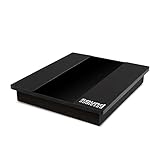
- Studio Grade Audio Performance Anywhere: a must-have subwoofer isolation riser for any home studio. High-performance acoustic isolation pad eliminates vibrations and ensures crisp, clear speaker sound.
- Thick Sound Dampening Foam Riser: Premium quality high-density foam pad made from thick foam, EVA material, and a sturdy MDF board for extra stability and optimal sound dampening performance.
- Universal 8-10 Inch Subwoofer Isolation Pad: Compatible with all 8-inch, 9-inch, or 10-inch subwoofers. Universal subwoofer pad fits all subwoofer, loudspeaker, or speaker models, types, and brands.
- Excellent Vibration Reduction And Stabilization: Reduce subwoofer-generated vibrations and enhance noise isolation anywhere. The non-slip base makes this subwoofer platform ideal for apartments and studios.
- Signature Sound Addicted Quality: Invest in a superior-quality 13" 3/4 x 15" 3/4 x 2" 1/2 speaker isolation pad that will stand the test of time and offer you excellent noise isolation and speaker performance.
When a stand is justified—and how to keep it safe
Consider elevated placement only when the subwoofer’s manufacturer permits it and you have a specific reason, such as a compact nearfield or studio model intended for a stand, or a measured integration problem that a height change addresses. Confirm that the support is rated for the cabinet’s weight, is wide and rigid enough, and cannot tip under ordinary contact. Keep cables out of walkways, particularly where children or pets could pull them. Check that ports and drivers have clearance. Large, heavy or down-firing home-theater subs are poor candidates for improvised tall stands.
If a subwoofer is near the floor already, raising it a few inches is not a substitute for finding a better room position or calibrating the system. If you test a height change, compare it from the listening seats at the same playback level; otherwise, a louder result can be mistaken for a better one.
Outdated Drivers Are Slowing You Down
One free scan finds every outdated or missing driver and matches the right update for your exact hardware.Free scan · exact hardware matchPC Slower Than It Used to Be?
A free scan shows the junk files, broken settings and background clutter dragging Windows down - then fixes them in one click.Free scan · Windows 10 & 11Buying isolation: match the product to the actual problem
Do not buy an accessory just because it promises “tighter” or “cleaner” bass. Choose by the support problem, cabinet weight and footprint, required clearance, and compatibility. Product capacities and pricing can change; verify current fit and live details with the manufacturer before purchasing.
- Threaded feet: SVS’s SoundPath Subwoofer Isolation System is intended to reduce floor and wall vibration, room rattles and movement. Check the subwoofer’s threaded inserts and whether the required configuration uses four or six feet; compatibility differs by model. The official page listed $64.99 in the supplied product information, but that is not a guaranteed current price.
- Broad platform for a smaller sub: Auralex’s SubDude-II measures 15 × 15 × 1.75 inches; its SubDude-HT measures 18 × 22 × 1.75 inches. Check the live product page for capacity, availability and current price, and make sure the platform does not obstruct a down-firing component. Auralex advises centering the sub on the platform and following the subwoofer manufacturer’s placement recommendations in its SubDude user guide.
- Heavier purpose-built platform: IsoAcoustics lists the Aperta Sub XL for subwoofers up to 160 pounds (72.5 kilograms). Verify that the cabinet fits securely and that the platform suits the installation; capacity alone does not establish compatibility.
- Smaller studio isolators: The ISO-Puck series is rated at 6 pounds per Mini unit, 20 pounds per ISO-Puck, and 40 pounds per ISO-Puck 76. IsoAcoustics recommends at least three isolators and staying at least 10% below the stated load limit. Treat those as per-unit ratings, and calculate the supported load for the number and arrangement actually used.
If a cable run is the reason the sub cannot go in a better acoustic location, a wireless audio link is a separate placement tool, not an isolation product or room correction. SVS says its SoundPath Wireless Audio Adapter can support up to six subwoofers with one transmitter and multiple receivers; check current compatibility and system requirements before relying on it.
Quick Recap
Product prices and availability are accurate as of the date/time indicated and are subject to change. Any price and availability information displayed on Amazon at the time of purchase will apply.




