Crashes, No Sound, or Screen Glitches?
Random freezes, missing sound and display glitches usually trace back to one bad driver. Find and replace yours safely.Free scan · under a minuteWindows Errors? Fix Them Before They Spread
Repair common Windows errors and clear accumulated junk for a smoother, more stable PC - no reinstall needed.Free scan · no reinstallThe correct meaning of a Rinnai error code depends on the exact heater model and generation. A code on an older V-, RU-, or RE-Series unit may not use precisely the same wording as a newer SENSEI RX or RE-Series model. Before ordering a part or attempting a repair, find the model number on the heater and use that unit’s Rinnai installation and operation manual.
For most homeowners, the safe response is to record the code, check power, gas, water flow, and accessible vent terminations, then follow the model-specific reset procedure once. If the code returns—or if it involves combustion, gas pressure, flame sensing, electrical components, a fan, a burner, or a safety device—stop resetting the heater and arrange service.
As an Amazon Associate I earn from qualifying purchases.
First, identify the heater and the exact indicator
Rinnai error-code labels vary by model family, market, and generation. This guide is based primarily on U.S. residential Rinnai documentation and covers codes commonly seen on several older outdoor units and newer RE-Series and SENSEI RX documentation. It should not be treated as a universal code chart for every Rinnai water heater sold worldwide.
Record the following before troubleshooting:
- The complete model number and, if available, the serial number.
- The exact display, including whether it shows a number, SS, Service Soon, or another message.
- Whether the problem happens at every faucet or only at one fixture.
- Whether the heater recently lost power, ran out of propane, experienced freezing weather, or had plumbing or vent work performed.
- Whether the code disappears and returns, or remains continuously displayed.
The model number is usually printed on the heater’s rating plate or product label. Use it to locate the matching Rinnai manual rather than relying only on a general online code list.
#1 Best Overall
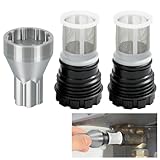
- 【Complete Maintenance Kit for Rinnai Water Heaters】Designed to work with all Rinnai inlet filter caps, this kit includes a precision removal tool plus 2 replacement inlet filters—everything you need for safe, fast, and hassle-free filter maintenance
- 【3-in-1 Multi-Use Removal Tool】Use it your way: inner hex slot for power screwdrivers, outer hex for standard wrenches, or hand-grip the recessed surface. Multiple operation options make filter removal easy for any skill level
- 【Prevents Damage & Costly Mistakes】Say goodbye to slipping pliers, cracked caps, or stripped threads. The custom-fit teeth remove inlet filters smoothly, while the included replacement filters give you a backup if the original screen is worn or damaged
- 【Durable Tool + Reliable Replacement Filters】This removal tool is built for repeated use, while the included inlet filters are designed to match factory specifications—ideal for DIY homeowners and professional technicians alike
- 【Save Time on Cleaning, Flushing & Descaling】Quickly remove, clean, or replace your inlet filter during routine maintenance. With both the tool and spare filters included, you avoid delays, extra purchases, and keep your water heater running efficiently
Safe checks you can make before calling for service
- Confirm electrical power. Check that the heater is plugged in or supplied by its dedicated circuit and that no breaker or GFCI has tripped. Do not remove the front cover to investigate internal wiring.
- Confirm fuel availability. Make sure the gas supply has not been intentionally shut off. On a propane installation, check whether the tank contains fuel. Do not adjust gas pressure, convert gas type, or work on gas piping.
- Look at accessible vent terminations. From outside, check for snow, leaves, insects, ice, or other visible debris at the approved air intake and exhaust termination. Do not disassemble venting, insert tools into it, or change its routing.
- Check water valves and demand. Confirm that the cold-water supply and hot-water isolation valves are open if your installation has accessible service valves. A faucet with very low flow may not activate a tankless heater.
- Record the code before resetting. A reset can erase useful clues. Correct an obvious external problem first, then use the reset sequence in the exact manual for your model.
If the code returns after the external issue has been corrected, treat the recurrence as a service signal. Repeatedly switching the heater off and on does not repair a failed sensor, blocked combustion path, gas-supply problem, or safety circuit.
Stop immediately if you smell gas. Do not operate electrical switches or attempt to restart the heater. Leave the area and contact your gas utility or emergency services according to local instructions. A qualified gas-appliance professional should investigate the heater.
Rinnai error codes: common meanings and next steps
The table below is a practical starting point, not a substitute for the manual for your model. The same number may be absent, renamed, or associated with a somewhat different diagnostic path on another Rinnai series.
| Code | Typical meaning | Safe homeowner checks | When professional service is required |
|---|---|---|---|
| 10 | Air-supply or exhaust blockage | Inspect accessible intake and exhaust terminations for snow, debris, or an obvious obstruction. | Venting, fan diagnosis, combustion testing, vent-length compliance, gas settings, and repairs inside the unit. |
| 11 | No ignition | Check electrical power, fuel availability, and whether a propane tank is empty. | Igniter, flame rod, gas-solenoid circuits, grounding, burner, gas pressure, and control-board diagnosis. |
| 12 | Flame failure or no flame detected | Check for an obvious interruption of gas service and visible vent obstruction. | Flame-sensing, gas pressure, venting, wiring, burner, combustion chamber, and electrical diagnosis. |
| 14 | Thermal fuse or thermal-safety fault | Do not bypass the safety device. Note whether the code returns immediately. | Every recurring code 14, including investigation of airflow, scale, heat-exchanger, gas-type, and combustion conditions. |
| 16 | Over-temperature warning or safety shutdown | Check for an accessible vent obstruction and whether water flow is unusually low. | Persistent shutdowns, short-cycling, restricted combustion, heat-exchanger, or other safety-related conditions. |
| 31 | Burner-sensor error on some legacy outdoor-unit documentation | There is generally no useful external repair for this code. | Sensor resistance testing and all internal electrical or burner-related diagnosis. |
| 61 | Combustion-fan fault on some legacy outdoor-unit documentation | Only note whether an accessible external obstruction is present; do not open the heater to test the fan. | Fan movement, wiring, control board, and combustion diagnosis. |
Code 10: air-supply or exhaust blockage
Code 10 is used for an air-supply or exhaust blockage in Rinnai RE-Series troubleshooting documentation. The heater may be unable to obtain the air needed for combustion or discharge combustion gases safely.
From outside, look for snow, leaves, nests, plastic, or other debris at the approved intake and exhaust termination. If the termination is visibly blocked, remove only loose material that can be cleared safely without dismantling the vent. Do not climb unsafely, remove vent sections, or probe into the pipe.
Other possible causes include an incorrect vent material or connection, excessive or noncompliant vent length, incorrect altitude-related parameters, or a blocked combustion fan. Those require a qualified professional who can verify the installation and perform combustion and fan checks.
Code 11: no ignition
Code 11 generally means the heater did not ignite or turn on when there was a demand for hot water. Begin with the limited checks above: electrical power, fuel availability, and an open gas supply. A propane heater may display this code simply because the cylinder is empty, although other causes are possible.
Rinnai’s diagnostic list also includes incorrect gas type or pressure, inadequate grounding, an igniter problem, a gas-solenoid fault, flame-rod wiring, a burner that is not seated correctly, burner-plate contamination, or a control-board grounding problem. These are not interchangeable homeowner fixes. Do not adjust the regulator, gas pressure, factory parameters, or internal wiring in an attempt to clear code 11.
Code 12: flame failure or no flame
Code 12 indicates that the heater failed to maintain or detect a flame. It can follow an interrupted gas supply, air in a gas line, an obstructed flue outlet, incorrect gas pressure or sizing, improper venting, or a power-supply problem.
Rank #2

- H98-510-S tankless Water Heater Filter Kit for Rinnai tankless Water Heater for Tankless Water Heater Insert Screen Assembly
- Items Description: Tankless water heater filter. For optimum dirt-holding, replace it about every 2-3 months. The part is easy and quick to install. Remove and replace the old or damaged parts, which can be completed in 5 minutes, improving time efficiency and quickly resuming daily activities.
- Size: The Filter Screen for the Tankless Water Heater is 0.94" x 1.8" x 0.78"
- Precautions: Replacement effectively restores the optimal performance of the water heater. For proper use and to avoid purchasing errors, check at the time of purchase that the product is compatible with tankless water heater circuits.
- After-Sales: If you have questions about our H98-510-S for Tankless Water Heater Filter Assembly, please get in touch with us, including pre-sale and post-sale questions. We will give you a satisfactory answer within 24 hours!
Internal causes can include a disconnected or dirty flame rod, damaged wiring, a gas-solenoid fault, or debris in the combustion chamber. Because this code involves gas combustion and flame sensing, a recurrence should be diagnosed by a trained professional rather than handled by repeated resets.
Code 14: thermal fuse or thermal-safety fault
On older Rinnai manuals, code 14 is associated with thermal-fuse activation; current RE-Series documentation describes it as a thermal-fuse fault. The safety circuit is intended to respond to an unsafe temperature condition or related problem.
Do these 3 things before closing this tab:
1Clear out junk files and repair common Windows errors2Scan for outdated or missing drivers - takes under a minute3Repair Windows errors before they cause bigger problemsRinnai lists possible contributors such as restricted airflow, incorrect gas type, low water flow in a circulating system, combustion-chamber or exhaust contamination, heat-exchanger damage, and scale-related hot spots. Mineral scale can create localized overheating, but code 14 is not proof that the heat exchanger merely needs flushing.
Never bypass, jumper, or replace a thermal fuse without finding the reason it activated. A recurring code 14 requires qualified service.
Code 16: over-temperature warning
Code 16 is an over-temperature warning or safety shutdown. Rinnai troubleshooting material points to restricted airflow or exhaust and insufficient water flow or short-cycling as initial possibilities. Older documentation also directs professionals to investigate combustion and heat-exchanger conditions.
Check only for an obvious external vent obstruction and an unusually low-flow hot-water demand. If the code persists, do not treat it as a simple reset issue. Continued operation under an over-temperature condition can damage the heater or leave an underlying safety problem unresolved.
Recommended Free Tools
Code 31: burner-sensor error
Code 31 appears in legacy Rinnai outdoor-unit documentation as a burner-sensor error. The listed diagnostic path includes measuring sensor resistance, which requires access to internal components and electrical test equipment.
Since the correct resistance value and test procedure depend on the model, this is not a suitable do-it-yourself repair for most homeowners. Arrange service and provide the technician with the exact model number and code history.
Code 61: combustion-fan fault
On legacy outdoor-unit documentation, code 61 identifies a combustion-fan problem. A professional may check whether the fan turns freely and then investigate the fan motor, wiring, control board, and combustion system.
Rank #3

- One Model, Anywhere: This Rinnai tankless water heater is installable indoors or outdoors thanks to our new Versa Vent and powered by either propane or natural gas thanks to a Smart Sense gas control system; RX-OVC vent cap required for outdoor install
- Never Run Out of Hot Water with this Compact Tankless Gas Water Heater: This condensing propane and natural gas tankless water heater from Rinnai is only the size of a small suitcase, but provides up to 7.1 GPM (4 fixtures at once)
- Smart, Efficient Design: This water heater's modern design includes an easy-to-use interface, Quick Flush feature for simplified flushing, as well as a super-high energy efficiency factor of UEF .97; See Controlr module for WiFi control (not included)
- Professional Installation Recommended: Visit the Find a Rinnai PRO page on our website to find a qualified technician to install your tankless water heater, and use the Rinnai Central App for help with setup, service & troubleshooting; We do not recommend installing a water heater without a technician
- Find Your Rinnai: See our product guides, manuals, energy guide, warranty information, videos, and tables to find the right tankless water heater size for your home; Check our Ground Water Temperature Map to see if this heater is optimal for your region
Do not open the cabinet or attempt to test live electrical components. If the fan is obstructed internally or the code returns after a reset, leave the heater off until it has been evaluated.
Free tools Windows power users keep installed
One-click scans. No signup required.
Is “SS” an error code?
Usually, SS means “Service Soon,” not an immediate component failure. In current Rinnai documentation, it is a maintenance reminder indicating that the selected service interval has elapsed. It may call for flushing and other scheduled maintenance, depending on the installation and model.
SS does not guarantee that every part of the heater is operating correctly, and it should not be used to explain a separate numbered code. Record both indicators if the display shows more than one message, then check the manual for the procedure to clear or acknowledge the maintenance reminder.
How to view Rinnai diagnostic-code history
Current RE-Series and SENSEI RX manuals provide a way to view the last nine maintenance or diagnostic codes through the controller. The button sequence is not identical for every controller and model, so do not apply a sequence from a different Rinnai manual.
Find the manual’s section on maintenance codes, diagnostic codes, or code history. Write down the stored codes in order before clearing anything. A history showing recurring 10, 11, 12, 14, 16, 31, or 61 codes can help a technician distinguish an intermittent event from a continuing fault.
When flushing may help—and when it will not
Mineral scale can accumulate in a tankless heater’s heat exchanger. Water quality, hardness, temperature, usage, and installation conditions affect how often maintenance is needed. Scale may contribute to reduced flow, temperature instability, localized hot spots, or some thermal-related faults.
Rinnai’s consumer flushing procedure uses four gallons of undiluted white vinegar and warns against chemical cleaning solutions. Depending on the installation, flushing requires isolation valves, purge ports, hoses, and a pump. The exact sequence in the model manual should control the work.
A tankless water heater flush kit can be useful for scheduled maintenance when the installation already has compatible isolation and purge valves. It is not a cure for ignition, flame, combustion-fan, sensor, control-board, or electrical faults. Check the heater model and installed valve arrangement before buying a kit.
Rinnai also identifies the Rinnai MIVK-T-LW isolation valve kit as an accessory. It is not a universal fit for every Rinnai installation, and adding or replacing service valves may involve plumbing changes. Confirm compatibility with the exact model and have a professional install valves if you are not comfortable isolating and draining a pressurized hot-water system.
The Tool Desk
Outbyte PC Repair FREERepair Windows errors before they cause bigger problemsFix Now →Outbyte Driver Updater FREEScan for outdated or missing drivers - takes under a minuteDriver Scan →During any flush, isolate the heater from the home’s water supply, follow the manual’s valve positions, protect against hot water and vinegar spills, and verify that the heater is fully returned to its normal configuration afterward. If you do not have purge valves, cannot identify the isolation valves, or are unsure how to connect a pump and hoses, hire a qualified plumber or water-heater technician.
Scale prevention
Flushing removes accumulated deposits; it does not permanently change hard water. In areas with hard water or recurring scale-related maintenance, a compatible treatment system may reduce future buildup. Rinnai lists ScaleCutter accessories, including the Rinnai ScaleCutter refill cartridge 103000039, but a refill cartridge is only appropriate for the corresponding ScaleCutter system. It is not a universal replacement and will not correct a displayed code by itself.
For persistent scale concerns, compare the water-treatment approach with the heater manual and local water conditions. A qualified water-treatment provider can help determine whether scale control is appropriate; do not assume that a treatment product eliminates the need for periodic flushing.
Rank #4

- Premium: H98-510-S Tankless Water Heater Filter Part for Rinnai Tankless Water Heater Insert Screen Assembly
- Items Description: Tankless water heater filter. For optimum dirt-holding, replace it about every 2-3 months. The part is easy and quick to install. Remove and replace the old or damaged parts in 5 minutes, improving efficiency and quickly resuming daily activities.
- Size: The Filter Screen for the Tankless Water Heater is 0.94" x 1.8" x 0.78" (see H98-510-S for the Tankless Water Heater Inlet Screen Assembly)
- Precautions: Replacement effectively restores the water heater's optimal performance. For proper use and to avoid purchasing errors, check at the time of purchase that the product is compatible with tankless water heater circuits.
- After-Sales: If you have questions about our H98-510-S for H98-510-S Tankless Water Heater Filter Assembly, please get in touch with us, including pre-sale and post-sale questions. We will give you a satisfactory answer within 24 hours!
Low flow or alternating hot and cold water without a code
A Rinnai heater may fail to activate when the hot-water flow is below the model’s minimum activation requirement. Low flow can also cause alternating hot and cold water. The minimum-flow specification is model-specific, so do not rely on a generic gallon-per-minute number.
Quick wins for a faster PC:
Clear out junk files and repair common Windows errorsFree Scan →Fix the driver behind crashes, sound loss and screen glitchesFind Drivers →Repair Windows errors before they cause bigger problemsFix Now →Useful observations include:
- Whether the problem occurs at one faucet or every fixture.
- Whether a clogged aerator, showerhead, or fixture screen is restricting flow.
- Whether increasing flow slightly makes the heater activate.
- Whether lowering the temperature setting improves stability.
- Whether another fixture is opening and closing or causing repeated short demands.
These observations can distinguish a fixture-flow problem from a heater, plumbing, or recirculation problem. Do not remove internal filters or alter heater parameters unless the model manual specifically identifies the step as an owner procedure.
When to stop troubleshooting and call a professional
Arrange qualified service instead of continuing DIY checks when:
- The same error code returns after one correct reset.
- The code involves gas supply, ignition, flame detection, combustion, venting, a burner, a fan, a sensor, a control board, or a thermal fuse.
- You need to measure gas pressure, sensor resistance, electrical voltage, or combustion values.
- The front cover must be removed or the combustion chamber must be opened.
- You suspect a blocked vent that cannot be cleared from a safe, accessible location.
- The heater repeatedly overheats, short-cycles, or produces unusual sounds or odors.
- You are unsure whether the gas type, venting, grounding, or installation settings are correct.
- A flush requires plumbing work or the unit has no clearly identified isolation and purge valves.
When contacting a technician, provide the model number, serial number, exact code, code history, fuel type, whether the unit is indoor or outdoor, and what happens immediately before the fault. A photo of the display and the accessible vent termination can also be useful.
For gas, combustion, electrical, sensor, fan, burner, venting, or recurring safety faults, use Rinnai’s official process to find a qualified Rinnai technician or contact a local qualified service provider. The goal is not merely to clear the display; it is to identify why the safety or operating fault occurred.
How to choose the right manual or part
- Match the full model number. Do not choose a part based only on “Rinnai tankless heater” or the error number.
- Confirm the market. U.S. manuals and gas specifications may differ from documentation for Canada, Europe, Australia, or other markets.
- Check the generation. A legacy V-, RU-, or RE-Series unit may have different code descriptions from a newer SENSEI RX or RE-Series model.
- Use accessories only for their intended installation. Flush kits, isolation valves, and ScaleCutter components depend on the installed plumbing arrangement and system compatibility.
- Do not pre-order an internal repair part from a code alone. Codes 11, 12, 14, 16, 31, and 61 can have several possible causes. A qualified diagnosis may show that the suspected part is not the failed component.
Frequently Asked Questions
Can I reset a Rinnai water heater error code myself?
You can generally follow the model-specific reset procedure after checking an obvious external issue such as lost power, an empty propane tank, or visible debris at the vent termination. If the code returns, stop cycling power and arrange qualified service.
Will flushing fix Rinnai code 11 or code 12?
Usually not. Codes 11 and 12 involve ignition or flame detection and may result from gas supply, venting, grounding, igniter, flame-rod, wiring, solenoid, or combustion problems. Scale can contribute to other symptoms, but flushing should not be treated as a general cure for ignition or flame codes.
What does SS mean on a Rinnai heater?
SS generally means Service Soon. Current Rinnai documentation uses it as a maintenance reminder when the selected service interval has elapsed. It is not necessarily an immediate component failure, although scheduled flushing and maintenance may be due.
Is code 14 dangerous?
Code 14 indicates a thermal-fuse or thermal-safety fault on the model families that use that designation. Do not bypass the safety device or repeatedly reset the heater. A recurring code requires qualified diagnosis of airflow, gas type, water flow, scale, combustion, and heat-exchanger conditions.
What’s actually slowing this PC down?
Pick the symptom - the matching free tool is one click away.
Why does my Rinnai heater have low flow but no error code?
The flow may be below the model’s minimum activation requirement, or a faucet aerator, showerhead, or fixture screen may be restricted. Increasing flow or lowering the temperature setting may help in some cases, but the minimum-flow specification is model-specific.
The Bottom Line
Use the exact Rinnai model manual before interpreting any code. Check only power, fuel availability, water flow, and accessible vent obstructions. A single reset after correcting an obvious external issue is reasonable; repeated resets are not a repair. Codes involving ignition, flame, combustion, fans, sensors, overheating, gas, electricity, or safety devices—and any code that returns—belong with a qualified Rinnai service professional.
Quick Recap
Product prices and availability are accurate as of the date/time indicated and are subject to change. Any price and availability information displayed on Amazon at the time of purchase will apply.




