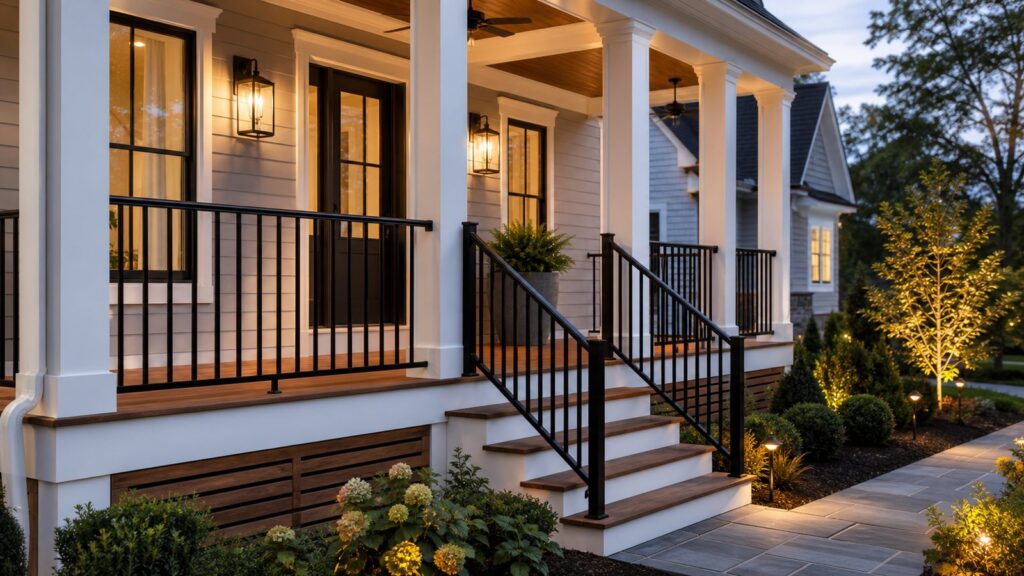
A porch railing has to do two jobs at once: protect people from a fall and look like it belongs on the house. The mistake we see most often is choosing from a pretty photo before checking height, spacing, post strength, stair handrails, maintenance, and cost. That is how homeowners end up with railings that look good online but fail inspection, block the view, rot early, or feel wrong for the architecture.
For most U.S. porch projects in 2026, basic installed railing systems often land around $10 to $50 per linear foot, while more specific installed ranges can run from about $20 to $70 per linear foot for common wood, around $40 to $80 per linear foot for many aluminum systems, $150 to $285 per linear foot for cable railing, and $100 to $600 per linear foot for glass railing. The spread is wide because a straight 20-foot porch rail on sound framing is a very different job from a wraparound porch with stairs, rot repair, gates, corners, and custom trim.
As an Amazon Associate I earn from qualifying purchases.
On our job sites, we pick porch railing in this order: safety requirement first, home style second, view or privacy goal third, maintenance tolerance fourth, and budget fifth. If the railing has to function as a guard, it needs to be treated as a structural assembly, not just exterior decoration.
What’s actually slowing this PC down?
Pick the symptom - the matching free tool is one click away.
Start With Code Before Style
Most residential codes require guards where a walking surface is more than 30 inches above grade within a defined distance from the edge. Local rules vary, but this 30-inch trigger is the number homeowners should know before they start shopping. Many residential guards are required to be at least 36 inches high, measured from the finished walking surface. Stairs also need careful review because a guard and a graspable handrail are not always the same thing.
#1 Best Overall

- Certified Safety – IBC/IRC/ASTM Compliant: Don't settle for "looks safe"—choose railing that's proven safe. This aluminum deck railing has been ASTM tested for strength and reliability, with 36" height, <4" baluster spacing designed to meet key safety requirements. Unlike railings that simply advertise “safe,” Egadis is backed by third-party testing to give families real confidence. A dependable choice for families, homeowners, and outdoor spaces where safety matters most. For commercial use or CA/WA projects, choose the 42" option to meet local requirements.
- Egadis – The Leader in Premium Modular Aluminum Railing Systems: Egadis, as the pioneer and leader in 1+1 modular aluminum railing system, unites strength—ASTM-tested performance, flexibility —300+ modules, convenience—patented clip-on design, low maintenance —AAMA 2604 finish, and refined modern design — making it easier to plan, simpler to install, and better suited for real outdoor deck projects without the high cost of professional labor.
- Flexible Design for Straight, Corner, and Custom Angles: This level railing kit is versatile enough to create both straight railings and 90-degree corner railings with ease. For non-90-degree angles, our universal brackets(not included) provide the perfect solution. Additionally, the aluminum railing kit can be cut to your desired length, offering exceptional flexibility for porches, decks, balconies, and other unique installation scenarios. 𝐑𝐞𝐜𝐨𝐦𝐦𝐞𝐧𝐝 𝟐/𝟑/𝟒 𝐏𝐚𝐜𝐤 𝐟𝐨𝐫 𝐥𝐨𝐰𝐞𝐫 𝐚𝐯𝐞𝐫𝐚𝐠𝐞 𝐩𝐫𝐢𝐜𝐞. 𝐄𝐱𝐩𝐥𝐨𝐫𝐞 𝟐–𝟖 𝐟𝐭 𝐥𝐞𝐯𝐞𝐥/𝐬𝐭𝐚𝐢𝐫 𝐨𝐩𝐭𝐢𝐨𝐧𝐬 𝐚𝐭 𝐭𝐡𝐞 "𝐄𝐠𝐚𝐝𝐢𝐬 𝐒𝐭𝐨𝐫𝐞".
- 100% All-Aluminum, Built For 30–50+ Years Outdoors: There's a reason aluminum is a top choice for deck railings—lasting strength, no iron rust, and decades of low upkeep. A railing marketed as aluminum doesn’t mean every component is aluminum. Egadis delivers true all-aluminum construction—from posts and panels to brackets and support rods—never sacrificing quality to cut costs with cheap iron or lower-grade 201 stainless steel substitutes. An AAMA 2604 weather-resistant finish helps withstand harsh outdoor conditions, reducing repainting and maintenance costs for lasting value year after year.
- All-in-One Railing Kit — Quick, Hassle-Free DIY: Includes 2 posts, 2 hand rails, 2 bottom rails, 30 balusters, 8 brackets, 2 support rods and all screws. No extra trips to the hardware store needed. Install easily on wood, concrete, brick, or stone. Simply measure your installation area, select the appropriate kit, mix and match kits for an efficient and fully customized DIY railing system. 𝐅𝐨𝐫 𝐚𝐧𝐲 𝐢𝐬𝐬𝐮𝐞𝐬—𝐢𝐧𝐜𝐥𝐮𝐝𝐢𝐧𝐠 𝐦𝐢𝐬𝐬𝐢𝐧𝐠 𝐨𝐫 𝐝𝐚𝐦𝐚𝐠𝐞𝐝 𝐩𝐚𝐫𝐭𝐬—𝐩𝐥𝐞𝐚𝐬𝐞 𝐦𝐞𝐬𝐬𝐚𝐠𝐞 𝐮𝐬 𝐭𝐡𝐫𝐨𝐮𝐠𝐡 “𝐙𝐮𝐢𝐥𝐝𝐦𝐚𝐫𝐬.” 𝐖𝐞’𝐫𝐞 𝐡𝐞𝐫𝐞 𝐭𝐨 𝐡𝐞𝐥𝐩.
Another common inspection issue is opening size. In many residential applications, guard infill must not allow a 4-inch sphere to pass through. That affects baluster spacing, cable layout, decorative patterns, lattice, mesh, and custom panels. Stair guards and triangular openings at stair treads may have their own rules. If children, pets, or rental use are part of the picture, we design tighter and cleaner instead of trying to barely pass.
Posts matter as much as the visible railing. A decorative sleeve over a weak post does not make the assembly safe. Raised porches, cable systems, tall guards, and stair rails need proper blocking, structural screws or bolts, manufacturer-approved brackets, and framing that can take lateral load. If the porch floor has rot at the rim, columns, stair stringers, or decking, railing replacement should include structural repair before finish work starts.
Porch Railing Cost Guide for 2026
Use these ranges as planning numbers, not bids. Local labor rates, access, demolition, stairs, finish details, and hidden framing repairs can move the price quickly. A contractor should price the linear footage, number of posts, number of corners, stair runs, gates, finish system, and any blocking or rot repair separately enough that you can see what is driving the total.
| Railing Type | Typical 2026 Cost Range | Best Fit | Maintenance | Watch For |
|---|---|---|---|---|
| Basic wood railing | About $20-$70 per linear foot installed | Traditional, colonial, craftsman, historic homes | Paint or stain every few years | Rot, peeling paint, custom labor |
| Vinyl/PVC railing | Often $20-$40 per linear foot for materials, more installed | Low-maintenance traditional porches | Wash periodically | Bulkier profiles, heat movement |
| Composite railing | Often $15-$35 per linear foot for materials before full labor and accessories | Traditional or transitional homes | Low | Post sleeves, caps, brackets, lighting add cost |
| Aluminum railing | Commonly $40-$70 per linear foot, with installed averages around $80 | Modern, transitional, coastal, view-focused porches | Low | Coastal hardware and powder coating quality |
| Cable railing | About $150-$285 per linear foot installed | View preservation, modern homes | Medium | Cable tension, stiff posts, inspection details |
| Glass railing | About $100-$600 per linear foot | Premium views and wind screening | High cleaning | Engineering, glass type, panel size, stairs |
| Wrought iron or steel | About $50-$120 per linear foot for wrought iron; stainless often $30-$80 | Historic, Spanish, Victorian, ornamental homes | Medium to high | Rust control, welding, coating, custom fabrication |
Labor commonly runs higher on stairs than on straight porch runs. Curves, angled corners, existing railing removal, disposal, custom paint, historic replication, and gates also add time. Railing replacements are often more economical when bundled with porch resurfacing, stair repairs, or post blocking because the crew is already opening up the structure.
30 Porch Railing Ideas That Actually Work
1. Classic white wood balusters
White painted wood is still one of the best choices for colonial, cape cod, farmhouse, and traditional front porches. It is easy to customize and easy to repair. Budget about $20 to $70 per linear foot installed for basic systems, with higher pricing for premium lumber, priming, painting, and trim details.
2. Black aluminum pickets
Black aluminum is one of the most practical modern railing choices. It visually recedes, keeps the porch open, resists rot, and works on brick, fiber cement, stone, and painted siding. It is often more expensive than basic wood but far easier to maintain.
3. Craftsman square balusters
Square balusters with substantial posts suit bungalows, craftsman homes, and restrained farmhouse designs. Keep the spacing code-compliant and avoid making the bottom rail too close to the porch floor where leaves and water collect.
4. Chippendale railing
Chippendale patterns add strong character to traditional homes, but layout matters. Plan post locations before building the pattern so corners and stair transitions do not interrupt the geometry. Expect more carpentry labor than a simple vertical baluster rail.
5. X-rail farmhouse railing
An X-rail can look right on rural, cottage, and farmhouse porches. The key is code spacing. A large X pattern alone may leave openings too large, so many projects need added pickets, mesh, or a modified pattern to pass inspection.
6. Horizontal wood slats
Horizontal slats give a porch a modern look and can add privacy. They also draw attention to spacing rules and may create a ladder-like appearance that some inspectors or homeowners dislike for child safety. Use rot-resistant wood and stainless or coated fasteners.
7. Cable railing
Cable railing is excellent for views, but it is not a budget shortcut. Installed costs commonly run about $150 to $285 per linear foot because the posts must be stiff, the cables need proper tension, and the terminations must be clean. Wood posts with stainless cable can look warm; aluminum or steel posts feel more modern.
Do these 3 things before closing this tab:
1Scan for outdated or missing drivers - takes under a minute2Clear out junk files and repair common Windows errors3Fix the driver behind crashes, sound loss and screen glitches8. Glass panel railing
Glass preserves views better than almost anything else and can reduce wind across an exposed porch. It is also one of the highest-cost options at roughly $100 to $600 per linear foot. Plan for frequent cleaning, tempered or laminated safety glass, clamps or channels, and engineering in windy locations.
9. Frosted glass privacy panels
Frosted glass works where privacy matters more than a long view, such as a porch facing a sidewalk or neighboring driveway. It feels more finished than plastic privacy screens, but it carries similar cost and cleaning concerns to clear glass.
10. Wrought-iron scrollwork
Ornamental iron suits Victorian, Spanish, and historic homes. It can be beautiful, but rust control is part of ownership. Ask about galvanizing, powder coating, welded repairs, and whether the design meets current guard spacing.
11. Simple steel tube railing
Steel tube railings can look sharp on modern homes and urban porches. They are strong and clean, but exterior steel needs the right coating system. In wet or coastal areas, low-grade steel details can become a maintenance problem fast.
12. Wood top rail with metal infill
A wood cap softens the feel of metal pickets, mesh, or cable. This is a good compromise for transitional homes where full metal feels too cold. Use a sloped or well-drained cap profile so water does not sit on the top rail.
13. Composite railing
Composite railing gives a traditional shape with lower maintenance than painted wood. Material pricing is often around $15 to $30 per linear foot, with branded systems commonly around $20 to $35 before full job labor, posts, caps, sleeves, stairs, and accessories.
14. Vinyl or PVC railing
Vinyl and PVC railings are popular where budget and low maintenance matter. Material sections are often reported around $20 to $40 per linear foot. The tradeoff is profile size: some PVC systems look bulky on small historic porches.
15. Drink-rail cap
A drink rail uses a wider cap, often matching the porch or deck boards, so guests have a place to set a cup. It is practical for entertaining, but the finished height still has to meet guard requirements. We also check that the cap does not trap water around posts.
Windows Errors? Fix Them Before They Spread
Repair common Windows errors and clear accumulated junk for a smoother, more stable PC - no reinstall needed.Free scan · no reinstallOutdated Drivers Are Slowing You Down
One free scan finds every outdated or missing driver and matches the right update for your exact hardware.Free scan · exact hardware match16. Integrated planter-box railing
Planter boxes can make a porch feel established and soften a plain railing. Treat them as add-ons, not structural supports. Soil is heavy and wet, so use liners, drainage, and attachment points that do not rot the rail assembly.
17. Privacy lattice above the rail
Lattice can work on side porches where privacy matters. For front porches, keep it restrained so it does not make the entry feel fenced in. Any lattice used as part of a required guard still has to meet opening and strength rules.
18. Hog-wire or mesh panels
Mesh panels are a practical choice for rustic, modern farmhouse, and cabin-style porches. They preserve more view than solid panels and contain pets well when detailed properly. Choose galvanized or powder-coated panels and frame them securely.
19. Stainless cable with wood posts
This combination works well when the house needs warmth but the view matters. The post design is the deciding factor. Cable tension can pull on weak posts, so we often use larger posts, tighter spacing, and proper blocking.
Quick wins for a faster PC:
Repair Windows errors before they cause bigger problemsFix Now →Scan for outdated or missing drivers - takes under a minuteDriver Scan →Clear out junk files and repair common Windows errorsFree Scan →20. Bronze powder-coated aluminum
Bronze is a strong alternative to black, especially against tan brick, warm stone, cedar, or cream siding. It hides dirt better than white and feels softer than black while keeping the low-maintenance advantage of aluminum.
21. Colonial turned balusters
Turned balusters are right for many older and traditionally detailed homes. Use them carefully: thin decorative stock may not meet modern expectations for durability. Custom profiles cost more but can preserve curb appeal on a period home.
22. Low-profile railing where code allows
Some low porches do not require a guard, depending on height and local code. In those cases, a low decorative rail can define the porch without blocking the yard. Do not assume this applies; measure from finished walking surface to grade and verify locally.
23. Railing with built-in lighting
Post-cap lights, under-rail lighting, and stair lighting improve safety and make the porch more usable at night. Low-voltage systems add cost for fixtures, wiring, transformers, and protected routing. Plan lighting before railing installation, not after.
The Tool Desk
Outbyte PC Repair FREERepair Windows errors before they cause bigger problemsFix Now →Outbyte Driver Updater FREEFix the driver behind crashes, sound loss and screen glitchesFind Drivers →24. Gate-integrated railing
A matching gate is useful for pets, small children, and pool-adjacent yards. Gates add hardware, alignment, and latch requirements. For child safety, use self-closing or higher-mounted latch options where appropriate.
Rank #2

- ULTIMATE RUST & WEATHER PROTECTION: Crafted from premium heavy-duty stainless steel with a durable black powder-coated finish. These balusters are engineered to withstand harsh outdoor elements-rain, snow, sun, and humidity-without rusting, peeling, or corroding for long-term use on porch railings and decking
- EASY SIDE-MOUNT DIY INSTALLATION (All Hardware Included): No complex cutting or welding required. Each baluster comes with pre-drilled holes, end caps, and all necessary mounting screws. The flexible side-mount design adapts to both flat decks and sloping stairs-allowing any homeowner to install a professional-looking railing in minutes
- WIDE COMPATIBILITY FITS MOST STANDARD RAILINGS: Designed to seamlessly integrate with most standard wooden handrail and post systems for deck stair railings, front porch railings, backyard decking, balcony guardrails, patio fences, and garden step barriers. A versatile solution for any residential outdoor renovation project
- CLEAN, SLEEK FINISH WITH PROTECTIVE END CAPS: The precision-fitted end caps cover sharp edges completely, preventing accidental scratches and blocking moisture intrusion. This thoughtful design keeps your railing looking neat, safe, and well-maintained for years to come
- MODERN MINIMALIST LOOK WITH SUPERIOR SAFETY: The robust, flat-vertical stainless steel structure delivers strong load-bearing capacity and stable protection for your family. Its clean, square, open design creates a modern aesthetic that does not block sunlight or obstruct your view-safety that looks great
25. Curved railing for wraparound porches
Curved railing can make a wraparound porch look custom instead of segmented. It also increases labor and fabrication cost. Aluminum, steel, and custom wood can all work, but radius, post spacing, and stair tie-ins need to be planned early.
26. Rope accent railing
Rope can look appropriate on coastal or nautical porches, but we treat it as decorative unless the assembly is specifically engineered and approved. It is better for low-risk edges, landscape transitions, or accent panels than required guards.
27. Custom laser-cut metal panels
Laser-cut panels can add privacy, pattern, and a high-end architectural look. They need careful engineering for wind, spacing, sharp edges, coating, and attachment. This is custom fabrication, so it will price well above basic pickets.
28. Painted two-tone rails and balusters
A dark top rail with white balusters, or white rails with black pickets, can refresh a porch without changing the structure. This works best when the existing railing is sound and code-compliant. Paint prep is the job: cleaning, sanding, priming, and sealing exposed end grain.
29. Natural cedar or redwood railing
Cedar and redwood bring warmth to craftsman, cabin, and contemporary porches. They still need sealing or staining, and sun exposure changes the color over time. Use stainless or compatible coated fasteners to avoid staining.
30. ADA-conscious stair rail with separate handrail
Porch stairs often need a graspable handrail in addition to a guard. A wide flat cap may be comfortable to lean on, but it usually is not a proper graspable handrail. On our stair projects, we confirm handrail height, returns, grip shape, and continuity before installation.
Independent reader supportYour contribution helps us test, update, and keep practical guides available for everyone.Best Choices by Home Style
For a Victorian or colonial home, start with painted wood, turned balusters, Chippendale patterns, or ornamental iron. The goal is to match the proportion and detail already on the house. A rail that is too thin can look temporary; a chunky off-the-shelf vinyl rail can look out of period.
Free tools Windows power users keep installed
One-click scans. No signup required.
For craftsman and bungalow homes, square wood balusters, tapered posts, stained cedar, or a wood-and-metal mix usually feels right. Keep the detailing honest and substantial. Craftsman porches often look best when posts, rails, skirting, and stair details are designed together.
For modern and transitional homes, black aluminum, steel tube, cable, glass, or horizontal slat systems usually work best. The risk is making the porch look like a commercial balcony, so pay attention to cap material, post spacing, and how the railing meets the siding and columns.
For farmhouse homes, use square pickets, X-rail designs with code-compliant infill, black metal pickets, or simple painted wood. Avoid over-decorating. The strongest farmhouse porches usually rely on proportion and clean carpentry, not complicated ornament.
For coastal homes, prioritize powder-coated aluminum, PVC, composite, stainless hardware, and rot-resistant framing details. Salt air punishes cheap fasteners, untreated wood, and thin coatings. Spending more on corrosion resistance usually costs less than redoing the railing early.
Recommended Free Tools
How to Choose for Views, Privacy, Kids, and Pets
If the porch overlooks water, mountains, a golf course, or a large yard, compare cable, glass, and slim black aluminum pickets. Cable is visually light but needs occasional tensioning. Glass keeps the view and blocks wind but costs more and shows fingerprints, pollen, and water spots. Black aluminum pickets are often the practical middle ground because they are lower cost than cable or glass and tend to disappear visually from a distance.
If privacy matters, use frosted glass, tighter horizontal slats, lattice sections, planter boxes, or laser-cut panels. Be careful on small porches: too much screening can make the entry feel narrow and dark. We usually preserve openness at the front steps and add privacy to the side returns.
For children and pets, avoid large openings, climbable layouts, weak gates, and decorative-only rope. The 4-inch sphere rule is a useful baseline, but real life may call for tighter spacing near stairs or where small pets are involved. Gates should latch reliably and should not sag after one season.
When to DIY and When to Hire a Pro
A capable homeowner can sometimes replace a short, low porch railing with a preassembled wood, vinyl, composite, or aluminum kit if the porch is low, the framing is sound, the layout is straight, and local permitting is simple. A realistic DIY schedule for a small straight section is one weekend for removal, layout, post installation, rail assembly, and cleanup, plus extra time for paint or stain.
Recommended Free Tools
Hire a pro when the porch is elevated, stairs are involved, the old framing shows rot, the railing must pass inspection, or the design includes cable, glass, steel, curves, gates, lighting, or custom patterns. Cable and glass are especially unforgiving because small layout errors show immediately and can create safety problems. Stair handrails also deserve professional attention because height, returns, grip size, and continuity are common inspection failures.
Before signing a contract, ask how posts will be anchored, whether blocking is included, what fasteners will be used, how rail height will be measured, whether permits are needed, and what product approvals or manufacturer instructions apply. A good railing proposal should make the invisible structural work clear.
Maintenance Reality by Material
Painted wood needs the most care but offers the most flexibility. Expect periodic washing and repainting or staining, often every 2 to 5 years depending on sun, moisture, and coating quality. End grain, post bases, and horizontal caps are the usual failure points.
Aluminum, vinyl, PVC, and composite need less routine maintenance. Washing with mild soap and water is usually enough, but hardware still matters. In humid and coastal regions, stainless or corrosion-resistant fasteners are not optional details.
Windows Errors? Fix Them Before They Spread
Repair common Windows errors and clear accumulated junk for a smoother, more stable PC - no reinstall needed.Free scan · no reinstallOutdated Drivers Are Slowing You Down
One free scan finds every outdated or missing driver and matches the right update for your exact hardware.Free scan · exact hardware matchCable systems need periodic tension checks. Glass systems need cleaning more often than any other railing type if the porch is exposed to sprinklers, salt air, pollen, or children’s hands. Steel and wrought iron need coating maintenance and prompt rust repair.
Final Builder Advice
The best porch railing is the one that looks like it was always meant to be part of the house and still passes a close inspection. Do not choose purely by the cheapest linear-foot number or the most dramatic inspiration photo. Measure the porch height, confirm whether the railing is a required guard, decide how much view or privacy you want, and then choose a material that matches the house and the weather.
For many homeowners, the strongest value choices are painted wood for traditional detail, black aluminum for low-maintenance openness, composite or PVC for easy traditional curb appeal, and cable or glass only when the view justifies the premium. Spend the money on solid posts, proper blocking, corrosion-resistant hardware, and clean stair handrails. Those details are what make a porch railing feel good after the first season, not just on installation day.
Frequently Asked Questions
How much does it cost to replace porch railings in 2026?
Many common porch and deck railing projects fall around $10 to $50 per linear foot for basic systems, but material-specific installed costs can range much higher. Wood often runs about $20 to $70 per linear foot installed, aluminum may average around $80 per linear foot installed, cable commonly runs $150 to $285 per linear foot installed, and glass can range from about $100 to $600 per linear foot.
Do these 3 things before closing this tab:
1Clear out junk files and repair common Windows errors2Scan for outdated or missing drivers - takes under a minute3Repair Windows errors before they cause bigger problemsWhat is the cheapest porch railing option?
Basic pressure-treated wood is often the cheapest installed option, especially for straight runs on sound framing. Vinyl or PVC can also be cost-effective for low-maintenance projects, though installed pricing depends on posts, sleeves, caps, stairs, and removal of the old railing.
Do I need a permit to replace porch railings?
You may need a permit if the railing is a required guard, if the porch is elevated, if stairs are involved, or if structural posts and framing are being changed. Many residential guards are triggered when the walking surface is more than 30 inches above grade, but local rules control the final answer.
What porch railing is best for a view?
Cable, glass, and slim black aluminum pickets are the main view-friendly choices. Cable is visually light but needs proper tensioning, glass preserves the most view but costs more and needs frequent cleaning, and black aluminum pickets are often the best balance of cost, durability, and visibility.
What is the best low-maintenance porch railing?
Powder-coated aluminum, composite, vinyl, and PVC are the usual low-maintenance choices. For coastal or humid areas, aluminum with quality powder coating, stainless hardware, and rot-resistant framing details is often the most durable approach.
Free tools Windows power users keep installed
One-click scans. No signup required.
Can I install porch railing myself?
DIY can work for a short, straight, low porch using a preassembled kit if the framing is sound and local code requirements are clear. Hire a pro for elevated porches, stairs, cable, glass, gates, lighting, custom metalwork, rot repair, or any railing that must pass inspection as a structural guard.
Quick Recap
Product prices and availability are accurate as of the date/time indicated and are subject to change. Any price and availability information displayed on Amazon at the time of purchase will apply.

