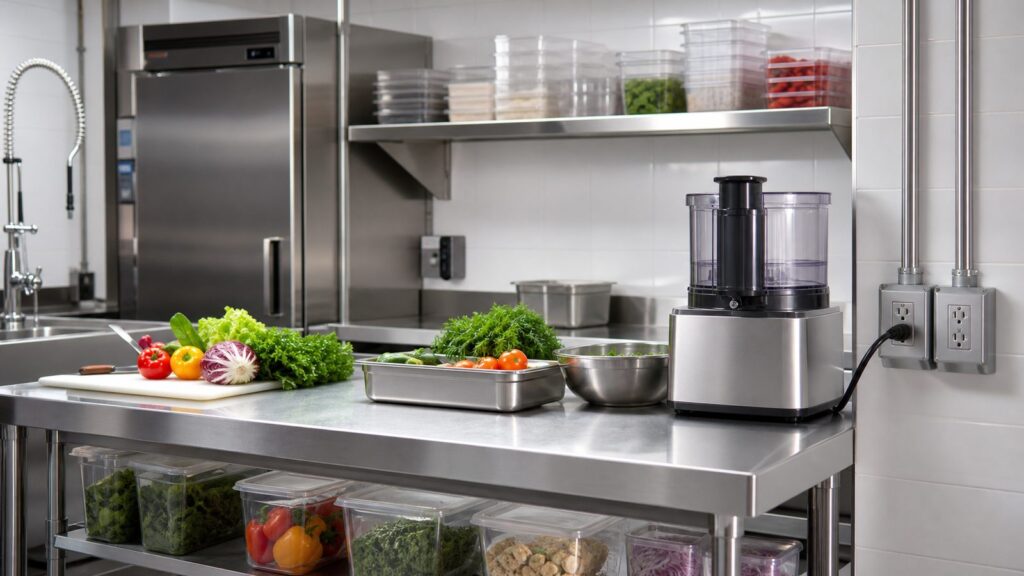
The best commercial food processor is not simply the most expensive machine on the spec sheet. It is the unit that cuts prep labor, survives daily use, cleans quickly, fits the station, meets health-department expectations, and does not create an electrical or workflow problem after the kitchen is built.
For most restaurants, cafes, bars, catering kitchens, and institutional kitchens in 2026, the right shortlist starts with NSF/ANSI-listed commercial-duty equipment from proven lines such as Robot Coupe, Waring, Hobart, Sammic, Vollrath, and similar professional manufacturers. From there, the decision comes down to five practical items: what you prep, how many pounds per day, what cuts you need, what power you have, and where the machine will live.
As an Amazon Associate I earn from qualifying purchases.
On our commercial kitchen projects, we treat food processors as both an operations decision and a construction coordination item. A 120V countertop processor may be a simple plug-in purchase. A larger continuous-feed unit or vertical cutter mixer may require a dedicated circuit, a different receptacle, panel capacity review, stainless worktable planning, splash control, and health-department plan review documentation. The cost of missing those details can be far higher than the cost difference between two machines.
The Tool Desk
Outbyte PC Repair FREERepair Windows errors before they cause bigger problemsFix Now →Outbyte Driver Updater FREEScan for outdated or missing drivers - takes under a minuteDriver Scan →Quick Answer: Best Commercial Food Processor by Kitchen Type
If you need one practical answer, a 3- to 4-quart commercial combination processor is the best all-around choice for many small and mid-size restaurants. It gives you a batch bowl for sauces, dressings, pestos, hummus, chopping, and purees, plus continuous-feed capability for slicing and shredding vegetables. Current 2026 street pricing for this category is commonly around $1,100 to $3,300.
#1 Best Overall

- SUPERIOR FUNCTION: The Cuisinart Food Processor with 720-watt motor functions as a vegetable chopper, blender, and food processer in one. Make any kind of dip, puree soup, or sauce including hummus, salsa, guacamole, and more.
- MUST-HAVE FEATURES: The 14-cup food chopper has “on” and “off/pulse” buttons with an extra-large feed tube with bowl sleeve assembly designed for both small and large feed tube pushers. It also comes with a detachable disc stem for easy clean up.
- INCLUDED ACCESSORIES: This food processor comes with dishwasher-safe parts including a stainless steel standard slicing disc (4mm), medium shredding disc, and stainless steel chopping/mixing blade.
- NOTE TO CONSUMER: The shredding and slicing blades of this electric chopper are not adjustable. Please refer to the manual before setting up.
- LIMITED 3-YEAR WARRANTY: The Cuisinart Food Processor comes with a limited 3-year warranty on the entire unit and a full 5-year warranty on the motor.
For a small cafe, bar, coffee shop, or garnish station, a compact commercial chopper/grinder or 2- to 2.5-quart batch processor may be enough. Expect roughly $350 to $700 for small entry commercial units and about $700 to $1,700 for light-to-mid commercial batch-bowl machines.
For a sandwich shop, salad concept, school kitchen, commissary, caterer, or high-volume prep operation, a dedicated continuous-feed processor usually saves more labor than simply buying a bigger bowl. These units commonly run about $2,000 to $6,700 in 2026, depending on horsepower, feed design, disc package, and production capacity.
For hospitals, central production kitchens, correctional facilities, universities, and commissaries doing large batches, emulsions, or texture-modified foods, a vertical cutter mixer or specialty high-capacity processor may be the correct tool. These machines are often $5,800 to $26,000 or more and must be coordinated early with electrical, equipment layout, and owner training.
The Three Main Types of Commercial Food Processors
Commercial food processors fall into three useful categories. Understanding the category matters more than memorizing model numbers, because each style solves a different kitchen problem.
Batch-Bowl Processors
A batch-bowl processor is the familiar bowl-and-blade machine used for chopping, grinding, pureeing, mixing, dressings, sauces, dips, nut work, and small prep tasks. Common commercial bowl sizes range from compact 0.75-quart chopper/grinders to 2-, 2.5-, 3-, and 4-quart processors.
Batch bowls are strongest when texture control matters. Pesto, chimichurri, hummus, salsa, dressings, marinades, compound butters, bread crumbs, and pastry prep all benefit from a good blade, a stable motor, and a bowl that is easy to scrape and wash. They are not the best answer when the kitchen needs to shred 80 pounds of cabbage or slice cases of onions every morning.
Continuous-Feed Processors
A continuous-feed processor is built for volume slicing, shredding, grating, julienne cuts, and vegetable prep. Instead of stopping after each bowl, the machine discharges into a hotel pan, lug, or bin. For labor-heavy kitchens, this is where the payback often shows up.
Outdated Drivers Are Slowing You Down
One free scan finds every outdated or missing driver and matches the right update for your exact hardware.Free scan · exact hardware matchPC Slower Than It Used to Be?
A free scan shows the junk files, broken settings and background clutter dragging Windows down - then fixes them in one click.Free scan · Windows 10 & 11If two prep cooks spend 45 minutes each day slicing vegetables by hand, that is 3.75 labor hours per week in a five-day operation and more than 350 hours per year in a seven-day kitchen. At $18 to $25 per hour loaded labor cost, a $3,000 to $5,000 continuous-feed unit can be a rational purchase if it removes repetitive prep without compromising quality.
Combination Units
Combination processors include both a batch bowl and a continuous-feed attachment in one countertop footprint. For many independent restaurants, this is the sweet spot. You get sauce and puree capability, plus daily slicing and shredding, without dedicating space and budget to two separate machines.
The tradeoff is setup and cleaning. A combination unit with more parts needs a disciplined wash procedure and organized blade storage. If the parts live loose on a shelf, the kitchen ends up with safety hazards, lost discs, and sanitation problems. We like to see a labeled wall rack, drawer insert, or dedicated covered bin shown directly on the equipment plan.
Rank #2

- Powerful Food Processor: This must-have Cuisinart Food Processor delivers reliable performance with durable design for everyday meal prep. This dishwasher safe electric food processor chops, slices, mixes—and more.
- 11-Cup Food Processor: Our 11-cup food processor offers the perfect size for meal prep, whether in everyday eating or entertaining. This spacious food processor allows you to process vegetables, dough, and more with ease in one efficient bowl
- Multi-Functional: Use this Cuisinart food chopper for everything from slicing vegetables to pureeing sauces. This electric chopper for kitchen provides consistent results, making it a reliable vegetable processor for quick and efficient prep.
- Safe, Mess-Free Operation: Built for convenience, this kitchen food processor includes a durable food processor cover for safe operation and mess-free use. A hallmark of this Cuisinart Pro Custom 11 is its sturdy construction and thoughtful design.
- Trusted Quality from Cuisinart: Known for innovative cookware and kitchen appliances, Cuisinart has been helping home cooks and professionals create exceptional meals with reliable performance and thoughtful design for decades.
Best Commercial Food Processors to Shortlist in 2026
The models below are examples of common, commercially available choices in the current US market. Exact pricing changes by vendor, configuration, accessories, and freight, so treat these as planning numbers rather than final quotes.
| Best Fit | Example Model | Typical 2026 Price | Why It Works | Construction Readiness Notes |
|---|---|---|---|---|
| Small cafe or bar prep | Waring WCG75, 0.75 qt | About $347 | Compact chopper/grinder for garnishes, nuts, spices, sauces, and very small batches. | Usually simple countertop placement. Confirm NSF listing, cleanable counter surface, nearby hand sink and warewashing path. |
| Budget commercial batch work | Waring WFP11SW, 2.5 qt | About $687 | Good entry point for cafes, bakeries, and small restaurants needing commercial-duty chopping and puree work. | Verify 120V circuit capacity and counter clearance. Plan storage for blade and accessories. |
| Mid-size batch processing | Waring WFP16S, 4 qt | About $879 | Larger bowl at a relatively approachable price for prep kitchens with daily sauce, dressing, and chopping tasks. | Check footprint, lid clearance, wash sink size, and whether the counter can stay clean around the base. |
| Value combination unit | Waring WFP16SC combination | About $1,107 | Combines batch-bowl processing with slicing and shredding capability for smaller restaurants. | Confirm disc package, discharge direction, pan height, and blade storage location before final layout. |
| Restaurant workhorse | Robot Coupe R2N / R2N Ultra | About $1,699 to $2,142 depending configuration | Common professional choice for independent restaurants needing a durable 3-quart class processor. | Ask for the cut sheet before purchase. Confirm voltage, plug, footprint, bowl clearance, NSF listing, parts support, and local service. |
| Dicing and combination prep | Robot Coupe R301 Dice combination | About $3,263 | Useful when consistent dice, slicing, shredding, and bowl processing all matter. | Coordinate accessory storage, cleaning procedure, operator training, and dedicated prep table space. |
| High-volume vegetable prep | Robot Coupe CL52E continuous-feed | About $4,319 | Built for volume slicing and shredding in salad, sandwich, catering, and institutional kitchens. | Mock up feed direction and discharge bin. Verify electrical requirements, clear working space, and noise impact. |
| Heavy-duty continuous feed | Hobart FP41-1 | About $3,758 | Strong candidate for kitchens that value heavy-duty construction and service support. | Confirm receptacle, amperage, counter or stand, cleaning clearance, and local Hobart service access. |
| Large-batch production | Hobart HCM450-3 vertical cutter mixer | About $26,399 | Production-scale machine for commissary, healthcare, education, and central kitchens. | Likely requires serious electrical coordination, floor or table planning, staff training, and preventive maintenance setup. |
For many owners, the best overall choice is not the largest machine. It is often a 120V commercial combination unit with the right discs and a reliable parts pipeline. That keeps the installation simpler while still removing a large amount of repetitive prep work.
How to Size a Commercial Food Processor
Start with the prep list, not the catalog. Before buying, write down what the kitchen actually processes in a normal week. Include pounds per day of onions, cabbage, lettuce, carrots, potatoes, cheese, herbs, nuts, sauces, doughs, purees, dressings, and garnishes. Then separate those tasks into batch work and continuous-feed work.
A 2- to 3.5-quart batch-bowl unit is usually enough for a small cafe, dessert shop, coffee shop kitchen, tasting room, or bar that makes sauces and small prep items. A 3- to 4-quart combination unit fits many restaurants that prep vegetables daily but are not processing case after case all morning. A dedicated continuous-feed unit becomes more attractive when prep volume is measured in full produce cases, not a few hotel pans.
Do not size only by horsepower. A 1 HP machine with the right bowl, blade, feed opening, and disc package may outperform a larger-looking unit that is awkward to clean or poorly matched to the menu. Bowl geometry, feed chute shape, duty cycle, available discs, replacement parts, and service support all matter.
Do these 3 things before closing this tab:
1Repair Windows errors before they cause bigger problems2Scan for outdated or missing drivers - takes under a minute3Clear out junk files and repair common Windows errorsWe also look at the operator. If the cook has to carry produce across the line, fight a low shelf, empty a bowl every 45 seconds, or walk ten steps to the sink after every batch, the machine will not deliver the labor savings promised in the brochure. A good prep station has produce storage, cutting board space, trash or compost, the processor, discharge pan, hand sink access, and warewashing flow all in a logical sequence.
2026 Cost Guide: Equipment, Installation, and Buildout Impact
Commercial food processor pricing is only one piece of the budget. In a finished kitchen with compliant power and counter space, installation may be minor. In a remodel, the same purchase can trigger electrical work, stainless table changes, new shelving, or health-department documentation.
| Category | Typical 2026 Cost | Best For | Watch For |
|---|---|---|---|
| Entry commercial chopper/grinder | $350-$700 | Bars, cafes, garnish prep, sauces, nuts, small batches | Small bowl, limited throughput, fewer cut options |
| Light-to-mid commercial batch processor, 2-3.5 qt | $700-$1,700 | Cafes, bakeries, small restaurants, sauce and puree prep | May not solve high-volume slicing or shredding labor |
| Combination batch bowl plus continuous feed, 3-4 qt | $1,100-$3,300 | Restaurants needing both bowl processing and vegetable prep | More parts to store, clean, inspect, and train staff on |
| Dedicated continuous-feed processor | $2,000-$6,700 | Salad, sandwich, catering, school, commissary, institutional kitchens | Needs planned discharge space, disc storage, and workflow coordination |
| Vertical cutter mixer or specialty processor | $5,800-$26,000+ | Central production, healthcare, education, large-batch processing | Electrical requirements, space, service access, and training are significant |
For context, complete commercial kitchen buildouts in 2026 are often quoted around $250 to $500 per square foot, commonly excluding equipment purchases. Restaurant buildouts vary widely: a second-generation restaurant space may land around $125 to $250 per square foot, while cold-shell or flagship projects can run $350 to $650 or more per square foot depending on the market, utility work, finishes, hood systems, walk-ins, and site conditions.
Commercial kitchen equipment budgets commonly range from about $40,000 to $200,000 for many restaurants. Full-service, high-volume, or specialty kitchens can reach $500,000 or more when hoods, walk-ins, dish systems, cooking lines, refrigeration, and specialty prep equipment are included. Against that backdrop, a $1,500 to $4,500 processor is not usually the biggest equipment line item, but it can have an outsized effect on labor and station efficiency.
What’s actually slowing this PC down?
Pick the symptom - the matching free tool is one click away.
Construction Readiness Checklist Before You Buy
Before an owner purchases a commercial processor, we want the equipment cut sheet in the hands of the general contractor, electrician, kitchen designer, and health-department reviewer. This is a small step that prevents a surprising number of field problems.
Rank #3

- POWERFUL PERFORMANCE: Equipped with a 1000-peak-watt motor, this Ninja food processor effortlessly handles tough ingredients, ensuring smooth and consistent results every time.
- AUTO-IQ TECHNOLOGY: Features 4 Auto-iQ intelligent preset programs that take the guesswork out of food prep, providing one-touch control for chopping, slicing, pureeing, and dough making.
- LARGE CAPACITY: The 9-cup bowl is perfect for large batches, making it ideal for family meals, entertaining, or weekly meal prep, saving you time and effort in the kitchen.
- PRECISION BLADES: Includes stainless steel precision blades designed for optimal performance, ensuring even chopping, slicing, and pureeing of all your ingredients.
- DOUGH BLADE INCLUDED: Comes with a specialized dough blade that makes mixing dough for bread, pizza, and pastries a breeze, delivering professional-quality results at home.
Confirm Electrical Requirements
Many countertop commercial food processors run on 120V single-phase power. That is helpful in remodels because it may avoid new 208V, 240V, or three-phase work. Larger continuous-feed units and vertical cutter mixers may require 208-240V or 460V three-phase power, dedicated circuits, special plugs, GFCI protection where required, and panel capacity checks.
In older kitchens, never assume an existing receptacle is suitable just because a plug fits. We often find small-appliance circuits that have been expanded over time without good documentation. A processor sharing a circuit with microwaves, merchandisers, blenders, warmers, or refrigeration can become a nuisance-trip problem during service.
Check Footprint, Height, and Clearance
Measure the machine footprint, full operating height, feed chute height, lid swing, bowl removal path, and discharge direction. Then compare that against the actual table, wall shelf, sneeze guard, upper cabinet, or pass-through above it. A machine that technically fits on the counter may still be miserable to use if the operator cannot load product naturally.
Free tools Windows power users keep installed
One-click scans. No signup required.
For continuous-feed units, plan the receiving pan or lug. The discharge height should work with common containers in the kitchen, not just the one shown in a catalog photo. If the processor discharges into a pan that is too low, unstable, or constantly overfilled, staff will work around the setup and lose the labor savings.
Plan Blade and Disc Storage
Sharp discs and blades need dedicated storage. This is a safety issue, a sanitation issue, and an inventory issue. Specify a wall-mounted rack, labeled drawer insert, covered container, or manufacturer storage box on the equipment plan. Loose blades in a dish pit or on a wire shelf are a cut hazard and a fast way to lose expensive accessories.
Coordinate Cleaning and Warewashing
The processor must break down and move through the kitchen’s cleaning process without crossing dirty and clean flows in a sloppy way. Confirm that bowls, lids, pushers, blades, discs, and attachments fit in the warewashing setup and that staff have a daily inspection checklist. Food-contact parts should be durable, smooth, cleanable, and used according to the manufacturer’s instructions.
Sanitation, NSF Listing, and Health-Department Notes
For a permitted food establishment, buy commercial-grade equipment and verify the listing for the specific model. NSF/ANSI 8 is the key sanitation standard category for commercial powered food-preparation equipment, including powered prep equipment such as grinders, mixers, slicers, peelers, and related machines. Do not rely on brand reputation alone; confirm the actual model and configuration.
The FDA Food Code is model guidance that state and local jurisdictions adopt and modify. In practice, local health departments commonly expect equipment in commercial kitchens to be durable, cleanable, food-contact-safe, and appropriate for the intended use. Residential processors are usually the wrong choice for a permitted commercial kitchen, even if the kitchen only runs light prep.
A food processor by itself usually does not create grease-laden vapor, so it typically does not trigger a Type I hood on its own. That does not mean placement is irrelevant. The station still needs to work with prep sinks, hand sinks, refrigerated storage, dishwashing flow, cleanable surfaces, splash zones, and food-contact surface rules.
For new kitchens and substantial remodels, include the processor on the equipment schedule submitted for plan review. List the manufacturer, model, voltage, phase, amperage, NSF or sanitation listing, location, and whether it is countertop, table-mounted, or floor-supported. That documentation helps reduce comments during review and prevents late changes after rough-in.
Rank #4

- ✅ Limitless Speed Control – Adjust speed freely from 1000 to 2500 RPM for precise cutting, chopping, stirring, and rubbing of various foods.
- ✅ Patented Stainless Steel Blade – Specially designed blade ensures efficient, smooth, and consistent food processing with enhanced durability.
- ✅ High-Quality Stainless Steel Construction – Entire machine made from food-grade stainless steel for longevity, hygiene, and easy cleaning.
- ✅ Dual Safety Protection & User-Friendly Design – Safe to operate with added protection features; allows you to add food while the machine is running.
- ✅ Ideal for Commercial Use – Perfect for cafeterias, canteens, hotels, and large kitchens processing vegetables, meat, bread, and more.
Workflow: Where the Processor Should Live
The best processor location is usually near produce receiving or refrigerated prep storage, close to a prep sink and worktable, with a short path to warewashing. It should not be squeezed into the cooking line just because there is an unused outlet. Food processors are prep tools. Put them where prep actually happens.
Quick wins for a faster PC:
Clear out junk files and repair common Windows errorsFree Scan →Scan for outdated or missing drivers - takes under a minuteDriver Scan →For a restaurant kitchen, we typically look for a stainless work surface at comfortable standing height, enough landing space on both sides, a nearby waste or compost container, and a clear path for clean containers. In a compact kitchen, a 24-inch by 48-inch stainless table may be enough for a small or mid-size processor. Higher-volume continuous-feed work may need a larger table, a mobile equipment stand, or dedicated produce prep area.
Open kitchens, cafes, schools, and healthcare settings also need a noise and vibration check. A heavier, smoother-running processor may cost more, but it can be worth it if the alternative is a machine that shakes the counter or disrupts guests, students, patients, or front-of-house staff. Rubber feet, stable tables, and proper surface selection help, but they do not fix a machine that is wrong for the environment.
Independent reader supportYour contribution helps us test, update, and keep practical guides available for everyone.When to DIY vs. When to Hire a Pro
A simple purchase can be handled in-house when the processor is a listed 120V countertop unit, the existing receptacle is compliant and not overloaded, the counter is stable and cleanable, the health department does not require a revised equipment plan, and staff can safely clean and store all parts. In that case, the owner or kitchen manager can usually buy the machine, document the manual and warranty, train staff, and add it to the cleaning checklist.
Hire a licensed electrician when the machine needs a new dedicated circuit, a different receptacle, GFCI protection, 208-240V service, three-phase power, or panel capacity verification. Electrical work in a commercial kitchen is not a good place for improvisation. Water, stainless surfaces, staff traffic, and continuous equipment use raise the stakes.
Recommended Free Tools
Bring in a general contractor, kitchen designer, or foodservice equipment consultant when the processor affects the prep station layout, stainless worktables, wall blocking, shelving, plumbing clearances, health-department plan review, or construction schedule. For remodels, coordination matters because even a small equipment change can collide with existing tile, FRP, outlets, drainboards, hand sinks, or traffic lanes.
For new restaurants, commissaries, schools, healthcare kitchens, and high-volume production spaces, the processor should be selected during design, not after final inspection. The right time to catch power, clearance, and workflow issues is before rough-in, not after the owner has already bought a machine and the electrician has already closed the walls.
Buying Checklist for Owners and Project Teams
Use this checklist before issuing a purchase order. It is the same practical review we use when equipment choices affect a commercial kitchen buildout.
- Menu fit: List actual foods, pounds per day, cut types, batch sizes, and peak prep windows.
- Processor type: Choose batch bowl, continuous feed, combination, or vertical cutter mixer based on the work, not the catalog category.
- Capacity: Confirm bowl size, feed opening, discharge method, duty cycle, and production rate.
- Electrical: Verify voltage, phase, amps, plug type, dedicated circuit needs, GFCI requirements, and panel capacity.
- Sanitation: Confirm NSF/ANSI listing or equivalent commercial sanitation certification for the exact model.
- Footprint: Check width, depth, operating height, lid clearance, feed direction, discharge path, and service access.
- Cleaning: Confirm part removal, wash procedure, warewashing fit, daily inspection tasks, and drying/storage method.
- Accessories: Confirm included discs, optional discs, dicing kits, replacement blades, pushers, bowls, lids, and lead times.
- Storage: Provide safe, labeled storage for blades and discs in the kitchen plan.
- Service: Check warranty, local service availability, replacement-part availability, and expected downtime if a key part fails.
Common Mistakes That Cost More Later
The most common mistake is buying a processor too late. If the owner waits until after construction to choose equipment, the kitchen may have the wrong outlet, no landing space, poor clearance, or no safe accessory storage. Fixing those items after turnover is more expensive and more disruptive than coordinating them during design.
The second mistake is buying for bowl size when the real bottleneck is slicing or shredding. A larger batch bowl will not solve high-volume vegetable prep as efficiently as a continuous-feed processor. Conversely, a powerful continuous-feed unit will not replace a well-matched bowl processor for sauces, emulsions, and fine texture control.
Best Value

- Multi-Functional Food Processor: This food processor offers 2 size of feeding holes to adapt to different sizes of vegetables, 6 kinds of detachable cutting disks are included, including H3 (3mm shred), H4 (4mm shred), 2 x H7 (7mm shred), P2 (2mm slice), P4 (4mm slice), to meet your different demands.
- Assuring Materia: This fruit and vegetable cutter is made of food-grade stainless steel and high-quality cast aluminum alloy with silver anodized surface. The rubber feet ensure stability during operating.
- Powerful Performance: This food cutter is equipped with a 550w high-efficient motor,with high rotation speed of 1600r/min. The rotation speed of cutting disks is able to reach 270r/min, highly improving your cutting efficiency.
- Considerate Details: The non-slip rubber feet ensures stability; The transparent cover of ON/OFF switch guarantees safety during cleaning; an extra feeding bar effectively protects your fingers from injury; magnetic safety switch automatically stops as hopper is opened.
- Versatile Cutting: This vegetable slicer and dicer is suitable for cutting various of vegetables, fruits and cheese, such as lettuce, cabbage, slicing onions and shredding cheese.
The third mistake is ignoring parts and service. A processor is only useful if the kitchen can get bowls, lids, blades, discs, seals, and switches when they wear out. For daily-use equipment, local service support and parts availability should carry real weight in the decision.
The fourth mistake is treating cleaning as an afterthought. If a machine is slow to disassemble, hard to wash, awkward to dry, or missing proper storage, staff may avoid using it or clean it inconsistently. That creates sanitation risk and reduces the return on the purchase.
Our Bottom Line
For many small and mid-size commercial kitchens, the best commercial food processor is a 120V, NSF-listed, 3- to 4-quart combination unit with a durable bowl, useful disc package, available replacement parts, and a station designed around actual prep flow. It offers the best balance of capability, installation simplicity, and labor savings.
Recommended Free Tools
For high-volume vegetable prep, move up to a dedicated continuous-feed processor. For central production, healthcare, schools, and commissaries, evaluate vertical cutter mixers or specialty processors early in design. In every case, get the cut sheet before purchase, verify the model listing, coordinate electrical requirements, and make sure the machine has a clean, safe, logical home in the kitchen.
A commercial food processor should make the kitchen faster without making the building harder to operate. When the equipment choice, construction details, and daily cleaning procedure line up, the machine pays for itself in labor savings, consistency, and fewer prep-line headaches.
Frequently Asked Questions
What size commercial food processor do most restaurants need?
Many small and mid-size restaurants do well with a 3- to 4-quart combination processor. It handles sauces and purees in the bowl and slicing or shredding through the continuous-feed attachment. High-volume salad, sandwich, catering, and commissary kitchens may need a dedicated continuous-feed unit instead.
How much does a commercial food processor cost in 2026?
Entry commercial chopper/grinders are commonly about $350-$700. Light-to-mid batch processors run about $700-$1,700. Combination units are often $1,100-$3,300. Dedicated continuous-feed processors commonly cost $2,000-$6,700, while large vertical cutter mixers can reach $5,800-$26,000 or more.
Does a commercial food processor need a hood?
Usually no. A food processor generally does not create grease-laden vapor, so it typically does not require a Type I hood by itself. Placement still needs to satisfy local health-department expectations for cleanable surfaces, prep flow, sinks, splash control, and food-contact equipment.
Can I use a residential food processor in a commercial kitchen?
For a permitted food establishment, that is usually a bad choice and may not pass local review. Commercial kitchens should use durable, cleanable, commercial-grade equipment with the proper sanitation listing for the specific model.
Do commercial food processors need special electrical work?
Many countertop units use 120V single-phase power, but larger continuous-feed processors and vertical cutter mixers may require 208-240V or 460V three-phase power, dedicated circuits, GFCI protection where required, and panel capacity review.
What should be included in the closeout package for a commercial food processor?
Include the manual, warranty, parts list, cleaning procedure, daily inspection checklist, accessory inventory, blade and disc storage plan, electrical information, and service contact. Staff training should cover safe assembly, operation, washing, drying, and storage.
Quick wins for a faster PC:
Fix the driver behind crashes, sound loss and screen glitchesFind Drivers →Repair Windows errors before they cause bigger problemsFix Now →Quick Recap
Product prices and availability are accurate as of the date/time indicated and are subject to change. Any price and availability information displayed on Amazon at the time of purchase will apply.

