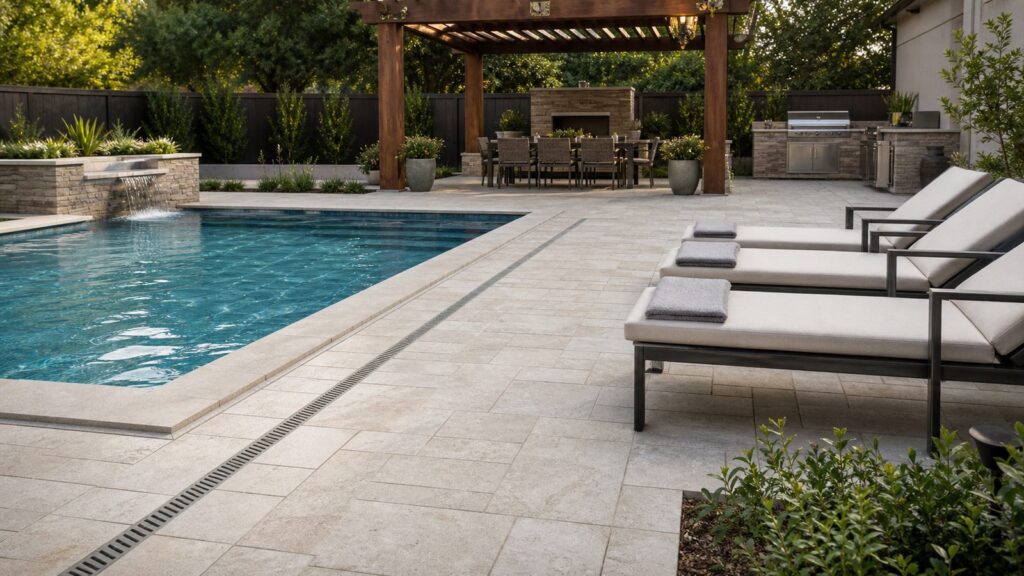
A good pool patio should look clean, feel comfortable under bare feet, drain correctly, and hold up to water, sun, chemicals, furniture, and foot traffic. The best design is not always the most expensive material. It is the one that fits your climate, pool type, yard slope, maintenance expectations, and budget.
For 2026, most professionally installed pool patios fall somewhere between $6 and $45+ per square foot, depending on whether you choose plain concrete, stamped concrete, pavers, porcelain, travertine, natural stone, or a raised wood/composite deck. Outdoor living features can change the budget quickly: a mid-size outdoor kitchen commonly runs $13,000 to $36,000, an installed fire pit can run $4,000 to $14,000, and shade structures, retaining walls, lighting, drainage, coping, and electrical work can all add real cost.
As an Amazon Associate I earn from qualifying purchases.
On our job sites, we start with function before finishes. Where will the loungers go? How will water leave the patio? Where do gates swing? Does the pool cover need clearance? Will the surface be too hot in August? Can the deck be bonded properly around the pool? Those answers shape the patio long before color samples do.
Do these 3 things before closing this tab:
1Clear out junk files and repair common Windows errors2Fix the driver behind crashes, sound loss and screen glitches3Repair Windows errors before they cause bigger problemsPool Patio Planning Rules That Matter Before You Pick a Material
A pool patio is not just decorative hardscape. It has to manage wet bare feet, chlorine or salt exposure, heat, movement between the pool shell and surrounding deck, stormwater, barriers, and often electrical bonding requirements near the water.
#1 Best Overall

- Timely Drainage Of Ground Water: Drainage ditch collects ground water and drains it in time. It is suitable for the renovation and construction of drainage systems such as swimming pools, decks, concrete, paving stones, terraces, sidewalks, garage doors, courtyards, and both sides of houses
- Specifications: 1-1/4" wide (12 pc 3.3 ft. Sections) Total: 39.3 ft. per Carton, pool drain has a flow rate of 4.3 GPM per linear foot. 1.4 square inches per linear foot. , When properly installed, it can withstand a pressure of no less than 600 pounds - recommended for pedestrian, single-car garage door, pool deck drains
- Stainless Steel Deck Drain Kit: Deck drain kit is made of a 0.88 mm Thick 304 stainless steel plate that is punched, punched, and bent. It has strong load-bearing, high durability, long service life, and can efficiently and long-lasting collect water on the ground
- Cleaning & Maintenance: Drainage trench is designed in a split style, and the top cover is detachable. When cleaning, you can easily clean it by removing the top cover and using a high-pressure water gun
- Connection of Channel Drains System: Each trench drain system is equipped with connection accessories, and you need to prepare the waterproof glue for construction; the store provides customized options such as right angles, tees, crosses, ports and ports with outlets
A practical sizing rule is to plan patio square footage roughly equal to the pool surface area for basic circulation and lounging. A 15-by-30-foot pool has 450 square feet of water surface, so a basic patio often starts around 450 square feet. If you want dining, grilling, umbrellas, a fire feature, or a cabana, plan more space. Four chaise lounges usually need a zone about 10 by 12 feet at minimum. A dining table with chairs needs roughly 10 to 12 feet in diameter so people can pull chairs out without backing into the pool edge.
Most pool patios should slope away from the pool, house, and structures. A common target is about 1/8 to 1/4 inch per foot, adjusted for the material and local code. Poor drainage causes ponding, algae, settlement, slippery surfaces, staining, and freeze-thaw damage. If the yard is flat, the solution may be a deck drain, channel drain, permeable paver area, dry well, or stormwater tie-in where allowed.
Before construction, check permit requirements for zoning setbacks, pool barriers, self-closing gates, electrical/GFCI work, equipotential bonding, gas lines, drainage changes, retaining walls, roofed structures, outdoor kitchens, HOA rules, and impervious-surface limits. Many jurisdictions require barriers around residential pools and electrical bonding around conductive parts and deck areas near the pool. Your local code office has the final say.
What’s actually slowing this PC down?
Pick the symptom - the matching free tool is one click away.
2026 Pool Patio Cost Comparison
These are broad installed U.S. ranges. Access, demolition, base depth, soil conditions, drainage, coping, stairs, curves, and regional labor can move a project above or below these numbers.
| Pool Patio Material or Feature | Typical 2026 Installed Cost | Best For | Maintenance Level |
|---|---|---|---|
| Plain or broom-finish concrete | $6-$18+ per sq. ft. for pool decks; plain patios often $4-$12 | Clean, budget-conscious patios | Low to moderate |
| Stamped or decorative concrete | $8-$30 per sq. ft. | Patterned look with monolithic slab | Moderate; sealer matters |
| Concrete pavers | $10-$35 per sq. ft.; premium pool pavers often $16-$40 | Repairable patios, freeze-thaw areas | Moderate |
| Porcelain pavers | Often premium paver pricing, commonly $16-$40+ per sq. ft. | Modern, low-maintenance patios | Low |
| Travertine | $15-$45+ per sq. ft. | Cooler-feeling resort-style decks | Moderate |
| Natural stone | About $16-$35 per sq. ft.; some stone higher | Custom, high-end landscapes | Moderate to high |
| Wood or composite raised deck | Often $35-$75 per sq. ft. | Above-ground pools and sloped yards | Moderate |
| Outdoor kitchen add-on | $13,000-$36,000 mid-size range | Full entertaining layouts | Moderate |
| Installed fire pit | $4,000-$14,000 | Evening seating away from splash zones | Low to moderate |
16 Beautiful Pool Patio Designs and Ideas
1. Light Travertine Resort Patio
Travertine is a favorite around pools because lighter colors tend to feel more comfortable in full sun than dark concrete, bluestone, or black pavers. A French pattern or large-format ashlar layout gives the patio a relaxed resort look without feeling busy.
Best for: sunny climates, saltwater pools, Mediterranean or coastal homes. Cost tier: high, commonly $15-$45+ per square foot. Maintenance: moderate; expect periodic cleaning, joint care, and sealing depending on finish and climate.
Construction note: choose a textured, pool-appropriate finish and test samples wet and hot before signing off. Coordinate the coping and field stone together so the pool edge feels intentional and comfortable.
Free tools Windows power users keep installed
One-click scans. No signup required.
2. Broom-Finish Concrete With a Saw-Cut Grid
This is one of the most practical pool patio designs when the budget needs discipline. A light broom finish provides traction, and saw-cut joints can be laid out in a clean grid so the slab looks designed rather than merely poured.
Best for: modern, farmhouse, and transitional homes. Cost tier: low to medium, often $6-$18+ per square foot for pool deck applications. Maintenance: low; clean regularly and manage cracks promptly.
Construction note: joint layout matters. We like to align saw cuts with pool corners, steps, coping breaks, and architectural lines whenever possible. Random cuts make even expensive concrete look careless.
3. Stamped Concrete With a Textured Sealer
Stamped concrete can mimic stone, slate, or pavers at a lower cost than many premium materials. Around pools, the key is traction. A glossy sealer may look good when dry but become slick when wet.
Best for: homeowners who want pattern and color without individual units. Cost tier: medium, commonly $8-$30 per square foot. Maintenance: moderate; resealing is part of ownership.
Construction note: ask for a slip-resistant additive in the sealer and avoid overly dark colors in full sun. Stamped concrete is harder to repair invisibly than pavers, so base prep and control joints are critical.
4. Large-Format Porcelain Pavers
Porcelain pavers create a crisp, modern patio with strong stain resistance and consistent color. They work especially well with rectangular pools, straight coping lines, glass fencing, and minimalist planting.
Best for: modern homes, small courtyards, and low-maintenance outdoor rooms. Cost tier: medium to high, often in the premium paver range of $16-$40+ per square foot. Maintenance: low.
Rank #2

- Clark Concrete Forms
Construction note: use exterior-rated, slip-resistant porcelain pavers made for pool environments. Large units demand a very well-prepared base, accurate grades, and careful edge detailing.
5. Concrete Pavers in Herringbone or Running Bond
Concrete pavers remain one of the most flexible choices for pool patios. They can handle movement better than a monolithic slab, individual units can be replaced, and patterns like herringbone add texture without relying on high contrast.
Best for: freeze-thaw regions, expansive soils, and family pools. Cost tier: medium, commonly $10-$35 per square foot. Maintenance: moderate; joints and edge restraints need attention over time.
Construction note: the base is the job. A properly compacted, well-drained base and solid edge restraint matter more than the paver color. Around pools, also coordinate coping height and paver thickness carefully.
Crashes, No Sound, or Screen Glitches?
Random freezes, missing sound and display glitches usually trace back to one bad driver. Find and replace yours safely.Free scan · under a minuteWindows Errors? Fix Them Before They Spread
Repair common Windows errors and clear accumulated junk for a smoother, more stable PC - no reinstall needed.Free scan · no reinstall6. Turf-Grid Paver Patio
Turf-grid pavers soften the hardscape and can reduce the visual mass of large pool decks. They work best as accent zones, side yards, or transition areas rather than the main splash-heavy walking surface.
Best for: modern landscapes, small lots, and drainage-conscious designs. Cost tier: medium. Maintenance: moderate to high if living turf is used; synthetic turf lowers watering but still needs cleaning.
Construction note: use this design where bare feet will not constantly drag wet grass or infill into the pool. It needs a stable base and drainage layer, not just pavers set into soil.
7. Flagstone Natural-Edge Patio
Flagstone gives a pool area an organic, garden-like character. Irregular pieces pair well with freeform pools, boulder edges, native planting, and wooded lots.
The Tool Desk
Outbyte PC Repair FREEClear out junk files and repair common Windows errorsFree Scan →Outbyte Driver Updater FREEScan for outdated or missing drivers - takes under a minuteDriver Scan →Best for: natural pools, rustic homes, and informal landscapes. Cost tier: high, with natural stone patios often around $16-$35 per square foot. Maintenance: moderate to high.
Construction note: avoid sharp edges, uneven lippage, and wide joints where bare feet will travel. Around pools, smoother is not always safer; the surface still needs wet traction.
8. Bluestone Lounge Terrace
Bluestone creates a refined terrace with strong architectural presence. Thermal-finish bluestone is more appropriate around pools than slick polished stone, and rectangular patterns can make a lounge zone feel tailored.
Best for: traditional, colonial, and high-end landscape designs. Cost tier: high; bluestone examples commonly fall around $15-$31 per square foot, with complex work higher. Maintenance: moderate.
Recommended Free Tools
Construction note: bluestone can get hot in direct sun, especially darker pieces. Use lighter selections where possible, provide shade, and consider reserving darker stone for borders or shaded areas.
9. Raised Spa and Spillway Patio
A raised spa with a spillway creates a focal point and gives the patio a strong organizing feature. The surrounding patio should give people space to sit near the spa without blocking circulation around the pool.
Best for: entertainment-focused backyards and pools with evening use. Cost tier: high. Maintenance: moderate to high because pumps, plumbing, tile, coping, and water features all need service access.
Rank #3

- Timely Drainage Of Ground Water: Drainage ditch collects ground water and drains it in time. It is suitable for the renovation and construction of drainage systems such as swimming pools, decks, concrete, paving stones, terraces, sidewalks, garage doors, courtyards, and both sides of houses
- Specifications: 1-1/4" wide (6 pc 3.3 ft. Sections) Total: 19.6 ft. per Carton, pool drain has a flow rate of 4.3 GPM per linear foot. 1.4 square inches per linear foot. , When properly installed, it can withstand a pressure of no less than 600 pounds - recommended for pedestrian, single-car garage door, pool deck drains
- Stainless Steel Deck Drain Kit: Deck drain kit is made of a 0.88 mm Thick 304 stainless steel plate that is punched, punched, and bent. It has strong load-bearing, high durability, long service life, and can efficiently and long-lasting collect water on the ground
- Cleaning & Maintenance: Drainage trench is designed in a split style, and the top cover is detachable. When cleaning, you can easily clean it by removing the top cover and using a high-pressure water gun
- Connection of Channel Drains System: Each trench drain system is equipped with connection accessories, and you need to prepare the waterproof glue for construction; the store provides customized options such as right angles, tees, crosses, ports and ports with outlets
Construction note: plan equipment access and noise control early. A beautiful spillway loses its appeal if the equipment pad is cramped, loud, or impossible to service.
Quick wins for a faster PC:
Fix the driver behind crashes, sound loss and screen glitchesFind Drivers →Repair Windows errors before they cause bigger problemsFix Now →10. Tanning Ledge Plus Chaise Zone
A tanning ledge inside the pool works best when the patio outside the pool supports the same use. Plan a dedicated chaise zone with umbrella sleeves, side tables, towel storage, and circulation behind the chairs.
Best for: resort-style lounging and families with young children. Cost tier: medium to high, depending on patio material. Maintenance: low to moderate.
Construction note: allow at least 3 feet of clear walkway where people pass behind loungers, and more if this is a main route to the house or gate. Furniture should be drawn on the plan at real size.
11. Outdoor Kitchen Pool Patio
An outdoor kitchen turns a pool deck into a full outdoor living area, but it should not sit where wet traffic constantly crosses in front of the grill. Keep cooking zones close enough to the house for convenience but far enough from the pool edge for safety and comfort.
Best for: frequent entertaining. Cost tier: high; mid-size outdoor kitchens commonly run $13,000-$36,000. Maintenance: moderate.
Construction note: utilities drive the design. Gas, electric, water, drainage, lighting, GFCI protection, appliance clearances, and counter overhangs need to be planned before the patio is installed.
12. Covered Cabana or Pergola Edge
Shade changes how a pool patio performs. A cabana, pavilion, or pergola gives people a dry zone for seating, towels, drinks, and phones, while also making the yard usable during peak sun.
Best for: hot climates and all-day pool use. Cost tier: medium to high depending on structure. Maintenance: moderate.
Construction note: roofed structures may trigger permits, setbacks, wind requirements, footings, and drainage details. In coastal and storm-prone regions, use corrosion-resistant hardware and wind-rated construction where required.
13. Fire Pit Conversation Zone Away From Splash Areas
A fire pit can work near a pool, but not at the edge of the splash zone. Set it off to the side with its own seating area so wet swimmers are not crossing through flames, furniture, or glassware.
Best for: evening use and shoulder-season entertaining. Cost tier: medium to high; installed fire pits commonly run $4,000-$14,000. Maintenance: low to moderate.
Construction note: check gas line permits, clearances from structures, overhead features, fencing, and plantings. If using pavers, plan the fire feature base and seating layout with the patio grid.
14. Compact Plunge-Pool Courtyard
A plunge pool does not need a huge patio to feel luxurious. In a small yard, use one consistent paving material, built-in seating, vertical planting, and a clear path from the house to the water.
Best for: urban lots, townhomes, and small backyards. Cost tier: medium to high per square foot because small projects still need mobilization, drainage, coping, and utility coordination. Maintenance: low to moderate.
Rank #4

- Premium 304 Stainless Steel – Built to Last Say goodbye to brittle PVC drains that crack and discolor. Made from heavy-duty 306 stainless steel plate that is punched, punched, this pool deck drain resists rust, corrosion, and fading, ensuring long-lasting strength and elegance even in chlorine, rain, and sun exposure.
- Easy Installation with Coupling Included This deck drainage system is simple to install and an included coupling. You need to prepare the waterproof glue for construction; Facoba provides customized options such as right angles, tees, crosses, ports and ports with outlets.If necessary, please contact the after-sales team
- Sleek, Modern Look for Luxury Outdoors Upgrade your pool deck, patio, or courtyard with a polished stainless steel finish that blends seamlessly with stone, tile, or concrete.This outdoor channel pool drain can withstand a pressure of no less than 602 pounds,this trench drain adds a touch of sophistication to any residential or commercial outdoor area.
- Low Maintenance, Easy Cleaning Tired of clogged drains? Drainage trench is designed in a split style, and the top cover is detachable Easy to clean and remove debris quickly and easily, making maintenance simple, Spend less time worrying about drainage and more time enjoying your outdoor living space.
- Versatile Applications – Beyond the Pool Deck Perfect not only for pool decks but also for patios, walkways, driveways, courtyards, and paver landscapes. Wherever water needs to be redirected, this stainless steel channel drain delivers professional-grade performance and style.
Construction note: every inch matters. Confirm gate swing, equipment access, pool cover clearance, storage, and furniture dimensions before construction begins.
15. Above-Ground Pool Wraparound Deck
A wraparound deck can make an above-ground pool feel integrated into the yard instead of temporary. Wood and composite decking also solve elevation changes where a flat patio would not meet the pool wall comfortably.
Free tools Windows power users keep installed
One-click scans. No signup required.
Best for: above-ground pools and sloped sites. Cost tier: high for professional work, often $35-$75 per square foot. Maintenance: moderate, especially with wood.
Construction note: this is structural work. Footings, guardrails, stairs, lateral bracing, gate hardware, and pool access panels must be designed correctly. Do not bury service access behind framing.
16. Multi-Level Patio for a Sloped Yard
Sloped yards can become excellent pool settings when the patio is broken into levels: a pool deck, a lounge terrace, a dining level, and possibly a lower fire area. This avoids one large retaining wall and creates distinct outdoor rooms.
Best for: hillside lots and yards with walkout basements. Cost tier: high. Maintenance: moderate.
Construction note: retaining walls, stairs, railings, drainage, and soil conditions are the project. Expect engineering or permit review when walls exceed local height thresholds or support surcharge loads near the pool.
Independent reader supportYour contribution helps us test, update, and keep practical guides available for everyone.How to Choose the Right Pool Patio Material
Start with climate. In hot Sunbelt yards, lighter travertine, light concrete, and light porcelain or concrete pavers usually feel better underfoot than dark stone. In freeze-thaw regions, segmented systems such as pavers can be easier to repair if movement occurs. In coastal areas, salt air makes hardware, fasteners, lighting, and metal shade structures part of the durability conversation.
Next, think about repairability. A cracked decorative concrete slab can be difficult to patch invisibly. Pavers and many stone systems allow individual units to be lifted and reset if settlement occurs. That does not make pavers automatically better, but it does change the long-term risk.
Then evaluate traction. Any sample should be tested wet. Sealed concrete, smooth stone, polished-looking porcelain, and dark dense materials can become slippery or hot. Around pools, texture is not a decorative afterthought; it is a safety feature.
Finally, match the material to the coping. The coping is the edge your feet, hands, pool cover, and waterline all interact with. It needs the right overhang, profile, movement joint, and finish. A patio can look expensive and still feel wrong if the coping detail is uncomfortable or visually mismatched.
Layout Details That Separate Good Pool Patios From Expensive Mistakes
Plan the furniture before the hardscape. Draw loungers, umbrellas, dining chairs, side tables, storage boxes, grill doors, and gates at real size. A pool patio that looks generous on paper can feel tight once six chairs and two umbrellas are installed.
Separate wet and dry zones. The immediate pool perimeter should be splash-tolerant and slip-resistant. Lounge areas need shade and enough room for chairs. Dining and cooking areas should be outside the main wet path. Fire features should be set away from towel traffic and children entering and exiting the pool.
Keep drainage visible in the plan even if it becomes visually subtle in the finished work. Deck drains, channel drains, permeable paver zones, and correct pitch are not glamorous, but they protect the patio. Water should not run toward the house, sit against the pool shell, or collect at gates and steps.
Recommended Free Tools
Do not forget access. Pool equipment, skimmers, covers, valves, lighting junctions, cleanouts, and outdoor kitchen utilities need service clearance. A patio that blocks maintenance access will cost more every time something needs repair.
Best Value

- Made in United States
- Package dimension : 62.0" L x 9.0" W x 8.0" H
- Package weight : 28.0 lbs
- Product type : OUTDOOR LIVING
When to DIY and When to Hire a Pro
Some pool-adjacent improvements are reasonable DIY work for a capable homeowner: assembling furniture, adding planters, installing freestanding shade, refreshing polymeric sand in a small paver area, or pressure washing with the correct equipment and cleaner. Small cosmetic upgrades can make a big difference without opening walls, moving utilities, or changing drainage.
Hire a professional when the work affects structure, drainage, electrical systems, gas lines, pool bonding, coping, retaining walls, or the main patio base. Pool patios are unforgiving because water exposes bad prep quickly. A low area that ponds, a slick sealer, an unbonded metal component, or a poorly compacted base can turn a beautiful design into a safety and maintenance problem.
For a typical professional pool patio, the timeline is often one to three weeks once permits, materials, and layout are ready. Larger projects with demolition, drainage corrections, outdoor kitchens, retaining walls, lighting, or shade structures can run four to eight weeks or more, especially if inspections are required at multiple stages.
Quick wins for a faster PC:
Repair Windows errors before they cause bigger problemsFix Now →Fix the driver behind crashes, sound loss and screen glitchesFind Drivers →Clear out junk files and repair common Windows errorsFree Scan →Permit and Safety Checklist for Pool Patio Projects
Before construction, confirm whether your project affects zoning setbacks, pool barrier requirements, gate swing and latch height, electrical bonding, GFCI protection, lighting, gas lines, drainage discharge, stormwater limits, retaining wall permits, roofed structure permits, and HOA approvals. Requirements vary by city, county, and state, and pool work is one area where assumptions get expensive.
Electrical coordination deserves special attention. Pool areas commonly require GFCI protection and equipotential bonding for conductive elements near the pool. That may include reinforcing steel, metal rails, ladders, diving equipment, some lighting components, and conductive deck or perimeter elements depending on the installation. This is not a place for guesswork.
Barrier planning should happen before patio layout is finalized. A beautiful paver pattern does not help if the gate lands in the wrong place, the latch conflicts with a column, or the fence line blocks equipment access. Plan the barrier, steps, gates, pool cover, and patio together.
Builder Recommendations for a Better Finished Patio
Use light colors for the main walking surface in sunny climates, and keep dark materials for borders, accents, shaded areas, or contrast at the coping. Test every finalist sample in direct sun and with water on it. What looks perfect in a showroom can feel too hot or too slick beside a pool.
Invest in drainage and base prep before premium finishes. A well-built broom-finish concrete deck will outperform a poorly based stone patio. For pavers and stone, ask about excavation depth, base material, compaction, edge restraint, joint material, and drainage strategy. For concrete, ask about reinforcement, control joints, expansion isolation at the pool shell, finish texture, curing, and sealer.
The best pool patios are designed as complete outdoor rooms. Paving is only one part. Shade, lighting, planting, privacy, towel storage, furniture clearances, and service access make the space usable every day. When those pieces are coordinated early, the finished patio looks better and costs less to correct later.
Final Takeaway
The most beautiful pool patio is the one that still works five summers from now. Choose a design that fits your climate, budget, maintenance tolerance, and the way your family actually uses the pool. Then build it with proper slope, base prep, coping, drainage, bonding, and barrier planning.
If you are comparing options, start with three questions: how hot will it feel, how slippery will it be wet, and how will water leave the patio? Once those are answered, the style decision becomes much easier.
Do these 3 things before closing this tab:
1Fix the driver behind crashes, sound loss and screen glitches2Repair Windows errors before they cause bigger problems3Scan for outdated or missing drivers - takes under a minuteFrequently Asked Questions
What is the best material for a pool patio?
There is no single best material for every pool. Light travertine and light porcelain are popular in hot climates, concrete is cost-effective, and pavers are repairable and useful in freeze-thaw areas. The best choice depends on heat, traction, drainage, budget, and maintenance.
How much does a pool patio cost in 2026?
Most installed pool patios cost about $6 to $45+ per square foot. Plain concrete is usually the lower-cost option, while porcelain, travertine, natural stone, raised decks, outdoor kitchens, and retaining walls increase the budget.
How much patio space do I need around a pool?
A practical starting point is patio square footage roughly equal to the pool surface area. Add more space for loungers, dining, grills, shade, fire features, and clear circulation around gates, steps, and pool covers.
Are dark pavers bad around a pool?
Dark pavers are not automatically bad, but they can become uncomfortable under bare feet in direct sun. They are often better used as borders, accents, or in shaded areas rather than as the main walking surface.
Do pool patios need permits?
They can. Permits may be required for the pool, barriers, electrical work, bonding, gas lines, drainage changes, retaining walls, roofed shade structures, outdoor kitchens, or impervious-surface changes. Local code determines the exact requirements.
Can I build a pool patio myself?
Small cosmetic improvements may be DIY-friendly, but main pool patio construction is usually professional work. Hire a pro when the project affects drainage, base prep, coping, electrical bonding, gas lines, retaining walls, or structural decking.
Quick Recap
Product prices and availability are accurate as of the date/time indicated and are subject to change. Any price and availability information displayed on Amazon at the time of purchase will apply.

