Quick wins for a faster PC:
Scan for outdated or missing drivers - takes under a minuteDriver Scan →Clear out junk files and repair common Windows errorsFree Scan →Fix the driver behind crashes, sound loss and screen glitchesFind Drivers →Some links on this page are affiliate links: if you buy through them we may earn a commission, at no extra cost to you.
The viable UK data-centre project is no longer simply the one with the cheapest land or the largest grid offer. Between 2026 and 2030, developers must coordinate credible demand, controlled land, deliverable electricity, planning consent, fibre, water and cooling, finance, construction capacity and local support.
The UK Government’s UK Compute Roadmap forecasts a need for at least 6 GW of AI-capable data-centre capacity by 2030. That policy ambition is colliding with a crowded electricity queue, environmental scrutiny and increasingly demanding AI infrastructure requirements.
As an Amazon Associate I earn from qualifying purchases.
The real data-centre development challenge
A data centre is an energy-intensive infrastructure project, not simply a warehouse with servers inside. Its development depends on a chain of linked decisions:
Demand → land → grid → planning → water and cooling → fibre → finance → construction → energisation.
#1 Best Overall

- Save valuable floor space: 6U wall mount server cabinet Dimensions: 13.78" H x21.65" W x17.72" D.Maximum mounting depth is 14.2"
- Keep critical network equipment secure: glass door and side panels are lockable to prevent unauthorized access. Front door can be installed on either side of the front of the cabinet to satisfy your door swing orientation preference
- Easy equipment configuration: Fully adjustable mounting rails and numbered U positions, with square holes for easy equipment mounting with top and bottom punch-out panels for easy cable access
- Durability: Made of high quality cold rolled steel holds up to 110lb (50kg) (Easy Assembly Required)
- PCI & HIPPA and EIA/ECA-310-E compliant
A weakness at any point can strand the project. A grid offer may arrive too late for the customer. Planning consent may not resolve substation, water or generator requirements. A site may have attractive land costs but inadequate fibre diversity. A facility marketed as “AI-ready” may not have the floor loading, electrical distribution or cooling capacity required by modern GPU equipment.
The practical test is therefore straightforward: can the developer demonstrate a credible customer, controlled land, a deliverable power path, a consentable environmental case and finance capable of carrying delay?
Recommended Free Tools
Start with the workload, not the site
The proposed facility’s purpose determines almost every subsequent design and development decision.
| Facility type | Typical development implications |
|---|---|
| Hyperscale campus | Large phased power demand, extensive land, major substations, high-capacity fibre and long-term customer commitments. |
| Wholesale colocation | Large halls or blocks leased to one or a small number of customers, often requiring flexible fit-out and strong resilience. |
| Retail colocation | Smaller deployments serving many customers, with dense interconnection, security and operational flexibility. |
| AI or neocloud facility | High rack densities, substantial electrical headroom, liquid or hybrid cooling, greater floor loading and rapid hardware refresh cycles. |
| Enterprise or sovereign facility | Security, data-residency, procurement and resilience requirements may be more important than maximum scale. |
| Edge facility | Smaller sites positioned close to users, networks or industrial processes, where latency and connectivity can outweigh campus scale. |
| Research or national-compute infrastructure | Demand may depend on public procurement, grant funding or institutional programmes rather than commercial leasing alone. |
AI demand is not identical to conventional cloud demand. Training workloads can be less location-sensitive, while inference may benefit from proximity to users, data sources and latency-sensitive applications. CBRE identifies higher power densities, increased floor loading and emerging GPU-focused “neocloud” demand as important trends in its UK Data Centres Outlook 2026.
Before acquiring land, prepare a workload brief covering:
- initial and ultimate IT load;
- expected average and peak demand;
- rack density and floor loading;
- availability and resilience requirements;
- latency and data-sovereignty needs;
- cooling technology;
- hardware-refresh cycles;
- customer concentration and contract duration.
Screen sites using delivered power, not cheap land
London and the South East retain major advantages: established cloud and interconnection ecosystems, dense fibre, experienced contractors, customer proximity and strong leasing demand. They also face expensive land, constrained power, environmental pressure and competition for powered sites.
PC Slower Than It Used to Be?
A free scan shows the junk files, broken settings and background clutter dragging Windows down - then fixes them in one click.Free scan · Windows 10 & 11Outdated Drivers Are Slowing You Down
One free scan finds every outdated or missing driver and matches the right update for your exact hardware.Free scan · exact hardware matchRegional and northern locations may offer more land, access to generation or transmission infrastructure, regeneration opportunities and possible alignment with AI Growth Zone policy. But weaker network density, higher latency for some workloads, a less established supply chain and uncertain local capacity can offset the apparent advantage.
Compare sites using total delivered cost and realistic energisation dates—not headline land price or an unverified MW figure.
A 12-point site-screening checklist
- Power availability: identify the relevant distribution or transmission network, proposed connection point, import capacity, reinforcement works and earliest realistic energisation date.
- Substation and cable rights: confirm land ownership, easements, access and any third-party dependencies.
- Fibre: obtain carrier information, route maps and evidence of physically diverse entry routes.
- Flood and ground conditions: assess flood risk, contamination, remediation, ground bearing capacity and abnormal foundations.
- Water and cooling: confirm supply, seasonal availability, abstraction constraints, discharge arrangements and drought response.
- Planning policy: review the local plan, relevant national policy, environmental designations and political context.
- Customer proximity: test latency, cloud availability-zone relationships, interconnection and leasing demand.
- Energy strategy: assess grid supply, renewables, batteries, backup generation and power-quality requirements.
- Construction access: test road capacity, abnormal-load routes, workforce availability and logistics.
- Waste heat: identify realistic nearby heat users or networks rather than treating recovery as an assumed benefit.
- Land assembly: verify title, restrictive covenants, access, neighbouring parcels and expansion options.
- Security and resilience: consider physical security, diverse utilities, flood resilience, fire strategy and operational continuity.
Power is the critical path
The scale of electricity-connection demand has made grid credibility central to data-centre development. Ofgem reported that contracted demand-connection offers increased from 41 GW to 125 GW between November 2024 and June 2025, with data-centre projects accounting for at least 80 GW of the increase. These are queue or contracted-demand figures—not commissioned load, operating consumption or confirmed construction.
Rank #2

- [12U] SERVER RACK & NETWORK RACK – UNIVERSAL 19" RACK MOUNT: Fits standard 19" rack mount gear, including servers, switches, routers, patch panels and NAS units. A space-saving small server rack for a homelab rack, home office or network closet.
- AV, STUDIO & AUDIO RACK FOR PRO GEAR: Works as a studio rack or audio rack for mixers, interfaces, preamps and power conditioners. It also makes a solid amp rack for power amps, DJ setups and live sound, and an AV rack for video and home theater components.
- HEAVY-DUTY 550 LB LOAD CAPACITY: Supports up to 550 lbs, so your server rack equipment, amps and AV gear stay stable. Built for full racks of heavy equipment in studios, server rooms and stage setups.
- ROBUST 1.5MM STEEL FRAME: The 36 lb rack case frame is made of 1.5mm thick steel for durability, less vibration and long-term reliability. [Open-frame option gives easy access to cables and good airflow, a practical alternative to an enclosed server cabinet.]
- MOBILE WITH LOCKING CASTERS + FULL SETUP KIT: Comes with 3" industrial-grade casters already installed, two of which lock, so the rack rolls into place and stays put. Includes 34 rack screws (5mm & 6mm), a 1U blank panel and an assembly tool.
A separate government consultation identified approximately 140 data centres in the transmission queue, representing about 50 GW. Again, this describes applications in the queue, not the capacity that will necessarily be built.
Ofgem’s proposed data-centre connection reforms, published on 29 July 2026, remain proposals as of 18 August 2026. The consultation closes on 16 September 2026. Measures under consideration include a data-centre commitment fee and queue-management milestones requiring evidence such as:
- a credible end user;
- procurement of long-lead electrical equipment;
- financial capability;
- technical capability;
- planning progress and a credible delivery programme.
The connection evidence pack should establish:
- the network company and point of connection;
- import capacity and phasing;
- the earliest realistic energisation date;
- reinforcement scope and responsibility;
- connection costs and security requirements;
- substation and cable land rights;
- whether the load is firm, flexible, interruptible or staged;
- the project’s position and obligations in the queue.
A nominal connection position should not be treated as an investment asset until it is supported by land control, planning progress, financing, customer evidence, equipment procurement and a construction schedule.
What behind-the-meter power can—and cannot—solve
On-site or dedicated generation may reduce dependence on a delayed grid connection, but it does not automatically make a project low-carbon, inexpensive or easy to consent.
| Option | Potential strength | Main issue |
|---|---|---|
| Standard grid connection | Lower operational complexity | Long or uncertain energisation date. |
| Grid plus battery | Peak management and short-duration resilience | Capital cost and limited duration. |
| Private-wire renewables | Greater control over energy provenance | Intermittency, land and balancing requirements. |
| Gas generation | Firm power and potential deployment speed | Carbon, air-quality, fuel and planning impacts. |
| Hydrogen generation | Potential long-term decarbonisation | Fuel availability and uncertain economics. |
| Flexible compute | Can reduce peak grid stress | Not all workloads tolerate interruption or migration. |
| Hybrid campus | Greater resilience and phasing options | Complex controls, permits and financing. |
The AI Growth Zones policy refers to behind-the-meter and low-carbon energy solutions. That is a policy direction, not evidence that a particular site has secured generation, fuel, grid-code compliance or planning approval.
Do these 3 things before closing this tab:
1Repair Windows errors before they cause bigger problems2Fix the driver behind crashes, sound loss and screen glitches3Clear out junk files and repair common Windows errorsEvery energy proposal should separate physical electricity supply from renewable contracts, certificates, hourly matching, backup generation and whole-life emissions. Calling a project “renewable-powered” without explaining those distinctions can mislead investors, planners and communities.
AI changes the building brief
AI systems can require far greater rack power than conventional enterprise deployments. They may also require liquid or hybrid cooling, stronger floor structures, larger electrical rooms, higher-capacity UPS and battery systems, additional network bandwidth and more complex thermal management.
“AI-ready” should therefore be a measurable specification, not a marketing label. Define:
- maximum and planned rack density;
- floor loading and equipment-room clear heights;
- busway and distribution capacity;
- liquid-cooling interfaces and coolant management;
- heat-rejection capacity;
- electrical headroom for future hardware;
- UPS, generator and battery topology;
- network capacity and route diversity;
- the physical and operational limits of each expansion phase.
Modular construction can support staged delivery, but only if the initial civil, electrical and mechanical design allows later phases without compromising live operations. Overbuilding unused capacity ties up capital; underbuilding can make the facility commercially obsolete before it opens.
The Tool Desk
Outbyte PC Repair FREERepair Windows errors before they cause bigger problemsFix Now →Outbyte Driver Updater FREEScan for outdated or missing drivers - takes under a minuteDriver Scan →Rank #3

- ADJUSTABLE DEPTH: 4- Post 22U 19" server rack enclosure with 4 vertical rails and adjustable mounting depth 5.7" to 33.0" (14,4cm to 83,8cm); IT rack is compatible with various servers / switches / data / video / AV and other IT networking equipment
- EASY SHIPPING AND ASSEMBLY: Enclosed 22U data rack cabinet ships compact flat-packed to avoid damage and facilitate installation; Include wheels & levelling feet to offer more stability; Home server rack cabinet is only 46.6in (118,3cm) in height
- DESIGN AND VENTILATION: Half height server rack cabinet has lockable and removable door and side panels with vented top allowing airflow; 4 Post 19" rack with 1764lb (800kg) weight capacity (stationary); Computer cabinet rack is EIA/ECA-310-E Compliant
- HARDWARE INCLUDED: Rolling home network rack includes rack mounting and equipment mounting hardware, such as 20 M6 cage nuts / screws, PVC cup washers; Front/rear doors and side panels Keys, 2x allen keys; Rack assembly hardware; Casters and leveling feet
- THE IT PRO'S CHOICE: Designed and built for IT Professionals, this 22U IT Server Cabinet is backed for life, including free lifetime 24/5 multi-lingual technical assistance
Planning is supportive—but not automatic
Planning rules differ across the UK.
England
In England, local planning policy, the National Planning Policy Framework, local plans, environmental regulations and potentially the Nationally Significant Infrastructure Projects regime may apply. The December 2024 NPPF reforms require local authorities to consider the need for data centres when preparing policies and determining applications. This supports digital infrastructure but does not create automatic permission or override environmental and local considerations.
Scotland, Wales and Northern Ireland
Scotland applies Scottish planning policy and the relevant local-development framework. Wales applies Welsh planning policy and local-development plans. Northern Ireland operates under its own planning system, with departmental decision-making. A UK-wide strategy must not assume that an English policy change applies in the devolved nations.
Local planning and the NSIP route
A data centre may be able to use the NSIP regime, but size or political importance alone does not make the route automatic. Eligibility and procedure depend on the statutory framework and project circumstances.
The NSIP process involves pre-application consultation, environmental documentation, examination and a decision by the Secretary of State. A prospective applicant can request a formal EIA scoping opinion through the Planning Inspectorate’s process; its EIA scoping FAQ explains the purpose of that stage.
A data-centre National Policy Statement has been described as being prepared, but an emerging or draft policy must not be treated as a designated statement. The Local Government Association’s explanation of National Policy Statements is useful when assessing policy status.
Planning permission is only one part of the consent package. The project may also need environmental permits, highway approvals, grid and substation consents, generation permissions, generator or air-quality permits, building-control approvals and discharge of planning conditions or reserved matters.
Independent reader supportYour contribution helps us test, update, and keep practical guides available for everyone.Environmental issues that can decide the project
A robust planning case should quantify—not merely describe—the project’s impact.
- electricity consumption and peak demand;
- operational and embodied carbon;
- backup-generator emissions and testing;
- water withdrawal, consumption and discharge;
- cooling-system blowdown;
- noise from chillers, fans, pumps, transformers and generators;
- visual impact, lighting and security fencing;
- construction traffic and abnormal loads;
- biodiversity, habitat and drainage;
- flood risk;
- emergency fuel storage;
- waste electrical equipment and refrigerants;
- heat rejection and potential waste-heat use;
- cumulative impacts from multiple campuses.
Cooling comparisons must be technology-specific. Air cooling may reduce water consumption but require more electricity or equipment. Evaporative cooling may improve efficiency in some conditions while consuming water. Liquid cooling can support dense AI racks but introduces coolant, maintenance, heat-rejection and resilience requirements.
Every proposal should state its water withdrawal, water consumption, seasonal peak, source, discharge, cooling technology, backup mode and response to drought or restrictions. Avoid unsupported claims such as “waterless cooling” unless routine water use, initial filling, maintenance, humidity control, discharge and upstream water impacts are clearly defined.
Rank #4
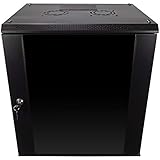
- DURABLE BUILD: Constructed from high-quality Cold Rolled Steel, the NavePoint Consumer Series 12U network cabinet boasts a sturdy, welded frame. Fitting EIA standard 19” networking equipment, this server cabinet confidently supports up to 110 lbs, providing a resilient base for your vital IT gear and equipment
- CONVENIENT DESIGN: This 12U cabinet features a reinforced, heat-treated, tempered glass front door with a security lock. Perfect for applications requiring both security and accessibility, its compact design of 17.72"L x 21.65"W x 24.42"H offers a practical solution for space-constrained settings.
- EASY & CUSTOMIZABLE EQUIPMENT SET UP - The 12U IT cabinet, with removable side panels and security locks, offers customization at its finest. Whether it's for an efficient device or cable management, this data cabinet ensures secure, adaptable configurations that suit your networking server requirements
- ENHANCED VENTILATION & SECURITY - Built-in fans and flow-through ventilation work to prevent overheating, ensuring optimal operation of your equipment. The reinforced, lockable tempered glass front door not only boosts security but also facilitates easy monitoring of installed equipment.
- SAFETY & COMPLIANCE - All NavePoint products are built to industry standards.
AI Growth Zones: opportunity, not guarantee
The Government’s AI Growth Zones programme aims to align energy readiness, planning support, investor assistance and delivery coordination. The policy also refers to targeted pricing support, national planning expertise and collaboration between developers, utilities and government.
However, an AI Growth Zone is not a universal exemption from planning or environmental law. Its value depends on the facts on the ground:
- Is the zone formally designated?
- Are its boundaries and infrastructure commitments clear?
- Is there genuinely available power within the zone?
- Is the energisation date written and deliverable?
- What planning mechanism is actually available?
- Who funds substations, roads, fibre and water infrastructure?
- Are there private investors or credible customers?
Policy intention, formal designation, planning support, power availability, investment and physical delivery should be recorded as separate milestones.
Free tools Windows power users keep installed
One-click scans. No signup required.
A six-gate delivery model
Gate 1: Strategic demand
- Identify the customer or customer class.
- Define workload, capacity, load curve, latency and sovereignty needs.
- Assess contract duration, credit quality and concentration risk.
Gate 2: Site control
- Secure freehold or leasehold control.
- Check access roads, cable routes, substations and water rights.
- Investigate covenants, contamination, remediation and neighbouring-land dependencies.
Gate 3: Power validation
- Obtain written network information.
- Confirm connection point, reinforcement scope and staged capacity.
- Test interim supply, cost exposure, security requirements and energisation assumptions.
Gate 4: Planning and environmental feasibility
- Review policy and begin pre-application engagement.
- Determine whether EIA screening or scoping is needed.
- Commission noise, visual, ecology, drainage, water, transport and air-quality work.
- Develop a credible community-benefit and mitigation package.
Gate 5: Finance and procurement
- Prepare a capital budget with escalation and delay allowances.
- Identify long-lead switchgear, transformers, generators, chillers and cooling equipment.
- Secure a construction partner and establish debt and equity conditions.
- Match procurement commitments to genuine customer and power milestones.
Gate 6: Delivery and commissioning
- Obtain planning permission and all relevant permits.
- Complete grid agreements, final design and equipment orders.
- Coordinate utility works, substation construction and building delivery.
- Test resilience, backup systems, controls, cooling and operational readiness before customer occupation.
Red flags for investors and authorities
- An unsupported grid date presented as guaranteed energisation.
- A large nameplate MW figure with no IT-load, mechanical-load, power-factor or backup schedule.
- An unnamed customer or no credible demand evidence.
- Renewable claims that confuse certificates or contracts with physical supply.
- No water source, discharge plan or drought strategy.
- Noise modelling that excludes night, testing, maintenance or cumulative conditions.
- A site described as AI-ready without rack-density, floor-loading and cooling specifications.
- Fibre described as “nearby” without diverse route evidence.
- Planning consent treated as proof that grid, water, permits and commissioning are resolved.
- An AI Growth Zone treated as a guaranteed subsidy, connection or planning exemption.
- Construction costs that omit substations, abnormal works, utility diversions, escalation or delay.
What a defensible evidence package contains
Before land acquisition or a major grid commitment, assemble a single evidence pack that can be understood by investors, network companies, planners and local communities. It should include:
- a customer and workload brief;
- title, access and utility-rights documentation;
- network correspondence and connection studies;
- a phased power-and-load schedule;
- site masterplan and expansion logic;
- fibre carrier letters and route-diversity analysis;
- water and cooling studies;
- noise, air-quality, ecology, drainage and transport assessments;
- an energy and carbon statement separating physical supply, procurement and backup;
- a procurement schedule for long-lead equipment;
- a fully costed construction programme;
- planning, permit and commissioning dependencies;
- community engagement and mitigation commitments.
This level of preparation also improves construction outcomes. It allows the design team and principal contractor to coordinate high-voltage works, modular halls, cooling plant, fire protection, security, logistics and commissioning around a realistic sequence rather than an aspirational completion date.
Conclusion
The UK’s data-centre opportunity is substantial, but the market is becoming less tolerant of speculative land and grid positions. Government policy may support additional AI capacity, yet the project still has to pass site-specific tests for electricity, planning, water, environmental impact, fibre, funding and delivery.
The strongest proposals will be phased, evidence-led and explicit about uncertainty. They will distinguish an application from a connection, a connection from energisation, policy support from permission, and renewable procurement from physical low-carbon supply.
What’s actually slowing this PC down?
Pick the symptom - the matching free tool is one click away.
For developers, investors and local authorities, the decisive question is not whether a site can host a data centre in theory. It is whether the whole dependency chain can be delivered, financed and operated in the required order.
Quick Recap
Product prices and availability are accurate as of the date/time indicated and are subject to change. Any price and availability information displayed on Amazon at the time of purchase will apply.

