Windows Errors? Fix Them Before They Spread
Repair common Windows errors and clear accumulated junk for a smoother, more stable PC - no reinstall needed.Free scan · no reinstallOutdated Drivers Are Slowing You Down
One free scan finds every outdated or missing driver and matches the right update for your exact hardware.Free scan · exact hardware matchSome links on this page are affiliate links: if you buy through them we may earn a commission, at no extra cost to you.
If you are choosing between PetSafe and eXtreme Dog Fence, the short answer is this: buy PetSafe if you want the lowest upfront cost, easy big-box availability, and a straightforward DIY system for a standard suburban yard. Buy eXtreme Dog Fence if your property is larger, rougher, wooded, rocky, frequently aerated, or you want heavier wire and longer warranty tiers.
That is the clean buyer answer. The better homeowner answer is that the brand is only half the decision. On our job sites, most underground dog fence problems come from layout, wire choice, splice quality, shallow burial, driveway crossings, utility conflicts, and weak training. A $250 kit installed carefully can outperform a more expensive system installed carelessly. A $700 upgraded kit can still fail if the loop runs through future planting beds, across an unmarked irrigation line, or under a driveway without protection.
As an Amazon Associate I earn from qualifying purchases.
The Tool Desk
Outbyte PC Repair FREEClear out junk files and repair common Windows errorsFree Scan →Outbyte Driver Updater FREEFix the driver behind crashes, sound loss and screen glitchesFind Drivers →This guide compares PetSafe and eXtreme Dog Fence from a builder’s point of view: cost, wire gauge, lot layout, installation details, durability, training, and the situations where an electronic dog fence should not be your only barrier.
Bottom Line: Which One Should You Buy?
For most small-to-medium suburban yards, PetSafe is the practical budget pick. PetSafe wired in-ground kits are widely available, commonly priced around $180 to $305 in 2026 for Basic, Classic, Stubborn Dog, and YardMax-style systems, and replacement parts are easy to find. A typical PetSafe wired kit includes 500 feet of 20-gauge boundary wire, enough for about one-third acre depending on the layout. Several systems expand to about 5 acres, and the Stubborn Dog system can expand up to 25 acres with additional wire.
For larger lots or tougher installation conditions, eXtreme Dog Fence is usually the better long-term buy. eXtreme sells Standard, Pro Grade, Max Grade, HYPER/Stubborn, and Contain & Train variants. Current listed starting prices run from about $215.95 for Contain & Train kits, $288.28 for Standard Active kits, $363.28 for Pro Grade, and $413.28 for Max Grade. The Standard tier uses 20-gauge wire and leaves out some installation extras, while Pro and Max packages are built around heavier-duty wire and more complete installation packages. eXtreme states that Standard and Basics systems carry 5-year warranties, while ProGrade and Max Grade systems carry 10-year warranties.
#1 Best Overall

- Peace Of Mind: Our in-ground fence gives your dog more room than traditional in-ground fences making him feel like the correction area is infinite and encouraging him to stay in the yard
- Secure A 1/3 Acre Yard: Create a safe 1/3-acre play area for your best friend; purchase additional wire to fence in up to a 5.5-acre yard
- Safe Pet Correction: The receiver collar has a tone-only mode and 5 levels of safe, static correction that you can adjust based on how your dog responds during training
- Diy Installation: This easy, do-it-yourself weekend project lets you create a fence that fits your yard
- Static-Free Reentry: Allows your dog to return home without being corrected if he passes the boundary
Here is the buying rule we would give a homeowner before they spend money:
What’s actually slowing this PC down?
Pick the symptom - the matching free tool is one click away.
- Choose PetSafe for a simple rectangular or gently irregular yard, one or two dogs, small-to-medium dogs, a tight budget, and easy access to replacement collars or accessories.
- Choose eXtreme Dog Fence for larger acreage, rough soil, rocky ground, freeze-thaw movement, heavy landscaping, frequent lawn aeration, stubborn dogs, or any property where future wire repairs would be expensive and annoying.
- Choose a physical fence or hybrid setup along roads, pools, public paths, livestock areas, or neighboring aggressive dogs. Electronic fences keep your dog in; they do not keep hazards out.
PetSafe vs eXtreme Dog Fence Comparison Table
| Category | PetSafe | eXtreme Dog Fence | Better Choice |
|---|---|---|---|
| Typical 2026 kit price | About $180-$305 for common DIY wired kits | About $215.95-$430.99+ depending on kit and wire tier | PetSafe for lowest upfront cost |
| Included wire | Commonly 500 ft of 20-gauge wire | Standard 20-gauge; Pro/Max tiers offer heavier-duty packages | eXtreme for durability upgrades |
| Coverage | Often starts around 1/3 acre; many systems expand to 5 acres; Stubborn Dog up to 25 acres | Designed for small yards through large properties depending on package | Tie for basic yards; eXtreme for rugged acreage |
| Retail availability | Strong big-box and online availability | More direct-to-consumer focused | PetSafe |
| Warranty position | Varies by product and retailer | 5 years on Standard/Basics; 10 years on ProGrade/Max Grade | eXtreme on higher tiers |
| Best use case | Standard suburban yards and budget DIY installs | Larger, rougher, or higher-risk installs | Depends on site conditions |
| Construction concern | 20-gauge wire may be more vulnerable to damage | Higher tiers better match pro-style wire expectations | eXtreme if you upgrade wire |
The biggest practical difference is not the collar button layout or the product box. It is wire durability. A buried containment system is only as dependable as the loop in the ground. If that wire breaks, the system is down until you locate and repair the break. In a manicured 6,000-square-foot lawn, that may be a small inconvenience. On a 2-acre wooded property with roots, irrigation, mulch beds, and a long driveway crossing, it becomes a real maintenance problem.
What PetSafe Does Best
PetSafe is strong where most homeowners start: price, availability, and simplicity. If you want to pick up a kit at a major retailer, install it over a weekend, and contain one dog in a normal yard, PetSafe makes sense.
Many PetSafe wired systems include 500 feet of 20-gauge boundary wire, which usually covers about one-third acre. That is a useful starting point for a smaller yard, but do not buy based only on acreage printed on the box. Measure the actual route. A narrow side yard, detached garage, pool exclusion, garden bed, or utility area can add more wire than expected.
PetSafe also has several product types. Wired in-ground systems define the boundary with a buried loop. Wireless systems are faster to set up and portable, but they usually create a circular boundary from the transmitter. That circular shape is convenient for campers, renters, and open lawns, but it is weak for irregular property lines, narrow side yards, wooded edges, pools, driveways, and areas where you need to keep the dog out of specific zones.
For a construction-minded homeowner, PetSafe’s best fit is a clean DIY yard: soft soil, minimal hardscape crossings, a dry transmitter location in a garage or basement, and a simple boundary with few splices. If the yard is easy to trench and you are comfortable with layout work, it is hard to argue with the value.
PetSafe Cost Snapshot
In 2026, common PetSafe wired kits generally land around $180 to $305 at major US retailers, depending on model, collar type, included surge protection, battery style, and acreage capacity. Accessory costs matter too. PetSafe official pricing examples include about $49.99 for 500 feet of extra 20-gauge boundary wire, about $21.74 for a surge protector, about $4.95 for an in-ground splice kit, and about $90.99 for a Stubborn Dog replacement or additional collar.
Those add-ons can move a “cheap” project upward quickly. If you need 1,500 feet of wire, a second collar, a surge protector, twisted lead-in wire, waterproof splices, and a trencher rental, the real project cost is not the shelf price of the kit.
What eXtreme Dog Fence Does Best
eXtreme Dog Fence is the better fit when the installation needs to be treated more like an exterior system than a pet gadget. The brand’s line includes Standard, Pro Grade, Max Grade, HYPER/Stubborn, and Contain & Train packages. That gives homeowners more room to match the system to the property and the dog.
Free tools Windows power users keep installed
One-click scans. No signup required.
The key reason to consider eXtreme is the availability of heavier-duty installation packages. The company’s Standard system uses 20-gauge wire and omits items such as a surge protector and twisted wire. That keeps the entry price lower, but it is not the version we would choose for a difficult yard. The Pro Grade and Max Grade tiers are the ones that make more sense where durability matters.
Wire gauge deserves more attention than it gets. Many DIY kits use 20-gauge wire because it is affordable and easy to handle. For better durability, 16-gauge or 14-gauge direct-burial wire is usually the smarter choice. Thicker wire stands up better to soil movement, freeze-thaw cycles, rodents, edging tools, aeration, and future landscape work. It is not indestructible, but it gives the system a better chance.
eXtreme is also attractive for homeowners who want a longer warranty tier. The company states its Standard and Basics systems have 5-year warranties, while ProGrade and Max Grade systems have 10-year warranties. Warranty terms are not a substitute for good installation, but they do indicate that the upper packages are intended for a more durable build.
eXtreme Dog Fence Cost Snapshot
Current listed 2026 starting prices show about $215.95+ for Contain & Train 20-gauge kits, $229.95+ for Contain & Train 16-gauge kits, $288.28+ for Standard Active, $303.28+ for HYPER Standard, $363.28+ for Pro Grade, $378.28+ for HYPER Pro Grade, $413.28+ for Max Grade, and $430.99+ for HYPER Max Grade.
That puts eXtreme above many basic PetSafe kits, especially once you move into Pro or Max packages. But if heavier wire avoids even one difficult break repair under a driveway edge, rocky soil, or mature landscaping, the higher package can be the better lifecycle value.
Rank #2

- Waterproof Collar: The waterproof collar comfortably fits dogs 5 pounds and up and adjusts to fit neck sizes 6-28 inches; compatible with all PetSafe Pawz Away pet barriers
- Long Battery Life: Battery quickly charges in 2-3 hours and can last up to 3 months with a single charge
- Personalize Your Dog'S Collar Settings: Teach your pets to stay in the secure play area with a sound-only training mode plus 5 levels of static on his receiver collar
- Add More Than 1 Pet: Unlimited number of collars can be added to the fence system and set to match your pets' personalities
- Perfectfit Technology: This unique feature lets you know when the collar is a proper fit
Wire Gauge Is the Detail That Decides Long-Term Value
If we were reviewing only collar features, this comparison would be incomplete. The buried wire is the infrastructure. Everything else depends on it.
Most entry-level kits use 20-gauge wire. It works in many easy yards, especially when installed at a consistent shallow depth and kept away from future digging. But 20-gauge wire is thin. It is more vulnerable to breaks from aerators, edging tools, shovels, rodents, roots, and soil movement. If you have sandy, soft soil and a quiet lawn, that risk may be acceptable. If you have clay soil that heaves, rocky fill, irrigation work, or heavy landscaping, upgrade.
For construction-grade advice, we recommend 14- or 16-gauge direct-burial boundary wire when the yard has rocky soil, freeze-thaw movement, regular aeration, mature roots, or a high likelihood of future digging. A 16-gauge wire is a strong middle ground for many homes. A 14-gauge wire is stiffer and more expensive, but it is the better choice for rougher conditions and larger properties.
Quick wins for a faster PC:
Fix the driver behind crashes, sound loss and screen glitchesFind Drivers →Clear out junk files and repair common Windows errorsFree Scan →Also understand the difference between solid boundary wire and twisted wire. The active loop should be solid boundary wire. Twisted wire is used only for neutral lead-in sections, usually between the transmitter or surge protector and the active loop. Twisting cancels the signal along that section so the dog can cross it without correction. Use it deliberately. Do not use twisted wire where you expect an active boundary.
Layout Comes Before Buying the Kit
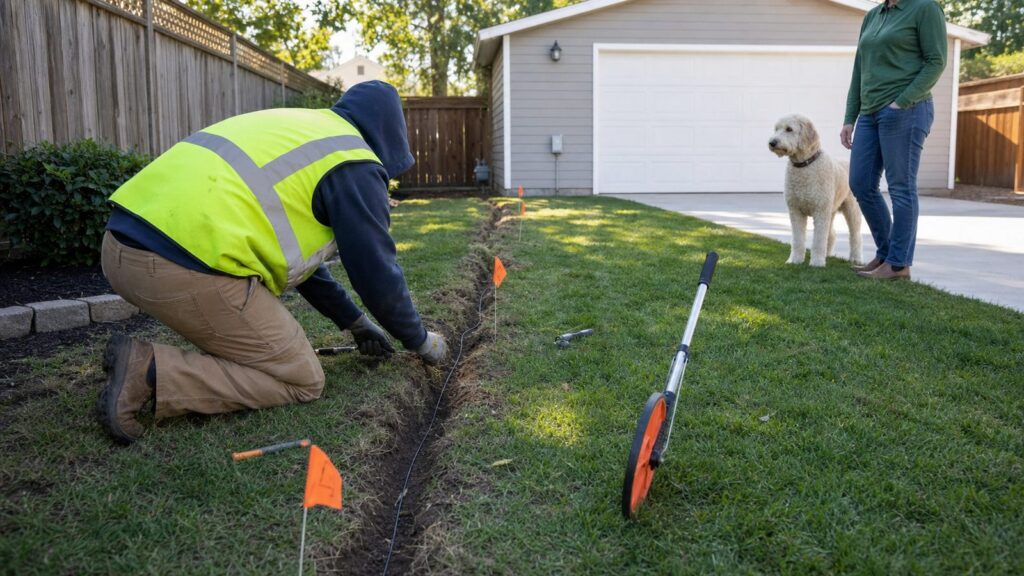
Before buying either brand, draw the route. Do not estimate from the lot size. Walk the property with a measuring wheel or long tape, and sketch the actual loop: house, garage, driveway, gates, garden beds, pool, septic field, irrigation valves, wooded edges, and any area the dog must not enter.
Then add at least 20 percent extra wire. eXtreme specifically recommends leaving about 20 percent extra wire during layout, and that is good field advice for either brand. Turns, burying slack, transmitter leads, driveway routing, splice allowances, and last-minute route changes consume wire fast. If your measured loop is 900 feet, plan for roughly 1,080 feet. If your route measures 1,600 feet, plan for about 1,920 feet.
Keep corners broad instead of sharp where possible. A clean radius is easier to trench, easier on the wire, and easier for the dog to understand during training. Avoid placing the boundary tight against a retaining wall, steep slope, busy road, or pool edge. The dog needs a warning zone, not a surprise correction at the exact hazard.
Recommended Free Tools
The transmitter should be mounted in a dry, protected area: garage, basement, utility room, or shed with proper moisture protection. eXtreme notes that its transmitter is not waterproof and needs a waterproof enclosure if installed outside. We prefer indoor mounting whenever practical because it protects electronics and keeps alarms accessible. If the system beeps after a storm or wire break, you want to hear it.
Installation Details That Separate a Good Job From a Bad One
A typical buried wire depth is shallow compared with utilities, often around 1 to 3 inches for many residential containment installs. The exact depth depends on the manufacturer’s guidance, soil, lawn conditions, and crossing details. The goal is to protect the wire from mowing and casual surface disturbance without burying it so deep that troubleshooting becomes difficult.
Call 811 before you dig. In many states, utility locating is not optional when you disturb soil. Requirements and notice windows vary by state, but the basic rule is simple: contact 811 before trenching, slicing, edging, or digging. Private utilities such as irrigation, landscape lighting, propane lines, pool lines, and low-voltage systems may not be marked by public utility locators. Those still need to be found before work starts.
For open lawn runs, a lawn edger, flat spade, wire trencher, or vibratory plow can work. For small yards, hand work is slow but manageable. For large properties, renting a trencher or hiring a fence/landscape contractor may save a full day of labor. Expect a careful DIY install on a modest yard to take a weekend once locating is complete. Larger lots, rocky soil, and hardscape crossings can stretch the job to several days.
Splices and Repairs
Splices are common failure points. Use waterproof gel-filled splice capsules, not ordinary indoor wire nuts wrapped in tape. Place splices where they can be found later, and mark them on the site sketch. A hidden splice in the middle of a mulch bed may be fine today, then impossible to find after three seasons of planting.
Record the final route. Take photos before closing trenches. Keep a copy with the homeowner file, not just inside the product manual. Before aeration, drainage work, planting, or edging changes, review the wire path. That 10-minute habit prevents many avoidable breaks.
Rank #3

- More Play Area - Designed in the USA, YardMax gives your pet more yard space than traditional in-ground fences by correcting them after they cross the boundary instead of before
- Choose Your Wire - In-ground wire is sold separately so that you can purchase the gauge best for your yard; PetSafe offers Standard (20 Gauge) and Heavy Duty (16 Gauge) in varying lengths
- Fits Most Yards - This do-it-yourself weekend project lets you create an in-ground fence designed to fit your yard
- 5 levels of Static Correction - 5 levels of adjustable static correction and a tone-only mode help keep your dog safe and secure inside their safe play area
- Static-Free Reentry - Allows your pet to return home without being corrected if your pet passes the boundary
Driveway and Sidewalk Crossings
Driveway crossings deserve extra care. Where feasible, use an existing expansion joint and seal it properly after placing the wire. If a saw cut is required, keep the cut straight and controlled. Avoid cutting near embedded utilities, radiant lines, rebar risks, or unknown conduit. Protect the wire from tire wear, snow plows, freeze-thaw movement, and water intrusion.
Concrete and asphalt crossings often decide whether DIY still makes sense. A clean expansion joint is manageable for a careful homeowner. A long saw cut across a wide driveway, decorative pavers, stamped concrete, or a heated slab is a strong reason to hire a pro.
Cost: Kit Price vs Real Installed Cost
The box price is only the starting point. A basic PetSafe kit may cost under $250, and an upgraded eXtreme package may start over $400, but the final project cost depends on the property.
Professional invisible dog fence installation in 2026 is commonly estimated around $800 to $2,800 nationally, or about $2 to $7 per linear foot. Electric dog fence pricing is often listed around $1,600 to $2,000 per acre, while GPS fence installed costs are roughly $450 to $1,300. Those ranges vary widely because a clean 400-foot lawn loop is not the same job as 2,000 feet through roots, hardscape, and utility conflicts.
| Cost Item | Typical 2026 Range | Notes |
|---|---|---|
| PetSafe wired DIY kit | $180-$305 | Common Basic, Classic, Stubborn Dog, and YardMax-type systems |
| PetSafe wireless system | $100-$500 | Portable, fast setup, usually circular boundary |
| eXtreme Contain & Train | $215.95-$229.95+ | 20-gauge and 16-gauge starting options |
| eXtreme Standard / HYPER Standard | $288.28-$303.28+ | Standard Active and stubborn-dog configurations |
| eXtreme Pro / Max tiers | $363.28-$430.99+ | Better fit for durability-focused installs |
| Professional installation | $800-$2,800 average | Often about $2-$7 per linear foot |
| Extra 500 ft PetSafe wire | About $49.99 | 20-gauge accessory pricing example |
| Additional collar | About $90.99+ | Varies by system and dog type |
Hidden costs include the 811 waiting period, utility-locate coordination, trencher rental, lawn restoration, concrete or asphalt saw cuts, waterproof splice kits, surge protection, extra twisted wire, replacement batteries, and contractor labor. If the contractor includes dog training, that can add cost but may be worth it for nervous, stubborn, or high-drive dogs.
Training Is Part of the Installation
Both brands require training. Boundary flags are not decoration and they are not permanent protection. They are temporary visual aids that help the dog learn where the warning zone begins.
Do these 3 things before closing this tab:
1Scan for outdated or missing drivers - takes under a minute2Repair Windows errors before they cause bigger problems3Fix the driver behind crashes, sound loss and screen glitchesPetSafe training guidance emphasizes repeated sessions and positive reinforcement near the flag line. That matches what we see in the field: the system works best when the dog learns the warning tone first, then gradually learns the boundary with calm repetition. Rushing training is one of the fastest ways to create confusion, fear, or boundary failure.
Plan on multiple short sessions over days or weeks, depending on the dog. Do not install the wire on Saturday and assume the dog can roam unattended on Sunday. For many dogs, early sessions should be 10 to 15 minutes, repeated consistently. Keep the collar fit correct, check contact points, and watch the dog’s behavior. A long-haired dog, small dog, stubborn dog, anxious dog, and high-prey-drive dog may each need a different collar setup and training pace.
If the dog bolts through the correction zone chasing a deer, delivery truck, or neighboring dog, the system cannot physically stop it. Worse, the dog may be reluctant to cross back into the yard because the correction zone is still there. That is one reason electronic containment should not be treated as equal to a physical fence in every setting.
Independent reader supportYour contribution helps us test, update, and keep practical guides available for everyone.When an Electronic Fence Is Not Enough
An electronic dog fence does not keep other dogs, wildlife, delivery drivers, children, or trespassers out. That single fact should drive the safety decision.
Use a physical fence, or at least a hybrid strategy, when the yard borders a busy road, school path, public sidewalk, pool, steep drop, livestock area, or aggressive neighboring animals. For high-risk road frontage, we prefer a physical barrier along the road and electronic containment only for internal boundaries or large rear acreage. The same logic applies around pools. A buried wire is not a pool barrier.
HOA rules, local ordinances, and subdivision covenants can also matter. Some neighborhoods restrict visible fences, but others may restrict electronic containment or require dogs to be physically restrained. If you are hiring a contractor, ask who is responsible for checking HOA rules and local requirements before installation starts.
When to DIY vs When to Hire a Pro
DIY makes sense when the yard is small, the soil is workable, the route is simple, and there are no difficult hardscape crossings. A homeowner who is comfortable with a measuring wheel, edger, spade, basic wiring, and product instructions can often install a basic wired system over a weekend after utility locating is complete.
Rank #4

- Add Unlimited Pets to Your System: Keep as many pets as you need safely in your yard with this add-a-dog receiver collar. Compatible with all PetSafe In-Ground Systems except YardMax and UltraSmart.
- Rechargeable: Quickly charges in 2-3 hours with each charge lasting up to 2 months depending on use
- Waterproof: For all of your pet's outdoor activities
- Adjustable: with 4 levels of correction plus tone only; fits dogs 5 pounds and up with neck sizes from 6 to 26 inches
- Low Battery Indicator: Let's you know when it is time to charge your collar
DIY is also more reasonable when the transmitter can be mounted near an outlet in a dry garage or basement, the loop has few splices, and the driveway has an expansion joint that can be used cleanly.
The Tool Desk
Outbyte Driver Updater FREEScan for outdated or missing drivers - takes under a minuteDriver Scan →Outbyte PC Repair FREEClear out junk files and repair common Windows errorsFree Scan →Hire a pro when the route is long, the soil is rocky or clay-heavy, the yard has irrigation, the wire must cross concrete or asphalt, the property has steep grades, or the containment plan includes multiple exclusion zones. Also consider hiring help for large acreage. At 1,500 to 2,500 linear feet, layout and trenching errors become expensive to fix.
A contractor should provide a route plan, confirm 811 coordination, discuss private utilities, use waterproof splices, protect driveway crossings, mount the transmitter in a dry location, include surge protection where appropriate, and leave you with a wire-path record. If they cannot explain how they handle those items, keep looking.
Maintenance Checklist After Installation
A buried dog fence is low-visibility infrastructure, not zero-maintenance infrastructure. Build a simple schedule and the system will last longer.
- Check collar fit and contact points monthly.
- Follow the battery replacement or recharge schedule for your specific collar.
- Test the transmitter alarm monthly so you know what a fault sounds like.
- Inspect the system after major storms, lightning events, excavation, or landscaping work.
- Refresh boundary flags during retraining or after long breaks.
- Review the wire path annually before aeration, edging, planting, drainage work, or irrigation repairs.
- Keep splice locations marked on the site sketch.
- Keep spare waterproof splice kits and compatible batteries on hand.
Surge protection is worth serious consideration, especially in storm-prone areas or where the loop covers a large open area. A long buried wire can act like a path for electrical surge. Surge protection is inexpensive compared with replacing a transmitter or troubleshooting a damaged loop after a storm.
Quick wins for a faster PC:
Scan for outdated or missing drivers - takes under a minuteDriver Scan →Clear out junk files and repair common Windows errorsFree Scan →Fix the driver behind crashes, sound loss and screen glitchesFind Drivers →Final Recommendation
PetSafe is the better buy for the homeowner who wants an affordable, accessible, proven DIY system for a normal yard. If your project is 500 to 1,000 feet of boundary in soft soil, with a simple garage-mounted transmitter and one dog, PetSafe is the practical choice.
eXtreme Dog Fence is the better buy when the site is harder on buried wire. If the property is large, rocky, wooded, aerated, landscaped, or exposed to freeze-thaw movement, step up to a heavier wire package. The higher upfront cost is easier to justify when a future wire break would mean hours of locating, digging, and lawn repair.
Our contractor recommendation is simple: choose the brand after you design the loop. Measure the real route, add 20 percent wire, identify utilities and hardscape crossings, choose 14- or 16-gauge direct-burial wire for tougher sites, use waterproof splices, protect the transmitter, and commit to training. Do that, and either system has a fair chance. Skip those steps, and even the better kit becomes a frustrating project.
Frequently Asked Questions
Is PetSafe or eXtreme Dog Fence better for most homeowners?
PetSafe is better for most standard suburban yards because it is affordable, widely available, and simple to support. eXtreme Dog Fence is better for larger or tougher properties where heavier wire, stronger installation packages, and longer warranty tiers matter.
Free tools Windows power users keep installed
One-click scans. No signup required.
Is 20-gauge dog fence wire good enough?
It can be good enough for simple lawns with soft soil and little future digging. For rocky soil, freeze-thaw movement, lawn aeration, irrigation work, or larger properties, 16-gauge or 14-gauge direct-burial wire is usually the better long-term choice.
How much does an underground dog fence cost in 2026?
DIY PetSafe wired kits commonly run about $180-$305, while eXtreme kits start around $215.95 and can exceed $430 for higher-tier packages. Professional installation is commonly about $800-$2,800 nationally, or roughly $2-$7 per linear foot.
Do I need to call 811 before installing a dog fence?
Yes. Call 811 before trenching, slicing, edging, or digging for a buried wire system. Public utility locates may not mark private lines such as irrigation, landscape lighting, pool lines, or propane lines, so those need separate attention.
Can an electronic dog fence replace a physical fence?
Not always. Electronic fences do not keep other dogs, wildlife, children, delivery drivers, or trespassers out. Along roads, pools, public paths, or aggressive neighboring animals, a physical fence or hybrid strategy is safer.
What’s actually slowing this PC down?
Pick the symptom - the matching free tool is one click away.
Are wireless PetSafe fences as accurate as wired fences?
Wireless systems are faster to set up and portable, but they usually create a circular boundary. Wired systems are better for exact property shapes, narrow side yards, wooded edges, pools, driveways, and exclusion zones.
Quick Recap
Product prices and availability are accurate as of the date/time indicated and are subject to change. Any price and availability information displayed on Amazon at the time of purchase will apply.

