Quick wins for a faster PC:
Fix the driver behind crashes, sound loss and screen glitchesFind Drivers →Clear out junk files and repair common Windows errorsFree Scan →Neither stair style is the universal winner. Open-riser stairs can be suitable when your locally adopted code allows them, the stair meets every dimensional and guard requirement, and the gap fits your household. Closed-riser stairs are the required choice for stairs covered by the U.S. ADA Standards, and they may better suit a home where keeping the stair visually continuous is a priority. The 2021 International Residential Code (IRC) places specific limits on riser height and open-riser openings, but it is a model code rather than a guarantee of what your city or state enforces. Because no reliable comparative fall-rate study establishes one style as safer overall, choose by applying the governing code first, then testing the design against accessibility, visibility, household needs and the physical constraints of your project.
What is the difference between an open riser and a closed riser?
A stair tread is the horizontal surface you step on. The riser is the vertical portion between one tread and the next.
As an Amazon Associate I earn from qualifying purchases.
Open-riser stairs
An open-riser stair leaves a visible gap between adjacent treads. You can see through the stair from one step to the next. The supporting structure may be a central stringer, side stringers, a steel frame or another engineered system; “open” describes the space between treads, not a particular structural method.
What’s actually slowing this PC down?
Pick the symptom - the matching free tool is one click away.
Closed-riser stairs
A closed-riser stair has a vertical board or other closure between each pair of treads. The stair reads as a continuous flight when viewed from the side, and the space behind one tread is concealed by the riser below it.
#1 Best Overall

- MADE FROM PET MATERIAL: LifeGrip General Anti-Slip Tapes are made from PET material, which offer superior durability and tensile strength. The higher tensile strength of PET allow our anti-slip tape to withstand heavy foot traffic, ensuring long-lasting performance. With its easy removal feature that leave no residue or surface damage, LifeGrip General Anti Slip Tapes are versatile and convenient for any application.
- IDEAL FOR EXTREME WEATHER – The PET base layer also withstands temperatures (-20ºc to 60ºc / -4 F to 140 F). No cracking, peeling, disintegrating using in hot or cold weather, perfect for INDOOR and OUTDOOR all year around.
- HIGH TRACTION TO PREVENT SLIPS - HYPO-ALLERGENIC 80 Grit Aluminum Oxide traction pad boosts foot traction with a subtle texture, giving you utmost protection without sacrificing comfort. Provides extra foot traction for protection to your child, family, elderly, and pets on slippery surfaces. Prevents slipping especially for elderly people.
- For ALL SMOOTH SURFACES - Our anti-slip tape has a thick and premium Acrylic adhesive that will form a strong, water-proof bond to Smooth Surfaces, Including concrete, metal, plastic, wood, tile, stone, laminate. This tape is weather and water proof, making it ideal for ensuring anti slip on steps, ladders, ramps, trailers, decks and other equipment.
- WHY US? – LifeGrip is a manufacturer who focuses on anti-slip products for more than 10 years. We are not a wholesaler or retailer. We decided to sell our own products to provide the best values to our customers. We are devoted to design and developer high quality and sustainable products to prevent slips.
The difference is simple geometrically, but it affects which rules apply, how the stair is seen, how objects interact with it and what your designer must resolve before construction.
Start with the code that governs your project
Before selecting a style, identify the building classification, the stair’s location and the code edition adopted by your authority having jurisdiction (AHJ). A detached private house, a common stair in a multifamily building and a stair serving a business may be regulated under different provisions. Ask the building department or a qualified designer which edition, local amendments and permit requirements apply; do not assume that the latest model-code text is automatically enforceable where you live.
What the 2021 IRC says about residential open risers
The 2021 IRC’s residential stair provisions limit riser height to 7 3/4 inches. For an open-riser condition, an opening located more than 30 inches vertically above the floor or grade below must not allow a 4-inch-diameter sphere to pass through. The text is in IRC section R311.7.5.1; related stair, guard and handrail provisions appear in the 2021 IRC Chapter 3 building-planning text.
Free tools Windows power users keep installed
One-click scans. No signup required.
That 4-inch test concerns the opening between treads. It is not a substitute for the rules governing guards at open sides of landings, balconies or stair flights. The IRC separately addresses when guards are required on open-sided walking surfaces more than 30 inches above the floor or grade, along with guard height and guard-opening limits. A compliant design must satisfy each applicable rule; passing the sphere test does not make a guard unnecessary, and a compliant guard does not automatically resolve an excessive riser opening.
Why the IRC number is not a nationwide permission slip
The IRC is a model code. A state, county or city may adopt a different edition, amend a provision or enforce another residential standard. Plans can also be affected by zoning, historic-district requirements, fire separation, structural engineering and local interpretations. Treat the 2021 figures as the requirements of the cited model-code edition, not as proof that your jurisdiction permits the same configuration today.
Rank #2

- MADE FROM PET MATERIAL: LifeGrip General Anti-Slip Tapes are made from PET material, which offer superior durability and tensile strength. The higher tensile strength of PET allow our anti-slip tape to withstand heavy foot traffic, ensuring long-lasting performance. With its easy removal feature that leave no residue or surface damage, LifeGrip General Anti Slip Tapes are versatile and convenient for any application.
- IDEAL FOR EXTREME WEATHER – The PET base layer also withstands extreme temperatures (-20ºc to 60ºc / -4 F to 140 F). No cracking, peeling, disintegrating using in extreme hot or cold weather, perfect for INDOOR and OUTDOOR all year around.
- HIGH TRACTION TO PREVENT SLIPS - HYPO-ALLERGENIC 80 Grit Aluminum Oxide traction pad boosts foot traction with a subtle texture, giving you utmost protection without sacrificing comfort. Provides extra foot traction for protection to your child, family, elderly, and pets on slippery surfaces. Prevents slipping especially for elderly people.
- SAFE ON ALL SMOOTH SURFACES - Our anti-slip tape has a thick and aggressive Acrylic adhesive that will form a strong, water-proof bond to Smooth Surfaces, Including concrete, metal, plastic, wood, tile, stone, laminate. This tape is weather and water proof, making it ideal for ensuring safety on steps, ladders, ramps, trailers, decks and other safety equipment.
- WHY US? – LifeGrip Safety is a manufacturer who focuses on anti-slip safety products for more than 10 years. We are not a wholesaler or retailer. We decided to sell our own products to provide the best values to our customers. We are devoted to design and developer high quality and sustainable products to prevent slips.
When the ADA stair rules apply
The U.S. Access Board’s ADA Standards, Chapter 5, covers stairs within the scope of the ADA Standards. Section 504.3 states, in full: Open risers are not permitted.
The same stair provisions specify risers from 4 to 7 inches high and treads at least 11 inches deep for those covered stairs.
These requirements should not be generalized to every private residential stair. A stair inside a typical private dwelling may not be an ADA-covered stair, while a stair in a covered facility or a common route can be. Your designer or accessibility professional must determine the scope before a layout is chosen.
Outdated Drivers Are Slowing You Down
One free scan finds every outdated or missing driver and matches the right update for your exact hardware.Free scan · exact hardware matchWindows Errors? Fix Them Before They Spread
Repair common Windows errors and clear accumulated junk for a smoother, more stable PC - no reinstall needed.Free scan · no reinstallIs one configuration proven safer?
No reliable comparative fall-rate evidence establishes that open-riser stairs or closed-riser stairs produce fewer falls in homes. The available code dimensions are minimum or maximum design requirements, not measurements of injury rates. A claim that one style is categorically safer would go beyond the evidence.
Safety is therefore a design-and-use question. Uniform geometry, secure handrails, adequate lighting, slip-resistant tread surfaces, correctly designed guards and a layout that household members can use confidently all matter. The open or closed condition is one decision within that system.
Compare the choices on the issues that actually decide a project
| Decision factor | Open riser | Closed riser |
|---|---|---|
| Code pathway | May be allowed under a locally adopted residential code if the applicable opening, riser, guard, handrail and other requirements are met. | Still must meet stair geometry, guard, handrail and other applicable rules; closing the riser does not waive those requirements. |
| ADA-covered stair | Not permitted under the cited ADA Standards. | Can be used if the entire stair also meets the covered stair’s dimensional and other accessibility requirements. |
| Gap between treads | Visible and open; its size and location must be checked against the governing code. | Closed by a riser, so there is no open passage between adjacent treads. |
| Visual character | Creates a lighter, more transparent appearance when that is the design objective; the effect is subjective and depends on structure, finishes and surrounding light. | Creates a more continuous, solid-looking flight and can visually separate one level from another. |
| Tread visibility | Still requires careful lighting and edge treatment; the open background can change how step edges read. | Still requires careful lighting and edge treatment; the vertical faces can create their own shadows. |
| Household fit | Requires checking children, pets, dropped objects, low-vision needs and the household’s comfort with the gap. | Removes the inter-tread gap but should still be assessed for visibility, mobility and handrail use. |
| Cost, maintenance and resale | No universal premium, maintenance burden or resale effect is established; those outcomes are project-specific. | No universal premium, maintenance burden or resale effect is established; those outcomes are project-specific. |
How household needs change the practical choice
Children and pets
Ask whether a child could place a hand, foot or toy in the gap, whether a pet could attempt to pass through it, and whether objects dropped from one level could land below. These are questions for the actual opening, stair height and household behavior—not proof that every open stair is unsafe. If the answers create an unacceptable concern, a closed riser or a code-compliant redesign may be the simpler choice.
Rank #3

- MULT-FUNCTIONAL: Cost-effective, multi-functional safety product. 6 inch by 32 inch LifeGrip Anti Slip Safety Tape with green Glow-in-the-Dark Strip. Photoluminescent stripe can be charged by either natural or artificial light sources. In low light conditions where visibility isn't very good at all, or even in power outs, the glow in the dark strip will help guide people, whether down walkways or warning or ledges and steps, helping to maintain efficient safety levels at all times.
- MADE FROM PET MATERIAL: Our General Anti-Slip Tapes are made from PET material, which is not only more environmentally safe than PVC but also offers superior durability and tensile strength. The higher tensile strength of PET allows our anti-slip tape to withstand heavy foot traffic and harsh environments, ensuring long-lasting performance. With its easy removal feature that leaves no residue or surface damage, LifeGrip General Anti-Slip Tapes are versatile and convenient for any application.
- IDEAL FOR EXTREME WEATHER – The PET base layer also withstands extreme temperatures (-10ºc to 60ºc / 14 F to 140 F). No cracking, peeling, disintegrating using in extreme hot or cold weather, perfect for INDOOR and OUTDOOR all year around.
- HIGH TRACTION TO PREVENT SLIPS - HYPO-ALLERGENIC 80 Grit Aluminum Oxide traction pad boosts foot traction with a subtle texture, giving you utmost protection without sacrificing comfort. Provides extra foot traction for protection to your child, family, elderly, and pets on slippery surfaces. Prevents slipping especially for elderly people.
- SAFE ON ALL SMOOTH SURFACES - Our anti-slip tape has a thick and aggressive Acrylic adhesive that will form a strong, water-proof bond to Smooth Surfaces, Including concrete, metal, plastic, wood, tile, stone, laminate. This tape is weather and water proof, making it ideal for ensuring safety on steps, ladders, ramps, trailers, decks and other safety equipment.
People with low vision
Step edges need to be easy to locate. The Access Board advises considering visual contrast at tread nosings or leading edges to help make stairs more visible to people with low vision. Contrast can come from the tread material, a contrasting nosing or another durable edge treatment selected with the designer. Contrast is not a replacement for correct dimensions, lighting or handrails.
Older adults and people with mobility limitations
Discuss the stair with the person who will use it. Consider whether the projected run, riser consistency, handrail shape and available landing space support the user’s gait and turning needs. If the stair is part of an accessible route or a covered facility, the applicable accessibility standard controls the geometry; do not try to solve an accessibility requirement with an open-riser aesthetic.
People who carry items up and down
Review where hands can remain on the handrail, where a person can pause and whether the stair’s width and landings accommodate the objects normally carried in the house. An open or closed riser does not by itself determine those dimensions. The complete plan, including doors, furniture paths and lighting controls, should be checked before fabrication.
Households planning to age in place
Think beyond the current occupants. A future resident, caregiver or buyer may have different visual or mobility needs. If the project is intended to remain adaptable, ask the designer whether the selected geometry, handrails and landings leave practical options for later improvements without rebuilding the flight.
Visibility, lighting and tread-edge details
Regardless of riser type, make the leading edge of every tread easy to identify. Use a lighting plan that avoids glare and deep shadows, especially at the top and bottom landings. Keep tread surfaces and nosings consistent from step to step; a single unexpected change can be harder to read than a uniformly finished flight.
Rank #4

- MADE FROM PET MATERIAL: LifeGrip General Anti-Slip Tapes are made from PET material, which offer superior durability and tensile strength. The higher tensile strength of PET allow our anti-slip tape to withstand heavy foot traffic, ensuring long-lasting performance. With its easy removal feature that leave no residue or surface damage, LifeGrip General Anti Slip Tapes are versatile and convenient for any application.
- IDEAL FOR EXTREME WEATHER – The PET base layer also withstands temperatures (-20ºc to 60ºc / -4 F to 140 F). No cracking, peeling, disintegrating using in hot or cold weather, perfect for INDOOR and OUTDOOR all year around.
- HIGH TRACTION TO PREVENT SLIPS - HYPO-ALLERGENIC 80 Grit Aluminum Oxide traction pad boosts foot traction with a subtle texture, giving you utmost protection without sacrificing comfort. Provides extra foot traction for protection to your child, family, elderly, and pets on slippery surfaces. Prevents slipping especially for elderly people.
- SAFE ON ALL SMOOTH SURFACES - Our anti-slip tape has a thick and premium Acrylic adhesive that will form a strong, water-proof bond to Smooth Surfaces, Including concrete, metal, plastic, wood, tile, stone, laminate. This tape is weather and water proof, making it ideal for ensuring safety on steps, ladders, ramps, trailers, decks and other equipment.
- WHY US? – LifeGrip Safety is a manufacturer who focuses on anti-slip safety products for more than 10 years. We are not a wholesaler or retailer. We decided to sell our own products to provide the best values to our customers. We are devoted to design and developer high quality and sustainable products to prevent slips.
The Access Board’s guidance on visual contrast is a design consideration, not an endorsement of a particular product. Stair tread tape may be an optional accessory for visibility or traction only when the specific product’s instructions and suitability support that use. The cited standards do not evaluate or recommend a tape product, so confirm adhesion, wear, cleaning and compatibility with the tread material before specifying it.
Open-riser design checks
Measure every opening that the code measures
Document the vertical location of each opening relative to the floor or grade below. Under the cited 2021 IRC condition, openings more than 30 inches above that surface must not pass a 4-inch-diameter sphere. Do not rely on a visual estimate; have the builder or inspector verify the built dimensions.
Coordinate guards and handrails separately
Show guards wherever the adopted code requires them and detail their height, structural attachment and opening limits independently from the inter-tread gap. A stair can meet the opening limit between treads and still fail a guard requirement, or it can have a compliant guard while another stair dimension is wrong.
Protect the structure and finishes
Open treads expose more of the supporting structure and the underside of the flight. The structural engineer and stair fabricator must coordinate stringers, tread connections, vibration control, finish thicknesses and the sequence of installation. Those details vary by material and span; obtain them in the project drawings rather than assuming a generic open-stair assembly will fit.
Closed-riser design checks
Do not treat a riser as a code shortcut
Adding vertical closures does not remove requirements for maximum riser height, minimum tread depth, uniformity, handrails, guards, landings or structural capacity. Check the adopted code for the complete stair, including transitions at the top and bottom.
Best Value
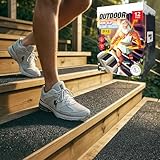
- [MAXIMIZE STABILITY] Boost stability with the 12-Pack 30" x 6" Thunder Grip waterproof heavy-duty non slip stair treads, ideal for the outdoor or indoor environment. Our 80-grit anti-slip stair treads prevent slips, ideal for seniors, pets, and kids.
- [DURABLE OUTDOOR DESIGN] Thunder Grip stair treads non slip outdoor are built to last. Our grip tape for stairs features robust adhesive, ensuring reliable performance in all weather conditions. Choose the stair strips instead of rubber mats.
- [EFFORTLESS INSTALLATION] Easily apply Thunder Grip non slip tape for outdoor steps. These outdoor stair treads non-slip weather resistant can be installed within minutes, enhancing stability instantly without hassle. Use our outdoor deck stair treads
- [VERSATILE USE] Thunder Grip's stair grips non slip serve multiple outdoor areas. Use our anti skid tape for steps outdoor on stairs, deck, wooden steps, entryways, ramps, and more to prevent falls and enhance grip.
- [MULTIPLE OPTIONS] Our wooden stair treads and non stick stair treads are available in a range of lengths and widths to accommodate different stair dimensions, ensuring perfect coverage for your needs.
Coordinate the riser with the tread finish
Account for the thickness of flooring, nosings and paint or veneer when setting out the stair. A change in finish after framing can alter the effective riser height or create a projecting edge. The final, finished dimensions—not only the rough framing—are what the inspector and user experience.
Plan access behind the stair
A closed flight may conceal wiring, plumbing or storage, but any access panels, doors or trim should be placed so they do not reduce tread clearance or create a protrusion. Resolve those interfaces on the drawings before the risers are fabricated.
A step-by-step process for choosing and approving the stair
- Identify the governing rules. Tell the building department or your qualified designer the property address, building type, stair location and intended users. Confirm the adopted code edition, amendments, permit path and whether the stair is within an ADA-covered facility or route.
- Record the physical constraints. Measure floor-to-floor height, available run, headroom, landings, doors, windows and the locations of structural supports. A preferred appearance cannot override a stair that cannot fit the required geometry.
- Sketch both configurations. Draw the same flight as open and closed, showing finished tread and riser dimensions, guards, handrails, landings and sightlines. This makes the visual and household trade-offs concrete instead of relying on a sample photograph.
- Check the numbers against the applicable code. For the cited 2021 IRC model provisions, verify the 7 3/4-inch residential riser maximum and the 4-inch-sphere limitation for the specified elevated open-riser openings. For a covered ADA stair, verify the 4-to-7-inch riser range, 11-inch minimum tread depth and the prohibition on open risers. Use your jurisdiction’s adopted text when it differs.
- Review guards and handrails as their own package. Confirm where guards are required, their height and opening limits, handrail continuity, graspability and structural attachment. Have these details reviewed with the same care as the tread-to-riser connection.
- Walk through visibility and use. Stand at the bottom, middle and top of the proposed stair at different times of day. Check whether tread edges, landings and handrails remain legible without glare. Include the people and pets who will actually use the home in the discussion.
- Select finishes and edge treatments. Choose durable tread surfaces, nosing profiles and any contrast treatment only after confirming compatibility with the stair system and the manufacturer’s instructions. Do not assume an accessory is suitable merely because it is marketed for stairs.
- Submit and inspect before concealment. Provide the permit drawings and structural information requested by the AHJ. During construction, verify rough and finished dimensions, guard openings, fasteners and handrail heights before finishes or ceilings hide the work.
Costs, maintenance and resale: what can—and cannot—be generalized
The cited code and accessibility sources do not establish a standard price difference between open and closed risers. Cost depends on the span, materials, engineering, finish quality, guard and handrail system, site access, demolition and local labor. An open design may require a particular structural frame or custom guard; a closed design may require additional riser panels, trim or finishing. Obtain itemized bids for the same geometry and finish level before treating one option as cheaper.
The Tool Desk
Outbyte PC Repair FREEClear out junk files and repair common Windows errorsFree Scan →Outbyte Driver Updater FREEFix the driver behind crashes, sound loss and screen glitchesFind Drivers →Maintenance is equally dependent on the assembly. Ask who will clean the underside or exposed structure of an open flight, how replacement treads are accessed and which finishes can be repaired without changing adjacent pieces. For a closed flight, ask how riser scuffs, nosing wear and concealed access will be handled. These are project questions, not universal properties of either style.
Resale effects are not established by the available evidence. If future marketability matters, document the code basis, finished dimensions and accessibility implications so a later owner understands what was approved. A design that is attractive but not permitted in the next jurisdiction or building classification can become a liability, while a code-compliant stair that suits the household is easier to explain and maintain.
Decision framework: when each style is the better fit
An open riser is a reasonable candidate when:
- Your AHJ confirms that the locally adopted code allows the configuration.
- The designer can document every required riser, opening, guard, handrail and structural detail.
- The stair is not an ADA-covered stair, or the applicable accessibility rules explicitly allow the proposed arrangement.
- The household accepts the visible gap after considering children, pets, dropped objects, low vision and future users.
- Lighting, tread-edge contrast and landing transitions can be made clear in the finished space.
A closed riser is the better fit when:
- The stair is covered by the ADA Standards, which state that open risers are not permitted.
- Your local code official, designer or project brief requires a closed configuration.
- The household prefers a continuous visual barrier between treads or does not want objects passing through the stair.
- The open alternative would require costly structural or guard customization that the project does not justify.
- Future users are likely to benefit from a more visually continuous flight, while all other stair dimensions remain compliant.
Bottom line for a home renovation or new build
Choose the stair that your jurisdiction permits and your household can use confidently—not the style that is marketed as universally safer. Open risers can work in a code-compliant private residential design when the elevated-opening limit, guards, handrails and complete stair geometry are addressed. Closed risers are mandatory for stairs covered by the ADA Standards and may be the more comfortable household choice when gaps, visibility or future adaptability are concerns. Have the final drawings reviewed locally before ordering custom components, because the adopted code and project conditions—not a generic open-versus-closed rule—decide what works in your home.
Quick Recap
Product prices and availability are accurate as of the date/time indicated and are subject to change. Any price and availability information displayed on Amazon at the time of purchase will apply.

